From Surf Wiki (app.surf) — the open knowledge base
Sciaenidae
Family of fishes
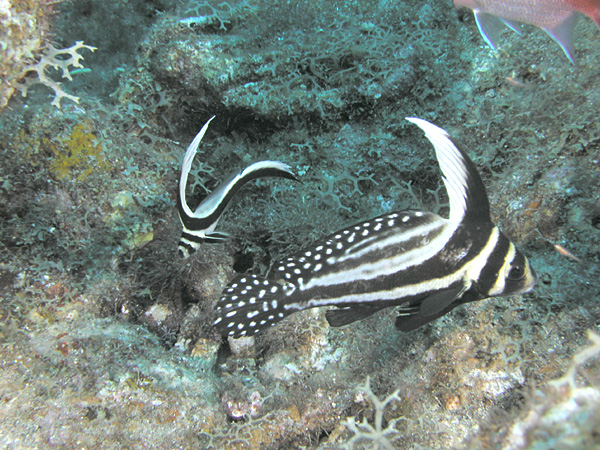
Family of fishes
Sciaenidae is a family of ray-finned fishes belonging to the order Acanthuriformes. They are commonly called drums or croakers or 67 genera.
Taxonomy
Sciaenidae was first proposed as a family in 1829 by the French zoologist Georges Cuvier. The 5th edition of Fishes of the World classifies the family in the suborder Sciaenoidei, alongside the rover family Emmelichthyidae, in the order Acanthuriformes. The Catalog of Fishes retains this family within the Acanthuriformes but does not recognise the suborder Sciaenoidei.
The 5th edition of Fishes of the World, Fishbase and Catalog of Fishes do not recognise subfamilies within the Sciaenidae
Genera
The following genera are classified within the family Sciaenidae:
| Aplodinotus | Rafinesque, 1819 | Argyrosomus | De la Pylaie, 1835 | Aspericorvina | Fowler, 1834 | Atractoscion | Gill, 1862 | Atrobucca | Chu, Lo & Wu, 1963 | Austronibea | Trewavas, 1977 | Bahaba | Herre, 1935 | Bairdiella | Gill, 1861 | Boesemania | Trewavas, 1977 | Cheilotrema | Tschudi, 1846 | Chrysochir | Trevawas & Yazdani, 1966 | Cilus | Delfin, 1900 | Collichthys | Günther, 1860 | Corvula | Jordan & Eigenmann, 1889 | Ctenosciaena | Fowler & B. A. Bean, 1923 | Cynoscion | Gill, 1861 | Daysciaena | Talwar, 1971 | Dendrophysa | Trewavas, 1964 | Elattarchus | Jordan & Evermann, 1896 | Eques | Bloch 1793 | Genyonemus | Gill, 1861 | Isopisthus | Gill, 1862 | Johnius | Bloch, 1793 | Kathala | Lal Mohan 1969 | Larimichthys | Jordan & Starks, 1905 | Larimus | Cuvier, 1830 | Leiostomus | Lacépède, 1802 | Lonchurus | Bloch, 1793 | Macrodon | Schinz, 1822 | Macrospinosa | Lal Mohan, 1969 | Megalonibea | Chu, Lo & Wu, 1963 | Menticirrhus | Gill, 1861 | Micropogonias | Bonaparte, 1831 | Miichthys | Lin, 1938 | Miracorvina | Trewavas, 1962 | Nebris | Cuvier, 1830 | Nibea | Jordan & W. F. Thompson, 1911 | Odontoscion | Gill, 1862 | Ophioscion | Gill, 1863 | Otolithes | Oken, 1817 | Otolithoides | Fowler, 1933 | Pachypops | Gill, 1861 | Pachyurus | Agassiz, 1831 | Panna | Lal Mohan, 1969 | Paralonchurus | Bocourt, 1869 | Paranebris | Chao, Béarez and Robertson, 2001 | Paranibea | Trewavas, 1977 | Pareques | Gill in Goode, 1876 | Pennahia | Fowler, 1926 | Pentheroscion | Trewavas, 1962 | Petilipinnis | Casatti, 2002 | Plagioscion | Gill, 1861 | Pogonias | Lacépède, 1801 | Protonibea | Trewavas, 1971 | Protosciaena | Sasaki, 1989 | Pseudolarimichthys | Lo, Liu, Mohd Nor & Chen, 2017 | Pseudotolithus | Bleeker, 1863 | Pteroscion | Fowler, 1925 | Pterotolithus | Fowler 1933 | Robaloscion | Béarez & Schwarzhans 2014 | Roncador | Jordan & Gilbert, 1880 | Sciaena | Linnaeus, 1758 | Sciaenops | Gill, 1863 | Seriphus | Ayres, 1860 | Sonorolux | Trewavas, 1977 | Stellifer | Oken, 1817 | Totoaba | Villamar, 1980 | Umbrina | Cuvier, 1816
Fossil genera
The following fossil genera are known:
- †Advenasciaena Kocsis, Lin, Bernard & Johari, 2024 [otolith]
- †Bruneisciaena Kocsis, Lin, Bernard & Johari, 2024 [otolith]
- †Carnevalella Bannikov, 2013 (only member of subfamily Carnevalellinae)
- †Caucasisciaena Bannikov, Carnevale & Landini, 2009
- †Chaoia Bannikov, Schwarzhans & Carnevale, 2018 [otolith]**
- †Croatosciaena Bannikov, Schwarzhans & Carnevale, 2018
- †Diaphyodus von Schafhäutl, 1863
- †Equetulus Aguilera & Schwarzhans, 2014 [otolith]
- ?†Fisherichthys Weems, 1999
- †Jefitchia Frizzell & Dante, 1965
- †Landinisciaena Bannikov, Schwarzhans & Carnevale, 2018
- †Leptosciaena Bannikov, Schwarzhans & Carnevale, 2018 [otolith]**
- †Lompoquia Jordan & Gilbert, 1919
- †Pebasciaena Schwarzhans, Aguilera, Scheyer & Carrillo-Briceño, 2022 [otolith]
- †Pontosciaena Bannikov, Schwarzhans & Carnevale, 2018 [otolith]**
- †Protolarimus Aguilera & Schwarzhans, 2014 [otolith]
- ?†Pseudoumbrina Menner, 1948
- †Taosciaena Lin & Chien, 2022 [otolith]
- †Trewasciaena Schwarzhans, 1993** The fossil genus Ioscion may be either a drumfish or belong to its own family more closely related to carangids.
The former Paratethys Sea appears to have been a hotspot of endemism for many of these extinct sciaenid taxa, as many articulated remains and otoliths are known from this region.**
Etymology
Sciaenidae takes its name from its type genus Sciaena which is derived from the Greek skiaina, which was used to refer to marine perch-like fishes.
Characteristics
A sciaenid has a long dorsal fin reaching nearly to the tail, and a notch between the rays and spines of the dorsal, although the two parts are actually separate. Drums are somberly coloured, usually in shades of brown, with a lateral line on each side that extends to the tip of the caudal fin. The anal fin usually has two spines, while the dorsal fins are deeply notched or separate. Most species have a rounded or pointed caudal fin. The mouth is set low and is usually inferior. Their croaking mechanism involves the beating of abdominal muscles against the swim bladder.
Sciaenids are found worldwide, in both fresh and salt water, and are typically benthic carnivores, feeding on invertebrates and smaller fish. They are small to medium-sized, bottom-dwelling fishes living primarily in estuaries, bays, and muddy river banks. Most of these fish types avoid clear waters, such as coral reefs and oceanic islands, with a few notable exceptions (e.g. reef croaker, high-hat, and spotted drum). They live in warm-temperate and tropical waters and are best represented in major rivers in Southeast Asia, northeast South America, the Gulf of Mexico, and the Gulf of California.
In the United States most fishers consider freshwater drum to be rough fish not suitable for eating, similar to carp, gar, and buffalo fish, although there are a number of people that enjoy fishing for these species and eating them, despite their limitations. | access-date = 2017-07-02
Fisheries
.jpg)
They are excellent food and sport fish, and are commonly caught by surf and pier fishers. Some are important commercial fishery species, notably small yellow croaker with reported landings of 218,000–407,000 tonnes in 2000–2009; according to FAO fishery statistics, it was the 25th most important fishery species worldwide. However, a large proportion of the catch is not reported at species level; in the FAO fishery statistics, the category "Croakers, drums, not elsewhere included", is the largest one within sciaenids, with annual landings of 431,000–780,000 tonnes in 2000–2009, most of which were reported from the western Indian Ocean (FAO fishing area 51) and northwest Pacific (FAO fishing area 61).{{Cite book | archive-url = https://web.archive.org/web/20170519070831/ftp://ftp.fao.org/FI/CDrom/CD_yearbook_2009/root/capture/yearbook_capture.pdf | archive-date = 2017-05-19 The future of croakers, like many other fish species in the United States and around the world is uncertain because overfishing continues to be a major threat. The population has decreased significantly which will affect their ability reproduce. In United States Croakers are managed by the federal and state governments to ensure that they're harvested sustainably.
Croaking mechanism
A notable trait of sciaenids is the ability to produce a "croaking" sound. However, the pitch and use of croaking varies species to species. The croaking ability is a distinguishing characteristic of sciaenids. The croaking mechanism is used by males as a mating call in some species.
To produce the croaking sound, special muscles vibrate against the swim bladder. These muscles are called sonic muscle fibres, and run horizontally along the fish's body on both sides around the swim bladder, connected to a central tendon that surrounds the swim bladder ventrally. These sonic muscle fibres are repeatedly contracted against the swim bladder to produce the croaking sound that gives drum and croaker their common name, effectively using the swim bladder as a resonating chamber. The sciaenids' large swim bladder is more expansive and branched than other species, which aids in the croaking. In some species the sonic muscle fibres are only present in males. These muscles strengthen during the mating season and are allowed to atrophy the rest of the time, deactivating the croaking mechanism. In other species, most notably the Atlantic croaker, the croaking mechanism is present in both sexes and remains active year-round. These species are thought to use croaking for communication, such as announcing hazards and location when in turbid water.
Croaking in communication
In some species, croaking is used for communication aside from attracting mates. For those species that have year-round croaking ability, the croaks may serve as a low-aggression warning during group feeding, as well as to communicate location in cloudy water. In those species that lack the ability to croak year-round, croaking is usually restricted to males for attracting mates. A disadvantage to the croaking ability is that it allows bottlenose dolphin to easily locate large groups of croaker and drum as they broadcast their position, indicating large amounts of food for the dolphins.
Timeline of genera
ImageSize = width:1000px height:auto barincrement:15px PlotArea = left:10px bottom:50px top:10px right:10px
Period = from:-65.5 till:10 TimeAxis = orientation:horizontal ScaleMajor = unit:year increment:5 start:-65.5 ScaleMinor = unit:year increment:1 start:-65.5 TimeAxis = orientation:hor AlignBars = justify
Colors =
- legends id:CAR value:claret id:ANK value:rgb(0.4,0.3,0.196) id:HER value:teal id:HAD value:green id:OMN value:blue id:black value:black id:white value:white id:cenozoic value:rgb(0.54,0.54,0.258) id:paleogene value:rgb(0.99,0.6,0.32) id:paleocene value:rgb(0.99,0.65,0.37) id:eocene value:rgb(0.99,0.71,0.42) id:oligocene value:rgb(0.99,0.75,0.48) id:neogene value:rgb(0.999999,0.9,0.1) id:miocene value:rgb(0.999999,0.999999,0) id:pliocene value:rgb(0.97,0.98,0.68) id:quaternary value:rgb(0.98,0.98,0.5) id:pleistocene value:rgb(0.999999,0.95,0.68) id:holocene value:rgb(0.999,0.95,0.88)
BarData= bar:eratop bar:space bar:periodtop bar:space bar:NAM1 bar:NAM2 bar:NAM3 bar:NAM4 bar:NAM5 bar:NAM6 bar:NAM7 bar:NAM8 bar:NAM9 bar:NAM10 bar:NAM11 bar:NAM12 bar:NAM13 bar:NAM14 bar:NAM15 bar:NAM16
bar:space bar:period bar:space bar:era
PlotData= align:center textcolor:black fontsize:M mark:(line,black) width:25 shift:(7,-4)
bar:periodtop from: -65.5 till: -55.8 color:paleocene text:Paleocene from: -55.8 till: -33.9 color:eocene text:Eocene from: -33.9 till: -23.03 color:oligocene text:Oligocene from: -23.03 till: -5.332 color:miocene text:Miocene from: -5.332 till: -2.588 color:pliocene text:Plio. from: -2.588 till: -0.0117 color:pleistocene text:Pleist. from: -0.0117 till: 0 color:holocene text:H.
bar:eratop from: -65.5 till: -23.03 color:paleogene text:Paleogene from: -23.03 till: -2.588 color:neogene text:Neogene from: -2.588 till: 0 color:quaternary text:Q.
PlotData= align:left fontsize:M mark:(line,white) width:5 anchor:till align:left
color:oligocene bar:NAM1 from: -28.4 till: 0 text: Larimus color:miocene bar:NAM2 from: -23.03 till: 0 text: Argyrosomus color:miocene bar:NAM3 from: -23.03 till: 0 text: Ctenosciaena color:miocene bar:NAM4 from: -23.03 till: 0 text: Nebris color:miocene bar:NAM5 from: -23.03 till: 0 text: Pogonias color:miocene bar:NAM6 from: -23.03 till: 0 text: Umbrina color:miocene bar:NAM7 from: -15.97 till: 0 text: Sciaenops color:miocene bar:NAM8 from: -11.608 till: 0 text: Bairdiella color:miocene bar:NAM9 from: -11.608 till: 0 text: Cynoscion color:miocene bar:NAM10 from: -11.608 till: 0 text: Menticirrhus color:miocene bar:NAM11 from: -11.608 till: 0 text: Sciaena color:pliocene bar:NAM12 from: -5.332 till: 0 text: Aplodinotus color:pliocene bar:NAM13 from: -5.332 till: 0 text: Seriphus color:pleistocene bar:NAM14 from: -2.588 till: 0 text: Genyonemus color:pleistocene bar:NAM15 from: -2.588 till: 0 text: Pennahia color:pleistocene bar:NAM16 from: -2.588 till: 0 text: Roncador
PlotData= align:center textcolor:black fontsize:M mark:(line,black) width:25
bar:period from: -65.5 till: -55.8 color:paleocene text:Paleocene from: -55.8 till: -33.9 color:eocene text:Eocene from: -33.9 till: -23.03 color:oligocene text:Oligocene from: -23.03 till: -5.332 color:miocene text:Miocene from: -5.332 till: -2.588 color:pliocene text:Plio. from: -2.588 till: -0.0117 color:pleistocene text:Pleist. from: -0.0117 till: 0 color:holocene text:H.
bar:era from: -65.5 till: -23.03 color:paleogene text:Paleogene from: -23.03 till: -2.588 color:neogene text:Neogene from: -2.588 till: 0 color:quaternary text:Q.
References
References
- (2014). "Family-group names of recent fishes". Zootaxa.
- (2016). "Fishes of the World". Wiley.
- (2023)
- "Eschmeyer's Catalog of Fishes Classification". California Academy of Sciences.
- {{Cof family
- (2017). "Molecular exploration of hidden diversity in the Indo-West Pacific sciaenid clade". PLOS ONE.
- (2024-12-01). "Late Miocene teleost fish otoliths from Brunei Darussalam (Borneo) and their implications for palaeoecology and palaeoenvironmental conditions". Historical Biology.
- Bannikov, A. F.. (2013-03-01). "A new late neogene genus of roakers (Perciformes, Sciaenidae) from the Eastern Black Sea Region". Paleontological Journal.
- (2009-09-01). "A new Early Miocene genus of the family Sciaenidae (Teleostei, Perciformes) from the eastern Paratethys". Comptes Rendus Palevol.
- (November 2018). "Neogene Paratethyan croakers (Teleostei, Sciaenidae)". Rivista Italiana di Paleontologia e Stratigrafia.
- (2019). "A review of the fossil record of the Labridae". Annalen des Naturhistorischen Museums in Wien. Serie A für Mineralogie und Petrographie, Geologie und Paläontologie, Anthropologie und Prähistorie.
- (2014-12-01). "Before the flood: Miocene otoliths from eastern Amazon Pirabas Formation reveal a Caribbean-type fish fauna". Journal of South American Earth Sciences.
- (2020-09-01). "First description of the fossil otolith-based sciaenid, Equetulus silverdalensis n. comb., in the Gulf Coastal Plain, USA, with comments on the enigmatic distribution of the species". PaleoBios.
- Cicimurri, David J.. (2009-06-22). "New record of an extinct fish, Fisherichthys folmeri Weems (Osteichthyes), from the lower Eocene of Berkeley County, South Carolina, USA". PaleoBios.
- (1965). "Otoliths of some early Cenozoic fishes of the Gulf Coast". Journal of Paleontology.
- (2022-02-24). "Fish otoliths from the middle Miocene Pebas Formation of the Peruvian Amazon". Swiss Journal of Palaeontology.
- (2022-02-01). "Late Miocene otoliths from northern Taiwan: insights into the rarely known Neogene coastal fish community of the subtropical northwest Pacific". Historical Biology.
- (2021-01-10). "Skeletal remains with otoliths in situ of the Miocene croaker Trewasciaena cf. kokeni (Teleostei, Sciaenidae) from the Pannonian of the Vienna Basin". Bulletin of Geosciences.
- California Academy of Sciences. (1890). "Occasional papers of the California Academy of Sciences". San Francisco : California Academy of Sciences.
- (9 March 2023). "Series Eupercaria (Incertae sedis): Families Callanthidae, Centrogenyidae, Dinopercidae, Emmelichthyidae, Malacanthidae, Monodactylidae, Moronidae, Parascorpididae, Sciaenidae and Sillagidae". Christopher Scharpf and Kenneth J. Lazara.
- (1998). "Encyclopedia of Fishes". Academic Press.
- "Global atlantic croaker production". husfarm.com.
- (May 16, 2006). "Bioacoustics of fishes of the family Sciaenidae". Transactions of the American Fisheries Society.
- Collin, Shaun. (2003). "Sensory processing in aquatic environments". Springer-Verlag New York.
- Roach, John. (November 7, 2005). "Fish Croaks Like a Frog, But Why?".
This article was imported from Wikipedia and is available under the Creative Commons Attribution-ShareAlike 4.0 License. Content has been adapted to SurfDoc format. Original contributors can be found on the article history page.
Ask Mako anything about Sciaenidae — get instant answers, deeper analysis, and related topics.
Research with MakoFree with your Surf account
Create a free account to save articles, ask Mako questions, and organize your research.
Sign up freeThis content may have been generated or modified by AI. CloudSurf Software LLC is not responsible for the accuracy, completeness, or reliability of AI-generated content. Always verify important information from primary sources.
Report