From Surf Wiki (app.surf) — the open knowledge base
Schwarz triangle
Spherical triangle that can be used to tile a sphere
_by_Louis_Zipfel.jpg)
Spherical triangle that can be used to tile a sphere
In geometry, a Schwarz triangle, named after Hermann Schwarz, is a spherical triangle that can be used to tile a sphere (spherical tiling), possibly overlapping, through reflections in its edges. They were classified in .
These can be defined more generally as tessellations of the sphere, the Euclidean plane, or the hyperbolic plane. Each Schwarz triangle on a sphere defines a finite group, while on the Euclidean or hyperbolic plane they define an infinite group.
A Schwarz triangle is represented by three rational numbers (p q r), each representing the angle at a vertex. The value means the vertex angle is of the half-circle. "2" means a right triangle. When these are whole numbers, the triangle is called a Möbius triangle, and corresponds to a non-overlapping tiling, and the symmetry group is called a triangle group. In the sphere there are three Möbius triangles plus one one-parameter family; in the plane there are three Möbius triangles, while in hyperbolic space there is a three-parameter family of Möbius triangles, and no exceptional objects.
Solution space
A fundamental domain triangle (p q r), with vertex angles , , and , can exist in different spaces depending on the value of the sum of the reciprocals of these integers:
\frac 1 p + \frac 1 q + \frac 1 r \quad \begin{cases} 1 &\implies \text{Sphere} \[2pt] = 1 &\implies \text{Euclidean plane} \[2pt] \end{cases}
This is simply a way of saying that in Euclidean space the interior angles of a triangle sum to , while on a sphere they sum to an angle greater than , and on hyperbolic space they sum to less.
Graphical representation
A Schwarz triangle is represented graphically by a triangular graph. Each node represents an edge (mirror) of the Schwarz triangle. Each edge is labeled by a rational value corresponding to the reflection order, being π/vertex angle.
| [[File:Schwarz triangle on sphere.svg | 280px]]Schwarz triangle (p q r) on sphere | [[File:Schwarz triangle graph.svg | 280px]]Schwarz triangle graph |
|---|
Order-2 edges represent perpendicular mirrors that can be ignored in this diagram. The Coxeter-Dynkin diagram represents this triangular graph with order-2 edges hidden.
A Coxeter group can be used for a simpler notation, as (p q r) for cyclic graphs, and (p q 2) = [p,q] for (right triangles), and (p 2 2) = [p]×[].
A list of Schwarz triangles
Möbius triangles for the sphere
| [[File:Sphere symmetry group d2h.svg | 120px]](2 2 2) or [2,2] | [[File:Sphere symmetry group d3h.svg | 120px]](3 2 2) or [3,2] | ... | [[File:Sphere symmetry group td.svg | 120px]](3 3 2) or [3,3] | [[File:Sphere symmetry group oh.svg | 120px]](4 3 2) or [4,3] | [[File:Sphere symmetry group ih.svg | 120px]](5 3 2) or [5,3] |
|---|
Schwarz triangles with whole numbers, also called Möbius triangles, include one 1-parameter family and three exceptional cases:
- [p,2] or (p 2 2) – Dihedral symmetry,
- [3,3] or (3 3 2) – Tetrahedral symmetry,
- [4,3] or (4 3 2) – Octahedral symmetry,
- [5,3] or (5 3 2) – Icosahedral symmetry,
Schwarz triangles for the sphere by density
The Schwarz triangles (p q r), grouped by density:
| Density | Dihedral | Tetrahedral | Octahedral | Icosahedral |
|---|---|---|---|---|
| d | (2 2 n/d) | |||
| 1 | (2 3 3) | (2 3 4) | (2 3 5) | |
| 2 | (3/2 3 3) | (3/2 4 4) | (3/2 5 5), (5/2 3 3) | |
| 3 | (2 3/2 3) | (2 5/2 5) | ||
| 4 | (3 4/3 4) | (3 5/3 5) | ||
| 5 | (2 3/2 3/2) | (2 3/2 4) | ||
| 6 | (3/2 3/2 3/2) | (5/2 5/2 5/2), (3/2 3 5), (5/4 5 5) | ||
| 7 | (2 3 4/3) | (2 3 5/2) | ||
| 8 | (3/2 5/2 5) | |||
| 9 | (2 5/3 5) | |||
| 10 | (3 5/3 5/2), (3 5/4 5) | |||
| 11 | (2 3/2 4/3) | (2 3/2 5) | ||
| 13 | (2 3 5/3) | |||
| 14 | (3/2 4/3 4/3) | (3/2 5/2 5/2), (3 3 5/4) | ||
| 16 | (3 5/4 5/2) | |||
| 17 | (2 3/2 5/2) | |||
| 18 | (3/2 3 5/3), (5/3 5/3 5/2) | |||
| 19 | (2 3 5/4) | |||
| 21 | (2 5/4 5/2) | |||
| 22 | (3/2 3/2 5/2) | |||
| 23 | (2 3/2 5/3) | |||
| 26 | (3/2 5/3 5/3) | |||
| 27 | (2 5/4 5/3) | |||
| 29 | (2 3/2 5/4) | |||
| 32 | (3/2 5/4 5/3) | |||
| 34 | (3/2 3/2 5/4) | |||
| 38 | (3/2 5/4 5/4) | |||
| 42 | (5/4 5/4 5/4) |
Triangles for the Euclidean plane
| [[File:Tile 3,6.svg | 120px]](3 3 3) | [[File:Tile V488 bicolor.svg | 120px]](4 4 2) | [[File:Tile V46b.svg | 120px]](6 3 2) |
|---|
Density 1:
Density 2:
- (6 6 3/2) - 120-30-30 triangle
Density ∞:
- (4 4/3 ∞)
- (3 3/2 ∞)
- (6 6/5 ∞)
Triangles for the hyperbolic plane
| Fundamental domains of (p q r) triangles |
|---|
Density 1:
- (2 3 7), (2 3 8), (2 3 9) ... (2 3 ∞)
- (2 4 5), (2 4 6), (2 4 7) ... (2 4 ∞)
- (2 5 5), (2 5 6), (2 5 7) ... (2 5 ∞)
- (2 6 6), (2 6 7), (2 6 8) ... (2 6 ∞)
- (3 3 4), (3 3 5), (3 3 6) ... (3 3 ∞)
- (3 4 4), (3 4 5), (3 4 6) ... (3 4 ∞)
- (3 5 5), (3 5 6), (3 5 7) ... (3 5 ∞)
- (3 6 6), (3 6 7), (3 6 8) ... (3 6 ∞)
- ...
- (∞ ∞ ∞)
Density 2:
- (3/2 7 7), (3/2 8 8), (3/2 9 9) ... (3/2 ∞ ∞)
- (5/2 4 4), (5/2 5 5), (5/2 6 6) ... (5/2 ∞ ∞)
- (7/2 3 3), (7/2 4 4), (7/2 5 5) ... (7/2 ∞ ∞)
- (9/2 3 3), (9/2 4 4), (9/2 5 5) ... (9/2 ∞ ∞)
- ...
Density 3:
- (2 7/2 7), (2 9/2 9), (2 11/2 11) ...
Density 4:
- (7/3 3 7), (8/3 3 8), (3 10/3 10), (3 11/3 11) ...
Density 6:
- (7/4 7 7), (9/4 9 9), (11/4 11 11) ...
- (7/2 7/2 7/2), (9/2 9/2 9/2), ...
Density 10:
- (3 7/2 7)
The (2 3 7) Schwarz triangle is the smallest hyperbolic Schwarz triangle, and as such is of particular interest. Its triangle group (or more precisely the index 2 von Dyck group of orientation-preserving isometries) is the (2,3,7) triangle group, which is the universal group for all Hurwitz groups – maximal groups of isometries of Riemann surfaces. All Hurwitz groups are quotients of the (2,3,7) triangle group, and all Hurwitz surfaces are tiled by the (2,3,7) Schwarz triangle. The smallest Hurwitz group is the simple group of order 168, the second smallest non-abelian simple group, which is isomorphic to PSL(2,7), and the associated Hurwitz surface (of genus 3) is the Klein quartic.
The (2 3 8) triangle tiles the Bolza surface, a highly symmetric (but not Hurwitz) surface of genus 2.
The triangles with one noninteger angle, listed above, were first classified by Anthony W. Knapp in. A list of triangles with multiple noninteger angles is given in.Klimenko and Sakuma, Two-generator discrete subgroups of Isom( H 2 ) containing orientation-reversing elements, Geometriae Dedicata October 1998, Volume 72, Issue 3, pp 247-282
Tessellation by Schwarz triangles
In this section tessellations of the hyperbolic upper half plane by Schwarz triangles will be discussed using elementary methods. For triangles without "cusps"—angles equal to zero or equivalently vertices on the real axis—the elementary approach of will be followed. For triangles with one or two cusps, elementary arguments of , simplifying the approach of , will be used: in the case of a Schwarz triangle with one angle zero and another a right angle, the orientation-preserving subgroup of the reflection group of the triangle is a Hecke group. For an ideal triangle in which all angles are zero, so that all vertices lie on the real axis, the existence of the tessellation will be established by relating it to the Farey series described in and . In this case the tessellation can be considered as that associated with three touching circles on the Riemann sphere, a limiting case of configurations associated with three disjoint non-nested circles and their reflection groups, the so-called "Schottky groups", described in detail in . Alternatively—by dividing the ideal triangle into six triangles with angles 0, /2 and /3—the tessellation by ideal triangles can be understood in terms of tessellations by triangles with one or two cusps.
Triangles without cusps


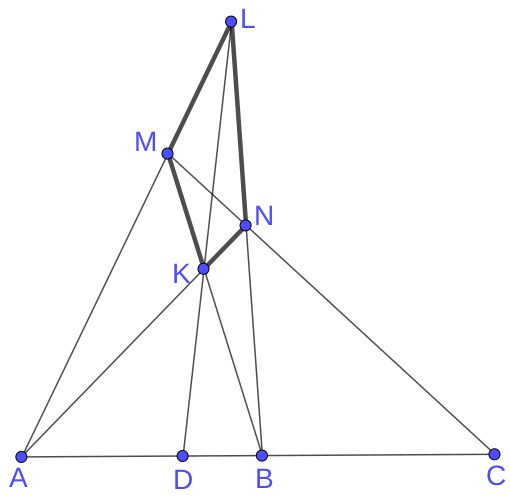
Suppose that the hyperbolic triangle Δ has angles /a, /b and /c with a, b, c integers greater than 1. The hyperbolic area of Δ equals − /a − /b − /c, so that
:\frac1a + \frac1b + \frac1c
The construction of a tessellation will first be carried out for the case when a, b and c are greater than 2.
The original triangle Δ gives a convex polygon P1 with 3 vertices. At each of the three vertices the triangle can be successively reflected through edges emanating from the vertices to produce 2m copies of the triangle where the angle at the vertex is /m. The triangles do not overlap except at the edges, half of them have their orientation reversed and they fit together to tile a neighborhood of the point. The union of these new triangles together with the original triangle form a connected shape P2. It is made up of triangles which only intersect in edges or vertices, forms a convex polygon with all angles less than or equal to and each side being the edge of a reflected triangle. In the case when an angle of Δ equals /3, a vertex of P2 will have an interior angle of , but this does not affect the convexity of P2. Even in this degenerate case when an angle of arises, the two collinear edges are still considered as distinct for the purposes of the construction.
The construction of P2 can be understood more clearly by noting that some triangles or tiles are added twice, the three which have a side in common with the original triangle. The rest have only a vertex in common. A more systematic way of performing the tiling is first to add a tile to each side (the reflection of the triangle in that edge) and then fill in the gaps at each vertex. This results in a total of 3 + (2a − 3) + (2b − 3) + (2c − 3) = 2(a + b + c) − 6 new triangles. The new vertices are of two types. Those which are vertices of the triangles attached to sides of the original triangle, which are connected to 2 vertices of Δ. Each of these lie in three new triangles which intersect at that vertex. The remainder are connected to a unique vertex of Δ and belong to two new triangles which have a common edge. Thus there are 3 + (2a − 4) + (2b − 4) + (2c − 4) = 2(a + b + c) − 9 new vertices. By construction there is no overlapping. To see that P2 is convex, it suffices to see that the angle between sides meeting at a new vertex make an angle less than or equal to . But the new vertices lies in two or three new triangles, which meet at that vertex, so the angle at that vertex is no greater than 2/3 or , as required.
This process can be repeated for P2 to get P3 by first adding tiles to each edge of P2 and then filling in the tiles round each vertex of P2. Then the process can be repeated from P3, to get P4 and so on, successively producing P**n from P**n − 1. It can be checked inductively that these are all convex polygons, with non-overlapping tiles. Indeed, as in the first step of the process there are two types of tile in building P**n from P**n − 1, those attached to an edge of P**n − 1 and those attached to a single vertex. Similarly there are two types of vertex, one in which two new tiles meet and those in which three tiles meet. So provided that no tiles overlap, the previous argument shows that angles at vertices are no greater than and hence that P**n is a convex polygon.
It therefore has to be verified that in constructing P**n from P**n − 1:
(a) the new triangles do not overlap with P**n − 1 except as already described;
(b) the new triangles do not overlap with each other except as already described;
(c) the geodesic from any point in Δ to a vertex of the polygon P**n − 1 makes an angle ≤ 2/3 with each of the edges of the polygon at that vertex.}} To prove (a), note that by convexity, the polygon P**n − 1 is the intersection of the convex half-spaces defined by the full circular arcs defining its boundary. Thus at a given vertex of P**n − 1 there are two such circular arcs defining two sectors: one sector contains the interior of P**n − 1, the other contains the interiors of the new triangles added around the given vertex. This can be visualized by using a Möbius transformation to map the upper half plane to the unit disk and the vertex to the origin; the interior of the polygon and each of the new triangles lie in different sectors of the unit disk. Thus (a) is proved.
Before proving (c) and (b), a Möbius transformation can be applied to map the upper half plane to the unit disk and a fixed point in the interior of Δ to the origin.
The proof of (c) proceeds by induction. Note that the radius joining the origin to a vertex of the polygon P**n − 1 makes an angle of less than 2/3 with each of the edges of the polygon at that vertex if exactly two triangles of P**n − 1 meet at the vertex, since each has an angle less than or equal to /3 at that vertex. To check this is true when three triangles of P**n − 1 meet at the vertex, C say, suppose that the middle triangle has its base on a side AB of P**n − 2. By induction the radii OA and OB makes angles of less than or equal to 2/3 with the edge AB. In this case the region in the sector between the radii OA and OB outside the edge AB is convex as the intersection of three convex regions. By induction the angles at A and B are greater than or equal to /3. Thus the geodesics to C from A and B start off in the region; by convexity, the triangle ABC lies wholly inside the region. The quadrilateral OACB has all its angles less than (since OAB is a geodesic triangle), so is convex. Hence the radius OC lies inside the angle of the triangle ABC near C. Thus the angles between OC and the two edges of P**n − 1 meeting at C are less than or equal to /3 + /3 = 2/3, as claimed.
To prove (b), it must be checked how new triangles in P**n intersect.
First consider the tiles added to the edges of P**n − 1. Adopting similar notation to (c), let AB be the base of the tile and C the third vertex. Then the radii OA and OB make angles of less than or equal to 2/3 with the edge AB and the reasoning in the proof of (c) applies to prove that the triangle ABC lies within the sector defined by the radii OA and OB. This is true for each edge of P**n − 1. Since the interiors of sectors defined by distinct edges are disjoint, new triangles of this type only intersect as claimed.
Next consider the additional tiles added for each vertex of P**n − 1. Taking the vertex to be A, three are two edges AB1 and AB2 of P**n − 1 that meet at A. Let C1 and C2 be the extra vertices of the tiles added to these edges. Now the additional tiles added at A lie in the sector defined by radii OB1 and OB2. The polygon with vertices C2 O, C1, and then the vertices of the additional tiles has all its internal angles less than and hence is convex. It is therefore wholly contained in the sector defined by the radii OC1 and OC2. Since the interiors of these sectors are all disjoint, this implies all the claims about how the added tiles intersect.

Finally it remains to prove that the tiling formed by the union of the triangles covers the whole of the upper half plane. Any point z covered by the tiling lies in a polygon P**n and hence a polygon P**n + 1. It therefore lies in a copy of the original triangle Δ as well as a copy of P2 entirely contained in P**n + 1. The hyperbolic distance between Δ and the exterior of P2 is equal to r 0. Thus the hyperbolic distance between z and points not covered by the tiling is at least r. Since this applies to all points in the tiling, the set covered by the tiling is closed. On the other hand, the tiling is open since it coincides with the union of the interiors of the polygons P**n. By connectivity, the tessellation must cover the whole of the upper half plane.
To see how to handle the case when an angle of Δ is a right angle, note that the inequality
:\frac1a + \frac1b + \frac1c .
implies that if one of the angles is a right angle, say a = 2, then both b and c are greater than 2 and one of them, b say, must be greater than 3. In this case, reflecting the triangle across the side AB gives an isosceles hyperbolic triangle with angles /c, /c and 2/b. If 2/b ≤ /3, i.e. b is greater than 5, then all the angles of the doubled triangle are less than or equal to /3. In that case the construction of the tessellation above through increasing convex polygons adapts word for word to this case except that around the vertex with angle 2/b, only b—and not 2b—copies of the triangle are required to tile a neighborhood of the vertex. This is possible because the doubled triangle is isosceles. The tessellation for the doubled triangle yields that for the original triangle on cutting all the larger triangles in half.
It remains to treat the case when b equals 4 or 5. If b = 4, then c ≥ 5: in this case if c ≥ 6, then b and c can be switched and the argument above applies, leaving the case b = 4 and c = 5. If b = 5, then c ≥ 4. The case c ≥ 6 can be handled by swapping b and c, so that the only extra case is b = 5 and c = 5. This last isosceles triangle is the doubled version of the first exceptional triangle, so only that triangle Δ1—with angles /2, /4 and /5 and hyperbolic area /20—needs to be considered (see below). handles this case by a general method which works for all right angled triangles for which the two other angles are less than or equal to /4. The previous method for constructing P2, P3, ... is modified by adding an extra triangle each time an angle 3/2 arises at a vertex. The same reasoning applies to prove there is no overlapping and that the tiling covers the hyperbolic upper half plane.
Let w be a limit point of the w**n, so that |w| = 1. Thus w lies on the arc of the unit circle between u and v. If w ≠ u, v, then R1 w**n would lie in X for n sufficiently large, contrary to assumption. Hence w =u or v. Hence for n sufficiently large w**n lies close to u or v and therefore must lie in one of the reflections of the triangle about the vertex u or v, since these fill out neighborhoods of u and v. Thus there is an element g in Γ such that g(w**n) lies in . Since by construction w**n is in the Γ-orbit of z1, it follows that there is a point in this orbit lying in , as required.See:
Ideal triangles
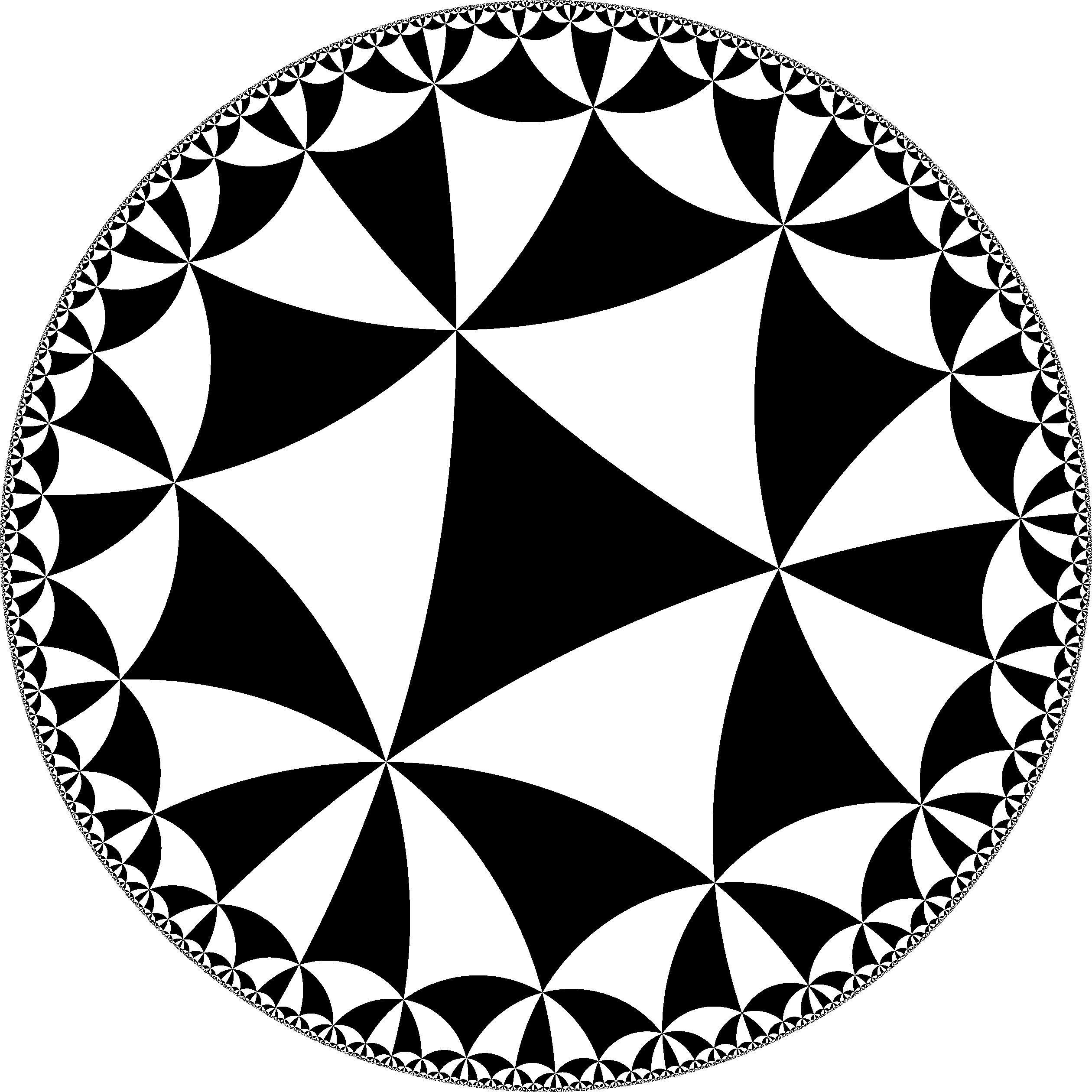
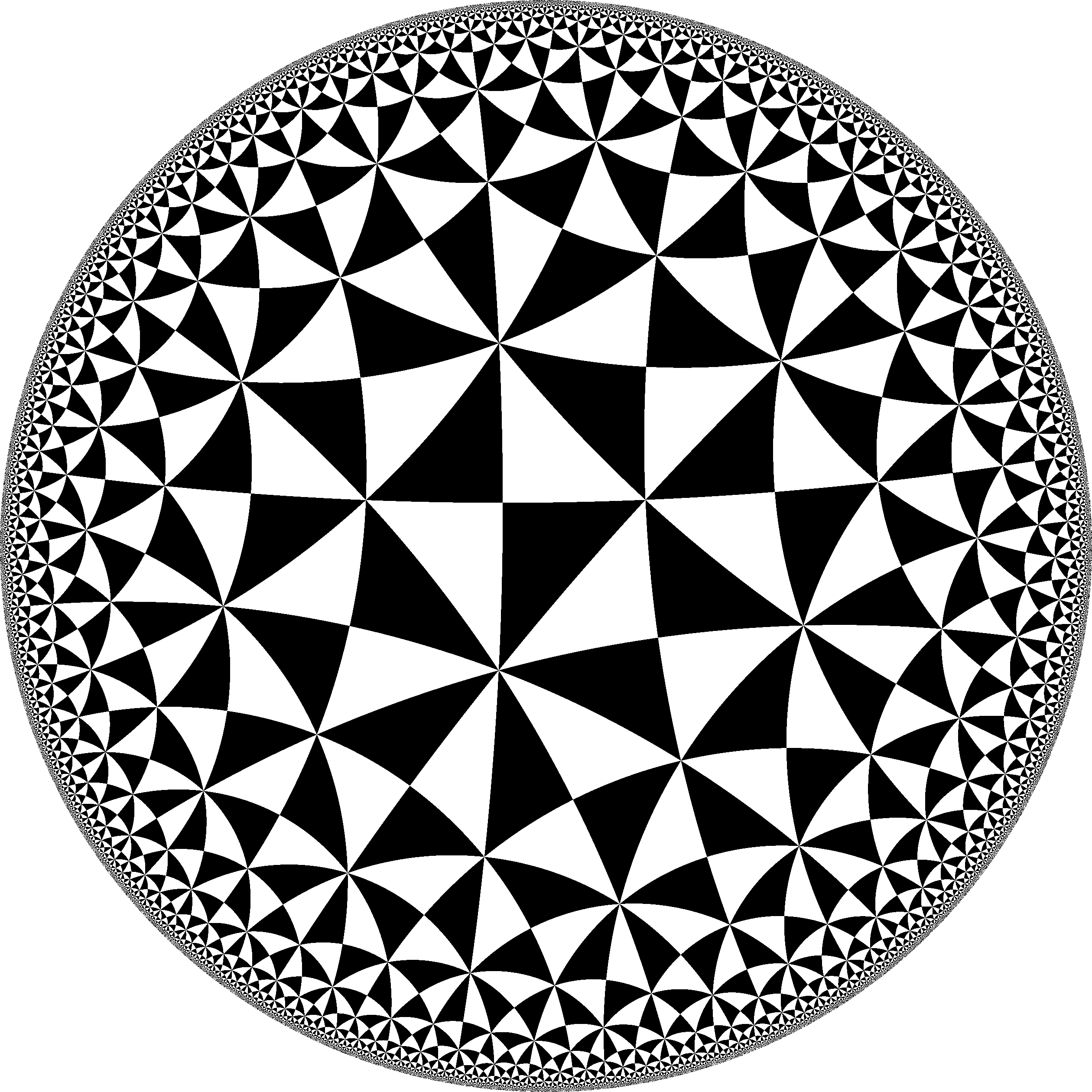
The tessellation for an ideal triangle with all its vertices on the unit circle and all its angles 0 can be considered as a special case of the tessellation for a triangle with one cusp and two nonzero angles /3 and /2. Indeed, the ideal triangle is made of six copies one-cusped triangle obtained by reflecting the smaller triangle about the vertex with angle /3. |File:H2checkers_23i.png|Tessellation for triangle with angles 0, /3 and /2 |File:H2chess_23ib.png|Tessellation for ideal triangle |File:Ideal-triangle hyperbolic tiling line-drawing.svg|Line drawing of tessellation by ideal triangles}}

Each step of the tiling, however, is uniquely determined by the positions of the new cusps on the circle, or equivalently the real axis; and these points can be understood directly in terms of Farey series following , and . This starts from the basic step that generates the tessellation, the reflection of an ideal triangle in one of its sides. Reflection corresponds to the process of inversion in projective geometry and taking the projective harmonic conjugate, which can be defined in terms of the cross ratio. In fact if p, q, r, s are distinct points in the Riemann sphere, then there is a unique complex Möbius transformation g sending p, q and s to 0, ∞ and 1 respectively. The cross ratio (p, q; r, s) is defined to be g(r) and is given by the formula
:(p, q; r, s) = \frac{(p-r)(q-s)}{(p-s)(q-r)}.
By definition it is invariant under Möbius transformations. If a, b lie on the real axis, the harmonic conjugate of c with respect to a and b is defined to be the unique real number d such that (a, b; c, d) = −1. So for example if a = 1 and b = −1, the conjugate of r is 1/r. In general Möbius invariance can be used to obtain an explicit formula for d in terms of a, b and c. Indeed, translating the centre t = (a + b)/2 of the circle with diameter having endpoints a and b to 0, d − t is the harmonic conjugate of c − t with respect to a − t and b − t. The radius of the circle is ρ = (b − a)/2 so (d − t)/ρ is the harmonic conjugate of (c − t)/ρ with respect to 1 and −1. Thus
:\frac{d-t}\rho = \frac\rho{c-t}
so that
:d = \frac{\rho^2}{r-t} + t = \frac{(c-a)b + (c-b)a}{(c-a) + (c-b)}.
It will now be shown that there is a parametrisation of such ideal triangles given by rationals in reduced form
:a = \frac{p_1}{q_1},\ b = \frac{p_1 + p_2}{q_1 + q_2},\ c = \frac{p_2}{q_2}
with a and c satisfying the "neighbour condition" p2q1 − q2p1 = 1.
The middle term b is called the Farey sum or mediant of the outer terms and written
:b = a \oplus c.
The formula for the reflected triangle gives
:d = \frac{p_1 + 2p_2}{q_1 + 2q_2} = a \oplus b.
Similarly the reflected triangle in the second semicircle gives a new vertex b ⊕ c. It is immediately verified that a and b satisfy the neighbour condition, as do b and c.
Now this procedure can be used to keep track of the triangles obtained by successively reflecting the basic triangle Δ with vertices 0, 1 and ∞. It suffices to consider the strip with 0 ≤ Re z ≤ 1, since the same picture is reproduced in parallel strips by applying reflections in the lines Re z = 0 and 1. The ideal triangle with vertices 0, 1, ∞ reflects in the semicircle with base [0,1] into the triangle with vertices a = 0, b = 1/2, c = 1. Thus a = 0/1 and c = 1/1 are neighbours and b = a ⊕ c. The semicircle is split up into two smaller semicircles with bases [a,b] and [b,c]. Each of these intervals splits up into two intervals by the same process, resulting in 4 intervals. Continuing in this way, results into subdivisions into 8, 16, 32 intervals, and so on. At the nth stage, there are 2n adjacent intervals with 2n + 1 endpoints. The construction above shows that successive endpoints satisfy the neighbour condition so that new endpoints resulting from reflection are given by the Farey sum formula.
To prove that the tiling covers the whole hyperbolic plane, it suffices to show that every rational in [0,1] eventually occurs as an endpoint. There are several ways to see this. One of the most elementary methods is described in in their development—without the use of continued fractions—of the theory of the Stern–Brocot tree, which codifies the new rational endpoints that appear at the nth stage. They give a direct proof that every rational appears. Indeed, starting with {0/1,1/1}, successive endpoints are introduced at level n+1 by adding Farey sums or mediants (p+r)/(q+s) between all consecutive terms p/q, r/s at the nth level (as described above). Let be a rational lying between 0 and 1 with a and b coprime. Suppose that at some level x is sandwiched between successive terms {{math|p/q br – as ≥ 1 and hence, since ,
:a + b = (r+s)(ap-bq) + (p+q)(br -as) \ge p+q+r+s.
This puts an upper bound on the sum of the numerators and denominators. On the other hand, the mediant (p+r)/(q+s) can be introduced and either equals x, in which case the rational x appears at this level; or the mediant provides a new interval containing x with strictly larger numerator-and-denominator sum. The process must therefore terminate after at most a + b steps, thus proving that x appears.
A second approach relies on the modular group G = SL(2,Z). The Euclidean algorithm implies that this group is generated by the matrices
:S=\begin{pmatrix} 0 & 1\ -1 & 0 \end{pmatrix},,,, T=\begin{pmatrix} 1 & 1\ 0 & 1 \end{pmatrix}.
In fact let H be the subgroup of G generated by S and T. Let
:g=\begin{pmatrix} a & b\ c & d\end {pmatrix}
be an element of SL(2,Z). Thus ad − cb = 1, so that a and c are coprime. Let
:v=\begin{pmatrix}a\ c\end{pmatrix},,,, u= \begin{pmatrix}1\ 0\end{pmatrix}.
Applying S if necessary, it can be assumed that |a| |c| (equality is not possible by coprimeness). We write a = mc + r with 0 ≤ r ≤ |c|. But then
:T^{-m}\begin{pmatrix} a\ c \end{pmatrix} = \begin{pmatrix} r\ c\end{pmatrix}.
This process can be continued until one of the entries is 0, in which case the other is necessarily ±1. Applying a power of S if necessary, it follows that v = h u for some h in H. Hence
:h^{-1}g=\begin{pmatrix}1 & p\ 0 & q\end{pmatrix}
with p, q integers. Clearly p = 1, so that h−1g = T**q. Thus g = h T**q lies in H as required.
To prove that all rationals in [0,1] occur, it suffices to show that G carries Δ onto triangles in the tessellation. This follows by first noting that S and T carry Δ on to such a triangle: indeed as Möbius transformations, S(z) = −1/z and T(z) = z + 1, so these give reflections of Δ in two of its sides. But then S and T conjugate the reflections in the sides of Δ into reflections in the sides of SΔ and TΔ, which lie in Γ. Thus G normalizes Γ. Since triangles in the tessellation are exactly those of the form gΔ with g in Γ, it follows that S and T, and hence all elements of G, permute triangles in the tessellation. Since every rational is of the form g(0) for g in G, every rational in [0,1] is the vertex of a triangle in the tessellation.
The reflection group and tessellation for an ideal triangle can also be regarded as a limiting case of the Schottky group for three disjoint unnested circles on the Riemann sphere. Again this group is generated by hyperbolic reflections in the three circles. In both cases the three circles have a common circle which cuts them orthogonally. Using a Möbius transformation, it may be assumed to be the unit circle or equivalently the real axis in the upper half plane.See:
Approach of Siegel
In this subsection the approach of Carl Ludwig Siegel to the tessellation theorem for triangles is outlined. Siegel's less elementary approach does not use convexity, instead relying on the theory of Riemann surfaces, covering spaces and a version of the monodromy theorem for coverings. It has been generalized to give proofs of the more general Poincaré polygon theorem. (Note that the special case of tiling by regular n-gons with interior angles 2/n is an immediate consequence of the tessellation by Schwarz triangles with angles /n, /n and /2.)For proofs of Poincaré's polygon theorem, see
Let Γ be the free product Z2 ∗ Z2 ∗ Z2. If Δ = ABC is a Schwarz triangle with angles /a, /b and /c, where a, b, c ≥ 2, then there is a natural map of Γ onto the group generated by reflections in the sides of Δ. Elements of Γ are described by a product of the three generators where no two adjacent generators are equal. At the vertices A, B and C the product of reflections in the sides meeting at the vertex define rotations by angles 2/a, 2/b and 2/c; Let g**A, g**B and g**C be the corresponding products of generators of Γ = Z2 ∗ Z2 ∗ Z2. Let Γ0 be the normal subgroup of index 2 of Γ, consisting of elements that are the product of an even number of generators; and let Γ1 be the normal subgroup of Γ generated by (g**A)a, (g**B)b and (g**C)c. These act trivially on Δ. Let = Γ/Γ1 and 0 = Γ0/Γ1.
The disjoint union of copies of indexed by elements of with edge identifications has the natural structure of a Riemann surface Σ. At an interior point of a triangle there is an obvious chart. As a point of the interior of an edge the chart is obtained by reflecting the triangle across the edge. At a vertex of a triangle with interior angle /n, the chart is obtained from the 2n copies of the triangle obtained by reflecting it successively around that vertex. The group acts by deck transformations of Σ, with elements in 0 acting as holomorphic mappings and elements not in 0 acting as antiholomorphic mappings.
There is a natural map P of Σ into the hyperbolic plane. The interior of the triangle with label g in is taken onto g(Δ), edges are taken to edges and vertices to vertices. It is also easy to verify that a neighbourhood of an interior point of an edge is taken into a neighbourhood of the image; and similarly for vertices. Thus P is locally a homeomorphism and so takes open sets to open sets. The image P(Σ), i.e. the union of the translates g(), is therefore an open subset of the upper half plane. On the other hand, this set is also closed. Indeed, if a point is sufficiently close to it must be in a translate of . Indeed, a neighbourhood of each vertex is filled out the reflections of and if a point lies outside these three neighbourhoods but is still close to it must lie on the three reflections of in its sides. Thus there is δ 0 such that if z lies within a distance less than δ from , then z lies in a -translate of . Since the hyperbolic distance is -invariant, it follows that if z lies within a distance less than δ from Γ() it actually lies in Γ(), so this union is closed. By connectivity it follows that P(Σ) is the whole upper half plane.
On the other hand, P is a local homeomorphism, so a covering map. Since the upper half plane is simply connected, it follows that P is one-one and hence the translates of Δ tessellate the upper half plane. This is a consequence of the following version of the monodromy theorem for coverings of Riemann surfaces: if Q is a covering map between Riemann surfaces Σ1 and Σ2, then any path in Σ2 can be lifted to a path in Σ1 and any two homotopic paths with the same end points lift to homotopic paths with the same end points; an immediate corollary is that if Σ2 is simply connected, Q must be a homeomorphism. To apply this, let Σ1 = Σ, let Σ2 be the upper half plane and let Q = P. By the corollary of the monodromy theorem, P must be one-one.
It also follows that g(Δ) = Δ if and only if g lies in Γ1, so that the homomorphism of 0 into the Möbius group is faithful.
Hyperbolic reflection groups
The tessellation of the Schwarz triangles can be viewed as a generalization of the theory of infinite Coxeter groups, following the theory of hyperbolic reflection groups developed algebraically by Jacques TitsSee:
- and geometrically by Ernest Vinberg.See:
- In the case of the Lobachevsky or hyperbolic plane, the ideas originate in the nineteenth-century work of Henri Poincaré and Walther von Dyck. As Joseph Lehner has pointed out in Mathematical Reviews, however, rigorous proofs that reflections of a Schwarz triangle generate a tessellation have often been incomplete, his own 1964 book "Discontinuous Groups and Automorphic Functions", being one example. Carathéodory's elementary treatment in his 1950 textbook Funktiontheorie, translated into English in 1954, and Siegel's 1954 account using the monodromy principle are rigorous proofs. The approach using Coxeter groups will be summarised here, within the general framework of classification of hyperbolic reflection groups.See:
Let r, s, t be symbols and let a, b, c ≥ 2 be integers, possibly ∞, with
{1 \over a} + {1 \over b} + {1 \over c}
Define Γ to be the group with presentation having generators r, s, t that are all involutions and satisfy \begin{align} (st)^a &= 1, \[2pt] (tr)^b &= 1, \[2pt] (rs)^c &= 1. \end{align} If one of the integers is infinite, then the product has infinite order. The generators r, s, t are called the simple reflections.
Set \begin{align} A &= \begin{cases} \cos\frac{\pi}{a} &\text{if } a \geq 2 \text{ is finite,} \[2pt] \cosh x,\ x 0 &\text{otherwise.} \end{cases} \[8pt] B &= \begin{cases} \cos\frac{\pi}{b} &\text{if } b \geq 2 \text{ is finite,} \[2pt] \cosh y,\ y 0 &\text{otherwise.} \end{cases} \[8pt] C &= \begin{cases} \cos\frac{\pi}{c} &\text{if } c \geq 2 \text{ is finite,} \[2pt] \cosh z,\ z 0 &\text{otherwise.} \end{cases} \end{align} Let e, e, e be a basis for a 3-dimensional real vector space V with symmetric bilinear form Λ such that \begin{align} \Lambda(\mathbf{e}_s, \mathbf{e}_t) &= -A, \[2pt] \Lambda(\mathbf{e}_t, \mathbf{e}_r) &= -B, \[2pt] \Lambda(\mathbf{e}_r, \mathbf{e}_s) &= -C , \end{align} with the three diagonal entries equal to one. The symmetric bilinear form Λ is non-degenerate with signature (2, 1). Define: \begin{align} \rho(\mathbf{v}) &= \mathbf{v} - 2 \Lambda(\mathbf{v},\mathbf{e}_r) \mathbf{e}_r \[2pt] \sigma(\mathbf{v}) &= \mathbf{v} - 2 \Lambda(\mathbf{v},\mathbf{e}_s) \mathbf{e}_s \[2pt] \tau(\mathbf{v}) &= \mathbf{v} - 2 \Lambda(\mathbf{v},\mathbf{e}_t) \mathbf{e}_t \end{align}
Theorem (geometric representation). The operators ρ, σ, τ are involutions on V, with respective eigenvectors {{math|e, e, e}} with simple eigenvalue −1. The products of the operators have orders corresponding to the presentation above (so στ has order a, etc). The operators ρ, σ, τ induce a representation of Γ on V which preserves Λ.
The bilinear form Λ for the basis has matrix
M = \begin{pmatrix} 1 & -C & -B\ -C & 1 & -A\ -B & -A & 1\ \end{pmatrix},
so has determinant \det(M) = 1 - A^2 - B^2 - C^2 - 2ABC. If , say, then the eigenvalues of the matrix are 1,\ 1 \pm \sqrt{A^2 + B^2}. The condition \tfrac{1}{a} + \tfrac{1}{b} immediately forces A^2 + B^2 1, so that Λ must have signature (2, 1). So in general a, b, c ≥ 3. Clearly the case where all are equal to 3 is impossible. But then the determinant of the matrix is negative while its trace is positive. As a result two eigenvalues are positive and one negative, i.e. Λ has signature (2, 1). Manifestly ρ, σ, τ are involutions, preserving Λ with the given −1 eigenvectors.
To check the order of the products like στ, it suffices to note that:
- the reflections σ and τ generate a finite or infinite dihedral group;
- the 2-dimensional linear span U of e and e is invariant under σ and τ, with the restriction of Λ positive-definite;
- W, the orthogonal complement of U, is negative-definite on Λ, and σ and τ act trivially on W.
(1) is clear since if generates a normal subgroup with . For (2), U is invariant by definition and the matrix is positive-definite since 0 Since Λ has signature (2, 1), a non-zero vector w in W must satisfy {{math|Λ(w, w)
\begin{alignat}{5} \sigma(\mathbf{e}_s) &= -{\mathbf e}_s, &\quad \tau(\mathbf{e}_s) &= 2 \cos(\tfrac{\pi}{a}) , \mathbf{e}_s + \mathbf{e}_t, \[2pt] \sigma(\mathbf{e}_t) &= 2 \cos(\tfrac{\pi}{a}) , \mathbf{e}_s + \mathbf{e}_t, &\quad \tau(\mathbf{e}_t) &= -{\mathbf e}_t, \end{alignat}
so that, if a is finite, the eigenvalues of στ are −1, ς and ς−1, where \varsigma = e^{\frac{2\pi i}{a}}; and if a is infinite, the eigenvalues are −1, X and X−1, where X = e^{2x}. Moreover a straightforward induction argument shows that if \theta = \tfrac{\pi}{a} then
\begin{align} (\sigma\tau)^m({\mathbf e}_s) &= \left[ \frac{\sin(2m+1)\theta}{\sin\theta} \right] {\mathbf e}_s + \left[ \frac{\sin 2m\theta}{\sin\theta} \right]{\mathbf e}_t, \[4pt] \tau(\sigma\tau)^m({\mathbf e}_s) &= \left[ \frac{\sin(2m+1)\theta}{\sin\theta} \right]{\mathbf e}_s + \left[ \frac{\sin(2m+2)\theta}{\sin\theta} \right] {\mathbf e}_t, \end{align}
and if x 0 then
\begin{align} (\sigma\tau)^m({\mathbf e}_s) &= \left[ \frac{\sinh(2m+1)x}{\sinh x} \right] {\mathbf e}_s + \left[ \frac{\sinh 2mx}{\sinh x} \right] {\mathbf e}t, \[4pt] \lim{x \to 0} \ (\sigma\tau)^m(\mathbf{e}_s) &= (2m+1)\mathbf{e}_s + 2m\mathbf{e}_t; \[12pt]
\tau(\sigma\tau)^m({\mathbf e}_s) &= \left[ \frac{\sinh(2m+1)x}{\sinh x} \right] {\mathbf e}_s + \left[ \frac{\sinh (2m+2)x}{\sinh x} \right] {\mathbf e}t, \[4pt] \lim{x \to 0} , \tau(\sigma\tau)^m(\mathbf{e}_s) &= (2m+1)\mathbf{e}_s + (2m+2)\mathbf{e}_t. \end{align}
Let Γ be the dihedral subgroup of Γ generated by s and t, with analogous definitions for Γ and Γ. Similarly define Γ to be the cyclic subgroup of Γ given by the 2-group {1, r}, with analogous definitions for Γ and Γ. From the properties of the geometric representation, all six of these groups act faithfully on V. In particular Γ can be identified with the group generated by σ and τ; as above it decomposes explicitly as a direct sum of the 2-dimensional irreducible subspace U and the 1-dimensional subspace W with a trivial action. Thus there is a unique vector \mathbf w = \mathbf{e}_r + \lambda\mathbf{e}_s + \mu\mathbf{e}_t in W satisfying and . Explicitly, \lambda = \frac{C + AB}{1 - A^2}, \quad \mu = \frac{B + AC}{1 - A^2}.
Remark on representations of dihedral groups. It is well known that, for finite-dimensional real inner product spaces, two orthogonal involutions S and T can be decomposed as an orthogonal direct sum of 2-dimensional or 1-dimensional invariant spaces; for example, this can be deduced from the observation of Paul Halmos and others, that the positive self-adjoint operator (S − T)2 commutes with both S and T. In the case above, however, where the bilinear form Λ is no longer a positive definite inner product, different ad hoc reasoning has to be given.
Theorem (Tits). The geometric representation of the Coxeter group is faithful.
This result was first proved by Tits in the early 1960s and first published in the text of with its numerous exercises. In the text, the fundamental chamber was introduced by an inductive argument; exercise 8 in §4 of Chapter V was expanded by Vinay Deodhar to develop a theory of positive and negative roots and thus shorten the original argument of Tits.See:
- ,
Let X be the convex cone of sums κe + λe + μe with real non-negative coefficients, not all of them zero. For g in the group Γ, define ℓ(g), the word length or length, to be the minimum number of reflections from r, s, t required to write g as an ordered composition of simple reflections. Define a positive root to be a vector ge, ge or ge lying in X, with g in Γ.
It is routine to check from the definitions thatSee:
- if for a simple reflection q and, if g ≠ 1, there is always a simple reflection q such that ;
- for g and h in Γ, ℓ(gh) ≤ ℓ(g) + ℓ(h).
Proposition. If g is in Γ and for a simple reflection q, then ge lies in ±X, and is therefore a positive or negative root, according to the sign.
Replacing g by gq, only the positive sign needs to be considered. The assertion will be proved by induction on , it being trivial for . Assume that . If , without less of generality it may be assumed that the minimal expression for g ends with ...t. Since s and t generate the dihedral group Γ, g can be written as a product , where or t(st) and h has a minimal expression that ends with ...r, but never with s or t. This implies that and . Since {{math|ℓ(h)
Corollary (proof of Tits' theorem). The geometric representation is faithful.
It suffices to show that if g fixes e, e, e, then . Considering a minimal expression for g ≠ 1, the conditions clearly cannot be simultaneously satisfied by the three simple reflections q.
Note that, as a consequence of Tits' theorem, the generators (left) satisfy the conditions (right): \begin{alignat}{5} (g &= st) \ \ \text{ s.t. } & g^a = 1,\[4pt] (h &= tr) \ \ \text{ s.t. } & h^b = 1,\[4pt] (k &= rs) \ \ \text{ s.t. } & k^c = 1, \[4pt] && ghk = 1. \end{alignat} This gives a presentation of the orientation-preserving index 2 normal subgroup Γ1 of Γ. The presentation corresponds to the fundamental domain obtained by reflecting two sides of the geodesic triangle to form a geodesic parallelogram (a special case of Poincaré's polygon theorem).See:
Further consequences. The roots are the disjoint union of the positive roots and the negative roots. The simple reflection q permutes every positive root other than e. For g in Γ, ℓ(g) is the number of positive roots made negative by g.
**Fundamental domain and Tits cone.**See:
Let G be the 3-dimensional closed Lie subgroup of GL(V) preserving Λ. As V can be identified with a 3-dimensional Lorentzian or Minkowski space with signature (2,1), the group G is isomorphic to the Lorentz group O(2,1) and therefore \mathrm{SL}_\pm(2,\R) \setminus {\pm ,I,}. Choosing e to be a positive root vector in X, the stabilizer of e is a maximal compact subgroup K of G isomorphic to O(2). The homogeneous space is a symmetric space of constant negative curvature, which can be identified with the 2-dimensional hyperboloid or Lobachevsky plane \mathfrak{H}^2. The discrete group Γ acts discontinuously on G / K: the quotient space Γ \ G / K is compact if a, b, c are all finite, and of finite area otherwise. Results about the Tits fundamental chamber have a natural interpretation in terms of the corresponding Schwarz triangle, which translate directly into the properties of the tessellation of the geodesic triangle through the hyperbolic reflection group Γ. The passage from Coxeter groups to tessellation can first be found in the exercises of §4 of Chapter V of , due to Tits, and in ; currently numerous other equivalent treatments are available, not always directly phrased in terms of symmetric spaces.
Approach of Maskit, de Rham and Beardon
gave a general proof of Poincaré's polygon theorem in hyperbolic space; a similar proof was given in . Specializing to the hyperbolic plane and Schwarz triangles, this can be used to give a modern approach for establishing that the existence of Schwarz triangle tessellations, as described in and . The Swiss mathematicians and Haefliger have provided an introductory account, taking geometric group theory as their starting point.See:
Notes
References
-
, Table 3: Schwarz's Triangles
-
(Note that Coxeter references this as "Zur Theorie der hypergeometrischen Reihe", which is the short title used in the journal page headers).
-
{{Citation
-
Reprinted by Masson in 1981 as .
-
{{cite journal| mr =0647210 |last=Deodhar | first= Vinay V. | author-link= Vinay Deodhar| title = On the root system of a Coxeter group |journal = Comm. Algebra| volume = 10 | year =1982 |issue=6 | pages = 611–630 | doi=10.1080/00927878208822738}}
-
{{citation
-
{{cite book| mr = 0207802 | last1 = Magnus| first1 = Wilhelm| author1-link= Wilhelm Magnus| last2= Karrass| first2 = Abraham| last3 = Solitar | first3= Donald | author3-link = Donald Solitar | title=Combinatorial group theory: Presentations of groups in terms of generators and relations| year =1976| publisher= Dover Books| edition= Second revised}}
-
{{cite journal| mr = 0679972 | last=Maxwell | first =George| title = Sphere packings and hyperbolic reflection groups | journal = J. Algebra| volume = 79 | year=1982 | pages = 78–97| doi=10.1016/0021-8693(82)90318-0 | doi-access = free }}
-
This manuscript was the foundational text for the theory of Coxeter groups, used for preparing Chapter IV of Bourbaki's Groupes et Algèbres de Lie; it was first published in 2001.
-
{{cite journal| first= Ernest B. | last = Vinberg| author-link = Ernest Vinberg| year=1971| title = Discrete linear groups generated by reflections | journal = Mathematics of the USSR-Izvestiya| pages= 1083–1119 | volume= 5 | issue = 5| doi = 10.1070/IM1971v005n05ABEH001203| bibcode = 1971IzMat...5.1083V| translator= P. Flor |mr = 0302779}}
References
- A. W. Knapp, ''Doubly generated Fuchsian groups'', [[Michigan Mathematical Journal]] 15 (1968), no. 3, 289–304
- {{harvnb. Carathéodory. 1954
- {{harvnb. Carathéodory. 1954
- {{harvnb. Carathéodory. 1954
- {{harvnb. Carathéodory. 1954
- {{harvnb. Carathéodory. 1954
- {{harvnb. Graham. Knuth. Patashnik. 1994
- {{harvnb. Series. 2015
- {{harvnb. Siegel. 1971
- {{harvnb. Beardon. 1984
- {{harvnb. Lehner. 1964
- {{harvnb. Maskit. 1971
- {{harvnb. Howlett. 1996
This article was imported from Wikipedia and is available under the Creative Commons Attribution-ShareAlike 4.0 License. Content has been adapted to SurfDoc format. Original contributors can be found on the article history page.
Ask Mako anything about Schwarz triangle — get instant answers, deeper analysis, and related topics.
Research with MakoFree with your Surf account
Create a free account to save articles, ask Mako questions, and organize your research.
Sign up freeThis content may have been generated or modified by AI. CloudSurf Software LLC is not responsible for the accuracy, completeness, or reliability of AI-generated content. Always verify important information from primary sources.
Report