From Surf Wiki (app.surf) — the open knowledge base
Schomburg Center for Research in Black Culture
Public research library in New York City
.jpg)
Public research library in New York City
| Field | Value | ||
|---|---|---|---|
| library_name | Schomburg Center | ||
| for Research in Black Culture | |||
| image | Schomburg_Center_for_Research_in_Black_Culture_(52008381132).jpg | ||
| image_size | 250px | ||
| country | United States | ||
| type | Research library | ||
| established | 1905 (as the 135th Street Branch) | ||
| 1925 (as the Division of Negro Literature, History and Prints) | |||
| items_collected | Poems by Phillis Wheatley, papers of Ralph Bunche, Malcolm X, and Hiram Rhodes Revels | ||
| collection_size | 10 million | ||
| director | Joy L. Bivins | ||
| website | Official website | ||
| library_logo | [[File:Schomburg Center for Research in Black Culture Logo.jpg | 249px | border]] |
for Research in Black Culture 1925 (as the Division of Negro Literature, History and Prints)
The Schomburg Center for Research in Black Culture is a research library of the New York Public Library (NYPL) and an archive repository for information on people of African descent worldwide. Located at 515 Malcolm X Boulevard (Lenox Avenue) between West 135th and 136th Streets in the Harlem neighborhood of Manhattan, New York City, it has, almost from its inception, been an integral part of the Harlem community. It is named for Afro-Puerto Rican scholar Arturo Alfonso Schomburg.
The resources of the center are broken up into five divisions: the Art and Artifacts Division, the Jean Blackwell Hutson General Research and Reference Division, the Manuscripts, Archives and Rare Books Division, the Moving Image and Recorded Sound Division, and the Photographs and Prints Division.
In addition to research services, the center hosts readings, discussions, art exhibitions, and theatrical events. It is open to the general public.
Early history
135th Street branch
In 1901, Andrew Carnegie tentatively agreed to donate $5.2 million () to construct 65 branch libraries in New York City, with the requirement that the City provide the land and maintain the buildings once construction was complete. Later in 1901, Carnegie formally signed a contract with the City of New York to transfer his donation to the city to then allow it to justify purchasing the land to house the libraries. McKim, Mead & White were chosen as the architects and Charles Follen McKim designed the three-story library building at 103 West 135th Street in the Italian Renaissance Palazzo mode. At its opening on July 14, 1905, the library had 10,000 books and the librarian in charge was Gertrude Cohen.
Rose tenure (1920–1942)
In 1920, Ernestine Rose, a white woman born in Bridgehampton in 1880, became the branch librarian. She quickly integrated the all-white library staff. Catherine Allen Latimer, the first African-American librarian hired by the NYPL, was sent to work with Rose, as was Roberta Bosely months later. Some time later, Sadie Peterson Delaney became employed at the branch. Together, they created a plan to assist in integrating reading into the lives of the library attendees and cooperated with schools and social organizations in the community.
In 1921, the library hosted the first exhibition of African-American art in Harlem; it became an annual event. The library became a focal point to the burgeoning Harlem Renaissance. In 1923, the 135th Street branch was the only branch in New York City employing Negroes as librarians, and consequently when Regina M. Anderson was hired by the NYPL, she was sent to work at the 135th Street branch.
Rose issued a report to the American Library Association, in 1923, which stated that requests for books about Negroes or written by Negroes had been increasing, and that the demand for professionally trained colored librarians was also. In late 1924, Rose called a meeting, with attendees including Arturo Alfonso Schomburg, James Weldon Johnson, Hubert Harrison, that decided to focus on preserving rare books, and solicit donations to enhance its African-American collection. On May 8, 1925, it began operating as the Division of Negro Literature, History and Prints, a division of the NYPL. In 1926, Schomburg was interested in selling his collection of African-American literature because he wanted it to be available to the general public, but he wanted the collection to stay in Harlem. Rose and the National Urban League convinced the Carnegie Foundation to pay $10,000 to Schomburg and then donate the books to the library. In 1926, the center's collection won acclaim with the addition of Schomburg's personal collection. By donating his collection, Schomburg sought to show that black people had a history and a culture and thus were not inferior to other races. About 5,000 objects in Schomburg's collection were donated.
In 1929, Anderson was desirous of a promotion and enlisted the help of W. E. B. Du Bois and Walter Francis White when she was being discriminated against by not being promoted. After letters of intervention on her behalf by Du Bois and White, and a boycott of the library by White, Anderson was promoted and transferred to the Rivington Street branch of the NYPL.
By 1930, the center had 18,000 volumes. In 1935, the Center developed a project to deliver books once a week to those handicapped severely enough that they could not make it to the library. Dr. Lawrence D. Reddick became the second curator of the Schomburg Collection of Negro Literature. At the behest of Reddick, in October 1940, the entire Division of Negro History, Literature and Prints was renamed the Schomburg Collection of Negro History and Literature. for Research in Black Culture Manhattan, New York City
In 1942, Rose retired after an extension was built onto the rear of the building, at a time when the library had 40,000 books. Dorothy Robinson Homer replaced her as Branch Librarian, after the Citizen's Committee of the 135th Street Branch Library specifically requested a Negro to replace Rose.
Countee Cullen branch
After the extension was built, the library became known as the Countee Cullen Library branch, and the 135th Street Library is still considered the original location of the Countee Cullen branch, although that name is now only used for the extension itself on West 136th Street.
Homer created a room of books just for young adults and created the American Negro Theatre in the basement that spawned the play Anna Lucasta, which was moved to Broadway. She kept the emphasis on building a community center for art, music and drama. She put on art exhibits that favored unknown, young artists of all races.
After the outbreak of WWII, Homer started a program of monthly concert recitals in the auditorium to enhance public spirit, but the demand by performers and audience members to continue the practice made it permanent.
Hutson tenure (1948–1980)
In 1948, Jean Blackwell was named the director of the center. In a 1966 speech, Hutson warned of the perilous status of the Schomburg collection.
In 1971, the center began being supported by the privately funded Schomburg Corporation. The next year, funds by New York City were allocated to renovate the building at 103 West 135th, and it was renamed the building of the Schomburg Collection for Research in Black Culture. Simultaneously, the entire Schomburg collection was rounded up from various branch libraries and transferred to the center. In 1972, it was designated as one of NYPL's research libraries.
In 1973, a building on the west side of Lenox Ave between 135th and 136th was bought to be demolished and a new building could be constructed. The location was chosen due to its proximity to other community agencies and because it was the "scene of the Harlem Renaissance." In 1978, the building on 135th Street between Lenox and 7th Avenues was entered into the National Register of Historic Places. In 1979, it was formally listed in the NRHP.
Schomburg Center
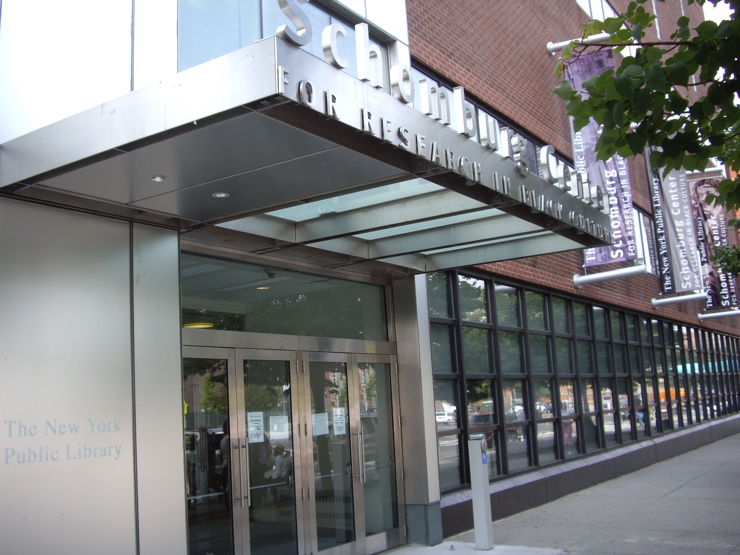
In 1980, a new Schomburg Center was founded at 515 Lenox Avenue. In 2016, both the original and current buildings, now joined by a connector, were designated a National Historic Landmark.
The Roger Furman Theatre is located within the building.
Wray tenure (1981–1983)
In 1981, Wendell L. Wray became the director of the center. Protests began over Wray's decision to not hire an African-American man to head the center's Manuscript, Archives, and Rare Books Division and instead hired Robert Morris. In 1983, Wray resigned to pursue academic research
Dodson tenure (1984–2011)
Howard Dodson became the director in 1984, at a time when the Schomburg was primarily a cultural center visited by tourists and schoolchildren and its research facilities were known only to scholars. As early as 1984, the Schomburg was recognized as the most important institution in the world for collections of art and literature of people in Africa or its diaspora. In 1983, a scholars-in-residence program started at the center. In 1986, an exhibit entitled Give me your poor... sparked controversy. In March 1987, a public funding campaign was started to raise money to renovate the old library and to enhance the new Center's housing and its functions.
In 1991, additions to the Schomburg Center were completed. The new center on Malcolm X was expanded to include an auditorium and a connection to the old landmark building on 135th. The Art and Artifacts Division and the Moving Image and Recorded Sound Division were moved into the old landmark building. In 2000, the Schomburg Center held an exhibition titled "Lest We Forget: The Triumph Over Slavery", which later went on tour around the world for more than a decade under the sponsorship of UNESCO's Slave Route Project. In 2005, the center held an exhibition of letters, photographs and other materials related to Malcolm X. In 2007, the building was renovated and expanded in an $11 million project. The Schomburg Center had 120,000 visitors a year; by 2010, Dodson announced he would retire in early 2011.
In 2007, the Schomburg Center was one of the sponsors of the African Burial Ground National Monument.
Muhammad tenure (2011–2016)
Following Howard Dodson's announcement of his retirement in 2010, In July, the center began an exhibit of Malcolm X footage and prints entitled Malcolm X: the Search for Truth.
Young tenure (2016–2020)
On August 1, 2016, the New York Public Library announced that poet and academic Kevin Young would begin as director of the Schomburg in the late fall of 2016. During Young's four-year tenure, attendance increased by 40%, to 300,000 visitors per year. He is credited with raising more than $10 million in grants and donations, and securing several high-profile acquisitions, including the papers of James Baldwin; Harry Belafonte; and the couple Ossie Davis and Ruby Dee. A $22.3 million renovation of the Schomburg Center buildings was completed in 2017. The project included new gallery and research areas; upgrades to the Langston Hughes Auditorium; a two-story annex; and upgrades to the second-floor Rare Books Reading Room.
Young stepped down at the end of 2020 to assume a new position as director of the Smithsonian's National Museum of African American History and Culture.
Bivins tenure (2021–present)
In 2021, Joy Bivins was appointed as the director of the Schomburg Center. The next year, the Dormitory Authority of the State of New York provided $8 million for a renovation of the Schomburg Center buildings. The work included energy-efficiency and safety upgrades, in addition to a replacement of existing windows and roof. The NYPL hosted various events in 2025 to celebrate the Schomburg Collection's 100th anniversary.
Collection

In 1998, the Schomburg Collection was considered as consisting of the rarest, and most useful, Afrocentric artifacts of any public library in the United States. At least as of late 2006, it is viewed as the most prestigious for African-American materials in the country. As of 2010, the Collection stood at 10 million objects, John Henrik Clarke, Lorraine Hansberry, Malcolm X and Nat King Cole. the National Negro Congress, and the files of the South African Dennis Brutus Defense Committee (restricted). Additionally, it includes the papers of Lawrence Brown (1893–1973), Melva L. Price, Ralph Bunche, Léon Damas, Thomas Henderson Kerr Jr., William Pickens, Hiram Rhodes Revels, Clarence Cameron White. The collection also includes manuscripts of Alexander Crummell and John Edward Bruce, manuscripts of Slavery, Abolitionism and on the West Indies, and letters and unpublished manuscripts of Langston Hughes. It includes some papers from Christian Fleetwood, Paul Robeson (restricted), Booker T. Washington, and Schomburg himself. It includes musical recordings, black and jazz periodicals, rare books and pamphlets, and tens of thousands of art objects. The center's collection includes documents signed by Toussaint Louverture and a rare recording of a speech by Marcus Garvey.
The Claude McKay Estate is represented by the Faith Childs Literary Agency. In the past, the center had acted as the literary representative of the heirs of Claude McKay.
References
Notes
Sources
Reference books
- Harris, Michael H., and Donald G. Davis Jr (1978). American Library History: a bibliography. Austin: University of Texas.
- Davis, Donald G. Jr, and John Mark Tucker (1989). American Library History: a comprehensive guide to the literature. Santa Barbara: ABC-CLIO, Inc.
Further reading
- Library Work in Schools 1901-12-18
- Gift To Public Library, The New York Times, 1926-05-26; exact date of the official transfer to the New York Public Library by the Carnegie Foundation at the behest of the National Urban League and Rose
- Books--Authors. The New York Times, 1940-07-26: Description of the donation by Schomburg to the Library in 1926
- Schomburg Collection Bulwark VS Propaganda, 1940
- "Harlem Wants Library Named For Schomburg: Late Bibliophile Gave Impetus to Move Establishing Unit" (1942)
- Eleanor Blau, "Friday A FIENDISH OPENING", The New York Times, Weekender Guide, February 1, 1985 (archived).
- John Jacob, "Black History Month", Washington Afro-American, February 2, 1988.
- Schomburg Center for Research in Black Culture (not digitized yet)
- Girardi, Pamela (2005). The American Historical Association's Guide to Historical Literature.
References
- (March 16, 1901). "Carnegie Offers City Big Gift". [[New-York Tribune]].
- (September 9, 1901). "Library Plans All Right Now: Carnegie Approves Controller Coler Contracts". The Evening World.
- {{harvp. White. Willensky. 2000
- (July 30, 1930). "Library's West 135th Street Branch Will Mark 25th Anniversary Tuesday: Schomburg Collection of Negro Literature Brought Harlem Unit 'to Attention of Book World--Considered Finest". New York Amsterdam News.
- (July 15, 1905). "New Library Opened". New-York Tribune.
- {{harvp. Tibbets. 1995
- {{harvp. Tibbets. 1995
- {{harvp. Sinnette. 1989
- (2000). "Handbook of Black Librarianship". Scarecrow Press.
- {{harvp. Wintz. 2007
- Rose, Ernestine. (July 1922). "Work With Negroes Round Table". Bulletin of the American Library Association.
- (March 21, 2018). "The Librarian at the Nexus of the Harlem Renaissance". Atlas Obscura.
- {{harvp. Whitmire. 2007
- (May 2, 1923). "Interest Increases In Negro Literature: Miss Ernestine Rose Does Not Believe in Purely Colored Libraries". [[New York Amsterdam News]].
- Marshall: 67; cf. [https://www.jstor.org/stable/25686069 Working with Negroes Roundtable by Ernestine Rose]
- {{harvp. Tibbets. 1995
- Anekwe, Simon. (November 4, 1978). "Schomburg Center, historic property". New York Amsterdam News.
- {{harvp. Sinnette. 1989
- {{harvp. Sinnette. 1989
- Clark, Roger. (December 1, 2025). "Schomburg Center celebrates 100 years with special exhibit on Black history". [[Charter Communications]].
- Lee, Felicia R.. (April 19, 2010). "Harlem Center's Director to Retire in Early 2011". The New York Times.
- (January 26, 1927). "Mrs. Latimer in Charge of Negro History Department: Ass't Librarian". New York Amsterdam News.
- Whitmire: ?
- (June 18, 1938). "Schomburg is Buried While Crowds Mourn: Famous Curator Dead at 64; Collected Rare Books, Prints". New York Amsterdam News.
- Berlack-Boozer, Thelma. (June 18, 1938). "Shut-Ins Cheered By Books From Library: Special Service for Them Operated Only At Busy Branch in West 135th". New York Amsterdam News.
- (August 23, 1929). "Curator of Negro Literature". The New York Times.
- {{harvp. Sinnette. 1989
- {{harvp. Tibbets. 1995
- (June 27, 1942). "New Librarian Takes Over At Harlem Branch: Mrs. Dorothy R. Homer, 10 Years on Job, Gets Top Spot at 135th St.". New York Amsterdam News.
- (April 16, 1961). "Miss Rhodes
[sic, Ernestine Rose] Dies; Integrated Library". New York Amsterdam News. - (2012). "About the Countee Cullen Library". The New York Public Library.
- Andrew L. Yarrow, [https://www.nytimes.com/1990/08/19/nyregion/repository-of-black-past-is-reopened.html "Repository of Black Past is Reopened"], ''The New York Times'', August 19, 1990 (archived).
- Courtney, Charles. (December 30, 1944). "Library Tradition Carried On By Dynamic Little Lady: She Heads Popular Uptown Library Branch Civic-Minded". New York Amsterdam News.
- (February 9, 1946). "Doris Earle and Sallee Smith Set For Joint Recital". New York Amsterdam News.
- (February 23, 1998). "Jean Blackwell Hutson, ex-Chief of Schomburg Center, dies". [[Jet (magazine).
- {{harvp. Dodson. Moore. Yancy. 2000
- (October 11, 1980). "Schomburg Center Opens in New York". [[Afro-American (newspaper).
- (August 29, 1987). "Recalling the Early Days at the Schomburg Center, a Harlem Cultural Hub (page 1 of 2)". The New York Times.
- (August 29, 1987). "Recalling the Early Days at the Schomburg Center, a Harlem Cultural Hub (page 2 of 2)". The New York Times.
- {{harvp. Dodson. Moore. Yancy. 2000
- {{harvp. Henderson. 1974
- Anekwe, Simon. (November 4, 1978). "Schomburg Center, historic property". New York Amsterdam News.
- Fraser, C. Gerald. (April 1, 1979). "Schomburg Unit Listed as Landmark: Spawning Ground of Talent 40 Seats Are Not Enough Plans for a Museum". The New York Times.
- "Manhattan Carnegie Libraries- West 135th Street Branch/ Schomburg Collection for Research in Black Culture-Photos {{!}} HDC".
- "Draft NHL nomination for Schomburg Center". National Park Service.
- Heyliger, Yvette. (October 25, 2016). "Autobiography of a Homegirl: Deep Somewhere in the Toy Box where All My Dolls are Kept". iUniverse.
- (March 10, 1983). "The City; Schomburg Center Loses Its Chief". The New York Times.
- (November 19, 1982). "The City; 2 Black Activists Seized in Protest". The New York Times.
- Anderson, Susan Heller. (January 13, 1984). "New York Day by Day". The New York Times.
- Lee, Felicia R.. (November 17, 2010). "Historian Will Direct Schomburg Center in Harlem". New York Times.
- (February 1, 1984). "Harlem Renaissance Exhibit Set Saturday at State Museum". [[The Daily Gazette.
- "Schomburg Center Scholars-in-Residence Program".
- (June 25, 1986). "'Liberty' Gala Perplexes Black Patriots". [[Tampa Bay Times.
- Marriott, Michel. (November 23, 1987). "Schomburg Center Acts to Halt Loss of Black History". The New York Times }}; [https://news.google.com/newspapers?id=ATAtAAAAIBAJ&sjid=6r0EAAAAIBAJ&dq=schomburg%20center&pg=2775%2C8088858 Culture Center Expansion.]{{Dead link.
- [https://www.nytimes.com/1991/04/08/nyregion/grand-opening-of-expanded-schomburg-center.html "Grand Opening of Expanded Schomburg Center"], ''The New York Times'', April 8, 1991 (archived).
- (April 20, 1991). "Research Complex Expanded". [[The Albany Herald]].
- "Memorial Dedication: African Burial Ground National Monument".
- Kelly, William P.. (August 1, 2016). "Introducing the New Director of the Schomburg Center, Kevin Young". NYPL blog.
- Schuessler, Jennifer (August 1, 2016). "[https://www.nytimes.com/2016/08/02/books/the-poet-kevin-young-is-named-new-director-of-schomburg-center.html The Poet Kevin Young Is Named New Director of Schomburg Center]". ''New York Times''. Retrieved April 10, 2021.
- Bowley, Graham (September 30, 2020). "[https://www.nytimes.com/2020/09/30/arts/design/kevin-young-to-lead-african-american-museum.html Kevin Young, Poet and Author, Is Named to Lead African American Museum]". ''New York Times''. Retrieved April 10, 2021.
- [https://www.harlemworldmagazine.com/smithsonian-names-harlems-schomburg-center-onetime-director-as-new-director/ "Smithsonian Names Harlem’s Schomburg Center Onetime Director As New Director"]. ''Harlem World Magazine''. October 6, 2020. Retrieved April 10, 2021.
- Hickman, Matt. (August 18, 2022). "Harlem’s Schomburg Center for Research in Black Culture receives $8 million in state support for major overhaul".
- Warerkar, Tanay. (October 16, 2017). "NYPL’s Schomburg Center in Harlem reveals its complete two-year renovation".
- "[https://www.si.edu/about/bios/kevin-young Kevin Young]". [[Smithsonian Institution]]. si.edu. Retrieved April 10, 2021.
- Moynihan, Colin. (2021-06-04). "Curator Joy Bivins Is Named New Director of the Schomburg Center". The New York Times.
- Valentine, Victoria L.. (June 6, 2021). "Curator Joy Bivins Named Director of Schomburg Center in Harlem: ‘In My Career, I Have Worked to Help Others Make Sense of History’".
- Sutton, Benjamin. (August 17, 2022). "Harlem’s Schomburg Center for Research in Black Culture receives $8m in state funding for major renovation".
- (February 4, 2025). "NYC's Schomburg Center for Research in Black Culture celebrating 100th anniversary".
- Farfan, Isa. (February 4, 2025). "The Schomburg Center for Research in Black Culture Is Turning 100".
- (1998). "Untold Stories: Civil Rights, Libraries and Black Librarianship". University of Illinois.
- Woo, Elaine. (October 21, 2006). "A Champion of Black History". Los Angeles Times.
- [http://archives.nypl.org/scm/20834 "John Henrik Clarke papers"], New York Public Library Archives & Manuscripts.
- [http://archives.nypl.org/scm/20931 "Lorraine Hansberry papers"], Schomburg Center for Research in Black Culture, The New York Public Library.
- "Symphony of the New World: 50th Anniversary of a Pioneering Organization". [[New York Public Library]].
- [http://www.nypl.org/sites/default/files/archivalcollections/pdf/mg38.pdf "Lawrence Brown Papers"] at Schomburg Center for Research in Black Culture, The New York Public Library.
- "Melva L. Price papers".
- "Thomas Henderson Kerr, Jr. papers".
- [http://archives.nypl.org/scm/20809 "William Pickens papers"], Schomburg Center for Research in Black Culture, The New York Public Library Archives & Manuscripts.
- [http://archives.nypl.org/scm/20822 "Dennis Brutus Papers"], Schomburg Center for Research in Black Culture, The New York Public Library Archives & Manuscripts.
- [http://archives.nypl.org/scm/20572 "Alexander Crummell Papers"], Schomburg Center for Research in Black Culture, The New York Public Library Archives & Manuscripts.
- [http://archives.nypl.org/scm/20649 "Paul Robeson collection, 1925–1956"] Schomburg Center for Research in Black Culture, The New York Public Library Archives & Manuscripts.
- [http://archives.nypl.org/scm/20789 "Booker T. Washington correspondence, 1889–1913"], Schomburg Center for Research in Black Culture, The New York Public Library Archives & Manuscripts.
- (2000). "Handbook of Black Librarianship". Scarecrow Press.
- (2004). "Complete poems". University of Illinois Press.
This article was imported from Wikipedia and is available under the Creative Commons Attribution-ShareAlike 4.0 License. Content has been adapted to SurfDoc format. Original contributors can be found on the article history page.
Ask Mako anything about Schomburg Center for Research in Black Culture — get instant answers, deeper analysis, and related topics.
Research with MakoFree with your Surf account
Create a free account to save articles, ask Mako questions, and organize your research.
Sign up freeThis content may have been generated or modified by AI. CloudSurf Software LLC is not responsible for the accuracy, completeness, or reliability of AI-generated content. Always verify important information from primary sources.
Report