From Surf Wiki (app.surf) — the open knowledge base
Schnabel car
Specialized railroad freight car

Specialized railroad freight car
A Schnabel car or Schnabel wagon is a specialized type of railroad freight car. It is designed to carry heavy and oversized loads in such a way that the load makes up part of the car. The load is suspended between the two ends of the cars by lifting arms; the lifting arms are connected to an assembly of span bolsters that distribute the weight of the load and the lifting arm over many wheels.
When a Schnabel car is empty, the two lifting arms are connected to one another and the car can usually operate at normal freight train speeds. Some Schnabel cars include hydraulic equipment that will either lift or horizontally shift the load while in transit (at very low speeds) to clear obstructions along the car's route. As of 2012, there were 31 Schnabel cars operating in Europe, 30 in North America, 25 in Asia, and one in Australia.
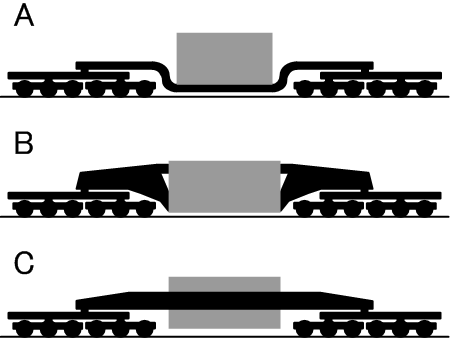
In this figure, black indicates parts of the car and gray is the cargo.]]
Examples
The largest Schnabel car in public railroad operation, reporting number WECX 801, was completed in 2012 by Kasgro Railcar for Westinghouse Nuclear and is used in North America primarily to transport reactor containment vessels. It has 36 axles (18 for each half). Each half contains nine trucks which are connected by a complex system of span bolsters. Its tare (unloaded) weight is 399.6 ST and has a load limit of 1017.9 ST for a maximum gross weight of 1417.5 ST. WECX 801 has the ability to shift its load 44 in vertically and up to 40 in laterally on either side of the car's centerline. When empty, this car measures 231 ft long; for comparison, a conventional boxcar currently operating on North American railroads has a single two-axle truck at each end of the car, measures 50 to(-) long and has a capacity of 70 to(-). The train's speed is limited to 25 mi/h when WECX 801 is empty, but only 15 mi/h when loaded, and the system requires a crew of six operators in addition to the train's crew.
The second largest Schnabel car in service, owned by ABB, bears the CEBX 800 registration, and is used in North America. Built by Krupp AG, it has 36 axles (18 for each half). Each half has 9 bogies linked together by a complex system of span bolsters. Its tare weight (empty mass) is 370 t. When empty, this wagon is 70.6 m long. It can carry a load of 34.5 m long and 852.3 t.
History
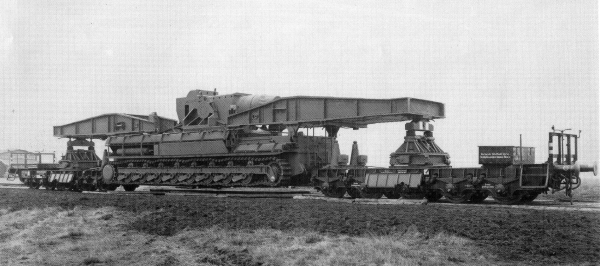
The word Schnabel is from German Tragschnabelwagen, meaning "carrying-beak-wagon", because of the usually tapered shape of the lifting arms, resembling a bird's beak.
In World War II, the German used Schnabel cars for transporting the heavy-calibre (54 cm and 60 cm calibre) siege mortars. These were self-propelled with a continuous-track suspension chassis of substantial length to maneuver into a firing position over a short range, but depended on a pair of purpose-designed Schnabel cars for long-range transport by rail. The same system was also used at the same time for the rail transport of the French FCM 2C super-heavy armoured fighting vehicle.
In the United States, the first Schnabel car, WECX 200, was built for Westinghouse Nuclear by manufacturer Greenville Steel Car in the 1960s.
A 1972 patent application granted in 1974 described a Schnabel car claimed to be simplified and easier to use.
, there are few Schnabel cars in the world because it is a niche mode of transport and because moving huge loads at low speeds affects other railway operations. Heavy-haul and oversize transport companies prefer moving large loads on a hydraulic modular trailer, which works faster and cheaper than the railroad. Heavy loads from Schnabel cars can be shifted to a hydraulic modular trailer along with the arms and bolster, keeping the load intact.
List of selected Schnabel wagons
| Class number | Maximum carrying capacity | Tare weight | Wheelsets | Quantity | |||
|---|---|---|---|---|---|---|---|
| (DB as at 31 Dec 1997) | Length over buffers | Bogie pivot spacing | |||||
| or | |||||||
| wheelset spacing | Length of | ||||||
| low loading bay | |||||||
| Uaai 812 | 159 t | 41,000 kg | 10 | 1 | 19,704 mm | 8,970 mm | N/A |
| Uaai 820 | 157 t | 83,100 kg | 12 | 1 | 31,440 mm | 19,100 mm | 8,500 mm |
| Uaai 821 | 190 t | ||||||
| (180 t | |||||||
| with suspension bars) | 83,800 kg | 12 | 1 | 30,124 mm | 19,100 mm | 8,000 mm | |
| Uaai 823 | 230 t | 102.2 t | 16 | 1 | 37,080 mm | N/A | N/A |
| Uaai 831 | 275 t | ||||||
| (250 t | |||||||
| with suspension bars) | 170,000 kg | 20 | 2 | 45,120 mm | 18,730 mm | ||
| 28,330 mm | N/A | ||||||
| Uaai 836 | 317 t | 82.870 kg | 20 | 1 | 31,800 mm | 15,300 mm | N/A |
| Uaai 837 | 398 t | N/A | 24 | 1 | N/A | N/A | N/A |
| Uaai 838 (313 t | |||||||
| with suspension bars) | N/A | 341 t | |||||
| 24 | 1 | N/A | N/A | N/A | |||
| Uaai 839 | 454 t | N/A | 32 | 1 | N/A | N/A | N/A |
Gallery
File:Tragschnabelwagen mit Transformator (8789).jpg|ÖBB Schnabel car with an electrical transformer near Koblenz in May 2009 File:JRF Shiki810-2.jpg|Two Schnabel cars without loads in Japan File:FRM Shiki160.jpg|Empty Japanese wagon File:Db-Uaai687.9-9960005-10.jpg|Many wheels of a German schnabel wagon File:Db-Uaai687.9-9960005-09.jpg|Arrival of a Schnabel wagon at its destination with a large transformer. The load will now be transported by road on a lowboy. File:Trafotransport.jpg|Onward transportation of the large transformer by road to the electricity substation File:Schnabel car patent US4041879-1.png|US patent image
References
References
- Vantuono, William C.. (June 14, 2012). "Kasgro builds "World's Largest Railroad Car"".
- "WECX 801".
- Tom Daspit, CEBX 800 [http://southern.railfan.net/schnabel/cars/cebx800/cebx800.html read] (Retrieved 2010-01-22).
- Jentz, Thomas. (2001). "Bertha's Big Brother: Karl-Geraet (60 cm & 54 cm)". Panzer Tracts.
- "Schnabel car".
- Streeter, Mercedes. (2025-05-02). "Some Of The Wildest Trains Carry Million-Pound Equipment By Converting Them Into Gigantic Train Cars".
- "Heavy rail transport".
- "Bauart 812".
- (September 8, 2015). "uaai 812. by FutureWGworker on DeviantArt".
- "Bauart 820".
- "Bauart 821".
- "Tiefladewagen mit 16 Radsätzen der Gattung Uaais 823 der NCS (NUCLEAR CARGO + SERVICE GmbH, Hanau), eingestellt als 35 RIV 80 D-NCS 9957 000-6, ... - Hellertal.startbilder.de".
- "Bauart 831".
- "Bauart 836".
- "Tiefladewagen".
- "Bauart 838".
- "uaai-839".
- [https://patents.google.com/patent/US4041879 US4041879A, filed December 1, 1975, issued to Charles R. Cockrell, with Combustion Engineering, Inc. as assignee, now expired.]
This article was imported from Wikipedia and is available under the Creative Commons Attribution-ShareAlike 4.0 License. Content has been adapted to SurfDoc format. Original contributors can be found on the article history page.
Ask Mako anything about Schnabel car — get instant answers, deeper analysis, and related topics.
Research with MakoFree with your Surf account
Create a free account to save articles, ask Mako questions, and organize your research.
Sign up freeThis content may have been generated or modified by AI. CloudSurf Software LLC is not responsible for the accuracy, completeness, or reliability of AI-generated content. Always verify important information from primary sources.
Report