From Surf Wiki (app.surf) — the open knowledge base
Scapegoat
Animal which is ritually burdened
.jpg)
Animal which is ritually burdened
the religious sense
A scapegoat is one of a pair of goats used in the Yom Kippur Temple service during the era of the Temple in Jerusalem. The scapegoat had a band of red wool placed on it, and was then released into the wilderness, taking with it all the sins and impurities of the people as an act of symbolic atonement. The other goat was sacrificed. The ritual is described in the Book of Leviticus of the Torah, and was performed by the High Priest of Israel (of the lineage of Aaron):
Practices with some similarities to the scapegoat ritual also appear in Ancient Greece and Ebla. The scapegoat ritual was performed throughout the Second Temple period, with historians such as Josephus mentioning it. With the destruction of the Second Temple in 70 AD, the scapegoat ritual became impossible to perform according to its original procedure, as there was no more Temple or High Priest.
Origins
Some scholars have argued that the scapegoat ritual can be traced back to Ebla around 2400 BC, whence it spread throughout the ancient Near East.{{multiref2| | |}}{{multiref2| | | }}
Etymology
Main article: Azazel
The Hebrew word he () occurs in Leviticus 16:8. Several translations for it exist, including "scapegoat", although many modern versions leave it untranslated as a proper noun Azazel, or at least footnote "for Azazel" as an alternative reading. The passage reads:
|ונתן אהרן על שני השעירם גרלות גורל אחד ליהוה וגורל אחד לעזאזל |And Aaron shall cast lots upon the two goats: one lot for the Lord, and the other lot for Azazel.
There are four major ways to take the word. The Brown–Driver–Briggs Hebrew Lexicon gives he (לעזאזל) as a reduplicative intensive of the stem he, "remove", hence he, "for entire removal", the purpose of the goat. This reading is supported by the Septuagint (Greek Old Testament) translation as "the sender away (of sins)".
The second way is to take it as a combination of "goat" and "go away", leading to "scapegoat." Early English Christian Bible versions follow the translation of the Septuagint and Latin Vulgate, which interpret he as "the goat that departs" (Greek grc, "goat sent out", Latin caper emissarius, "emissary goat"). William Tyndale rendered the Latin as "(e)scape goat" in his 1530 Bible. This translation was followed by subsequent versions up through the King James Version of the Bible in 1611: "And Aaron shall cast lots upon the two goats; one lot for the Lord, and the other lot for the scapegoat."
The third way to take it is as a name for the place that the goat is sent to. Jewish sources in the Talmud (Yoma 6:4,67b) give the etymology of he as a compound of he, strong or rough, and he, mighty, that the goat was sent to the most rugged or strongest of mountains.
A fourth line of thought is that Azazel is the name of a fallen angel, an angelic force, or a pagan deity. This can be seen in the pseudepigraphical Book of Enoch, which was broadly contemporary with the Septuagint and the Targums.
Relevance? This guy is ancient.--
Ancient Judaism
Main article: Azazel
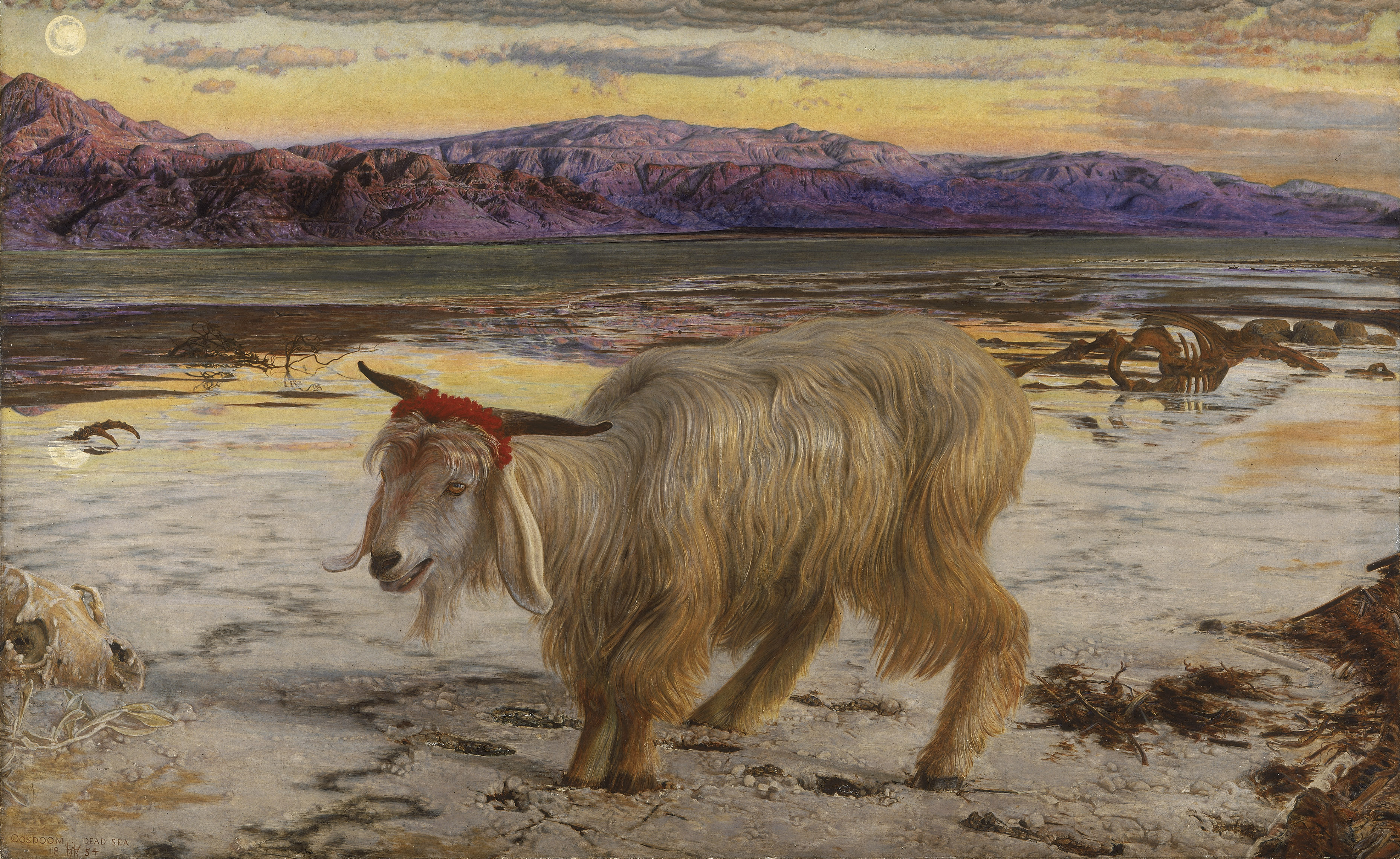
The scapegoat was a goat that was designated () he; "for absolute removal" (for symbolic removal of the people's sins with the literal removal of the goat), and outcast in the desert as part of the Yom Kippur Temple service at the Temple in Jerusalem. The origins are attributed to the Exodus with the original Tabernacle, and continued through the times of the First Temple and Second Temple.
Once a year, on Yom Kippur, the High Priest of Israel sacrificed a bull as a sin offering to atone for sins he may have committed unintentionally throughout the year. Subsequently he took two goats and presented them at the door of the tabernacle. Two goats were chosen by lot: one to be "for YHWH", which was offered as a blood sacrifice, and the other to be the scapegoat to be sent away into the wilderness. The blood of the slain goat was taken into the Holy of Holies behind the sacred veil and sprinkled on the mercy seat, the lid of the ark of the covenant. Later in the ceremonies of the day, the High Priest confessed the sins of the Israelites to God placing them figuratively on the head of the other goat, the scapegoat, who would symbolically "take them away". A band of red wool was placed on the scapegoat's head. While any Jew could lead the scapegoat into the wilderness, in practice, a priest was generally picked for the task. The tractate Yoma of the Mishnah goes into detail about the procedure and its meaning.
At some point in the Second Temple period (538 BC – 70 AD), the procedure changed to explicitly throw the scapegoat off a cliff upon taking it to the wilderness, most likely to prevent the sins from "returning" as an unlucky omen. This doesn't seem to have actually been mandatory, and the High Priest could continue the service as soon as the goat was banished, rather than having to wait for a report of the scapegoat dying.
Christian perspectives
_-_James_Tissot.jpg)
The early Christian non-canonical work the Epistle of Barnabas (70 AD-135 AD) reworks much of the Jewish scriptures to actually be symbolic prophecies of the coming of Christianity, heavily drawing on typology to show that Old Testament "types" are omens of a later fulfillment in Christianity. It depicts the scapegoat ritual as a symbolic foretelling of the fate of Jesus and of Christians, with both the sacrificed goat and the scapegoat of the same "type" of being destined to suffer. It draws a parallel between the red wool band and the crown of thorns, with both Jesus and the scapegoat cursed yet crowned. It indicates to Christian readers that part of following Jesus will be the necessity of suffering.
When this happens, the one who takes the goat leads it into the wilderness and removes the wool, and places it on a blackberry bush, whose buds we are accustomed to eat when we find it in the countryside. (Thus the fruit of the blackberry bush alone is sweet.) And so, what does this mean? since the thorn is a fearful thing, and a person can retrieve the wool only by experiencing pain --
Similar practices
Ancient Syria
A concept superficially similar to the biblical scapegoat is attested in two ritual texts of the 24th century BC archived at Ebla. They were connected with ritual purification on the occasion of the king's wedding. In them, a she-goat with a silver bracelet hung from her neck was driven forth into the wasteland of "Alini"; "we" in the report of the ritual involves the whole community. Such "elimination rites", in which an animal, without confession of sins, is the vehicle of evils (not sins) that are chased from the community are widely attested in the Ancient Near East.
Ancient Greece
Ancient Greeks practiced scapegoating rituals in exceptional times based on the belief that the repudiation of one or two individuals would save the whole community. Scapegoating was practiced with different rituals across ancient Greece for different reasons but was mainly used during extraordinary circumstances such as famine, drought, or plague. The scapegoat would usually be an individual of lower society such as a criminal, slave, or poor person and was referred to as the grc, grc or grc.
There is a dichotomy, however, in the individuals used as scapegoats in mythical tales and the ones used in the actual rituals. In mythical tales, it was stressed that someone of high importance had to be sacrificed if the whole society were to benefit from the aversion of catastrophe (usually a king or the king's children). However, since no king or person of importance would be willing to sacrifice himself or his children, the scapegoat in actual rituals would be someone of lower society who would be given value through special treatment such as fine clothes and dining before the sacrificial ceremony.
Sacrificial ceremonies varied across Greece depending on the festival and type of catastrophe. In Abdera, for example, a poor man was feasted and led around the walls of the city once before being chased out with stones. In Massalia, a poor man was feasted for a year and then cast out of the city in order to stop a plague. The scholia refer to the grc being killed, but many scholars reject this and argue that the earliest evidence (the fragments of the iambic satirist Hipponax) show the grc being only stoned, beaten, and driven from the community.
References
References
- Porter, Miles V. Van Pelt. (2000). "Azazel". William B. Eerdmans Publishing Company.
- p. 736.
- (1991). "The Merriam-Webster New Book of Word Histories". [[Merriam-Webster]].
- "AZAZEL". JewishEncyclopedia.com.
- The JPS guide to Jewish traditions. Page 224. Ronald L. Eisenberg, Jewish Publication Society – 2004. "(Leviticus 16:8–10). In talmudic times, a popular rabbinic interpretation was that Azazel referred to the place to which the goat was sent, the eretz g'zera (inaccessible region) of Leviticus (16:22). Later, Azazel became associated with another..."
- The JPS Torah Commentary: Leviticus Nahum M. Sarna, Chaim Potok, Jewish Publication Society – 1989. "According to the first, Azazel is the name of the place in the wilderness to which the scapegoat was dispatched; ... According to the second line of interpretation, Azazel describes the goat. The word 'aza'zel is a contraction.
- Archie T. Wright ''The Origin of Evil Spirits: The Reception of Genesis 6.1–4'' Page 111. 2005. "However, the corresponding Aramaic fragment of / Enoch 10.4 does not use the name Azazel; instead, the name has been reconstructed by Milik to read Asa'el. Stuckenbruck suggests the presence of the biblical form Azazel in the Ethiopic.
- Wright, David P. "Azazel". Pages 1:536–537 in [[Anchor Bible Dictionary]]. Edited by David Noel Freedman et al. New York: Doubleday, 1992.
- ''The Symbolism of the Azazel Goat''. Ralph D. Levy. 1998. "This is still fairly straightforward, and is translated by the majority of the versions as "for Azazel" (Targums Onkelos and Pseudo-Jonathan follow this understanding, as do the RSV, NRSV, REB, and Tanakh). KJV and NKJV have "to be the scapegoat".
- Gesenius. "I have no doubt that it should be rendered 'averter{{'".
- (1933). "The Mishnah". [[Oxford University Press]].
- "Azazel".
- "Wesley's Explanatory Notes". StudyLight.org.
- Lookadoo, Jonathon. (2022). "The Epistle of Barnabas: A Commentary". Cascade Books.
- (2003). "The Apostolic Fathers volume II". Harvard University Press.
- Zatelli, Ida. (April 1998). "The Origin of the Biblical Scapegoat Ritual: The Evidence of Two Eblaite Text". [[Vetus Testamentum]].
- David P. Wright, ''The Disposal of the Impurity: Elimination Rites in the Bible and in Hittite and Mesopotamian Literature'' (Atlanta: Scholars Press) 1987:15–74.
- Bremmer, Jan. (1983). "Scapegoat Rituals in Ancient Greece". Harvard Studies in Classical Philology.
- Westbrook, Raymond. "Who Led the Scapegoat in Leviticus 16:21?". Journal of Biblical Literature.
This article was imported from Wikipedia and is available under the Creative Commons Attribution-ShareAlike 4.0 License. Content has been adapted to SurfDoc format. Original contributors can be found on the article history page.
Ask Mako anything about Scapegoat — get instant answers, deeper analysis, and related topics.
Research with MakoFree with your Surf account
Create a free account to save articles, ask Mako questions, and organize your research.
Sign up freeThis content may have been generated or modified by AI. CloudSurf Software LLC is not responsible for the accuracy, completeness, or reliability of AI-generated content. Always verify important information from primary sources.
Report