From Surf Wiki (app.surf) — the open knowledge base
Saxony-Anhalt
State in Germany

State in Germany
| Field | Value | |
|---|---|---|
| <!-- See Template:Infobox settlement for additional fields and descriptions --> | official_name | Saxony-Anhalt |
| native_name | de | |
| nds | ||
| settlement_type | State | |
| imagesize | 270px | |
| image_flag | Flag_of_Saxony-Anhalt_(state).svg | |
| flag_size | 120px | |
| image_shield | Wappen Sachsen-Anhalt.svg | |
| shield_size | 75px | |
| anthem | de | |
| "Song for Saxony-Anhalt" | ||
| image_map | Locator map Saxony-Anhalt in Germany.svg | |
| mapsize | 155px | |
| coordinates | ||
| subdivision_type | Country | |
| subdivision_name | Germany | |
| seat_type | Capital | |
| seat | Magdeburg | |
| seat1_type | Largest city | |
| seat1 | Magdeburg | |
| governing_body | Landtag of Saxony-Anhalt | |
| leader_party | CDU | |
| leader_title | Minister-President | |
| leader_name | Sven Schulze | |
| leader_title1 | Governing parties | |
| leader_name1 | / / | |
| leader_title2 | Bundesrat votes | |
| leader_name2 | 4 (of 69) | |
| leader_title3 | Bundestag seats | |
| leader_name3 | 16 (of 630) (as of 2025) | |
| total_type | Total | |
| area_footnotes | ||
| area_total_km2 | 20000 | |
| population_footnotes | ||
| population_total | ||
| population_as_of | ||
| population_density_km2 | auto | |
| demographics_type1 | GDP | |
| demographics1_footnotes | ||
| demographics1_title1 | Total | |
| demographics1_info1 | €79.421 billion (2024) | |
| demographics1_title2 | Per capita | |
| demographics1_info2 | €36,517 (2024) | |
| timezone1 | CET | |
| utc_offset1 | +1 | |
| timezone1_DST | CEST | |
| utc_offset1_DST | +2 | |
| iso_code | DE-ST | |
| blank_name_sec2 | NUTS Region | |
| blank_info_sec2 | DEE | |
| blank2_name_sec2 | HDI (2022) | |
| blank2_info_sec2 | 0.921 | |
| · 16th of 16 | ||
| website | sachsen-anhalt.de |
nds "Song for Saxony-Anhalt" · 16th of 16
Saxony-Anhalt ( ; ; ) is a state of Germany, bordering the states of Brandenburg, Saxony, Thuringia and Lower Saxony. It covers an area of 20000 km2 and has a population of 2.17 million inhabitants, making it the 8th-largest state in Germany by area and the 11th-largest by population. Its capital and most populous city is Magdeburg.
The state of Saxony-Anhalt was formed in July 1945 after World War II, when the Soviet army administration in Allied-occupied Germany formed it from the former Prussian Province of Saxony and the Free State of Anhalt. Saxony-Anhalt became part of the German Democratic Republic in 1949, but was dissolved in 1952 during administrative reforms and its territory was divided into the districts of Halle and Magdeburg. Following German reunification, the state of Saxony-Anhalt was re-established in 1990 and became one of the new states of the Federal Republic of Germany.
Saxony-Anhalt is renowned for its rich cultural heritage and possesses the highest concentration of UNESCO World Heritage sites in Germany.
Geography
Saxony-Anhalt is one of 16 constituent states of Germany. It is located in the western part of eastern Germany. By size, it is the 8th largest state in Germany and by population, it is the 11th largest.
It borders four other states: Brandenburg to the north-east, Saxony to the south-east, Thuringia to the south-west and Lower Saxony to the north-west.
In the north, the Saxony-Anhalt landscape is dominated by the flat expanse of the North German Plain. The old Hanseatic towns Salzwedel, Gardelegen, Stendal and Tangermünde are located in the sparsely populated Altmark. The Colbitz-Letzlingen Heath and the Drömling near Wolfsburg mark the transition between the Altmark region and the Elbe-Börde-Heath region with its fertile, sparsely wooded Magdeburg Börde. Notable towns in the Magdeburg Börde are Haldensleben, Oschersleben (Bode), Wanzleben, Schönebeck (Elbe), Aschersleben and the capital Magdeburg, from which the Börde derives its name.
The Harz mountains are located in the south-west, comprising the Harz National Park, the Harz Foreland and Mansfeld Land. The highest mountain of the Harz (and of Northern Germany) is Brocken, with an elevation of 1,141 meters (3,735 ft). In this area, one can find the towns of Halberstadt, Wernigerode, Thale, Eisleben and Quedlinburg.
The wine-growing area Saale-Unstrut and the towns of Zeitz, Naumburg (Saale), Weißenfels and Freyburg (Unstrut) are located on the rivers Saale and Unstrut in the south of the state.
The metropolitan area of Halle (Saale) forms an agglomeration with Leipzig in Saxony. This area is known for its highly developed chemical industry (the Chemiedreieck – chemical triangle), with major production plants at Leuna, Schkopau (Buna-Werke) and Bitterfeld. Finally, in the east, Dessau-Roßlau and Wittenberg are situated on the Elbe (as is the capital Magdeburg) in the Anhalt-Wittenberg region.
Administrative subdivisions==

_-_geo.hlipp.de_-_28216.jpg)
The capital and largest city of Saxony-Anhalt is Magdeburg. The second-largest city in the state is Halle (Saale). From 1994 to 2003, the state was divided into three regions (Regierungsbezirke), Dessau, Halle and Magdeburg and, below the regional level, 21 districts (Landkreise). Since 2004, however, this system has been replaced by 11 rural districts and three urban districts.

The districts are:
- Altmarkkreis Salzwedel
- Anhalt-Bitterfeld
- Börde
- Burgenlandkreis
- Harz
- Jerichower Land
- Mansfeld-Südharz
- Saalekreis
- Salzlandkreis
- Stendal
- Wittenberg
The independent cities are:
- Dessau-Roßlau
- Halle (Saale)
- Magdeburg
Largest towns
The largest towns in Saxony-Anhalt as of 30 June 2022:
| Rank | City | Population |
|---|---|---|
| 1 | Magdeburg | 241,517 |
| 2 | Halle | 226,586 |
| 3 | Dessau-Roßlau | 75,938 |
| 4 | Lutherstadt Wittenberg | 45,010 |
| 5 | Weißenfels | 38,228 |
| 6 | Halberstadt | 36,676 |
| 7 | Stendal | 37,406 |
| 8 | Bitterfeld-Wolfen | 36,552 |
| 9 | Merseburg | 33,302 |
| 10 | Wernigerode | 32,477 |
File:KST Dom Magdeburg Jann.jpg|Magdeburg - Capital city of Saxony-Anhalt - The Magdeburg Cathedral is the city's landmark. File:2012-03 Halle 02 Marktplatz.jpg|Halle is the second-largest city in Saxony-Anhalt. File:Dessau marktplatz 01.jpg|Dessau market square File:WittenbergMittelstr.JPG|Inside the old town of Wittenberg, a UNESCO World Heritage Site File:Halberstadt Stadt der Kirchen Foto 2005 Wolfgang Pehlemann Wiesbaden Germany PICT0042.jpg|Halberstadt with its churches File:MerseburgDomschloßsaale.JPG|Merseburg with its castle and cathedral File:Agnesberg.JPG|Castle in Wernigerode
History
Main article: History of Saxony-Anhalt

Saxony-Anhalt is a federal state with a relatively short history, compared to other German federal states. It was formed in 1945 out of former Prussian territories and mainly consists of three distinct historical regions: the area around Magdeburg, the formerly independent Anhalt and a southern part which once was part of Saxony but had been annexed by Prussia in the 19th century. This historical origin can still be seen in the coat of arms of the federal state.
In April 1945 the US Army took control of most of the western and northern area of the future Saxony-Anhalt. The U.S. Group Control Council, Germany (a precursor of the OMGUS) appointed the first non-Nazi officials in leading positions in the area. Erhard Hübener, put on leave by the Nazis, was reappointed Landeshauptmann (state governor). By early July the US Army withdrew from the former Prussian Province of Saxony to make way for the Red Army to take it as part of the Soviet occupation zone, as agreed by the London Protocol in 1944.
On 9 July the Soviet SVAG ordered the merger of the Free State of Anhalt, Halle-Merseburg, the governorate of Magdeburg (in its then borders), Allstedt (before Thuringia) and some Brunswickian eastern exclaves and salients (Calvörde and the eastern part of the former Blankenburg district) with the Province of Saxony. The previously Saxon Erfurt governorate had become a part of Thuringia.
Anhalt takes its name from Anhalt Castle near Harzgerode; the origin of the name of the castle remains unknown. Anhalt was once an independent German federal state dating back centuries.
The SVAG appointed Hübener as president of the provincial Saxon administration, a newly created function. The administration was seated in Halle an der Saale, which became the capital, also of later Saxony-Anhalt until 1952. On 3 September 1945 the new administration enacted by Soviet-inspired ordinance the mass expropriations, mostly hitting holders of large real estates, often of noble descent.
On the occasion of the first (and one and only) election in the Soviet zone, allowing parties truly to compete for seats in provincial and state parliaments, on 20 October 1946, the Province of Saxony was renamed as the Province of Saxony-Anhalt (**), taking the prior merger into account. On 3 December 1946 the members of the new provincial parliament elected Hübener the first minister-president of Saxony-Anhalt, with the votes of the CDU and Liberal Democratic Party of Germany (LDPD). Thus he became the only governor in the Soviet zone who was not a member of the communist Socialist Unity Party of Germany (SED), making him an inconvenience for the Soviet forces.
After the official Allied decision to dissolve the Free State of Prussia, which had remained in limbo since the Prussian coup of 1932, its former provinces, in as far as they still existed, achieved statehood; thus the province emerged into the State of Saxony-Anhalt on 6 October 1947. It became part of the German Democratic Republic (East Germany) in 1949. From 1952 on, the East German states were dissolved, and Saxony-Anhalt's territory was divided into the East German districts of Halle and Magdeburg, except that the territory around Torgau was assigned to Leipzig. In 1990, in the course of German reunification, the districts were reintegrated as a state. The territory around Torgau did not return to the state and joined Saxony. Torgau is now the centre of the Nordsachsen district (since 2008).
In 2015 the skeletal remains of an ancient inhabitant of Karsdorf dated from the Early Neolithic (7200 BP) were analysed; he turned out to belong to the paternal T1a-M70 lineage and maternal lineage H1.
Demographics
Since German reunification, there has been a continuous downward trend in the population of Saxony-Anhalt. This is partly due to outward migration and partly because the death rate exceeds the birth rate. Although the birth rate has been steady since 1994, the net reproduction rate is only approximately 70%. However, the total fertility rate reached 1.50 in 2014, the highest value since 1990.
Religion
The region has historically been associated with the Lutheran faith, but under Communist rule, church membership was strongly discouraged and much of the population disassociated itself from any religious body. Saxony-Anhalt contains many sites tied to Martin Luther's life, including Lutherstadt Eisleben and Lutherstadt Wittenberg.
In 2018, the majority of citizens in Saxony-Anhalt were irreligious and more were leaving the churches than entering them – in fact, Saxony-Anhalt is the most irreligious state in Germany. Of the Saxon-Anhaltish, 15.2% adhered to the major denominations of Christianity (11.9% were members of the Protestant Church in Germany and 3.3% were Catholics), 2% were members of other religions (mostly Islam, Judaism, the New Apostolic Church and Mandeism). Of the citizens of Saxony-Anhalt, 82.8% were religiously unaffiliated. As of July 2019 there were 1,892 Jehovah's Witnesses (publishers) in Sachsen-Anhalt. Originally their branch office for Germany was in Magdeburg. When World War II ended in 1945, the property in Magdeburg, then part of East Germany, was returned and the branch was reestablished. But on 30 August 1950 Communist police stormed the facilities and arrested the workers, and the Jehovah's Witnesses in the German Democratic Republic (DDR) were banned.
Foreigners
The percentage of foreigners in Saxony-Anhalt was 4.9 percent by 31 December 2018, the third lowest among the 16 states of Germany (together with Saxony and Thuringia).
The largest foreign resident groups by 31 December 2022 were:
| Nationality | Population (31 December 2022) | Population (31 December 2023) | ||
|---|---|---|---|---|
| Ukraine | ||||
| Syria | ||||
| Poland | ||||
| Romania | ||||
| Afghanistan | ||||
| India | ||||
| Turkey | ||||
| Bulgaria | ||||
| Russia | ||||
| Vietnam |
Politics
Main article: Politics of Saxony-Anhalt
List of minister presidents
Main article: List of minister-presidents of Saxony-Anhalt
Ministry of Finance
Main article: Ministry of Finance (Saxony-Anhalt)
Landtag
Main article: Landtag of Saxony-Anhalt
2021 state election
Minister-president Reiner Haseloff (CDU) retained his position in a coalition with former partner SPD and newly the FDP. Before the election the coalition had consisted of the CDU, SPD and Greens.
Economy
The gross domestic product (GDP) of the state was 62.7 billion euros in 2018, which accounts for 1.9% of Germany's total economic output and ranks 13th among the 16 German states. GDP per capita adjusted for purchasing power was 26,000 euros or 86% of the EU27 average in the same year. The GDP per employee was 88% of the EU average. The GDP per capita was the second lowest of all German states.
By 2020, the GDP of the state dropped to 62.654 billion euros, shortly after reaching an all-time high of 64.115 billion euros in 2019.
Development
Saxony-Anhalt was part of the communist German Democratic Republic. After the breakdown of communism and the German reunification in 1990, the collapse of non-competitive former GDR industries temporarily caused severe economic problems. In 2000, Saxony-Anhalt had the highest unemployment rate of all German states, at 20.2%.
However, the process of economic transformation towards a modern market economy seems to be completed. Massive investments in modern infrastructure have taken place since 1990, and the remaining and newly created businesses are highly competitive. For example, the industry has doubled its share of international revenue from 13 percent in 1995 to 26 percent in 2008. Meanwhile, the unemployment rate has fallen considerably. By 2010 the GDP of Saxony-Anhalt was almost two and a half times higher than it was in 1991.
Even though part of this recovery was brought on by the positive performance of the German economy, Saxony-Anhalt not only followed the national trend, but clearly outperformed other German states. For example, it outperformed three German states in terms of unemployment (10.8%, as of September 2011): the German capital and city-state of Berlin (12.7%), the city-state Free Hanseatic City of Bremen (11.3%) and Mecklenburg-Western Pomerania (11%).
The unemployment began to fall under 10% in 2016, and stood at 7.1% in October 2018.
| Year | 2000 | 2001 | 2002 | 2003 | 2004 | 2005 | 2006 | 2007 | 2008 | 2009 | 2010 | 2011 | 2012 | 2013 | 2014 | 2015 | 2016 | 2017 |
|---|---|---|---|---|---|---|---|---|---|---|---|---|---|---|---|---|---|---|
| Unemployment rate in % | 20.2 | 19.7 | 19.6 | 20.5 | 20.3 | 20.2 | 18.3 | 15.9 | 13.9 | 13.6 | 12.5 | 11.6 | 11.5 | 11.2 | 10.7 | 10.2 | 9.6 | 8.4 |
Structure
- The chemical industry is quite important, with almost 25,500 employees across 214 plants in 2010. One of the biggest chemical producing areas can be found around the city of Bitterfeld-Wolfen. Because of the chemical industry, Saxony-Anhalt attracts more foreign direct investments than any other state in eastern Germany.
- The state is the location of numerous wind farms producing wind-turbine energy.
- Saxony-Anhalt is also famous for its good soil. Hence, the food industry has an important role with almost 19,500 employees across 190 plants in 2010. Some of the best known products are Baumkuchen from Salzwedel and Halloren chocolate globes from Germany's oldest chocolate factory in Halle.
Tourism
Saxony-Anhalt has seven World Heritage Sites, the highest number of all states in Germany. File:Quedlinburg asv2018-10 img03 Castle.jpg|Collegiate church, castle, and the old town of Quedlinburg File:Wittenberg,Luthers Hochzeit.jpg|Luther memorials in Wittenberg File:Lutherstadt Eisleben Markt.jpg|Luther memorials in Eisleben File:Dessau Bauhaus-Gebäude asv2024-06 img1.jpg|Bauhaus Dessau File:WörlitzAmaliengrotte.JPG|Dessau-Wörlitz Garden Realm File:Naumburger Dom 3.jpg|Naumburg Cathedral
Transport
The region's international commercial airport is Leipzig/Halle Airport which provides flights to other parts of Germany and other European destinations. The airport also serves as the main European hub for cargo flights operated by DHL Aviation and the main hub for AeroLogic.
Education
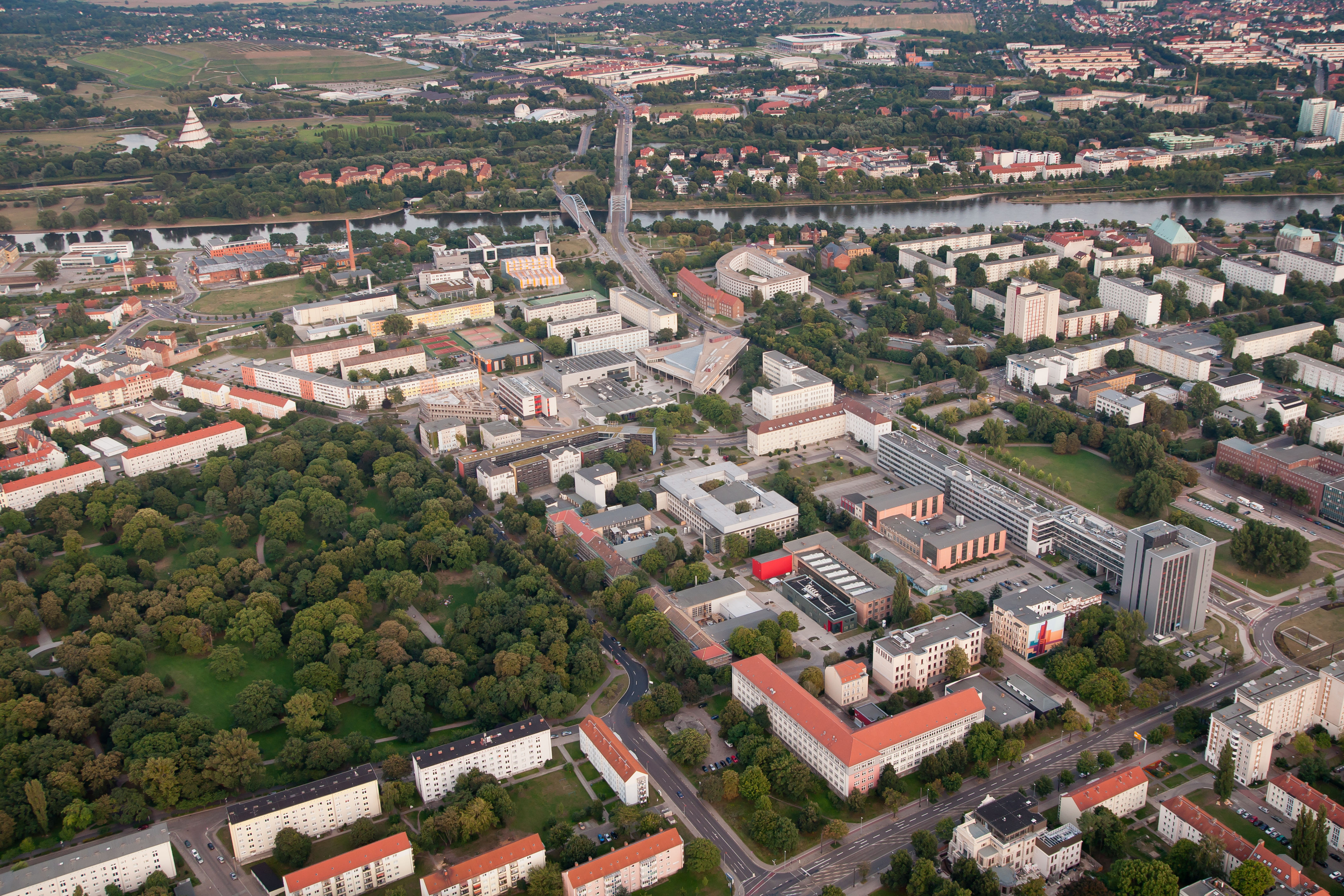
Saxony-Anhalt has several universities, including:
- Anhalt University of Applied Sciences
- Harz University of Applied Studies
- Magdeburg-Stendal University of Applied Sciences
- Martin Luther University of Halle-Wittenberg
- Merseburg University of Applied Sciences
- Otto von Guericke University Magdeburg
Anthem
- "Lied für Sachsen-Anhalt" ("Song for Saxony-Anhalt")
- Motto: "Land of the Early Risers"
References
References
- "Fläche und Bevölkerung".
- https://www.gtai.de/en/invest/business-location-germany/federal-states/saxony-anhalt
- (2025). "Gross domestic product, gross value added in the states of the Federal Republic of Germany 1991 to 2024 (Series 1 Volume 1)".
- "Subnational HDI".
- {{cite Collins Dictionary. Saxony-Anhalt
- {{Merriam-Webster. Saxony-Anhalt
- "Tabellen Bodenfläche". [[Statistisches Landesamt Sachsen-Anhalt]].
- {{Population Germany
- (2023-12-12). "Fortschreibung des Bevölkerungsstandes auf Basis des Zensus 2022". Federal Office for statistics.
- [http://st.juris.de/st/LKreisGebNRG_ST_rahmen.htm District reform law] {{webarchive. link. (19 July 2011 11 November 2005 {{in lang). de
- The latter, however, a salient originally not assigned as part of the Soviet zone, was unilaterally handed over by the Britons only on 22 July.
- [http://www.gedenkkultur-dessau-rosslau.de/1945-1949/chronik1 "1945–1949"] {{Webarchive. link. (12 March 2012 , on: [http://www.gedenkkultur-dessau-rosslau.de ''Gedenkkultur Dessau-Roßlau''] {{webarchive). link. (26 August 2011 . Retrieved on 16 August 2011.)
- Marres, E.C.W.L. (Boed). "Our Far Forebears".
- (2015). "Massive migration from the steppe was a source for Indo-European languages in Europe". Nature.
- Statistisches Landesamt Sachsen-Anhalt. "Bevölkerungsentwicklung seit 1966". statistik.sachsen-anhalt.de.
- "Germany: States and Major Cities".
- [http://www.sachsen-anhalt-wahl.de/das-land-sachsen-anhalt/religion-in-sachsen-anhalt.htm#more-15] {{webarchive. link. (17 March 2012)
- [https://www.ekd.de/ekd_de/ds_doc/Ber_Kirchenmitglieder_2018.pdf Evangelische Kirche in Deutschland – Kirchemitgliederzahlen Stand 31. Dezember 2018] {{Webarchive. link. (19 February 2020 EKD, January 2020)
- (2019-07-17). "Ausländische Bevölkerung".
- (2020-04-08). "1/3 der Ausländerinnen und Ausländer im Rahmen der EU-Freizügigkeit in Sachsen-Anhalt".
- "Regional GDP per capita ranged from 30% to 263% of the EU average in 2018".
- "Germany GDP: Sachsen Anhalt {{!}} Economic Indicators {{!}} CEIC".
- Statistisches Landesamt Sachsen-Anhalt. (29 January 2014). "Statistical Office of the State of Saxony-Anhalt (2010)". Statistik.sachsen-anhalt.de.
- [http://www.halle.ihk.de/webKreator/upload/temp_dokumente/1034285159/Regionalstatistik%202010.pdf Chamber of Commerce and Industry of Halle-Dessau (2010), p. 14]{{dead link. (August 2014)
- "Chamber of Commerce and Industry of Berlin (2011), p. 2".
- "(2010)". fDi Atlas.
- (2011). "Chamber of Commerce and Industry of Berlin".
- "Arbeitslosenquote nach Bundesländern in Deutschland 2018 {{!}} Statista".
- (Destatis), Statistisches Bundesamt. (13 November 2018). "Federal Statistical Office Germany – GENESIS-Online".
- [http://www.fdiatlas.com/area/Europe/Germany/region/Saxony-Anhalt/sectorstrengths fDi Atlas] {{Webarchive. link. (4 April 2012 (2010))
- "Denkmäler in der UNESCO Liste des Welterbes in Deutschland nach Bundesland 2019".
This article was imported from Wikipedia and is available under the Creative Commons Attribution-ShareAlike 4.0 License. Content has been adapted to SurfDoc format. Original contributors can be found on the article history page.
Ask Mako anything about Saxony-Anhalt — get instant answers, deeper analysis, and related topics.
Research with MakoFree with your Surf account
Create a free account to save articles, ask Mako questions, and organize your research.
Sign up freeThis content may have been generated or modified by AI. CloudSurf Software LLC is not responsible for the accuracy, completeness, or reliability of AI-generated content. Always verify important information from primary sources.
Report