From Surf Wiki (app.surf) — the open knowledge base
Savona, British Columbia

| Field | Value |
|---|---|
| official_name | Savona |
| settlement_type | Community |
| pushpin_map | Canada British Columbia |
| pushpin_label_position | none |
| pushpin_map_caption | Location of Savona in British Columbia |
| subdivision_type | Country |
| subdivision_name | Canada |
| subdivision_type1 | Province |
| subdivision_name1 | British Columbia |
| subdivision_type2 | Region |
| subdivision_name2 | Thompson Country |
| subdivision_type3 | Regional district |
| subdivision_name3 | Thompson-Nicola |
| leader_title | |
| established_title | |
| area_total_km2 | 3.89 |
| area_land_km2 | |
| population_as_of | 2021 |
| population_total | 519 |
| population_density_km2 | auto |
| timezone | PST |
| utc_offset | -8 |
| coordinates | |
| elevation_footnotes | |
| elevation_m | 343 |
| postal_code_type | Postal code |
| postal_code | V0K 2J0 |
| area_codes | 250, 778, 236, & 672 |
| blank_name | Highways |
| blank_info |
Savona ( ) is an unincorporated community in the Thompson Country region of south central British Columbia. The place is on the western end and south shore of Kamloops Lake, adjacent to the outlet into the Thompson River. On BC Highway 1, the locality is by road about 38 km east of Cache Creek and 45 km west of Kamloops. The surrounding countryside is semi-arid grasslands and hills, which support cattle ranching.
First Nations
For thousands of years, First Nations used trails and waterways to travel between hunting, fishing and trading areas. Prior to the 1860s, French was probably more common in parts of the interior than English. Consequently, Boute du Lac (meaning foot of the lake) Indians was the name initially assigned to this indigenous group. Since the Hudson's Bay Brigade Trail crossed the Thompson at Kamloops, these people would have experienced limited exposure to the French-speaking fur trade era.
During the 1860s, the Savona Ferry Indians became the new name and the people gravitated to the Deadman Valley to build a small church and few houses. Having previously wintered in the valley and at the lake outlet, the establishment of the reserve in the late 1860s, revised the name to the Deadman Creek Band. In 1985, the traditional name of Skeetchestn Band was reinstated. Archaeological sites are scattered throughout the area. The main reserve is northwest of Savona on the Deadman River.
Ferries and bridges
About 1858, during the Fraser Canyon Gold Rush, François Saveneux established a ferry across the fast current of the Thompson. The small ferry could likely carry two packhorses accompanied by riders. Herded cattle would swim across. Place names quickly anglicized, resulting in the Savona spelling. Lieutenant Mayne's 1859 sketch of the Fraser Canyon identifies but does not name the ferry. The family lived on the south shore and François died in 1862. His widow continued the ferry, which Ned Roberts took over in the mid-1860s, residing on the north shore. James Uren was the operator when the government assumed control in 1870. He built a large scow to carry a four-horse rig.
The 1875 flood snapped the rope, which was replaced by a steel cable in 1876. High water set the ferry adrift in 1878. The next year, when the cable broke, two occupants were saved, but one drowned. The 630 ft long bridge, with a 140 ft Howe truss main span, opened in 1884. This swing bridge experienced severe flood damage in 1888 and complete destruction in 1894. When reinstated in 1895, the ferry remained free, but a charge was levied for after hours service. In the late 1890s, hordes travelling to the Klondike Gold Rush created a busy period.
In 1903, high water sent the ferry to destruction downstream. Almost a year later, a replacement was installed.
In 1906, the second bridge opened 500 yd east of the 1884 site. Three small spans flanked three 164 ft ones. After being largely swept away in 1908, the third bridge was quickly built upon the existing piers. In 1929, a two-lane 700 ft steel bridge, about 400 m downstream, replaced the wooden bridge. The next year, the former bridge was dynamited.
Widening of the 1929 bridge to 24 ft began in 1957 and was completed the following year.
In 1972, a pickup truck and trailer jackknifed on the bridge. After colliding with a semi-trailer on the bridge in 1979, an RV plunged about 100 ft, killing the two occupants. In 1982, a semi-trailer crashed through a guardrail on the bridge and fell to the riverbed, killing the driver.
In 1991, a two-lane concrete bridge replaced the one-lane Bailey bridge over the railway track at the Savona East access. In 1993, Cortez Construction adopted the "Highline" method to install the girders for the river bridge replacement.
Roads and steamers
The Big Bend Gold Rush of 1865 prompted the construction of the wagon road from Cache Creek to Savona. Gustavus Blin Wright built the 23 mi, 18 ft wide road, which opened in April 1866. A stage coach service began immediately. That month, ten mules hauled the boiler for the SS Marten over this route. The boat hull had been built at Shuswap Lake and floated down to Savona for installation of the machinery. Launched in May 1866, this first steamboat on Kamloops Lake provided a link to Seymour on Shuswap Lake, from where prospectors proceeded to the Big Bend.
In 1869, the wagon road from Savona to Kamloops was completed.
In 1872, the Canadian Pacific Railway (CP) built the small steamer SS Kamloops to carry supplies for surveyors from Savona. Mara and Wilson, Kamloops merchants, bought the Marten from the Hudson's Bay Company (HBC) in 1875. The next year, the vessel smashed into the HBC warehouse, demolishing the east wing. In 1877, the Marten was wrecked.
After the railway opened, a steamer service from Kamloops still operated for over a decade.
By 1915, a good road existed south to Lower Nicola.
In 1931, a new piece of road known as the eight-mile hill, about halfway between Cherry Creek and Savona, opened to traffic.
In 1953, the 7 mi realignment from the highway bridge to the viewpoint, which included the Savona bypass, opened.
Largely paved by 1937, the road westward was replaced by a more elevated highway in the 1960s.
Prior to Greyhound Canada ceasing all interprovincial routes in 2018, an application the prior year included a service reduction via Savona. Ebus provides a three times weekly bus service.
Earlier north shore community

The settlement grew adjacent to the HBC post. In 1867, the post office opened. Named Savona's Ferry, the place was a postage zone boundary. When the Colony of British Columbia changed from sterling to decimal currency in 1867, the postage rate to this boundary was 12.5 cents and beyond was 25 cents. The post office was closed 1870–1881.
In 1870, James Uren purchased the W.H. Kay stopping house, which he refurbished and later extended. In the early 1870s, James Sabiston operated a store. Uren managed the HBC warehouse 1873–1878, which held freight awaiting lake transport to Kamloops. About 1882, he renamed the lodgings as Savona House. John Jane's general store, which opened in 1881, soon faced competition from the various stores across the lake which sprang up to serve the CP construction crews. Around this time, Abraham Thomas opened a saloon, which became known as the Central Hotel. In fall 1883, James A. Newland and Adam B. Ferguson opened a hotel called Lakeview House, which thrived during the CP construction period. The location of the cemetery on the north shore suggests its existence by this time.
In 1886, Barnard's Express relocated headquarters to Ashcroft, James Uren died in England, Ferguson bought out his hotel partner, and many of the residences lay abandoned. Ferguson closed the hotel in 1891, and one account claims the building was hauled across the frozen lake, possibly to be used as a family residence. That year, John Jane closed his store. By then, the north shore settlement was largely deserted. Thomas may have continued his hotel as late as 1904.
Earlier south shore community
No buildings existed in 1882 at what became the CP townsite in 1884. H.F. Keefer's general store, a little log structure at a site which for several years was known as Keefers Point, was the first business. Many more followed but soon disappeared once the railway construction moved on. When the jail was built, John Kirkup became the initial jailer and constable.
The Savona brewery, which opened in 1885, burned down in 1889. Laid out in 1885, the townsite never rose to significance but remained a small hamlet.
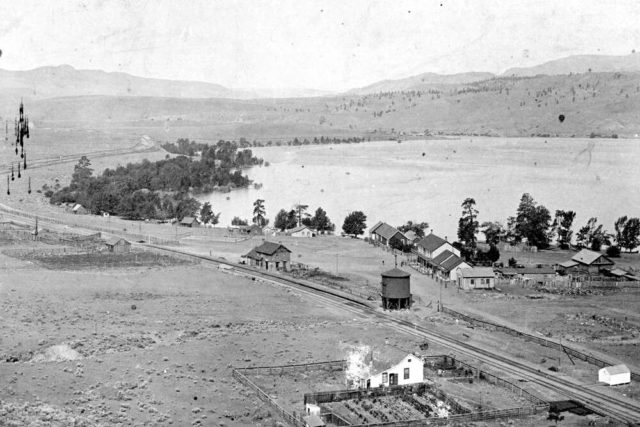
In 1886, Mat Finlay took over management of the Van-Horne Hotel from Mr. Crotty. In 1891, Ferguson acquired the Finlay hotel, which he renamed Lakeview House, and John Jane opened his large new store. Successive storekeepers ensured the ongoing presence of a general store in the community. An attempt to start a school around 1889 appears to have failed, probably due to insufficient students. In 1894–95, the first school opened in a former brewery residence that was dragged uptown. The first proper schoolhouse was erected in 1900.
In 1904, a community hall opened. In 1909, brothers Jack and Jake Christian bought the hotel.
Prior to 1910, the names Savona's Ferry, Van Horne, Savonas, and Savona, were used interchangeably until settling upon the latter. Although a provincial constable was resident at that time, it is unclear whether the presence had been intermittent since the 1880s.
In 1911, Savona became a Canadian Northern Railway (CNoR) construction base, which temporarily boosted the population. That year, the new 70 by community hall opened.
In 1913, a tender was published for a new jail/courtroom/constable's quarters. Around 1915, St Hilda's Anglican church was built. A resident constable remained until the mid-1920s. In 1924, fire destroyed the hotel.
Advertised for sale In 1930, the 1913 jail complex was sold and converted in 1932 to a private residence. In 1937, a new one-room school replaced the old one. In the later 1930s, Savona Lodge and Savona Hotel were established.
In 1953, St Hilda's Anglican Church was moved across the CP tracks to a more central location. About 1954, BC Hydro transmission lines introduced electricity to the area. That summer, Dey's new store and café opened on the new bypass, replacing the building destroyed by fire months earlier.
In 1959, a voluntary fire department was established. In 1963, the new firehall opened and the department received a new pumper truck.
By the 1960s, the CP water tank was no longer used by trains but remained for several more years to supply Savona prior to the installation of its own water system. The new parish house of St Hilda's church was dedicated in 1965.
BC Tel extended the toll-free calling areas in 1982 and 1990. In 1998, the remaining customers on party lines switched to direct dialing.
Railways
Canadian Pacific
CP chose the name Port Van Horne (after William Cornelius Van Horne, CP general manager) for the proposed railway siding, steamboat landing, warehouses, and community. In December 1884, the eastward advance of the CP rail head from Port Moody halted about one mile east.
CP assigned little prominence to the new name, preferring to use some variation of Savona. Assumedly, a spur connected to the landing, from where supplies were forwarded farther up the lake. Restarted in the summer, the tracklaying reached Kamloops in July 1885.

Andrew Onderdonk was awarded the government contracts for Emory Bar–Savona in 1880 and Port Moody–Emory Bar in 1882 and the CP contract for Savona–Craigellachie in 1884 (although the location of the latter would depend upon where the two advancing rail heads met).
Built in 1884, the station and agent's residence were unimpressive and have been mistakenly identified as the standard-design (Bohi's Type 5) single-storey station building with gable roof and dormers (identical to Keefers). The replacement in the late 1890s was the standard-design Plan H-I-20-6 (Bohi's Type 1) split level station building, which was destroyed in 1969 or 1972. (The latter was similar to Gleichen station).
In 1898, a train struck a man, who sustained fatal injuries.
By 1900, the station was a significant shipping point for livestock.
In 1908, a man died on falling from a train about 7 mi east.
In 1910, a brakeman, who was jolted from the top of a car, when the emergency brakes inexplicably engaged, received severe lacerations to the head and was knocked unconscious. A court awarded $3,000 in damages. Later that year, a freight train ran over a man, causing fatal injuries.

In 1911, a locomotive and several passenger cars derailed about 4 mi east. That year, CP erected a new freight shed.
In 1912, a locomotive struck a landslide and plunged 200 ft down an embankment. Two men died, several cars were derailed, and significant track was destroyed.
In 1913, a passenger alighting from a moving train slipped on the icy platform and fell under the cars, where he sustained fatal injuries. A week later a westbound passenger train struck and killed an individual.
In 1939, when the westbound royal train made a water stop, King George VI and Queen Elizabeth came out onto the rear observation platform of their car and the crowd sang God Save the King, accompanied by a single violin.
In 1957, a locomotive and boxcar derailed.
In 1969, 25 units of a westbound freight train derailed about 1 mi west.
In the 1970s, a westbound freight train derailed just to the west. On rolling down an embankment into the river, boxcars spilled their contents. Not realizing that the passing flotsam included colour TV sets, some men fishing downstream mistakenly assumed it was all garbage. A submerged TV later recovered by the official salvager worked perfectly.
In 1980, a train ran over and killed an inebriated woman sleeping on the track.
In 1981, a man walking along the track sustained fatal injuries when struck by a train.
In 1987, a train killed a man sitting on the track.
In 1995, a major train wreck occurred.
In 1998, five cars of an eastbound train derailed, severing the tracks.
In 2008, a car loaded with potash toppled over onto its side.
The CP Savona passing track is 7725 ft.
| CP Train Timetables (Regular stop or Flag stop) | Mile | 1887 | 1891 | 1898 | 1905 | 1909 | 1912 | 1916 | 1919 | 1929 | 1932 | 1935 | 1939 | 1943 | 1948 | 1954 | 1960 | 1964 | 1965 | 1966 | ||||
|---|---|---|---|---|---|---|---|---|---|---|---|---|---|---|---|---|---|---|---|---|---|---|---|---|
| url=https://open.library.ubc.ca/viewer/chungtext/1.0362163#p5z-3r0f:%22Kamloops%22 | page=6 (TT 70) | title=Timetable | date=28 Apr 1935 | website=library.ubc.ca}} | ||||||||||||||||||||
| Ashcroft | 47.3 | Regular | Regular | Regular | Regular | Regular | Regular | Regular | Regular | Regular | Regular | Regular | Regular | Regular | Regular | Both | Regular | Regular | Both | Flag | ||||
| Semlin | 37.3 | Flag | Flag | Flag | Flag | Flag | Flag | Flag | Flag | |||||||||||||||
| Pennys | 32.0 | Regular | Regular | Flag | Flag | Flag | ||||||||||||||||||
| Walhachin | 32.0 | Both | Both | Both | Both | Regular | Regular | Regular | Regular | Regular | Regular | Both | Both | |||||||||||
| Savonas | 25.2 | Regular | Regular | Regular | Regular | Regular | ||||||||||||||||||
| Savona | 25.2 | Both | Both | Both | Both | Both | Both | Both | Both | Both | Both | Regular | Regular | Flag | ||||||||||
| Munro | 19.7 | Flag | Flag | Flag | Flag | Flag | ||||||||||||||||||
| CherryCreek | 14.6 | Regular | Flag | Regular | Flag | Flag | Flag | Flag | Flag | Flag | Flag | Flag | Flag | Flag | Flag | Flag | ||||||||
| Tranquille | 8.6 | Flag | Flag | Flag | Flag | Flag | Flag | Flag | Flag | Flag | Flag | Flag | Flag | Flag | Flag | |||||||||
| Kamloops | 0.0 | Regular | Regular | Regular | Regular | Regular | Regular | Regular | Regular | Regular | Regular | Regular | Regular | Regular | Regular | Both | Regular | Regular | Regular | Regular |
Canadian National
During the early 1910s, a CNoR hospital existed at Savona.
In April 1914, about 150 members of the IWW marched to confront construction strike-breakers on the north shore at Savona, where a large contingent of armed provincial police and special constables was stationed. A locomotive enlisted to clear the strikers, bumped a leader causing head injuries, a broken leg, and a few broken ribs. In the confusion, 48 strikers were arrested. Convicted of vagrancy, they received one to three months in jail.
In December 1914, the westward advance of the CNoR rail head from Kamloops passed through Savona.
The Canadian National Railway (CN) passing track at Savona on the predominantly single-track subdivision was 2997 ft in 1916, progressively extending to the current 13350 ft.
Like the CP water tower, the CN tank held 40000 USgal.
In 1928, three members of a section gang were buried alive under a rockslide at a nearby tunnel entrance.
In 1931, Smith Curtis sustained some broken bones on being struck by a freight train.
The 1948 flood undermined a pier of the CN Deadman River bridge. When the pier toppled, two 90 ft steel spans crashed into the river. The reopening was a year later.
In 1971, a train struck a teenager on the CN Savona Bridge, causing extensive injuries.
In 1980, a train struck an inebriated man lying beside the track, causing multiple fractures of the knee.
In 1983, a freighthopper, who fell from a boxcar, met with nine days in jail.
The CN train station was razed in 1980.
| CN and Official Guide Train Timetables (Regular stop or Flag stop) | Mile | 1916 | 1923 | 1927 | 1933 | 1936 | 1938 | 1943 | 1947 | 1950 | 1956 | 1960 | ||||
|---|---|---|---|---|---|---|---|---|---|---|---|---|---|---|---|---|
| url=http://streamlinermemories.info/CAN/CN56-9TT.pdf#page=54 | page=54 (TT136) | title=Timetable | date=30 Sep 1956 | website=streamlinermemories.info}} | ||||||||||||
| Ashcroft | 2715.8 | Regular | Regular | Regular | Regular | Both | Flag | Both | Both | Both | Both | Flag | ||||
| McAbee | 2707.9 | Regular | Regular | Regular | Flag | Flag | Flag | Flag | ||||||||
| Anglesey | 2703.0 | Regular | Regular | Regular | Flag | Flag | Flag | Flag | ||||||||
| Walhachin | 2699.5 | Regular | Regular | Regular | Flag | Flag | Flag | Flag | ||||||||
| Savona | 2692.6 | Regular | Regular | Flag | Flag | Flag | Flag | |||||||||
| CopperCreek | 2687.7 | Regular | Regular | Regular | Flag | Flag | Flag | Flag | ||||||||
| Frederick | 2680.7 | Regular | Regular | Flag | Flag | Flag | Flag | |||||||||
| Tranquille | 2674.8 | Regular | Regular | Regular | Regular | Both | Both | Both | Both | Both | Both | Regular | ||||
| Halston | 2667.9 | Regular | Regular | Flag | Flag | Flag | Flag |
Forestry
Established in 1906, the Savona Land and Lumber Company opened the Monarch Lumber Co mill in 1907, which had an electric generation plant. The average daily cut was 35000 ft in 1908, increasing to 70000 ft in 1909. About 30 employees lived in the company boarding house. A 1911 fire at the mill destroyed a shed and contents and about 500000 ft of finished lumber in the yard.
In spring 1912, the Canada United Lumber Co was incorporated to take over various lumber interests, including the Savona mill. About this time, fire destroyed the mill. Rebuilding was completed in the fall. Sold to Annis Lumber in 1914, the sawmill closed in 1918.
Savona Timber opened a new mill around 1947 and merged with Ashcroft Lumber around 1964.
A log, which rolled from a truck being unloaded in 1968, killed a man. That year, Evans Products acquired the business, which comprised a sawmill, plywood plant, planer mill and chipping facilities.
A 1976 fire gutted the Savona Timber offices. In 1978, a mill worker was electrocuted.
Reduced demand caused temporary lay offs and shorter work weeks in 1980, 1981, and 1983.
By 1990, Ainsworth Lumber had purchased the operations. During 1997 and 1998, Ainsworth upgraded the plywood facility.
Temporary lay offs and reduced hours returned in 2000, 2001, and 2008.
A 2009 fire caused no major structural damage to the mill. Months later, Ainsworth Lumber permanently ceased operations.
In 2010, Aspen Planers purchased the property. Trading as Savona Specialty Plywood, production resumed the next year.
Natural gas transmission
During 1957, Westcoast Transmission installed a 600 ft natural gas pipeline across the Thompson, immediately southwest of the current highway bridge.
Savona is Compressor station No. 7.
As one of the compressor stations in western Canada with a waste heat recovery system, Savona has a 5 MW zero-emission facility operated by Enbridge.
In 2020, a new gas cooler was added to the plant.
Notable people
- Smith Curtis (1855–1949), lawyer and politician, resident.
- Michelle Good (1956– ), author, resident.
- Jean-Marie Le Jeune (1855–1930), missionary, resident.
Savona |1951|125 |1956|306 |1961|532 |1966|508 |1971|670 |1976|609 |1981| |1986|358 |1991|541 |1996| |2001| |2006| |2011*|519 |2016|538 |2021|519
- Revised figure
Later community
Seasonal or permanent residences have replaced the old lakeshore motels, campgrounds and auto courts that dotted the waterfront. Several commercial enterprises provide employment opportunities.
In 2005, a new 1410 ft2 wood frame public library was erected. The next year, the heritage centre opened inside the former library building.
The water supply system, which serves about 300 customers, was largely constructed in 1977 and upgraded in 1996, 2010, and 2018. A municipal sewer system does not exist. In 2006, the regional district took over the system from the local improvement district.
In 2009, curbside garbage collection was implemented. In 2011, broadband internet was introduced.
In 2012, controversy surrounded the dismissal of the entire team of volunteer medical emergency responders by the fire chief.
In 2013, sewage again overflowed at a trailer park, which highlighted neighbourhood concerns regarding noisy summer parties and a rezoning which permitted 12 RV units. The property has been used intermittently as a campground since the 1960s.
In 2015, a new boat launch opened.
Savona infrastructure includes a post office, library, volunteer fire department, Anglican church, grocery store, two gas stations, and the Lakeside Country Inn.
Savona Elementary is part of School District 73 Kamloops/Thompson.
Leisure
.jpg)
The Savona Balancing Rock rests upon a clay hoodoo. The Kamloops Lake Viewpoint has picnic tables and pit toilets. The Savona Caves are found on Savona Mountain. The Savona Lakeshore Park lies within the hamlet.
Painted Bluffs Provincial Park, known for multi-coloured rockfaces, is east of Copper Creek.
Campgrounds exist at Steelhead Provincial Park immediately west, Juniper Beach Provincial Park farther west, and Tunkwa Provincial Park to the south.
Filming location
Scenes from the following were shot in the Savona area:
- An Unfinished Life (2005).
- The Andromeda Strain (miniseries) (2008).
- 2012 (2009).
- Hard Ride to Hell (Video 2010).
- Juggernaut (2017).
Footnotes
References
References
- {{BCGNIS. 17180. Savona (community)
- (6 Jun 1970). "Kamloops Daily Sentinel".
- Gregory, David. (2006). "Okanagan Historical Society: Is Priest Camp Really St. Joseph's Station?".
- {{BCGNIS. 65774. Skeetchestn (Indian Reserve)
- (4 Jan 1978). "Kamloops News".
- "Commissioner of Land and Works annual report, 1883".
- "Commissioner of Land and Works annual report, 1884".
- (26 Aug 1886). "Inland Sentinel".
- "Commissioner of Land and Works annual report, 1894".
- (2 Aug 1895). "Inland Sentinel".
- (20 May 1898). "Inland Sentinel".
- (9 Jun 1903). "Inland Sentinel".
- (26 Apr 1904). "Inland Sentinel".
- (13 Aug 1908). "Nicola Herald".
- (26 Jul 1929). "Kamloops Sentinel".
- (21 Mar 1930). "Kamloops Sentinel".
- (5 Dec 1957). "Kamloops Daily Sentinel".
- (28 Feb 1958). "Kamloops Daily Sentinel".
- (17 Jun 1972). "Kamloops Daily Sentinel".
- (2 Jan 1980). "Kamloops News".
- (5 Nov 1982). "Kamloops News".
- (28 Aug 1991). "Kamloops This Week".
- (2 Dec 1992). "Kamloops This Week".
- Kunlcz, Rae-Anne. (1993). "British Columbia Road Runner: Highline Spans Savona".
- (17 Jan 1962). "Kamloops Daily Sentinel".
- (11 Oct 1969). "Kamloops Daily Sentinel".
- (28 Apr 1976). "Kamloops News".
- (20 May 1886). "Inland Sentinel".
- (11 Mar 1981). "Merritt Herald".
- (14 Aug 1931). "Merritt Herald".
- (5 Oct 1953). "Kamloops Sentinel".
- "Application Summary".
- "Kamloops To Prince George".
- Deaville, Alfred Stanley. (1928). "The colonial postal systems and postage stamps of Vancouver Island and British Columbia 1849–1871".
- (1926). "BC Historical Association Report and Proceedings".
- (1874). "First Victoria directory, fifth issue, and British Columbia guide".
- (30 May 1930). "Merritt Herald".
- (23 Dec 1886). "Inland Sentinel".
- (19 Sep 1891). "Inland Sentinel".
- (29 Nov 1910). "Kamloops Standard".
- (15 Jan 1962). "Kamloops Daily Sentinel".
- (28 May 1885). "Inland Sentinel".
- Braches, Fred. (2002). "BC Historical News: Celebrating Education: "A Miserable, Cold, and Draughty School"".
- "Public Schools annual report, 1894–95".
- (19 Jan 1962). "Kamloops Daily Sentinel".
- (15 Apr 1904). "Inland Sentinel".
- (27 Dec 1910). "Kamloops Standard".
- (21 Jul 1911). "Kamloops Standard".
- (6 Oct 1911). "Merritt Herald".
- (22 Apr 1913). "Kamloops Standard".
- "St. Hilda's Parish (Savona, B.C.)".
- (27 Jul 1923). "Kamloops Standard-Sentinel".
- (28 Mar 1930). "Kamloops Sentinel".
- (7 Jul 2009). "Kamloops Daily News".
- (21 Jul 1936). "Kamloops Sentinel".
- (14 Jun 1938). "Kamloops Sentinel".
- (28 Oct 1953). "Kamloops Sentinel".
- (16 Nov 1953). "Kamloops Sentinel".
- (6 Aug 1954). "Kamloops Sentinel".
- (24 Apr 1959). "Kamloops Daily Sentinel".
- (10 Jun 1963). "Kamloops Daily Sentinel".
- (27 Nov 1965). "Kamloops Daily Sentinel".
- (25 Jun 1982). "Kamloops News".
- (15 Nov 1989). "Kamloops This Week".
- (12 Mar 1998). "Kamloops Daily News".
- (5 Aug 1884). "Daily Colonist".
- (24 Dec 1884). "Daily British Columbian".
- (23 Apr 1885). "Inland Sentinel".
- (18 Dec 1884). "Daily Colonist".
- (14 Jul 1885). "Daily Colonist".
- Johnson, Arthur J.. (1936). "The Canadian Pacific railway and British Columbia, 1871–1886".
- (1993). "Canadian Pacific's Western Depots". South Platte Press.
- "Hamlet of Gleichen".
- (28 Sep 1898). "Revelstoke Herald".
- (18 Sep 1902). "Kamloops Standard".
- (22 Jan 1909). "Inland Sentinel".
- (3 Feb 1910). "Orchard City Record".
- (24 Feb 1911). "Nicola Valley News".
- (23 Sep 1910). "Merritt Herald".
- (27 Jan 1911). "Kamloops Standard".
- (9 Jun 1911). "Merritt Herald".
- (13 Apr 1912). "Daily News".
- (20 Jan 1913). "Inland Sentinel".
- (28 Jan 1913). "Inland Sentinel".
- (9 Jun 1939). "Merritt Herald".
- (12 Feb 1957). "Kamloops Daily Sentinel".
- (3 Feb 1969). "Kamloops Daily Sentinel".
- (1 Aug 1984). "Merritt Herald".
- "Death Certificate (Arlene THOMPSON)".
- "Death Certificate (Raymond GUIMONT)".
- "Death Certificate (Carmen Dwayne JULES)".
- (23 Aug 1995). "Kamloops This Week".
- (8 Jul 1998). "Kamloops This Week".
- (16 Jul 2008). "Kamloops Daily News".
- "CP Thompson Subdivision".
- (28 Apr 1935). "Timetable".
- (May 1887). "Timetable".
- (15 Jun 1891). "Timetable".
- (18 Mar 1898). "Timetable".
- (8 Oct 1905). "Timetable".
- (1 Sep 1909). "Timetable".
- (1 Dec 1912). "Timetable".
- (5 Sep 1916). "Timetable".
- (30 Nov 1919). "Timetable".
- (1929). "Timetable".
- (25 Sep 1932). "Timetable".
- (5 Feb 1939). "Timetable".
- (27 Jun 1943). "Timetable".
- (5 Dec 1948). "Timetable".
- (25 Apr 1954). "Timetable".
- (30 Oct 1960). "Timetable".
- (26 Apr 1964). "Timetable".
- (25 Apr 1965). "Timetable".
- (24 Apr 1966). "Timetable".
- (7 Oct 1911). "Mail Herald".
- (22 Aug 1980). "Kamloops News".
- (29 Aug 1980). "Kamloops News".
- (24 Dec 1914). "Victoria Daily Times".
- "Report of the Department of Railways, 1916".
- "CN Ashcroft Subdivision".
- (14 Mar 1928). "Daily News".
- (10 Apr 1931). "Daily News".
- Villiers, Edward. (2003). "BC Historical News: The Station Agent's Rifle".
- (23 Aug 1971). "Kamloops Daily Sentinel".
- (20 May 1980). "Kamloops News".
- (8 Aug 1983). "Kamloops News".
- "CNR Savona depot".
- (30 Sep 1956). "Timetable".
- (Mar 1916). "Official Guide".
- (Oct 1923). "Official Guide".
- (Jan 1927). "Official Guide".
- (Mar 1933). "Official Guide".
- (Sep 1938). "Official Guide".
- (28 Apr 1943). "Timetable".
- (Apr 1947). "Official Guide".
- (30 Apr 1950). "Timetable".
- (30 Oct 1960). "Timetable".
- (27 Aug 1907). "Inland Sentinel".
- (22 Dec 1908). "Inland Sentinel".
- (22 Apr 1909). "Kamloops Standard".
- (11 Jun 1909). "Inland Sentinel".
- (4 Dec 1911). "Inland Sentinel".
- (17 May 1912). "Kamloops Standard".
- (25 Oct 1912). "Inland Sentinel".
- (21 Sep 1964). "Kamloops Daily Sentinel".
- (4 Nov 1968). "Kamloops Daily Sentinel".
- (21 Nov 1968). "Kamloops Daily Sentinel".
- (7 Jul 1976). "Kamloops News".
- (12 Apr 1979). "Kamloops News".
- (2 Jul 1980). "Kamloops News".
- (3 Mar 1982). "Kamloops News".
- (7 Oct 1983). "Kamloops News".
- (6 May 1990). "Kamloops This Week".
- (15 Jul 1997). "Kamloops Daily News".
- (8 Sep 2000). "Kamloops This Week".
- (14 Feb 2001). "Kamloops This Week".
- (17 Apr 2008). "Kamloops Daily News".
- (12 Mar 2009). "Kamloops Daily News".
- (8 Oct 2009). "Kamloops Daily News".
- (13 May 2010). "Merritt News".
- (20 Apr 2011). "Kamloops This Week".
- (19 Jul 1957). "Kamloops Daily Sentinel".
- (28 May 1965). "Kamloops Daily Sentinel".
- "Capital Power: Savona Waste Heat".
- (6 Nov 2019). "Radio NL News".
- (2 Jun 2021). "Global News".
- (17 May 1967). "Merritt Herald".
- "1956 Census".
- "1961 Census".
- "1966 Census".
- "1971 Census".
- "1976 Census".
- "1986 Census".
- "1991 Census".
- (February 8, 2017). "2016 Census".
- (February 9, 2022). "2021 Census".
- (29 Mar 2005). "Kamloops Daily News".
- (20 Jun 2006). "Kamloops Daily News".
- "Savona Community Water System".
- (Apr 2018). "Savona Water Master Plan".
- (8 Sep 2006). "Kamloops Daily News".
- (15 Aug 2009). "Kamloops Daily News".
- (25 Oct 2011). "Kamloops This Week".
- (18 Jun 2012). "Kamloops Daily News".
- (6 Nov 2013). "Kamloops Daily News".
- (29 Mar 2013). "Kamloops Daily News".
- (1 Jul 2015). "Spin".
- "Savona PO".
- "Savona: Community Clubs & Organizations".
- "Savona".
- "Savona Elementary School".
- "Painted Bluffs Park".
- "Steelhead Park".
- "Juniper Beach Park".
- "Tunkwa Park".
- (20 May 2003). "Kamloops Daily News".
- (19 Jun 2007). "Kamloops Daily News".
- (26 Sep 2008). "Kamloops Daily News".
- (21 Aug 2009). "Kamloops This Week".
- (7 Jun 2016). "Merritt Herald".
This article was imported from Wikipedia and is available under the Creative Commons Attribution-ShareAlike 4.0 License. Content has been adapted to SurfDoc format. Original contributors can be found on the article history page.
Ask Mako anything about Savona, British Columbia — get instant answers, deeper analysis, and related topics.
Research with MakoFree with your Surf account
Create a free account to save articles, ask Mako questions, and organize your research.
Sign up freeThis content may have been generated or modified by AI. CloudSurf Software LLC is not responsible for the accuracy, completeness, or reliability of AI-generated content. Always verify important information from primary sources.
Report