From Surf Wiki (app.surf) — the open knowledge base
Satya
Sanskrit word and a virtue in Indian religions
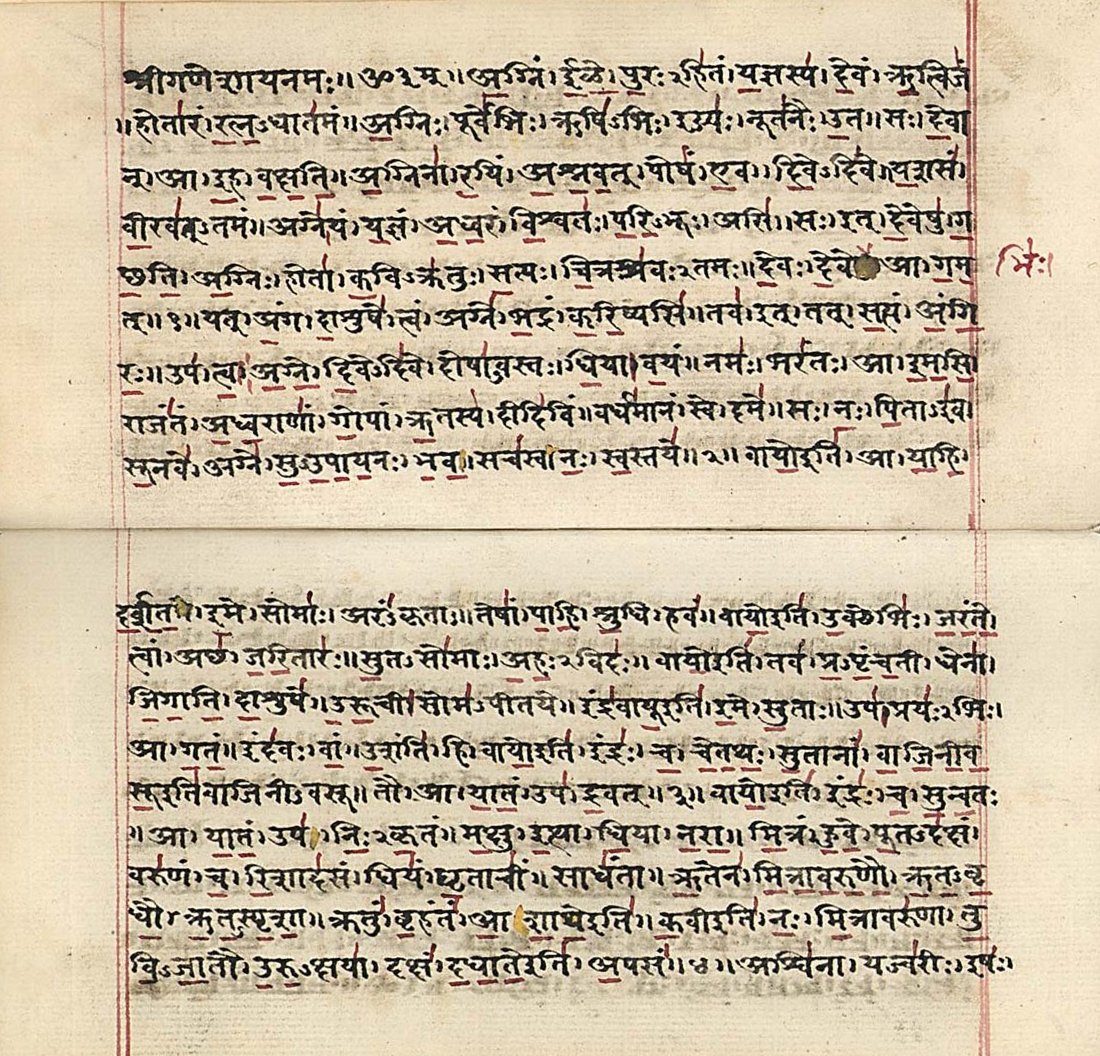
Sanskrit word and a virtue in Indian religions
Etymology and meaning
sa has cognates in a number of diverse Indo-European languages, including the words "sooth" and "sin" in English, "ru" ("суть") in Russian, "sand" (truthful) in Danish, "sann" in Swedish, and "ae" in Avestan, the liturgical language of Zoroastrianism.{{multiref2
In the Vedas and later sutras, the meaning of the word sa evolved into an ethical concept about truthfulness. It means being true and consistent with reality in one's thought, speech, and action.
{{transliteration|sa|Sat}}
sa () is the root of many Sanskrit words and concepts such as sa ("pure, truthful") and sa ("truth"). The Sanskrit root sa has several meanings or translations:
- "Absolute reality"
- "Fact"
- "Brahman" (not to be confused with Brahmin)
- "that which is unchangeable"
- "that which has no distortion"
- "that which is beyond distinctions of time, space, and person"
- "that which pervades the universe in all its constancy"
sa is a common prefix in ancient Indian literature. It implies variously that which is good, true, genuine, virtuous, being, happening, real, existing, enduring, lasting, or essential. For example, sa means true doctrine, sa means one devoted to the truth.
The negation of sa is sa, meaning delusion, distorted, untrue, the fleeting impression that is incorrect, invalid, and false. The concepts of sa and sa are famously expressed in the Pavamana Mantra found in the (1.3.28): tamaso mā jyotir gamaya mṛtyor mā amṛtam gamaya|Lead me from delusion to truth from darkness to light from mortality to immortality}} sa is one of the three characteristics of Brahman as described in sa. This association between sa, 'truth', and sa, ultimate reality, is also expressed in Hindu cosmology, wherein sa, the highest heaven of Hindu cosmology, is the abode of sa.
Hinduism
Main article: Hinduism
Vedic literature
Main article: Historical Vedic religion
sa is a central theme in the Vedas. It is equated with and considered necessary to the concept of sa (ऋतं, sa)—that which is properly joined, order, rule, nature, balance and harmony. sa results from sa in the Vedas, as it regulates and enables the operation of the universe and everything within it. sa is considered essential, and without it, the universe and reality falls apart and cannot function.
In the Rigveda, sa and sa are opposed to sa and sa (falsehood). In the Vedas, sa includes current, future, and past contexts. states, that in Rigveda, "sa is the modality of acting in the world of sa, as the truth to be built, formed or established".
Upanishads
sa is widely discussed in various Upanishads, including the Brihadaranyaka Upanishad where sa is called the means to Brahman, as well as Brahman (Being, true self). In hymn 1.4.14 of Brihadaranyaka Upanishad, Satya (truth) is equated to Dharma (morality, ethics, law of righteousness), as
Nothing is higher than the Law of Righteousness (sa). The weak overcomes the stronger by the Law of Righteousness. Truly that Law is the Truth (sa); Therefore, when a man speaks the Truth, they say, "He speaks Righteousness"; and if he speaks Righteousness, they say, "He speaks the Truth!" For both are one.
Brihadaranyaka Upanishad
Taittiriya Upanishad's hymn 11.11 states, "Speak the sa (truth), conduct yourself according to the sa (morality, ethics, law)".
The hymns of Upanishads portray truth as ultimately always prevailing. The Mundaka Upanishad, for example, states in Book 3, Chapter 1,
सत्यमेव जयते नानृतं Translation 1: Truth alone triumphs, not falsehood. Translation 2: Truth ultimately triumphs, not falsehood. Translation 3: The true prevails, not the untrue. |Mundaka Upanishad, 3.1.6}}
Sandilya Upanishad of Atharvaveda, in Chapter 1, includes ten forbearances as virtues, in its exposition of Yoga. It defines sa as "the speaking of the truth that conduces to the well being of creatures, through the actions of one's mind, speech, or body."
Deussen states that sa is described in the major Upanishads with two layers of meanings—one as empirical truth about reality and another as abstract truth about universal principle, being, and the unchanging. Both of these ideas are explained in early Upanishads, composed before , by variously breaking the word sa or sa into two or three syllables. In later Upanishads, the ideas evolve and transcend into sa as truth (or truthfulness), and sa as the Being, Be-ness, real Self, the eternal.
Epics
The Shanti Parva of the Mahabharata states, "The righteous hold that forgiveness, truth, sincerity, and compassion are the foremost (of all virtues). Truth is the essence of the Vedas."
The Epic repeatedly emphasizes that sa is a basic virtue, because everything and everyone depends on and relies on sa.
सत्येन विधृतं सर्वं सर्वं सत्ये परतिष्ठितम अपि पापकृतॊ रौद्राः सत्यं कृत्वा पृथक पृथक अद्रॊहम अविसंवादं परवर्तन्ते तदाश्रयाः ते चेन मिथॊ ऽधृतिं कुर्युर विनश्येयुर असंशयम|To speak the truth is meritorious. There is nothing higher than truth. Everything is upheld by truth, and everything rests upon truth. Even the sinful and ferocious, swear to keep the truth amongst themselves, dismiss all grounds of quarrel and uniting with one another set themselves to their (sinful) tasks, depending upon truth. If they behaved falsely towards one another, they would then be destroyed without doubt.|attr1=The Mahabharata, Chapter CCLIX: Shanti Parva}}
Yoga Sutras
In the Yoga Sutras of Patanjali, it is written, “When one is firmly established in speaking truth, the fruits of action become subservient to him." In Yoga sutra, sa is one of the five sa, or virtuous restraints, along with sa (restraint from violence or injury to any living being); sa (restraint from stealing); sa (celibacy or restraint from sexually cheating on one's partner); and sa (restraint from covetousness and craving). Patanjali considers sa as a restraint from falsehood in one's action (body), words (speech, writing), or feelings / thoughts (mind). In Patanjali's teachings, one may not always know the truth or the whole truth, but one knows if one is creating, sustaining, or expressing falsehood, exaggeration, distortion, fabrication, or deception. sa is, in Patanjali's Yoga, the virtue of restraint from such falsehood, either through silence or through stating the truth without any form of distortion.
Jainism
Main article: Jainism
sa is one of the five vows prescribed in Jain Agamas. sa was also preached by Mahavira.{{multiref2
According to the Jain text Sarvārthasiddhi: "That which causes pain and suffering to the living is not commendable, whether it refers to actual facts or not".
According to the Jain text Puruşārthasiddhyupāya:
Buddhism
Main article: Buddhism, Sacca (Buddhism)
The term sa (Pali: pi) is translated into English as "reality" or "truth." In terms of the Four Noble Truths (pi), the Pali can be written as pi, pi, pi, and pi.
'The Four Noble Truths' (pi) are the briefest synthesis of the entire teaching of Buddhism, since all those manifold doctrines of the threefold Pali canon are, without any exception, included therein. They are the truth of suffering (mundane mental and physical phenomenon), of the origin of suffering (pi, craving), of the extinction of suffering (pi or sa), and of the Noble Eightfold Path leading to the extinction of suffering (the eight supra-mundane mind factors).
Sikhism
Main article: Sikhism, Satnam
The Gurmukhs do not like falsehood; they are imbued with Truth; they love only Truth.|Gurubani, Hymn 3|}}
Sat or truthfulness is one of the 5 virtues in Sikhism.
Indian emblem motto

The motto of the republic of India's emblem is Satyameva Jayate which is literally translated as 'Truth alone triumphs'.
References
Citations
Sources
References
- Tiwari, Kedar Nath. (1998). "Classical Indian Ethical Thought". Motilal Banarsidass.
- (1992). "Encyclopaedia of the Hindu World". Concept Publishing Company.
- Dhand, A.. (2002). "The dharma of ethics, the ethics of dharma: Quizzing the ideals of Hinduism". Journal of Religious Ethics.
- Ishwaran, Karigoudar. (1999). "Ascetic Culture: Renunciation and Worldly Engagement". Brill.
- Macdonell, Arthur Anthony. (2004). "A Practical Sanskrit Dictionary with Transliteration, Accentuation, and Etymological Analysis Throughout". Motilal Banarsidass Publ..
- Chaudhuri, H.. (1954). "The Concept of Brahman in Hindu Philosophy". Philosophy East and West.
- (2002). "Neoplatonism and Indian Philosophy". SUNY Press.
- Hindery, Roderick. (1996). "Comparative ethics in Hindu and Buddhist traditions". Motilal Banarsidass.
- (2000). "Sourcebook of the world's religions: an interfaith guide to religion and spirituality". New World Library.
- Holdrege, Barbara. (2004). "The Hindu world". Routledge.
- de Nicolás, Antonio T.. (2003). "Meditations Through the Rig Veda". iUniverse.
- (1950). "Brihadaranyaka Upanishad". Advaita Ashrama.
- Johnston, Charles. (23 October 2014). "The Mukhya Upanishads: Books of Hidden Wisdom". Kshetra.
- Horsch, Paul. (2004). "From Creation Myth to World Law: The early history of Dharma". Journal of Indian Philosophy.
- "taittirIya upanishad".
- Easwaran, E.. (2007). "The Upanishads". Nilgiri Press.
- [https://sa.wikisource.org/wiki/मुण्डकोपनिषद् Mundaka Upanishad (Sanskrit)] Wikisource
- (2008). "Compassionate Space". India International Centre.
- Lal, Brij. (2011). "A Vision for Change: Speeches and Writings of A.D. Patel 1929–1969". Australian National University Press.
- (1884). "The Upanishads, Part 2". Clarendon Press.
- Patanjali states five restraints, rather than ten. The complete list of ten forbearances in Sandilya Upanishad are, in the order they are listed in original Upanishad manuscript: {{transliteration. sa. ahimsa, {{transliteration. sa. satya, {{transliteration. sa. asteya, {{transliteration. sa. brahmacharya, {{transliteration. sa. daya, {{transliteration. sa. arjava, {{transliteration. sa. kshama, {{transliteration. sa. dhrti, {{transliteration. sa. mitahara, and {{transliteration. sa. saucha
- Narayanaswami Aiyar, K.. (1914). "Thirty minor Upanishads". V̇asanṭā Press.
- Deussen, Paul. (1908). "The Philosophy of the Upanishads". T&T Clark.
- (1903). "The Mahābhārata: Shanti parva".
- (1891). "The Mahabharata, Vanti Parva, Volume II". Pratapa Chandra Ray, Bharata Press.
- Patanjali. (September 2012). "Yoga Sutras". Sanskrit Works.
- Palkhivala, Aadil. (August 28, 2007). "Teaching the Yamas in Asana Class". Yoga Journal.
- Bryant, Edwin. (19 April 2011). "Food for the Soul: Vegetarianism and Yoga Traditions". Praeger.
- Jain, Vijay K.. (2012). "Acharya Amritchandra's Purushartha Siddhyupaya: Realization of the Pure Self, With Hindi and English Translation". Vikalp Printers.
- Jain, S.A.. (1992). "Reality (English Translation of Srimat Pujyapadacharya's Sarvarthasiddhi)". Jwalamalini Trust.
- www.wisdomlib.org. (2008-09-27). "Sacca, Saccā: 11 definitions".
- "Bauddha Darsana Lecture 6 Four Noble Truths". Consortium for Educational Communication.
- "four noble truths".
- {{SGGS page
This article was imported from Wikipedia and is available under the Creative Commons Attribution-ShareAlike 4.0 License. Content has been adapted to SurfDoc format. Original contributors can be found on the article history page.
Ask Mako anything about Satya — get instant answers, deeper analysis, and related topics.
Research with MakoFree with your Surf account
Create a free account to save articles, ask Mako questions, and organize your research.
Sign up freeThis content may have been generated or modified by AI. CloudSurf Software LLC is not responsible for the accuracy, completeness, or reliability of AI-generated content. Always verify important information from primary sources.
Report