From Surf Wiki (app.surf) — the open knowledge base
Sathyamangalam Tiger Reserve
Tiger Reserve in Tamil Nadu, India

Tiger Reserve in Tamil Nadu, India
| Field | Value |
|---|---|
| name | Sathyamangalam Tiger Reserve |
| iucn_category | IV |
| photo | Nilgiris Biosphere Reserve.jpg |
| photo_caption | Map of Nilgiris Biosphere Reserve, showing Sathyamangalam Wildlife Sanctuary |
| map | India Tamil Nadu#India |
| relief | 1 |
| mapframe | Yes |
| coords | |
| established | 3 November 2008 |
| area_km2 | 1408.6 |
| elevation | 1790 |
| nearest_city | Coimbatore |
| governing_body | Tamil Nadu Forest Department |
| website | https://sathytiger.org/ |
Sathyamangalam Tiger Reserve is a protected area and tiger reserve located along the area straddling both the Western Ghats and Eastern Ghats in the Erode district of the Indian state of Tamil Nadu. The Sathyamangalam Forest Division is part of the Bramhagiri-Nilgiris-Eastern Ghats Elephant Reserve notified in 2003. In 2008, part of the Sathyamangalam Forest Division was declared a wildlife sanctuary, which was further enlarged in 2011 to cover a forest area of 1411.6 km2. It is the largest wildlife sanctuary in Tamil Nadu. In 2013, an area of 1408.6 km2 of the erstwhile sanctuary was notified as a tiger reserve and it was the fourth tiger reserve established in the state as a part of Project Tiger.
The reserve is a significant ecosystem and a wildlife corridor in the Nilgiri Biosphere Reserve between the Western Ghats and the Eastern Ghats and a genetic link between the five other protected areas which it adjoins, including the Sigur Plateau, Mudumalai and Bandipur National Parks, Billigiriranga Swamy Temple and Cauvery Wildlife Sanctuaries. The reserve covers parts of Talavady, Sathyamangalam and Gobichettipalayam taluks of Erode district in western Tamil Nadu.
The reserve had a tiger population of 80 individuals in 2018 which was 25 in 2011. In 2022, the reserve won the TX2 award by World Wide Fund in collaboration with wildlife conservation agencies for its growth in tiger population.
History
Patches of sandalwood reserves including the Sathyamangalam forests were notified under the Indian Forest Act, 1927. The forests were part of the erstwhile Coimbatore district with a range officer at Sathyamangalam and eight guards. The forest division is currently located in Erode district and forms a part of the Brahmagiri-Nilgiris-Eastern Ghats elephant reserve notified in 2003. In 2008, the Government of Karnataka sent a proposal to declare the contiguous Billigiriranga Swamy Temple Wildlife Sanctuary as a tiger reserve which was subsequently approved in 2010. In July 2010, the Minister of State for Environment and Forests of the Government of India requested the Chief Minister of Tamil Nadu to consider the possibility of proposing the Sathyamangalam wildlife sanctuary as a Project Tiger reserve as per the provisions of the Wildlife Protection Act of 1972 as the area is contiguous with the forests of Bandipur and Mudumalai tiger reserves. On 1 April 2010, the Government of Tamil Nadu announced that it would initiate the process to declare the sanctuary as a tiger reserve because of the consistent sighting of tigers in the forest area and that the declaration would strengthen wildlife conservation efforts, as the central government would provide additional financial support for the appointment of additional anti-poaching watchers and for the establishment of anti-poaching camps.
On 10 March 2011, the Principal Chief Conservator of Forests said that the proposal for according tiger reserve status for the Sathyamangalam reserve forests is under consideration. He said that studies using camera traps indicated there could be 19 to 25 tigers in the forests. A 2011 camera trap tiger density study conducted by World Wildlife Fund indicated that the sanctuary is home to at least 25 tigers. In the same year, a DNA based project initiated by the state forest department collected 150 samples of pugmarks from the Sathyamangalam forests and 69 of them were found positive for tigers by tests conducted at the Centre for Cellular and Molecular Biology in Hyderabad. The findings also indicated that the region was home to as many as 30 tigers.
Supported by the reports of tiger sightings, the Tamil Nadu Forest Department submitted a detailed report to the state government supporting the proposal to declare the sanctuary as a tiger reserve and the proposal was taken up for consideration by the Tamil Nadu Council of Ministers in early 2012. In March 2013, the Government of India issued an order declaring the Sathyamangalam Wildlife Sanctuary as the fourth tiger reserve in the state, with the other three being Mudumalai, Indira Gandhi National Park and Kalakkad Mundanthurai Tiger Reserve.
Expanse
The total area originally declared as a sanctuary was 524.3494 km2. The boundaries of the sanctuary were the Thalavadi range of Thalamalai forests and Hasanur, T.N.Palayam ranges of Gobichettipalayam taluk of Guthiyalathur forests, contiguous with Billigiriranga Swamy Temple Wildlife Sanctuary in the north and the rivers of Moyar and Bhavani, contiguous with Mudumalai National Park and Sigur Plateau in the south. The eastern boundary is formed by the Bargur reserved forests in Anthiyur taluk and Bandipur National Park in the west. The sanctuary includes the areas of Guthiyalathur reserved forests (299.47 km2), Guthiyalathur extension (1.62 km2), Thalamalai reserved forests (210.85 km2) and Thalamalai extension (12.41 km2).
In September 2011, the Department of forests increased the sanctuary area by declaring an additional 887.26 km2 in seven reserve forests of Sathyamangalam forest division. The largest chunks of additional area are 487.92 km2 from Guthiyalathur and 319.87 km2 from Thalamalai reserve forests, thus increasing the total sanctuary area to 1411.6 km2. Of the total area, the core zone comprises 917.27 km2 reserved forests and tourism is allowed in the buffer zone with only forest officials permitted entry into the core zone.
Flora
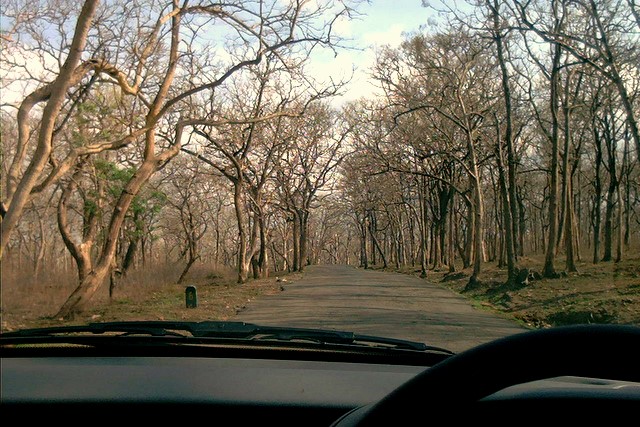
The Sathyamangalam forest is mostly tropical dry forest, part of the South Deccan Plateau dry deciduous forests ecoregion. There are five distinct forest types: tropical evergreen (Shola), semi-evergreen, mixed-deciduous, dry deciduous and thorn forests. Evergreen forests are restricted to small patches in a few high altitude hill tops of Sathyamamgalam between 750 m and 1649 m. These patches are threatened on account of land use changing to hill agriculture and plantation crops, including fruit. Semi-evergreen forests are found at high altitude. Mixed and dry deciduous forests are located on middle altitude slopes and the thorn forests are usually found in the foothills and some times, due degradation of dry deciduous forests, at the middle elevations. About 65% of the forest division is under forest cover. Significant areas of mixed shrubland and grasslands support a large population of herbivore ungulates, the preferred prey of tigers.
Fauna


The Sathyamangalam forests link the Eastern Ghats and Western Ghats allowing gene flow between diverse fauna populations of the two eco-regions. The 2009 wildlife survey conducted by Government of Tamil Nadu enumerated 12 Bengal tiger, 836 Indian elephants, 779 blackbucks, and 20 leopards.
The 2010 wildlife survey counted 12 Bengal tigers. In December 2011, the Conservator of Forests of Tamil Nadu stated that the sanctuary is home to at least 28 tigers as confirmed by a camera trap study conducted by World Wildlife Fund. In 2018, 80 tigers were recorded. In 2022, the reserve won the TX2 award by World Wide Fund in collaboration with wildlife conservation agencies for its growth in tiger population.
As per the 2011 census, the Sathyamangalam forests was home to over 850 Indian elephants and is part of a protected area, which consists of the largest Asian elephant population in the world.
Birds
The reserve hosts many bird species including treepies, bulbuls, Old World babblers, mynahs and crows. In 2010, the first ever bird survey was conducted in the Sathyamangalam forests and a total of 230 species of birds were recorded in the survey.
In 2010, a small population of critically endangered Indian vulture (Gyps indicus) and three other species of vultures were discovered in the Moyar river valley. 20 nests were sighted and the population was estimated to consist up of 40 adults. It was last sighted in the region in the 1970s, and the rediscovery is significant to its conservation. Diclofenac, which caused the decline of vulture population was banned in 2006 and since then, vulture numbers have started to grow back.
Issues and conservation
Conservation of the Sathyamangalam Forest Division is administered by the Tamil Nadu Forest Department governed through Conservator of Forests, STR-Erode. The sanctuary is listed among the top five places in India for poaching tigers by the international wild life trade monitoring network, TRAFFIC. In February 2016, the National Tiger Conservation Authority announced that drones will be used to monitor tiger population in five tiger reserves including Sathyamangalam.
The reserve also faces issues due to forest fires, uncontrolled grazing of cattle and growth of invasive plant species, damaging the ecosystem. Man-animal conflicts are common especially with elephants and leopards. Elephants raid crop fields and illegal electric fences used to protect crops mortally wound elephants and five elephants were electrocuted in three-month period between January and April 2013. As of 2011, solar powered fencing that give a short and safe electric shock was laid over a length of 239 km to prevent the entry of elephants into agricultural lands. The state forest department also dug trenches at a cost of to prevent the elephants from entering human habitats. Leopards prey on domestic cattle with as many as 27 goats killed by them in a single month in November 2012.
Tribal population
Sathyamangalam Tiger Reserve forests are home to indigenous tribal people belonging largely to the Irulas, also known as the Urali, and Soliga communities. In 2011, the Tamil Nadu state forest department officials conducted a study on the cattle and human population in the seven forest settlements and 12 revenue settlements inside the protected area.
The forests were also the home of notorious criminal and bandit Veerapan, who made a living by poaching, smuggling ivory and sandalwood from the forests and selling them on the black market. Veerapan was killed by the Tamil Nadu Police in October 2004.
References
References
- (5 February 2022). "Saving the tiger in Sathyamangalam". [[The Hindu]].
- "Tamil Nadu Forest Department Official Website". Forest Department, [[Government of Tamil Nadu]].
- "About STR-Erode". [[Government of Tamil Nadu]].
- "Conservation Awards". [[World Wide Fund.
- (25 January 2022). "Sathyamangalam Tiger Reserve bags TX2 award". [[The Hindu]].
- E. Key. (1885). "The Manual of the Administration of the Madras Presidency, Vol. II". Government Press, Madras.
- Principal Secretary to Government of Tamil Nadu. (3 December 2008). "Declaration of Sathyamangalam Forest Division as Wild Life Sanctuary under the Wild Life (Protection) Act.". [[Government of Tamil Nadu]].
- Biloy, C.R.. (4 December 2010). "Good news for the tiger?". [[The Hindu]].
- (24 October 2010). "Over 100 tigers spotted in three tiger reserves, says forest minister". [[The Times of India]].
- (2011). "Tiger reserve status for Sathyamangalam likely". [[The Hindu]].
- Shaji, K. A.. (2011). "WWF study confirms at least 25 tigers in Sathyamangalam forests". [[The Times of India]].
- (6 April 2012). "Two more tiger reserves for TN". IBN Live.
- (20 March 2013). "Sathyamangalam declared tiger reserve". [[The Times of India]].
- Aravind Kumar, B.. (27 September 2011). "Sathyamangalam wildlife sanctuary expanded to 1.41 lakh hectares". [[The Hindu]].
- Ramesh, S.. (27 September 2011). "Plan for tiger reserve to be sent to Union Ministry for approval". [[The Hindu]].
- (2002). "Terrestrial Ecoregions of the Indo-Pacific: a Conservation Assessment". Island Press.
- (2011). "27.0 Shola Forests and Some Important Species of Southernmost Eastern Ghats". [[Wildlife Institute of India]], Dehradun.
- (2010). "Sathyamangalam could be a tiger reserve". [[The Times of India]].
- Vinoj Kumar, P.C.. (2008). "Trouble in Jumbo Land". [[Tehelka]].
- Ramesh, S. (2011). "Focus back on preventing poaching in forests". [[The Hindu]].
- (2013). "25 tigers in Sathyamangalam forest". [[The Times of India]].
- Madhavan, K.. (1 April 2010). "Healthy tigers spotted in Sathyamangalam forests". [[The Hindu]].
- (30 September 2010). "Survey records 230 species of birds in Sathyamangalam forests". [[The Hindu]].
- Oppili, P.. (15 April 2010). "Vultures' nests sighted in Moyar river valley". [[The Hindu]].
- (2010). "Is diclofenac the only culprit for declining population of Gyps vultures in the Moyar Valley". Current Science.
- Oppilli, P.. (1 February 2016). "Drug ban gives vultures wings, improves diversity". [[The Times of India]].
- Aditi, R.. (21 September 2015). "Drug Ban to Help Vulture Numbers Soar". [[The New Indian Express]].
- "Project Tiger". [[Government of India]].
- "About Project Elephant". [[Government of India]].
- Kedlaya, G.. (8 April 2013). "Sathyamangalam gets reserve tag". [[Deccan Herald]].
- (2 February 2016). "NTCA awaiting final approval for use of drones to monitor India's Tiger reserves". BGR.
- (13 December 2012). "Human-elephant conflicts intensify in Sathyamangalam". [[The Hindu]].
- (24 December 2011). "23 elephant deaths reported in Erode district in 2011". [[NDTV]].
- (April 2011). "Right of Passage: Elephant Corridors of India". [[Sanctuary Asia]].
- (19 November 2004). "The end of Veerappan". [[The Hindu]].
This article was imported from Wikipedia and is available under the Creative Commons Attribution-ShareAlike 4.0 License. Content has been adapted to SurfDoc format. Original contributors can be found on the article history page.
Ask Mako anything about Sathyamangalam Tiger Reserve — get instant answers, deeper analysis, and related topics.
Research with MakoFree with your Surf account
Create a free account to save articles, ask Mako questions, and organize your research.
Sign up freeThis content may have been generated or modified by AI. CloudSurf Software LLC is not responsible for the accuracy, completeness, or reliability of AI-generated content. Always verify important information from primary sources.
Report