From Surf Wiki (app.surf) — the open knowledge base
Satellite constellation
Group of artificial satellites working together as a system
Group of artificial satellites working together as a system
A satellite constellation is a group of artificial satellites working together as a system. Unlike a single satellite, a constellation can provide permanent global or near-global coverage, such that at any time everywhere on Earth at least one satellite is visible. Satellites are typically placed in sets of complementary orbital planes and connect to globally distributed ground stations. They may also use inter-satellite communication.
Other satellite groups
Satellite constellations should not be confused with:
- satellite clusters, which are groups of satellites moving very close together in almost identical orbits (see satellite formation flying);
- satellite series or satellite programs (such as Landsat), which are generations of satellites launched in succession;
- satellite fleets, which are groups of satellites from the same manufacturer or operator that function independently from each other (not as a system).
Overview
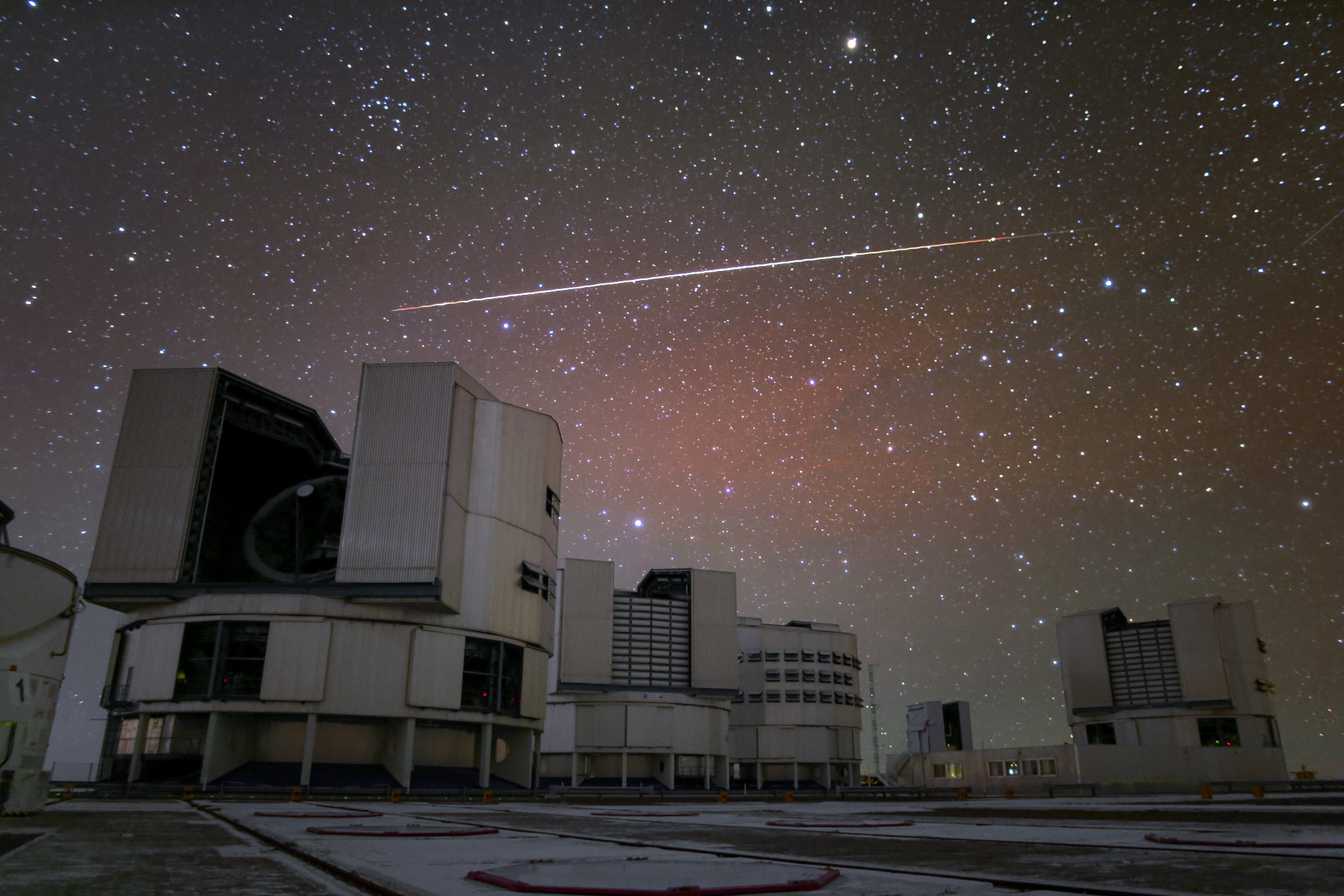
Satellites in medium Earth orbit (MEO) and low Earth orbit (LEO) are often deployed in satellite constellations, because the coverage area provided by a single satellite only covers a small area that moves as the satellite travels at the high angular velocity needed to maintain its orbit. Many MEO or LEO satellites are needed to maintain continuous coverage over an area. This contrasts with geostationary satellites, where a single satellite, at a much higher altitude and moving at the same angular velocity as the rotation of the Earth's surface, provides permanent coverage over a large area.
For some applications, in particular digital connectivity, the lower altitude of MEO and LEO satellite constellations provide advantages over a geostationary satellite, with lower path losses (reducing power requirements and costs) and latency. The propagation delay for a round-trip internet protocol transmission via a geostationary satellite can be over 600ms, but as low as 125ms for a MEO satellite or 30ms for a LEO system.
Examples of satellite constellations include the Global Positioning System (GPS), Galileo and GLONASS constellations for navigation and geodesy in MEO, the Iridium and Globalstar satellite telephony services and Orbcomm messaging service in LEO, the Disaster Monitoring Constellation and RapidEye for remote sensing in Sun-synchronous LEO, Russian Molniya and Tundra communications constellations in highly elliptic orbit, and satellite broadband constellations, under construction from Starlink and OneWeb in LEO, and operational from O3b in MEO.
Design
Walker Constellation
There are a large number of constellations that may satisfy a particular mission. Usually constellations are designed so that the satellites have similar orbits, eccentricity and inclination so that any perturbations affect each satellite in approximately the same way. In this way, the geometry can be preserved without excessive station-keeping thereby reducing the fuel usage and hence increasing the life of the satellites. Another consideration is that the phasing of each satellite in an orbital plane maintains sufficient separation to avoid collisions or interference at orbit plane intersections.

A class of circular orbit geometries that has become popular is the Walker Delta Pattern constellation. This has an associated notation to describe it which was proposed by John Walker. His notation is:
: i: t/p/f
where:
- i is the inclination;
- t is the total number of satellites;
- p is the number of equally spaced planes; and
- f is the relative spacing between satellites in adjacent planes. The change in true anomaly (in degrees) for equivalent satellites in neighbouring planes is equal to f × 360 / t.
For example, the Galileo navigation system is a Walker Delta 56°:24/3/1 constellation. This means there are 24 satellites in 3 planes inclined at 56 degrees, spanning the 360 degrees around the equator. The "1" defines the phasing between the planes, and how they are spaced. The Walker Delta is also known as the Ballard rosette, after A. H. Ballard's similar earlier work. Ballard's notation is (t,p,m) where m is a multiple of the fractional offset between planes.

Another popular constellation type is the near-polar Walker Star, which is used by Iridium. Here, the satellites are in near-polar circular orbits across approximately 180 degrees, travelling north on one side of the Earth, and south on the other. The active satellites in the full Iridium constellation form a Walker Star of 86.4°:66/6/2, i.e. the phasing repeats every two planes. Walker uses similar notation for stars and deltas, which can be confusing.
These sets of circular orbits at constant altitude are sometimes referred to as orbital shells.
Orbital shell
In spaceflight, an orbital shell is a set of artificial satellites in circular orbits at a certain fixed altitude. In the design of satellite constellations, an orbital shell usually refers to a collection of circular orbits with the same altitude and, oftentimes, orbital inclination, distributed evenly in celestial longitude (and mean anomaly). For a sufficiently high inclination and altitude the orbital shell covers the entire orbited body. In other cases the coverage extends up to a certain maximum latitude.
Several existing satellite constellations typically use a single orbital shell. New large megaconstellations have been proposed that consist of multiple orbital shells.
List of satellite constellations
Navigational satellite constellations
Main article: Satellite navigation
| Name | Operator | Satellites and orbits | ||||
|---|---|---|---|---|---|---|
| (latest design, excluding spares) | Coverage | Services | Status | Years in service | ||
| Global Positioning System (GPS) | USSF | 24 in 6 planes at 20,180 km (55° MEO) | Global | Navigation | Operational | 1993–present |
| GLONASS | Roscosmos | 24 in 3 planes at 19,130 km (64°8' MEO) | Global | Navigation | Operational | 1995–present |
| Galileo | EUSPA, ESA | 24 in 3 planes at 23,222 km (56° MEO) | Global | Navigation | Operational | 2019–present |
| BeiDou | CNSA | {{ubl | 3 geostationary at 35,786 km (GEO) | 3 in 3 planes at 35,786 km (55° GSO) | 24 in 3 planes at 21,150 km (55° MEO) | Global |
| NAVIC | ISRO | {{ubl | 3 geostationary at 35,786 km (GEO) | 4 in 2 planes at 250–24,000 km (29° GSO) | Regional | Navigation |
| QZSS | JAXA | {{ubl | 1 geostationary at 35,786 km (GEO) | 3 in 3 planes at 32,600–39,000 (43° GSO) | Regional | Navigation |
Communications satellite constellations
Broadcasting
- Sirius Satellite Radio until 2013
- XM Satellite Radio until 2011
- SES
- Othernet
- Molniya (discontinued)
Monitoring
- Spire (AIS, ADS-B)
- Iridium (AIS, ADS-B, IoT)
- Myriota (IoT)
- Swarm Technologies (IoT)
- Astrocast (IoT)
- TDRSS
Internet access
| Name | Operator | Constellation design | Coverage | Freq. | Services | |||
|---|---|---|---|---|---|---|---|---|
| Broadband Global Area Network | Broadband Global Area Network (BGAN) | Inmarsat | 3 geostationary satellites | 82°S to 82°N | Internet access | |||
| Global Xpress (GX) | Inmarsat | 5 Geostationary satellites | Ka band | Internet access | ||||
| Globalstar | Globalstar | url=https://www.n2yo.com/satellites/?c=17 | title=Globalstar satellites | website=www.n2yo.com | access-date=2019-11-22}} | 70°S to 70°N | Internet access, satellite telephony | |
| Iridium | Iridium Communications | 66 at 780 km, 86.4° (6 planes) | Global | {{ubl | L band | |||
| O3b | SES | 20 at 8,062 km, 0° (circular equatorial orbit) | 45°S to 45°N | Ka band | Internet access | |||
| O3b mPOWER | SES | 8 at 8,062 km, 0° (circular equatorial orbit) | ||||||
| 5 more to be launched by end 2026 | 45°S to 45°N | Ka (26.5–40 GHz) | Internet access | |||||
| Orbcomm | ORBCOMM | 17 at 750 km, 52° (OG2) | 65°S to 65°N | IoT and M2M, AIS | ||||
| Defense Satellite Communications System (DSCS) | 4th Space Operations Squadron | Military communications | ||||||
| Wideband Global SATCOM (WGS) | 4th Space Operations Squadron | 10 geostationary satellites | Military communications | |||||
| ViaSat | Viasat, Inc. | 4 geostationary satellites | Varying | Internet access | ||||
| Eutelsat | Eutelsat | 20 geostationary satellites | Commercial | |||||
| Thuraya | Thuraya | 2 geostationary satellites | EMEA and Asia | L band | Internet access, satellite telephony | |||
| Starlink | SpaceX | LEO in several orbital shells{{ubl | ~5000 satellites at 550 km (Oct 2023) | 12000 satellites at ~350–550 km (planned) | {{ubl | |||
| OneWeb constellation | Eutelsat (completed merger in Sep 2023) | 882–1980(planned) | Global | {{ubl | Ku (12–18 GHz) |
Other Internet access systems are proposed or currently being developed:
| Constellation | Manufacturer | Number | Weight | Unveil. | Avail. | Altitude | Offer | Band | Inter-sat. | ||||||
|---|---|---|---|---|---|---|---|---|---|---|---|---|---|---|---|
| links | |||||||||||||||
| IRIS² | European Space Agency | TBD | TBD | ||||||||||||
| Telesat LEO | {{ubl | Airbus SSTL | SS/Loral | 117–512 | 2016 | 2027 | 1,000–1,248 km | Fiber-optic cable-like | |||||||
| Hongyun | CASIC | 156 | 2017 | 2022 | 160–2,000 km | ||||||||||
| Hongyan | CASC | 320-864 | 2017 | 2023 | 1,100–1,175 km | ||||||||||
| url=https://www.satellitetoday.com/mobility/2021/03/31/hanwha-systems-plans-2000-satellite-leo-constellation-for-mobility-applications/ | title=Hanwha Systems Plans 2,000-Satellite LEO Constellation for Mobility Applications | work=Via Satellite | first=Rachel | last=Jewett | date=31 March 2022 | access-date=12 July 2022}} | 2000 | 2022 | 2025 | ||||||
| Project Kuiper | Amazon | 3236 | 2019 | 2024 | 590–630 km | 56°S to 56°N |
Some systems were proposed but never realized:
| Name | Operator | Constellation design | Freq. | Services | Abandoned date |
|---|---|---|---|---|---|
| Celestri | Motorola | 63 satellites at 1400 km, 48° (7 planes) | Ka band (20/30 GHz) | Global, low-latency broadband Internet services | 1998 May |
| Teledesic | Teledesic | {{ubl | 840 satellites at 700 km, 98.2° (21 planes) [1994 design] | 288 satellites at 1400 km, 98.2° (12 planes) [1997 design] | Ka band (20/30 GHz) |
| LeoSat | Thales Alenia | 78–108 satellites at 1400 km | Ka (26.5–40 GHz) | High-speed broadband internet | 2019 |
; Progress
- Boeing Satellite is transferring the application to OneWeb
- LeoSat shut down completely in 2019
- The OneWeb constellation had 6 pilot satellites in February 2019, 74 satellites launched as of 21 March 2020 but filed for bankruptcy on 27 March 2020
- Starlink: first mission (Starlink 0) launched on 24 May 2019; 955 satellites launched, 51 deorbited, 904 in orbit ; public beta test in limited latitude range started in November 2020
- O3b mPOWER: first 6 satellites launched December 2022-November 2023 with service start April 2024. 7 more in 2024–2026.
- Telesat LEO: two prototypes: 2018 launch
- CASIC Hongyun: prototype launched in December 2018
- CASC Hongyan prototype launched in December 2018, might be merged with Hongyun
- Project Kuiper: FCC filing in July 2019. Prototypes launched in October 2023.
Earth observation satellite constellations
- RADARSAT Constellation
- Planet Labs
- Pléiades 1A and 1B
- Satellogic
- RapidEye
- Disaster Monitoring Constellation
- A-train
- SPOT 6 and SPOT 7
- Spire
- Synspective
Notes
References
References
- "On the increasing number of satellite constellations".
- [https://www.satelliteevolutiongroup.com/articles/LEO-Constellations&Tracking.pdf ''LEO constellations and tracking challenges''] Satellite Evolution Group, September 2017, Accessed 26 March 2021
- [https://www.telesat.com/wp-content/uploads/2020/07/Real-Time-Latency-Rethinking-Remote-Networks.pdf ''Real-Time Latency: Rethinking Remote Networks''] {{Webarchive. link. (2021-07-21 Telesat, February 2020, Accessed 26 March 2021)
- J. G. Walker, Satellite constellations, Journal of the British Interplanetary Society, vol. 37, pp. 559-571, 1984
- A. H. Ballard, Rosette Constellations of Earth Satellites, IEEE Transactions on Aerospace and Electronic Systems, Vol 16 No. 5, Sep. 1980.
- J. G. Walker, Comments on "Rosette constellations of earth satellites", IEEE Transactions on Aerospace and Electronic Systems, vol. 18 no. 4, pp. 723-724, November 1982.
- [https://fcc.report/IBFS/SAT-MOD-20181108-00083/1569860 SPACEX NON-GEOSTATIONARY SATELLITE SYSTEM, Attachment A, TECHNICAL INFORMATION TO SUPPLEMENT SCHEDULE S], US Federal Communications Commission, 8 November 2018, accessed 19 November 2019.
- (2019-07-08). "Amazon lays out constellation service goals, deployment and deorbit plans to FCC".
- "Land Xpress".
- "Globalstar satellites".
- (21 February 2018). "This is how Elon Musk plans to use SpaceX to give internet to everyone".
- (14 February 2018). "SpaceX Set to Launch 2 Starlink Satellites to Test Gigabit Broadband". [[ISPreview]].
- (2020-09-09). "SpaceX's Satellite Internet Service Latency Comes in Under 20 Milliseconds".
- (2018-03-20). "OneWeb asks FCC to authorize 1,200 more satellites".
- Thierry Dubois. (Dec 19, 2017). "Eight Satellite Constellations Promising Internet Service From Space". Aviation Week & Space Technology.
- (11 September 2018). "Telesat says ideal LEO constellation is 292 satellites, but could be 512".
- Telesat Canada. (August 24, 2017). "Telesat Technical Narrative".
- Telesat Canada. (August 24, 2017). "SAT-PDR-20170301-00023".
- Zhao, Lei. (5 March 2018). "Satellite will test plan for communications network". [[China Daily]].
- Jones, Andrew. (13 November 2018). "China to launch first Hongyan LEO communications constellation satellite soon". [[GBTimes]].
- ((EL2squirrel (cedar))). (12 December 2019). "Chinese version of OneWeb: The Hongyan system consists of 864 satellites, with 8 Tbps of bandwidth, Orbital altitude 1175km".
- Jewett, Rachel. (31 March 2022). "Hanwha Systems Plans 2,000-Satellite LEO Constellation for Mobility Applications". Via Satellite.
- Porter, Jon. (2019-04-04). "Amazon will launch thousands of satellites to provide internet around the world".
- (2017-12-17). "Boeing wants to help OneWeb satellite plans". Advanced Television.
- "LeoSat, absent investors, shuts down".
- (2020-03-21). "OneWeb increases mega-constellation to 74 satellites".
- (2020-03-30). "Coronavirus: OneWeb blames pandemic for collapse".
- (2020-03-27). "Voluntary Petition for Non-Individuals Filing for Bankruptcy".
- Samantha Mathewson. (6 November 2020). "SpaceX opens Starlink satellite internet to public beta testers: report".
- [https://www.satellitetoday.com/connectivity/2024/04/24/ses-o3b-mpower-meo-system-is-now-operational-service-rollout-to-follow/ ''SES’ O3b mPOWER MEO System is Now Operational, Service Rollout to Follow''] Via Satellite. 24 April 2024. Accessed 29 April 2025
- Barbosa, Rui C.. (21 December 2018). "Chinese Long March 11 launches with the first Hongyun satellite". [[NASASpaceFlight.com]].
- Barbosa, Rui. (29 December 2018). "Long March 2D concludes 2018 campaign with Hongyan-1 launch". [[NASASpaceFlight.com]].
- (14 December 2019). "Notice that these satellites from CASC are mentioned as part of a "national satellite Internet system". There are rumors that several of the planned Chinese private LEO comsat constellations have been recently absorbed into one big nationalized one.".
This article was imported from Wikipedia and is available under the Creative Commons Attribution-ShareAlike 4.0 License. Content has been adapted to SurfDoc format. Original contributors can be found on the article history page.
Ask Mako anything about Satellite constellation — get instant answers, deeper analysis, and related topics.
Research with MakoFree with your Surf account
Create a free account to save articles, ask Mako questions, and organize your research.
Sign up freeThis content may have been generated or modified by AI. CloudSurf Software LLC is not responsible for the accuracy, completeness, or reliability of AI-generated content. Always verify important information from primary sources.
Report