From Surf Wiki (app.surf) — the open knowledge base
Santiphap Park
Park in Bangkok, Thailand

Park in Bangkok, Thailand
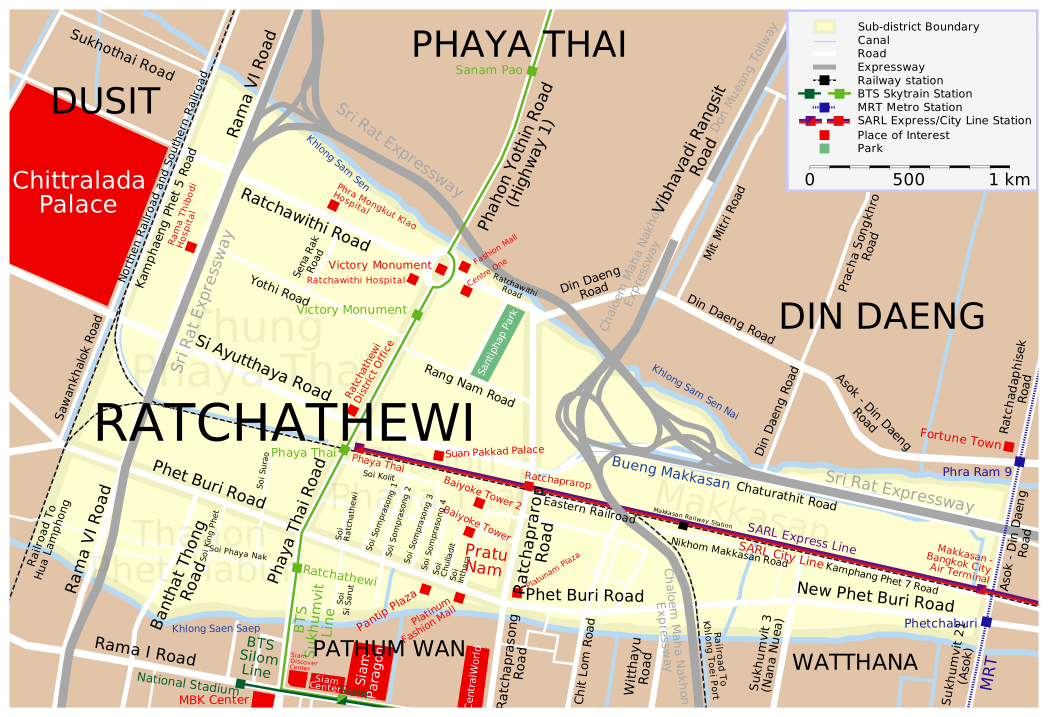
Santiphap Park (, , literally "Peace Park") is an 8 acre park in Bangkok, Thailand. It is located between Ratchawithi Road and Rang Nam Road in Ratchathewi district.
The land on which Santiphap Park is built is leased from the Crown Property Bureau by the Bangkok Metropolitan Administration (BMA). It was previously the site of subsidized housing overseen by the National Housing Authority. The BMA obtained a 30-year lease, beginning in October 1990. Construction on the park began in 1997.
Santiphap Park was opened to the public on August 18, 1998. The name Santiphap, meaning "peace", as well as the date of the park's opening, commemorate the end of World War II, which took place 53 years earlier.
The dove is the symbol of Santiphap Park. A blackened bronze sculpture situated in the park's central pond depicts a dove carrying in its beak an olive branch with five blossoms, representing the spread of peace throughout the world. The sculpture is based on a drawing by Pablo Picasso.
The entrance signs to Santiphap Park are a facsimile of the handwriting of Buddhadasa Bhikkhu, a renowned Buddhist monk, philosopher and pacifist.


Over 30 species of birds have been recorded in the park since its creation. Birds most often seen or heard there: feral pigeon, spotted dove, zebra dove, plaintive cuckoo, common koel, coppersmith barbet, Asian palm-swift, streak-eared bulbul, black-naped oriole, large-billed crow, oriental magpie-robin, pied fantail, black-collared starling, Asian pied starling, common myna, white-vented myna, olive-backed sunbird, scarlet-backed flowerpecker, Eurasian tree sparrow. Common winter (October–March) visitors: barn swallow, red-breasted flycatcher, inornate warbler. Species which are seen there less often (but all year round): striated heron, Javan pond-heron, little egret, painted stork, house swift, common iora, common tailorbird, yellow-vented bulbul, red-whiskered bulbul, house sparrow. Less common winter visitors: Chinese pond-heron, ashy drongo, brown shrike, Asian paradise-flycatcher. In the wasteland on which the park was later constructed, white-breasted waterhen, black-capped kingfisher, and verditer flycatcher were also recorded. Much more unusually for central Bangkok, orange-headed thrush and laced woodpecker have been recorded in a quieter condominium garden 50 m from the park.
The park contains a public address system which is used to broadcast a numbered list of park rules at 07:00, 08:00, 15:00, and 18:00; the national anthem at 08:00 and 18:00; and Thai music 07:00-10:00 and 15:00-18:00 most days. The rules and anthem are often audible from over a block away. Complaints by local residents have been ignored by the park management. The central circular paved area in the park is used for aerobics 18:00-18:45, weather permitting.
Santiphap Park is open from 05:00 until 21:00, and is used by 2–3,000 people on working days, and 3–4,000 on holidays.
References
References
- [http://203.155.220.217/office/ppdd/publicpark/thai/mainpark/T_Santiphap.html Suan Santiphap], Public Park Office, Department of Environment (in Thai). Retrieved on February 26, 2009.
This article was imported from Wikipedia and is available under the Creative Commons Attribution-ShareAlike 4.0 License. Content has been adapted to SurfDoc format. Original contributors can be found on the article history page.
Ask Mako anything about Santiphap Park — get instant answers, deeper analysis, and related topics.
Research with MakoFree with your Surf account
Create a free account to save articles, ask Mako questions, and organize your research.
Sign up freeThis content may have been generated or modified by AI. CloudSurf Software LLC is not responsible for the accuracy, completeness, or reliability of AI-generated content. Always verify important information from primary sources.
Report