From Surf Wiki (app.surf) — the open knowledge base
Santiago
Capital and largest city of Chile

Capital and largest city of Chile
| Field | Value |
|---|---|
| official_name | Santiago |
| settlement_type | Capital city |
| image_skyline | {{multiple image |
| border | infobox |
| total_width | 300 |
| perrow | 1/2/3/2 |
| caption_align | center |
| image1 | Santiago de Chile, Desde Cerro San Cristóbal (cropped panorama).jpg |
| caption1 | Skyline of Santiago, with Sanhattan and Gran Torre Santiago, from San Cristóbal Hill |
| image2 | Palacio de La Moneda - miguelreflex.jpg |
| caption2 | La Moneda Palace |
| image3 | Biblioteca_Nacional_de_Chile,_2012-09-08.jpg |
| caption3 | National Library of Chile |
| image4 | Chile_-_Santiago_24_-_Virgin_Mary_statue_on_Cerro_San_Cristóbal_(6977789601).jpg |
| caption4 | San Cristóbal Hill |
| image5 | Torre Entel, Santiago 20230312.jpg |
| caption5 | Torre Entel |
| image6 | Fuente_Neptuno_en_la_Terraza_del_Cerro_Santa_Lucía_II.jpg |
| caption6 | Santa Lucía Hill |
| image7 | Metropolitan Cathedral of Santiago.jpg |
| caption7 | Metropolitan Cathedral of Santiago |
| image8 | Chilean_National_Museum_of_Fine_Arts_2023.jpg |
| caption8 | National Museum of Fine Arts |
| image_flag | Flag of Santiago de Chile.svg |
| flag_alt | Flag of Santiago |
| seal_size | 75px |
| image_shield | Coat of arms of Santiago (Chile).svg |
| nickname | "The City of the Island Hills" |
| named_for | Saint James |
| mapframe | yes |
| mapframe-zoom | 9 |
| pushpin_map | Chile#South America |
| pushpin_relief | 1 |
| pushpin_map_caption | Location in Chile |
| coordinates | |
| subdivision_type | Country |
| subdivision_name | Chile |
| subdivision_type1 | Region |
| subdivision_type2 | Province |
| subdivision_name1 | Santiago Metropolitan Region |
| subdivision_name2 | Santiago Province |
| established_title | Foundation |
| established_date | |
| founder | Pedro de Valdivia |
| unit_pref | Metric |
| area_total_sq_mi | 247.6 |
| elevation_m | 570 |
| elevation_ft | 1870 |
| population_rank | 1st in Chile |
| 5th in South America | |
| population_total | 6,269,384 |
| population_as_of | 2017 |
| population_density_km2 | auto |
| population_density_sq_mi | 25,436 |
| population_metro | 6,903,479 |
| population_demonym | Santiaguinos (-as) |
| population_note | |
| demographics_type1 | GDuP |
| demographics1_title2 | Capital city |
| demographics1_info2 | US$117.1 billion (2023) |
| demographics1_title3 | Per capita |
| demographics1_info3 | US$17,000 (2023) |
| postal_code_type | Postal code |
| postal_code | 8320000 |
| area_code | +56 2 |
| website | |
| blank_name | HDI (2023) |
| blank_info | 0.908(1st) – very high |
| pushpin_map_narrow | yes |
| timezone | CLT |
| utc_offset | −04:00 |
| timezone_DST | CLST |
| utc_offset_DST | −03:00 |
the capital of Chile
| mapframe-zoom = 9 5th in South America
Santiago ( , ; ), also known as Santiago de Chile (), is the capital and largest city of Chile and one of the largest cities in the Americas. Located in the Chilean Central Valley within the Santiago Basin, between the Andes to the east and the Chilean Coastal Range to the west, it anchors the Santiago Metropolitan Region and its conurbation of Greater Santiago, which comprises more than forty communes and concentrates over a third of the national population and around 45% of Chile’s GDP. Most of the city lies between 500 and 650 m (1,640–2,133 ft) above sea level, with recent urban growth extending into the Andean foothills.
The basin that Santiago occupies has been inhabited since at least the 10th millennium BC, with early agricultural villages established along the Mapocho River and later incorporated into the Inca sphere of influence. During the Spanish invasion of the Americas, conquistador Pedro de Valdivia founded the colonial city of Santiago del Nuevo Extremo on 12 February 1541, laying out a grid plan around the Plaza Mayor (now Plaza de Armas). Despite early food shortages, Indigenous attacks, floods, and devastating earthquakes—notably in 1647—the city consolidated as the capital of the Captaincy General of Chile. Santiago remained the political center during the Chilean War of Independence, beginning with the First Government Junta in 1810 and culminating in patriot victory at the Battle of Maipú in 1818, and subsequently expanded through 19th-century railway construction, state-building projects, and the creation of major educational and cultural institutions.
The city today is the political and administrative heart of Chile: it houses the presidential palace and the main organs of the executive and judiciary, while the National Congress meets primarily in nearby Valparaíso. Economically, Santiago is the country’s principal industrial, commercial, and financial hub and a regional center for services, hosting the headquarters of major Chilean companies, regional offices of international organizations such as the Economic Commission for Latin America and the Caribbean (ECLAC), and several of the nation’s leading universities and research institutes. Urban growth has been marked by the emergence of high-rise business districts such as Sanhattan, dominated by Gran Torre Santiago, the tallest building in South America and the second tallest building in Latin America (behind Mexico's T.Op Torre 1).
Santiago’s urban landscape combines a 19th-century neoclassical core and surviving colonial churches with extensive modern residential districts, standalone hills such as Cerro Santa Lucía and Cerro San Cristóbal, and parklands along the Mapocho River, including Parque Forestal, Parque Bicentenario, and Santiago Metropolitan Park. The city has a cool semi-arid climate with Mediterranean characteristics, warm, dry summers and cool, wetter winters; its location in an enclosed valley contributes both to its scenic views of the high Andes and to chronic air pollution and winter smog. Santiago is served by Arturo Merino Benítez International Airport, a dense network of urban highways, and one of Latin America’s most extensive metro systems.
Etymology
The name Santiago was chosen by the Spanish conqueror Pedro de Valdivia when he founded the city in 1541 as "Santiago del Nuevo Extremo," in reference to his home region of Extremadura and as a tribute to James the Great, the patron saint of Spain. The saint's name appears in various forms in Spanish, such as Diego, Jaime, Jacobo, or Santiago, with the latter derived from the Galician evolution of Vulgar Latin Sanctu Iacobu. Allegedly, there was no indigenous name for the area where Santiago is located, but the Mapuche language uses the adapted name Santiaw.
In Chile, several entities share the name Santiago, which can often lead to confusion. The commune of Santiago, also referred to as Santiago Centro, is an administrative division encompassing the area occupied by the city during colonial times. It is governed by the Municipality of Santiago and led by a mayor. This commune is part of Santiago Province, which is headed by a provincial delegate appointed by the President of the Republic, and it is also part of the Santiago Metropolitan Region, governed by a popularly elected governor.
When the term Santiago is used without further clarification, it typically refers to Gran Santiago ('Greater Santiago'), the metropolitan area characterized by continuous urban development. This area includes the commune of Santiago and over 40 other communes, encompassing much of Santiago Province and parts of neighboring provinces. The definition of the metropolitan area has evolved over time as the city has expanded, incorporating smaller cities and rural areas.
Residents of the city and region are referred to as santiaguinos (for males) and santiaguinas (for females).
History
Prehistory
Archaeological evidence suggests that the first human groups arrived in the Santiago basin around the 10th millennium BC. These groups were primarily nomadic hunter-gatherers, traveling from the coast to the interior to hunt guanacos during the Andean snowmelt. By around 800 AD, the first permanent settlers established agricultural communities along the Mapocho River, where they cultivated crops such as maize, potatoes, and beans, and domesticated camelids.
The villages of the Picunche people (as they were known to Chileans) or the Promaucae (as referred to by the Incas) were under Inca rule from the late 15th century to the early 16th century. The Incas established a settlement of mitimas in the valley, located in the center of present-day Santiago, with fortifications such as Huaca de Chena and the El Plomo hill sanctuary. According to Chilean historian Armando de Ramón, the area served as a base for failed Inca expeditions to the south and was a junction along the Inca Trail.
Founding of the city

Pedro de Valdivia, a conquistador from Extremadura sent by Francisco Pizarro from Peru, arrived in the Mapocho valley on 13 December 1540, after a long journey from Cusco. Valdivia and his party camped by the river on the slopes of the Tupahue hill and gradually began interacting with the Picunche people who lived in the area. Valdivia later called a meeting with the local chiefs, during which he explained his plan to establish a city on behalf of Charles I of Spain. The city would serve as the capital of his governorship of Nueva Extremadura.
On 12 February 1541, Valdivia officially founded the city of Santiago del Nuevo Extremo ('Santiago of New Extremadura') in honor of the Apostle James, the patron saint of Spain. The city was established near Huelén, which Valdivia renamed Santa Lucía. He assigned the city's layout to master builder Pedro de Gamboa, who designed a grid plan. At its center, Gamboa placed a Plaza Mayor, which became the town's central hub. Surrounding the plaza, plots were designated for the cathedral, the jail, and the governor's house. The city was divided into eight blocks from north to south and ten blocks from east to west, between the Mapocho River and the Cañada with each quarter-block, or solar, granted to settlers. The colonial architecture following the grid plan consisted of one or two-story houses, adobe walls, tile roofs, and rooms around interior corridors and patios.
Valdivia left for the south with his troops months later, initiating the Arauco War. Santiago was left vulnerable, and a coalition of Mapuche and Picunche tribes led by chief Michimalonco destroyed the city on 11 September 1541, despite the efforts of a Spanish garrison of 55 soldiers defending the fort. The defense was led by Spanish Conquistadora Inés de Suárez. When she realized they were being overpowered, she ordered the execution of all indigenous prisoners, displaying their heads on pikes and throwing some towards the attackers. In response to this brutal act, the indigenous forces dispersed in fear. The city was gradually rebuilt, with the newly established city of Concepción gaining political prominence as the Royal Audiencia of Chile was established there in 1565. However, the ongoing threat of the Arauco War and frequent earthquakes delayed the establishment of the Royal Court in Santiago until 1607, which solidified the city's status as the capital.
During the early years of the city, the Spanish suffered from severe shortages of food and other supplies. The Picunches had adopted a strategy of halting cultivation and retreating to more remote locations,
Colonial Santiago


Although Santiago was facing the threat of permanent destruction early on, due to attacks from indigenous peoples, earthquakes, and floods, the city began to grow rapidly. Out of the 126 blocks designed by Pedro de Gamboa in 1558, 40 were occupied. In 1580, the first major buildings in the city started to be erected, marked by the placement of the foundation stone of the first Cathedral in 1561 and the building of the church of San Francisco in 1572. Both of these structures were primarily made of adobe and stone. In addition to the construction of significant buildings, the city began to thrive as the surrounding areas welcomed tens of thousands of livestock.
During the 16th and 17th centuries, the growth of the city was hindered by a series of disasters including an earthquake, a smallpox epidemic in 1575, the Mapocho River floods in 1590, 1608, and 1618, and a devastating earthquake on 13 May 1647 which resulted in the death of over 600 people and affected over 5,000 others. Despite these setbacks, the capital of the Captaincy General of Chile continued to grow, with all the power of the country being centered on the Plaza de Armas in Santiago.
In 1767, the corregidor Luis Manuel de Zañartu launched one of the most significant architectural projects of the colonial period, the Calicanto Bridge, connecting the city to La Chimba on the north side of the Mapocho River. He also began constructing embankments to prevent river overflows. Although the bridge was completed, its piers were frequently damaged by the river. In 1780, Governor Agustín de Jáuregui hired the Italian architect Joaquín Toesca, who designed several important buildings, including the cathedral's façade, the Palacio de La Moneda, the San Carlos Canal, and the completion of the embankments during the government of Ambrosio O'Higgins. These works were officially opened in 1798. The O'Higgins government also opened the road to Valparaíso in 1791, connecting the capital with the country's main port. File:Schmidtmeyer, Peter & Scharf, G - The Cañada, Santiago -JCB Library f1 (cropped).jpg|The colonial La Cañada neighborhood in Santiago de Chile, in 1821, by Scharf and Schmidtmeyer. John Carter Brown Library. File:Schmidtmeyer, Peter & Scharf, G - Scenes at a Fair -JCB Library f1.2.jpg|Scenes at a fair in Santiago de Chile, in 1821, by Scharf and Schmidtmeyer. John Carter Brown Library.|alt=Scenes at a fair in Santiago de Chile, in 1821, by Scharf and Schmidtmeyer. John Carter Brown Library.: 320, 348 File:Schmidtmeyer- Paroissien, James & Scharf, G - The Mint of Santiago -JCB Library f1.3.jpg|The colonial Real Casa de la Moneda (now called Palacio de la Moneda) in 1824 (by Paroissien, Scharf and Rowney & Forster). John Carter Brown Library. File:Plaza o great Square of Santiago with diffent national costumes (cropped2).jpg|[Colonial] Plaza o great Square of Santiago with different local costumes, in 1826, by John Miers. British Library. File:Plaza de Armas de Santiago de Chile en 1850.jpg|[Colonial] Square in Downtown Santiago, in 1850, by the French-born Ernest Charton. File:Plaza de la Independencia de Santiago in 1854 by Claude Gray.jpg|Colonial Plaza de Armas de Santiago in 1854 by Claude Gay. In the foreground you can see the still intact Palace of the Real Audiencia of Chile, and in the background the unfinished Cathedral, both built by the Italian Joaquin Toesca. File:Santiago plaza independencia selleny expedic novara 1859.jpg|Colonial Plaza de Armas de Santiago in 1859 by Joseph Selleny aboard the Novara expedition, to the left, the (beginning to be modified) Palace of the Real Audiencia of Chile, and to the right, the colonial Portal de Sierra Bella. File:Portal of Sierra Bella in the Plaza de Armas de Santiago de Chile in 1860 by Eugéne Maunoury.jpg|Portal de Sierra Bella and gardens of the Plaza de Armas in 1860. The colonial imprint was maintained until well into the 19th century, this commercial portal faithfully reflects the appearance of colonial Santiago. Photograph by Eugéne Maunoury, belonging to the Bibliothèque nationale de France.
Capital of the Republic

On September 18, 1810, the First Government Junta was proclaimed in Santiago, marking the beginning of Chile’s path to independence. The city, which became the capital of the newly formed nation, faced various challenges, particularly from military actions in the vicinity.
Although institutions like the Instituto Nacional and the National Library were established during the Patria Vieja, they were shut down after the patriots’ defeat at the Battle of Rancagua in 1814. The royal government continued until 1817, when the Army of the Andes emerged victorious at the Battle of Chacabuco and restored the patriot government in Santiago. However, independence was still uncertain. The Spanish army achieved further victories in 1818 and advanced toward Santiago, but their progress was finally halted at the Battle of Maipú on April 5, 1818, on the Maipo River plains.

With the end of the war, Bernardo O'Higgins was accepted as Supreme Director and, like his father, undertook several important projects for the city. During the Patria Nueva era, previously closed institutions were reopened. The General Cemetery was inaugurated, work on the San Carlos Canal was completed, and the drying riverbed in the south arm of the Mapocho River, known as La Cañada, which had been used as a landfill for some time, was transformed into an avenue now known as the Alameda de las Delicias.
Two earthquakes struck the city in the 19th century: one on November 19, 1822, and another on February 20, 1835. Despite these disasters, the city continued to grow rapidly. In 1820, the population was recorded as 46,000, but by 1854, it had risen to 69,018. By 1865, the census reported 115,337 residents. This significant increase was due to suburban expansion to the south and west of the capital, as well as the growth of the bustling district of La Chimba, which resulted from the division of old properties in the area. This new peripheral development marked the end of the previous checkerboard structure that had dominated the city center.
19th century

During the Republican era, several institutions were founded, including the University of Chile, the Normal School of Preceptors, the School of Arts and Crafts, and the Quinta Normal. The latter comprised the Museum of Fine Arts (now the Museum of Science and Technology) and the National Museum of Natural History. These institutions were established primarily for educational purposes, but also served as examples of public planning during that period. In 1851, the first telegraph system connecting the capital to the Port of Valparaíso was inaugurated.
During the "Liberal Republic" and the administration of Mayor Benjamín Vicuña Mackenna, a new phase in the urban development of the capital was initiated. One of the main projects during this period was the remodeling of Cerro Santa Lucía, which had fallen into disrepair despite its central location. In his effort to transform Santiago, Vicuña Mackenna initiated the construction of the Camino de Cintura, a road surrounding the entire city. The redevelopment of Alameda Avenue also took place during this time, turning it into the city's main road.
Also during this era, O'Higgins Park was established with the help of European landscapers in 1873. The public park, known for its large gardens, lakes, and carriage trails, became a landmark in Santiago. Other notable structures were also opened during this period, including the Teatro Municipal opera house and the Club Hípico de Santiago. In addition, the 1875 International Exposition was held in the Quinta Normal grounds.

Santiago emerged as the central hub of the national railway system. On 14 September 1857, the first railway arrived in the city and terminated at the Santiago Estación Central railway station, which was under construction at the time and officially opened in 1884. During this period, rail lines connected Santiago to Valparaíso and regions in northern and southern Chile. The streets of Santiago were also paved, and by 1875, there were 1,107 railway cars in the city, while 45,000 people used trams daily.
The centennial Santiago
Geography

The city lies in the center of the Santiago Basin, a large bowl-shaped valley consisting of broad and fertile lands surrounded by mountains. The city has a varying elevation, gradually increasing from 400 m in the western areas to more than 700 m in the eastern areas. Santiago's international airport, in the west, lies at an altitude of 474 m. The historic center, Plaza de Armas, lies at 565 m. Estadio San Carlos de Apoquindo, at the eastern edge of the city, has an elevation of 960 m.
The Santiago Basin is part of the Intermediate Depression and is remarkably flat, interrupted only by a few "island hills;" among them are Cerro Renca, Cerro Blanco, and Cerro Santa Lucía. The basin is approximately 80 km in a north–south direction and 35 km from east to west. The Mapocho River flows through the city.
The city is flanked by the main chain of the Andes to the east and the Chilean Coastal Range to the west. On the north, it is bordered by the Cordón de Chacabuco, a mountain range of the Andes. At the southern border lies the Angostura de Paine, an elongated spur of the Andes that almost reaches the coast.
The mountain range immediately bordering the city on the east is known as the Sierra de Ramón, which was formed due to tectonic activity of the San Ramón Fault. This range reaches 3296 meters at Cerro de Ramón. The Sierra de Ramón represents the "Precordillera" of the Andes. 20 km further east is the even larger Cordillera of the Andes, which has mountains and volcanoes that exceed 6000 m and on which some glaciers are present. The tallest is the Tupungato mountain at 6570 m. Other mountains include Tupungatito, San José, and Maipo. Cerro El Plomo is the highest mountain visible from Santiago's urban area.
During recent decades, urban growth has outgrown the boundaries of the city, expanding to the east up the slopes of the Andean Precordillera. In areas such as La Dehesa, Lo Curro, and El Arrayan, urban development is present at over 1,000 meters of altitude.
The natural vegetation of Santiago is made up of a thorny woodland of Vachellia caven (also known as Acacia caven and espinillo) and Prosopis chilensis in the west and an association of Vachellia caven and Baccharis paniculata in the east around the Andean foothills.
File:La Parva, centro de esquí (2011D2021A).jpg|Ski Center La Parva File:2019-04-06-12h10m43.jpg|Santiago Metropolitan Park File:Santiago en invierno.jpg|Santiago in the winter File:Santiago de Chile.jpg|Santiago in the summer
Climate
Santiago has a cool semi-arid climate (BSk according to the Köppen climate classification), with Mediterranean (Csb) patterns, while the eastern areas, being closer to the mountain range, have a true Mediterranean climate (Csb): warm dry summers (October to March) with temperatures reaching up to 35 °C on the hottest days; winters (April to September) are cool with cool to cold mornings; typical daily maximum temperatures of 14 °C, and low temperatures near 0 °C. In climate station of Quinta Normal (near downtown) the precipitation average is 286.3 mm, and in climate station of Quebrada de Macul between the communes of Peñalolén and La Florida (in higher grounds near the Andes mountains) the precipitation average is 438 mm.
In the airport area of Pudahuel, mean rainfall is 276.9 mm per year, about 80% of which occurs during the winter months (May to September), varying between 50 and of rainfall during these months. That amount contrasts with a very sunny season during the summer months between December and March, when rainfall does not exceed 4 mm on average, caused by an anticyclonic dominance continued for about seven or eight months. There is significant variation within the city, with rainfall at the lower-elevation Pudahuel site near the airport being about 20 percent lower than at the older Quinta Normal site near the city center.
Santiago's rainfall is highly variable and heavily influenced by the El Niño Southern Oscillation cycle, with rainy years coinciding with El Niño events and dry years with La Niña events. The wettest year since records began in 1866 was 1900 with 819.7 mm – part of a "pluvial" from 1898 to 1905 that saw an average of 559.3 mm over eight years incorporating the second wettest year in 1899 with 773.3 mm – and the driest 1924 with 66.1 mm. Typically there are lengthy dry spells even in the rainiest of winters, intercepted with similarly lengthy periods of heavy rainfall. For instance, in 1987, the fourth wettest year on record with 712.1 mm, there was only 1.7 mm in the 36 days between 3 June and 8 July, followed by 537.2 mm in the 38 days between 9 July and 15 August.
Precipitation is usually only rain, as snowfall only occurs in the Andes and Precordillera, being rare in eastern districts, and extremely rare in the central and western districts of the city. The city is affected only occasionally by snowfall. The period between 2000 and 2017 has been registered 9 snowfalls and only two have been measured in the central Santiago (2007 and 2017). The amount of snow registered in Santiago on 15 July 2017 ranged between 3.0 cm in Quinta Normal and 10.0 cm in La Reina (Tobalaba).
Temperatures vary throughout the year from an average of 20 °C in January to 8 °C in June and July. In the summer days are very warm to hot, often reaching over 30 °C and a record high close to 38 °C, while nights are very pleasant and cool, at 11 °C. During autumn and winter the temperature drops, and is slightly lower than 10 °C. The temperature may even drop to 0 °C, especially during the morning. The historic low of -6.8 °C was in July 1976.
Santiago's location within a watershed is one of the most important factors determining the climate of the city. The coastal mountain range serves as a screen that stops the spread of maritime influence, contributing to the increase in annual and daily thermal oscillation (the difference between the maximum and minimum daily temperatures can reach 14 °C) and maintaining low relative humidity, close to an annual average of 70%. It also prevents the entry of air masses, with the exception of some coastal low clouds that penetrate to the basin through the river valleys.
Prevailing winds are from the southwest, with an average of 15 km/h, especially during the summer; the winter is less windy.
|Jan record high C = 39.3 |Feb record high C = 37.2 |Mar record high C = 36.8 |Apr record high C = 34.5 |May record high C = 31.1 |Jun record high C = 26.7 |Jul record high C = 28.2 |Aug record high C = 29.9 |Sep record high C = 32.9 |Oct record high C = 35.7 |Nov record high C = 35.2 |Dec record high C = 37.1 |year record high C = 39.3 |Jan record low C = 2.7 |Feb record low C = 4.7 |Mar record low C = 2.1 |Apr record low C = -2.6 |May record low C = -5.9 |Jun record low C = -6.5 |Jul record low C = -6.8 |Aug record low C = -6.2 |Sep record low C = -4.5 |Oct record low C = -2.8 |Nov record low C = 0.7 |Dec record low C = 3.3 |year record low C = -6.8 |Jan record high C = 38.3 |Feb record high C = 36.2 |Mar record high C = 36.2 |Apr record high C = 33.9 |May record high C = 31.6 |Jun record high C = 27.3 |Jul record high C = 28.4 |Aug record high C = 31.0 |Sep record high C = 32.6 |Oct record high C = 34.3 |Nov record high C = 34.9 |Dec record high C = 37.3 |year record high C = 38.3 |Jan record low C = 7.2 |Feb record low C = 6.2 |Mar record low C = 0.0 |Apr record low C = -1.0 |May record low C = -2.1 |Jun record low C = -3.3 |Jul record low C = -3.5 |Aug record low C = -3.4 |Sep record low C = -2.6 |Oct record low C = -0.3 |Nov record low C = 3.1 |Dec record low C = 1.0 |year record low C = -3.5
Natural disasters
Santiago is located on the Pacific Ring of Fire, where two tectonic plates, the Nazca and South American Plates, collide. This results in a high frequency of earthquakes. The first recorded earthquake to hit Santiago was in 1575, just 34 years after its founding. The most devastating earthquake in the city's history took place in 1647, inspiring the novel The Earthquake In Chile by Heinrich von Kleist.
In response to the destructive earthquakes of 1960 (Valdivia) and 1985 (Algarrobo), Santiago implemented strict building codes to minimize damage from future earthquakes. In 2010, Chile was hit by the sixth largest recorded earthquake with a magnitude of 8.8 on the moment magnitude scale. The earthquake caused the death of 525 people, 13 of whom were in Santiago, and resulted in an estimated cost of 15–30 billion US dollars. Although many homes were damaged, the stricter building codes prevented the scale of destruction seen in the Haiti earthquake of the same year, in which over 100,000 people lost their lives. While large earthquakes pose a threat, smaller earthquakes from local faults in and around Santiago are also a significant risk. In particular, the San Ramón and El Arrayán faults in the east and north of the city are considered to be particularly dangerous.
The eastern neighborhoods of Santiago are also susceptible to landslides, especially of the debris flow type, which pose a significant hazard to the area.
Environmental issues
Santiago has a serious air pollution problem. Despite a decrease in air pollution in the 1990s, the level of pollution has not significantly improved since 2000. In fact, a study conducted by a Chilean university in 2010 showed that the pollution levels in Santiago had doubled since 2002. Particulate matter air pollution, specifically PM2.5 and PM10, frequently exceeds the standards set by the US Environmental Protection Agency and the World Health Organization, posing a significant threat to public health.
One of the major sources of air pollution in Santiago is the El Teniente copper mine smelter, which operates year-round. The government typically does not classify it as a local pollution source, as it is located just outside the reporting area of the Santiago Metropolitan Region, 110 kilometers from downtown.
During the winter months, thermal inversion can trap and concentrate smog and air pollution in the Central Valley.
However, Santiago has made significant progress in wastewater treatment, with the Mapocho Wastewater Treatment Plant beginning operations in 2012. This development increased the city’s wastewater treatment capacity to 100%, making Santiago the first capital city in Latin America to achieve full coverage of potable water, sewerage, and municipal wastewater treatment.
Demographics
According to data collected in the 2002 census by the National Institute of Statistics, the Santiago metropolitan area population reached 5,428,590 inhabitants, equivalent to 35.9% of the national total and 89.6% of total regional inhabitants. This figure reflects broad growth in the population of the city during the 20th century: it had 383,587 inhabitants in 1907; 1,010,102 in 1940; 2,009,118 in 1960; 3,899,619 in 1982; and 4,729,118 in 1992. (percentage of total population, 2007)

The growth of Santiago has undergone several changes over the course of its history. In its early years, the city had a rate of growth 2.9% annually until the 17th century, then down to less than 2% per year until the early 20th century figures. During the 20th century, Santiago experienced a demographic explosion as it absorbed migration from mining camps in northern Chile during the economic crisis of the 1930s. The population surged again via migration from rural sectors between 1940 and 1960. This migration was coupled with high fertility rates, and annual growth reached 4.9% between 1952 and 1960. Growth has declined, reaching 1.4% in the early 2000s. The size of the city expanded constantly; The 20,000 hectares Santiago covered in 1960 doubled by 1980, reaching 64,140 hectares in 2002. The population density in Santiago is 8,464 inhabitants/km2.
The population of Santiago has seen a steady increase in recent years. In 1990 the total population under 20 years was 38.0% and 8.9% were over 60. Estimates in 2007 show that 32.9% of men and 30.7% of women were less than 20 years old, while 10.2% of men and 13.4% of women were over 60 years. For the year 2020, it is estimated that the figures will be 26.7% and 16.8%.
4,313,719 people in Chile say they were born in one of the communes of the Santiago Metropolitan Region, Other communes of Greater Santiago with high numbers of immigrants are Estación Central (17%) and Recoleta (16%).
Economy
Santiago is the industrial and financial center of Chile, and generates 45% of the country's GDP. Some international institutions, such as ECLAC (Economic Commission for Latin America and the Caribbean), have their offices in Santiago. The strong economy and low government debt is attracting migrants from Europe and the United States.
Santiago's steady economic growth over the past few decades has transformed it into a modern metropolis. The city is now home to a growing theater and restaurant scene, extensive suburban development, dozens of shopping centers, and a rising skyline, including the second tallest building in Latin America, the Gran Torre Santiago. It includes several major universities, and has developed a modern transportation infrastructure, including a free flow toll-based, partly underground urban freeway system and the Metro de Santiago, South America's most extensive subway system.
Santiago is an economically divided city (Gini coefficient of 0.47). The western half (zona poniente) of the city is, on average, much poorer than the eastern communes, where the high-standard public and private facilities are concentrated.
Commercial development

The Costanera Center, a mega project in Santiago's Financial District, includes a 280000 m2 mall, a 300 m tower, two office towers of 170 m each, and a hotel 105 m tall. In January 2009 the retailer in charge, Cencosud, said in a statement that the construction of the mega-mall would gradually be reduced until financial uncertainty is cleared. In January 2010, Cencosud announced the restart of the project, and this was taken generally as a symbol of the country's success despite the Great Recession. Close to Costanera Center another skyscraper is already in use, Titanium La Portada, 190 m tall. Although these are the two biggest projects, there are many other office buildings under construction in Santiago, as well as hundreds of high rise residential buildings. In February 2011, Gran Torre Santiago, part of the Costanera Center project, located in the called Sanhattan district, reached the 300-meter mark, officially becoming the tallest structure in Latin America.
Commerce
Santiago is Chile's retail capital. Falabella, Paris, Johnson, Ripley, La Polar, and several other department stores dot the mall landscape of Chile. The east side neighborhoods like Vitacura, La Dehesa, and Las Condes are home to Santiago's Alonso de Cordova street, and malls like Parque Arauco, Alto Las Condes, Mall Plaza and Costanera Center are known for their luxurious shopping. Alonso de Cordova, Santiago's equivalent to Rodeo Drive or Rua Oscar Freire in São Paulo, has exclusive stores like Louis Vuitton, Hermès, Emporio Armani, Salvatore Ferragamo, Ermenegildo Zegna, Swarovski, MaxMara, Longchamp, and others. Alonso de Cordova also houses some of Santiago's most famous restaurants, art galleries, wine showrooms and furniture stores. The Costanera Center has stores like Armani Exchange, Banana Republic, Façonnable, Hugo Boss, Swarovski, and Zara. There are plans for a Saks Fifth Avenue in Santiago. Several mercados in the city such as the Mercado Central de Santiago sell local goods. Barrio Bellavista and Barrio Lastarria have some of the most exclusive night clubs, chic cafés and restaurants.
Transportation
Air
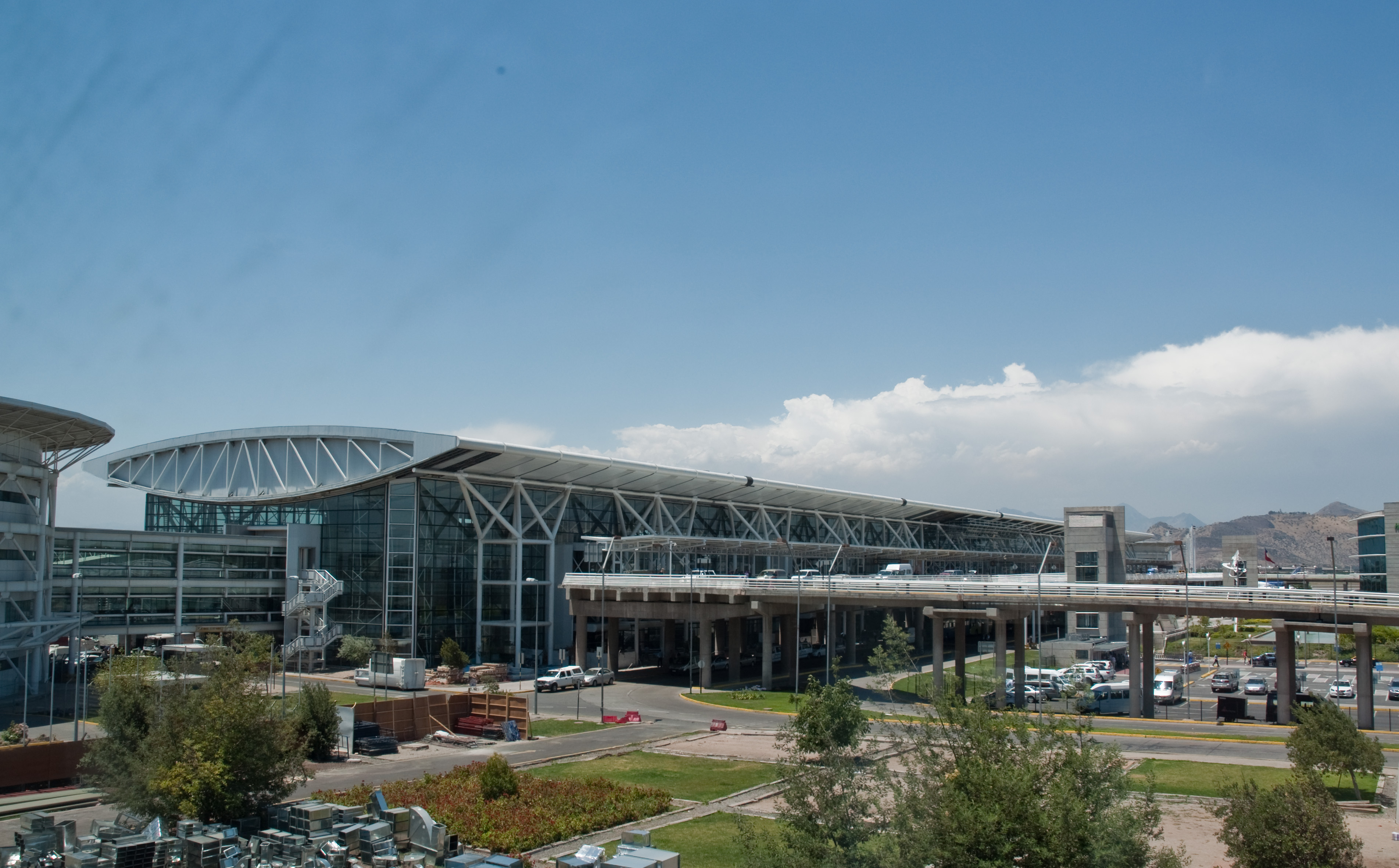
Arturo Merino Benítez International Airport (IATA: SCL) is Santiago's national and international airport and the principal hub of LATAM Airlines, Sky Airline, Aerocardal and JetSmart. The airport is located in the western commune of Pudahuel. The largest airport in Chile, it is ranked sixth in passenger traffic among Latin American airports, with 14,168,282 passengers served in 2012 – a 17% increase over 2011. It is located 15 km from the city center.
Peldehue airport in Colina began operations on 13 December 2021. It will be able to service up to 25 flights each hour. Santiago is also served by Eulogio Sánchez Airport (ICAO: SCTB), a small, privately owned general aviation airport in the commune of La Reina.
Rail


Trains operated by Chile's national railway company, Empresa de los Ferrocarriles del Estado (EFE), connect Santiago to several cities in the south-central part of the country: Rancagua, San Fernando, Talca (connected to the coastal city of Constitución by a different train service), Linares and Chillán. All such trains arrive and depart from the Estación Central railway station (Central Station), which can be accessed by bus or subway. The proposed Santiago–Valparaíso railway line would connect Santiago with Valparaíso in 45 minutes, and expansions of the commuter rail network to Melipilla and Batuco are under discussion.
Inter-urban buses
Bus companies provide passenger transportation from Santiago to most areas of the country as well as to foreign destinations, while some also provide parcel shipping and delivery services.
There are several bus terminals in Santiago:
- Terminal San Borja: located in Estación Central metro station. Provides buses to all destinations in Chile and to some towns around Santiago.
- Terminal Alameda: located in Universidad de Santiago metro station. Provides buses to all destinations in Chile.
- Terminal Santiago: located one block west of Terminal Alameda. Provides buses to all destinations in Chile as well as to destinations in most countries in South America, except Bolivia.
- Terrapuerto Los Héroes: located two blocks east of Los Héroes metro station. Provides buses to south of Chile and some northern cities, as well as Argentina (Mendoza and Buenos Aires) and Paraguay (Asunción).
- Terminal Pajaritos: located in Pajaritos metro station. Provides buses to the international airport, inter-regional services to Valparaíso, Viña del Mar and several other coastal cities and towns.
- Terminal La Cisterna: located in La Cisterna metro station. Provides buses to towns around southern Santiago, Viña del Mar, Temuco and Puerto Montt.
- Terminal La Paz: located about two blocks away from La Vega Central Market; the closest Metro station is Puente Cal y Canto. It connects the rural areas north of Santiago.
Highways
EFE provides suburban rail service under the brandname of Metrotren. There are 2 southbound routes. The most popular is the Metrotren Nos service, between the Central Station of Santiago and Nos station, in San Bernardo. This line, inaugurated in 2017, serves 8 million people per year, with 12 trains serving 10 stations with a frequency of 6 minutes during rush hours, and 12 during the rest of the time. The other route is the Metrotren Rancagua service, between the Central Station of Santiago and the Rancagua station, connecting Santiago with the regional capital of O'Higgins.
Bus
Administrative divisions
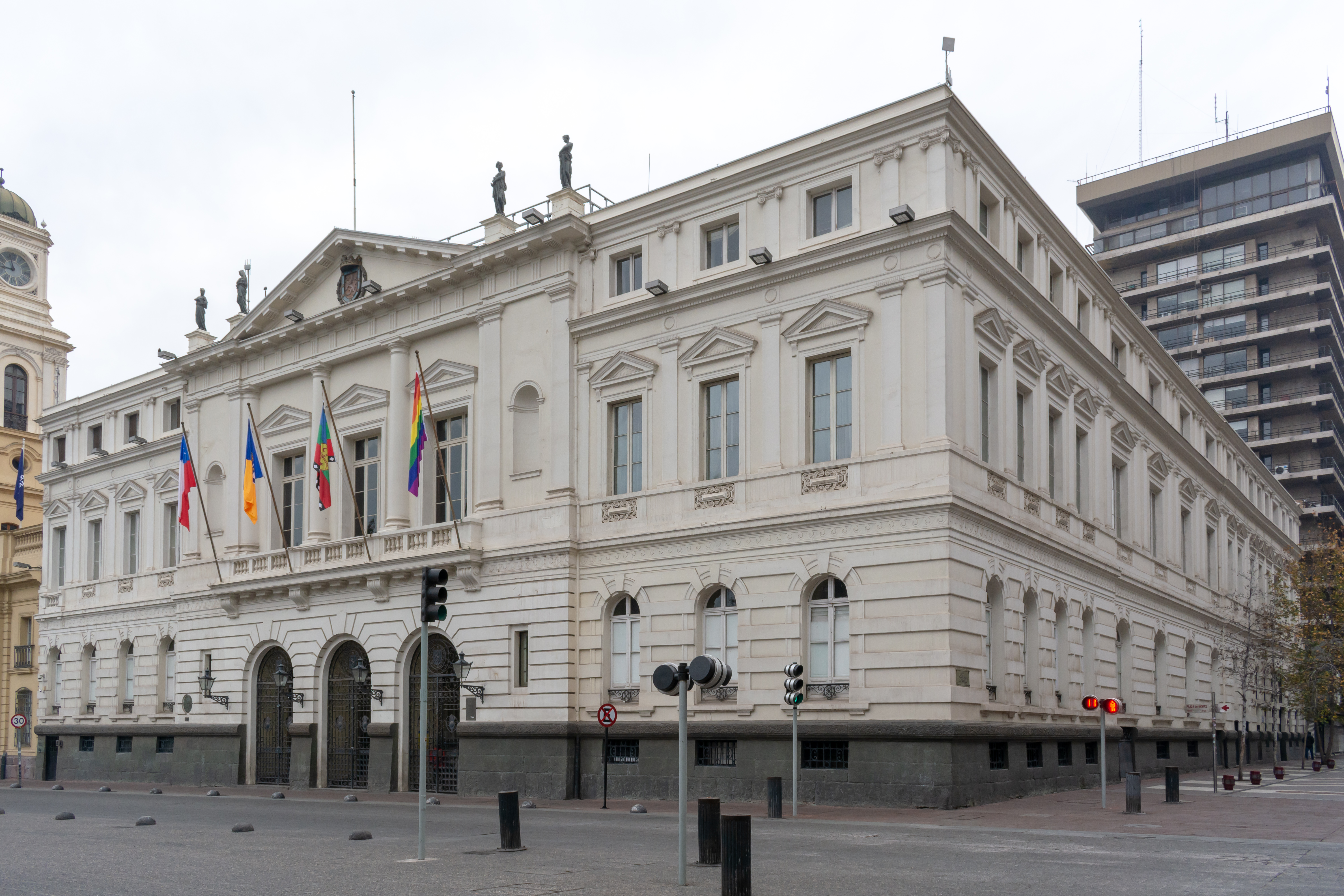
Greater Santiago lacks a metropolitan government for its administration, which is distributed between authorities, complicating the operation of the city as a single entity. The highest authorities in Santiago are considered to be the governor of the Santiago Metropolitan Region, who is popularly elected to the office, now held by Claudio Orrego, and the regional presidential delegate of Santiago Metropolitan Region, an official appointed by the president of Chile.
The conurbation of Greater Santiago does not fit perfectly into any administrative division, as it extends into four different provinces and 35 communes plus 11 satellite communes which together make the Santiago Metropolitan Area. The majority of its 641.4 km² (as of 2002) lie within Santiago Province, with some peripheral areas contained in the provinces of Cordillera, Maipo, and Talagante.
Although there is no official consensus in this regard, the communes of the city are usually grouped into seven sectors: north, center, northeast, southeast, south, southeast and southwest.
| La Granja |
|---|
| Peñalolén |
|---|
| Vitacura |
|---|
|- ! colspan="3" style="text-align:center;"| Communes in other provinces |-
| Pirque |
|---|
| San Bernardo |
|---|
| San José de Maipo |
|---|
|}
Culture
Only a few historical buildings from the Spanish colonial period remain in the city, because – like the rest of the country – Santiago is regularly hit by earthquakes. Extant buildings include the Casa Colorada (1769), the San Francisco Church (1586), and Posada del Corregidor (1750).
The cathedral on the central square (Plaza de Armas) is a sight that ranks as high as the Palacio de La Moneda, the Presidential Palace. The original building was built between 1784 and 1805, and architect Joaquín Toesca was in charge of its construction. Other buildings surrounding the Plaza de Armas are the Central Post Office Building, which was finished in 1882, and the Palacio de la Real Audiencia de Santiago, built between 1804 and 1807. It houses the Chilean National History Museum, with 12,000 objects that can be exhibited. On the southeast corner of the square stands the green cast-iron Commercial Edwards building, which was built in 1893. East of that is the colonial building of the Casa Colorada (1769), which houses the Museum of Santiago. Close by is the Municipal Theater of Santiago, which was built in 1857 by the French architect Brunet of Edward Baines. It was badly damaged by an earthquake in 1906. Not far from the theater is the Subercaseaux Mansion and the National Library, one of the largest libraries of South America.
The Former National Congress Building, the Justice Palace, and the Royal Customs Palace (Palacio de la Real Aduana de Santiago) are located close to each other. The latter houses the Museum of pre-Columbian art. A fire destroyed the building of the Congress in 1895, which was then rebuilt in a neoclassical style and reopened in 1901. The Congress was deposed under the military dictatorship (1973–89) of Augusto Pinochet, and after the dictatorship was newly constituted on 11 March 1990, in Valparaíso.
The building of the Justice Palace (Palacio de Tribunales) is located on the south side of the Montt Square. It was designed by the architect Emilio Doyére and built between 1907 and 1926. The building is home to the Supreme Court of Chile. The panel of 21 judges is the highest judicial power in Chile. The building is also the headquarters of the Court of Appeals of Santiago.
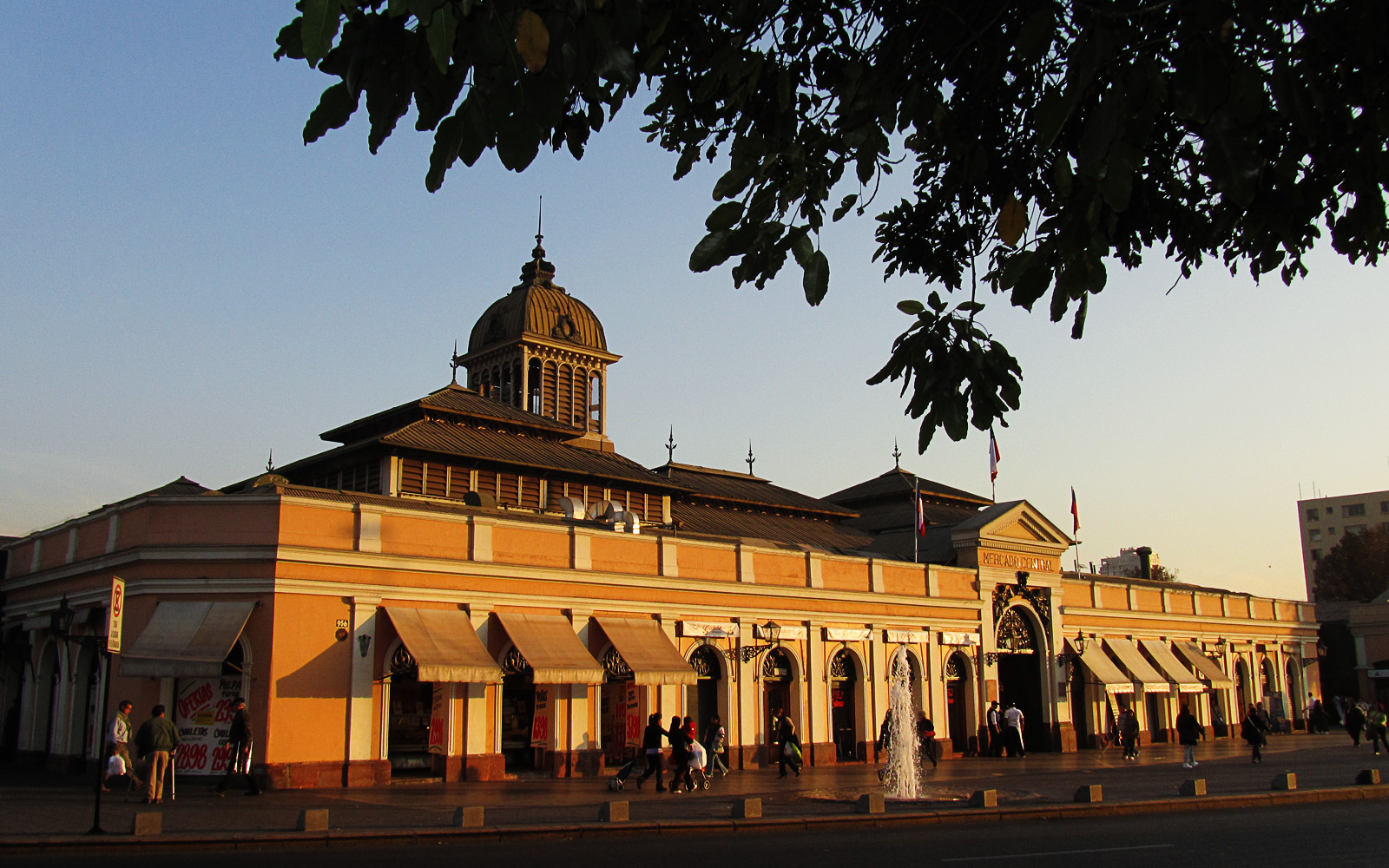
Bandera street leads toward the building of the Santiago Stock Exchange (the Bolsa de Comercio), completed in 1917, the Club de la Unión (opened in 1925), the Universidad de Chile (1872), and toward the oldest churchhouse in the city, the San Francisco Church (constructed between 1586 and 1628), with its Marian statue of the Virgen del Socorro ("Our Lady of Help"), which was brought to Chile by Pedro de Valdivia. North of the Plaza de Armas ("Square of Arms", where the colonial militia was mustered) are the Paseo Puente, the Santo Domingo Church (1771), and the Central Market (Mercado Central), an ornamental iron building. Also in downtown Santiago is the Torre Entel, a 127.4-meter-high television tower with observation deck completed in 1974; the tower serves as a communication center for the communications company, ENTEL Chile.
The Costanera Center was completed in 2009, and includes housing, shopping, and entertainment venues. The project, with a total area of 600,000 square meters, includes the 300-meter high Gran Torre Santiago (South America's tallest building) and other commercial buildings. The four office towers are served by highway and subway connections.
File:Teatro Municipal, Santiago 20230521 01.jpg|Municipal Theater of Santiago File:Palacio de La Moneda.png|Palacio de La Moneda File:Museo de Arte Contemporáneo Santiago2.jpg|Contemporary Art Museum of Santiago File:Museo Nacional de Bellas Artes.jpg| The National Museum of Fine Arts, located next to Parque Forestal. File:Palacio Edwards, Santiago 20230416.jpg|Palacio Edwards File:Casa Matriz Banco de Chile 2013.jpg|Head Office of the Bank of Chile
Heritage and monuments

Within the metropolitan area of Santiago, there are 174 heritage sites in the custody of the National Monuments Council, among which are archeological, architectural and historical monuments, neighborhoods and typical areas. Of these, 93 are located within the commune of Santiago, considered the historic center of the city. Although no santiaguino monument has been declared a World Heritage Site by Unesco three have already been proposed by the Chilean government: the Incan sanctuary of El Plomo, the church and convent of San Francisco and the palace of La Moneda.
In the center of Santiago are several buildings built during the Spanish domination and that mostly correspond to, as the Metropolitan Cathedral and the aforementioned church of San Francisco Catholic churches. Buildings of the period are those located on the sides of Plaza de Armas, as the seat of Real Audiencia, the Post Office or the Casa Colorada.
During the nineteenth century and the advent of independence, new architectural works began to be erected in the capital of the young republic. The aristocracy built small palaces for residential use, mainly around the neighborhood Republica and preserved until today. To this other structures adopted artistic trends from Europe, as the Equestrian Club of Santiago, the head offices of the University of Chile and the Catholic University, Central Station and the Mapocho Station, Mercado Central, join the National Library, Museum of Fine Arts and the Barrio París-Londres, among others.
Various green areas in the city contain within and around various sites of heritage character. Among the most important are the fortifications of Santa Lucia hill, the shrine of the Virgin Mary on the summit of San Cristobal hill, the lavish crypt of the General Cemetery, Parque Forestal, the O'Higgins Park and the Quinta Normal Park.
Cultural activities and entertainment


In Santiago's major theater companies are located, hosting several national and international projects, with the highest expression during the International Theater Festival known as Santiago a Mil, which takes place every January since 1994 and has gathered more than one million spectators. Also is the Planetarium at the University of Santiago de Chile.
To carry out various cultural, artistic and musical events, there are several precincts within which highlight the Mapocho Cultural Center, 100 Matucana Cultural Center, the Gabriela Mistral Cultural Center, Centro Cultural Palacio de La Moneda, the Movistar Arena and the Caupolican Theater. On the other hand, the opera and ballet performances are permanently accepted by the Municipal Theater of Santiago, located in the heart of the city and which has a capacity of 1500 spectators.
There are 18 cinemas in the capital with a total of 144 rooms and over 32,000 seats, the projection centers than 5 arthouse add.
For children and teenagers, there are several entertainment venues, such as amusement park Fantasilandia, the National Zoo or the Buin Zoo on the outskirts of the city. The Bellavista, Brasil, Manuel Montt, Plaza Ñuñoa and Suecia account for most of the nightclubs, restaurants and bars in the city, the main evening entertainment centers in the capital. In order to promote the economic development of other regions, the law prohibits the construction of a casino in the metropolitan region, but nearby are the casino from the coastal city of Vina del Mar, 120 km from distance from Santiago, and Monticello Grand Casino in Mostazal, 56 kilometers south of Santiago, which opened in 2008.
Museums and libraries

Santiago has a wealth of museums of different kinds, among which are three of 'National' class administered by the Directorate of Libraries, Archives and Museums (DIBAM): the National History Museum, National Museum of Fine Arts and the National Museum of Natural History.
Most of the museums are located in the historic city center, occupying the old buildings of colonial origin, such as with the National History Museum, which is located in the Palacio de la Real Audiencia. La Casa Colorada houses the Museum of Santiago, while the Colonial Museum is housed in a wing of the Church of San Francisco and the Museum of Pre-Columbian Art occupies part of the old Palacio de la Aduana. The Museum of Fine Arts, though it is located in the city center, was built in the early twentieth century, especially for housing the museum and in the back of the building was laid in 1947, the Museum of Contemporary Art, under the Faculty of Arts of the University of Chile.
Quinta Normal Park also has several museums, among which are the already mentioned Natural History, Artequin Museum, the Museum of Science and Technology, and the Santiago Railway Museum. In 2010, the Museum of Memory and Human Rights was inaugurated, which commemorates the victims of human rights violations committed during the country's military dictatorship.
In other parts of the city there are some museums such as the Aeronautical Museum in Cerrillos, Museum of Tajamares in Providence and the Museo Interactivo Mirador in La Granja. The latter opened in 2000 and designed mainly for children and youth has been visited by more than 2.8 million visitors, making it the busiest museum in the country.
The most important public library is the National Library located in downtown Santiago. Its origins date back to 1813, when it was created by the nascent Republic and was moved to its current premises a century later, also home to the headquarters of the National Archives. In order to provide more closeness to the population, incorporating new technologies and complement the services provided by public libraries and the National Library was opened in 2005 the Library of Santiago at Barrio Matucana.
Palacio de la Real Audiencia y Cajas Reales 2013-09-24 13-40-32.jpg|The National Historical Museum, located in the Plaza de Armas Chile-02568 - Post Office (49032531863).jpg|The Central Post Office Building Frontis_Museo_Nacional_de_Historia_Natural_de_Chile.jpg|The National Museum of Natural History, located in the Quinta Normal. BibliotecaNacionaldeChile.JPG|The National Library from La Alameda.
Music
Santiago has two symphony orchestras:
- Orquesta Filarmónica de Santiago ("Santiago Philharmonic Orchestra"), which performs in the Teatro Municipal (Municipal Theater of Santiago)
- Orquesta Sinfónica de Chile ("Chile Symphony Orchestra"), part of the Universidad de Chile, performs in its theater.
There are a number of jazz establishments, some of them, including "El Perseguidor", "Thelonious", and "Le Fournil Jazz Club", are located in Bellavista, one of Santiago's "hippest" neighborhoods, though "Club de Jazz de Santiago", the oldest and most traditional one, is in Ñuñoa. Annual festivals featured in Santiago include Lollapalooza and the Maquinaria festival.
Newspapers
The most widely circulated newspapers in Chile are published by El Mercurio and Copesa and have earned more than the 91% of revenues generated in printed advertizing in Chile.
Some newspapers available in Santiago are:
- The Santiago Times
- La Segunda
- La Tercera
- La Cuarta
- El Mercurio
- The Clinic
- Las Últimas Noticias
Media
Santiago is home to the major Chilean television networks including the public broadcaster TVN and the privately held Canal 13, Chilevisión, La Red and Mega. In addition, the radio stations ADN Radio Chile, Radio Agricultura, Radio Concierto, Radio Cooperativa, Radio Pudahuel and Radio Rock & Pop are located in the city.
Sports
Santiago is home to some of Chile's most successful soccer clubs. Colo-Colo, founded on 19 April 1925, has a long tradition, and has played continuously in the highest league since the establishment of the first Chilean league in 1933. The club's wins include 30 national titles, 10 Copa Chile successes, and champions of the Copa Libertadores tournament in 1991, the only Chilean team to have won this tournament. The club hosts its home games in the Estadio Monumental in the commune of Macul.

Universidad de Chile has 18 national titles and 5 Copa Chile wins. In 2011 they were champions of Copa Sudamericana, the only Chilean team to have won this tournament. The club was founded on 24 May 1927, under the name Club Deportivo Universitario as a union of Club Náutico and Federación Universitaria. The founders were students of the University of Chile. In 1980, the organization separated from the University of Chile and the club is now completely independent. The team plays its home games in the Estadio Nacional de Chile in the commune of Ñuñoa.
Club Deportivo Universidad Católica (UC) was founded on 21 April 1937. It consists of fourteen different departments. This team plays its home games in Estadio San Carlos de Apoquindo. Universidad Católica has 13 national titles, making it the third most successful soccer club in the country. It has played the Copa Libertadores more than 20 times, reaching the final in 1993, losing to São Paulo FC.
Several other soccer clubs are based in Santiago, including Unión Española, Audax Italiano, Palestino, Santiago Morning, Magallanes and Barnechea. Other sports, mainly tennis and basketball, are also popular. The Club Hípico de Santiago and the Hipódromo Chile are the two horseracing tracks in the city.
Santiago hosted the final stages of the official 1959 Basketball World Cup, where Chile won the bronze medal.
The city held a round of the all-electric FIA Formula E Championship on 3 February 2018, on a temporary street circuit incorporating the Plaza Baquedano and Parque Forestal. It was the first FIA sanctioned race in the country.
The 2023 Pan American Games were held in Santiago.
The 2027 Special Olympics World Summer Games will be held in Santiago. This will mark the first time that a Spanish speaking country, the southern hemisphere and Latin America has ever hosted the Special Olympics World Games.
Recreation


There is an extensive network of bicycle trails in the city, especially in the Providencia commune. The longest section is the Americo Vespuccio road, which contains a very wide dirt path with many trees through the center of a street used by motorists on both sides. The next longest path is along the Mapocho River along Andrés Bello Avenue. Many people use folding bicycles to commute to work.
The city's main parks are:
- 150-hectare Santiago Metropolitan Park, which covers the San Cristóbal Hill and includes the Chilean National Zoo and the Santiago Cable Car.
- Parque Bicentenario, a 30-hectare park alongside the Mapocho river in Vitacura
- O'Higgins Park
- Quinta Normal Park
- Forestal Park, park located at the city center alongside Mapocho river
- Santa Lucia Hill
- Parque Araucano in Las Condes, adjacent to the Parque Arauco shopping mall contains 30 hectares of gardens.
- Parque Inés de Suarez in Providencia
- Parque Padre Hurtado, also known as Parque Intercomunal.
- Parque de la Familia
- Parque Mapocho Río
There are ski resorts to the east of the city (Valle Nevado, La Parva, El Colorado) and wineries in the plains west of the city.
Cultural venues include:
- Museo de Bellas Artes – Fine Arts Museum
- Museo Violeta Parra, an art museum dedicated to Chilean folk artist Violeta Parra [opened in 2015 and damaged in 2020]
- Barrio Bellavista, cultural and bohemian neighborhood
- Central Station, railway station designed by Gustave Eiffel
- Víctor Jara Stadium
- Ex National Congress
- Plaza de Armas, central square
- Palacio de La Moneda, government palace.
- Teatro Municipal (Municipal Theater of Santiago), the principal opera house of the country.
The main sports venues are Estadio Nacional (site of the 1962 World Cup final), Estadio Monumental David Arellano, Estadio Santa Laura, and Estadio San Carlos de Apoquindo.
Religion
.jpg)
As in most of Chile, the majority of the population of Santiago is Catholic. According to the National Census, carried out in 2002 by the National Statistics Bureau (INE), in the Santiago Metropolitan Region, 3,129,249 people 15 and older identified themselves as Catholics, equivalent to 68.7% of the total population, while 595,173 (13.1%) described themselves as Evangelical Protestants. Around 1.2% of the population declared themselves as being Jehovah's Witnesses, while 2.0% identified themselves as Latter-day Saints (Mormons), 0.3% as Jewish, 0.1% as Eastern Orthodox and 0.1% as Muslim. Approximately 10.4% of the population of the Metropolitan Region stated that they were atheist or agnostic, while 5.4% declared that they followed other religions. In 2010 construction was initiated on the Santiago Bahá'í Temple, serving as the Baháʼí House of Worship for South America, in the commune of Peñalolen. Construction at the site was completed and the temple was dedicated in October 2016.
Education
The city is home to numerous universities, colleges, research institutions, and libraries.
The largest university and one of the oldest in the Americas is Universidad de Chile. The roots of the university date back to the year 1622, as on 19 August the first university in Chile under the name of Santo Tomás de Aquino was founded. On 28 July 1738, it was named the Real Universidad de San Felipe in honor of King Philip V of Spain. In the vernacular, it is also known as Casa de Bello (Spanish: House of Bello – after their first Rector, Andrés Bello). On 17 April 1839, after Chile's independence from the Kingdom of Spain, it was renamed the Universidad de Chile, and reopened on 17 September 1843.
The Pontificia Universidad Católica de Chile (PUC) was founded in June 1888 and was ranked as the best school in Latin America in 2014. On 11 February 1930 it was declared a university by a decree of Pope Pius XI. It received recognition by the Chilean government as an appointed Pontifical University in 1931. Joaquín Larraín Gandarillas (1822–1897), Archbishop of Santiago, was the founder and first rector of the PUC. The PUC is a modern university; the campus of San Joaquin has a number of contemporary buildings and offers many parks and sports facilities. Several courses are conducted in English. Ex-president, Sebastián Piñera, minister Ricardo Raineri, and minister Hernán de Solminihac all attended PUC as students and worked in PUC as professors. In the 2010 admission process, approximately 48% of the students who achieved the best score in the Prueba de Selección Universitaria matriculated in the UC.
Higher education
Traditional


- Universidad de Chile (U or UCH)
- Pontificia Universidad Católica de Chile (PUC)
- Universidad de Santiago de Chile (USACH)
- Universidad Metropolitana de Ciencias de la Educación (UMCE)
- Universidad Tecnológica Metropolitana (UTEM)
- Universidad Técnica Federico Santa María (UTFSM)
Non-traditional
- Universidad Adolfo Ibáñez (UAI)
- Universidad del Desarrollo (UDD)
- Universidad Diego Portales (UDP)
- Universidad Alberto Hurtado (UAH)
- Universidad Central de Chile (Ucen)
- Universidad Nacional Andrés Bello (Unab)
- Universidad Academia de Humanismo Cristiano (UAHC)
- Universidad Mayor (UM)
- Universidad Finis Terrae
- Universidad de Los Andes
- Universidad Gabriela Mistral (UGM)
- Universidad del Pacífico
- Universidad de las Américas
- Universidad de Artes, Ciencias y Comunicación (UNIACC)
- Universidad San Sebastián (USS)
- Universidad Bolivariana
Other
International relations
Santiago is home to a number of international relations institutions, such as the Regional Unit for International Affairs (URAI) of the Metropolitan Regional Government of Santiago, responsible for analyzing and managing the Santiago Metropolitan Region’s bilateral and multilateral relations with Latin America and the rest of the world; the International Cooperation Commission of the Metropolitan Regional Council of Santiago; the Ministry of Foreign Affairs of Chile; the National Migration Service; the National Headquarters for Migration and International Police of the Investigations Police of Chile; the General Directorate for Export Promotion; the Chilean Agency for International Cooperation for Development; the International Relations Unit of the Municipality of Peñalolén; and municipal migration offices in 32 communes of the Santiago Metropolitan Area.
International organizations

Santiago serves as the national and Latin American regional headquarters for several international organizations, such as the Economic Commission for Latin America and the Caribbean (ECLAC), the United Nations Development Programme (UNDP), the Pan American Health Organization (PAHO), the Food and Agriculture Organization of the United Nations (FAO), the International Labour Organization (ILO), the United Nations Educational, Scientific and Cultural Organization (UNESCO), the World Bank, the Inter-American Development Bank, and CAF – Development Bank of Latin America and the Caribbean.
Internationalization in higher education
In the field of international relations and higher education, the main actors in Santiago are the Office of the Vice President for International Affairs of the Pontifical Catholic University of Chile, the Office of International Relations of the University of Chile, the Department of International and Interuniversity Relations of the University of Santiago, Chile, the Office of International Relations of the Adolfo Ibáñez University, the Vice-Rector’s Office for International Affairs of the Andrés Bello University, the Directorate of Globalization of the University of Development, and the General Directorate of International Relations of the Diego Portales University. Santiago also hosts higher education and research institutions specializing in International Relations, such as the Institute of International Studies of the University of Chile, the Institute for Advanced Studies of the University of Santiago, Chile, the Diplomatic Academy of Chile “Andrés Bello” (ACADE), and the National Academy of Political and Strategic Studies (ANEPE).
Embassies
Twin towns – sister cities
Santiago is twinned with:
- CHN Beijing, China
- ARG Buenos Aires, Argentina
- CHN Guangzhou, China
- UKR Kyiv, Ukraine
- UK London, England, United Kingdom
- ESP Madrid, Spain
- USA Miami, United States
- USA Minneapolis, United States
- LVA Riga, Latvia
- BRA São Paulo, Brasil
- MAR Tangier, Morocco
Cooperation and friendship
- FRA Paris, France
- TUN Tunis, Tunisia
Union of Ibero-American Capital Cities
Santiago is part of the Union of Ibero-American Capital Cities from 12 October 1982.
References
Bibliography
References
- "TelluBase—Chile Fact Sheet (Tellusant Public Service Series)". Tellusant.
- "Subnational HDI (v9.0)". Institute for Management Research.
- {{cite LPD. 3
- (June 2018). "SÍNTESIS DE RESULTADOS CENSO 2017".
- (2024-07-05). "James the Apostle – St. Paul Anglican Church".
- (2006). "Gramática básica de la lengua mapuche". Editorial UC Temuco.
- "Re-Solution: Claudio Orrego, Governor of the Santiago Metropolitan Region".
- De Ramón, Armando. (2000). "Santiago de Chile (1541-1991): Historia de una sociedad urbana". Editorial Sudamericana.
- Pobladores de Chile, 1565–1580, libro de Juan Guillermo Muñoz Correa, Ediciones Universidad de la Frontera, Temuco, 1989.
- Ledermann, Walter. (February 2021). "De cómo se gestó el alcantarillado de Santiago de Chile". Revista Chilena de Infectología.
- Valencia, Nicolás. (2022-11-23). "Santiago Architecture City Guide: 41 Buildings, Complexes and Parks to Visit in the Chilean Capital".
- (December 2018). "Katulongkon: contextualización y antecedentes transculturales del simbolismo de la cabeza entre los Reche-Mapuche". Estudios Atacameños.
- León, Leonardo. (1991). "La merma de la sociadad indígena en Chile central y la última guerra de los promaucaes". Institute of Amerindian Studies, University of St. Andrews.
- (1821). "The Cañada. Santiago".
- (1821). "Travels Into Chile, Over the Andes, in the Years 1820 and 1821: With Some Sketches of the Productions and Agriculture; Mines and Metallurgy; Inhabitants, History, and Other Features, of America; Particularly of Chile, and Arauco". [[Daler-Rowney.
- (1821). "Scenes at a Fair, Santiago".
- (1824). "The Mint of Santiago".
- [[John Miers (botanist). (1826). "Travels in Chile and La Plata".
- [[John Miers (botanist). (1826). "Travels in Chile and La Plata. CHAPTER XII - CHILE DESCRIBED". Cambridge University Press.
- (1850). "Plaza de Armas de Santiago en 1850".
- [[Claude Gay]]. (1847). "Historia fisica y politica de Chile segun documentos adquiridos en esta republica durante doce años de residencia en ella y publicada bajo los auspicios del supremo gobierno. Volume 13".
- (2004-10-18). "A History of Chile, 1808-2002". [[Cambridge University Press]].
- Anson Uriel Hancock. (1893). "A History of Chile". C. H. Sergel.
- Martín. (29 May 2007). "Past, present, and future images of a "green space" in the metropolitan area of Santiago". Revista Urbanismo, Nº3.
- (1821). "Travels Into Chile, Over the Andes, in the Years 1820 and 1821: With Some Sketches of the Productions and Agriculture; Mines and Metallurgy; Inhabitants, History, and Other Features, of America; Particularly of Chile, and Arauco". [[Daler-Rowney.
- (1821). "Tertulia and Mate Party".
- De Ramón, Armando. (2000). "Memoria Chilena - Documentos". Editorial Sudamericana.
- Peaklist. (2007). "Argentina and Chile Central, Ultra-Prominences".
- (2017). "Sinopsis bioclimática y vegetacional de Chile". [[Editorial Universitaria]].
- Radio Pauta. (24 June 2023). "Meteorólogo sobre la instalación del clima semiárido en Santiago: "El cambio climático solo está acelerando un proceso que viene desde hace siglos"".
- Gelcich. (2020). "Boletín Nacional de Análisis de Riesgos Agroclimáticos para las Principales Especies Frutales y Cultivos y la Ganadería (Introducción)". Boletín Agrometeorológico, Instituto de Investigaciones Agropecuarias.
- "Cartografía interactiva de los climas de Chile (seleccionar estaciones: Pudahuel, Quinta Normal y Los Cerrillos)". Universidad Católica de Chile (UC).
- Rutllant, Josè and [[Humberto Fuenzalida. Fuenzalida, Humberto]]; "Synoptic Aspects of the Central Chile Rainfall Variability Associated with the Southern Oscillation," ''International Journal of Climatology'', vol. 11 (1991), pp. 63–76
- [[Roland Paskoff. Paskoff, Roland P.]]; "Geomorphological Processes and Characteristic Landforms in the Mediterranean Regions of the World," ''Mediterranean Type Ecosystems''; in ''Ecological Studies'', Volume 7, 1973, pp. 53–60
- [[Louis Lliboutry. Lliboutry, Louis]]; "Studies of the shrinkage after a sudden advance, blue bands and wave ogives on Glaciar Universidad (central Chilean Andes)," ''Journal of Glaciology''; vol. 3, Issue 24, pp. 261–270
- Luis Lazcano. (23 November 2011). "Temperatura Mensual".
- Luis Lazcano. (23 November 2011). "Temperatura Mensual".
- Luis Lazcano. (23 November 2011). "Temperatura Mensual".
- In winter, the [[snow line]] is about {{convert. 2100.. m. -1. 1500.. -. 2900.. m. link. (23 March 2014 . {{in lang). es '''Sociedad Chilena de Ingeniería Hidráulica''', '''XI Congreso Chileno'''. Retrieved 20 January 2012.
- Dirección Meteorológica de Chile. (13 August 2017). "Eventos de nieve en Santiago de Chile".
- Vicencio, José. (28 January 2019). "40 grados y contando: La histórica ola de calor que batió récord en la zona central". Dirección Meteorológica de Chile.
- "How Does Air Movement Affect Weather?".
- (March 2001). "Estadistica Climatologica Tomo I". Dirección General de Aeronáutica Civil.
- "Datos Normales y Promedios Históricos Promedios de 30 años o menos". Dirección Meteorológica de Chile.
- "Temperaturas Medias y Extremas en 30 Años-Entre los años: 1991 al 2020-Nombre estación: Pudahuel Santiago". Dirección Meteorológica de Chile.
- "Temperatura Mensual Histórica de la Estación". Dirección Meteorológica de Chile.
- "Pudahuel Aeropuerto Santiago Climate Normals 1991–2020". [[National Oceanic and Atmospheric Administration]].
- "Datos Normales y Promedios Históricos Promedios de 30 años o menos". Dirección Meteorológica de Chile.
- "Temperatura Mensual Histórica de la Estación". Dirección Meteorológica de Chile.
- "Quinta Normal Santiago Climate Normals 1991–2020". [[National Oceanic and Atmospheric Administration]].
- "Klimatafel von Santiago de Chile (Stadt) / Chile". Deutscher Wetterdienst.
- "Datos Normales y Promedios Históricos Promedios de 30 años o menos". Centro de Agricultura y Medioambiente.
- Buchenau, Jürgen, and Lyman L. Johnson. ''Aftershocks: Earthquakes and Popular Politics in Latin America''. Albuquerque: U of New Mexico, 2009. Print.
- Snook, Margaret. "Chile's Earthquake: View from Santiago." ''The Guardian'', 27 February 2010. Retrieved 30 September 2014
- (2021). "The likely Quaternary active El Arrayán fault, Santiago, Chile". [[Andean Geology]].
- (2010). "The West Andean Thrust, the San Ramón Fault, and the seismic hazard for Santiago, Chile". [[Tectonics (journal).
- (2018). "Landslide susceptibility maps of Santiago city Andean foothills, Chile". [[Andean Geology]].
- [http://en.mercopress.com/2007/06/29/severe-air-pollution-plagues-chilean-cities "Severe air pollution plagues Chilean cities"] {{Webarchive. link. (25 May 2014 29 June 2007.)
- Morales, Pamela. (26 January 2010). "Chilean University Finds Santiago Pollution Has Doubled". [[The Santiago Times]].
- Valdez, Ana. (2012). "Elemental concentrations of ambient particles and cause specific mortality in Santiago, Chile: a time series study.". Environmental Health.
- "Cipma.cl".
- "Bio.puc.cl".
- Pedro Oyola. "the role of monitoring in air quality management".
- (14 May 2008). "Conoma.cl". Conama.cl.
- "From dump to urban wetland, wildlife returns to river in Chile's capital". Reuters.
- Sarria De la Vega, Bárbara. (2020-11-19). "Mapocho Urbano Limpio: a 10 años del exitoso proyecto de descontaminación del agua".
- Se consideran en total las comunas de la [[Santiago Province, Chile. Provincia de Santiago]], más [[Padre Hurtado]], [[Pirque]], [[Puente Alto]] y [[San Bernardo (Chile). San Bernardo]]. Estas cifras no son equivalentes a la de la ciudad de Santiago pues excluyen ciertas áreas fuera de dichas comunas e incluyen algunas zonas rurales; sin embargo, representa a un 95,4% de la población total del área metropolitana.
- INE. "Chile, proyecciones de población al 30 de junio (1990–2020): Región Metropolitana de Santiago".
- which, according to the 2002 census, amounts to 28.5% of the national total. 67.6% of the inhabitants of Santiago claim to have been born in one of the communes of the metropolitan area. In communes such as [[Santiago Centro]] and [[Independencia, Chile. Canal 13]]: [http://www.t13.cl/noticia/nacional/Censo-2017-28-de-habitantes-en-la-comuna-de-Santiago-son-inmigrantes Censo 2017: 28% de habitantes en la comuna de Santiago son inmigrantes] {{Webarchive. link. (27 May 2019 . Published: 2018-5-5.)
- [https://www.24horas.cl/data/estas-son-las-comunas-de-chile-con-mayor-porcentaje-de-poblacion-extranjera-2704696 Estas son las comunas de Chile con mayor porcentaje de población extranjera] {{Webarchive. link. (27 May 2019 . ''24 Horas Chile''. Published 2018-5-5.)
- "Santiago.cl". Santiago.cl.
- "Why You Should Move to Santiago, Chile". BrophyWorld.
- (June 2007). "Geographic Income Inequality in Chile". Revista de Analisis Economico.
- Martínez, Adrián. "Chile: Economy, income inequality growing". Infosurhoy.com.
- (29 January 2009). "Reuters.com". In.reuters.com.
- "La Segunda".
- "Estadisticas de trafico de pasajeros". Aeropuerto de Santiago.
- Rojas, Tamara. (13 December 2021). "Inauguran Aeródromo de Peldehue en Colina: realizará hasta 25 vuelos por hora".
- "EFE".
- "Railway-technology.com". Railway-technology.com.
- "Metrosantiago.cl". Metrosantiago.cl.
- [https://www.railjournal.com/regions/central-south-america/chilean-president-inaugurates-santiago-line-3/ "Chilean president inaugurates Santiago metro Line 3"] {{Webarchive. link. (3 September 2019 , ' 'International Railway Journal' ')
- Villegas, Alejandro. (2022-12-27). "Gobierno volvió a la carga con plan "anti Uber": han quitado más de 4.500 autos de aplicaciones".
- "Moovit Public Transit Index".
- (2025-06-03). "Día Mundial de la Bicicleta: el auge del ciclismo urbano y nuevos desafíos para la movilidad activa".
- (2025-06-03). "En Santiago ya se pedalea en serio: viajes en bicicleta se duplicaron en 12 años".
- Vega, Rodrigo Iván Mora. (2020). "Efectos Urbanos De La Construcción Del Parque Lineal Y Ciclovía Pocuro, En Santiago[1]". Urbano.
- Diethelm, Magdalena. (2025-07-19). "Chile lidera: Estos son los países de América Latina con más kilómetros de ciclovías".
- Citizen. (2025-11-05). "Study Confirms Bike Lanes Reduce Conflicts Between Cyclists and Pedestrians in Santiago".
- "Un 89% de los ciclistas dicen sentirse inseguros al transitar por las calles sin ciclovías".
- (2021-10-31). "Nuevo Reglamento del MTT: ¿Qué exige en cuanto a luces, reflectantes, cascos, y dispositivos para cargar niños?".
- (13 April 2007). "Anuario Parque de Vehículos en Circulación". Instituto Nacional de Estadísticas.
- Pontificia Universidad Católica de Chile (2004), Boletín de Políticas Públicas: ''[http://www.puc.cl/icp/webcp/papers/boletin_santiago.pdf Una autoridad metropolitana para Santiago]'' {{dead link. (May 2016)
- Alexander Galetovic; Pablo Jordán. (Summer 2008). "Santiago: ¿Dónde estamos?, ¿Hacia dónde vamos?". Estudios Públicos.
- Emporis: {{usurped
- "The Santiago Times – News and Current Affairs From Chile".
- [http://www.elciudadano.cl/2008/01/02/torta-para-dos-%C2%BF-hasta-cuando/ Torta para dos ¿Hasta cuando?], elciudadano.cl {{Webarchive. link. (23 July 2011)
- Sebastián Varela. (23 May 2017). "Es oficial: el 3 de febrero se correrá la Fórmula E en Santiago". [[La Tercera]].
- Michael Pavitt. (4 November 2017). "Santiago confirmed as host of 2023 Pan American Games". Inside the Games.
- "Bicycles in Santiago, New York, and Tokyo".
- "INE, Chile, 2002 Census". Ine.cl.
- "Baháʼí Temple of South America".
- Watkins, Katie. (27 January 2015). "In Progress: Baháʼí Temple of South America / Hariri Pontarini Architects". Arch Daily.
- [http://www.historia.uchile.cl/CDA/fh_article/0,1389,SCID%253D11760%2526ISID%253D489%2526PRT%253D11759%2526JNID%253D12,00.html Fuentes documentales y bibliográficas para el estudio de la historia de Chile. Capítulo III: "La Universidad de Chile 1842 – 1879." 1. La ley orgánica de 1842] {{Webarchive. link. (24 September 2015 www.uchile.cl)
- "Top 10 Universities in Latin America". Top Universities.
- "Los Mejores Puntajes Prefieren la UC – DSRD – PUC". DSRD.
- "Migrant Offices Adhered to the Migrant Seal".
- "ECLAC".
- "Chile".
- "UNESCO Santiago".
- "Chile".
- "Vice-Rector’s Office for International Affairs".
- "International Relations - University of Chile".
- "Department of International and Interuniversity Relations {{!}} University of Santiago, Chile".
- "Welcome to UAI {{!}} Accredited University in All Areas".
- "UNAB International {{!}} General Directorate of International Relations".
- "International Relations {{!}} Universidad del Desarrollo".
- "UDP International - Diego Portales University".
- "Institute of International Studies - University of Chile".
- "Institute for Advanced Studies {{!}} University of Santiago, Chile".
- "Home - Diplomatic Academy of Chile "Andrés Bello"".
- "ANEPE – The National Academy of Political and Strategic Studies (ANEPE) is a State Higher Education Institution under the Ministry of National Defense.".
- "Sister Cities". Beijing.
- "Convenios Internacionales". Buenos Aires.
- "Sister Cities". Guangzhou.
- (2018-02-15). "Перелік міст, з якими Києвом підписані документи про поріднення, дружбу, співробітництво, партнерство". Kyiv.
- (2017-02-16). "The Twin Cities of Oxford, Cambridge and London". Oxford Royale Academy.
- "Agreements with cities". Madrid.
- (2017-04-05). "Miami y Santiago firman Acuerdo de Hermanamiento". Ilustre Municipalidad de Santiago.
- "About Sister Cities". City of Minneapolis.
- "Riga Twin Cities". Riga.
- "Cidades-Irmãs de São Paulo". São Paulo.
- (2016-02-19). "Un jumelage Tanger - Phuket (Thaïlande) en projet".
- (September 2015). "Les pactes d'amitié et de coopération". Paris.
- "Coopération internationale". Tunis.

This article was imported from Wikipedia and is available under the Creative Commons Attribution-ShareAlike 4.0 License. Content has been adapted to SurfDoc format. Original contributors can be found on the article history page.
Ask Mako anything about Santiago — get instant answers, deeper analysis, and related topics.
Research with MakoFree with your Surf account
Create a free account to save articles, ask Mako questions, and organize your research.
Sign up freeThis content may have been generated or modified by AI. CloudSurf Software LLC is not responsible for the accuracy, completeness, or reliability of AI-generated content. Always verify important information from primary sources.
Report