From Surf Wiki (app.surf) — the open knowledge base
Santanaraptor
Extinct genus of dinosaurs
Extinct genus of dinosaurs
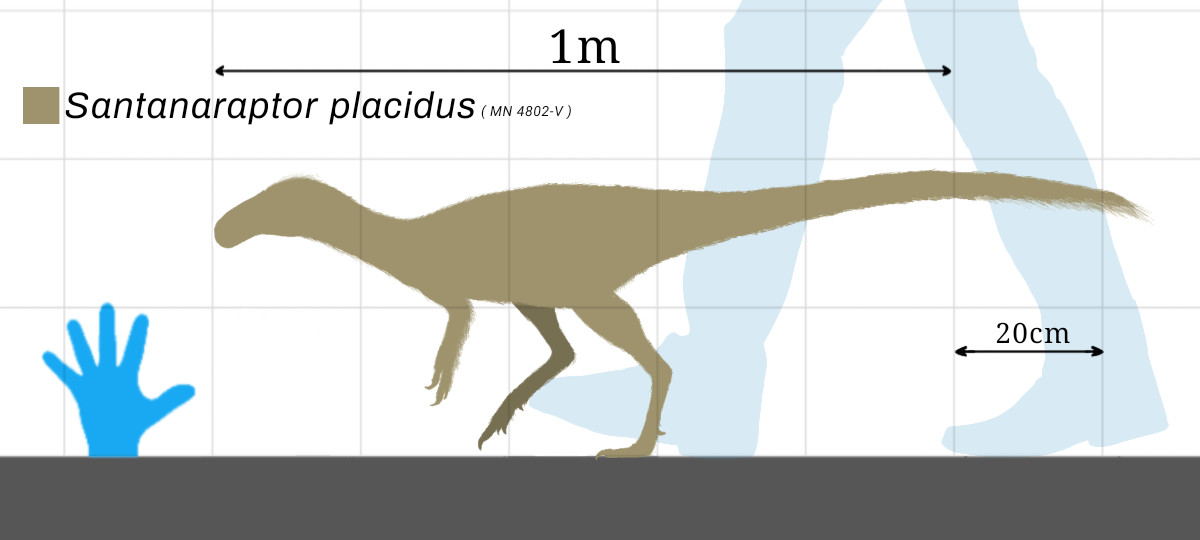
Santanaraptor (meaning "Santana Formation thief") is a genus of coelurosaurian theropod dinosaur that lived in South America during the Early Cretaceous (late Aptian-early Albian), about 112 million years ago.
Discovery
The type species is S. placidus, first described by Kellner in 1999. The species epithet refers to , who founded the Museu de Paleontologia da Universidade Regional do Cariri.
Description
The holotype (MN 4802-V) is a juvenile partial skeleton consisting of three caudal vertebrae with chevrons, ischia, femora, tibia, fibula, pes, and soft tissue. The fossilized tissue includes a thin epidermis, muscle fibers, and possibly blood vessels. Skin impressions under the left foot are also preserved, showing scales. It was unearthed in 1996 from the Romualdo Formation (Santana Group) in the Ceará State, northeastern Brazil. While primarily known from hindquarter elements, the individual represented by the fossil may have reached 1.5 m in length and 15 kg in mass. The fossil consists of bones from the pelvis, hindlimbs, and tail. These provide little information on its overall appearance. However, it was definitely a coelurosaur, and a few of its details suggest that it might be a member of the tyrannosauroids. It is presumed to be similar to Dilong and Guanlong in that it had long arms, three fingered hands, and slim hindlimbs.
Classification

Santanaraptor was originally thought to be a maniraptoran theropod when it was first discovered. However, it is now thought to be a basal coelurosaur based on several features present on the femur. Santanaraptor was tabulated by Holtz (2004) as the first tyrannosauroid known from Gondwana, a position also found by Delcourt and Grillo (2018) who recovered Santanaraptor as a tyrannosauroid in all of their phylogenetic analyses based on three different datasets. However, this position has been criticised, as the supposed tyrannosauroid characters are widely distributed in Coelurosauria, and several aspects of the foot are more similar to noasaurids.
In their comprehensive revision of Santanraptor and Mirischia, Delcourt et al. (2025) recovered the former in two different positions: as a megaraptoran within Tyrannosauroidea based on equal weight phylogenetic analyses and as an early branching maniraptoromorph based on implied weight phylogenetic analyses, forming a clade with Tanycolagreus, Mirischia and Juratyrant outside Tyrannosauroidea.
References
References
- Kellner, A. W. A.. (1999). "Short Note on a new dinosaur (Theropoda, Coelurosauria) from the Santana Formation (Romualdo Member, Albian), northeastern Brazil". Boletim do Museu Nacional (Serie Geologia).
- (2022). "Morphology and distribution of scales, dermal ossifications, and other non-feather integumentary structures in non-avialan theropod dinosaurs". Biological Reviews.
- Kellner, A. W. A. (1996). Fossilized theropod soft tissue. ''Nature'' '''379''', 32. doi: https://doi.org/10.1038/379032a0
- Benton, Michael J.. (2012). "Prehistoric Life". [[Dorling Kindersley]].
- Paul, Gregory S.. (2016). "The Princeton Field Guide to Dinosaurs". Princeton University Press.
- Holtz, Thomas R. Jr.. (2004). "Tyrannosauroidea". University of California Press.
- (2018). "Tyrannosauroids from the Southern Hemisphere: Implications for biogeography, evolution, and taxonomy". Palaeogeography, Palaeoclimatology, Palaeoecology.
- Doran Brownstein, Chase. (2021). "Dinosaurs from the Santonian–Campanian Atlantic coastline substantiate phylogenetic signatures of vicariance in Cretaceous North America". Royal Society Open Science.
- (2025). "The coelurosaur theropods of the Romualdo formation, early Cretaceous (Aptian) of Brazil: ''Santanaraptor placidus'' meets ''Mirischia asymmetrica''". The Anatomical Record.
This article was imported from Wikipedia and is available under the Creative Commons Attribution-ShareAlike 4.0 License. Content has been adapted to SurfDoc format. Original contributors can be found on the article history page.
Ask Mako anything about Santanaraptor — get instant answers, deeper analysis, and related topics.
Research with MakoFree with your Surf account
Create a free account to save articles, ask Mako questions, and organize your research.
Sign up freeThis content may have been generated or modified by AI. CloudSurf Software LLC is not responsible for the accuracy, completeness, or reliability of AI-generated content. Always verify important information from primary sources.
Report