From Surf Wiki (app.surf) — the open knowledge base
Sankt Goarshausen
Town in Rhineland-Palatinate, Germany
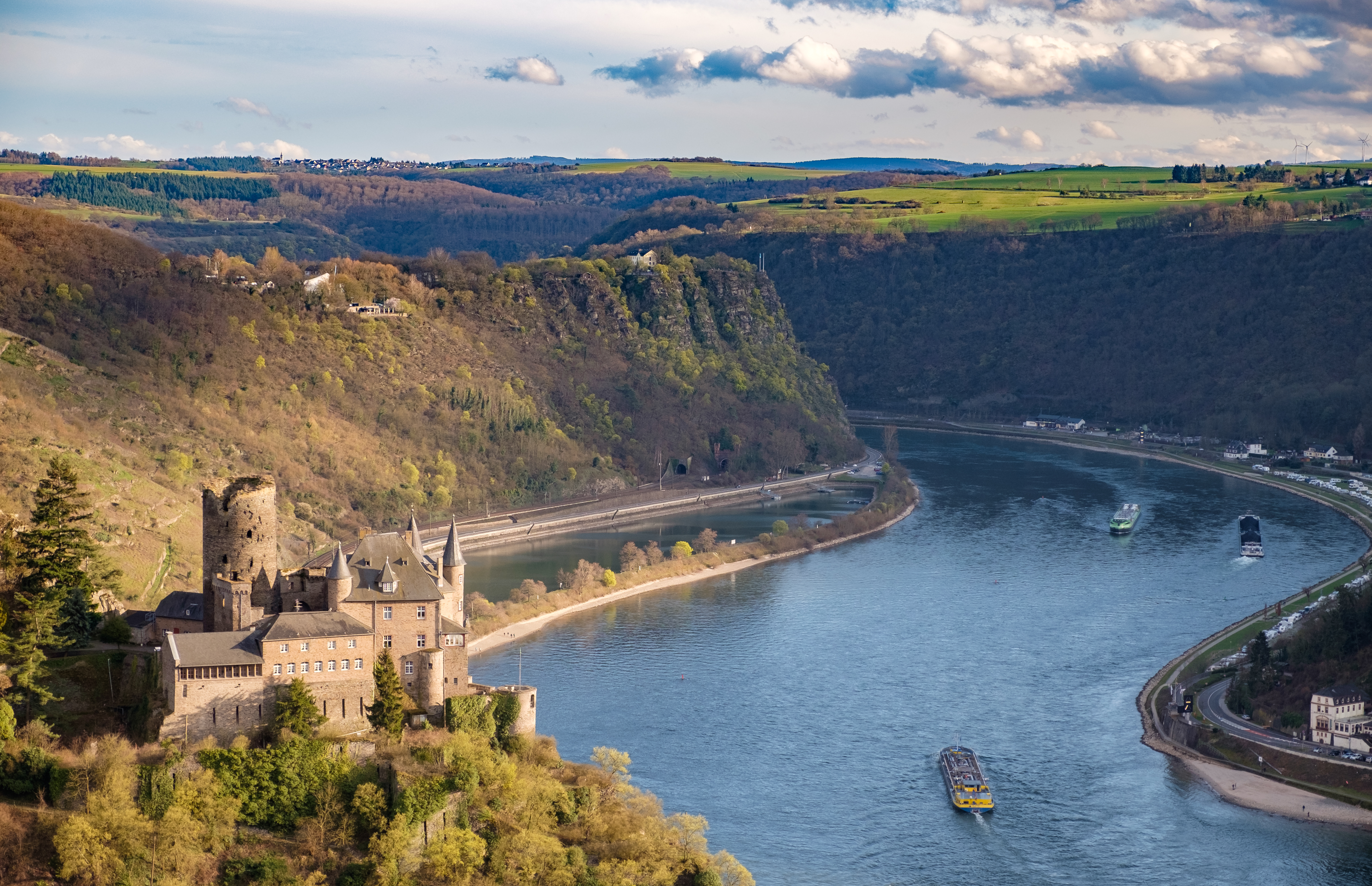
Town in Rhineland-Palatinate, Germany
| Field | Value |
|---|---|
| type | Stadt |
| name | Sankt Goarshausen |
| image_photo | Sankt goarshausen.jpg |
| image_coa | DEU Sankt Goarshausen COA.svg |
| coordinates | |
| image_plan | Sankt Goarshausen in EMS.svg |
| state | Rheinland-Pfalz |
| district | Rhein-Lahn-Kreis |
| Verbandsgemeinde | Loreley |
| elevation | 100 |
| area | 7.06 |
| postal_code | 56346 |
| area_code | 06771 |
| licence | EMS, DIZ, GOH |
| Gemeindeschlüssel | 07 1 41 121 |
| divisions | 4 |
| website | |
| mayor | Matthias Pflugradt |
| leader_term | 2019–24 |
Sankt Goarshausen (; abbreviated St. Goarshausen) is a town located in the Rhein-Lahn-Kreis in Nassau on the eastern shore of the Rhine, in the section known as the Rhine Gorge, directly across the river from Sankt Goar, in the German state Rhineland-Palatinate. It is located within the Nassau Nature Park and the Rhine Gorge UNESCO world heritage site, and was historically part of the Duchy of Nassau. It lies approximately 30 km south of Koblenz, and it is above all famous for the Lorelei rock nearby. Sankt Goarshausen is the seat of the Loreley collective municipality. The town's economy is based on wine making and tourism.
The Sankt Goarshausen railway station connects the town with Wiesbaden, Frankfurt and Koblenz. Sankt Goarshausen was formerly the terminus of the Nassau Light Railway line between Sankt Goarshausen and Nastätten.
History
In 1885, St. Goarshausen had almost 1,456 inhabitants. Close to the town in the hillside just above it, lie the ruins of 14th century Castle Katz, ruined since 1806.
Demographics
Traditionally more than 60% of the population are Protestants, while around 30% are Catholics; however Sankt Goarshausen is located in close proximity to Catholic-majority areas where the reverse situation exists. Due to the abandonment of religious beliefs, fewer people are members of the churches today, whether Protestant or Catholic. Sankt Goarshausen had a small but well-established Jewish community from the 17th century to the 1930s, peaking at 2.4% in 1895. As of 1860, the district of St. Goarshausen, which included St. Goarshausen proper and its surrounding villages, had a population that included 8557 Protestants, 3840 Catholics, 110 Jews and 6 Mennonites.
Economy
The town has 1,585 inhabitants December 31, 2002, and is the seat of the township association (Verbandsgemeinde) Loreley. With the villages Ehrental, Wellmich and Heide, the number of inhabitants is over 2,000.
The most important economic areas for St. Goarshausen are tourism and wine making. In earlier times the town was an important place along the Rhein for fishing and as an embarkation area. Today, the formerly very busy town is losing its importance and relies more and more on tourism. Especially problematic for St. Goarshausen is the short distance to the larger city Nastätten, that has replaced St. Goarshausen as the regional centre.
In tourism, the biggest competitor is the twin city St. Goar on the other shore of the Rhine. St. Goar is only reachable by ferry, as the closest bridge is 30 km away. While there is an established need for a bridge across the Rhine, plans for connecting the towns have not yet been realised.
To help tourism, a visitors centre has been established in connection to the Lorelei rock.
Sights
The most famous and most popular tourist attraction in town is the Lorelei rock.
In St. Goarshausen, there are two castles, Burg Katz (English: Castle Cat, formerly Burg Neu-Katzenelnbogen) and Burg Maus (English: Castle Mouse). Burg Katz is not open for visitors. There is a good view of the town from Burg Maus, and also visible are the ruins of Burg Rheinfels on the other side of Rhine.
Recurring events
- The third weekend of September: Rhein in Flammen, large fireworks from Burg Katz in St. Goarshausen, Burg Rheinfels in St. Goar and from the middle of the Rhine.
- The Night of the Prog festival was held annually at the Loreley Amphitheatre (except in 2020 when it was cancelled due to the pandemic) until 2024, the year of the Final Night of the Prog.
Gallery
Image:Sankt goarshausen.jpg|View of St. Goarshausen Image:Burg Katz Oberhalb St. Goarshausen.JPG|Burg Katz, above St. Goarshausen Image:Thomas M Richardson St Goarshausen.jpg|St. Goarshausen, by Thomas M. Richardson Felsen Loreley.jpg|Loreley Rock St. Goarshausen-1.jpg|St. Goarshausen St. Goarshausen.jpg|St. Goarshausen StGH006.jpg|Castle Katz StGH001.jpg|Secthaus St. Goarshausen StGH003.jpg|St. Goarshausen - Wellmich StGH004.jpg|St. Goarshausen - Wellmich Sankt Goar.jpg|St. Goar Burgruine_Rheinfels_xx.jpg|Castle Rheinfels Goarshausen Heinrich Heine bust2.jpg|Bust of Heinrich Heine
References
References
- [https://www.wahlen.rlp.de/de/kw/wahlen/kd/gebiete/1410000000000.html Direktwahlen 2019, Rhein-Lahn-Kreis], Landeswahlleiter Rheinland-Pfalz, accessed 5 August 2021.
- [http://www.alemannia-judaica.de/st_goarshausen_synagoge.htm#Zur%20Geschichte%20der%20j%C3%BCdischen%20Gemeinde Sankt Goarshausen], Alemannia Judaica
- ''[https://www.dilibri.de/rlb/periodical/pageview/148527 Staats- und Adreß-Handbuch des Herzogthums Nassau für das Jahr 1860]'', p. 130, [[Wiesbaden]], Government of the [[Duchy of Nassau]]
This article was imported from Wikipedia and is available under the Creative Commons Attribution-ShareAlike 4.0 License. Content has been adapted to SurfDoc format. Original contributors can be found on the article history page.
Ask Mako anything about Sankt Goarshausen — get instant answers, deeper analysis, and related topics.
Research with MakoFree with your Surf account
Create a free account to save articles, ask Mako questions, and organize your research.
Sign up freeThis content may have been generated or modified by AI. CloudSurf Software LLC is not responsible for the accuracy, completeness, or reliability of AI-generated content. Always verify important information from primary sources.
Report