From Surf Wiki (app.surf) — the open knowledge base
Sandton
Area in Gauteng province, South Africa

Area in Gauteng province, South Africa
| Field | Value | |
|---|---|---|
| name | Sandton | |
| image_skyline | {{multiple image | |
| total_width | 280 | |
| border | infobox | |
| perrow | 1/2/3/1 | |
| caption_align | center | |
| image1 | SandtonGP-skyline.jpg | |
| alt1 | Sandton Skyline | |
| caption1 | Sandton skyline | |
| image2 | Discovery HQ.jpg | |
| alt2 | Discovery headquarters | |
| caption2 | Discovery Headquarters | |
| image3 | Montecasino.jpg | |
| alt3 | Montecasino | |
| caption3 | Montecasino | |
| image4 | Sandton-convention-centre.jpg | |
| alt4 | Sandton City Shopping Centre | |
| caption4 | Sandton City shopping center | |
| image5 | The Leonardo, Johannesburg.jpg | |
| alt5 | The Leonardo | |
| caption5 | The Leonardo hotel | |
| pushpin_map | South Africa Gauteng#South Africa#Africa | |
| coordinates | ||
| subdivision_type | Country | |
| subdivision_name | South Africa | |
| subdivision_type1 | Province | |
| subdivision_name1 | Gauteng | |
| subdivision_type2 | District | |
| subdivision_type3 | Municipality | |
| subdivision_name3 | City of Johannesburg | |
| subdivision_type4 | Main Place | |
| established_title | Established | |
| established_date | 1906 | |
| leader_title | Councillor | |
| area_footnotes | ||
| area_total_km2 | 143.54 | |
| population_footnotes | ||
| population_total | 222415 | |
| population_as_of | 2011 | |
| population_density_km2 | auto | |
| <!-- demographics (section 1) --> | demographics_type1 | Racial makeup (2011) |
| demographics1_footnotes | ||
| demographics1_title1 | Black African | |
| demographics1_info1 | 34.7% | |
| demographics1_title2 | Coloured | |
| demographics1_info2 | 2.5% | |
| demographics1_title3 | Indian/Asian | |
| demographics1_info3 | 11.1% | |
| demographics1_title4 | White | |
| demographics1_info4 | 49.8% | |
| demographics1_title5 | Other | |
| demographics1_info5 | 1.9% | |
| <!-- demographics (section 2) --> | demographics_type2 | First languages (2011) |
| demographics2_footnotes | ||
| demographics2_title1 | English | |
| demographics2_info1 | 63.9% | |
| demographics2_title2 | Afrikaans | |
| demographics2_info2 | 7.4% | |
| demographics2_title3 | Zulu | |
| demographics2_info3 | 6.3% | |
| demographics2_title4 | Northern Sotho | |
| demographics2_info4 | 3.2% | |
| demographics2_title5 | Other | |
| demographics2_info5 | 19.2% | |
| <!-- Other information --> | timezone1 | SAST |
| utc_offset1 | +2 | |
| postal_code_type | Postal code (street) | |
| postal_code | 2196 | |
| postal2_code_type | PO box | |
| postal2_code | 2146 | |
| area_code_type | Area code | |
| settlement_type | City |
Sandton is a financial, commercial and residential area, located in the northern part of the City of Johannesburg Metropolitan Municipality. Formerly an independent municipality, Sandton's name came from the combination of two of its suburbs, Sandown and Bryanston.
History
Early settlers
Archaeological findings suggest the area which Sandton comprises today, had originally been occupied by various indigenous groups, before European settlement, most notably the Tswana and, to a lesser extent, Sotho people. The old Tswana people often refer to Sandton as "Ga Lowe" which in the language of Setswana means the place of origin. The remains of an Iron Age smelter was discovered in Lone Hill, a suburb of northern Sandton.
One of the first Voortrekker parties to settle in the area were the Esterhuysen family on the farm Zandfontein (Afrikaans and Dutch for Sandy Spring or Sand Fountain). A monument to commemorate them may be found just off Adrienne Street in Sandown where the family cemetery is located. Zandfontein, Driefontein (Afrikaans and Dutch for Three Springs/Fountains) and Rietfontein (Afrikaans and Dutch for Reed Spring or Fountain of Reeds) encumbered what was to become Sandton. The municipal coat of arms of Sandton pays homage to the three farms with three round fountain barrels on its chevron.
In the late 19th century, the Wilhelmi family of Hannover, Germany, acquired the farm Driefontein No. 3 while Rietfontein was owned by the Ehler family. The original Driefontein homestead, now within the confines of the Field & Study Centre, was looted during the Anglo-Boer War. The ruins are visible on the northern bank of the Klein Jukskei River. The Wilhemi family, upon return from Germany, built the 'new' 1906 Driefontein Farmhouse on what is present-day Fifteenth Street, Parkmore cum Riverclub. The farmhouse served as the icon and headquarters for the now defunct Sandton Historical Foundation and is listed as a City of Johannesburg Owned Heritage Site.
1960s and 1970s
Sandton was established as a separate municipality in 1969 by the office of the Administrator of the Transvaal. It had formerly not formed part of Johannesburg but was managed, in part by its administrators and Pretoria through the North Eastern Peri-Urban Land administration. Initially, it was very much a residential area consisting mostly of small holdings with a rural equestrian lifestyle attracting many of the upper-middle classes and Johannesburg elites. Prior to the 1960s a stream was located at the site of present day Katherine Street.
The Rivonia Trial derives its name from the Liliesleaf Farm precinct situated in the Sandton suburb where many of the Black freedom fighters such as Nelson Mandela were captured by the South African state and subsequently tried for treason. Rivonia had previously been known as Edenburg and was changed to make itself distinct from Edenburg, Free State. It was named for the surname Riven.
Sandton and its constituencies were traditionally relatively more liberal than surrounds. For example, the motion which never materialised by residents in favour for the inclusion of Alexandra, Gauteng then a demarcated black township in terms of the Group Areas Act, into Sandton's jurisdiction proved troublesome for the National Party government which had a strong constituency in the adjacent town of Randburg.
1980s and 1990s
The construction of Sandton City by Rapp & Maister (which was eventually taken over by the Liberty Group which still retains 75% of the complex) marked a significant change for the Sandton area. It created rapid commercialisation and industrialisation. Sandton came to symbolise the White Flight movement of Johannesburg and secured itself as Johannesburg's second Central Business District.
After the demise of apartheid, by 1996, Sandton initially formed part of the interim Eastern Metropolitan Substructure, and in 2000 came to be included, along with the former towns of Randburg and Roodepoort, as part of the newly demarcated City of Johannesburg Metropolitan Municipality thus losing its separate municipal government and town status. Despite this, Sandton is still unofficially regarded as a distinct region of the city and operates as a macro-suburb.
Role in 21st century Johannesburg
Financial and business centre
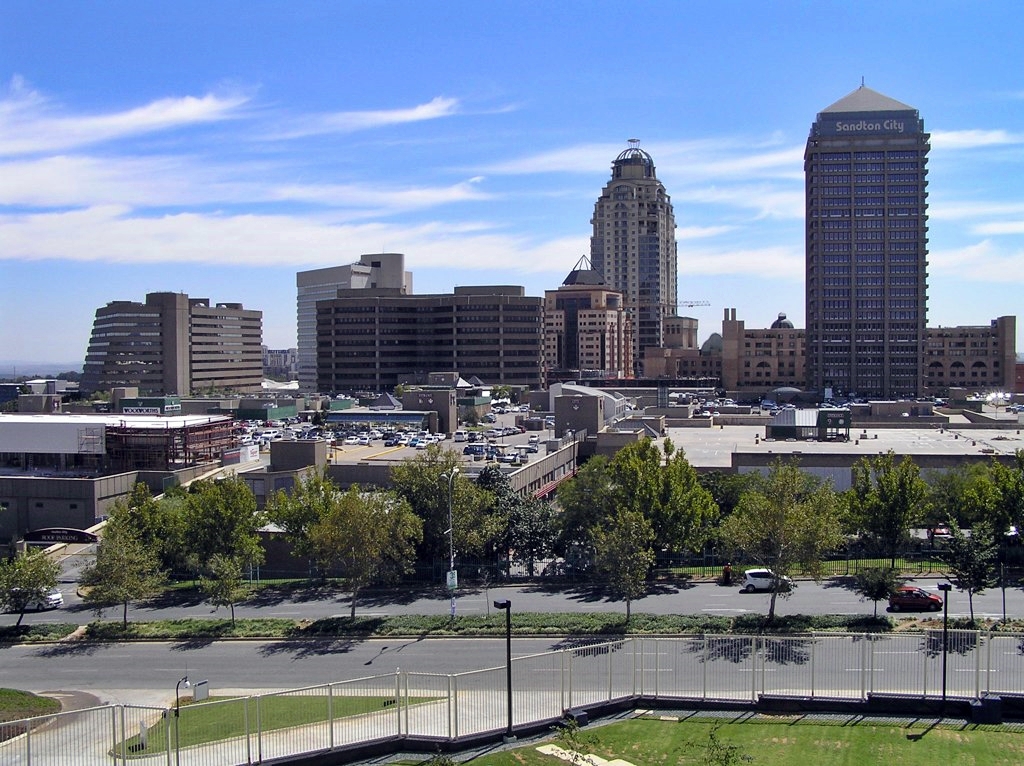
Urban decay in downtown Johannesburg caused many corporate offices to move from the Johannesburg CBD to Sandton in the 1990s. It has become the new financial district of South Africa and Johannesburg's premier business centre. Much of the financial focus of Johannesburg has shifted from the Central Business District to Sandton.
However, three of South Africa's four largest banks have kept their head offices in downtown Johannesburg. The other bank, Nedbank, has its headquarters in Sandton. A considerable amount of the city's A-grade office space is to be found in Sandton. The JSE Securities Exchange, Johannesburg's stock exchange, relocated its offices to Sandton from the central business district in the late 1990s.
Sandton is home to the Sandton Convention Centre, one of the largest convention centres on the continent and primary site of the 2002 World Summit on Sustainable Development (also known as "Rio + 10"), which Johannesburg hosted. The convention centre also hosted the African National Congress' victory celebrations after the party was re-elected at the 2004 election.
When it comes to green buildings in Africa, Sandton is an epicentre. One of the highest rated green buildings in South Africa – rated by Green Building Council South Africa (GBCSA) – is Upper Grayston Office Park, located in Sandton.
Tourism and retail hub
One of the main attractions in Sandton is Sandton City, which ranks among the largest shopping centres in Africa. The completion of this precinct by the Liberty Group was the catalyst for the subsequent development of this entire area. Together with Nelson Mandela Square, the centre, with some 144,000 m2 of shopping space, is one of the largest in the Southern Hemisphere. Much of Johannesburg's business tourism is centred on Sandton, which has various 5-star hotels under the Southern Sun, Hilton, Radisson and Protea brands.
Liberty Group announced in 2008 that Sandton City will receive a R 1.77-billion upgrade. Nelson Mandela Square, formerly known as Sandton Square, was renamed in March 2004, after the unveiling of a 6-metre bronze statue of the former South African president. Liliesleaf Farm, where Nelson Mandela lived in the early 1960s and where many leading political activists were arrested in 1963 and tried as part of the now infamous Rivonia Trial, is just north of Nelson Mandela Square, close to the N1 Highway, off Rivonia Road. Discovery Holdings has, in 2018, completed a large new head office along with shopping mall in the area.

A 55-floor mixed use building, The Leonardo, become the tallest building in all of Africa at the time 234 m following its completion in 2018, but has since been replaced by other taller buildings.
Sandton Central Management District
The central business area of Sandton is divided into three City Improvement Districts, which have a unified identity called the Sandton Central Management District, branded as Sandton Central. This district is responsible, using additional funds levied on its behalf by the municipality, for the provision of additional services. The Sandton Central Management district provides additional cleaning, law enforcement, beautification and planning services to the area it services.
Geography
Sandton is located approximately 16 kilometres north of the Johannesburg CBD, bordered by Midrand to the north, Johannesburg to the south, Randburg to the west and Alexandra to the east.
Transport
Gautrain
Sandton houses the flagship station of the Gautrain rapid rail link. The station is located on the corner of West Street and Rivonia Road. The system has direct connections to OR Tambo International Airport and an inter-city commuter service from Pretoria through Rosebank to Johannesburg Park Station. Sandton's associated Gaubus network comprises direct routes to Fourways, Gallo Manor, Randburg and Rivonia. People can also connect busses and travel to many parts of Centurion, Marlboro, Parktown, Rosebank and Pretoria using the service.
Roads
The main freeway to get in to the city is the M1 freeway (from Johannesburg and the N1) through the M60 at Marlboro Drive, the M40 at Grayston Drive and the M30 at Corlett Drive. The N1 freeway (Western Bypass) passes through the northern part of Sandton, with off-ramps at the M9 (Rivonia Road) & R511/M81 (Winnie Mandela Drive). One can use the M9, M27, M71, M75 and M85 metropolitan routes.
Education
The main campus of the Lycée Jules Verne, a French international school, is in Sandton. Sandton used to be home of the former Bond University South Africa. Sandton also houses many primary to high schools including:
- Brescia House School
- Bryandale Primary School
- Bryanston High School
- Bryanston Primary School
- Bryneven Primary School
- Buccleuch Primary School
- Crawford College, Sandton
- Grayston Preparatory School
- Hyde Park High School
- King David School Sandton
- Montrose Primary School
- Redhill School
- Rivonia Primary School
- Sandown High School
- Sandton Junior School
- Sandton Primary School
- St David's Marist, Inanda
- St. Peters College
- St Stithians College
- Wendywood Primary School
- Wendywood High School
- Amedeo College
- Qurtuba Islamic Academy
Notable people
- Sir Donald Gordon
- Jani Allan
- Leka, Crown Prince of Albania
- Daniella Pellegrini
- Sibs Shongwe-La Mer
- Amor Vittone, singer
References
References
- "Main Place Sandton". Census 2011.
- Raper, P. E.. "Dictionary of Southern African Place Names".
- V. Ellenberger. "History and Pre-History in Botswana".
- "Sandton (South Africa)".
- Content, Print. (2016-07-06). "Sandton: Then and now".
- Lodge, Tom. (1 June 2003). "Politics in South Africa: From Mandela to Mbeki". New Africa Books.
- (31 March 2016). "Sandton is an epicentre for green building in Africa".
- (2023-04-30). "UPPER GRAYSTON BLD F project study".
- [http://www.sandtoncentral.co.za/about/what-is-the-sandton-central-management-district What is The Sandton Central Management District?] {{webarchive. link. (12 December 2010)
- [http://www.sandtoncentral.co.za/about/a-city-improvement-district A City Improvement District] {{webarchive. link. (12 December 2010)
- [http://www.sandtoncentral.co.za/about/the-sandton-central-agm-report-2009-2010 The Sandton Central AGM Report 2009 - 2010] {{webarchive. link. (11 February 2011)
- Mafika. (2010-06-08). "Gallery: Launch of the Gautrain".
- "Gautrain Bus Route Downloads".
- Falkner, John. (May 2012). "South African Numbered Route Description and Destination Analysis". National Department of Transport.
- link. (10 February 2015 ." ''[[Lycée Jules Verne (South Africa)). Lycée Jules Verne]]''. Retrieved on 18 January 2015. "Lycée Français Jules Verne, Corner Bauhinia and Cestrum, Morningside Ext 40" and "Ecole Miriam Makeba 816 - 818 George Avenue Corner George & Eastwood, Eastwood – Arcadia, Pretoria"
This article was imported from Wikipedia and is available under the Creative Commons Attribution-ShareAlike 4.0 License. Content has been adapted to SurfDoc format. Original contributors can be found on the article history page.
Ask Mako anything about Sandton — get instant answers, deeper analysis, and related topics.
Research with MakoFree with your Surf account
Create a free account to save articles, ask Mako questions, and organize your research.
Sign up freeThis content may have been generated or modified by AI. CloudSurf Software LLC is not responsible for the accuracy, completeness, or reliability of AI-generated content. Always verify important information from primary sources.
Report