From Surf Wiki (app.surf) — the open knowledge base
San Gabriel Mountains
Mountain range of the Transverse Ranges in California, United States

Mountain range of the Transverse Ranges in California, United States
| Field | Value |
|---|---|
| name | San Gabriel Mountains |
| photo | Telegraph Cucamonga and Ontario Peaks.jpg |
| photo_caption | Summits in the eastern San Gabriel Mountains, Angeles National Forest, San Bernardino County, California. The main peaks are: Telegraph Peak 8,985 feet (left), Cucamonga Peak, 8,859 feet (center), and Ontario Peak 8693 feet (center right), as seen from Baldy Bowl on Mount San Antonio. |
| country | United States |
| subdivision1 | California |
| subdivision3_type | Counties |
| subdivision3 | |
| highest | Mount San Antonio |
| elevation_ft | 10069 |
| map_image | Wpdms shdrlfi020l san gabriel mountains.jpg |
| coordinates | |
| length_mi | 68.4 |
| width_mi | 22.5 |
| area_mi2 | 970 |
The San Gabriel Mountains () are a mountain range located in Los Angeles and San Bernardino counties, California, United States. The mountain range is part of the Transverse Ranges and lies between the Los Angeles Basin and the Mojave Desert, with Interstate 5 to the west and Interstate 15 to the east. The range lies in, and is surrounded by, the Angeles and San Bernardino National Forests, with the San Andreas Fault as its northern border.
The highest peak in the range is Mount San Antonio, commonly referred to as Mt. Baldy. Mount Wilson is another notable peak, known for the Mount Wilson Observatory and the antenna farm that houses many of the transmitters for local media. The observatory may be visited by the public. On October 10, 2014, President Barack Obama designated the area the San Gabriel Mountains National Monument. The Trust for Public Land has protected more than 3,800 acres of land in the San Gabriel Mountains, its foothills, and the Angeles National Forest. The mountains were once known as the Sierra Madre, lending the name to the city of Sierra Madre; however, since 1965, the name "Sierra Madre" has referred to a different mountain range to the west in Santa Barbara County.
Geography
Much of the range features rolling peaks. The range lacks craggy features, but contains a large number of canyons and is generally very rugged and difficult to traverse. The San Gabriel Mountains are composed of a large fault block between the San Andreas Fault Zone to the north, and the San Gabriel Fault and the Sierra Madre-Cucamonga Fault Zones to the south. This tectonic block was uplifted during the Miocene and has since been dissected by numerous rivers and washes.
Setting and elevation
The highest elevation, Mount San Antonio (Mount Baldy) at 10069 ft, rises towards the eastern extremity of the range which extends from the Cajon Pass (Interstate 15) on the east, where the San Gabriel Mountain Range meets the San Bernardino Mountain Range, westward to meet the Santa Susana Mountains at Newhall Pass (Interstate 5).
South and east of Santa Clarita and north of San Fernando, the San Gabriel Mountains crest abruptly up to about 4,000 ft. Pacoima and Big Tujunga Canyons cut through the range just east of San Fernando, carrying runoff into the San Fernando Valley. Little Tujunga Canyon Road bridges the range in this area, connecting the San Fernando Valley to the Santa Clara River valley in the north. Towering over Big Tujunga Canyon north of Big Tujunga Reservoir, and south of Acton, is Mount Gleason, which at 6,502 ft, is the highest in this region of the San Gabriels. South of the gorge is the southern "foothills" of the mountains, which rise abruptly 4,000 ft above the Los Angeles Basin and give rise to the Arroyo Seco, a tributary of the Los Angeles River.
Southeast of Big Tujunga Canyon, the southern front range of the San Gabriels gradually grows in elevation, culminating in notable peaks such as Mount Wilson at 5,710 ft. On the north the range is abruptly dissected by the canyon of the West Fork San Gabriel River. Even further north the range slopes up into the towering main crest of the San Gabriels, a sweeping arc-shaped massif 30 mi in length that includes most of the highest peaks in the range: Waterman Mountain, at 8,038 ft; Mount Islip, at 8,250 ft, Mount Baden-Powell, at 9,399 ft, Pine Mountain, at 9648 ft, and Mount San Antonio, the highest peak in the range at 10,068 ft.
On the north slopes of the San Gabriel crest, the northern ranks of mountains drop down incrementally to the floor of the Mojave Desert in a much more gradual manner than the sheer southern flank. The Angeles Crest Highway, one of the main routes across the San Gabriels, runs through this area from west to east. Little Rock, Big Rock, and Sheep Creeks drain off the northern part of the mountains, forming large alluvial fans as they descend into the Mojave. To the east, the San Andreas Fault cuts across the range, forming a series of long, straight, and narrow depressions, including Swarthout Valley and Lone Pine Canyon. South of Mount San Antonio, San Antonio Creek drains the mountains, cutting the deep San Antonio Canyon.
East of San Antonio Canyon, the range gradually loses elevation, and the highest peaks in this section of the mountain range are in the south, rising dramatically above the cities of Claremont, Upland and Rancho Cucamonga. However, there are still several notable peaks in this region, including Telegraph Peak, at 8,985 ft, Cucamonga Peak, at 8,859 ft, and Ontario Peak, rising 8,693 ft. Lytle Creek, flowing generally southeast, drains most of the extreme eastern San Gabriels. The range terminates at Cajon Pass, through which runs Interstate 15, and beyond which rise the even higher San Bernardino Mountains.
Locale
The Range is bounded on the north by the Antelope Valley and the Mojave Desert and to the south by the communities of Greater Los Angeles. The south side of the range is almost continuously urbanized and includes the Los Angeles city communities of Sylmar, Pacoima, and Sunland-Tujunga, as well as cities and unincorporated areas of San Fernando, La Crescenta, La Cañada Flintridge, Altadena, Pasadena, Sierra Madre, Arcadia, Monrovia, Bradbury, Duarte, Azusa, Glendora, San Dimas, La Verne, Claremont, Upland, Rancho Cucamonga, Fontana, Rialto and West San Bernardino. The north side of the range is less densely populated and includes the city of Palmdale as well as the small unincorporated towns of Acton, Littlerock, Pearblossom, Valyermo, Llano, Piñon Hills, and Phelan. At the west end of the range lies the city of Santa Clarita. Within the mountains themselves are the small unincorporated communities of Mount Baldy, Wrightwood, Big Pines and Lytle Creek.
Hydrology
Melting snow and rain runoff on the south side of the San Gabriels' highest mountains give rise to its largest river, the San Gabriel River. Just to the west of Mount Hawkins, a north–south divide separates water running down the two main forks of the river and their tributaries. The West Fork, beginning at Red Box Saddle, runs 14 mi eastward, and the East Fork, starting north of Mount San Antonio, flows 18 mi south and west through a steep, rugged and precipitous gorge. The two meet at San Gabriel Reservoir and turn south, boring through the southern portion of the San Gabriels, emptying of the mountains near Azusa into the urban San Gabriel Valley, and eventually to the Pacific Ocean near Seal Beach.
Peaks
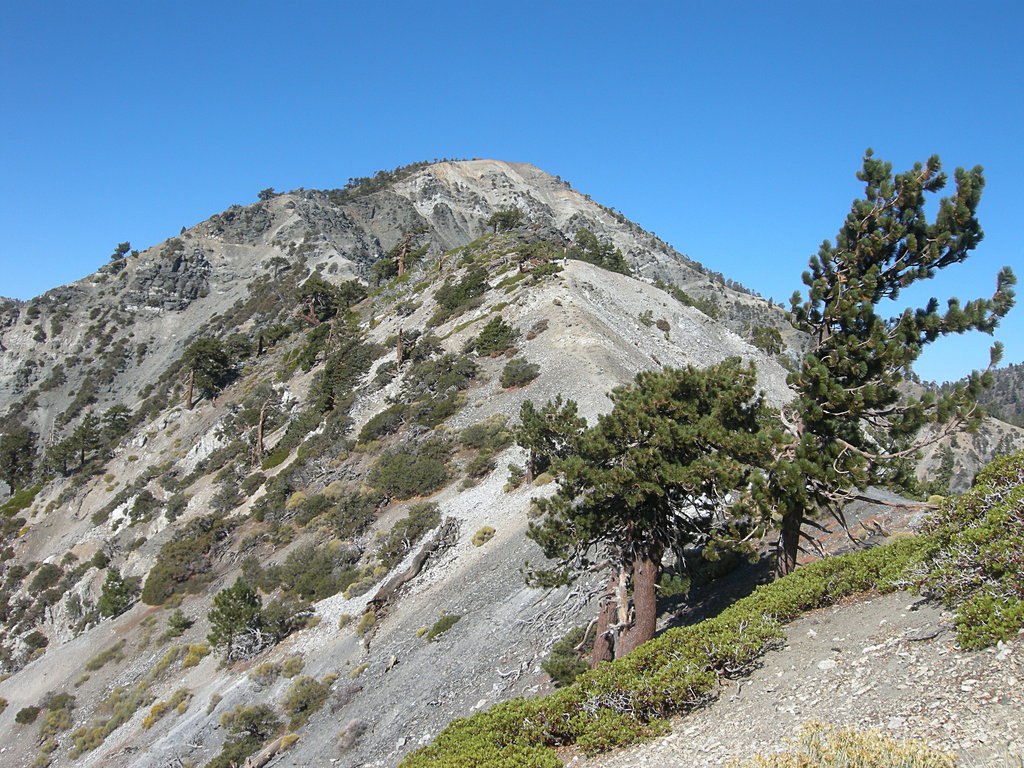
San Gabriel Mountains peaks within the Angeles National Forest include:
- Mount San Antonio (Mount Baldy), 10064 ft
- Pine Mountain, 9648 ft
- Dawson Peak, 9575 ft
- Mount Harwood, 9552 ft
- Mount Baden-Powell, 9399 ft
- Throop Peak, 9138 ft
- Mount Burnham, 9001 ft
- Telegraph Peak, 8985 ft
- Cucamonga Peak, 8859 ft
- Ontario Peak, 8693 ft
- Mount Lewis, 8396 ft
- Timber Mountain, 8307 ft
- Mount Islip, 8250 ft — site of historic Mt. Islip fire lookout tower
- Mount Williamson, 8214 ft
- Waterman Mountain, 8038 ft
- Iron Mountain, 8007 ft
- South Mount Hawkins, 7783 ft — lookout destroyed in Curve Fire, 2002
- Pallett Mountain, 7779 ft
- Pacifico Mountain, 7124 ft
- Mount Gleason, 6502 ft
- Strawberry Peak, 6164 ft
- San Gabriel Peak, 6162 ft
- Mount Disappointment, 5960 ft
- Mount Lawlor, 5961 ft
- Vetter Mountain, 5911 ft — site of historic Vetter Mountain Fire lookout tower
- Rattlesnake Peak, 5826 ft
- Mount Wilson, 5710 ft — location of the Mount Wilson Observatory
- Mount Lowe, 5703 ft — site of Mount Lowe Railway
- Iron Mountain, 5,636 ft
- Josephine Peak, 5561 ft
- Condor Peak, 5440 ft
- Monrovia Peak, 5409 ft
- Rankin Peak, 5269 ft
- Smith Mountain, 5111 ft
- Mount Lukens, 5074 ft
- Mount McKinley, 4925 ft
- Magic Mountain, 4864 ft
- Mendenhall Peak, 4636 ft
- Clamshell Peak, 4360 ft
- Los Piñetos Peak 3560 ft
- Kagel Mountain, 3537 ft
- Potato Mountain, 3422 ft
- Echo Mountain, 3210 ft
- Bare Mountain 6,388 ft (1,947 m)
- Hoyt Mountain 4,416 ft (1,346 m)
Climate
The climate of the range varies with elevation from continental to Mediterranean, with mostly dry summers (except for scattered summer thunderstorms) and cold, wet winters. Snow can fall above 3,000. ft elevation during cold fronts between November and April, but is most common in December through March. Annual precipitation totals are mostly in excess of 25 in on the coastal (southern) slopes above 3,000. ft elevation, with up to 45 in falling in some areas above 5,000. ft.
The coastal (south) side of the range receives vastly more precipitation than the desert (northern) side. The highest precipitation is found in the central and eastern parts of the range (Mt. Wilson to Mt. San Antonio). Annual precipitation totals are highly variable from year to year, and can be extremely high during wet El Nino years (sometimes over 70. in, with single storm totals over 10. in). Runoff from the mountains during big storms often produces flooding in adjacent foothill communities (especially in areas denuded by wildfires). The range is mostly smog-free above 5,000. ft elevation, above the inversion layer. The large telescope installation at Mt. Wilson is a testimony to the clear atmospheric conditions that prevail, although light pollution from the L.A. basin below has hindered telescope activities in recent decades.
Wildfires
The San Gabriel Mountains sees frequent wildfires. They are often driven by dry Santa Ana wind events in the summer and fall. Notable wildfires in the San Gabriel Mountains have included the 2009 Station Fire, 2020 Bobcat Fire, the 2024 Bridge Fire, and the 2025 Greater Los Angeles Wildfires.
Geology
Granitic and metasedimentary rocks are the primary constituent of the San Gabriel Mountains. Metasedimentary rocks were attached to the North American craton in the Precambrian eon, and granitic rocks formed throughout the Mesozoic as oceanic plates subducted underneath the North American west coast. Like nearly all of the other mountains in the Transverse Ranges, the San Gabriels are a series of fault blocks that were uplifted in the Cenozoic. Tectonic uplift rates and erosion rates systematically increase as topography steepens eastward in the San Gabriel Mountains, where the San Andreas and San Jacinto faults meet.
Current rates of erosion in the eastern San Gabriel mountains are among the fastest in the continental United States and have accelerated in response to the increased frequency of wildfires over the 1900s. Over future centuries, it remains unclear whether soil and brush ecosystems in the San Gabriel mountains will continue to re-establish soil and vegetation after increasing fire and soil-erosion frequencies, or if increasing fire frequencies and erosion will strip soils and permanently alter soil cover and vegetation types across the mountain ecosystem.
History
Indigenous History
For thousands of years before the arrival of the Spanish in the Los Angeles basin, the San Gabriel Mountains have been home to Indigenous peoples. Several of the groups that either inhabited or traveled through the mountain range include the Gabrielino-Tongva, Fernandeño Tataviam, Serrano (Yuhaviatam), Kitanemuk, and Chumash. These groups relied on the San Gabriel Mountains for resources and took care to sustain its ecosystem. The Tongva, for instance, practiced sustainable resource management. Women were practitioners of ethnobotany and gathered food from plants such as acorns (kwi), chia seeds, manzanita berries, and mountain cherries. Men hunted deer and rabbits using greasewood-shaft arrows, while the community’s fishermen caught steelhead trout with yucca-fiber nets. Controlled fires were also used deliberately to promote growth.
In addition to being a massive resource base, the mountains served the people as a sacred and cultural landscape and were viewed as living entities The legend of Mount San Antonio’s (Mount Baldy) creation describes two brothers, Sea-god and Land-god, who fought over humanity. When Sea-god tried to flood the earth, Land-god raised the mountains to protect the people, forming the San Gabriel range. Another myth goes that the Serrano followed a white eagle to settle around Mount San Antonio, which marked a territorial boundary between their people and the Tongva.
The mountains connected the coast, valleys, and desert regions, facilitating trade and inter-tribal relations. Goods—such as shells, pigments, foods, and tools—, stories, and rituals were exchanged, and intermarriage also occurred. To get to Chilao in the backcountry, one main route climbed the West Fork San Gabriel River toward Mount Wilson, Red Box Saddle, and Millard Canyon. Other routes connected with desert tribes by traversing the entire range and entering the Mojave Desert
Indigenous People and Mission San Gabriel
Following Spanish colonization in the late 18th century, many Indigenous communities in the San Gabriel region were displaced to nearby missions. The construction of Mission San Gabriel Arcángel (1771–1775) marked the fourth California mission, which was built and sustained by the Gabrielino-Tongva people.
Missionization disrupted Tongva spiritual, social, and environmental practices as the people underwent conversion and forced intensive agricultural and domestic labor. Under these conditions, communities endured starvation, illness, and violence. The San Gabriel Cemetery contains over 6,000 Indigenous burials. The establishment of Mission San Gabriel also marked the destruction of preexisting villages such as Asuksangna, which had flourished near the San Gabriel River before Spanish settlement. Indigenous tradition continued to disappear with the influx of white settlers who travelled to the San Gabriel Mountains during the Gold Rush.
19th-century Mining
In 1842, Placerita Canyon in the western San Gabriel Mountains was the site of California’s first confirmed gold discovery. Mining camps were established along the canyons of the San Gabriel Mountains in the 19th century and into areas such as the East Fork of the San Gabriel River, where the historic mining town of Eldoradoville is located. By the late 1930s, most serious mining ventures in the San Gabriel Mountains had ended.
As gold production declined, economic activities in the mountains shifted toward timber, homesteading, and recreation, which led into the "Great Hiking Era” (1880-1938). The erosion, sedimentation, and deforestation that was caused by mining later influenced forest conservation policy. The San Gabriel Timberland Reserve of 1892 was the result of public calls for watershed protection in response to the environmental degradation and fire damage of the late 19th century. This reserve served as a precursor to the Angeles National Forest.
Ecology
There are both areas of conifer as well as broadleaf forestation, including the presence of some endemic taxa. Conifer (pine, fir, cedar) and oak forests are most widespread above 5,000 feet where the precipitation is above 30 in (the central and eastern high San Gabriels). In the wetter areas, madrone and bay laurel trees also occur in places, and ferns are common. Trees like willow, alder, and cottonwood are also found throughout the range along with the stream courses (riparian habitat), even at lower elevations. Chaparral (dense shrub, brush, and small tree) vegetation is widespread where there is no continuous tall tree cover, especially at lower elevations. Chaparral is highly adapted to fire and replaces trees for decades after fires. With the recent increase in wildfire frequency and damage, chaparral occupies more and more of the San Gabriels each year. There is a subspecies of the leather oak which is found only within the San Gabriel Mountains. The Rift Zone along the San Andreas Fault produces numerous springs, sag ponds, and wetland areas that are critical habitats for a variety of native species. A prime example of such a sag pond is Jackson Lake just west of Wrightwood.
Larger animals include California mule deer, California black bear, San Pedro Martir coyote and the rarely seen mountain lion or cougar. Smaller mammals include raccoons, opossum, skunk, and bobcats. Golden and bald eagles are found rarely, but hawks are common. Rattlesnakes are common and often encountered on trails by hikers. Critically endangered yellow-legged frogs have declined or vanished from the streams due to the loss of suitable habitat. The San Gabriel Canyon system in the San Gabriel Mountains is also home to a rare endemic species of salamander, the San Gabriel slender salamander, which is only known to be found above 850 metres elevation.
The San Gabriel Mountains were once home to a thriving population of Southern Steelhead. The Arroyo Seco and San Gabriel River had two major populations, but due to damming and channelization, these fish cannot make it upstream anymore. However, wild native rainbow trout still exist in streams and ponds throughout the mountains.
Transportation

The main road that runs through the San Gabriel Mountains is the Angeles Crest Highway, State Route 2. It starts in the southwest at the city of La Cañada Flintridge and ends at its junction with State Route 138, just past Wrightwood, near the Victor Valley and the western Cajon Valley. Past its junction with Angeles Forest Highway, traveling east, Angeles Crest Highway features blind curves, various bumps, and potholes. This section of the "Crest" is closed during the winter due to rockfall and avalanche hazards. State Route 2, just past Mountain High, is called the Big Pines Highway to the Route 138 junction.
Another key county route through, the mountains is Angeles Forest Highway. The highway begins 11 miles northeast of La Cañada Flintridge at its Angeles Crest Highway junction. Ending near Acton, it allows easy access to the central Forest and the fast-growing Antelope Valley. Because the "Forest" and the 11 mile "Crest" portion leading to La Cañada Flintridge is well traveled by Antelope Valley commuters, its road maintenance is much better, and it is open much of the winter.
State Route 39 connected the city of Azusa with the Angeles Crest Highway until it was seriously damaged by landslides, first in 1978, and again in 2005. The highway was opened to emergency crews in February 2003.
People heading to Mount Waterman must now travel west to Pasadena and then travel on the Angeles Crest Highway (Highway 2) in La Cañada Flintridge, a nearly two-hour trip. Reopening Highway 39 would cut the drive time to the Waterman Ski Area in half and shorten the trip east to Wrightwood.
According to the Caltrans District Seven "Inside Seven" Newsletter, "Two projects that will address those issues and get the highway reopened are scheduled for construction soon. The first, building two retaining walls near the city of Azusa from Old San Gabriel Canyon Road to approximately 4 miles south of SR-2, could begin in mid-2009. The second, a $45 million project to reconstruct the roadway, construct soldier pile retaining walls, repair drainage systems, install rockfall protection, and provide asphalt concrete overlay and traffic striping, should begin in fall 2010."
In 2011, the planned repair of the road was abruptly terminated, due to concerns of high future maintenance costs, and potential impact on the local bighorn sheep population. However, in October 2016, Caltrans announced it was again considering plans to reopen the road, after pressure from local communities.
Recreation
In the winter, snowboarding and skiing are quite popular in the San Gabriels, at Mountain High and Mt. Baldy. The two other resorts, Mount Waterman and Kratka Ridge, are rarely open due to insufficient snow. In the summer, canyoneering, hiking, backpacking, picnicking, and camping are some of the activities popular with visitors. From time to time, a hiker gets lost or stuck on a mountain ledge or may fall downhill. Some of the more extreme cases of emergency search-and-rescue efforts will often be given air time on Los Angeles television and radio newscasts. The Pacific Crest Trail passes along the mountain ridge.
During the winter, many Southern California mountaineers climb a variety of snow routes and even some ice routes in the San Gabriel Mountains. Baldy Bowl is by far the most popular route, getting hundreds of climbers per season. There are numerous other routes.
Rock climbing is not as common in the San Gabriel Range as it is in neighboring areas, as this range is notable for loose rock. Various faults crisscross the range, making it one of the steepest and fastest-growing ranges in the world. Plate tectonic activity breaks up most rock, making it unsuitable for rock climbing. Williamson Rock was the most famous climbing area until it was closed to climbing. There are many other craggy areas scattered about the range that provide mostly traditional climbing opportunities.
The Angeles National Forest Fire Lookout Association has rebuilt and operates Vetter Mountain Lookout, and Slide Mountain Lookout. The organization is rebuilding South Mount Hawkins Lookout.
Nearby ranges
- San Rafael Hills
- Santa Ana Mountains
- Verdugo Mountains
- San Bernardino Mountains
- Santa Susana Mountains
- Santa Monica Mountains
- Sierra Pelona Mountains
- Topatopa Mountains
- Tehachapi Mountains
Gallery
File: LA San Gabriel Mountains.jpg|San Gabriel Mountains east of downtown Los Angeles File:FredricRiceDW.jpg|San Gabriel Wilderness file: The_Bridge_to_Nowhere_(San_Gabriel_Mountains).jpg|The Bridge to Nowhere File:VetterLookout01.jpg|Vetter Lookout File:AngelesCrestHighway-001.jpg|Highway 2 through the San Gabriel Mountains File: Big Dalton Dam near full capacity 15 February 1973.jpg|Big Dalton Dam near full capacity File:Monrovia_CA_San_Gabriel_Mountains_i210.JPG|Monrovia and the San Gabriel Mountains File:San gabriel dam.JPG|San Gabriel Dam Image:San Gabriel Mts Cajon Pass.JPG|San Gabriel Mountains from Cajon Pass File:Mount-Islip.jpg|Mount Islip File: Harwood southeast snow.JPG|Snowpack File: Station Fire over La Cañada Flintridge.jpg|Wildfire File: Telescope dome on Mt. Wilson, Pasadena, California (63805).jpg|Mount Wilson Observatory File: Angeles National Forest - Social 2.jpg|Angeles National Forest
References
References
- {{cite gnis
- (10 October 2014). "President Obama Designates San Gabriel Mountains National Monument". [[whitehouse.gov]].
- "Los Angeles Natural Lands". The Trust for Public Land.
- Cliff, Edward P. (Chairman). (1965). "Decisions on Geographic Names in the United States". [[United States Department of the Interior]].
- Anderson, J. Lawford. (1990). "The Nature and Origin of Cordilleran Magmatism". Geological Society of America.
- (2015-03-01). "The role of waterfalls and knickzones in controlling the style and pace of landscape adjustment in the western San Gabriel Mountains, California". Geological Society of America Bulletin.
- (2002). "Controls on the erosion and geomorphic evolution of the San Bernardino and San Gabriel Mountains, southern California". Geological Society of America.
- Nourse, Jonathan A.. (2002). "Middle Miocene reconstruction of the central and eastern San Gabriel Mountains, southern California, with implications for evolution of the San Gabriel fault and Los Angeles basin". Geological Society of America.
- "Mount San Antonio - Peakbagger.com".
- [http://www.fs.fed.us/r5/angeles/recreation/hike-islipsad2littlejimmy-mtislip.shtml USFS.gov: Mt. Islip fire lookout tower]
- "Geology of the San Gabriel Mountains, Transverse Ranges Province". United States Geological Survey.
- (2018). "Fracture density and grain size control on the relief structure of bedrock landscapes". Geology.
- (2010). "Landscape form and millennial erosion rates in the San Gabriel Mountains, CA". Earth and Planetary Science Letters.
- (2019). "Bedrock fracture density controls on hillslope erodibility in steep, rocky landscapes with patchy soil cover, southern California, USA". Earth and Planetary Science Letters.
- (2011). "A model for fire-induced sediment yield by dry ravel in steep landscapes". Journal of Geophysical Research: Earth Surface.
- (2013). "Vegetation and wildfire controls on sediment yield in bedrock landscapes". Geophysical Research Letters.
- (June 3, 2025). "Tribal Histories in the Mountains: Indigenous History of the San Gabriel Mountains.".
- Medina, Daniel. (30 September 2013). "The Indigenous Dawn of the San Gabriel Mountains.".
- (2 May 2024). "San Gabriel Mountains National Monument".
- "History of San Gabriel.".
- City of San Gabriel. "History of San Gabriel.".
- "San Gabriel Arcángel.".
- Anderson Keeley, Cherrelle. (2018). "Native Peoples' Relationship to the California Chaparral".
- Worden, Leon. "History of the Angeles National Forest / Santa Clarita Valley.".
- (27 April 2025). "Archaeology and Cultural Resources – Angeles National Forest.".
- C. Michael Hogan. 2010. [http://www.eoearth.org/article/Leather_Oak ''Leather Oak, Quercus durata''. Encyclopedia of Earth. National Council for Science and Environment]. Washington DC {{Webarchive. link. (January 26, 2020)
- Bailey, Tia. (2022-09-21). "Yellow-Legged Frogs To Be Reintroduced to San Gabriel Mountains". Outsider.
- IUCN SSC Amphibian Specialist Group.. (2023). "''Batrachoseps gabrieli''". [[IUCN]].
- Scauzillo, Steve. (2016-10-17). "Caltrans considering a new plan to reopen Highway 39 to Wrightwood". San Gabriel Valley Tribune.
This article was imported from Wikipedia and is available under the Creative Commons Attribution-ShareAlike 4.0 License. Content has been adapted to SurfDoc format. Original contributors can be found on the article history page.
Ask Mako anything about San Gabriel Mountains — get instant answers, deeper analysis, and related topics.
Research with MakoFree with your Surf account
Create a free account to save articles, ask Mako questions, and organize your research.
Sign up freeThis content may have been generated or modified by AI. CloudSurf Software LLC is not responsible for the accuracy, completeness, or reliability of AI-generated content. Always verify important information from primary sources.
Report