From Surf Wiki (app.surf) — the open knowledge base
San Francisco Public Utilities Commission
American local government agency

American local government agency
| Field | Value |
|---|---|
| agency_name | San Francisco Public Utilities Commission |
| logo | San Francisco Public Utilities Commission logo.svg |
| formed | |
| jurisdiction | City and County of San Francisco |
| headquarters | 525 Golden Gate Ave., San Francisco, CA 94102 |
| employees | ~2,700 |
| budget | $3.5 billion USD (operating and capital combined, 2023-24) |
| chief1_name | Dennis J. Herrera |
| chief1_position | General Manager |
| website |
The San Francisco Public Utilities Commission (SFPUC) is a public agency of the City and County of San Francisco that provides water, wastewater, and electric power services to the city. The SFPUC also provides wholesale water service to an additional 1.9 million customers in three other San Francisco Bay Area counties.
Functions
The SFPUC manages a complex water supply system consisting of reservoirs, tunnels, pipelines and treatment facilities and is the third largest municipal utility agency in California. The SFPUC provides fresh water from Hetch Hetchy Reservoir and other sources to 2.7 million customers for residential, commercial, and industrial uses. About one-third of its delivered water is sent to customers within San Francisco, while the remaining two-thirds are sent to customers in Alameda, San Mateo, and Santa Clara counties.
The SFPUC has been an clean power provider for more than 100 years, when it began generating hydro power for the construction of the O'Shaughnessy Dam. The SFPUC Power Enterprise includes two power programs: Hetch Hetchy Power and CleanPowerSF.
Hetch Hetchy Power generates and delivers 100% greenhouse gas-free energy to more than 6,300 customer accounts, including municipal buildings and facilities, such as San Francisco General Hospital, San Francisco International Airport, schools, libraries and the Muni transit system. Hetch Hetchy Power also provides electricity to some commercial and residential developments, including affordable housing sites.
The SFPUC also administers and operates CleanPowerSF, a Community Choice Aggregation program within the guidelines of California State law.
Together, the SFPUC’s two power programs meet over 75% of the electricity demand in San Francisco. In 2023, CleanPowerSF and Hetch Hetchy Power collectively saved customers more than $170 million on electric bills compared to for-profit utility PG&E.
The SFPUC manages an extensive wastewater system that collects, conveys, and provides secondary treatment to combined sewage flows (both stormwater and sewage) within the City & County of San Francisco before discharging it into the San Francisco Bay and the Pacific Ocean. The Southeast Water Pollution Control Plant handles about 80% of the city's wastewater, while the Oceanside Water Pollution Control Plant handles the remaining 20%. A third facility, the North Point Wet-Weather Facility, only operates during wet weather to provide primary treatment to combined sewage prior to discharging to the San Francisco Bay.
Historical origins
From the mid-19th Century, much of the Alameda County watershed was owned by the Spring Valley Water Company (SVWC), a private enterprise which held a monopoly on water service to San Francisco.
In 1906, William Bowers Bourn II, a major stockholder in the SVWC, and owner of the giant Empire Mine, hired Willis Polk to design a "water temple" atop the spot where three subterranean water mains converge, from the Arroyo de la Laguna and Alameda Creeks, the Sunol infiltration galleries, and a 30-inch pipeline from the artesian well field of Pleasanton.
Municipal efforts to buy out the SVWC had been a source of constant controversy from as early as 1873, when the first attempt to purchase it was turned down by San Francisco voters because the price was too high. Other sources claim that as one born into wealth and classically educated, Bourn was partially motivated by a sense of civic responsibility.
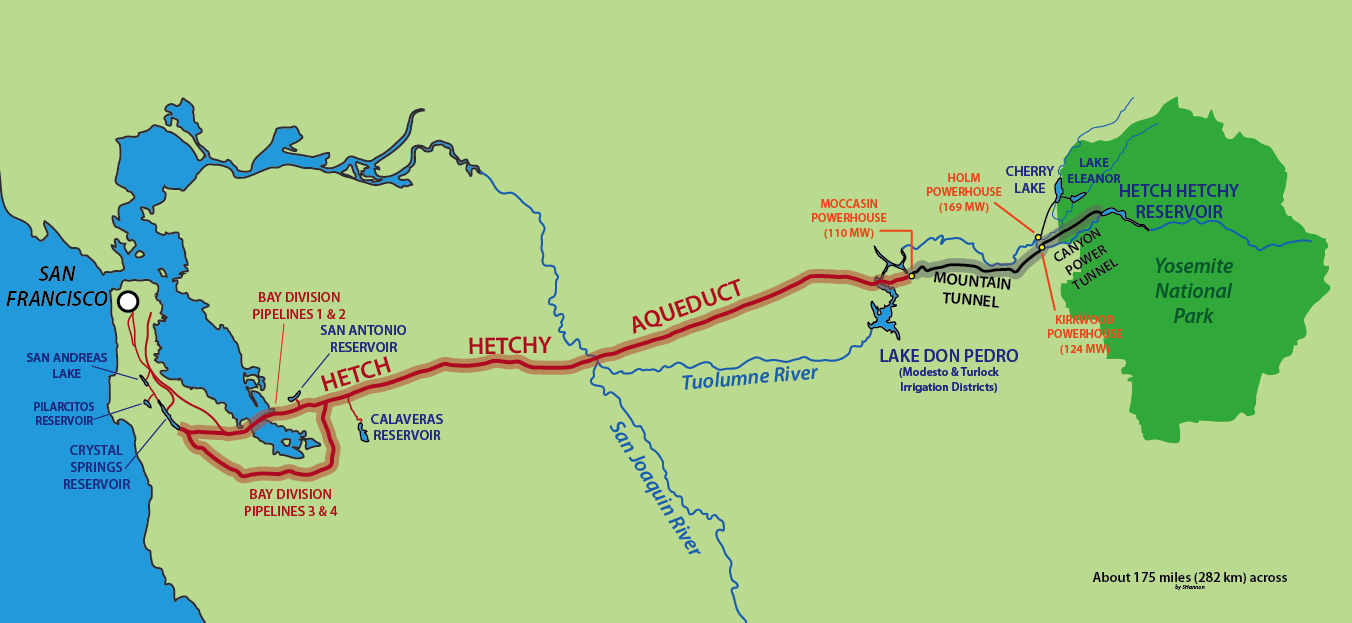
Prior to completion of the Hetch Hetchy Aqueduct in 1934, half of San Francisco's water supply, approximately 6 million gallons per day passed through the Sunol temple. The SVWC, including the temple, was purchased by the city of San Francisco in 1930 for US$40 million.
In 1932, a new city charter was adopted which established the San Francisco Public Utilities Commission. At the time of its formation, the commission was responsible for the Hetch Hetchy Project, San Francisco Municipal Railway, Water Department, and Airport. The Airport was later transferred out of the SFPUC to the newly formed Airport Commission in 1971. Similarly, in 1994 the Municipal Railway was moved out to the separate Public Transportation Commission.
Structure and leadership
.jpg)
The SFPUC is headed by a board consisting of five Commissioners, who are nominated by the Mayor of San Francisco and confirmed by the San Francisco Board of Supervisors. Each of the five Commissioners is chosen according to criteria set forth in the San Francisco City Charter:
Seat 1 on the Commission shall be a member with experience in environmental policy and an understanding of environmental justice issues. Seat 2 shall be a member with experience in ratepayer or consumer advocacy. Seat 3 shall be a member with experience in project finance. Seat 4 shall be a member with expertise in water systems, power systems, or public utility management, and Seat 5 shall be an at-large member.
The Commission meets on the second and fourth Tuesdays of each month. Their responsibility is to provide operational oversight in such areas as rates and charges for services, approval of contracts, and organizational policy.
The board appoints a General Manager as the chief executive of the SFPUC, with each division headed by an Assistant General Manager (AGM). The six divisions are: Business Services, External Affairs, Infrastructure, Power Enterprise, Water Enterprise, and Wastewater Enterprise.
Controversy
Main article: San Francisco Department of Public Works corruption scandal
Then-SFPUC director Harlan Kelly resigned on November 30, 2020, charged with accepting bribes from a contractor. Kelly's trial began in June 2023. Kelly was convicted in July 2023 of felony bribery and bank fraud and sentenced to four years in prison.
Environmental sustainability
With the goal of improving sustainability and the city of San Francisco's goal to become a "zero emission city" by 2030, the SFPUC is implementing a number of projects in all of its core businesses: water, power and sewer.
- Water: SFPUC is applying a "Water System Improvement Program" (WSIP) to manage a wide range of projects focusing on the optimization of pipelines, pump stations and water tanks usage.
- Power: SFPUC is generating and providing different typologies of clean energy (hydroelectric, solar and biogas) for municipal services and citizens needs. Moreover, in collaboration with Paradox Engineering is seeking to exploit street light pole developing an integrated infrastructure with the specific scope of monitor the usage of urban services, optimize the power consumption and consequently reduce waste.
- Sewer: SFPUC is applying the "Sewer System Improvement Program" (SSIP) to manage a wide range of projects that includes optimization of pump stations and wastewater treatment processes. In addition, SFPUC has applied over $50M of funding to pilot and are constructing various Low Impact Designs (LID) through their "Early Implementation Projects" to test if LID features such as bio-retention systems or creek daylighting projects would reduce the volume of stormwater that would be collected, conveyed and treated. By reducing the stormwater flows to the wastewater treatment plants, energy consumption may be reduced. SFPUC is equally committed to environmental justice causes and will address sewage flooding at many flood-prone neighborhoods in San Francisco: (1) Cayuga Avenue, (2) Alemany Circle, (3) Folsom and 17th Streets, (4) Toland Street, (5) Foerster Street, (6) Urbano Dr and Victoria Street, (7) Wawona Ave and 15th Ave. The low-lying areas of San Francisco along the San Francisco Bay is vulnerable to periodic flooding from runoff and wastewater during winter storms. Continued land subsidence, sea level rise, and urban growth in hitherto industrial neighborhoods will continue to challenge the runoff and sewage collection and conveyance system.
References
References
- "About SFPUC". San Francisco Public Utilities Commission.
- "Serving 2.7 million residential, commercial and industrial customers". San Francisco Public Utilities Commission.
- "SFPUC Commits to Largest Wind Development in CleanPowerSF History". San Francisco Public Utilities Commission.
- "About the Wastewater Enterprise". San Francisco Public Utilities Commission.
- "Treating the Liquid Flows". San Francisco Public Utilities Commission.
- Chris Metinko. (2 January 2006). "City owns a hearty connection to beer". The Contra Costa Times.
- Matt Smith. (22 September 2004). "Big Dam Mess". SF Weekly.
- Hanson, Warren D.. (1994). "San Francisco Water and Power: A History of the Municipal Water Department and Hetch Hetchy System". City and County of San Francisco.
- Hanson, Warren D.. (2005). "San Francisco Water and Power: A History of the Municipal Water Department and Hetch Hetchy System". City and County of San Francisco.
- Communications and Public Outreach. (2002). "History of the SFPUC". SF Public Utilities Commission.
- Brechin, Gray A.. (1999). "Imperial San Francisco: Urban Power, Earthly Ruin". University of California Press.
- Teresa Brown. (29 November 2002). "Welcome to Sunol". Pleasanton Weekly.
- "San Francisco Public Utilities Commission : Our History". San Francisco Public Utilities Commission.
- "The San Francisco Airport Commission is formed {{!}} San Francisco International Airport". San Francisco International Airport.
- (18 August 2017). "Muni History". San Francisco Municipal Transportation Agency.
- "San Francisco Municipal Code - 1996 Charter". American Legal Publishing Company.
- "SFPUC Executive Management". San Francisco PUC.
- (November 30, 2020). "Statement from Mayor London Breed on the Resignation of San Francisco Public Utilities Commission General Manager Harlan Kelly".
- (November 30, 2020). "SFPUC chief charged with accepting bribes in alleged City Hall corruption scheme". [[San Francisco Chronicle]].
- (19 October 2021). "Federal Charges Against Former San Francisco PUC General Manager Expanded To Include Bank Fraud Conspiracy".
- Barba, Michael. (2023-06-27). "Corruption Trial Begins for SF's Ex-Utilities Chief Harlan Kelly".
- (2023-07-17). "Northern District of California {{!}} Jury Convicts Former San Francisco Public Utilities Commission General Manager of Felony Bribery and Bank Fraud Charges {{!}} United States Department of Justice".
- (2024-03-18). "Northern District of California {{!}} Former San Francisco PUC Chief Sentenced To Four Years In Prison {{!}} United States Department of Justice".
- "Street lighting in San Francisco turns smart with Paradox Engineering". Startupticker.ch. Retrieved on september 2013..
This article was imported from Wikipedia and is available under the Creative Commons Attribution-ShareAlike 4.0 License. Content has been adapted to SurfDoc format. Original contributors can be found on the article history page.
Ask Mako anything about San Francisco Public Utilities Commission — get instant answers, deeper analysis, and related topics.
Research with MakoFree with your Surf account
Create a free account to save articles, ask Mako questions, and organize your research.
Sign up freeThis content may have been generated or modified by AI. CloudSurf Software LLC is not responsible for the accuracy, completeness, or reliability of AI-generated content. Always verify important information from primary sources.
Report