From Surf Wiki (app.surf) — the open knowledge base
San Francisco City Hall
City Hall for the City and County of San Francisco, California

City Hall for the City and County of San Francisco, California
| Field | Value |
|---|---|
| name | San Francisco City Hall |
| image | San Francisco City Hall 2.JPG |
| image_size | 325px |
| caption | San Francisco City Hall in 2008 |
| location | 1 Dr. Carlton B. Goodlett Place |
| San Francisco, California | |
| coordinates | |
| map_type | United States San Francisco Central |
| pushpin_label | San Francisco City Hall |
| start_date | |
| completion_date | |
| building_type | Government offices |
| architectural_style | Beaux-Arts |
| antenna_spire | 93.73 m |
| floor_count | 5, including ground floor |
| elevator_count | 9 (6 passenger, 3 freight) |
| cost | |
| ($ dollars in 2016) | |
| floor_area | 46000 m2 |
| architect | Bakewell & Brown |
| owner | City and County of San Francisco |
| management | Real Estate Division |
| embedded | |
| references |
San Francisco, California ($ dollars in 2016)
San Francisco City Hall is the seat of government for the City and County of San Francisco, California. Re-opened in 1915 in its open space area in the city's Civic Center, it is a Beaux-Arts monument to the City Beautiful movement that epitomized the high-minded American Renaissance of the 1880s to 1917. The structure's dome is taller than that of the United States Capitol by 42 feet. The present building replaced an earlier City Hall that was destroyed during the 1906 earthquake, which was two blocks from the present one.
The principal architect was Arthur Brown, Jr., of Bakewell & Brown, whose attention to the finishing details extended to the doorknobs and the typeface to be used in signage. Brown also designed the San Francisco War Memorial Opera House, Veterans Building, Temple Emanuel, Coit Tower and the Federal office building at 50 United Nations Plaza.
TOC
Architecture
The building's vast open space is more than 500000 ft2 and occupies two full city blocks. It is 390 ft between Van Ness Avenue and Polk Street, and 273 ft between Grove and McAllister Streets. Its dome, which owes much to Mansart's Baroque domes of the Val-de-Grâce (church) and Les Invalides in Paris, rises 307.5 ft above the Civic Center Historic District. It is 19 ft higher than the United States Capitol, and has a diameter of 112 ft, resting upon 4 x 50 ton (44.5 metric ton) and 4 x 20 ton (17.8 metric ton) girders, each 9 ft deep and 60 ft long.
The building as a whole contains 7,900 tons (7,035 metric tons) of structural steel from the American Bridge Company of Ambridge, Pennsylvania near Pittsburgh. It is faced with Madera County granite on the exterior, and Indiana sandstone within, together with finish marbles from Alabama, Colorado, Vermont, and Italy. Much of the statuary is by Henri Crenier.
The upper levels of the Rotunda are public and handicapped accessible. Opposite the grand staircase, on the second floor, is the office of the Mayor. Bronze busts of former Mayor George Moscone and his successor, Dianne Feinstein, stand nearby as tacit reminders of the Moscone assassination, which took place just a few yards from that spot in the smaller rotunda of the mayor's office entrance. A bust of former county supervisor Harvey Milk, who was assassinated in the building was unveiled on May 22, 2008. The inscription that dominates the grand Rotunda and the entrance to the mayor's small rotunda, right below Father Time, reads:
SAN • FRANCISCO O • GLORIOVS • CITY • OF • OVR HEARTS • THAT • HAST • BEEN TRIED • AND • NOT • FOVND WANTING • GO • THOV • WITH LIKE • SPIRIT • TO • MAKE THE • FVTVRE • THINE 1912 JAMES ROLPH JR. MAYOR 1931
The words were written by the previous Mayor Edward Robeson Taylor, and dedicated by Mayor James Rolph.
While plaques at the Mall entrance memorialize President George Washington's farewell address and President Abraham Lincoln's Gettysburg Address, the primary themes of the statuary are to the past mayors, with the dates of their terms in office. The medallions in the vaults of the Rotunda are of Equality, Liberty, Strength, Learning and, as memorialized in the South Light Court display, Progress.
History

From 1849 to 1850, San Francisco's municipal government was on the west side of Portsmouth Square at the Office of the Alcalde, who was the municipal magistrate, with both judicial and administrative functions, and the ayuntamiento, the town council, or cabildo.
In May 1850, after the first City Charter was adopted, the first San Francisco City Hall was established at the former luxury hotel Graham House on the corner of Kearny and Pacific streets, which was later consumed by the great fire of June 1851. In 1852, San Francisco City Hall was at 750 Kearny Street between Washington and Merchant Streets, at the converted Jenny Lind Theatre building and Parker House, located then between the El Dorado Hotel and The Union, opposite the east side of Portsmouth Square. Later, this was the site of a Hall of Justice, as seen on the TV series, Ironside.
The current 1916 City Hall building is a replacement for the 1899 building, construction for which began in 1871 designed by Augustus Laver and Thomas Stent.The 1899 city hall also contained a smaller extension which contained the city's Hall of Records, which housed the very first Flag of California. It was bounded by Larkin Street, McAllister Street, and City Hall Avenue (a street, now built over, which ran from the corner of Grove and Larkin to the corner of McAllister and Leavenworth), largely where the current public library and U.N. Plaza stand today. Noted city planner and architect Daniel Burnham published a plan in 1905 to redesign the city, including a new Civic Center complex around City Hall, but the plans were shelved in the wake of the 1906 San Francisco earthquake, which destroyed the 1899 City Hall.
The 1899 building was designed as a complex of buildings to be built on a triangular park, the former site of an old cemetery. The state appropriated the land and auctioned off portions of the property. Construction began in 1870, was finished 27 years later, in 1897, costing six million dollars ($146,472,824.43 in 2025 dollars). With seven chief architects and twenty-seven years, corruption built up. Even the materials were compromised; the building's cast bricks were rumored to be shoddy and the walls were found to be padded with sand. Fireplaces were built and later heating systems were installed. There were major sewage problems, the place was said to stink all the time. The floors didn't match up, chimneys didn't draw so the rooms were smoky. It was a badly designed building, and fell with the 1906 San Francisco Earthquake, only nine years later.
James "Sunny Jim" Rolph]]
Reconstruction plans following the earthquake for the Civic Center complex called for a neo-classical design as part of the City Beautiful Movement, as well as a desire to rebuild the city in time for the 1915 Panama–Pacific International Exposition. A bond was authorized for $8.8 million on March 28, 1912, of which the new City Hall was budgeted for $3.5 million to $4 million. After Arthur Brown Junior's design was selected from the competition, construction started in 1913 and was completed by 1915, in time for the Exposition.
.jpg)
Ground was broken for the 1916 City Hall at Van Ness and Fulton on April 5, 1913, and the cornerstone was laid on October 25 of that year. Mayor Rolph moved into City Hall on December 28, 1915, the final stone was laid on March 31, 1916, and scaffolding was finally removed on July 28, officially marking the end of construction. The ruins of the old City Hall were sold shortly thereafter in August 1916 for , with removal to be completed within 40 days.
The main rotunda served as the site where many prominent politicians and public servants were laid in state. General Fredrick Funston, hero of the Spanish–American War, Philippine–American War, and the 1906 earthquake laid there in 1917. President Warren G. Harding laid here in 1923. Former mayor and governor James Rolph was laid in state in City Hall following his death in 1934.
Joe DiMaggio and Marilyn Monroe were married at City Hall in January 1954.
In May 1960, the main Rotunda was a site of a student protest against the House Un-American Activities Committee and a countering police action whereby students from UC Berkeley, Stanford, and other local colleges were fire hosed down the steps beneath the rotunda. This event was memorialized by students during the Free Speech Movement at UC Berkeley four years later.
On November 27, 1978, former Supervisor Dan White assassinated Mayor George Moscone and Supervisor Harvey Milk inside of City Hall.
The Loma Prieta earthquake of 1989 damaged the structure, and twisted the dome four inches (102 mm) on its base. Afterward, under the leadership of the San Francisco Bureau of Architecture in collaboration with Carey & Co. preservation architects, and Forell/Elsesser Engineers, work was completed to render the building earthquake resistant through a base isolation system,In an earthquake, the mass of the dome threatens to act as a pendulum, rocking the building's structure and tearing it apart, but the base isolation system of hundreds of rubber and stainless-steel insulators inserted into City Hall's underpinnings should have the effect of disrupting seismic waves before they can affect the structure. which would likely prevent total collapse of the building. City Hall reopened after its seismic upgrade in January 1999, and was the world's largest base-isolated structure at that time.
Prior to the retrofitting, the San Francisco County Superior Court’s civil courtrooms were located in City Hall but have been located across the street at the 400 McAllister courthouse since it opened in 1997.
The original grand plaza has undergone several extensive renovations, with radical changes in its appearance and utility. Prior to the 1960s there were extensive brick plazas, few trees, and a few large, simple, raised, and circular ponds with central fountains, all in a style that discouraged loitering. The plaza was then extensively excavated for underground parking. At this time a central rectangular pond, with an extensive array of water vents (strangely, all in several strict rows and all pointing east, with identical arcs of water, and completely without sculptural embellishment), was added, with extensive groves of trees (again, in 60s modernist style, planted with absolute military precision on rectangular grids). In the 1990s, with the rise of the problem of homelessness, the plaza was once again remodeled to make it somewhat less habitable—although the most significant change, the replacement of the pond and pumps with a lawn, could be reasonably justified on the basis of energy and water conservation.
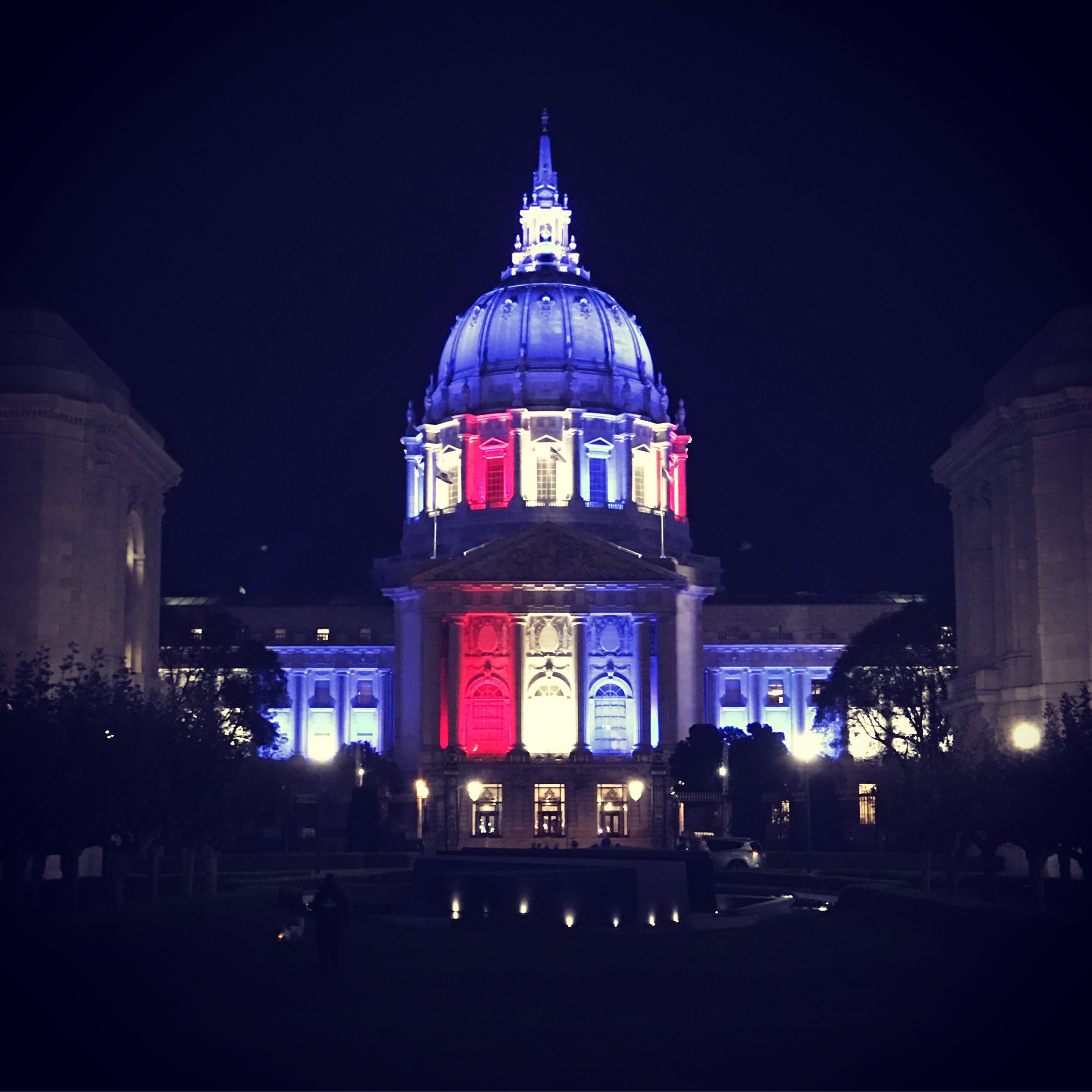
The building features color changeable LED lighting at the outside of the Rotunda, and between the exterior columns. The colors change to coincide with different events happening in the city and elsewhere.
During the COVID-19 pandemic, City Hall was closed from March 2020 until reopening on June 7, 2021.
In popular culture
- Dirty Harry (1971) filmed several scenes at City Hall, including inside the Mayor's office.
- The Towering Inferno (1974)
- Invasion of the Body Snatchers (1978)
- Foul Play (1978)
- A View to a Kill (1985)
- The Grand Staircase is featured in the Raiders of the Lost Ark (1981) as a stand-in for an unnamed government building in Washington, D.C.
- Ten-thousand-watt spotlights triggered the fire sprinkler system during the filming of Bicentennial Man (1999), resulting in water damage. The crew previously shot in the Supervisors' chambers.
- Milk (2008)
- *The Man in the High Castle (TV series) * (2015)
- The Etruscan Smile (2018)
References
Informational notes
Citations
References
- "City of San Francisco Designated Landmarks". City of San Francisco.
- "Emporis building ID 118739". [[Emporis]].
- {{SkyscraperPage. 10624
- {{Structurae. 20009318
- Gosciniak, Gregor. (26 June 2005). "San Francisco City Hall". CityMayors.
- 9780241007648
- Daub Firmin Hendrickson Sculpture Group. (2007). "Winning Maquette for Harvey Milk City Hall Memorial Sculpture Competition". The Harvey Milk City Hall Memorial Committee.
- "MermaidVision - P3090056".
- (1855). "The Annals of San Francisco".
- "Proceedings of the Ayuntamiento: 1 April 1850". Daily Alta California, Volume 1, Number 84, 6 April 1850.
- "San Francisco". CA State Parks.
- "THE NEW CITY HALL". Daily Alta California, Volume 3, Number 217, 6 August 1852.
- "The Congratulations of the San Francisco Architects to the Successful Architect or the New City Hall". Daily Alta California, Volume 23, Number 7638, 19 February 1871.
- (September 1905). "Report on a plan for San Francisco". Association for the Improvement and Adornment of San Francisco.
- (24 March 1912). "The Need for a New City Hall and People's Center". San Francisco Call.
- (25 October 1913). "Godspeed to the New City Hall, Started Today". San Francisco Call.
- (2009). "San Francisco Attractions: City Hall". A View on Cities.
- (6 April 1913). "City Hall Excavating Officially Begins". San Francisco Call.
- (5 April 1913). "Now for New City Hall". San Francisco Call.
- (October 25, 1913). "Rolph Lays City Hall's Stone". San Francisco Call.
- (29 December 1915). "War Necessities Drive Men to Substitutes In Manufactures". Morning Press.
- (1 April 1916). "Last Stone Laid In S.F. City Hall". Madera Tribune.
- (29 July 1916). "City Hall Finished". Press Democrat.
- (9 August 1916). "Bay City Hall Ruins Sold". Sacramento Union.
- (24 February 1917). "Funston's Body Lies In State at Bay". Sacramento Union.
- (2011). "San Francisco in the 1930s: The WPA Guide to the City by the Bay". University of California Press.
- (4 June 1934). "State Mourns at Rolph's Bier". Healdsburg Tribune.
- (15 January 1954). "Gorgeous Marilyn Monroe Married to Joe DiMaggio". San Bernardino Sun.
- Adams, Gerald. (29 December 1998). "Rebuilt, restored reborn: City Hall reopens, with jewels polished and population reduced". The San Francisco Chronicle.
- "San Francisco County / Historic California County Courthouses {{!}} CSCHS".
- (April 27, 2017). "Who's Behind the Colorful Lights at San Francisco City Hall?". [[KQED Inc.]].
- RODRIGUEZ, OLGA R.. (2021-06-07). "San Francisco's City Hall hosts 4 weddings in reopening".
- Hartlaub. (November 22, 2010). "Six best uses of San Francisco City Hall in the movies". [[San Francisco Chronicle]].
- Wilson, Sean. (September 21, 2021). "James Bond movies revisited: A View To A Kill {{!}} Cineworld cinemas".
- "Photo: Grace Jones and Tanya Roberts at City Hall in San Francisco to introduce latest James Bond film "A View to a Kill" - ARKMILT19850505003".
- (2013). "World Film Locations: San Francisco". Intellect Books, The University of Chicago Press.
- (19 June 1999). "City Hall Doesn't Want to See Sequel to Disney Movie Flood / Stricter regulations on events held there being considered".
- Kit, Borys. (February 1, 2008). "'Milk' shoot does the Castro good". [[The Hollywood Reporter]].
- [https://www.imdb.com/title/tt5459382/trivia/ "The Etruscan Smile" - IMDb Trivia]

This article was imported from Wikipedia and is available under the Creative Commons Attribution-ShareAlike 4.0 License. Content has been adapted to SurfDoc format. Original contributors can be found on the article history page.
Ask Mako anything about San Francisco City Hall — get instant answers, deeper analysis, and related topics.
Research with MakoFree with your Surf account
Create a free account to save articles, ask Mako questions, and organize your research.
Sign up freeThis content may have been generated or modified by AI. CloudSurf Software LLC is not responsible for the accuracy, completeness, or reliability of AI-generated content. Always verify important information from primary sources.
Report