From Surf Wiki (app.surf) — the open knowledge base
San Diego County, California
County in California, United States

County in California, United States
| Field | Value | |
|---|---|---|
| <!-- See the table at Template:Infobox settlement for all fields and descriptions of their usage. --> | name | San Diego County |
| settlement_type | County | |
| <!-- Images and maps -----------> | image_skyline | {{multiple image |
| total_width | 280 | |
| border | infobox | |
| perrow | 1/2/2/1 | |
| caption_align | center | |
| image1 | San_Diego_skyline_18_(cropped).jpg | |
| caption1 | San Diego and San Diego Bay | |
| image2 | Oceanside, CA USA - Mission San Luis Rey De Francia, 1798 - panoramio (cropped) (cropped).jpg | |
| caption2 | Oceanside | |
| image3 | Fontspoint02262006 (cropped).JPG | |
| caption3 | Anza-Borrego Desert | |
| image4 | US Navy 110212-N-8158F-595 A formation of F-A-18 Hornet strike fighters assigned to the U.S. Navy flight demonstration squadron, the Blue Angels, f (cropped).jpg | |
| caption4 | Coronado | |
| image5 | Del Mar Racetrack (cropped).jpg | |
| caption5 | Del Mar | |
| image6 | View of El Capitan from Santee's Sky Ranch (cropped).jpg | |
| caption6 | El Cajon and the Cuyamaca Mountains | |
| image_flag | Flag of San Diego County, California.png | |
| image_seal | Seal of San Diego County, California.png | |
| image_blank_emblem | Logo of San Diego County, California.png | |
| blank_emblem_type | Logo | |
| blank_emblem_size | 100px | |
| blank_emblem_link | List of U.S. county and city insignia | |
| image_map | ||
| map_caption | Interactive map of San Diego County | |
| image_map1 | Map of California highlighting San Diego County.svg | |
| mapsize1 | 200px | |
| map_caption1 | Location in California | |
| <!-- Location ------------------> | coordinates | |
| named_for | Saint Didacus of Alcalá | |
| subdivision_type | Country | |
| subdivision_name | United States | |
| subdivision_type1 | State | |
| subdivision_name1 | California | |
| seat_type | County seat | |
| seat | San Diego | |
| seat1_type | Largest city | |
| seat1 | San Diego | |
| established_title | Formed | |
| established_date | February 18, 1850 | |
| <!-- Government ------------> | government_type | Council–CEO |
| governing_body | Board of Supervisors | |
| leader_title | Chair | |
| leader_name | Terra Lawson-Remer (D) | |
| leader_title1 | Vice Chair | |
| leader_name1 | Monica Montgomery Steppe (D) | |
| leader_title2 | Chair Pro Tem | |
| leader_name2 | Paloma Aguirre (D) | |
| leader_title3 | Board of Supervisors{{cite web | |
| url | http://www.sandiegocounty.gov/content/sdc/general/bos.html | |
| title | Board of Supervisors | |
| publisher | County of San Diego | |
| access-date | January 12, 2015}} | |
| leader_name3 | {{Collapsible list | |
| title | Supervisors | |
| frame_style | border:none; padding:0; | |
| list_style | text-align:left; | |
| 1 | Paloma Aguirre (D) | |
| 2 | Joel Anderson (R) | |
| 3 | Terra Lawson-Remmer (D) | |
| 4 | Monica Montgomery Steppe (D) | |
| 5 | Jim Desmond (R) | |
| leader_title4 | Chief Administrative Officer | |
| leader_name4 | Ebony N. Shelton | |
| <!-- Area ------------------> | unit_pref | US |
| area_total_sq_mi | 4526 | |
| area_land_sq_mi | 4207 | |
| area_water_sq_mi | 319 | |
| area_footnotes | ||
| <!-- Elevations ------------> | elevation_max_footnotes | |
| elevation_max_ft | 6533 | |
| elevation_min_ft | ||
| population_as_of | April 1, 2020 | |
| population_total | 3298634 | |
| pop_est_as_of | 2024 | |
| population_est | 3298799 | |
| population_density_sq_mi | auto | |
| <!-- GDP -----------> | demographics_type2 | GDP |
| demographics2_footnotes | ||
| demographics2_title1 | Total | |
| demographics2_info1 | $257.341 billion (2022) | |
| <!-- Time zones -----------> | timezone | Pacific Time Zone |
| utc_offset | –8 | |
| timezone_DST | Pacific Daylight Time | |
| utc_offset_DST | –7 | |
| <!-- Codes ----------------> | postal_code_type | |
| area_code_type | Area codes | |
| area_code | 760/442 and 619/858 | |
| blank_name_sec1 | FIPS code | |
| blank_info_sec1 | 06-073 | |
| blank1_name_sec1 | GNIS feature ID = | |
| blank_name_sec2 | Congressional districts | |
| blank_info_sec2 | 48th, 49th, 50th, 51st, 52nd | |
| website |
| access-date = January 12, 2015}}
San Diego County (), officially the County of San Diego, is a county in the southwest corner of the U.S. state of California, north to its border with Mexico. As of the 2020 census, the population was 3,298,634; it is the second-most populous county in California and the fifth-most populous in the United States. Its county seat is San Diego, the second-most populous city in California and the eighth-most populous in the United States. It is the southwesternmost county in the 48 contiguous United States, and is a border county. It is home to 18 Indian reservations, the most of any county in the United States. There are 16 military installations of the U.S. Navy, Marine Corps, and Coast Guard in the county.
San Diego County comprises the San Diego–Chula Vista–Carlsbad, CA Metropolitan Statistical Area, which is the 18th most populous metropolitan statistical area and the 18th most populous primary statistical area in the United States. San Diego County is also part of the San Diego–Tijuana region, the largest metropolitan area shared between the United States and Mexico. From north to south, San Diego County extends from the southern borders of Orange and Riverside counties to the Mexico–U.S. border and the municipalities of Tijuana and Tecate in Baja California. From west to east, San Diego County stretches from the Pacific Ocean to its boundary with Imperial County, which separated from it in 1907.
San Diego County has more than 70. mi of coastline. This forms the most densely populated region of the county, which has a mild Mediterranean to semiarid climate and extensive chaparral vegetation, similar to the rest of the western portion of Southern California. Precipitation and temperature extremes increase to the east, with mountains that receive frost and snow in the winter. These lushly forested mountains receive more rainfall than the average in Southern California, while the desert region of the county lies in a rain shadow to the east, which extends into the Desert Southwest region of North America.
History
Main article: History of San Diego
The area which is now San Diego County has been inhabited for more than 12,000 years by the Kumeyaay (also known as 'Iipai-Tiipai or by the historical Spanish name Diegueño), Luiseño, Cupeño, Cahuilla, and the Acjachemen people and their local predecessors.
In 1542, the explorer Juan Rodríguez Cabrillo, who may have been born in Portugal but sailed under the flag of Castile, claimed San Diego Bay for the Spanish Empire, and he named the site San Miguel. In November 1602, Sebastián Vizcaíno surveyed the harbor and what are now Mission Bay and Point Loma and named the area for Saint Didacus, a Spaniard more commonly known as San Diego. European settlement in what is now San Diego County began with the founding of the San Diego Presidio and Mission San Diego de Alcalá by Spanish soldiers and clerics in 1769. This county was part of Alta California under the Viceroyalty of New Spain until the Mexican declaration of independence. From 1821 through 1848, this area was part of Mexico.
San Diego County became part of the United States as a result of the Treaty of Guadalupe Hidalgo in 1848, ending the Mexican–American War. This treaty designated the border to pass through a point one marine league south of the southernmost point of the port of San Diego, ensuring that the United States received all of the natural harbor of San Diego Bay.
San Diego County was one of the original counties of California, created at the time of California statehood in 1850.
At the time of its establishment in 1850, San Diego County was relatively large, and included all of southernmost California south and east of Los Angeles County. It included areas of what are now Inyo and San Bernardino Counties, as well as all of what are now Riverside and Imperial Counties.
During the later part of the 19th century, there were numerous changes in the boundaries of San Diego County, when various areas were separated to make up the counties mentioned above. The most recent changes were the establishments of Riverside County in 1893 and Imperial County in 1907. Imperial County was also the last county to be established in California, and after this division, San Diego no longer extended from the Pacific Ocean to the Colorado River, and it no longer covered the entire border between California and Mexico.
Geography
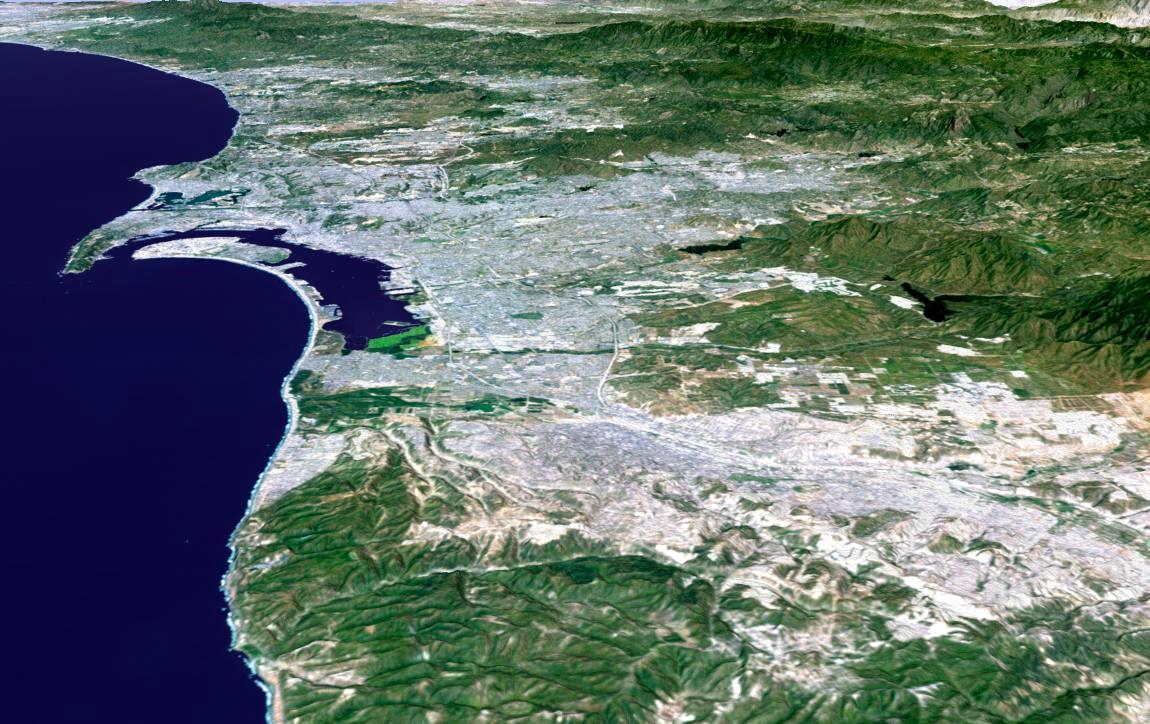
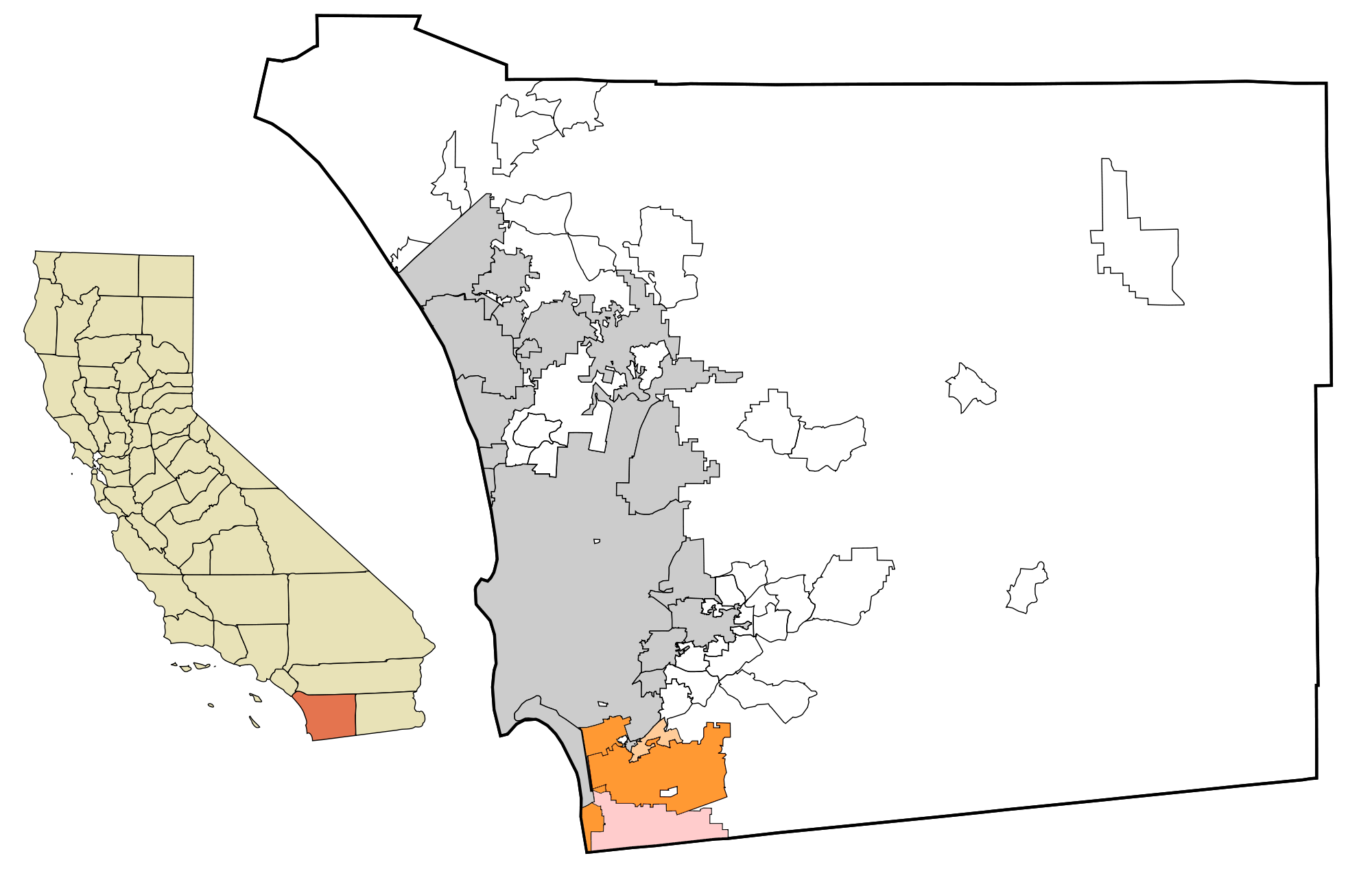
According to the U.S. Census Bureau, the county has an area of 4526 sqmi, of which 4207 sqmi is land and 319 sqmi (7.0%) is water. The county is larger in area than the combined states of Rhode Island and Delaware.
San Diego County has a varied topography. On its western side is more than 70. mi of coastline. Most of San Diego between the coast and the Laguna Mountains consists of hills, mesas, and small canyons. Snow-capped (in winter) mountains rise to the east, with the Sonoran Desert farther to the east. The Cleveland National Forest is spread across the central portion of the county, while Anza-Borrego Desert State Park occupies most of the northeast.
Although the county's western third is primarily urban, the mountains and deserts in the eastern two-thirds are primarily undeveloped backcountry. Most of these backcountry areas are home to a native plant community known as chaparral. San Diego County contains more than 1000000 acres of chaparral, twice as much as any other California county.
Periodically the area has been subject to wildfires that force thousands to evacuate. The most recent are the December 2017 Lilac Fire, the May 2014 San Diego County wildfires, the Witch Creek Fire in 2007, and the Cedar Fire in 2003. California defines a fire season in which fires are most likely to occur, usually between late July and late October (which are the driest months of the area). Signs posted in numerous spots of the county provide information on the level of threats from fires based on weather conditions.
Regions
Northern San Diego County is known as North County; the eastern suburbs are collectively known as East County; the rural areas located further east and extending to the Imperial County line are known as the Mountain Empire; and the southern suburbs, extending to the Mexican border, are collectively known as the South Bay or South County, including South San Diego, an exclave of the city of San Diego which has no land connection to the rest of the city.
Location
San Diego County is bordered on the northwest by Orange County, on the north by Riverside County; on the east by Imperial County; on the south by Mexico; and on the west by the Pacific Ocean.
Climate
Main article: Climate of San Diego, California
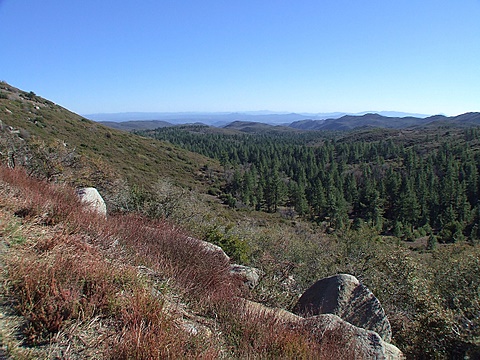
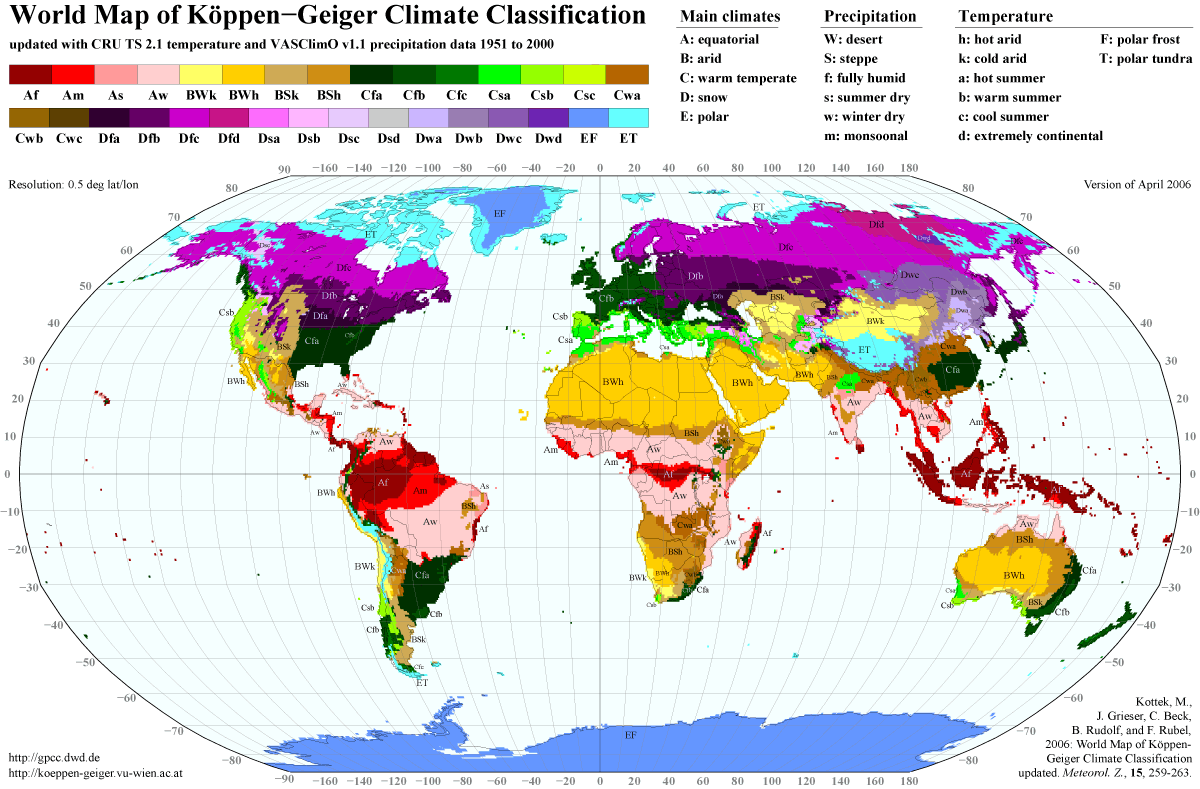
Under the Köppen climate classification system, the urban and suburban San Diego area straddles areas of Mediterranean climate (Csa) to the north and hot semi-arid climate (BSh) to the south and east. As a result, it is often described as "arid Mediterranean" and "semi-arid steppe." Farther east, arid desert conditions prevail. Western San Diego's climate is characterized by warm, dry summers and mild winters with most of the annual precipitation falling between November and March. The city has mild, mostly dry weather, with an average of 201 days above 70 °F and low rainfall (9 – annually). Summer temperatures are generally warm, with average highs of 70 – and lows of 55 –. Temperatures exceed 90 °F only four days a year. Most rainfall occurs from November to April. Winter temperatures are mild, with average high temperatures of 66 – and lows of 50 –.
The climate in the San Diego area, like much of California, often varies significantly over short geographical distances resulting in microclimates. In San Diego's case this is mainly due to the city's topography (the Bay, and the numerous hills, mountains, and canyons). Frequently, particularly during the "May gray/June gloom" period, a thick marine layer will keep the air cool and damp within a few miles of the coast, but will yield to bright cloudless sunshine approximately 5 – inland. This happens every year in May and June. Even in the absence of June gloom, inland areas tend to experience much more significant temperature variations than coastal areas, where the ocean serves as a moderating influence. Thus, for example, downtown San Diego averages January lows of 48 °F and August highs of 77 °F. The city of El Cajon, just 10 mi northeast of downtown San Diego, averages January lows of 42 °F and August highs of 89 °F. Julian, in the mountains, has an average January low of 29 °F and August high of 85 °F. Borrego Springs, in the Colorado Desert, has an average January low of 43 °F and August high of 106 °F.
Rainfall along the coast averages about 10 in of precipitation annually, which occurs mainly during the cooler months of December through April. Though there are few wet days per month during the rainy period, rainfall can be heavy when it does occur. However, the rainfall is greater in the higher elevations of San Diego. Some of the higher areas of San Diego, such as Palomar Mountain and the Laguna Mountains, receive 20 – of rain per year, supporting lush forests similar to the Sierra Nevada and California Coast Range. The Colorado Desert portion of the county lies to the east of the mountains, which receives the least amount of precipitation; Borrego Springs, the largest population center in the desert, averages only 5 in, with a high evaporation rate.
Adjacent counties and municipalities
| image- style="width:350px;"| width = 344 | height=245 | image-bg-color = #dddddd; font-size:smaller


National protected areas
- Cabrillo National Monument
- Cleveland National Forest (part)
- San Diego National Wildlife Refuge Complex, which includes
- San Diego National Wildlife Refuge
- San Diego Bay National Wildlife Refuge
- Tijuana Slough National Wildlife Refuge
- Seal Beach National Wildlife Refuge (located in Orange County)
There are seven official wilderness areas in San Diego County that are part of the National Wilderness Preservation System (NWPS). Four of these are integral parts of Cleveland National Forest, whereas three are managed by the Bureau of Land Management (BLM). Some of these extend into neighboring counties (as indicated below):
- Otay Mountain Wilderness (BLM)
- Pine Creek Wilderness (Cleveland National Forest)
- Hauser Wilderness (Cleveland National Forest)
- Carrizo Gorge Wilderness (BLM)
- Sawtooth Mountains Wilderness (BLM)
- Agua Tibia Wilderness (Cleveland National Forest) partly in Riverside County
- San Mateo Canyon Wilderness (Cleveland National Forest) mostly in Riverside County
State parks and protected areas
- Anza-Borrego Desert State Park (majority)
- Torrey Pines State Natural Reserve
- Cuyamaca Rancho State Park
- Palomar Mountain State Park
- San Pasqual Battlefield State Historic Park
- Old Town San Diego State Historic Park
- Border Field State Park
- Tijuana River National Estuarine Research Reserve
- San Onofre State Beach
- Moonlight State Beach
- Carlsbad State Beach
- South Carlsbad State Beach
- Leucadia State Beach
- San Elijo State Beach
- Cardiff State Beach
- Torrey Pines State Beach
- Silver Strand State Beach
Mountains
- Cuyamaca Mountains
- In-Ko-Pah Mountains
- Jacumba Mountains
- Laguna Mountains
- Palomar Mountain
- Peninsular Ranges
- San Ysidro Mountains
- Santa Ana Mountains
- Volcan Mountains
There are 236 mountain summits and peaks in San Diego County including:
- Black Mountain
- Cuyamaca Peak (second highest point in San Diego County)
- Cowles Mountain (highest point in the city of San Diego)
- Mount Helix
- Hot Springs Mountain (highest point in San Diego County)
- Margarita Peak
- Mount Soledad
- Stonewall Mountain
- El Cajon Mountain
- Woodson Mountain (known for Potato Chip Rock)
Bays and lagoons
- Buena Vista Lagoon
- Agua Hedionda Lagoon
- Batiquitos Lagoon
- San Elijo Lagoon
- Los Peñasquitos Lagoon
- Mission Bay
- San Diego Bay
Lakes
- Lake Cuyamaca
- Lake Hodges
- Santee Lakes
- Sweetwater Reservoir
- Upper Otay Reservoir
- Lower Otay Reservoir
- Lake Wohlford
- El Capitan Reservoir
- Sutherland Reservoir
- Lake Henshaw
- Lake Murray
- San Vicente Reservoir
- Lake Jennings
- Barrett Dam
- Natural Rock Tanks
- Little Laguna Lake
- Big Laguna Lake
- Big Lake
- Twin Lakes
- Jean Lake
- Lost Lake
- Swan Lake
- Lake Miramar
- Lake Poway
- Dixon Lake
- Lindo Lake
Rivers
- San Diego River
- San Luis Rey River
- San Dieguito River
- Sweetwater River
- Otay River
- Tijuana River
- Tijuana River Mouth State Marine Conservation Area
- Santa Margarita River
Forests
- Marys Grove
Environmental risks
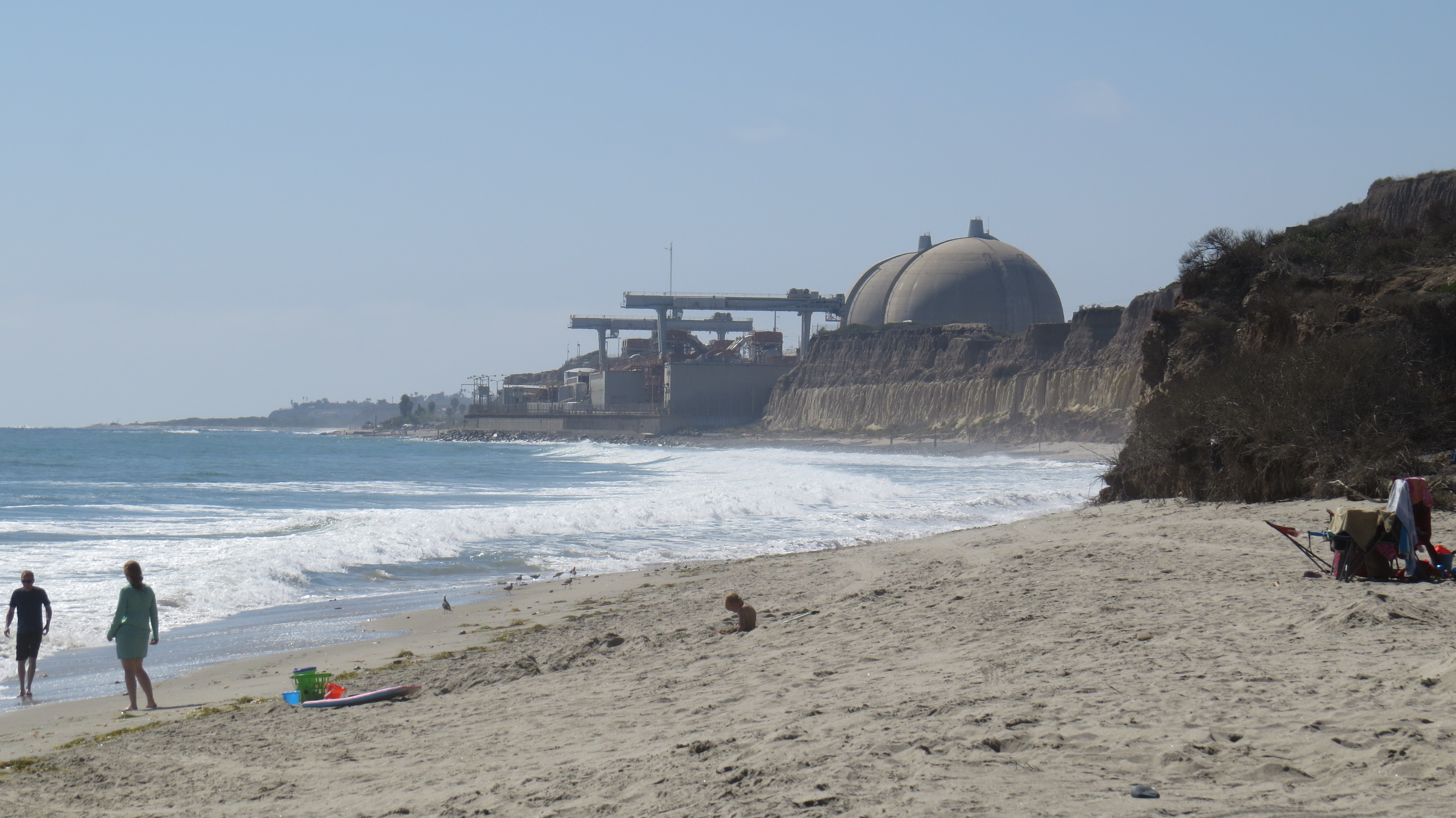
More than 1,700 tons of radioactive waste are stored at San Onofre Nuclear Generating Station, which sits in an area where there is a record of past tsunamis.
Portions of the Tijuana River has been heavily contaminated with sewage since the 1990's. There has been efforts to expand the South Bay International Wastewater Treatment Plant, such as one designated by the United States Environmental Protection Agency in 2025.
Demographics
Main article: Demographics of San Diego County, California
In the 1847 census of San Diego County ordered by Richard Barnes Mason, it found that 2,287 people lived in the county, to include Native Americans, Pacific Islanders, and African Americans. Since at least 2014, San Diego County is the fifth most populous county in the United States. In 2000, only about 3% of San Diego County residents left the county for work while 40,000 people commuted into the metropolitan area.

| align-fn = center 1790–1960 1900–1990 1990–2000 2010 2020
2020 census
As of the 2020 census, the county had a population of 3,298,634 with a median age of 37.1 years; 20.9% were under the age of 18 and 15.2% were 65 years of age or older. For every 100 females there were 99.2 males, and among residents age 18 and over there were 97.7 males per 100 females.
The racial makeup of the county was 49.5% White, 4.7% Black or African American, 1.2% American Indian and Alaska Native, 12.5% Asian, 0.5% Native Hawaiian and Pacific Islander, 15.8% from some other race, and 15.8% from two or more races. Hispanic or Latino residents of any race comprised 33.9% of the population.
95.6% of residents lived in urban areas, while 4.4% lived in rural areas.
There were 1,158,764 households in the county, of which 32.2% had children under the age of 18 living with them and 25.8% had a female householder with no spouse or partner present. About 23.2% of all households were made up of individuals and 9.0% had someone living alone who was 65 years of age or older.
There were 1,228,505 housing units, of which 5.7% were vacant. Among occupied housing units, 53.5% were owner-occupied and 46.5% were renter-occupied. The homeowner vacancy rate was 0.9% and the rental vacancy rate was 4.7%.
Racial and ethnic composition
| Race / Ethnicity (NH = Non-Hispanic) | Pop 1980 | Pop 1990 | title=P004: Hispanic or Latino, and Not Hispanic or Latino by Race – 2000: DEC Summary File 1 – San Diego County, California | url=https://data.census.gov/table?g=050XX00US06073&tid=DECENNIALSF12000.P004 | website=United States Census Bureau | access-date= }} | title=P2: Hispanic or Latino, and Not Hispanic or Latino by Race – 2010: DEC Redistricting Data (PL 94-171) – San Diego County, California | url=https://data.census.gov/cedsci/table?q=p2&g=050XX00US06073&tid=DECENNIALPL2010.P2 | website=United States Census Bureau | access-date= }} | Pop 2020 | % 1980 | % 1990 | % 2000 | % 2010 | % 2020 |
|---|---|---|---|---|---|---|---|---|---|---|---|---|---|---|---|---|
| White alone (NH) | 1,374,649 | 1,633,281 | 1,548,833 | 1,500,047 | 1,422,205 | 73.83% | 65.38% | 55.04% | 48.46% | 43.11% | ||||||
| Black or African American alone (NH) | 102,165 | 149,898 | 154,487 | 146,600 | 145,014 | 5.49% | 6.00% | 5.49% | 4.74% | 4.40% | ||||||
| Native American or Alaska Native alone (NH) | 14,616 | 15,050 | 15,253 | 14,098 | 12,841 | 0.79% | 0.60% | 0.54% | 0.46% | 0.39% | ||||||
| Asian alone (NH) | 89,861 | 185,144 | 245,297 | 328,058 | 400,589 | 4.83% | 7.41% | 8.72% | 10.60% | 12.14% | ||||||
| Native Hawaiian or Pacific Islander alone (NH) | x | x | 12,164 | 13,504 | 12,991 | 0.43% | 0.44% | 0.43% | 0.44% | 0.39% | ||||||
| Other race alone (NH) | 5,378 | 3,862 | 5,822 | 6,715 | 18,125 | 0.29% | 0.15% | 0.21% | 0.22% | 0.55% | ||||||
| Mixed race or Multiracial (NH) | x | x | 81,012 | 94,943 | 167,240 | x | x | 2.88% | 3.07% | 5.07% | ||||||
| Hispanic or Latino (any race) | 275,177 | 510,781 | 750,965 | 991,348 | 1,119,629 | 14.78% | 20.45% | 26.69% | 32.03% | 33.94% | ||||||
| Total | 1,861,846 | 2,498,016 | 2,813,833 | 3,095,313 | 3,298,634 | 100.00% | 100.00% | 100.00% | 100.00% | 100.00% |
2010 census
The 2010 United States census reported that San Diego County had a population of 3,095,313. The racial makeup of San Diego County was 1,981,442 (64.0%) White, 158,213 (5.1%) African American, 26,340 (0.9%) Native American, 336,091 (10.9%) Asian (4.7% Filipino, 1.6% Vietnamese, 1.4% Chinese, 3.2% Other Asian), 15,337 (0.5%) Pacific Islander, 419,465 (13.6%) from other races, and 158,425 (5.0%) from two or more races. Hispanic or Latino of any race were 991,348 people (32.0%). Including those of mixed race, the total number of residents with Asian ancestry was 407,984.
2009 estimates
As of 2009, the racial makeup of the county was 79.4% White American, 5.6% Black or African American, 1% Native American, 10.4% Asian, 0.5% Pacific Islander, 10.3% from other races, and 3.6% from two or more races. 31.3% of the population were Hispanic or Latino of any race.
67.0% spoke only English at home; 21.9% spoke Spanish, 3.1% Tagalog and 1.2% Vietnamese.
2000 census
In 2000, there were 994,677 households, out of which 33.9% had children under the age of 18 living with them, 50.7% were married couples living together, 11.6% had a female householder with no husband present, and 33.3% were non-families. 24.2% of all households were made up of individuals, and 7.9% had someone living alone who was 65 years of age or older. The average household size was 2.73 and the average family size was 3.29.
As of 2000, 25.7% of the population was under the age of 18, 11.30% was from 18 to 24, 32.0% from 25 to 44, 19.8% from 45 to 64, and 11.2% was 65 years of age or older. The median age was 33 years. For every 100 females, there were 101.2 males. For every 100 females age 18 and over, there were 99.7 males.
Other demographic data
In 2012, it was estimated that there were 198,000 unauthorized immigrants; the origin of the plurality of them is Mexico.
In 2018, the median household income was $70,824; most people spend more than 30% of their income on housing costs. In August of that year, the median home price was $583,000; this is lower than the median home price in Los Angeles, and Orange counties.
Income
According to the 2000 census, the median income for a household in the county was $47,067, and the median income for a family was $53,438. Males had a median income of $36,952 versus $30,356 for females. The per capita income for the county was $22,926. About 8.9% of families and 12.4% of the population were below the poverty line, including 16.5% of those under age 18 and 6.8% of those age 65 or over.
Much of the county's high-income residents are concentrated in the northern part of the city of San Diego. The San Diego metropolitan area has two places with both a population of over 50,000 and a per capita income of over $40,000: Carlsbad and Encinitas.
The county's largest continuous high-income urban area is a triangle from a first point on the northern edge of Carlsbad, a second point southeast of Escondido, and a third point on the southern edge of La Jolla. It contains all or most of the cities of Carlsbad, Encinitas, Solana Beach, Del Mar, and Poway in addition to a substantial portion of northern San Diego.
Homelessness
According to a point-in-time count taken for the San Diego Regional Task Force on Homelessness, there were 8,576 homeless individuals on January 6, 2018, a 6% decrease from 2017. 3,586 were sheltered, and 4,990 were not. 4,912 (75.3%) were in the city of San Diego. North County Inland had 1,153 (13.4%), North County Coastal with 822 homeless (9.6%), 602 (7%) were found in South County, and 1,087 (12.7%) in East County.
Religion
According to a 2014 Pew Research Center survey, 68% of adults in the county were Christian, of whom 32% were Catholic. 27% were religiously unaffiliated, and 5% adhered to a non-Christian faith. According to the University of Southern California, in 2010, the largest faith in the county was Catholicism, followed by non-denominational Christians, and Mormons.
In 2014, the county had 978 religious organizations, the seventh most out of all US counties.
Immigration data
In 2014 according to Pew Research Center, there are about 170,000 undocumented immigrants living in the region. San Diego has been a destination for trafficked minors from Mexico and the Philippines. In 2018, the United States Border Patrol caught an average of over a hundred individuals crossing the border illegally each day.
Economy
San Diego County and Imperial County are part of the Southern Border Region, one of nine such regions. As a regional economy, the Southern Border Region is the smallest but most economically diverse region in the state. However, the two counties maintain weak relations and have little in common aside from their common border. The region has a high cost of living. This includes the highest cost of water in the United States. , San Diego County is within the top ten highest cost of rent in the United States; this has led to people moving out of the county.
Agriculture
San Diego County's agriculture industry was worth $1.85 billion in 2013, and is one of the top five egg producing counties in the United States. In 2013, San Diego County also had the most small farms of any county in the United States, and had the 19th largest agricultural economy of any county in the United States. According to the San Diego Farm Bureau, San Diego County is the United States' leading producer of avocados and nursery crops. Until the early 20th century, San Diego County had a thriving wine industry; however the 1916 Charles Hatfield flood was the beginning of the end of the industry which included the destruction of the Daneri winery in Otay Valley. , there are roughly one hundred vineyards and wineries in San Diego County.
By the 20192020 statistical survey, California Department of Food & Agriculture (cdfa) found that the nursery trade dominated the county's agriculture by dollar value. Second place went to avocado production.
Breweries
Main article: Beer in San Diego County, California
The county has been called "the Craft Beer Capital of America". Brewing has been one of the fastest-growing business sectors with local breweries ranking among the 50 largest craft brewers in the United States and breweries that are consistently rated among the top breweries in the world.
Cannabis
Commercial operations to grow, test, or sell cannabis are not allowed in the unincorporated areas of the county. Companies must be licensed by the local agency to operate and each city or county may authorize none or only some of these activities. Local governments may not prohibit adults, who are in compliance with state laws, from growing, using, or transporting marijuana for personal use.
Tourism

Tourism plays a large part in the economics of the San Diego metropolitan area. Tourists are drawn to the region for a well rounded experience, everything from shopping to surfing as well as its mild climate. Its numerous tourist destinations include Westfield UTC, Seaport Village, and Fashion Valley for shopping. SeaWorld San Diego and Legoland California as amusement parks. Golf courses such as Torrey Pines Golf Course and Balboa Park Golf Course. Museums such as the Museum of Us, the San Diego Museum of Art, Fleet Science Center, San Diego Natural History Museum, USS Midway Museum, and the San Diego Air & Space Museum. Historical places such as the Gaslamp Quarter, Balboa Park and Old Town San Diego State Historic Park. Wildlife refuges, zoos, and aquariums such as the San Diego Zoo, San Diego Zoo Safari Park, Birch Aquarium, Living Coast Discovery Center, and the San Diego-La Jolla Underwater Park. Outdoor destinations include the Peninsular Ranges for hiking, biking, mountainboarding and trail riding. Surfing locations include Swami's, Stone Steps Beach, Torrey Pines State Beach, Cardiff State Beach, San Onofre State Beach and the southern portion of Black's Beach.
The region is host to the second largest cruise ship industry in California which generates an estimated $2 million annually from purchases of food, fuel, supplies, and maintenance services. In 2008, the Port of San Diego hosted 252 ship calls and more than 800,000 passengers.
Culture
The culture of San Diego is influenced heavily by American and Mexican cultures due to its position as a border town, its large Hispanic population, and its history as part of Spanish America and Mexico. The area's longtime association with the U.S. military also contributes to its culture. Present-day culture includes many historical and tourist attractions, a thriving musical and theatrical scene, numerous notable special events, a varied cuisine, and a reputation as one of America's premier centers of craft brewing.
Sports

Sports in San Diego County includes major professional league teams, other highest-level professional league teams, minor league teams, and college athletics. San Diego County hosts two teams of the major professional leagues, the San Diego Padres of Major League Baseball (MLB) and San Diego FC of Major League Soccer (MLS). The county is home to several universities whose teams compete in various NCAA Division I sports, most notably the San Diego State Aztecs. The Farmers Insurance Open, a professional golf tournament on the PGA Tour, is played annually at Torrey Pines Golf Course.
San Diego County hosted the National Football League (NFL)'s San Diego Chargers from 1961 to 2017, when the team relocated to the Greater Los Angeles area (now the Los Angeles Chargers). The county also hosted the National Basketball Association (NBA)'s San Diego Rockets from 1967 to 1971 (now the Houston Rockets) and San Diego Clippers from 1978 to 1984 (now the Los Angeles Clippers). San Diego County has never hosted a National Hockey League (NHL) franchise, though it hosted the San Diego Mariners of the now-defunct World Hockey Association (WHA) from 1974 to 1977.
Currently, there is no NFL, NBA, or NHL team in the county. San Diego is the largest American city not to have won a championship in a "Big Four" major professional league. The city does have one major league title to its name: the 1963 American Football League (AFL) Championship won by the San Diego Chargers, when the AFL was an independent entity prior to the AFL–NFL merger in 1970. Due to its lackluster record on winning professional championships, and in some cases retaining professional teams, some San Diego sports fans believe there is a curse on professional sports in the city.
Government

Main article: Government of San Diego County, California
The government of San Diego County is defined and authorized under the Constitution of California, California law, and the Charter of the County of San Diego. Much of the government of California is in practice the responsibility of county governments such as the government of San Diego County. The County government provides countywide services such as elections and voter registration, law enforcement, jails, vital records, property records, tax collection, public health, and social services. In addition the County serves as the local government for all unincorporated areas. Some chartered cities such as San Diego and Chula Vista provide municipal services such as police, public safety, libraries, parks and recreation, and zoning. Other cities such as Del Mar and Vista arrange to have the County provide some or all of these services on a contract basis.
The county government is composed of the elected five-member San Diego County Board of Supervisors, several other elected offices and officers
| Office | Official | Party | |
|---|---|---|---|
| Clerk | Clerk Jordan Marks | Republican | |
| District Attorney | District Attorney Summer Stephan | Independent | |
| Sheriff | Sheriff Kelly Martinez | Democratic | |
| Treasurer | Treasurer Dan McAllister | Republican |
and numerous county departments and entities under the supervision of the Chief Administrative Officer such as the Probation Department. In addition, several entities of the government of California have jurisdiction conterminous with San Diego County, such as the San Diego Superior Court.
Under its foundational Charter, the five-member elected Board of Supervisors is the county legislature. The board operates in a legislative, executive, and quasi-judicial capacity. As a legislative authority, it can pass ordinances for the unincorporated areas (ordinances that affect the whole county, like posting of restaurant ratings, must be ratified by the individual city). As an executive body, it can tell the county departments what to do, and how to do it. As a quasi-judicial body, the Board is the final venue of appeal in the local planning process.
As of January 2025, the members of the San Diego County Board of Supervisors are:
| District | Supervisor | Party | |
|---|---|---|---|
| 1 | District 1 Paloma Aguirre (Chair Pro Tem) | Democrat | |
| 2 | District 2 Joel Anderson | Republican | |
| 3 | District 3 Terra Lawson-Remer (Chair) | Democrat | |
| 4 | District 4 Monica Montgomery Steppe (Vice Chair) | Democrat | |
| 5 | District 5 Jim Desmond | Republican |
For several decades, ending in 2013, all five supervisors were Republican, white, graduates of San Diego State University, and had been in office since 1995 or earlier. The Board was criticized for this homogeneity, which was made possible because supervisors draw their own district lines and, until 2010, were not subject to term limits.) That pattern was broken in 2013 when Slater-Price retired; she was replaced by Democrat Dave Roberts, who won election to the seat in November 2012 and was inaugurated in January 2013.
The San Diego County Code is the codified law of San Diego County in the form of ordinances passed by the Board of Supervisors. The Administrative Code establishes the powers and duties of all officers and the procedures and rules of operation of all departments.
The county motto is "The noblest motive is the public good." County government offices are housed in the historic County Administration Center Building, constructed in 1935–1938 with funding from the Works Progress Administration.
Politics
| San Diego County registered voters (2019) | Total population | Registered voters | Democratic | Republican | Democratic–Republican spread | No party preference | American Independent | Libertarian | Other | Green | Peace and Freedom |
|---|---|---|---|---|---|---|---|---|---|---|---|
| 3,338,330 | |||||||||||
| 1,747,383 | 52.3% | ||||||||||
| 623,925 | 35.7% | ||||||||||
| 475,149 | 27.2% | ||||||||||
| 552,538 | 31.6% | ||||||||||
| 55,800 | 3.2% | ||||||||||
| 16,355 | 0.9% | ||||||||||
| 11,474 | 0.7% | ||||||||||
| 6,887 | 0.4% | ||||||||||
| 5,255 | 0.3% |
Main article: Politics of San Diego County
Voting
With its prominent military presence, San Diego County historically has been a Republican Party stronghold, but in recent years it has come to favor the Democratic Party. The Republican presidential nominee carried the county in every election from 1948 through 2004, except in 1992, when Bill Clinton won a 37% plurality of the vote. In 2008, Barack Obama became the first Democratic presidential candidate to win a majority of votes in San Diego County since World War II. Democratic candidates continued to carry the county in 2012, 2016, 2020 and 2024. Joe Biden's 2020 margin of victory in the county, 22.8%, was the largest for a Democratic candidate since 1936, though it was narrower than Biden's statewide margin of 29.2%.
The city of San Diego itself is more Democratic than the county average and has largely voted Democrat in each presidential election since 1992; certain areas and cities within the county are swing areas and have split their votes in post-2000 elections. The county's Republican population gradually increases the further one travels away from downtown; the Republican strongholds include La Jolla, Coronado, the regions of North and East County, the eastern backlands, and remote mountain communities such as Julian. While these areas have traditionally voted Republican, all also contain varied electorates of Democrats, Libertarians, and independents.
A unique feature of the political scene is the use of Golden Hall, a convention facility next to San Diego's City Hall. The County Registrar of Voters rents the hall to distribute election results. Supporters and political observers gather to watch the results come in; supporters of the various candidates parade around the hall, carrying signs and chanting; candidates give their victory and concession speeches and host parties for campaign volunteers and donors at the site; and television stations broadcast live from the floor of the convention center. The atmosphere at Election Central on the evening of election day has been compared to the voting portion of a political party national convention.
On November 4, 2008, San Diego County voted 53.71% for Proposition 8, which amended the California Constitution, effectively placing a ban on same-sex marriages; this proposition would restore Proposition 22, which was overturned by a ruling from the California Supreme Court. However, the City of San Diego, along with the North County coastal cities of Del Mar, Encinitas, and Solana Beach voted against Proposition 8. La Mesa was a virtual tie for Prop. 8 support, while Carlsbad supported the referendum by only a 2% margin.
Federal and state representation
In the U.S. House of Representatives, San Diego County is split between five congressional districts:{{cite web |access-date = September 24, 2014 |archive-url = https://web.archive.org/web/20130930184128/http://wedrawthelines.ca.gov/downloads/meeting_handouts_072011/handouts_20110729_q2_cd_finaldraft_splits.zip |archive-date = September 30, 2013 |url-status = dead
- and
- .
In the California State Assembly, San Diego County is split between seven legislative districts:{{cite web |access-date = September 28, 2014 |archive-url = https://web.archive.org/web/20151023054757/http://wedrawthelines.ca.gov/downloads/meeting_handouts_072011/handouts_20110729_q2_ad_finaldraft_splits.zip |archive-date = October 23, 2015 |url-status = dead
- ,
- ,
- ,
- ,
- ,
- , and
- .
In the California State Senate, San Diego County is split between five legislative districts:{{cite web |access-date = September 28, 2014 |archive-url = https://web.archive.org/web/20151023054153/http://wedrawthelines.ca.gov/downloads/meeting_handouts_072011/handouts_20110729_q2_sd_finaldraft_splits.zip |archive-date = October 23, 2015 |url-status = dead
- ,
- ,
- , and
- .
Crime
The following table includes the number of incidents reported and the rate per 1,000 persons for each type of offense.
| Population and crime rates | Population | Violent crime | Homicide | Forcible rape | Robbery | Aggravated assault | Property crime | Burglary | Larceny-theftOnly larceny-theft cases involving property over $400 in value are reported as property crimes. | Motor vehicle theft | Arson |
|---|---|---|---|---|---|---|---|---|---|---|---|
| 3,060,849 | |||||||||||
| 12,775 | 4.17 | ||||||||||
| 75 | 0.02 | ||||||||||
| 746 | 0.24 | ||||||||||
| 4,033 | 1.32 | ||||||||||
| 7,921 | 2.59 | ||||||||||
| 43,525 | 14.22 | ||||||||||
| 14,522 | 4.74 | ||||||||||
| 41,278 | 13.49 | ||||||||||
| 13,938 | 4.55 | ||||||||||
| 394 | 0.13 |
Cities by population and crime rates
| Cities by population and crime rates | City | Population | Violent crimes | Violent crime rate | ||
|---|---|---|---|---|---|---|
| per 1,000 persons | Property crimes | Property crime rate | ||||
| per 1,000 persons | ||||||
| Carlsbad | 107,879 | 265 | 2.46 | 2,109 | 19.55 | |
| Chula Vista | 249,830 | 581 | 2.33 | 5,081 | 20.34 | |
| Coronado | 19,345 | 20 | 1.03 | 504 | 26.05 | |
| Del Mar | 4,263 | 15 | 3.52 | 211 | 49.50 | |
| El Cajon | 101,864 | 365 | 3.58 | 2,414 | 23.70 | |
| Encinitas | 60,960 | 150 | 2.46 | 1,296 | 21.26 | |
| Escondido | 147,386 | 628 | 4.26 | 3,887 | 26.37 | |
| Imperial Beach | 26,956 | 147 | 5.45 | 471 | 17.47 | |
| La Mesa | 58,444 | 224 | 3.83 | 1,732 | 29.64 | |
| Lemon Grove | 25,932 | 137 | 5.28 | 434 | 16.74 | |
| National City | 59,920 | 371 | 6.19 | 1,863 | 31.09 | |
| Oceanside | 171,141 | 728 | 4.25 | 4,289 | 25.06 | |
| Poway | 48,968 | 94 | 1.92 | 559 | 11.42 | |
| San Diego | 1,338,477 | 5,529 | 4.13 | 31,700 | 23.68 | |
| San Marcos | 85,810 | 227 | 2.65 | 1,502 | 17.50 | |
| Santee | 54,700 | 154 | 2.82 | 1,109 | 20.27 | |
| Solana Beach | 13,181 | 24 | 1.82 | 313 | 23.75 | |
| Vista | 96,087 | 465 | 4.84 | 1,885 | 19.62 |
Education
San Diego County contains three public state universities: University of California, San Diego (UC San Diego); San Diego State University (SDSU); and California State University, San Marcos (CSUSM). Major private universities in the county include University of San Diego (USD), Point Loma Nazarene University (PLNU), Alliant International University (AIU), and National University. It also includes three law schools, the USD School of Law, California Western School of Law, and the Thomas Jefferson School of Law.
Within the county there are 24 public elementary school districts, 6 high school districts, and 12 unified school districts. There are also five community college districts.
Several cities in the county maintain public library systems, including the city of San Diego itself. The San Diego County Library serves all other areas of the county. In 2010 the county library had 33 branches and two bookmobiles; circulated over 10.7 million books, CDs, DVDs, and other material formats; recorded 5.7 million visits to library branches; and hosted 21,132 free programs and events. The San Diego County Library is one of the 25 busiest libraries in the nation as measured by materials circulated.
Community College Districts
- Grossmont–Cuyamaca Community College District
- MiraCosta Community College District
- Palomar Community College District
- San Diego Community College District
- Southwestern Community College District
K-12 schools
;School districts:
K-12 unified:
- Borrego Springs Unified School District
- Bonsall Unified School District
- Carlsbad Unified School District
- Coronado Unified School District
- Mountain Empire Unified School District
- Oceanside Unified School District
- Poway Unified School District
- Ramona Unified School District
- San Diego Unified School District
- San Marcos Unified School District
- Vista Unified School District
- Valley Center-Pauma Unified School District
- Warner Unified School District
Secondary:
-
Escondido Union High School District
-
Fallbrook Union High School District
-
Grossmont Union High School District
-
Julian Union High School District
-
San Dieguito Union High School District
-
Sweetwater Union High School District Elementary:
- Alpine Union Elementary School District
- Cajon Valley Union Elementary School District
- Cardiff Elementary School District
- Chula Vista Elementary School District
- Dehesa Elementary School District
- Del Mar Union Elementary School District
- Encinitas Union Elementary School District
- Escondido Union Elementary School District
- Fallbrook Union Elementary School District
- Jamul-Dulzura Union Elementary School District
- Julian Union Elementary School District
- La Mesa-Spring Valley School District
- Lakeside Union School District
- Lemon Grove Elementary School District
- National Elementary School District
- Rancho Santa Fe Elementary School District
- San Pasqual Union Elementary School District
- San Ysidro Elementary School District
- Santee School District
- Solana Beach Elementary School District
- South Bay Union School District
- Spencer Valley Elementary School District
- Vallecitos Elementary School District
Military
_returning_to_San_Diego_040309-N-7949W-002.jpg)
San Diego is the headquarters of the U.S. Navy's Eleventh Naval District and is the Navy's principal location for West Coast and Pacific Ocean operations. Naval Base San Diego is principal home to the Pacific Fleet (although the headquarters is located in Pearl Harbor). NAS North Island is located on the north side of Coronado, and is home to Headquarters for Naval Air Forces and Naval Air Force Pacific, the bulk of the Pacific Fleet's helicopter squadrons, and part of the West Coast aircraft carrier fleet.
The Naval Special Warfare Center is the primary training center for SEALs, and is also located on Coronado. The area contains five major naval bases and the U.S. Marines base Camp Pendleton. Marine Corps Base Camp Pendleton is the major West Coast base of the United States Marine Corps and serves as its prime amphibious training base. It is located on the Southern California coast, bordered by Oceanside to the south, San Clemente to the north, and Fallbrook to the east.
U.S. Navy
- Naval Base San Diego, also known as 32nd Street Naval Station
- Naval Amphibious Base Coronado
- Naval Air Station North Island
- Naval Base Point Loma, which includes the Submarine Base and the Fleet Antisubmarine Warfare Training Center
- Naval Information Warfare Systems Command (NAVWAR)
- Naval Medical Center San Diego, also known as Bob Wilson Naval Hospital and Balboa Naval Hospital
U.S. Marine Corps
- Marine Corps Base Camp Pendleton
- Marine Corps Air Station Miramar
- Marine Corps Recruit Depot San Diego
U.S. Coast Guard
- Coast Guard Air Station San Diego
U.S. Air Force
- San Diego Air National Guard Station, which is home to the 147th Combat Communications Squadron.
Media
San Diego County is primarily served by media in San Diego, including TV and radio stations based in the city. It comprises the entire San Diego media market.
Newspapers
San Diego County is served by many newspapers. The major regional paper is The San Diego Union-Tribune, also known as U-T San Diego or just "The U-T" by locals, is ranked 23rd in the country (by daily circulation) as of March 2013. The Union-Tribune serves both San Diego County and neighboring Imperial County. The former North County Times, based in Escondido and serving portions of Riverside County and North County, was purchased by the Union-Tribune in 2012 and closed down. For about a year after absorbing the North County Times the Union-Tribune published a North County edition, but the regional edition was later abandoned. The Los Angeles Times is also delivered in portions of the county. Many of the area's cities, towns and neighborhoods have their own local newspapers, such as the Coronado Eagle; the Union-Tribune acquired eight local weekly publications in 2013 and has continued to publish them as independent local newspapers, including the La Jolla Light. The San Diego Daily Transcript reports business and legal news. Privately-published papers, like the Military Press Newspaper and the Navy Dispatch, serve the military community both on and off base.
Other media
County Television Network is a public-access television cable channel, offering a "hometown blend of C-SPAN, the Lifetime, History, Travel, and Discovery channels" for the county, and funded by fees paid by cable companies.
Transportation
Main article: Transportation in San Diego County
Major highways
Border crossings to Mexico
- San Ysidro Port of Entry
- Otay Mesa Port of Entry
- Otay Mesa East Port of Entry (projected opening 2028)
- Tecate Port of Entry
Railroads
- (Amtrak) Pacific Surfliner
- Coaster
- Metrolink
- San Diego and Arizona Eastern Railway
- San Diego and Imperial Valley Railroad
Light rail and local transit
- San Diego Trolley
- San Diego Metropolitan Transit System (MTS)
- Sprinter
- North County Transit District (NCTD)
The Port of San Diego
- Embarcadero
Airports
Carlsbad
- McClellan–Palomar Airport (CRQ)
El Cajon
- Gillespie Field (SEE)
Oceanside
- Oceanside Municipal Airport (OKB)
City of San Diego
- San Diego International Airport (SAN)
- Montgomery-Gibbs Executive Airport (MYF)
- Brown Field Municipal Airport (SDM)
Unincorporated San Diego County
- Agua Caliente Airport (L54)
- Borrego Valley Airport (L08)
- Fallbrook Community Airpark (L18)
- Jacumba Airport (L78)
- Ocotillo Airport (L90)
- Ramona Airport (RNM)
Communities
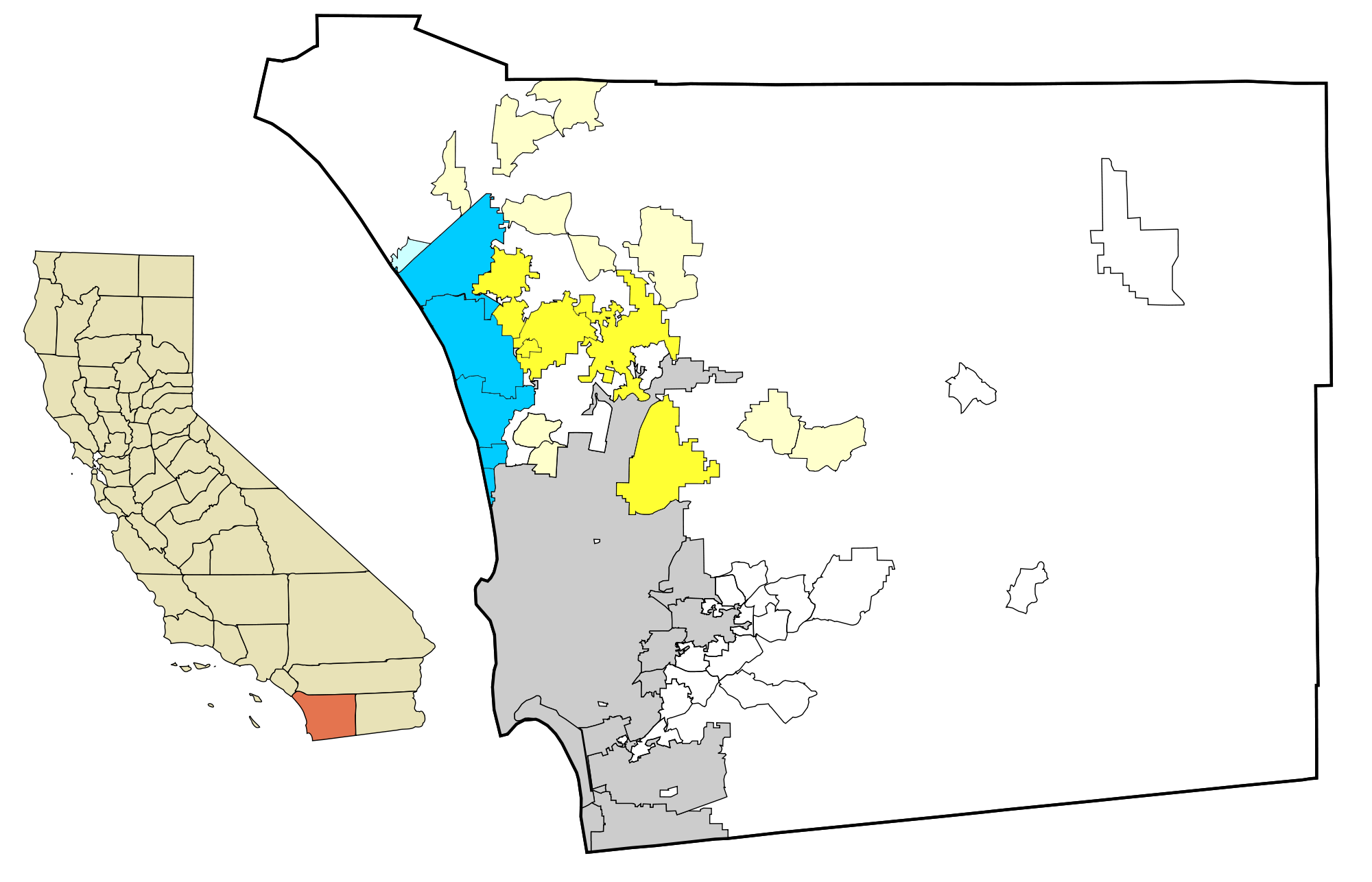

Cities
| City | Date incorporated | Population |
|---|---|---|
| (2020 Census) | ||
| Carlsbad | 114,746 | |
| Chula Vista | 275,487 | |
| Coronado | 20,192 | |
| Del Mar | 3,954 | |
| El Cajon | 106,215 | |
| Encinitas | 62,007 | |
| Escondido | 151,038 | |
| Imperial Beach | 26,137 | |
| La Mesa | 61,121 | |
| Lemon Grove | 27,627 | |
| National City | 56,173 | |
| Oceanside | 174,068 | |
| Poway | 48,841 | |
| San Diego (county seat) | 1,386,932 | |
| San Marcos | 94,833 | |
| Santee | 60,037 | |
| Solana Beach | 12,941 | |
| Vista | 98,381 |
Census-designated places (CDPs)
- Alpine
- Bonita
- Bonsall
- Borrego Springs
- Bostonia
- Boulevard
- Campo
- Camp Pendleton Mainside
- Camp Pendleton South
- Casa de Oro-Mount Helix
- Crest
- Del Dios
- Descanso
- Elfin Forest
- Eucalyptus Hills
- Fairbanks Ranch
- Fallbrook
- Granite Hills
- Harbison Canyon
- Harmony Grove
- Hidden Meadows
- Jacumba Hot Springs
- Jamul
- Julian
- Lake San Marcos
- Lakeside
- La Presa
- Mount Laguna
- Pala
- Pine Valley
- Potrero
- Rainbow
- Ramona
- Rancho San Diego
- Rancho Santa Fe
- San Diego Country Estates
- Spring Valley
- Valley Center
- Winter Gardens
Unincorporated communities
- 4S Ranch
- Agua Caliente Springs
- Ballena
- Banner
- Casa de Oro
- Cuyamaca
- De Luz
- De Luz Heights
- Dehesa
- Dulzura
- East Otay Mesa
- Flinn Springs
- Foster
- Guatay
- Jesmond Dene
- Jofegan
- Kentwood-In-The-Pines
- Lake Henshaw
- Lincoln Acres
- Manzanita
- Morena Village
- Mount Helix
- Oak Grove
- Ocotillo Wells
- Pala Mesa
- Palomar Mountain
- Pauma Valley
- Pine Hills
- Ranchita
- Rincon
- San Felipe
- Santa Ysabel
- Shelter Valley
- Tecate
- Warner Springs
- Wynola
Indian reservations
San Diego County has 18 federally recognized Indian reservations, more than any other county in the United States. Although they are typical in size to other Indian reservations in California (many of which are termed "Rancherías"), they are relatively small by national standards, and all together total 200.2 sqmi of area.
- Barona Indian Reservation
- Campo_Reservation_flag.jpg Campo Indian Reservation
- Flag of the Viejas Band of Kumeyaay Indians.PNG Capitan Grande Reservation
- Ewiiaapaayp band seal.png Ewiiaapaayp Indian Reservation
- Inaja and Cosmit Indian Reservation
- Jamul_Indian_Village_Kumeyaay_flag.jpg Jamul Indian Village
- La Jolla Indian Reservation
- La Posta Indian Reservation
- Los_Coyotes_Band_of_Cahuilla_and_Cupeno_Indians_official_flag.png Los Coyotes Indian Reservation
- Manzanita_Band_of_Diegueño_Mission_Indians_flag.gif Manzanita Indian Reservation
- Mesa Grande Indian Reservation
- Pala Indian Reservation
- Pauma and Yuima Indian Reservation
- Rincon-Band-of-Luiseño-Flag.jpg Rincon Indian Reservation
- San_Pasqual_Band_of_Diegueño_Mission_Indians_flag.gif San Pasqual Indian Reservation
- Iipay_Nation_of_Santa_Ysabel_Kumeyaay_flag.gif Santa Ysabel Indian Reservation
- Sycuan_Band_Kumeyaay_flag.jpg Sycuan Indian Reservation
- Flag of the Viejas Band of Kumeyaay Indians.PNG Viejas Indian Reservation
Population ranking
The population ranking of the following table is based on the 2020 census of San Diego County.
† county seat
| Rank | City/Town/etc. | Municipal type | Population (2020 Census) | Population (2010 Census) |
|---|---|---|---|---|
| 1 | San Diego † | City | 1,386,932 | 1,307,402 |
| 2 | Chula Vista | City | 275,487 | 243,916 |
| 3 | Oceanside | City | 174,068 | 167,086 |
| 4 | Escondido | City | 151,038 | 143,911 |
| 5 | Carlsbad | City | 114,746 | 105,328 |
| 6 | El Cajon | City | 106,215 | 99,478 |
| 7 | Vista | City | 98,381 | 93,834 |
| 8 | San Marcos | City | 94,833 | 83,781 |
| 9 | Encinitas | City | 62,007 | 59,518 |
| 10 | La Mesa | City | 61,121 | 57,065 |
| 11 | Santee | City | 60,037 | 53,413 |
| 12 | National City | City | 56,173 | 58,582 |
| 13 | Poway | City | 48,841 | 47,811 |
| 14 | La Presa | CDP | 35,033 | 34,169 |
| 15 | Fallbrook | CDP | 32,267 | 30,534 |
| 16 | Spring Valley | CDP | 30,998 | 28,205 |
| 17 | Lemon Grove | City | 27,627 | 25,320 |
| 18 | Imperial Beach | City | 26,137 | 26,324 |
| 19 | Winter Gardens | CDP | 22,380 | 20,631 |
| 20 | Rancho San Diego | CDP | 21,858 | 21,208 |
| 21 | Ramona | CDP | 21,468 | 20,292 |
| 22 | Lakeside | CDP | 21,152 | 20,648 |
| 23 | Coronado | City | 20,192 | 18,912 |
| 24 | Casa de Oro-Mount Helix | CDP | 19,576 | 18,762 |
| 25 | Bostonia | CDP | 16,882 | 15,379 |
| 26 | Alpine | CDP | 14,696 | 14,236 |
| 27 | Solana Beach | City | 12,941 | 12,867 |
| 28 | Bonita | CDP | 12,917 | 12,538 |
| 29 | Camp Pendleton South | CDP | 12,468 | 10,616 |
| 30 | San Diego Country Estates | CDP | 10,395 | 10,109 |
| 31 | Valley Center | CDP | 10,087 | 9,277 |
| 32 | Camp Pendleton Mainside | CDP | 9,683 | 5,200 |
| 33 | Jamul | CDP | 6,179 | 6,163 |
| 34 | Eucalyptus Hills | CDP | 5,517 | 5,313 |
| 35 | Lake San Marcos | CDP | 5,328 | 4,437 |
| 36 | Bonsall | CDP | 4,546 | 3,982 |
| 37 | Hidden Meadows | CDP | 4,484 | 3,485 |
| 38 | Harbison Canyon | CDP | 4,048 | 3,841 |
| 39 | Del Mar | City | 3,954 | 4,161 |
| 40 | Granite Hills | CDP | 3,267 | 3,035 |
| 41 | Rancho Santa Fe | CDP | 3,156 | 3,117 |
| 42 | Borrego Springs | CDP | 3,073 | 3,429 |
| 43 | Fairbanks Ranch | CDP | 3,002 | 3,148 |
| 44 | Campo | CDP | 2,955 | 2,684 |
| 45 | Crest | CDP | 2,828 | 2,593 |
| 46 | Harmony Grove | CDP | 2,079 | N/A |
| 47 | Rainbow | CDP | 1,884 | 1,832 |
| 48 | Julian | CDP | 1,768 | 1,502 |
| 49 | Pine Valley | CDP | 1,645 | 1,510 |
| 50 | Pala Indian Reservation | AIAN | 1,541 | 1,315 |
| 51 | Descanso | CDP | 1,499 | 1,423 |
| 52 | Pala | CDP | 1,490 | N/A |
| 53 | San Pasqual Reservation | AIAN | 1,270 | 1,097 |
| 54 | Rincon Reservation | AIAN | 1,095 | 1,215 |
| 55 | Barona Reservation | AIAN | 756 | 640 |
| 56 | Potrero | CDP | 648 | 656 |
| 57 | Elfin Forest | CDP | 600 | N/A |
| 58 | Jacumba | CDP | 540 | 561 |
| 59 | Viejas Reservation | AIAN | 538 | 520 |
| 60 | Campo Indian Reservation | AIAN | 398 | 362 |
| 61 | Del Dios | CDP | 396 | N/A |
| 62 | Boulevard | CDP | 359 | 315 |
| 63 | Santa Ysabel Reservation | AIAN | 263 | 330 |
| 64 | Sycuan Reservation | AIAN | 218 | 211 |
| 65 | Pauma and Yuima Reservation | AIAN | 179 | 206 |
| 66 | La Jolla Reservation | AIAN | 145 | 476 |
| 67 | Manzanita Reservation | AIAN | 101 | 78 |
| 68 | Mesa Grande Reservation | AIAN | 87 | 98 |
| 69 | Mount Laguna | CDP | 74 | 57 |
| 70 | La Posta Indian Reservation | AIAN | 50 | 55 |
| 71 | Los Coyotes Reservation | AIAN | 15 | 98 |
| 72 | Ewiiaapaayp Reservation | AIAN | 5 | N/A |
| Capitan Grande Reservation | AIAN | 0 | 0 | |
| Inaja and Cosmit Reservation | AIAN | 0 | 0 | |
| Jamul Indian Village | AIAN | 0 | N/A |
Former cities
| City | Year | Year | Fate |
|---|---|---|---|
| East San Diego | 1912 | 1923 | Merged into San Diego |
| Elsinore (now Lake Elsinore) | 1888 | 1893 | Riverside County formed |
| Imperial | 1904 | 1907 | Imperial County formed |
| Riverside | 1883 | 1893 | Riverside County formed |
| San Jacinto | 1888 | 1893 | Riverside County formed |
Future and past incorporation efforts
The communities of Del Dios, Elfin Forest, Harmony Grove, and Pala were newly-designated as CDPs in the 2020 census.
Some CDPs and unincorporated communities of San Diego County have explored incorporating as cities/towns in the past (California makes no legal distinction between the titles of "city" and "town", allowing communities that incorporate to choose their designation, though there has never been an incorporated town in San Diego County). Alpine, Bonita, Fallbrook, Lakeside, Ramona, Rancho Santa Fe and Spring Valley have each been tied to various incorporation studies, organized efforts and discussions in the past. Some of these past efforts have culminated in ballot initiatives. Voters in Fallbrook previously rejected incorporation in 1981 and 1987. Rancho Santa Fe residents also rejected incorporation in 1987. Among the existing cities of San Diego County, some had multiple failed incorporation efforts before ultimately succeeding in becoming a city. Lemon Grove, for example, saw incorporation measures fail in 1955, 1958 and 1964 before a successful incorporation vote in 1977. Other cities have seen incorporation success thanks to mergers of neighboring unincorporated communities. Encinitas, for example, became an incorporated city through a consolidated effort between the then-unincorporated communities of Cardiff-by-the-Sea, Leucadia, Encinitas and Olivenhain in 1986. Encinitas and Solana Beach in 1986 are the most recent examples of successful campaigns for incorporation within the County of San Diego.
Notes
References
References
- "Chronology". California State Association of Counties.
- "Chief Administrative Officer". County of San Diego.
- "Home".
- "Hot Springs Mountain". Peakbagger.com.
- "Gross Domestic Product by County and Metropolitan Area, 2022". [[Bureau of Economic Analysis]].
- "Quick Facts: San Diego County, California".
- "Find a County". National Association of Counties.
- (February 28, 2013). "OMB Bulletin No. 13-01: Revised Delineations of Metropolitan Statistical Areas, Micropolitan Statistical Areas, and Combined Statistical Areas, and Guidance on Uses of the Delineations of These Areas". [[United States Office of Management and Budget]].
- (March 2013). "Table 1. Annual Estimates of the Population of Metropolitan and Micropolitan Statistical Areas: April 1, 2010 to July 1, 2012". [[United States Census Bureau]], Population Division.
- (March 2013). "Table 2. Annual Estimates of the Population of Combined Statistical Areas: April 1, 2010 to July 1, 2012". [[United States Census Bureau]], Population Division.
- "climate map".
- "KUMEYAAY RESEARCH DEPARTMENT USA American San Diego County Indian Reservations Tribes of Baja California Mexico Culture".
- "San Diego Historical Society".
- "Journal of San Diego History, October 1967".
- "San Diego de Alcalá – California Missions Resource Center".
- Coy, Owen C.; PhD. (1923). "California County Boundaries". California Historical Commission.
- (August 22, 2012). "2010 Census Gazetteer Files". United States Census Bureau.
- (April 17, 2002). "wild san diego county".
- Gerber, James ed. [http://www.borderecoweb.sdsu.edu/bordpub/brdlnk94.pdf Economic Profile of the San Diego-Tijuana Region: Characteristics for Investment and Governance Decisions] {{Webarchive. link. (March 21, 2012 . Institute for Regional Studies of the Californias. 1995. p.11)
- "The California Chaparral Field Institute".
- M. Kottek. (2006). "World Map of the Köppen-Geiger climate classification updated". Meteorol. Z..
- "California May Grey / June Gloom".
- "Monthly Averages for San Diego, CA". [[The Weather Channel (United States).
- "Monthly Averages for El Cajon, CA". [[The Weather Channel (United States).
- "Monthly Averages for Julian, CA". [[The Weather Channel (United States).
- "Monthly Averages for Borrego Springs, CA". [[The Weather Channel (United States).
- "About the refuge complex". San Diego National Wildlife Refuge.
- "About the Refuge". San Diego National Wildlife Refuge.
- "About the Refuge". San Diego Bay National Wildlife Refuge.
- "About the Refuge". Tijuana Slough National Wildlife Refuge.
- "About the Refuge". Seal Beach National Wildlife Refuge.
- "Mountains in USA".
- (August 28, 2018). "How a nuclear stalemate left radioactive waste stranded on a California beach". The Verge.
- (August 15, 2018). "Op-Ed: The San Onofre nuclear plant is a 'Fukushima waiting to happen'". Los Angeles Times.
- (July 16, 2020). "Coastal Panel Votes 10–0 to Allow Storage of Spent Nuclear Fuel at San Onofre". Times of San Diego.
- US EPA, OA. (2025-08-28). "EPA and US IBWC Announce Major Milestone in Delivering 100% Solution to the Tijuana River Sewage Crisis".
- (Summer 1975). "The Decline of Californios". The Journal of San Diego History.
- Jennewein, Chris. (March 26, 2015). "San Diego Nation's 5th Most Populous County in 2014". Times of San Diego.
- "San Diego County Commute".
- "U.S. Census Bureau QuickFacts: San Diego County, California".
- "Census of Population and Housing from 1790–2000". United States Census Bureau.
- "Historical Census Browser". University of Virginia Library.
- (March 27, 1995). "Population of Counties by Decennial Census: 1900 to 1990". United States Census Bureau.
- (April 2, 2001). "Census 2000 PHC-T-4. Ranking Tables for Counties: 1990 and 2000". United States Census Bureau.
- (2021). "2020 Decennial Census Demographic Profile (DP1)".
- (2021). "2020 Decennial Census Redistricting Data (Public Law 94-171)".
- (2023). "2020 Decennial Census Demographic and Housing Characteristics (DHC)".
- "California: 1980, General Social and Economic Characteristics, Part 1 - Table 59: Persons by Race, Hispanic Origin, and Sex".
- "California: 1990, Part 1 - Table 5: Race and Hispanic Origin".
- "P004: Hispanic or Latino, and Not Hispanic or Latino by Race – 2000: DEC Summary File 1 – San Diego County, California".
- "P2: Hispanic or Latino, and Not Hispanic or Latino by Race – 2010: DEC Redistricting Data (PL 94-171) – San Diego County, California".
- "P2: Hispanic or Latino, and Not Hispanic or Latino by Race – 2020: DEC Redistricting Data (PL 94-171) – San Diego County, California".
- included in the Asian category in the 1980 Census
- included in the Asian category in the 1990 Census
- not an option in the 1980 Census
- not an option in the 1990 Census
- {{USCensus2010CA
- . (2010). ["Profile of General Population and Housing Characteristics: 2010"](https://factfinder.census.gov/bkmk/table/1.0/en/DEC/10_SF2/PCT1/310M100US41740/popgroup~031). *United States Census Bureau*.
- Sheldon X. Zhang. (November 2012). "Looking for a Hidden Population: Trafficking of Migrant Laborers in San Diego County". San Diego State University.
- Stebbins, Samuel. (August 15, 2018). "Priced out of the market? Cities where the middle class can no longer afford a home". USA Today.
- Molnar, Phillip. (September 26, 2018). "New record: San Diego home price hits $583K". San Diego Union-Tribune.
- U.S. Census Bureau. American Community Survey, 2011 American Community Survey 5-Year Estimates, Tables B01003 and B19025. [https://www.census.gov U.S. Census website]. Retrieved October 26, 2013.
- https://www.rtfhsd.org/wp-content/uploads/2017/06/2018-WPoint-in-Time-Count-Annual-Report.pdf. San Diego Regional Task Force on the Homeless. Retrieved March 4, 2020.
- . (2014). ["Adults in the San Diego metro area"](http://www.pewforum.org/religious-landscape-study/metro-area/san-diego-metro-area/). *Per Research Center*.
- . (September 17, 2009). ["San Diego County"](https://crcc.usc.edu/sandiego/). *University of Southern California*.
- (December 8, 2017). "Social Capital Variables Spreadsheet for 2014".
- Stewart, Joshua. (February 9, 2017). "San Diego home to 170k immigrants here illegally, study shows". San Diego Union-Tribune.
- (April 2016). "The Nature and Extent of Gang Involvement in Sex Trafficking in San Diego County". United States Department of Justice.
- Marosi, Richard. (May 14, 2018). "The aggressive prosecution of border-crossers is straining the courts. Will 'zero tolerance' make it worse?". Richmond Times-Dispatch.
- (May 2018)
- . (January 31, 2017). ["Report: Wages don't cover high cost of living for 33% of San Diegans"](http://fox5sandiego.com/2017/01/31/report-wages-dont-cover-high-cost-of-living-for-33-of-san-diegans/). *KSWB-TV*.
- Rivard, Ry. (May 30, 2017). "Why San Diego Pays Some of Highest Water Rates in State and Country". News Deeply.
- Stafford, Audra. (January 19, 2018). "San Diegans Coping with Rising Rental Costs". KNSD.
- Collins, Jeff. (April 24, 2017). "Leaving California? After slowing, the trend intensifies". Mercury News.
- Dwane Brown. (January 10, 2014). "San Diego County Agricultural Industry Thrives". KPBS.
- J. Harry Jones. (January 1, 2015). "New rules create 'Chicken Disneyland'". San Diego Union Tribune.
- Ha Dang. (2013). "2013 Crop Statistics and Annual Report". County of San Diego.
- . (2014). ["San Diego County Agriculture Facts"](http://www.sdfarmbureau.org/SD-Ag/Ag-Facts.php). *San Diego Farm Bureau*.
- DiMarino, Maurice. (2015). "San Diego was the first area in California where vineyards were planted and wine produced". San Diego Vintners Association.
- Wycoff, Ann. (September 23, 2016). "The Ultimate San Diego Wine Guide".
- (2021). "California Agricultural Statistics Review 2019-2020".
- Elder, Adam. (March 2010). "San Diego: America's Beer Capital". San Diego Magazine.
- (August 5, 2020). "Plan To Allow Legal Pot Shops In Unincorporated Areas Dies For Lack Of Support". City News Service.
- Lewis, Connie. (September 27, 2004). "Cruise Ships Face Stiffer Anti-Pollution Policies". San Diego Business Journal.
- "San Diego Metro Magazine".
- (May 18, 2023). "Major League Soccer awards expansion team to San Diego".
- California Government Code § 23004
- "About County Government". League of Women Voters of California.
- "Board of Supervisors".
- (June 30, 2011). "Supervisor's shameless self-preservation". San Diego Union Tribune.
- Orr, Katie. (June 9, 2010). "Voters Approve Term Limits for Supervisors". KPBS.
- Perry, Tony. (November 23, 2012). "Dave Roberts brings diversity to the San Diego County supervisors". Los Angeles Times.
- "The County Administration Center". San Diego County webpage.
- (September 6, 2014). "Report of Registration – State Reporting Districts". County of San Diego.
- U.S. Census Bureau. American Community Survey, 2011 American Community Survey 5-Year Estimates, Table B02001. [https://www.census.gov U.S. Census website]. Retrieved October 26, 2013.
- "Report of Registration as of February 10, 2019. Registration by Political Subdivision by County". State of California.
- Leip, David. "Dave Leip's Atlas of U.S. Presidential Elections".
- Libby, Sarah. (November 5, 2012). "Where to Find Us on Election Day". Voice of San Diego.
- "Amid the celebrations, farewell – The San Diego Union-Tribune".
- "San Diego County Proposition 8 Results by Community – Jim's Blog".
- Office of the Attorney General, Department of Justice, State of California. [http://stats.doj.ca.gov/cjsc_stats/prof09/00/11.pdf Table 11: Crimes – 2009] {{webarchive. link. (December 2, 2013 . Retrieved November 14, 2013.)
- United States Department of Justice, Federal Bureau of Investigation. [https://www.fbi.gov/about-us/cjis/ucr/crime-in-the-u.s/2012/crime-in-the-u.s.-2012/tables/8tabledatadecpdf/table-8-state-cuts/table_8_offenses_known_to_law_enforcement_by_california_by_city_2012.xls Crime in the United States, 2012, Table 8 (California)]. Retrieved November 14, 2013.
- "San Diego County Board of Education".
- [http://www.sdcl.org/aboutus.html County of San Diego: San Diego County Library]. Sdcl.org (September 30, 2007). Retrieved on 2014-05-24.
- [http://dbpcosdcsgt.co.san-diego.ca.us/screens/AR2010/index.html San Diego County Library: Annual Report FY 2009–2010]. Dbpcosdcsgt.co.san-diego.ca.us (September 21, 2009). Retrieved on 2014-05-24.
- "2020 census - school district reference map: San Diego County, CA". [[U.S. Census Bureau]].
- "San Diego Economy". CityData.com.
- Estes, Kenneth W.. (1999). "The Marine Officer's Guide – Sixth Edition". Naval Institute Press.
- "Top 25 U.S. Newspapers for March 2013". Alliance for Audited Media.
- (September 10, 2012). "U-T Buys North County Times and Californian". San Diego Business Journal.
- Horn, Jonathan. (November 1, 2013). "U-T buys 8 local community newspapers". San Diego Union Tribune.
- "About CTN". San Diego County.
- "University of San Diego".
- "2010 U.S. Census website". [[United States Census Bureau]].
- "Explore Census Data".
- "Explore Census Data".
- "2010 Census Interactive Population Search : Pala Indian Reservation".
- "Explore Census Data".
- "2010 Census Interactive Population Search : San Pasqual Reservation".
- "2010 Census Interactive Population Search : Rincon Reservation".
- "Explore Census Data".
- "Explore Census Data".
- "2010 Census Interactive Population Search : Viejas Reservation".
- "2010 Census Interactive Population Search : Campo Indian Reservation".
- "Explore Census Data".
- "2010 Census Interactive Population Search : Santa Ysabel Reservation".
- "2010 Census Interactive Population Search : Sycuan Reservation".
- "2010 Census Interactive Population Search : Pauma and Yuima Reservation".
- "2010 Census Interactive Population Search : La Jolla Reservation".
- "2010 Census Interactive Population Search : Manzanita Reservation".
- "2010 Census Interactive Population Search : Mesa Grande Reservation".
- "2010 Census Interactive Population Search : La Posta Indian Reservation".
- "2010 Census Interactive Population Search : Los Coyotes Reservation".
- "Explore Census Data".
- "Explore Census Data".
- "Explore Census Data".
- "Explore Census Data".
- "Explore Census Data".
- "2005 California Government Code Sections 56010-56081 :: :: :: CHAPTER 2. :: DEFINITIONS".
- (June 9, 1986). "More New Cities Mean Less Money, Growing Problems for County".
- "Our History".
- (June 8, 1988). "Fallbrook Rejects Incorporation".
- (June 3, 1987). "Rancho Santa Fe Rejects Cityhood : Residents of Wealthy North County Enclave Vote Against Incorporation".
- "The City of Lemon Grove".
- "About Encinitas".
This article was imported from Wikipedia and is available under the Creative Commons Attribution-ShareAlike 4.0 License. Content has been adapted to SurfDoc format. Original contributors can be found on the article history page.
Ask Mako anything about San Diego County, California — get instant answers, deeper analysis, and related topics.
Research with MakoFree with your Surf account
Create a free account to save articles, ask Mako questions, and organize your research.
Sign up freeThis content may have been generated or modified by AI. CloudSurf Software LLC is not responsible for the accuracy, completeness, or reliability of AI-generated content. Always verify important information from primary sources.
Report