From Surf Wiki (app.surf) — the open knowledge base
Samuel Goudsmit
Dutch-American physicist (1902–1978)

Dutch-American physicist (1902–1978)
| Field | Value | ||||
|---|---|---|---|---|---|
| name | Samuel Goudsmit | ||||
| image | File:Goudsmit Samuel A6.jpg | ||||
| caption | Goudsmit in c. 1940 | ||||
| birth_name | Samuel Abraham Goudsmit | ||||
| birth_date | |||||
| birth_place | The Hague, Netherlands | ||||
| death_date | |||||
| death_place | Reno, Nevada, U.S. | ||||
| field | Physics | ||||
| work_institutions | University of Michigan | ||||
| alma_mater | University of Leiden (Ph.D) (1927) | ||||
| doctoral_students | Robert Bacher | ||||
| known_for | {{plainlist | ||||
| children | {{plainlist | ||||
| *Esther Marianne Goudsmit<ref name | "USHMM"}} | ||||
| spouse | {{plainlist | ||||
| *{{marriage | Jaantje Logher | 1927 | 1960 | end | divorced}} |
| *<ref name | "USHMM"/}} | ||||
| prizes |
- Electron spin
- Operation Alsos}}
- Esther Marianne Goudsmit}}
- }} Samuel Abraham Goudsmit (July 11, 1902 – December 4, 1978) was a Dutch-American physicist famous for jointly proposing the concept of electron spin with George Eugene Uhlenbeck in 1925.
Goudsmit, along with Uhlenbeck, was nominated numerous times for the Nobel Prize in Physics for their discovery of electron spin but never won, despite strong support from nominators. I. I. Rabi remarked that the omission of Goudsmit and Uhlenbeck from the Nobel Prize list "will always be a mystery to me."
Life and career
Goudsmit was born in The Hague, Netherlands, of Dutch Jewish descent. He was the son of Isaac Goudsmit, a manufacturer of water-closets, and Marianne Goudsmit-Gompers, who ran a millinery shop. In 1943, his parents were deported to a concentration camp by the German occupiers of the Netherlands and were murdered there.
Goudsmit studied physics at the University of Leiden under Paul Ehrenfest, where he obtained his PhD in 1927. After receiving his PhD, Goudsmit served as a professor at the University of Michigan between 1927 and 1946. In 1930 he co-authored a text with Linus Pauling titled The Structure of Line Spectra.
During World War II he worked at the Massachusetts Institute of Technology. As scientific head of the Alsos Mission, he successfully reached a German group of nuclear physicists around Werner Heisenberg and Otto Hahn at Hechingen (then French zone) in advance of French physicist Yves Rocard, who had previously succeeded in recruiting German scientists to come to France.
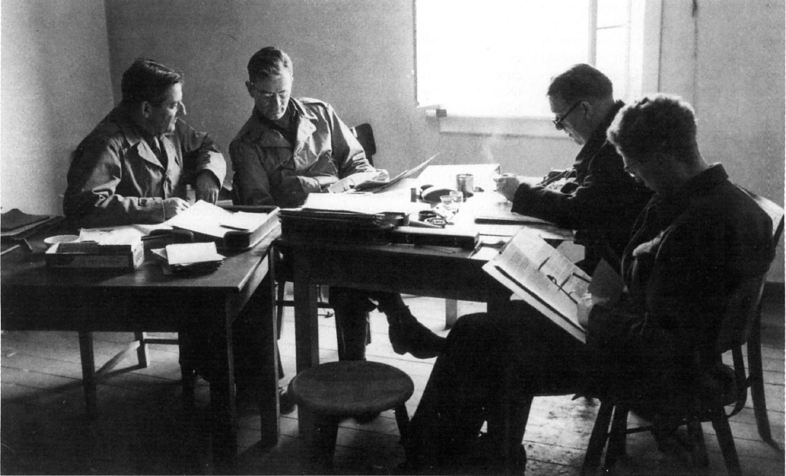
Alsos, part of the Manhattan Project, was designed to assess the progress of the Nazi atomic bomb project. In the book Alsos, published in 1947, Goudsmit concludes that the Germans did not get close to creating a weapon. He attributed this to the inability of science to function under a totalitarian state and to Nazi scientists' lack of understanding of how to engineer an atomic bomb. Both of these conclusions have been disputed by later historians (see Heisenberg) and contradicted by the fact that the totalitarian Soviet state produced the bomb shortly after the book's release. However that statement overlooks the actions of physicist Klaus Fuchs who sent "many intelligence reports directly from Los Alamos".

After the war he was briefly a professor at Northwestern University, and from 1948 to 1970 was a senior scientist at the Brookhaven National Laboratory, chairing the Physics Department 1952–1960. He meanwhile became well known as editor-in-chief of the leading physics journal Physical Review, published by the American Physical Society. In July 1958 he started the journal Physical Review Letters, which offers short notes with attendant brief delays. On his retirement as editor in 1974, Goudsmit moved to the faculty of the University of Nevada, Reno, where he remained until his death four years later.
As a student in Leiden he also developed an interest in Ancient Egypt. He collected Egyptian antiquities and made a few scholarly contributions to Egyptology. His wife bequeathed the Samuel A. Goudsmit Collection of Egyptian Antiquities to the Kelsey Museum of Archaeology at the University of Michigan in Ann Arbor, Michigan. In 2017 it was announced that Dutch Egyptologist Nico Staring had identified an object from the collection with an object presumed lost from the Egyptian Museum of Berlin. The fragmentary stela must have been looted from the museum after its bombardment and had been sold to Goudsmit in 1945. It was returned to Berlin in April 2017.
Goudsmit became a corresponding member of the Royal Netherlands Academy of Arts and Sciences in 1939, though he resigned the next year. He was readmitted in 1950. He was elected to the United States National Academy of Sciences in 1947, the American Philosophical Society in 1952, American Academy of Arts and Sciences in 1964.
Marriages and children
Goudsmit married Jaantje Logher, in 1927. Their daughter, Esther Marianne Goudsmit was born in 1933 in Ann Arbor, Michigan. In 1964 she earned a PhD in Zoology from the University of Michigan, and in 1972 became a Professor of Biology at Oakland University, Rochester, Michigan. She retired in 1995.
Samuel and Jaantje divorced in 1960, and in the same year Goudsmit married Irene Bejach. Like Goudsmit's parents, Irene's father, a German medical doctor and Berlin public health official, Curt Dietrich Bejach, had been murdered by the Nazis. He perished at the Auschwitz concentration camp.
Irene and her sister, Helga, left Germany for the United Kingdom as children shortly prior to the outbreak of World War II. They were evacuated as part of the Kindertransport programme, and lived for seven years in the Attenborough family home.
Works
References
References
- "Biography of Document Creator Samuel Abraham Goudsmit, Samuel and Irene Goudsmit Collection, United States Holocaust Memorial Museum (Document Accession Number: 1995.A.0300 Duplicate 1, RG Number: RG-10.228". [[United States Holocaust Memorial Museum]].
- "Goudsmit, Samuel A. (Samuel Abraham), 1902-1978". [[American Institute of Physics.
- G.E. Uhlenbeck and S. Goudsmit, Naturwissenschaften 13(47) (1925) 953.
- Goldhaber, Maurice. (April 1979). "Obituary: Samuel A. Goudsmit". Physics Today.
- (November 2, 1988). "George E. Uhlenbeck Dies at 87; Co-Discoverer of Electron's Spin". [[The New York Times]].
- Benjamin Bederson, 2008, [https://www.nasonline.org/publications/biographical-memoirs/memoir-pdfs/goudsmit-samuel.pdf ''Samuel Abraham Goudsmit 1902 — 1978'', Biographical Memoir], [[National Academy of Sciences]], Washington D.C.
- {{MathGenealogy
- Samuel Goudsmit. (1927). "Atoommodel en structuur der spectra".
- Asimov. "Asimov's Biographical Encyclopedia of Science and Technology".
- Koeth, Tim. (May 2019). "Tracking the journey of a uranium cube". [[Physics Today]].
- "Samuel A. Goudsmit Papers, 1921-1979".
- (2018). "The Laser Inventor".
- [http://cdli.ucla.edu/collections/kelsey/kelsey_intro.html Description of Goudsmit's contribution to the museum], cdli.ucla.edu. Accessed September 5, 2022.
- (2017-06-02). "Kelsey Museum Returns Artifact to Egyptian Museum in Berlin".
- "S.A. Goudsmit (1902 - 1978)". [[Royal Netherlands Academy of Arts and Sciences]].
- "Samuel Goudsmit".
- "APS Member History".
- "Samuel Abraham Goudsmit".
- "Biographical Note, Curt Bejach Collection, Leo Baeck Institute, Center for Jewish History (Collection Identifier: AR 10876)". [[Leo Baeck Institute]], [[Center for Jewish History]].
- Wolfisz, Francine. (December 3, 2020). "'We are one family': Sir David Attenborough recalls Jewish refugee 'sisters'". [[Jewish News]], [[The Times of Israel]].
This article was imported from Wikipedia and is available under the Creative Commons Attribution-ShareAlike 4.0 License. Content has been adapted to SurfDoc format. Original contributors can be found on the article history page.
Ask Mako anything about Samuel Goudsmit — get instant answers, deeper analysis, and related topics.
Research with MakoFree with your Surf account
Create a free account to save articles, ask Mako questions, and organize your research.
Sign up freeThis content may have been generated or modified by AI. CloudSurf Software LLC is not responsible for the accuracy, completeness, or reliability of AI-generated content. Always verify important information from primary sources.
Report