From Surf Wiki (app.surf) — the open knowledge base
Samson
Important character from the book of judges of the Hebrew Bible

Important character from the book of judges of the Hebrew Bible
| Field | Value |
|---|---|
| name | Samson |
| image | File:Lucas Cranach d.Ä. - Simson bezwingt den Löwen.jpg |
| caption | Samson's Fight with the Lion (1525) by Lucas Cranach the Elder |
| native_name_lang | he |
| predecessor | Abdon |
| successor | Eli |
| partner | Delilah |
| father | Manoah |
| mother | not named |
| restingplace | Zorah, Nahal Sorek |
the biblical figure
Samson (; ) was the last of the judges of the ancient Israelites mentioned in the Book of Judges (chapters 13 to 16) and one of the last leaders who "judged" the twelve tribes of Israel before the institution of the monarchy. He is sometimes regarded as an Israelite version of the popular Near Eastern folk hero archetype also embodied by the Sumerian Gilgamesh and Enkidu, as well as the Greek Heracles. Samson was given superhuman powers by God in the form of extreme strength.
The biblical account states that Samson was a Nazirite and that he was given immense strength to aid him against his enemies and allow him to perform superhuman feats, including slaying a lion with his bare hands and massacring a Philistine army with a donkey's jawbone. The cutting of Samson's long hair would violate his Nazirite vow and nullify his ability.
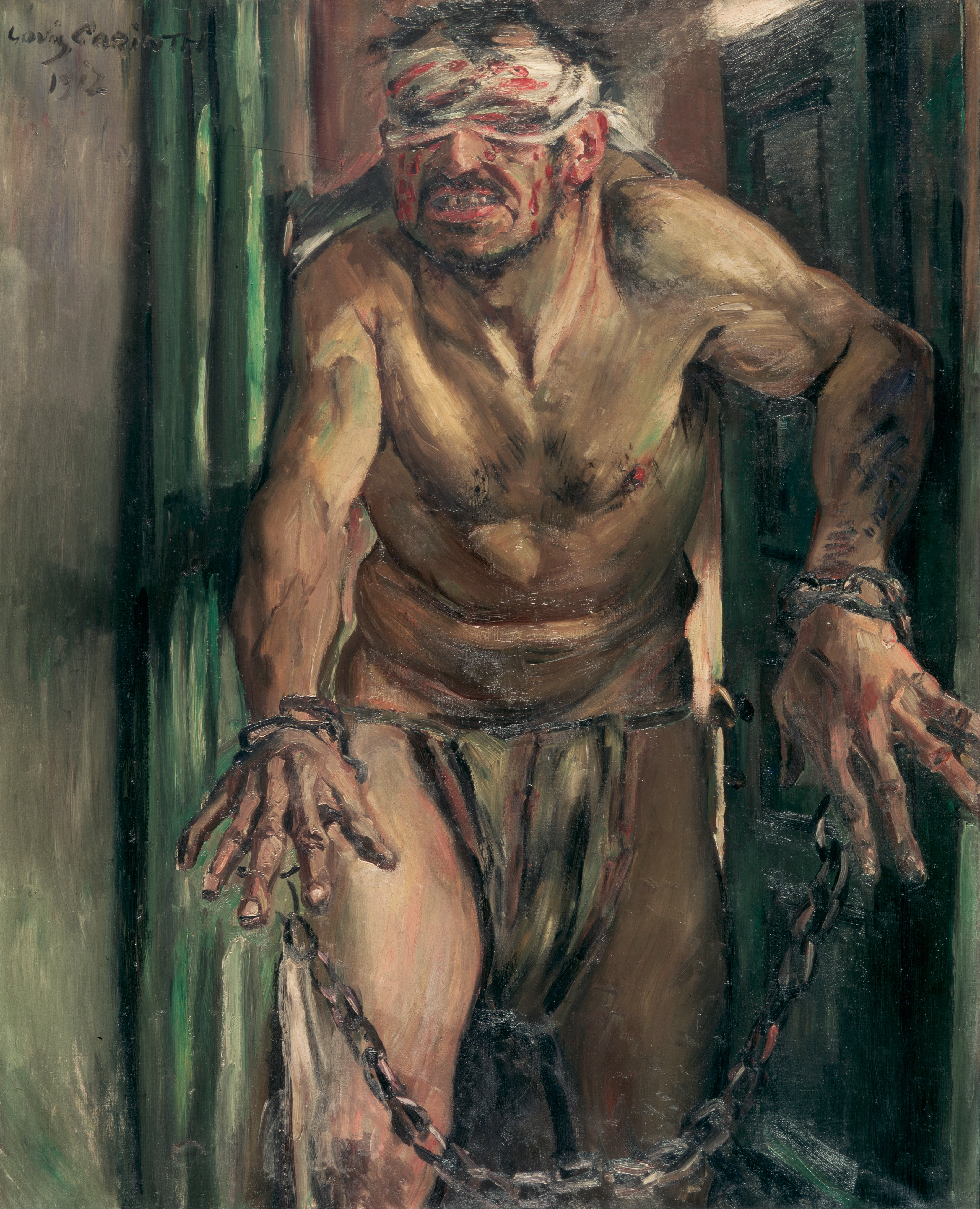
Samson is betrayed by his lover Delilah, who, sent by Philistine officials to entice him, orders a servant to cut his hair while he is sleeping and turns him over to the Philistines, who gouged out his eyes and forced him to mill grain at Gaza. While there, his hair begins to grow again. When the Philistines take Samson into their temple of Dagon, Samson asks to rest against one of the support pillars. After being granted permission, he prays to God and miraculously recovers his strength, allowing him to bring down the columnscollapsing the temple and killing both himself and the Philistines.
Samson has been the subject of rabbinic, Christian, and Islamic commentary, with some Christians viewing him as a type of Jesus, based on similarities between their lives. Notable depictions of Samson include John Milton's closet drama Samson Agonistes and Cecil B. DeMille's 1949 Hollywood film Samson and Delilah. Samson also plays a major role in Western art and traditions. Samson's narrative also inspired modern military and political references, including Israel's nuclear strategy "Samson Option" and units like Samson's Foxes.
Biblical narrative
Birth
According to the account in the Book of Judges, Samson lived during a time of repeated conflict between Israel and Philistia, when God was disciplining the Israelites by giving them "into the hand of the Philistines". Manoah was an Israelite from Zorah, descended from the Danites, and his wife had been unable to conceive. The Angel of the Lord appears to Manoah's wife and proclaims that the couple would soon have a son who would begin to deliver the Israelites from the Philistines.
The Angel of the Lord states that Manoah's wife was to abstain from all alcoholic drinks, unclean foods, and her promised child was not to shave or cut his hair. He was to be a Nazirite from birth. In ancient Israel, those wanting to be especially dedicated to God for a time could take a Nazirite vow which included abstaining from wine and spirits, not cutting hair or shaving, and other requirements. Manoah's wife believes the Angel of the Lord; her husband was not present, so he prays and asks God to send the messenger once again to teach them how to raise the boy who is going to be born.
After the Angel of the Lord returns, Manoah asks him his name, but he says, "Why do you ask my name? It is beyond understanding." Manoah then prepares a sacrifice, but the Angel of the Lord will only allow it to be for God. He touches it with his staff, miraculously engulfing it in flames, and then ascends into the sky in the fire. This is such dramatic evidence of the nature of the Messenger that Manoah fears for his life, since it was said that no one could live after seeing God. However, his wife convinces him that, if God planned to slay them, he would never have revealed such things to them. In due time, their son Samson is born, and he is raised according to the angel's instructions.
Marriage to a Philistine
When he is a young adult, Samson leaves the hills of his people to see the cities of Philistia. He falls in love with a Philistine woman from Timnah, whom he decides to marry, ignoring the objections of his parents over the fact that she is not an Israelite. In the development of the narrative, the intended marriage is shown to be part of God's plan to strike at the Philistines.
According to the biblical account, Samson is repeatedly seized by the "Spirit of the Lord", who blesses him with immense strength. The first instance of this is seen when Samson is on his way to ask for the Philistine woman's hand in marriage, when he is attacked by a lion. He simply grabs it and rips it apart, as the spirit of God divinely empowers him. However, Samson keeps it a secret, not even mentioning the miracle to his parents. He arrives at the Philistine's house and becomes betrothed to her. He returns home, then comes back to Timnah some time later for the wedding. On his way, Samson sees that bees have nested in the carcass of the lion and made honey. He eats a handful of the honey and gives some to his parents.
At the wedding feast, Samson tells a riddle to his thirty groomsmen (all Philistines). If they can solve it, he will give them thirty pieces of fine linen and garments, but if they cannot they must give him thirty pieces of fine linen and garments. The riddle is a veiled account of two encounters with the lion, at which only he was present:
Out of the eater came something to eat. Out of the strong came something sweet.
The Philistines are infuriated by the riddle. The thirty groomsmen tell Samson's new wife that they will burn her and her father's household if she did not discover the answer to the riddle and tell it to them. At the urgent and tearful imploring of his bride, Samson gives her the solution, and she passes it on to the thirty groomsmen.

Before sunset on the seventh day, they say to him, What is sweeter than honey? and what is stronger than a lion? Samson replies, If you had not plowed with my heifer, you would not have solved my riddle.
Samson then travels to Ashkelon (a distance of roughly 30 miles) where he strikes down thirty Philistines for their garments; he then returns and gives those garments to his thirty groomsmen. In a rage, Samson returns to his father's house. The family of his bride instead give her to one of the groomsmen as wife. Some time later, Samson returns to Timnah to visit his wife, unaware that she is now married to one of his former groomsmen. But her father refuses to allow Samson to see her, offering to give Samson a younger sister instead.
Samson goes out, gathers 300 foxes, and ties them together in pairs by their tails. He then attaches a burning torch to each pair of foxes' tails and turns them loose in the grain fields and olive groves of the Philistines. The Philistines learn why Samson burned their crops and burn Samson's wife and father-in-law to death in retribution.
In revenge, Samson slaughters many Philistines, saying, "I have done to them what they did to me." Samson then takes refuge in a cave in the rock of Etam. An army of Philistines go to the tribe of Judah and demand that 3,000 men of Judah deliver them Samson. With Samson's consent, given on the condition that the Judahites would not kill him themselves, they tie him with two new ropes and are about to hand him over to the Philistines when he breaks free of the ropes. Using the jawbone of an ass, he slays 1,000 Philistines.

Delilah
Later, Samson travels to Gaza, where he sees a prostitute () and visits her. His enemies wait at the gate of the city to ambush him, but he tears the gate from its very hinges and frame and carries it to "the hill that is in front of Hebron".
He then falls in love with Delilah in the valley of Sorek. The Philistines approach Delilah and induce her with 1,100 silver coins to find the secret of Samson's strength so that they can capture their enemy, but Samson refuses to reveal the secret and teases her, telling her that he will lose his strength if he is bound with fresh bowstrings. She does so while he sleeps, but when he wakes up he snaps the strings. She persists, and he tells her that he can be bound with new ropes. She ties him up with new ropes while he sleeps, and he snaps them, too. She asks again, and he says that he can be bound if his locks are woven into a weaver's loom. She weaves them into a loom, but he simply destroys the entire loom and carries it off when he wakes.
Delilah, however, persists and Samson finally capitulates and tells Delilah that God supplies his power because of his consecration to God as a Nazirite, symbolized by the fact that a razor has never touched his head and that if his hair is cut off the vow would be broken and he would lose his strength. Delilah then woos him to sleep "in her lap" and calls for a servant to cut his hair. Samson loses his strength and he is captured by the Philistines, who blind him by gouging out his eyes. They then take him to Gaza, imprison him, and put him to work turning a large millstone and grinding grain.
--
Death
One day, the Philistine leaders assemble in a temple for a religious sacrifice to Dagon, one of their most important deities, for having delivered Samson into their hands. They summon Samson so that people can watch him perform for them. The temple is so crowded that people are even climbing onto the roof to watchand all the rulers of the entire government of Philistia have gathered there too, some 3,000 people in all. Samson is led into the temple, and he asks his captors to let him lean against the supporting pillars to rest. However, while in prison his hair had begun to grow again. He prays for strength and God gives him strength to break the pillars, causing the temple to collapse, killing him and the people inside.
After his death, Samson's family recovered his body from the rubble and buried him near the tomb of his father Manoah. A tomb structure which some attribute to Samson and his father stands on the top of the mountain in Tel Tzora, although a separate tradition passed down by the traveler Isaac Chelo in 1334 alleges that Samson was buried at the monument known as al-Jārib in Sheikh Abū Mezār, a village (now ruin) located near Tel Beit Shemesh. Near the village there used to be shown a hewn rock, known as Qal'at al-mafrazah, on whose top and sides are quarried different impressions and thought to be the altar built by Manoah. At the conclusion of Judges 16, it is said that Samson had "judged" Israel for twenty years.
Interpretations
Archaeology
In August 2012, archaeologists from Tel Aviv University announced the discovery of a circular stone seal, approximately 15 mm in diameter, which was found on the floor of a house at Beth Shemesh and appears to depict a man, possibly long-haired, next to the sketchy depiction of a large animal resembling contemporary images of lions. The seal is dated to the 12th century BCE. According to Haaretz, "excavation directors Prof. Shlomo Bunimovitz and Dr. Zvi Lederman of Tel Aviv University say they do not suggest that the human figure on the seal is the biblical Samson. Rather, the geographical proximity to the area where Samson lived, and the time period of the seal, show that a story was being told at the time of a hero who fought a lion, and that the story eventually found its way into the biblical text and onto the seal". The human figure appears to be unarmed, which would correspond to the Samson story.
Rabbinic literature
Main article: Samson in rabbinic literature
Rabbinic literature identifies Samson with Bedan, a Judge mentioned by Samuel in his farewell address () among the Judges who delivered Israel from their enemies. However, the name "Bedan" is not found in the Book of Judges. The name "Samson" is derived from the Hebrew word šemeš, which means "sun",
Jewish legend records that Samson's shoulders were sixty cubits broad. Many Talmudic commentaries, however, explain that this is not to be taken literally, for a person that size could not live normally in society; rather, it means that he had the ability to carry a burden 60 cubits wide (approximately 30 meters) on his shoulders. He was lame in both feet but, when the spirit of God came upon him, he could step with one stride from Zorah to Eshtaol, while the hairs of his head arose and clashed against one another so that they could be heard for a like distance. Samson was said to be so strong that he could uplift two mountains and rub them together like two clods of earth, yet his superhuman strength, like Goliath's, brought woe upon its possessor.
In licentiousness, he is compared with Amnon and Zimri, both of whom were punished for their sins. Samson's eyes were put out because he had "followed them" too often. (As his eyes led him astray by lust, this was the reason he was blinded.) It is said that, in the twenty years during which Samson judged Israel, he never required the least service from an Israelite, and he piously refrained from taking the name of God in vain. Therefore, as soon as he told Delilah that he was a Nazarite of God, she immediately knew that he had spoken the truth. When he pulled down the temple of Dagon and killed himself and the Philistines, the structure fell backward so that he was not crushed, his family being thus enabled to find his body and to bury it in the tomb of his father.
In the Talmudic period, some seem to have denied that Samson was a historical figure, regarding him instead as a purely mythological personage. This was viewed as heretical by the rabbis of the Talmud, and they attempted to refute this. They named Hazzelelponi as his mother in Numbers Rabbah Naso 10 and in Bava Batra 91a and stated that he had a sister named "Nishyan" or "Nashyan".
Christian interpretations

Samson's story has also garnered commentary from a Christian perspective; the Epistle to the Hebrews praises him for his faith. Ambrose, following the portrayal of Josephus and Pseudo-Philo, represents Delilah as a Philistine prostitute, and declares that "men should avoid marriage with those outside the faith, lest, instead of love of one's spouse, there be treachery." Caesarius of Arles interpreted Samson's death as prefiguring the crucifixion of Jesus, remarking: "Notice here an image of the cross. Samson extends his hands spread out to the two columns as to the two beams of the cross." He also equates Delilah with Satan, who tempted Christ.
Following this trend, more recent Christian commentators have viewed Samson as a type of Jesus Christ, based on similarities between Samson's story and the life of Jesus in the New Testament. Samson's and Jesus' births were both foretold by angels, Samson's betrayal by Delilah has also been compared to Jesus' betrayal by Judas Iscariot; both Delilah and Judas were paid in pieces of silver for their respective deeds. Ebenezer Cobham Brewer notes in his A Guide to Scripture History: The Old Testament that Samson was "blinded, insulted [and] enslaved" prior to his death, and that Jesus was "blindfolded, insulted, and treated as a slave" prior to his crucifixion. Brewer also compares Samson's death among "the wicked" with Christ being crucified between two thieves.
Islamic literature

The Quran and authentic hadith never mentions Samson by name and characteristics specifically. However, there are several non-canonical works of Quran exegesis and scholastic traditions among Islamic literature that mention Samson (), particularly In the study of Tafsir.
, a Hadith scholar and son of Abu Hatim Muhammad ibn Idris al-Razi, mentioned Samson in his exegesis by quoting the opinion of Mujahid ibn Jabr where he described Samson as "an Israelite who wore armor and struggling in the way of God for 1,000 months".
Al-Tabari and Abu Ishaq al-Tha'labi incorporated the biblical figure of Samson into the Quranic prophetic world. Al-Tabari in particular has given details in History of the Prophets and Kings by incorporating biblical narratives with the authority of Israʼiliyyat tradition from Wahb ibn Munabbih, that his mother gave birth to him after she made a Nazar (vow) to God. Samson lived nearby a Pagan society, where he actively raided their settlement alone, armed with a camel's jawbone and always obtained spoils of war from his successful raids. This tradition of Tabari was traced from one of his teacher, Muhammad ibn Hamid ar-Razi. This tradition by Muhammad ibn Hamid also recorded by Al-Dhahabi through the records from Abu Dawud al-Sijistani, Al-Tirmidhi, Ibn Majah, Tabari, and al-Baghawi. However, al-Dhahabi also reported that the tradition from Muhammad Ibn Hamid were deemed inauthentic or flawed narrator by Hadith experts such as Ya'qub ibn Syaibah and Muhammad al-Bukhari. Furthermore, Ibn Ishaq also criticize the transmitter whose Muhammad ibn Hamid received from, which was Salamah ibn al-Fadl. Ibn Ishaq deemed him as unreliable narrator who were notorious for narrating traditions without stating his sources.
Abu Ishaq al-Tha'labi featured al-Tabari's narration in his tafsir with more extensive details, where the Nisba (onomastics) of Samson was "Shamsun ibn Masuh". Furthermore, Abu Ishaq added the raids of Samson against the paganic kingdom were happened for the span of 1,000 month and killed "thousands of infidels", where it became a proverb in the saying "better than a thousand months" for the Laylat al-Qadr (Night of Power) which believed by Muslims as a moment of night where every good deeds and faith observance multiplied for more than 1,000 months.
Ibn Kathir has recorded in his Tafsir Ibn Kathir that the interpretation of the Qur'an episode Al-Qadr verses 3-4 was about the lifetime of Samson, who goes to Jihad (religious war) for the span of 1,000 month (83 years). Badr al-Din al-Ayni mentioned in his work of Umdat al-Qari Hadiths of Sahih al-Bukhari exegesis, about the similar episode of the religious war done by Samson in 1,000 month. Meanwhile, Tafsir al-Tha'labi work by Ahmad ibn Muhammad al-Thalabi also recorded this narration about Samson episode in Al-Qadr chapter interpretation. Aahmad al-Thalabi also interpreted that Samson was considered as one of Prophets and messengers in Islam and bestowed honorific Peace Be Upon Him for Samson. Tha'labi traced his interpretation to Wahb ibn Munabbih.
Scholarly

Comparison with other religious and mythological figures
Some modern academics have interpreted Samson as a solar deity, as a demi-god (such as Hercules or Enkidu, among others) somehow enfolded into Jewish religious lore, or as an archetypical folk hero.
In the late nineteenth and early twentieth centuries, some comparative mythologists interpreted Samson as a euhemerized solar deity, arguing that Samson's name is derived from Hebrew šemeš, meaning "Sun", Although this hypothesis is still sometimes promoted in scholarly circles, it has generally fallen out of favor due to the superficiality of supporting evidence.
An interpretation far more popular among current scholars holds that Samson is a Hebrew variant of the same international Near Eastern folk hero which inspired the earlier Mesopotamian Enkidu and the later Greek Heracles (and, by extension, his Roman Hercules adaptation). Heracles and Samson both slew a lion bare-handed (the former killed the Nemean lion). Likewise, they were both believed to have once been extremely thirsty and drunk water which poured out from a rock, and to have torn down the gates of a city. They were both betrayed by a woman (Heracles by Deianira, Samson by Delilah), who led them to their respective dooms. Both heroes, champions of their respective peoples, die by their own hands: Heracles ends his life on a pyre; whereas Samson makes the Philistine temple collapse upon himself and his enemies. In this interpretation, the annunciation of Samson's birth to his mother is a censored account of divine conception.

Samson also strongly resembles Shamgar, another hero mentioned in the Book of Judges, who, in , is described as having slain 600 Philistines with an ox-goad.
Traditional views
These views are disputed by traditional and conservative biblical scholars who consider Samson to be a literal historical figure and thus reject any connections to mythological heroes. Joan Comay, co-author of Who's Who in the Bible: The Old Testament and the Apocrypha, The New Testament, believes that the biblical story of Samson is so specific concerning time and place that Samson was undoubtedly a real person who pitted his great strength against the oppressors of Israel.
Religious and moral meaning or lack of it
In contrast, James King West considers that the hostilities between the Philistines and Hebrews appear to be of a "purely personal and local sort". He also considers that Samson stories have, in contrast to much of Judges, an "almost total lack of a religious or moral tone".
Conversely, Elon Gilad of Haaretz writes "some biblical stories are flat-out cautions against marrying foreign women, none more than the story of Samson". Gilad notes how Samson's parents disapprove of his desire to marry a Philistine woman and how Samson's relationship with Delilah leads to his demise. He contrasts this with what he sees as a more positive portrayal of intermarriage in the Book of Ruth.
Death by suicide {{ anchor |Suicide| suicide}}
| Christian views on suicide | Jewish views on suicide | :he: המאבד עצמו לדעת אין לו חלק לעולם הבא | Judges 16:30
Samson did not commit suicide {{ anchor |Not suicide}}
Some Christians and Jews claim Samson committed an act of "self sacrifice" rather than suicide.
Samson's death was a suicide attack {{ anchor |suicide attack|Suicide attack|Suicide operation|Martyrdom operation}}
| Samson #militant | label1 = Militant suicide operations (below) | Suicide attack #Religious terminology | Suicide attack #Biblical references | Suicide mission #Samson
In Arabic language media, the story of Samson's suicide is often described as the first suicide attack.
- Note: the Hebrew word used in the headline is "HaShahid" (הראשון lit: The Shahid). The modern Hebrew word is derived from the Arabic word "Shaheed" (شهيد), meaning martyr, but is not used to refer to Jewish martyrs. The loanword in Modern Hebrew has connotations of suicide terrorism. Source: Multiple writers in English have also interpreted Samson's suicide and the associated killing of thousands of Philistines as a suicide attack, portrayed in a positive light by the text, and compared him to those responsible for the September 11 attacks.
The story of Samson, as told by John Milton in Samson Agonistes, was one of the examples of "Suicide bombers in Western literature" included in a study by Japanese-born German academic . Author: () Takeda's article was published by Contemporary Justice Review. Takeda's other examples were Ajax, The Robbers, and The Just Assassins. Author: () He also covered the same concept in his thesis for doctorate from the University of Tübingen. His conclusion that "suicide bombings are not the expressions of specific cultural peculiarities or exclusively religious fanaticisms. Instead, they represent a strategic option of the desperately weak who strategically disguise themselves under the mask of apparent strength, terror, and invincibility".
Cultural influences
Main article: Cultural references to Samson
Cultural traditions
Samson is the emblem of Lungau, Salzburg, and parades in his honor are held annually in ten villages of the Lungau and two villages in the north-west Styria (Austria). During the parade, a young bachelor from the community carries a massive figure made of wood or aluminum said to represent Samson. The tradition, which was first documented in 1635, was entered into the UNESCO list of Intangible Cultural Heritage in Austria in 2010.

References to Samson in media and the arts
As an important biblical character, Samson has been referred to in popular culture and depicted in a vast array of films, artwork, and popular literature. Preserved Smith argued that John Milton's closet drama Samson Agonistes is an allegory for the downfall of the Puritans and the restoration of the English monarchy in which the blinded and imprisoned Samson represents Milton himself, the "Chosen People" represent the Puritans, and the Philistines represent the English Royalists. The play combines elements of ancient Greek tragedy and biblical narrative. Samson is portrayed as a hero, whose violent actions are mitigated by the righteous cause in whose name they are enacted. and speaks approvingly of the subjugation of women.
In 1735, George Frideric Handel wrote the oratorio Samson, with a libretto by Newburgh Hamilton, based on Samson Agonistes. The oratorio is almost entirely set inside Samson's prison and Delilah only briefly appears in Part II. In 1877, Camille Saint-Saëns composed the opera Samson and Delilah with a libretto by Ferdinand Lemaire in which the entire story of Samson and Delilah is retold. In the libretto, Delilah is portrayed as a seductive femme fatale, but the music played during her parts invokes sympathy for her. The narrative of Samson and Delilah is retold in indie pop singer Regina Spektor's "Samson" (2002), which includes the lyrics "I cut his hair myself one night / A pair of dull scissors and the yellow light / And he told me that I'd done alright."
The 1949 biblical drama Samson and Delilah, directed by Cecil B. DeMille and starring Victor Mature and Hedy Lamarr in the titular roles, was widely praised by critics for its cinematography, lead performances, costumes, sets, and innovative special effects. It became the highest-grossing film of 1950, and was nominated for five Academy Awards, winning two. According to Variety, the film portrays Samson as a stereotypical "handsome but dumb hulk of muscle".
Samson has been especially honored in Russian artwork because the Russians defeated the Swedes in the Battle of Poltava on the feast day of St. Sampson, whose name is homophonous with Samson's. The lion slain by Samson was interpreted to represent Sweden, as a result of the lion's placement on the Swedish coat of arms. In 1735, C. B. Rastrelli's bronze statue of Samson slaying the lion was placed in the center of the great cascade of the fountain at Peterhof Palace in Saint Petersburg.
Political and military news and commentary {{ anchor |Political references to Samson|Political references to Shimshon}}
News
In Arabic language media, the story of Samson's suicide is often described as the first suicide attack.
In Arabic Samson's dying words differ slightly from the usual Biblical quote. In Arabic the expression is phrased differently, as roughly "Against me and my enemies, O Lord!" (). The phrase is a proverb in Arabic, about an attacker's desire to harm his enemy even at the cost of the attacker causing his own death. This expression been used in The New Arab newspaper to describe Russian nuclear strategy.
Noam Chomsky and others have said Israel suffers from a "Samson complex" which could lead to the destruction of Israel as well as Israel's opponent.
Military and militant references to Samson {{ anchor |Military|military|Militant|militant}}

.jpg)
military
Numerous current and historical military units, pieces of military hardware, operations, and strategies have names have reference the story of Samson, from both formal defense forces and irregular militant groups. Some refer to his strength, or stories during his lifetime. However, most military references to Samson refer to his death or from Judges 16:30. From Judges 16:30 – Usually translated as * 'Let me die with the Philistines' * – English: 30 And Samson said: 'Let me die with the Philistines'. And he bent with all his might; and the house fell upon the lords, and upon all the people that were therein. So the dead that he slew at his death were more than they that he slew in his life. Hebrew: ל וַיֹּאמֶר שִׁמְשׁוֹן, תָּמוֹת נַפְשִׁי עִם-פְּלִשְׁתִּים, וַיֵּט בְּכֹחַ, וַיִּפֹּל הַבַּיִת עַל-הַסְּרָנִים וְעַל-כָּל-הָעָם אֲשֶׁר-בּוֹ; וַיִּהְיוּ הַמֵּתִים, אֲשֶׁר הֵמִית בְּמוֹתוֹ, רַבִּים, מֵאֲשֶׁר הֵמִית בְּחַיָּיו. – Description: In the close up image, her name is the last on the list, with her Hebrew alias in brackets .
The Samson Option nuclear strategy
Main article: Samson Option, Suicide attack #Samson Option, The Samson Option: Israel's Nuclear Arsenal and American Foreign Policy
The Samson Option is the name of Israel's nuclear strategy. The strategy was described by Seymour Hersh in his book of the same name. Israel's alleged nuclear strategy, the "Samson Option", takes its name from Samson's suicide in Gaza City, the same Biblical story that the Lehi and Irgun militant group used to describe potential and attempted suicide attacks. The story is about an Israelite judge named Samson, who kills himself and the Philistines who captured him by pushing apart the pillars of a Dagon temple, bringing down the roof crushing everyone.
Militant suicide operations
The Lehi militant group used the story of Samson's death, in Judges 16, in discussions about possible and planned suicide attacks, during their Insurgency in Palestine against the British in the Middle East and Europe. In a meeting about ways to assassinate General Evelyn Barker, the British Army commander in Mandatory Palestine, a young woman volunteered to carry out the assassination as a suicide bombing. They refer to it as a "" proposal () as a reference to the words of Samson in (Judges 16:30), or a "Samson option". On that occasion other members of the group allegedly rejected her offer. She also had a physical disability that might have made her unable to carry out the plan the group had in mind. The Lehi memorialize her among their martyrs and fallen combatants (), but her cause of death is not described.128 Lehi Martyrs
Lehi militants, and the Irgun commander, did approve a different suicide operation plan in 1947, The only resulting casualties were one militant from each group, both male and both much younger than the women whose offer was rejected.
Operation Samson
Main article: Mivtsa Shimshon
The name Operation Samson or Operation Shimshon ( or Mivtza Shimshon) has been used, or discussed but rejected, for multiple military or militant plans.
1947 Operation Samson
Operation Samson (), was the names of a suicide operation planned by the Lehi militant group in April 1947. A Lehi militant and an Irgun militant killed themselves with IEDs made by a second Lehi militant, but the original plan was to kill some of their British opponents in the process. Shortly before midnight on 21 April 1947, two condemned Zionist militants – Meir Feinstein and Moshe Barazani – wrote "Mene! Mene! Tekel Upharsin!", from Daniel 5:25, on the walls of their shared death row cell in Jerusalem Central Prison in British-controlled Palestine, shortly before they then blew themselves to pieces. But when Lehi and Irgun veterans tell the story, they usually quote Samson's dying words from Judges 16:30, "" ().
File: Bombing of Jerusalem old railway station.jpg | Damage caused to Jerusalem railway station by a suitcase bomb. One of the militants involved blew himself up in prison 6 months later, after being sentenced to death for the train station bombing. File: Irgun memorial plaque in Jerusalem.JPG | Plaque at the Jerusalem-Khan railway station about the bombing and the suicide afterwards (Note: 12 April is a misprint, other sources say the night of 21–22 April) File: PXL 20231006 082143649.jpg | Sign for a path named after Moshe Barazani (the Lehi militant), in the Yair Farm settlement (named after Lehi founder Yair Stern), in the West Bank, Palestine
1967 Operation Samson
Operation Samson was the name of a nuclear weapons plan during the Six-Day War in 1967.
- Kikar HaShabbat (website) – https://www.kikar.co.il/israel-news/skxtpr
- Ynet – https://www.ynet.co.il/articles/0,7340,L-4971483,00.html Operation Shimshon
- Politico Europe – https://www.politico.eu/article/israels-secret-plan-to-nuke-the-egyptian-desert/
Twenty years later, there was another plan called Operation Shimshon (). English sources using the name "Operation Samson"
English sources using the name "Operation Shimshon"
- Politico Europe – https://www.politico.eu/article/israels-secret-plan-to-nuke-the-egyptian-desert/
- The National (Abu Dhabi) Hebrew sources using the name מבצע שמשון
- Ynet – https://www.ynet.co.il/articles/0,7340,L-4971483,00.html
- Kikar HaShabbat (website) – https://www.kikar.co.il/israel-news/skxtpr "Already on the eve of the Six-Day War in June 1967, when Israel feared for its fate, it quickly assembled an improvised nuclear device and threatened to activate it, according to researcher Dr. Avner Cohen. (Haaretz, "Dayan's Dilemma", 6.4.2017) This was the first hint of "Operation Samson"[1] - a scenario in which Israel activates its nuclear weapons as a last resort, in the sense of 'let my soul die with the Philistines'." That footnote explains the name Samson, "[1] 'Samson's Choice' is a code name for the event that Israel decides to use an atomic bomb. The analogy of the authors of the name is, of course, after Samson, the hero-judge (and Messiah of his generation) who pulled down the pillars of the temple of the god Dagon in Gaza, and on the day of his death killed more than in his entire life, as he wrote: 'My soul shall die with the Philistines'." The codename was Shimshon (Hebrew: שמשון Romanized: Shimshon) was used by the Israeli militarily for a plan to donate an improvised nuclear weapon or two in Egypt's Sinai desert during the Six-Day War. Attop Mount Sinai by helicopter or possibly at the border via improvised nuclear truck bombs.
According to US journalist Seymour Hersh, everything was ready for production at this time save an official order to do so. Israel crossed the nuclear threshold on the eve of the Six-Day War in May 1967. Avner Cohen confirmed some of Hersh's story and revealed further details in a 2017 report published by the Wilson Centre think tank. Cohen said that he was attempting to explain the reasons for the outbreak of the Six-Day War. In the version told by Hersh, "[Prime Minister Levi] Eshkol, according to a number of Israeli sources, secretly ordered the Dimona [nuclear reactor] scientists to assemble two crude nuclear devices. He placed them under the command of Brigadier General Yitzhak Yaakov, the chief of research and development in Israel's Defense Ministry. One official said the operation was referred to as Spider because the nuclear devices were inelegant contraptions with appendages sticking out. The crude atomic bombs were readied for deployment on trucks that could race to the Egyptian border for detonation in the event Arab forces overwhelmed Israeli defenses".
The Israelis had a plan to resort to using nuclear weapons if they were at risk of losing the war. They called the plan "Operation Samson" or "Operation Shimshon" (מבצע שמשון Mivtza Shimshon), the Hebrew name for Samson from the Bible. The Samson plan was to conduct a first test on the battlefield in Egypt. The rushed deployment plan was also partly inspired by a worry that Egypt would try to thwart Israeli attempts to develop fully functional weapons by attacking Israel's nuclear research facility. The deployment plan included detonating a nuclear weapon on the top of Mount Sanai as an intimidating show of force. Israelis improvised multiple never-before-tested devices to deploy in the Sinai. General Yitzhak (Yitza) Yaakov was worried that if the plan was used then he and his troops in Egypt would be killed. The plan was not used because Israel managed to avoid losing using only conventional weapons.
In an article titled "Last Secret of the Six-Day War" the New York Times reported that in the days before the 1967 Six-Day War Israel planned to insert a team of paratroopers by helicopter into the Sinai. Their mission was to set up and remotely detonate a nuclear bomb on a mountaintop as a warning to belligerent surrounding states. While outnumbered, Israel effectively eliminated the Egyptian Air Force and occupied the Sinai, winning the war before the test could even be set up. Retired Israeli brigadier general Itzhak Yaakov referred to this operation as the Israeli Samson Option.
Rejected name for ''Operation Gideon's Chariots''
In May 2025 Operation Samson was suggested, and rejected, as a name for the operation that was named Operation Gideon's Chariots. The reason for rejection was that the plan did not intend that the army would die with the enemy in the way that Samson died with the Philistines he killed.Rejected name for Operation Gideon's Chariots:
Military units named after Samson (Shimshon)
Samson's Foxes
Main article: Samson's Foxes
Samson's Foxes () were a military unit formed in 1948, now defunct. The unit's name is derived from the story in where Samson is described as having attached torches to the tails of three hundred foxes, leaving the panicked beasts to run through the fields of the Philistines, burning all in their wake.
Shualey Shimshon
Shualey Shimshon (Samson's Foxes) is now the name of the 846th Battalion (Patrol Battalion) of the Givati Brigade.
Left: Modern Givati Brigade insignia. -- Middle: Givati fighter pin. -- Right: Givati Brigade patrol battalion pin. -- }}
Samson Unit
The Samson Unit () was an IDF undercover unit that operated in the Gaza Strip from 1986 until 1996. Their main role was conducting undercover military operations against irregular militants in the Gaza Strip. The insignia of the Samson Unit (1986–1996) depict Samson pushing apart the pillars of the temple of Dagon in was in Gaza City.
Shimshon Battalion 92nd Infantry Battalion of the Kfir Brigade
The Samson Unit's name and insignia were transferred to the Shimshon Battalion, the 92nd Infantry Battalion of the Kfir Brigade ().
Military hardware
Samson Remote Controlled Weapon Station
Main article: Samson Remote Controlled Weapon Station
| File: M2-Katlanit001.jpg | M2 Browning machine gun mounted on Katlanit RCWS| File: Pandur_II_with_RCWS-30.JPG | 30mm Mk44 Bushmaster II and M240 machine gun and Spike LR mounted on Czech Pandur II IFV
FV106 Samson
Main article: FV106 Samson
FV106 Samson was a British Army armoured recovery vehicle, one of the CVR(T) family. The main role of this vehicle was to recover the CVR(T) family of vehicles, but could also recover other light tracked vehicles such as the FV430 series.
| File: Samson CVR(T) ARV.jpg | File: Samson CVR(T) rear view.jpg
Lockheed Martin C-130J Super Hercules
Shimshon ( or ) is the name for some models of the Lockheed Martin C-130J Super Hercules.C-130J-30 and related variants:
- U.S. Defense Security Cooperation Agency. (הקישור אינו פעיל)
- גילי כהן, חיל האוויר יקבל עוד שני מטוסי "סופר הרקולס", באתר הארץ, 31 במאי 2016
- Israel Receives First C-130J Super Hercules: ‘Shimshon’, Lockheed Martin, June 2013
- חותם על השמשון הראשון, באתר חיל האוויר הישראלי.
- גילי כהן, ישראל קיבלה את מטוס ה"סופר הרקולס" הראשון, באתר הארץ, 28 ביוני 2013.
- "שמשון" נוסף נחת בנבטים מאתר חיל האוויר, 20 באוגוסט 2015
- זוהר בונה, "מטוס "שמשון" רביעי נחת בישראל", אתר חיל האוויר הישראלי
- כרמל ליבמן, "שני ק"מ מעל כל היתר: בשקט, בלילה ומהר הרבה יותר - טייסת ה"שמשון" מרחיבה את פעילותה המבצעית", אתר צה"ל, 3 בינואר 2019
- מתי ברנהרט, ה"סופרטנקר ישראלי": ניסוי ראשון בשיתוף חיל האוויר, באתר "סרוגים", 17 August 2021
They are used by the 103 Squadron of the Israeli Air Force. The 103 Squadron of the Israeli Air Force, also known as the Elephants Squadron, is a C-130J Super Hercules squadron based at Nevatim Airbase. The Squadron formerly operated the C-130E and KC-130H models of the Hercules.
File: IDF Squadron 103. II.jpg | The Samson Squadron expanding its operational activities File: 120516 Independence Flypast Hercules 02 (crpped).jpg | C-130J Shimshon during Israel's 68th Independence Day File: Hatzerim 240615 Samson 03.jpg | 103 Squadron Aircraft taking off File: SHIMSHON.jpg | Samson-C130J aircraft of the 'Elephant'Squadron
Explanatory notes
References
References
- (1999). "Dictionary of Deities and Demons in the Bible". William B. Eerdmans.
- Margalith, Othniel. (January 1987). "The Legends of Samson/Heracles". Vetus Testamentum.
- {{wwbible. Old Testament, 316–317
- {{bibleverse. Judges. 16:17. HE
- {{bibleverse. Judges. 16:5. HE
- {{Bibleverse. Judges. 13. HE
- {{bibleverse. Judges. 13:2. HE
- Rogerson, John W.. (1999). "Chronicle of the Old Testament Kings: the Reign-By-Reign Record of the Rulers of Ancient Israel". Thames & Hudson.
- {{wwbible. Old Testament, 317
- {{bibleverse. Judges. 13:7. HE
- "Judges 13 NIV".
- {{Bibleverse. Judges. 14. HE
- [http://biblehub.com/judges/14-6.htm Judges 14:6], Bible hub.
- Rogerson, John W.. (1999). "Chronicle of the Old Testament Kings: the Reign-By-Reign Record of the Rulers of Ancient Israel". Thames & Hudson.
- {{bibleverse. Judges. 14:14. HE
- {{bibleverse. Judges. 14:18. HE
- {{wwbible. Old Testament, 318
- {{Bibleverse. Judges. 15. HE
- Rogerson, John W.. (1999). "Chronicle of the Old Testament Kings: The Reign-By-Reign Record of the Rulers of Ancient Israel". Thames & Hudson.
- {{cite JewishEncyclopedia. link
- Porter, J. R.. (2000). "The Illustrated Guide to the Bible". Barnes & Noble Books.
- {{Bibleverse. Judges. 16. HE
- Judges 16:17
- Judges 16:16 (ESV)
- Rogerson, John W.. (1999). "Chronicle of the Old Testament Kings: The Reign-By-Reign Record of the Rulers of Ancient Israel". Thames & Hudson.
- (2012). "The Book of Judges". [[Eerdmans]].
- (2003). "Nelson's Old Testament Survey: Discovering the Essence, Background and Meaning About Every Old Testament Book". [[Thomas Nelson (publisher).
- {{wwbible. Old Testament, 319
- "Judges 16:27 Now the temple was full of men and women; all the lords of the Philistines were there, and about three thousand men and women were on the roof watching Samson entertain them.".
- {{bibleverse. Judges. 16:22. HE
- {{bibleverse. Judges. 16:28–30. HE, JPS (1917)
- (2008). "IsraGuide 2007/2008". Feldheim Publishers.
- Ben-Yosef, Sefi. "Israel Guide – Judaea (A useful encyclopedia for the knowledge of the country)". Keter Publishing House, in affiliation with the Israel Ministry of Defence.
- Hasson, Nir. (30 July 2012). "Seal found by Israeli archeologists may give substance to Samson legend". [[Haaretz]].
- [https://www.sciencedaily.com/releases/2012/08/120813103403.htm "Ancient seal may add substance to the legend of Samson"], at sciencedaily.com, 13 August 2012. Accessed 25 April 2024.
- Wiener, Noah. (30 July 2012). "Lion Seal from Beth Shemesh Sparks Samson Discussion". [[Biblical Archaeology Society]] (BAS).
- Wiener (2012), see "Update": comment by Dale W. Manor, Field Director of Beth-Shemesh excavations.
- "BibleGateway – Keyword Search: Bedan".
- Psalms. 84:12
- Ben Yehoyada and Maharal, in commentary to Talmud, tractate "sotah" 10a
- Talmud tractate ''Sotah'' 10a: "And [[Johanan bar Nappaha. Rabbi Yoḥanan]] says: [[Balaam]] was lame in one of his legs, as it is stated with regard to him: 'And he went, limping [''shefi'']'. Samson was lame in both of his two legs, as it is stated "a horned snake [''shefifon''] in the path' (Genesis 49:17)"
- ''Midrash [[Leviticus Rabbah]]'' viii. 2
- ''Sotah'' 9b.
- ''Midrash [[Eccl. Rabbah]]'' i., end
- ''[[Leviticus Rabbah]]''. xxiii. 9
- ''Sotah'' l.c.
- (24 June 2009). "The Eleventh Plague footnote 12 "...'I am the Lord' implies: I am He who inflicted punishment upon Samson, Amnon, and Zimri, and who will inflict punishment upon any one who will act in accordance with their practices..."". aishcom.
- ''Midrash [[Numbers Rabbah]]'' ix. 25
- ''Midrash [[Genesis Rabbah]]'' l.c. § 19
- {{Bibleverse. Hebrews. 11:32–11:34. NIV
- (2012). "Women's Bible Commentary". Westminster John Knox Press.
- Thomson, Edward. (1838). "Prophecy, Types, And Miracles, The Great Bulwarks of Christianity: Or A Critical Examination And Demonstration of Some of The Evidences By Which The Christian Faith Is Supported". Hatchard & Son.
- Beasley, Robert C.. (2008). "101 Portraits of Jesus in the Hebrew Scriptures". Signalman.
- Lynn G, S. (2008). "A Study of the Good the Bad and the Desperate Women in the Bible". Xulon Press.
- Brewer, Ebenezer Cobham. (1858). "A Guide to Scripture History. The Old Testament". Trinity Hall, Cambridge.
- (2017). "Samson and Delilah not mentioned in Quran and Sunnah".
- (2015). "Benarkah Samson itu Nabi?". Yufid Network.
- Dickinson, Eerik. (2001). "The development of early Sunnite hadīth criticism: the Taqdima of Ibn Abī Ḥātim al-Rāzī (240/854-327/938)". BRILL.
- (2008). "The Muslim Samson: Medieval, modern and scholarly interpretations". Bulletin of the School of Oriental and African Studies.
- (2023). "Apakah Kisah Samson Kisah Benar atau Dusta?". دار التراث.
- (2018). "شمشون الجبار: ثلاث روايات لبطل واحد".
- "Tafsir al-Tha'labi: Al-Kashf wa al-Bayan 'an Tafsir al-Qur'an". دار التفسير.
- Mobley (2006), p. 5.
- Jastrow, Morris. (1898). "The Religion of Babylonia and Assyria". Ginn & Company.
- Burney, Charles Fox. (1918). "The Book of Judges, with Introduction and Notes". Rivingtons.
- Graves, Robert. (1955). "The Greek Myths".
- (2006). "Samson and the Liminal Hero in the Ancient Near East". T & T Clark.
- (2000). "Eerdmans Dictionary of The Bible". William B. Eerdmans Publishing Co..
- Wajdenbaum, P.. (2014). "Argonauts of the Desert: Structural Analysis of the Hebrew Bible". Routledge.
- Gnuse, Robert. (2018-01-02). "Samson and Heracles Revisited". Scandinavian Journal of the Old Testament.
- {{wwbible. Old Testament, 320
- West, James King. (1971). "Introduction to the Old Testament". MacMillan Company.
- Gilad, Elon. (4 June 2014). "Intermarriage and the Jews: What Would the Early Israelites Say?". [[Haaretz]].
- (12 April 2023). "Did Samson Commit Suicide?".
- Wicker, Brian. (2003). "Samson Terroristes: A Theological Reflection on Suicidal Terrorism". New Blackfriars.
- Atiya, A. S.. (1973). "Review of Christian Egypt: Faith and Life". Middle East Journal.
- Drury, Shadia. (2003). "Terrorism: From Samson to Atta". Arab Studies Quarterly.
- "Samson:Emblem of Lungau". Saliburger Lungau.
- "Samsontragen im Lungau und Bezirk Murau".
- (1930). "A History of Modern Culture". University Press.
- Teskey, Gordon. (2006). "Delirious Milton: The Fate of the Poet in Modernity". Harvard University Press.
- Lieb, Michael. (1994). "Milton and the Culture of Violence". Cornell University Press.
- Guillory, John. (1986). "Rewriting the Renaissance: The Discourses of Sexual Difference in Early Modern Europe". University of Chicago Press.
- (2000). "Culture, Entertainment, and the Bible". Sheffield Academic Press.
- Alessandra, Rincón. (August 7, 2018). "Regina Spektor Gives Chilling Performance Of 'Samson' On 'Late Show': Watch".
- McKay, James. (2013). "The Films of Victor Mature". McFarland & Company.
- Barton, Ruth. (2010). "Hedy Lamarr: The Most Beautiful Woman in Film". University Press of Kentucky.
- (4 October 2014). "23rd Academy Awards Winners". www.oscars.org.
- ''Variety'' staff. (31 December 1949). "Variety – Review: ''Samson and Delilah''". [[Variety (magazine).
- (2006). "Scenarios of Power: Myth and Ceremony in Russian Monarchy: From Peter the Great to the Abdication of Nicholas II". Princeton University Press.
- (18 February 2023). "عليّ وعلى أعدائي يا رب".
- (25 February 2018). "شمشون الجبار: ثلاث روايات لبطل واحد {{!}} منشور".
- (3 September 2022). link
- Balint, Benjamin, "Eyeless in Israel: Biblical metaphor and the Jewish state," review of ''Lion's Honey: The Myth of Samson,'' by Benji Segal, ''[[The Weekly Standard]]'', October 30, 2006, pages 35–36
- link. (27 July 2017)
- Sheleg, Yair. (2007-04-07). "The Good Jailer". [[Haaretz]].
- (20 April 2007). "60 שנה אחרי: התנ"ך של פיינשטיין שב הביתה".
- {{Bibleverse. Judges. 16:30
- "What is Samson Option, Israel's nuclear threat that's no longer a theory? {{!}} World News - Business Standard".
- Brinkley, Joel. (1991-10-20). "Israeli Nuclear Arsenal Exceeds Earlier Estimates, Book Reports". [[The New York Times]].
- Charles, Dan. (1991-11-23). "Review: Israel has its nuclear demons".
- (16 November 2018). "Israel and the "Samson Option" in an Interconnected World".
- "The Good Jailer - Haaretz Com - Haaretz.com".
- {{harvnb. Klein. 2022: {{langx. he. תמות נפשי עם פלשתים — ברזני ופינשטיין עירקי ואשכנזי ישבו ביחד בתא הנידונים למוות וחיכו בשלווה ליום מותם. איש לח"י אליעזר בן עמי העלה את רעיון שמשון תמות נפשי עם בריטים. והכין לשניים תפוז נפץ כדי שביום התלייה גם התליינים יתפוצצו.. My soul will die with the Philistines — Barzani and Feinstein, Iraqi and Ashkenazi, sat together in the death row cell and calmly awaited the day of their death. A Lehi member, {{ill. Eliezer Ben-Ami. he. אליעזר בן עמי, came up with the idea of Samson dying with the British, and he prepared an explosive orange for the two of them so that on the day of the hanging, the executioners would also explode.
- (23 April 1947). "HANGMAN DEFEATED BY CONDEMNED MEN IN PALESTINE". paperspast.natlib.govt.nz.
- (23 April 1947). "SUICIDE OF TWO CONDEMNED JEW TERRORISTS". trove.nla.gov.au.
- (19 April 2007). "The writing on the wall". [[The Jerusalem Post]].
- (3 June 2017). "The 1967 Six-Day War {{!}} Wilson Center".
- [[Haaretz]]: [https://www.haaretz.co.il/news/politics/2017-06-04/ty-article/.premium/0000017f-db87-df62-a9ff-dfd77e5f0000 Hebrew] and [https://www.haaretz.com/israel-news/2017-06-04/ty-article/israeli-ex-general-nuking-sinai-in-1967-wouldve-hurt-israel/0000017f-f846-ddde-abff-fc672eff0000 English]
- "Israel's Nuclear Weapons Program and Lessons for Iran". [[Council on Foreign Relations]].
- (3 June 2017). "The 1967 Six-Day War | Wilson Center".
- "עוזרו של דיין בששת הימים על התוכנית לפיצוץ גרעיני: "כמובן שדיברנו על ניסוי" - מדיני ביטחוני".
- (3 June 2017). "'Last Secret' of 1967 War: Israel's Doomsday Plan for Nuclear Display". [[The New York Times]].
- (3 June 2017). "'Last Secret' of 1967 War: Israel's Doomsday Plan for Nuclear Display". [[The New York Times]].
- Author details from [[Wikimedia Commons]]:. (2020-10-09). link. Guy Eliraz גיא אלירז
- Margalith, O.. (1985). "Samson's foxes. Vetus Testamentum, 35 (Fasc. 2)".
- Katz, Samuel M.. (9 February 2016). "The Ghost Warriors: Inside Israel's Undercover War Against Suicide Terrorism". Penguin.
- (13 April 2015). "Imagining the Kibbutz: Visions of Utopia in Literature and Film". Penn State Press.
- [[ישראל היום]]. link. (6 July 2025)
- "Israel Receives First C-130J Super Hercules: 'Shimshon'". [[Lockheed Martin]].
- Tazpit News Agency. (April 10, 2015). "IAF welcomes Super Hercules aircraft". Ynet News.
- "103 Squadron - The Elephants". Globalsecurity.org.
This article was imported from Wikipedia and is available under the Creative Commons Attribution-ShareAlike 4.0 License. Content has been adapted to SurfDoc format. Original contributors can be found on the article history page.
Ask Mako anything about Samson — get instant answers, deeper analysis, and related topics.
Research with MakoFree with your Surf account
Create a free account to save articles, ask Mako questions, and organize your research.
Sign up freeThis content may have been generated or modified by AI. CloudSurf Software LLC is not responsible for the accuracy, completeness, or reliability of AI-generated content. Always verify important information from primary sources.
Report