From Surf Wiki (app.surf) — the open knowledge base
Samosa
Deep-fried pastry snack

Deep-fried pastry snack
| Field | Value |
|---|---|
| name | Samosa(s) |
| image | Samosa-and-Chatni.jpg |
| image_size | 280px |
| caption | Samosas with fresh green chutney |
| type | Savoury pastry |
| alternate_name | sambusa, samusa, siṅgaṛā/siṅāṛā, samose |
| region | South Asia, West Asia, East Africa, Central Asia, Southeast Asia, West Africa |
| course | Entrée, side dish, snack |
| served | Hot |
| main_ingredient | Flour, vegetables (e.g. potatoes, onions, peas, lentils), spices, chili peppers, mince, and cheese |
| place_of_origin | Central Asia and the Middle East |
A samosa () () is a fried South Asian pastry with a savoury filling that mostly consists of vegetables like spiced potatoes, onions, and peas, but can include meat, fish, or cheese. Its name originates from the Middle Persian word sambosag (سنبوسگ) (meaning 'triangular pastry'). It is made in different shapes, including triangular, cone, or crescent, depending on the region. Samosas are often accompanied by chutney, and have origins in medieval times or earlier. Sweet versions are also made. Samosas are popular snacks in South Asia and its diaspora, and across Asia and Africa.
Etymology
The English word samosa derives from the Hindustani word hi (, ), traceable to the Middle Persian word pal (سنبوسگ) 'triangular pastry'.
Similar pastries are called ar in Arabic from Persian; medieval Arabic recipe books sometimes spell it ar. All these word-forms are borrowed from the Persian.
History
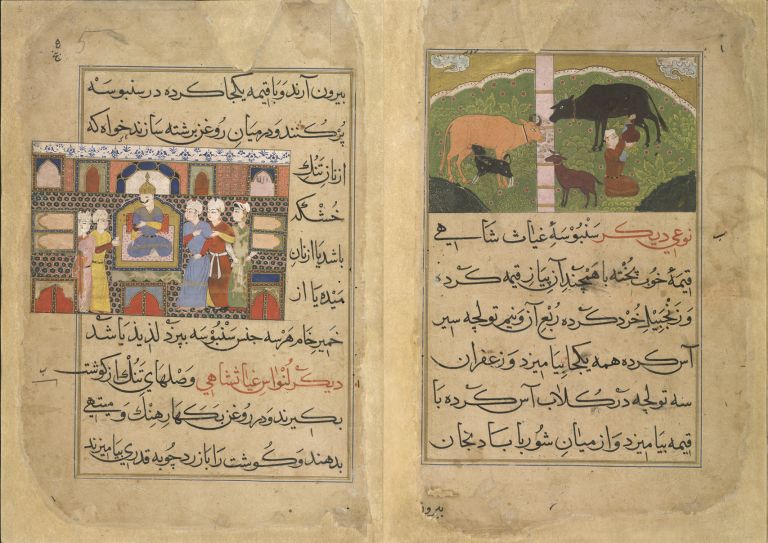

The South Asian samosa is believed to be derived from a medieval precursor from the Middle East that was baked and not deep fried. The earliest mention of a samosa precursor was by Abbasid-era poet Ishaq al-Mawsili, praising the sanbusaj. Recipes are found in 10th–13th-century Arab cookery books, under the names sanbusak, sanbusaq, and sanbusaj, all deriving from the Persian word fa. In Iran, the dish was popular until the 16th century, but by the 20th century its popularity was restricted to certain provinces (such as the lrl of Larestan). Abolfazl Beyhaqi (995–1077), an Iranian historian, mentioned it in his history, Tarikh-e Beyhaghi.
The Central Asian samsa was introduced to the Indian subcontinent in the 13th or 14th century by chefs from the Middle East and Central Asia who cooked in the royal kitchens for the rulers of the Delhi Sultanate. Amir Khusro (1253–1325), a scholar and the royal poet of the Delhi Sultanate, wrote around 1300 CE that the princes and nobles enjoyed the "samosa prepared from meat, ghee, onion, and so on". Ibn Battuta, a 14th-century traveller and explorer, describes a meal at the court of Muhammad bin Tughluq, where the samushak or sambusak, a small pie stuffed with minced meat, almonds, pistachios, walnuts and spices, was served before the third course of pulao. Nimatnama-i-Nasiruddin-Shahi, a medieval Indian cookbook started for Ghiyath Shah, the ruler of the Malwa Sultanate in central India, mentions the art of making samosa. The Ain-i-Akbari, a 16th-century Mughal document, mentions the recipe for qottab, which it says, "the people of Hindustan call sanbúsah".
The samosa gained its popularity for its savoury flavour and convenience. The pocket-sized food item was a readily available snack for workers and travellers across Central and South Asia.
Regional varieties
South Asia
In India, samosas are prepared with an all-purpose flour (locally known as maida) and stuffed with a filling, often a mixture of diced and cooked or mashed boiled potatoes, onions, green peas, lentils, ginger, spices and green chillies. A samosa can be either vegetarian or non-vegetarian, depending on the filling. The entire pastry is deep-fried in vegetable oil to a golden-brown colour. It is served hot, often as a chaat street food, with fresh chutneys. In the Indian states of Assam, Odisha, West Bengal, Bihar and Jharkhand, singaras (সিঙ্গারা) or shingras (চিংৰা) (the East Indian version of samosas) are popular snacks found almost everywhere. They are a bit smaller than in other parts of India, with a filling of cooked diced potato, peanuts, and sometimes raisins. In Hyderabad, a smaller version with a thicker pastry crust and minced meat filling, called lukhmi, is eaten.
Both flat (triangular) and full-shaped (tetrahedron/triangular pyramid) samosas are popular in Bangladesh. A Bengali version of the full-shaped samosa is called a সিঙাড়া (bn) and is normally smaller than the standard variety. The bn is usually filled with pieces of potatoes, vegetables, and nuts.
Samosas are called ne in the eastern part of Nepal, from their shape which is like a water caltrop (shingara in Eastern India); the rest of the country calls it samosa.
A distinct variety of samosa, available in Karachi, is called ur (; "paper samosa" in English) due to its thin and crispy covering, which resembles a wonton or spring roll wrapper. Fillings include beef, chicken, and lamb, or they can be made as a sweet.
The types and varieties of samosa made in Maldivian cuisine are known as dv. They are filled with a mixture including fish like tuna and onions.
File:Samosas before being fried.jpg|Samosas before being fried, at a sweet shop in Kolkata File:Samosa with sauce available at Indian Coffee Houses in Kerala .jpg|Samosa with tomato ketchup at coffee houses in Kerala File:Vegetable Samosa.jpg|Vegetable samosa File:Samosas, snack food at Wikipedia's 16th Birthday celebration in Chittagong (01).jpg|Bangladeshi shingaras
Central Asia
The samsa is a savoury pastry in Central Asian cuisines such as that of Uzbekistan. It consists of a pastry stuffed with meat and sometimes vegetables and baked in a tandoor oven, rather than being fried.
In Tajik cuisine, tg are triangular pastries, filled with minced beef or mutton mixed with tail fat, flavoured with onions and spices, and baked in a tandoor oven.
File:Samsa of Khiva.jpg|A batch of samsas being baked in a tandoor oven in Khiva, Uzbekistan
Southeast Asia
Samosas are called my (စမူဆာ) in Burmese, and are an extremely popular street snack in Burma. Samosas are also used in a traditional Burmese salad called samuza thoke (စမူဆာသုပ်; ), a salad of cut samosa pieces with onions, cabbage, fresh mint, light potato and chickpea curry broth, masala, chili powder, salt and lime.
In Indonesia, snacks similar similar to samosas include pastel, panada and epok-epok.
File:samosa.jpg|Burmese-style my, smaller than their Indian counterparts File:Indonesian-style samosa.jpg|Indonesian-style samosa identified as kue kering
Africa
All across East Africa, samosas, known by several variants of the name, are popular. In Somalia, sambuus filled with vegetables, meat, or seafood are eaten on special occasions. Samosas, locally called samoussas, are a popular snack on Réunion. They are filled with chicken, cheese, crabs or potatoes.
South African samoosas tend to be smaller than Indian ones. Samosa dough is also used for a flatbread called farmaas puri, which consists of rolled-up sheets of dough stacked with minced meat, which are cut into thin circles and deep fried. Originating in South Africa, farmaas puri spread to Gujarati communities in India and Pakistan, where it is popular during Ramadan.
In West African countries such as Ghana and Nigeria, samosas are a common street food. In Nigeria, they are usually served in parties along with chicken or beef, puff puff, spring rolls and plantains and are among the finger foods called "small chops".
File:Sambusadish2.jpg|Somali sambuus being fried
Middle East
Sambousek () are usually filled with either meat, onion, pine nuts, za’atar, spinach dock, or cheese.{{cite book
Sambuseh () originated in Iran but is now rare there. The sweet fried pastry qottab is derived from it. Modern Iranian Sambuseh is made either with a sausage and pizza cheese based filling, or with vegetables.
Sambusak (Hebrew: סמבוסק) comes in several distinct forms, as sambusak has been influenced differently by Sephardic and Mizrahi cuisine. Sephardi sambusak is generally thicker, baked, and stuffed with either cheese or beef and coated with sesame or nigella seeds. Mizrahi sambusak is generally thinner, larger, fried, and stuffed with curry-spiced chickpea and onion, and is usually not coated with seeds.
File:Sambousek.JPG|Sambousek File:Falafel2.jpg|Sambuseh at a bazar in Ahvaz, Iran
Portuguese-speaking regions
In Goa (India), Portugal, and Angola, samosas are known as chamuças. They are filled with chicken, beef, pork, lamb or vegetables, and generally served quite hot. Samosas are an integral part of Goan Catholic and Portuguese cuisine, where they are a common snack.{{cite news
Chamuças.jpg|Goan chamuças Ponta Delgada, São Miguel, Azores (Açores) Archipelago, Portugal (49051209161).jpg|Portuguese chamuças in Ponta Delgada, Azores Chamuças en Afrique portugaise.JPG|Angolan chamuças
English-speaking regions
Samosas are popular in the United Kingdom and the English-speaking Commonwealth including Canada, and in the United States. They may be called samboosa or sambusac, but in South Africa, they are often called samoosa. Frozen samosas are increasingly available. Variations can be made using filo, or flour tortillas.
Al-Shabaab's samosa ban
Al-Shabaab, the extremist group controlling parts of Somalia, banned samosas in 2011 over concerns about the possible use of rotten meat in the filling.
References
References
- {{cite OED2. samosa
- "Samosa".
- Davidson, Alan. (1999). "The Oxford Companion to Food". [[Oxford University Press]].
- (23 September 2011). "Middle East Today: An Encyclopedia of Life in the Republic". ABC-CLIO.
- Reza, Sa’adia. (18 January 2015). "Food's Holy Triangle". [[Dawn (newspaper).
- "Samosa".
- [https://www.hindustantimes.com/india/lovely-triangles/story-aIL2GLawECV084GXmGqshI.html Lovely triangles] {{webarchive. link. (8 January 2009 ''[[Hindustan Times]]'', 23 August 2008.)
- link. (7 March 2023 . accessed: 26 April 2021.)
- (2001). "Medieval Arab Cookery". [[Prospect Books]].
- (23 October 2015). "Indigenous Culture, Education and Globalization: Critical Perspectives from Asia". Springer.
- (4 January 2017). "TBI Food Secrets: Unravelling the Fascinating History of the Samosa, India's Favourite Street Snack".
- Beyhaqi, Abolfazl, ''Tarikh-e Beyhaghi'', p. 132.
- (4 January 2017). "TBI Food Secrets: Unravelling the Fascinating History of the Samosa, India's Favourite Street Snack".
- [http://www.tribuneindia.com/2004/20040905/spectrum/food.htm Savoury temptations] {{Webarchive. link. (5 December 2008 ''[[The Tribune (Chandigarh)). The Tribune]]'', 5 September 2005.
- [http://www.india-today.com/iplus/1999_3/life3.html Regal Repasts] {{webarchive. link. (7 January 2009 Jiggs Kalra and Dr [[Pushpesh Pant]], ''[[India Today). India Today Plus]]'', March 1999.
- (2009). "The Grove Encyclopedia of Islamic Art and Architecture". [[Oxford University Press]].
- link. (27 July 2011 ''[[Ain-i-Akbari]]'', by [[Abu'l-Fazl ibn Mubarak]]. English tr. by [[Heinrich Blochmann]] and Colonel Henry Sullivan Jarrett, 1873–1907. [[Asiatic Society of Bengal]], [[Calcutta]], Volume I, Chapter 24, page 59. "10. Quṭáb, which the people of Hindústán call sanbúsah. This is made several ways. 10 s. meat; 4 s. flour; 2 s. g'hí; 1 s. onions; ¼ s. fresh ginger; ½ s. salt; 2 d. pepper and coriander seed; cardamum, cumin seed, cloves, 1 d. of each; ¼ s. of summáq. This can be cooked in 20 different ways, and gives four full dishes".)
- (24 July 2023). "The Story of the Samosa".
- Pal, Sanchari. (4 January 2017). "TBI Food Secrets: Unravelling the Fascinating History of the Samosa, India's Favourite Street Snack".
- "Samosas Recipe by Niru Gupta". NDTV Food.
- Collingham, Elizabeth M.. (2006). "Curry: A Tale of Cooks and Conquerors". [[Oxford University Press]].
- link
- (19 July 2023). "Unraveling the history of samosas". The Annapurna Express.
- (14 May 2020). "Easy samosa recipes to kill those evening hunger pangs".
- [[Xavier Romero-Frias]], ''[https://www.himalmag.com/eating-on-the-islands/ Eating on the Islands] {{Webarchive. link. (28 March 2020 '', [[Himal Southasian]], Vol. 26 no. 2, pages 69-91 {{ISSN). 1012-9804
- "Tandoor Samsa: Happiness Baked Fresh!". Visit Uzbekistan Magazine.
- "Sambusa baraki".
- "စမူဆာသုပ်".
- Lugo, Ligia. (25 February 2021). "Traveling Through Cuisine: How to Make Samosas at Home". Go World Travel Magazine.
- (6 May 2021). "Why Somali fried dumplings deserve a place on your table and in your heart". [[Los Angeles Times]].
- Leslie, par. (17 June 2018). "Samoussas".
- "Samoosas in South African Cuisine".
- (11 September 2010). "Samoosa (Samosa) | Indian Fusion South Africa".
- (26 April 2012). "Samoosas".
- Shabbir, Buraq. (4 April 2024). "Gujaratis bring decades-old recipes to Ramadan iftar spreads in Pakistan’s Karachi". [[Arab News]].
- (24 August 2017). "How To Make Samosa (Small Chops)". [[The Guardian (Nigeria).
- "Cheese sambousek".
- (1 May 2020). "جدل حول "سمبوسة ولا سمبوسك وجلاش ولا أولاش".. فما أصل الكلمة؟". [[Masrawy]].
- (5 Apr 2023). "«السمبوسة» نجمة المائدة الرمضانية.. ما أصلها؟". [[Al Khaleej (newspaper)]].
- (21 May 2019). "الكبة والسمبوسك.. أطباق شامية على موائد فلسطين الرمضانية". Felesteen News.
- (11 January 2026). "This deep-fried pastry is one of the world's most popular". [[The Sydney Morning Herald]].
- "Sambusak (Sephardic Stuffed Pastries)".
- Sheff, Sharon Gomperts and Rachel Emquies. (2022-05-26). "A Classic of the Iraqi Kitchen: Curried Chickpea Sambusak".
- (30 January 2007). "Lineups threaten to stall Fredericton's hot samosa market". [[CBC.ca]].
- Fox, Chris. (29 July 2009). "Patel couldn't give her samosas away". [[The Daily Gleaner]].
- [http://www.southafrica.info/plan_trip/travel_tips/questions/saenglish.htm#s South African English is lekker!] {{Webarchive. link. (18 March 2012 . Retrieved 13 June 2007.)
- [https://www.traderjoes.com/FearlessFlyer/Article/4800#s Trader Joe's Fearless Flyer: Mini Vegetable Samosas] {{Webarchive. link. (12 January 2020. Retrieved 27 May 2019.)
- [http://www.epicurious.com/recipes/food/views/13008 Fennel-Scented Spinach and Potato Samosas] {{Webarchive. link. (30 January 2008. Retrieved 6 February 2008.)
- [http://www.fsafood.com/fsacom/Recipes/Recipe+Index/A-Z+Listing/P/Potato+Samosas.htm Potato Samosas] {{Webarchive. link. (18 October 2006. Retrieved 6 February 2008.)
- "Samosas Banned: Islamist Group Calls The Pastry 'Offensive', Huffington Post, 07/29/2011".
This article was imported from Wikipedia and is available under the Creative Commons Attribution-ShareAlike 4.0 License. Content has been adapted to SurfDoc format. Original contributors can be found on the article history page.
Ask Mako anything about Samosa — get instant answers, deeper analysis, and related topics.
Research with MakoFree with your Surf account
Create a free account to save articles, ask Mako questions, and organize your research.
Sign up freeThis content may have been generated or modified by AI. CloudSurf Software LLC is not responsible for the accuracy, completeness, or reliability of AI-generated content. Always verify important information from primary sources.
Report