From Surf Wiki (app.surf) — the open knowledge base
Same-sex marriage in Spain
none
none
| Field | Value |
|---|---|
| short_title | Same-sex marriage in Spain |
| legislature | Cortes Generales |
| long_title | *Ley 13/2005 por la que se modifica el Código Civil en materia de derecho a contraer matrimonio.* (Law 13/2005 that amends the Civil Code regarding the right to contract marriage) |
| introduced_by | Prime Minister José Luis Rodríguez Zapatero (PSOE) |
| date_enacted | June 30, 2005 |
| date_signed | July 1, 2005 |
| related_legislation | Spanish Civil Code |
Same-sex marriage has been legal in Spain since July 3, 2005. In 2004, the nation's newly elected government, led by Prime Minister José Luis Rodríguez Zapatero of the Socialist Workers' Party, began a campaign to legalize same-sex marriage, including the right of adoption by same-sex couples. After much debate, a law permitting same-sex marriage was passed by the Cortes Generales (the Spanish Parliament, composed of the Senate and the Congress of Deputies) by a vote of 187–147 on June 30, 2005, and published on July 2. The law took effect the next day, making Spain the third country in the world to allow same-sex couples to marry on a national level, after the Netherlands and Belgium, and 17 days ahead of the right being extended across all of Canada.
Roman Catholic authorities were adamantly opposed, criticising what they regarded as the weakening of the meaning of marriage, despite support from 66% of the population. Other associations expressed concern over the possibility of lesbian and gay couples adopting children. After its approval, the conservative People's Party challenged the law in the Constitutional Court. Approximately 4,500 same-sex couples married in Spain during the first year of the law. Shortly after the law was passed, questions arose about the legal status of marriages to non-Spaniards whose countries did not permit same-sex marriage. A decision from the Ministry of Justice stated that the country's same-sex marriage law allows a Spanish citizen to marry a non-Spaniard regardless of whether that person's homeland recognizes the union. At least one partner must be a Spanish citizen in order to marry, although two non-Spaniards may marry if they both have legal residence in Spain.
Rodríguez Zapatero and the Socialist Workers' Party were re-elected in the 2008 election, but the next election in 2011 delivered a landslide victory to the People's Party. Prime Minister Mariano Rajoy said he opposed same-sex marriage, but any decision about repealing the law would be made only after the ruling of the Constitutional Court. On November 6, 2012, the law was upheld by the court with eight support votes and three against. Minister of Justice Alberto Ruiz-Gallardón announced that the government would abide by the ruling and the law would not be repealed.
Legal history
Background and summary
The first law recognising cohabiting same-sex couples was passed in 1994 for the purpose of providing limited legal rights with regard to renting. During the 1990s and early 2000s, several city councils and autonomous communities opened registries for de facto unions (, pareja de hecho or pareja estable){{efn|In Spain's regional and recognized minority languages:
- (), or parella estable ()
- (), or parella estable ()
- (), or bikote egonkorra ()
- (), or pareya estable ()
- ()
- ()
The Socialist Workers' Party (PSOE) manifesto for the 2004 general election included the pledge of amending the Civil Code to introduce same-sex marriage, granting it the same status as heterosexual marriage in order to "ensure full social and legal equality for lesbians and gays". After the Socialists' victory in the election, Prime Minister José Luis Rodríguez Zapatero promised at his inauguration address to bring this change forward: "The moment has finally arrived to end once and for all the intolerable discrimination which many Spaniards suffer because of their sexual preferences. ... As a result, we will modify the Civil Code to recognize their equal right to marriage with the resulting effects over inheritance, labor rights and social security protection". On June 30, 2004, Minister of Justice Juan Fernando López Aguilar announced that the Congress of Deputies had provisionally approved a government plan for legislation to extend the right of marriage to same-sex couples. López Aguilar also announced two propositions, introduced by the regional Convergence and Union party of Catalonia: one would introduce legal status for both opposite-sex and same-sex common-law unions (parejas de hecho (), "de facto unions"), while the other would permit transgender people to legally change their name and sex designation without the requirement of surgery. The bill regarding same-sex marriage was approved by the Council of Ministers on October 1, 2004, submitted to Parliament on December 31, and passed by the Congress of Deputies on April 21, 2005. However, it was rejected on June 22, 2005 by the Senate, where the opposition People's Party held a plurality of the seats. The bill was returned to the lower house, which holds the power to override the Senate, and final approval was given to the bill on June 30, 2005, with 187 "yes" votes, 147 "no" votes, and 4 abstentions.
With the final approval and enactment of the bill on July 2, 2005, Spain became the third country in the world to formally legalize same-sex marriages nationwide, after the Netherlands and Belgium. The first same-sex wedding took place eight days after the bill became law, and was performed in the city council chamber of the Madrid suburb of Tres Cantos between Carlos Baturín and Emilio Menéndez. The first same-sex marriage between women took place in Barcelona eleven days later. In the Basque Country, the first marriage for a male couple was performed in Vitoria-Gasteiz, and the first marriage for a lesbian couple occurred in Errenteria.
In spite of these steps toward equal treatment, a legal flaw remained: if children were born within a lesbian marriage, the non-biological mother was not legally regarded as a parent; she still had to undergo the lengthy financial process of adoption. This right was granted to heterosexual couples (married or not), where a stepfather could declare his wife's children to be his without further process. On November 7, 2006, the Spanish Parliament amended the law on assisted reproduction, allowing the non-biological mother to be regarded as a parent alongside her female spouse who is the birth-mother.
Ratification of Law 13/2005
The projected bill announced on June 30, 2004 by the Minister of Justice was studied by the General Council of the Judiciary. Although the General Council admitted that the existing discrimination against homosexuals could not be condoned, it was quite critical about extending marriage toward same-sex couples (including collateral adoption). It argued that the extension was not demanded by the Constitution, and that ending discrimination could be achieved through other legal means, such as the extension of civil unions.
Despite this negative report, the Zapatero Government presented the bill to Congress on October 1, 2004. With the exception of the People's Party and members of the Democratic Union of Catalonia, the different parliamentary parties favoured the reform. On April 21, 2005, Congress approved the bill, with 183 "yes" votes (including a member of the People's Party) and 136 "no" votes and 6 abstentions. The bill to allow same-sex marriage in Spain was short; it added a new paragraph to Article 44 of the Civil Code, saying that: Matrimony shall have the same requisites and effects regardless of whether the persons involved are of the same or different sex.{{efn|In some languages of Spain:
- }}
| Party | Voted for | Voted against | Abstained | Absent (Did not vote) | ||
|---|---|---|---|---|---|---|
| Spanish Socialist Workers' Party | {{collapsible list | title= 157 | 1= María del Rosario de Aburto Baselga | 2= José Acosta Cubero | 3= Carmen Alborch | |
| People's Party | {{collapsible list | title= 1 | 1= Celia Villalobos | {{collapsible list | title= 133 | 1= Ángel Jesús Acebes Paniagua |
| Convergence and Union | {{collapsible list | title= 2 | 1= Carles Campuzano i Canadés | 2= Mercè Pigem i Palmès | {{collapsible list | title= 3 |
| Republican Left of Catalonia | {{collapsible list | title= 8 | 1= Josep Andreu Domingo | 2= Rosa María Bonàs i Pahisa | 3= Francesc Canet Coma | |
| Basque Nationalist Party | {{collapsible list | title= 5 | 1= José Ramón Beloki Guerra | 2= Josu Iñaki Erkoreka Gervasio | 3= Aitor Esteban Bravo | |
| United Left | {{collapsible list | title= 5 | 1= María Carme García Suárez | 2= Joan Herrera Torres | 3= Gaspar Llamazares Trigo | |
| Canarian Coalition | {{collapsible list | title= 1 | 1= Luis Mardones Sevilla | – | – | |
| Galician Nationalist Bloc | {{collapsible list | title= 1 | 1= Francisco Rodríguez Sánchez | – | – | |
| Chunta Aragonesista | {{collapsible list | title= 1 | 1= José Antonio Labordeta Subías | – | – | |
| Eusko Alkartasuna | {{collapsible list | title= 1 | 1= Begoña Lasagabaster Olazabal | – | – | |
| Nafarroa Bai | {{collapsible list | title= 1 | María Uxue Barkos Berruezo]] | – | – | |
| Total | 136 | 6 | 25 |
In accordance with constitutional provisions, the text approved by the Congress was then submitted to the Senate for final approval, change or veto. On June 21, 2005, experts were called to the Senate to debate the issue. The expert's opinions were diverse; some stated that same-sex adoption had no effect on a child's development, except for perhaps a higher tolerance towards homosexuality. However, psychiatrist Aquilino Polaino, called by the People's Party as an expert, called homosexuality a pathology and emotive disorder. Among other assertions that generated debate, he claimed that "many homosexuals have rape abuse antecedents since childhood" and that homosexuals generally come from families with "hostile, alcoholic and distant" fathers, and mothers who were "over protective" toward boys and "cold" toward girls. Prominent People's Party members later rejected Polaino's assertions.
The Senate vetoed the text submitted by the Congress. The veto was proposed by the People's Party, which held the plurality of the seats, and by the Democratic Union of Catalonia, and was approved by 131 "yes" votes and 119 "no" votes and 2 abstentions. As a result, the text was sent back to the Congress. On June 30, 2005, it was approved by Congress, which, in accordance with constitutional provisions, overrode the Senate veto. This was achieved with 187 "yes" votes (including a member of the People's Party, Celia Villalobos), 147 "no" votes, and four abstentions. The veto override implied its approval as law. The vote was held after Zapatero unexpectedly took the floor to speak in its support, saying "We are expanding the opportunities for happiness of our neighbors, our colleagues, our friends and our relatives. At the same time, we are building a more decent society." Mariano Rajoy, the leader of the opposition People's Party, was denied the opportunity to address Congress after Zapatero's appearance, and accused Zapatero of "dividing Spanish society".
| Party | Voted for | Voted against | Abstained | Absent (Did not vote) | ||
|---|---|---|---|---|---|---|
| Spanish Socialist Workers' Party | {{collapsible list | title= 159 | 1= María del Rosario de Aburto Baselga | 2= José Acosta Cubero | 3= Carmen Alborch | |
| People's Party | {{collapsible list | title= 1 | 1= Celia Villalobos | {{collapsible list | title= 143 | 1= Ángel Jesús Acebes Paniagua |
| Convergence and Union | {{collapsible list | title= 2 | 1= Carles Campuzano i Canadés | 2= Mercè Pigem i Palmès | {{collapsible list | title= 4 |
| Republican Left of Catalonia | {{collapsible list | title= 8 | 1= Josep Andreu Domingo | 2= Rosa María Bonàs i Pahisa | 3= Francesc Canet Coma | |
| Basque Nationalist Party | {{collapsible list | title= 5 | 1= Pedro María Azpiazu Uriarte | 2= José Ramón Beloki Guerra | 3= Aitor Esteban Bravo | |
| United Left | {{collapsible list | title= 5 | 1= María Carme García Suárez | 2= Joan Herrera Torres | 3= Gaspar Llamazares Trigo | |
| Canarian Coalition | {{collapsible list | title= 3 | 1= Luis Mardones Sevilla | 2= Paulino Rivero | 3= Román Rodríguez Rodríguez | |
| Galician Nationalist Bloc | {{collapsible list | title= 2 | 1= María Olaia Fernández Dávila | 2= Francisco Rodríguez Sánchez | – | |
| Chunta Aragonesista | {{collapsible list | title= 1 | 1= José Antonio Labordeta Subías | – | – | |
| Eusko Alkartasuna | – | – | – | {{collapsible list | title= 1 | |
| Nafarroa Bai | {{collapsible list | title= 1 | María Uxue Barkos Berruezo]] | – | – | |
| Total | 147 | 4 | 12 |
When the media asked King Juan Carlos I if he would sign the bill that was being debated in the Cortes Generales, he answered that he was the King of Spain, not of Belgiuma reference to King Baudouin of Belgium, who refused to sign the Belgian law legalising abortion. For the King to withhold his royal assent, it would effect a veto of the legislation. However, the King gave his royal assent to the law on July 1, 2005, and the law was gazetted in the Boletín Oficial del Estado on July 2, and came into effect on July 3. The King received criticism by Carlist and other far-right conservatives for signing the legislation.
Reactions
.jpg)
The bill's passage was met with concern by Catholic authorities, including Pope John Paul II—who warned of "a weakening of family values"—and his successor Pope Benedict XVI. Gay rights supporters argued that while the Catholic Church also formally opposed opposite-sex, non-religious marriage, its opposition was not as vocal; for example, the Church did not object to the marriage of Prince Felipe to Letizia Ortiz, who had divorced from a previous civil marriage. The Church was unable to gather enough support to derail the bill, even though more than 60% of Spaniards identify as members of the Catholic faith. Sociologists believed this may be due to a significant increase of cultural liberalism in the realm of individual rights in recent years, where the Church traditionally had most influence, especially on family issues. A poll showed that three quarters of Spaniards believed the church hierarchy was out of touch with social reality. A complementary explanation might be that the Church's influence on Spaniards declined after the death in 1975 of General Francisco Franco, whose regime was closely linked to the Church.
Prime Minister Zapatero responded to church criticism by saying:
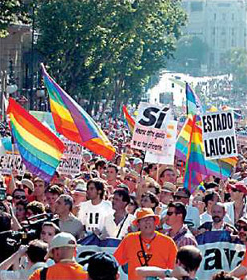
A public protest against the law was held on June 19, 2005. Protesters—led by People's Party members, Spanish bishops and the Spanish Family Forum (Foro Español de la Familia)—said they had rallied 1.5 million people against what they considered "an attack on the traditional family and Spanish values"; the Government Delegation in Madrid counted 166,000 at the same event. Two weeks after this protest, coinciding with Gay Pride Day, the National Federation of Lesbians, Gays, Transsexuals and Bisexuals (FELGT; Federación Estatal de Lesbianas, Gays, Transexuales y Bisexuales) estimated two million people marched in favour of the new law; police sources counted 97,000. Both marches took place in Madrid, at the time governed by the conservative People's Party.
Spanish Roman Catholic bishops also claimed that the government, by extending the right of marriage to same-sex couples, "weakened the meaning of marriage", which they defined as "the union of a heterosexual couple". The Spanish Family Forum expressed concern over the possibility of same-sex couples adopting and raising children, and argued that adoption is not a right for the parents, but for the adopted. Gay associations replied that de facto adoption by same-sex couples had existed for a long time in Spain, since many couples were already rearing minors adopted by one of the partners. Joint adoption by same-sex couples was already legal in Navarre (2000), the Basque Country (2003), Aragon (2004), Catalonia (2005) and Cantabria (2005) before the same-sex marriage law legalized it nationwide. In addition, in Asturias (2002), Andalusia (2002) and Extremadura (2003), same-sex couples could jointly begin procedures to temporarily or permanently take children in care. These associations also argued that there was no scientific basis for the claim that the parents' sexual orientation would cause developmental problems for their adopted children. This view is officially supported by the Spanish School of Psychology, which also states that homosexuality is not a pathology.
In a 2008 biography, Queen Sofía of Spain revealed that she preferred the term "civil union" to "marriage" for committed same-sex relationships. This and other alleged comments by the Queen opened the Spanish monarchy to rare criticism in 2008, with the Zarzuela Palace issuing an apology on behalf of the Queen for the "inexact" quotes attributed to her. Antonio Poveda, the president of FELGT, said his organization accepted the Queen's apology, but added that there remains ill feelings by the gay community towards the Queen over the comments. King Juan Carlos, known to be far more liberal than his wife, was reportedly incensed by the biography, with reporters stating the King would fire palace officials who allegedly approved official royal endorsement of the book. During the 2011 general election, People's Party leader Mariano Rajoy said he also preferred the term "civil union" to marriage for same-sex couples.
In late 2017, the Socialist Workers' Party began calling for reforms to the Spanish Constitution to explicitly state the right of all couples, opposite-sex and same-sex, to marry. Currently, Article 32 of the Constitution notes the right of men and women to marry, but does not provide an explicit definition of marriage.
Opposition court challenges
On July 21, 2005, a judge from the city of Dénia, Valencia refused to issue a marriage license to a lesbian couple. The judge filed a challenge against the same-sex marriage law with the Constitutional Court based on Article 163 of the Constitution, which allows judges to challenge constitutional changes. In August 2005, a judge from Gran Canaria refused licenses to three same-sex couples and mounted another constitutional challenge. In December 2005, the Constitutional Court rejected both challenges owing to both judges' lack of standing to file them. On September 30, 2005, the opposition People's Party decided to initiate a separate constitutional challenge, causing division within the party. The outcome was published on November 6, 2012, seven years after the challenge was presented. The court decided to uphold the same-sex marriage law with eight support votes and three against.
On February 27, 2007, the Spanish Family Forum presented an initiative signed by 1.5 million people to legislate marriage as "the union of a man and a woman" only, thus effectively prohibiting same-sex marriage. The initiative was rejected by the Congress of Deputies. On May 30, 2007, the aforementioned judge of Dénia was condemned by the Disciplinary Committee of the General Council of the Judiciary to pay €305 for refusing to marry the couple and was also strictly warned against doing it again. She attributed this action to government "propagandistic machinery".
Residency issues
Shortly after the law was passed, questions arose about the legal status of marriages to non-Spaniards, after a Spaniard and an Indian national living in Catalonia were denied a marriage license on the grounds that India did not permit same-sex marriage. However, on July 22, another judge in Catalonia married a Spanish woman and her Argentinian partner (the first same-sex marriage between women in Spain). This judge disagreed with his colleague's decision and gave preference to the right of marriage over Argentinian law, which at the time did not allow same-sex marriage.
On July 27, the Junta de Fiscales de Sala—a body within the Public Prosecutor's Office that advises the Ministry of Justice—issued an opinion that LGBT Spaniards can marry foreigners from countries that do not permit same-sex marriage. These marriages would be valid according to Spanish law, but did not imply automatic validity according to the foreigner's national law. A ruling published in the Boletín Oficial del Estado stated:
According to the instructions from the Ministry of Justice, Spanish consulates abroad may carry out the preliminary paperwork for a same-sex marriage. At least one of the marrying partners must be a Spanish citizen, residing in the consular demarcation. However, the marriage itself can only take place at the consulate if local laws recognize same-sex marriages. In all other cases, the partners must marry in Spanish territory. Two non-resident foreigners cannot marry in Spain, as at least one of the partners must be a Spanish resident, although they both may be non-Spanish citizens.
Marriage statistics
According to the Spanish National Statistics Institute (INE), 75,301 same-sex marriages had taken place up to the end of 2023. Figures for 2020 are much lower than previous years because of the restrictions in place due to the COVID-19 pandemic.
In 2018, most same-sex marriages were performed in Catalonia at 987, followed by Madrid at 956, Andalusia at 774, Valencia at 589, the Canary Islands at 333, the Balearic Islands at 194, the Basque Country at 191, Murcia at 145, Castilla-La Mancha at 135, Galicia at 124, Castile and León at 92, Aragon at 68, Extremadura at 66, Asturias and Navarre at 50 each, Cantabria at 41, La Rioja at 24, Melilla at 7 and Ceuta at 2. Another 42 were performed abroad in Spanish consulates.
| Year | Same-sex marriages | Opposite-sex | ||||||||||||||||||||||||||||
|---|---|---|---|---|---|---|---|---|---|---|---|---|---|---|---|---|---|---|---|---|---|---|---|---|---|---|---|---|---|---|
| marriages | Total | |||||||||||||||||||||||||||||
| marriages | % | |||||||||||||||||||||||||||||
| same-sex | Male | Female | Total | 2005 | 2006 | 2007 | 2008 | 2009 | 2010 | 2011 | 2012 | 2013 | 2014 | url=https://www.ine.es/prensa/np976.pdf | title=Movimiento Natural de la Población | publisher=INE | year=2016 | language=es | access-date=March 20, 2020 | archive-date=August 19, 2019 | archive-url=https://web.archive.org/web/20190819011324/http://www.ine.es/prensa/np976.pdf | url-status=live}} | 2016 | 2017 | 2018 | 2019 | 2020 | 2021 | 2022 | 2023 |
| 914 | 355 | 1,269 | 118,190 | 119,459 | 1.06% | |||||||||||||||||||||||||
| 3,000 | 1,313 | 4,313 | 203,453 | 207,766 | 2.08% | |||||||||||||||||||||||||
| 2,141 | 1,052 | 3,193 | 210,579 | 204,772 | 1.56% | |||||||||||||||||||||||||
| 2,051 | 1,143 | 3,149 | 194,067 | 197,216 | 1.62% | |||||||||||||||||||||||||
| 1,984 | 1,098 | 3,082 | 174,062 | 177,144 | 1.74% | |||||||||||||||||||||||||
| 1,955 | 1,238 | 3,193 | 167,247 | 170,440 | 1.87% | |||||||||||||||||||||||||
| 2,073 | 1,467 | 3,540 | 159,798 | 163,338 | 2.17% | |||||||||||||||||||||||||
| 1,935 | 1,520 | 3,455 | 165,101 | 168,556 | 2.05% | |||||||||||||||||||||||||
| 1,648 | 1,423 | 3,071 | 153,375 | 156,446 | 1.96% | |||||||||||||||||||||||||
| 1,679 | 1,596 | 3,275 | 159,279 | 162,554 | 2.01% | |||||||||||||||||||||||||
| 1,925 | 1,813 | 3,738 | 165,172 | 168,910 | 2.21% | |||||||||||||||||||||||||
| 2,188 | 2,132 | 4,320 | 171,023 | 175,343 | 2.46% | |||||||||||||||||||||||||
| 2,323 | 2,314 | 4,637 | 168,989 | 173,626 | 2.67% | |||||||||||||||||||||||||
| 2,358 | 2,512 | 4,870 | 162,743 | 167,613 | 2.91% | |||||||||||||||||||||||||
| 2,492 | 2,649 | 5,141 | 161,389 | 166,530 | 3.08% | |||||||||||||||||||||||||
| 1,475 | 1,637 | 3,112 | 87,558 | 90,670 | 3.43% | |||||||||||||||||||||||||
| 2,158 | 2,877 | 5,035 | 143,553 | 148,588 | 3.39% | |||||||||||||||||||||||||
| 2,856 | 3,380 | 6,236 | 172,871 | 179,107 | 3.48% | |||||||||||||||||||||||||
| 3,165 | 3,507 | 6,672 | 165,758 | 172,430 | 3.87% |
Notable weddings

A same-sex marriage between two men, Pedro Díaz and Muño Vandilaz, occurred in Rairiz de Veiga on 16 April 1061. They were married by a priest at a small chapel. The historic documents about the church wedding were found at the Monastery of San Salvador de Celanova.
Although not an official same-sex marriage, in 1901 Marcela Gracia Ibeas and Elisa Sanchez Loriga were married at the Igrexa de San Xurxo in A Coruña by Elisa secretly being re-baptized as a man.
Since its legalization in 2005, couples from across sections of Spanish society have entered into same-sex marriages. Within the first year the law received royal assent, Pedro Zerolo, an influential Socialist member of the Madrid City Council, married Jesús Santos in October, and popular television presenter Jesús Vázquez married Roberto Cortés in November. In October 2005, Spain's prominent anti-terrorism judge Fernando Grande-Marlaska married his fiancé Gorka Gómez. In August 2006, Ourense City Councilor Pepe Araujo, whose party originally opposed the law, married his fiancé Nino Crespo. In September 2006, Alberto Linero Marchena and Alberto Sánchez Fernández, both army soldiers assigned to the Morón Air Base near Seville, became Spain's first military personnel to marry under the new law. In August 2008, Doña Luisa Isabel Álvarez de Toledo, 21st Duchess of Medina Sidonia and three-time Grandee of Spain (branded the Red Duchess for her socialist activism) became the highest ranking Spanish noble to marry in an articulo mortis (deathbed) wedding to longtime companion Liliana Maria Dahlmann, now the Dowager Duchess of Medina Sidonia by right of her late wife.
In June 2015, Mayor Javier Maroto of Vitoria-Gasteiz announced his engagement to longtime partner Josema Rodríguez. The wedding was held on September 18, 2015 at Vitoria-Gasteiz City Hall. Maroto, a member of the conservative People's Party's national board, is known for his views contrary to the stance of his own party pertaining to same-sex marriage in Spain. Prime Minister Mariano Rajoy, who had challenged the law approving same-sex marriage when he was opposition leader, attended the wedding celebrations as a guest.
Religious performance
Marriage in Spain may be contracted by religious or civil authorities. Religious marriages are recognised by the State and have the same status as civil marriages. Most major Christian denominations in Spain do not perform same-sex marriages in their places of worship. Some small Christian churches such as the Metropolitan Community Church perform blessings of same-sex marriages. The Spanish Evangelical Church (IEE) adopted a resolution in 2015 calling for the acceptance of same-sex unions. The move was widely criticised by the Federation of Evangelical Religious Entities of Spain (FEDERE), which chose to maintain the IEE as a member while also adopting a motion preventing any church supporting same-sex unions to be admitted as a member in the future. Despite not permitting its clergy to bless or officiate at same-sex marriages, the Spanish Reformed Episcopal Church issued a statement "reject[ing] the alleged right of [FEDERE] to interfere in the internal affairs of the different churches and communities that make it up".
The Catholic Church opposes same-sex marriage and does not allow its priests to officiate at such marriages. In December 2023, the Holy See published Fiducia supplicans, a declaration allowing Catholic priests to bless couples who are not considered to be married according to church teaching, including the blessing of same-sex couples. Archbishop of Barcelona Juan José Omella said on 23 December that the declaration would require "a change of mentality for Europe, because it is difficult for us to understand this way of asking God for things that was not done before." The first blessing occurred at a church in Miajadas in May 2024. That same month, a same-sex couple held a civil marriage in a church in Talavera de la Reina. According to InfoVaticana, the Archdiocese of Toledo "[had] ceded [the church] to the City Council of Talavera de la Reina due to its deplorable state, so that the municipal government could use it for cultural activities". The marriage was officiated by a local PP councillor, but caused some controversy in Catholic circles.
Public opinion
A poll by the government-run Centre for Sociological Investigations (Centro de Investigaciones Sociológicas), published in April 2005, reported that 66% of Spaniards favoured legalising same-sex marriage. Another poll taken by Instituto Opina a day before the bill passed placed support for the same-sex marriage bill at 62.1% and support of adoption by same-sex couples at 49.1%. An Instituto Opina poll taken nine months after the bill had passed showed that 61% agreed with the legalization.
On July 25, 2007, the BBVA Foundation published their report Social portrait of Spanish people, which showed that 60% of Spain's population supported same-sex marriage. This support occurred mainly among the younger population, between 15 and 34 years old (75%), people with higher education (71%), people not attached to any religion (75.5%), and those identified by left and centre-left political views (71.9%). However, only 44% of the population favored the right of adoption by same-sex couples, in contrast to 42% opposition.
A May 2013 Ipsos poll found that 76% of respondents were in favour of same-sex marriage and another 13% supported other forms of recognition for same-sex couples. According to an Ifop poll conducted that same month, 71% of Spaniards supported allowing same-sex couples to marry and adopt children.
The 2015 Eurobarometer found that 84% of Spaniards thought same-sex marriage should be allowed throughout Europe, while 10% were opposed. A Pew Research Center poll, conducted between April and August 2017 and published in May 2018, showed that 77% of Spaniards supported same-sex marriage, 13% were opposed and 10% did not know or refused to answer. When divided by religion, 90% of religiously unaffiliated people, 79% of non-practicing Christians and 59% of church-attending Christians supported same-sex marriage. Opposition was 7% among 18–34-year-olds.
The 2019 Eurobarometer found that 86% of Spaniards thought same-sex marriage should be allowed throughout Europe, while 9% were opposed. A Pew Research Center poll conducted between February and May 2023 showed that 87% of Spaniards supported same-sex marriage, 10% were opposed and 3% did not know or refused to answer. When divided by political affiliation, support was highest among those on the left of the political spectrum at 94%, followed by those at the center at 88% and those on the right at 82%. The 2023 Eurobarometer showed that support had increased to 88%, while 9% were opposed. The survey also found that 89% of Spaniards thought that "there is nothing wrong in a sexual relationship between two persons of the same sex", while 9% disagreed.
Notes
References
References
- (April 15, 2004). "Spain's new government to legalize gay marriage". SignonSanDiego.com.
- (July 1, 2005). "Spain approves liberal gay marriage law". [[St. Petersburg Times]].
- (July 20, 2005). "Spanish bishops decry legislation weakening marriage". Catholic World News.
- (June 18, 2005). "Manifiesto del Foro de la Familia". 20 Minutos.es.
- Thornberry, Malcolm. (October 28, 2005). "Spain's Highest Court Agrees To Hear Gay Marriage Challenge". 365gay.com.
- (July 30, 2006). "Conservative mayor presides over gay wedding". Euronews.
- (August 9, 2005). "Spain's same-sex marriage law applies to foreigners". Advocate.com.
- (November 25, 2011). "Spain gay rights and abortion activists fear backlash". [[BBC]].
- (November 20, 2011). "Factbox: Policies of Spain's People's Party". [[Reuters]].
- (November 28, 2011). "Mariano Rajoy, New Spain Prime Minister, Opposes Same-Sex Marriage Law". [[Huffington Post]].
- (November 6, 2012). "Same-sex marriage upheld by Spain's highest court". Reuters.
- Internet, Unidad Editorial. "Amplio respaldo del Tribunal Constitucional al matrimonio homosexual".
- "SENTENCIA".
- Internet, Unidad Editorial. "Gallardón no tocará la ley vigente".
- (November 7, 2012). "Gallardón: "No modificaré la ley y la dejaré exactamente como está"". El País.
- (November 6, 2012). "El Gobierno mantendrá el matrimonio homosexual tal y como lo ha validado el TC".
- (24 November 1994 }} {{Cite web). "BOE-A-1994-26003 Ley 29/1994, de 24 de noviembre, de Arrendamientos Urbanos".
- "Soŀlicitud d'inscripció d'una unió de fet en el Registre Administratiu d'Unions de Fet de la Comunitat Valenciana". Generalitat Valenciana.
- "Parellas estables". Generalitat de Catalunya.
- "Rexistro de parellas de feito". Xunta de Galicia.
- (March 30, 2010). "Izatezko bikoteak". Euskadi.es.
- "6/2000 Foru Legea, uztailaren 3koa, bikote egonkorrentzako berdintasun juridikoari buruzkoa". Iusplaza.
- "Xuntanza Civil". Ayuntamiento de Candamo.
- "Registre de cobles estables de Catalonha". gencat.cat.
- Galán, José Ignacio Pichardo. "Same-sex couples in Spain. Historical, contextual and symbolic factors". Institut national d'études démographiques.
- "Ley 1/2001, de 6 de abril, por la que se regulan las uniones de hecho". Noticias Juridicas.
- "Llei 18/2001 de 19 de desembre, de parelles estables". Govern de les Illes Balears.
- "LEY 4/2002, de 23 de mayo, de Parejas Estables". Agencia Estatal Boletín Oficial del Estado.
- "DECRETO 117/2002, de 24 de octubre, por el que se crea el Registro de Uniones de Hecho en Castilla y León y se regula su funcionamiento". Junta de Castilla y León.
- "Ley de Cantabria 1/2005, de 16 de mayo, de Parejas de Hecho de la Comunidad Autónoma de Cantabria.". Noticias Juridicas.
- "Decreto 248/2007, de 20 de diciembre, por el que se crea y se regula el Registro de Parejas de Hecho de Galicia.". Noticias Juridicas.
- "Decreto 30/2010, de 14 de mayo, por el que se crea el Registro de Parejas de Hecho de La Rioja". El Gobierno de La Rioja.
- "9L/PPL-0018 | Asamblea Regional de Murcia".
- (May 25, 2018). "Murcia será en junio la última comunidad en regular por ley las parejas de hecho".
- "Reglamento regulador del Registro de Uniones de Hecho".
- "REGLAMENTO REGULADOR DEL REGISTRO DE PAREJAS DE HEC HO DE LA CIUDAD AUTÓNOMA DE MELILLA".
- "World legal survey:Spain". The International Lesbian and Gay Association.
- (2004). "Merecemos una España mejor. Programa Electoral Elecciones Generales 2004". Partido Socialista Obrero Español (PSOE).
- (November 9, 2006). "Spanish lawmakers approve bill to let transsexuals change gender without surgery". Advocate.com.
- Goodman, Al. (October 1, 2004). "Spain moves closer on gay marriage". CNN.
- Thornberry, Malcolm. (April 21, 2005). "Same-Sex Marriage Passes First Big Hurdle In Spain". 365GAY.com Inc..
- (April 21, 2005). "Spain paves way for gay marriage". BBC News.
- (June 23, 2005). "Spain Senate rejects same-sex marriage bill". Planetout Inc..
- (June 30, 2005). "Spain Becomes Third Country To Legalize Gay Marriage". 365GAY.com.
- Woolis, Daniel. (June 2, 2005). "Spain's Gay Marriage Law Goes Into Effect". 365GAY.com.
- Goodman, Al. (July 11, 2005). "First gay couple marries in Spain". CNN.
- (June 22, 2005). "La primera boda entre dos mujeres se celebra en Cataluña". CADENASER.COM.
- (June 22, 2022). "Euskal Herriko lehenengo ezkontza homosexualak". eitb.eus.
- De Cózar, Álvaro. (October 18, 2006). "El Gobierno revisará la discriminación de las lesbianas con bebés 'in vitro'". El País.
- (November 7, 2006). "Lesbianas podrán ser madres de los hijos "in vitro" de sus parejas". Terra.
- (December 29, 2004). "El Consejo de Ministros aprobará el matrimonio homosexual". Agencia Pulsar.
- (January 15, 2005). "El CGPJ pide que se paralice la reforma que permitirá los matrimonios entre homosexuales". El Mundo.
- (April 22, 2005). "El Congreso aprueba el matrimonio entre personas del mismo sexo". El Mundo.
- (April 22, 2005). "El Congreso aprueba la ley que permite casarse a los homosexuales". 20 minutos.
- "Codi Civil". Department of Justice.
- "Código Civil". University of Santiago de Compostela.
- "Kode Zibila". Iusplaza.
- (April 21, 2005). "CONGRESO DE LOS DIPUTADOS (DICTAMEN DE COMISIÓN) – PROYECTO DE LEY por la que se modifica el Código Civil en materia de derecho a contraer matrimonio (Dictamen con la incorporación del las correcciones técnicas).".
- (June 20, 2005). "Psicólogos y juristas avalan adopción y correcto desarrollo del niño". Web de Hogar.
- (June 21, 2005). "Dirigentes del PP discrepan del experto citado por su partido que tachó de enfermos a los gays". El Mundo.
- (June 23, 2005). "Spanish Senate vetoes gay marriage law". Catholic News Agency.
- Green, Jennifer. (July 1, 2005). "Spain Legalizes Same-Sex Marriage". The Washington Post.
- (June 30, 2005). "CONGRESO DE LOS DIPUTADOS (VOTACIÓN EN RELACIÓN CON EL VETO DEL SENADO) – PROYECTO DE LEY por la que se modifica el Código Civil en materia de derecho a contraer matrimonio.".
- (May 13, 2006). "Don Juan Carlos, sobre el matrimonio gay: 'Soy el Rey de España y no el de Bélgica'". El Mundo.
- (June 2, 2005). "Disposiciones Generales". Boletin Oficial del Estado.
- (April 22, 2005). "Vatican condemns Spain gay bill". BBC News.
- McLean, Renwick. (June 1, 2005). "Spain Legalizes Gay Marriage; Law Is Among the Most Liberal". The New York Times.
- Tremlett, Giles. (June 17, 2005). "Bishops to lead gay law protest". The Guardian.
- (October 1, 2004). "Spain approves gay marriage bill". BBC.
- "Organize marriage in Spain". SpainWeddings Editor.
- (2005-06-30). "Freedom and Equality". Partners Task Force.
- Arroyo, Marta. (June 20, 2006). "Una multitud pide que se retire la ley del Matrimonio Homosexual". El Mundo.
- (February 7, 2005). "La marcha del Orgullo Gay celebra la Ley del Matrimonio Homosexual". Telefónica de España, S.A.U..
- (February 7, 2005). "Multitudinaria marcha del Orgullo Gay festeja Matrimonio Homosexual". Terra.
- (November 6, 2007). "Homosexual Families: Adoption and Foster Care". Institute of Childhood and Urban World.
- (April 2005). "CATALONIA OKs GAY ADOPTION". Just Out.
- Lantigua, Isabel F. (June 21, 2005). "Los psicólogos niegan que la homosexualidad sea una enfermedad". El Mundo.
- Burnett, Victoria. (November 27, 2008). "Queen Sofia Unamused by a Book Quoting Her". [[The New York Times]].
- (October 31, 2008). "Queen of Spain's Gay Marriage Comment Ignites Controversy". FoxNews.com.
- (October 31, 2008). "Spanish Queen alone in anti-gay comments". .expatica.com Dutch News.
- Rhodes, Matt. (August 31, 2008). "Spain: Gay Anger Over Spanish Queen Book". sky.com.
- Morris and Larraz, Sarah and Theresa. (October 31, 2008). "Queen draws ire over gay marriage comment". reuters.com.
- (December 5, 2017). "El PSOE plantea que la reforma constitucional consagre la laicidad de Estado y el matrimonio homosexual". ABC Spain.
- Thornberry, Malcolm. (July 22, 2005). "Spanish Judge: Gay Marriage Possibly Unconstitutional". 365GAY.com.
- Thornberry, Malcolm. (August 13, 2005). "New Threat To Spain's Gay Marriage Law". 365GAY.com.
- (December 15, 2005). "Spain's High Court Upholds Gay Marriage Law". 365GAY.com.
- Remirez DeGanuza, Carmen. (September 22, 2005). "Aguirre critica el recurso contra el matrimonio gay y Rajoy la desautoriza". El Mundo.
- García Pedraz, Javier. (November 6, 2012). "22.442 matrimonios homosexuales, pendientes hoy del Constitucional". El País.
- Peral, María. (November 6, 2012). "Sí al matrimonio homosexual". El Mundo.
- De Benito, Emilio. (February 28, 2007). "El Congreso rechaza la iniciativa para prohibir el matrimonio homosexual". El País.
- (May 30, 2007). "305 euros de multa por no querer oficiar bodas homosexuales". El País.
- Woolls, Daniel. (June 6, 2005). "Spain's Gay Marriage Law Hits Snag Over Foreigners". 365Gay.com.
- Drago, Tito. (2005). "ESPAÑA:Matrimonio gay se internacionaliza". I.P.S.
- "Fiscalía acuerda apoyar los matrimonios gays entre españoles y extranjeros". naciongay.
- "Sobre la tramitación del matrimonio / BOE con la circular del Ministerio de Justicia". FELGT.
- Peral, María. (July 27, 2005). "La Fiscalía apoya el matrimonio homosexual con extranjeros aunque sus países lo prohíban". El Mundo.
- "Estadística de matrimonios. Movimiento natural de la población".
- "Matrimonios de mismo sexo por Comunidad Autónoma de residencia del matrimonio y mes de celebración.".
- (2006). "Movimiento Natural de la Población". INE.
- (2007). "Movimiento Natural de la Población". INE.
- (2008). "Movimiento Natural de la Población". INE.
- (2009). "Movimiento Natural de la Población". INE.
- (2010). "Movimiento Natural de la Población". INE.
- (2011). "Movimiento Natural de la Población". INE.
- (2012). "Movimiento Natural de la Población". INE.
- (2013). "Movimiento Natural de la Población". INE.
- (2014). "Movimiento Natural de la Población". INE.
- (2015). "Movimiento Natural de la Población". INE.
- (2016). "Movimiento Natural de la Población". INE.
- (2017). "Movimiento Natural de la Población". INE.
- (2018). "Movimiento Natural de la Población". INE.
- (2019). "Movimiento natural de la población". INE.
- (2020). "Movimiento natural de la población". INE.
- (2021). "Movimiento natural de la población". INE.
- (2022). "Movimiento natural de la población". INE.
- (2023). "Movimiento natural de la población". INE.
- (2024). "Movimiento Natural de la Población / Indicadores Demográficos Básicos. Año 2023". INE.
- Bernardo, Ángela. (June 9, 2015). "Pedro Zerolo: el legado del activista político".
- Callón, Carlos. "Callón gaña o Vicente Risco de Ciencias Sociais cun ensaio sobre a homosexualidade na Idade Media".
- (February 6, 2018). "La historia de amor de Elisa y Marcela, que se casaron en 1901 por la iglesia".
- (August 4, 2006). "Un concejal del PP de Ourense protagoniza la primera boda gay de un cargo de su partido". 20minutos.
- (September 15, 2006). "Dos militares homosexuales se casan hoy en la primera boda gay del Ejército español". 20minutos.
- Nash, Elizabeth. (February 5, 2008). "Red Duchess a rebel to the last as she snubs family and leaves all to wife". The Independent.
- Keeley, Graham. (March 16, 2008). "Red Duchess wed lesbian lover to snub children". The Daily Telegraph.
- Algorri, Luis. (March 28, 2008). "Liliana, el poder de la nueva duquesa". Tiempo.
- [http://www.eldiariomontanes.es/sociedad/201506/03/maroto-alcalde-vitoria-casa-20150603004146-v.html Maroto, el alcalde de Vitoria, se casa con su novio] {{Webarchive. link. (April 8, 2018 , ''El Diario Montañés'', June 3, 2015.)
- [http://www.elmundo.es/loc/2015/09/15/55f6da0122601d5e418b4585.html Mariano Rajoy sí irá a la boda de Javier Maroto y su novio 'Josema'] {{Webarchive. link. (March 11, 2018 , ''El Mundo'', September 15, 2015.)
- [http://www.diariovasco.com/politica/201509/18/maroto-dice-aqui-derecho-20150918230119.html Maroto: «El PP dice hoy aquí que el derecho al matrimonio es para todos»] {{Webarchive. link. (June 12, 2018 , ''El Diario Vasco'', September 18, 2015.)
- [https://edition.cnn.com/2015/09/17/europe/spain-gay-wedding-rajoy/ A same-sex wedding sparks a political furor in Spain] {{Webarchive. link. (June 12, 2018 , ''CNN'' By Tim Lister and Helena de Moura, September 17, 2015.)
- (March 22, 2017). "Los anglicanos se solidarizan con la Iglesia Evangélica Española". Periodista Digital.
- (13 March 2018). "FEREDE mantiene a las iglesias inclusivas de la IEE como miembros de pleno derecho Aunque no se aceptará en el futuro a iglesias de teología pro LGTBI". www.cristianosgays.com.
- (5 January 2016). "Ultimátum a la Iglesia Evangélica Española por su aceptación de la realidad LGTB". dosmanzanas.com.
- Otaola, Javier. (February 28, 2023). "Bendita homosexualidad, por Javier Otaola".
- Flynn, JD. (2023-12-22). "Is the 'false narrative' narrative a false narrative?".
- Coppen, Luke. (19 December 2023). "'Fiducia supplicans': Who's saying what?". The Pillar.
- Pantoja, Andrés. (14 May 2024). "¿Boda gay o bendición a pareja homosexual?: Un párroco 'monta un Cristo' en Cáceres". Antena 3.
- (4 May 2024). "Celebran una 'boda gay' en la antigua parroquia de El Salvador de Talavera". Infovaticana.
- Giles, Ciaran. (April 21, 2005). "Spain: Gay marriage bill clears hurdle". Planetout.com.
- (July 2, 2005). "Same-Sex Marriage Legislation OK in Spain". Angus Reid Global Monitor.
- (April 20, 2006). "Spaniards Back Government on Same-Sex Marriage". Angus Reid Global Monitor.
- (July 25, 2007). "Un 44% de los españoles acepta la adopción por parejas del mismo sexo frente a un 42% que se opone". El País.
- (May 7–21, 2013). "Same-Sex Marriage". Ipsos.
- "Enquête sur la droitisation des opinions publiques européennes".
- "Special Eurobarometer 437".
- [http://www.pewforum.org/2018/05/29/religion-and-society/ "Religion and society"] {{Webarchive. link. (July 18, 2018 , ''Pew Research Center'', May 29, 2018)
- [http://www.pewforum.org/2018/05/29/being-christian-in-western-europe/ "Being Christian in Western Europe"] {{Webarchive. link. (September 25, 2018 , ''Pew Research Center'', May 29, 2018)
- [http://www.pewforum.org/2018/10/29/eastern-and-western-europeans-differ-on-importance-of-religion-views-of-minorities-and-key-social-issues/ "Eastern and Western Europeans Differ on Importance of Religion, Views of Minorities, and Key Social Issues"] {{Webarchive. link. (January 3, 2019 , [[Pew Research Center]], 2017)
- "Eurobarometer on Discrimination 2019: The social acceptance of LGBTI people in the EU". European Commission.
- (13 June 2023). "How people in 24 countries view same-sex marriage". Pew Research Center.
- "Eurobarometer 2023: Discrimination in the European Union". europa.eu.
This article was imported from Wikipedia and is available under the Creative Commons Attribution-ShareAlike 4.0 License. Content has been adapted to SurfDoc format. Original contributors can be found on the article history page.
Ask Mako anything about Same-sex marriage in Spain — get instant answers, deeper analysis, and related topics.
Research with MakoFree with your Surf account
Create a free account to save articles, ask Mako questions, and organize your research.
Sign up freeThis content may have been generated or modified by AI. CloudSurf Software LLC is not responsible for the accuracy, completeness, or reliability of AI-generated content. Always verify important information from primary sources.
Report