From Surf Wiki (app.surf) — the open knowledge base
Salzburg (state)
Austrian state
Austrian state
| Field | Value | |
|---|---|---|
| <!-- See Template:Infobox settlement for additional fields and descriptions --> | name | Salzburg |
| official_name | State of Salzburg | |
| de | ||
| bar | ||
| it | ||
| settlement_type | State | |
| image_flag | Flag of Salzburg.svg | |
| flag_size | 120px | |
| image_shield | Salzburg Wappen.svg | |
| shield_size | 60px | |
| anthem | Salzburger Landeshymne | |
| image_map | Salzburg in Austria.svg | |
| subdivision_type | Country | |
| subdivision_name | ||
| seat_type | Capital | |
| seat | Salzburg | |
| governing_body | Landtag of Salzburg | |
| leader_party | ÖVP | |
| leader_title | Governor | |
| leader_name | Karoline Edtstadler | |
| leader_title1 | Deputy Governors | |
| leader_name1 | ||
| area_total_km2 | 7052.88 | |
| population_total | 562606 | |
| population_as_of | 2022 | |
| population_density_km2 | auto | |
| demographics_type1 | GDP | |
| demographics1_footnotes | ||
| demographics1_title1 | Total | |
| demographics1_info1 | €29.926 billion (2021) | |
| demographics1_title2 | Per capita | |
| demographics1_info2 | €53,300 (2021) 1st in Austria | |
| timezone1 | CET | |
| utc_offset1 | +1 | |
| timezone1_DST | CEST | |
| utc_offset1_DST | +2 | |
| iso_code | AT-5 | |
| blank_name_sec1 | HDI (2022) | |
| blank_info_sec1 | 0.945 | |
| · 2nd of 9 | ||
| blank_name_sec2 | NUTS Region | |
| blank_info_sec2 | AT3 | |
| blank1_name_sec2 | Votes in Bundesrat | |
| blank1_info_sec2 | 4 (of 62) | |
| website | www.salzburg.gv.at |
de bar it
· 2nd of 9 Salzburg (, ; , also known as Salzburgerland; ) is a state (Land) of Austria bordering Germany and Italy. In German, its official name is Land Salzburg, to distinguish it from its eponymous capital Salzburg.
The state of Salzburg is closely tied to the former Prince-Archbishopric of Salzburg, an ecclesiastical principality of the Holy Roman Empire that existed for centuries until its secularization in 1803. After the Napoleonic Wars, the territory changed hands several times, becoming part of Austria, then briefly Bavaria, before being permanently incorporated into the Austrian Empire in 1816. In the 20th century, the region became a federated state of Austria and is today known for its Alpine landscapes, cultural heritage, and the annual Salzburg Festival.
Geography
Location
Salzburg State covers an area of 7,156 km2. It stretches along its main river — the Salzach – which rises in the Central Eastern Alps in the south to the Alpine foothills in the north. It is located in the north-west of Austria, close to the border with the German state of Bavaria; to the northeast lies the state Upper Austria; to the east the state Styria; to the south the states Carinthia and Tyrol. With 561,714 inhabitants, it is one of the country's smaller federal states in terms of population.
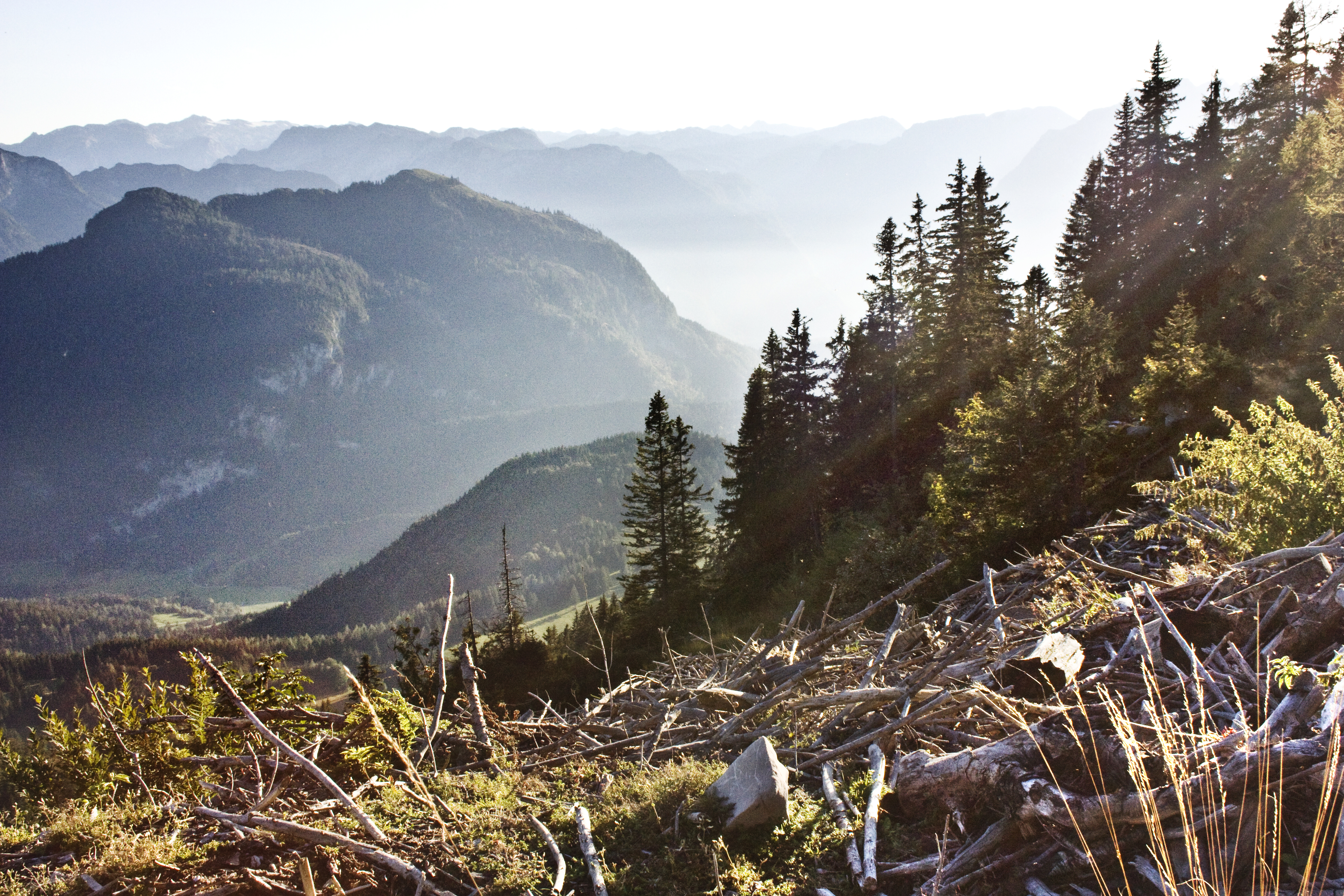
Running through the south are the main ranges of the Alpine divide (incl. the Hohe Tauern mountains) with numerous three-thousanders. The Dachstein massif and the Berchtesgaden Alps ranges of the Northern Limestone Alps border Salzburg State to the east and north.
Regions
The state is traditionally subdivided in five major regions (Gaue), congruent with its political districts (Bezirke, see administrative divisions).

- In the northern part:
- Flachgau (Salzburg city and environs), the flat () Salzburg Basin around the confluence of Salzach and Saalach, stretching from the slopes of the Salzkammergut Mountains in the east to the Untersberg massif and the Chiemgau Alps in the west.
- Tennengau (district capital Hallein), named after the Tennen Mountains, including the broad Salzach Valley south of Salzburg and the surrounding ranges of the Limestone Alps.
- The southern, mountainous (colloquially Innergebirg) part is divided into:
- Pinzgau (Zell am See) in the southwest,
- Pongau (St. Johann im Pongau) on Salzach and Enns, and
- Lungau (Tamsweg) in the southeast, separated by the Niedere Tauern range.
Major cities and towns
Salzburg municipalities with town privileges:
- [[File:AUT Salzburg (Stadt) COA.svg|15px]] Salzburg (pop. 148,521)
- [[File:Hallein (Austria) Coat of Arms CoA.svg|16px]] Hallein (20,022)
- [[File:AUT Saalfelden COA.svg|15px]] Saalfelden (16,046)
- [[File:Wappen at st johann.png|15px]] St. Johann im Pongau (10,740)
- [[File:AT Bischofshofen COA.svg|16px]] Bischofshofen (10,352)
- [[File:AUT Zell am See COA.svg|15px]] Zell am See (9,683)
- [[File:Wappen at seekirchen.png|15px]] Seekirchen (9,945)
- [[File:Wappen at neumarkt am wallersee.png|15px]] Neumarkt am Wallersee (5,846)
- [[File:Wappen at oberndorf bei salzburg.png|15px]] Oberndorf bei Salzburg (5,600)
- [[File:Wappen at mittersill.png|15px]] Mittersill (5,443)
- [[File:AUT Radstadt COA.jpg|15px]] Radstadt (4,864)
Wals-Siezenheim, a common municipality with about 12,000 inhabitants, is known as 'Austria's largest village'.
History
Salt mining has played an important role in the region's development; Salzburg means "salt city".
Salzburg as an independent state
Independence from Bavaria was secured in the late 14th century. The Archbishopric of Salzburg was an independent prince-bishopric and State of the Holy Roman Empire until German Mediatisation in 1803.
Electorate of Salzburg
The territory was secularized and, as the Electorate of Salzburg, given as compensation to Ferdinand III, former Grand Duke of Tuscany, the brother of Emperor Francis II.
The end of independence
Following the Austrian defeat at Austerlitz in 1805, Salzburg was annexed by Austria as compensation for the loss of Tyrol to the Kingdom of Bavaria, and Ferdinand was transferred to the Grand Duchy of Würzburg.
Bavarian Salzburg
After Austria's defeat in 1809, the region was handed over to Bavaria in 1810.
The country divided between Bavaria and Austria
In 1816, following the defeat of Napoleon and the provision of adequate compensation to Bavaria at the Congress of Vienna, it was returned to Austria with the exception of the north-western Rupertiwinkel which remained Bavarian. The Salzburger Land was administered as the department of Salzach from Linz, the capital of Upper Austria. In 1849 the Duchy of Salzburg was established as a crown land of the Austrian Empire and, after 1866, Austria-Hungary.
World War I
Salzburg participated in World War I, as part of the Austro-Hungarian Empire. 49,000 Salzburgers were called to arms, of whom 6,000 were killed.
Post-World War I Austrian republics
In 1918 after World War I, the Duchy of Salzburg was dissolved and replaced with the State of Salzburg, as a component part initially of German Austria and subsequently of the First Republic of Austria, the separate state which was mandated by the Allied powers.
In 1921 a plebiscite Salzburg, a majority of 99.11% voted for a unification with Germany.
Salzburg in Germany
As a result of Germany's annexation of Austria in 1938, Austria, including Salzburg State, was incorporated into Nazi Germany.
American control
After the defeat of Nazi Germany in 1945, the Allies occupied the territory of Austria, being recognized as an independent territory under their rule. Salzburg State was occupied by the United States.
Salzburg as an Austrian state
In 1955, Austria was again declared an independent state and Salzburg was once again one of the reconstituted federal states of the Second Republic of Austria.
Demographics
The historical population is given in the following chart: Colors= id:lightgrey value:gray(0.9) id:darkgrey value:gray(0.7) id:sfondo value:rgb(1,1,1)
ImageSize = width:800 height:auto barincrement:28 PlotArea = left:40 bottom:40 top:20 right:20 DateFormat = x.y Period = from:0 till:580 TimeAxis = orientation:horizontal AlignBars = late ScaleMajor = gridcolor:darkgrey increment:50 start:0 ScaleMinor = gridcolor:lightgrey increment:10 start:0 BackgroundColors = canvas:sfondo
PlotData= color:skyblue width:22 shift:(-60,-5) fontsize:M anchor:till bar:1869 from:0 till:153 text:153,159 bar:1880 from:0 till:164 text:163,570 bar:1890 from:0 till:174 text:173,510 bar:1900 from:0 till:193 text:192,763 bar:1910 from:0 till:215 text:214,737 bar:1923 from:0 till:223 text:222,831 bar:1934 from:0 till:246 text:245,801 bar:1939 from:0 till:257 text:257,226 bar:1951 from:0 till:327 text:327,232 bar:1961 from:0 till:347 text:347,292 bar:1971 from:0 till:405 text:405,115 bar:1981 from:0 till:442 text:442,301 bar:1991 from:0 till:482 text:482,365 bar:2001 from:0 till:515 text:515,327 bar:2011 from:0 till:532 text:531,721 bar:2021 from:0 till:561 text:560,710
TextData= fontsize:M pos:(35,20) text:"Source: Statistik Austria"
Politics
Salzburg adopted its current provincial constitution in 1999. The provincial government (Landesregierung) is headed by a governor (Landeshauptmann), who is elected by a majority in the provincial parliament Landtag. Provincial elections are held every five years.
After World War II, most provincial governments were led by the conservative Austrian People's Party (ÖVP). ÖVP politician Josef Klaus (1910-2001), later chancellor of Austria, served as governor of Salzburg from 1949 till 1961. In 2004 Gabi Burgstaller became the first Social Democratic (and first female) governor of Salzburg.

The last results, in April 2023 (Compared to 2018) were:
{|class="wikitable" style="text-align:right" |- ! ! Party ! Votes in % ! Change ! Seats ! Change |- | 30.37% | 7.4% | 12
3 25.75% 6.9% 10 3 - 17.87% 2.1% 7 1 - 11.66% 11.3% 4 4 - 8.20% 1.1% 3 - - 4.20% 3.1% 0 3 - 1.19% 1.2% 0 New - 0.77% 0.8% 0 New - }
The current governor of Salzburg, Wilfried Haslauer (ÖVP), entered into coalition discussions with the FPÖ, after his proposition of a ÖVP-FPÖ-SPÖ coalition was rejected by the Social Democrats. Haslauer said "I regret that we could not implement the Alliance for Salzburg". After successful coalition negotiations, the ÖVP and the FPÖ entered into a governing coalition with Haslauer as the Governor and Marlene Svazek as the First Deputy Governor.https://www.euractiv.com/section/politics/news/right-wing-coalition-to-govern-in-salzburg-gives-foretaste-of-upcoming-elections/ Salzburg State has joined Lower Austria and Upper Austria as the third black-blue coalition provincial government. The ÖVP has four seats in the government, while the FPÖ has three. The current president (speaker) of the Salzburg federal state parliament is Brigitta Pallauf.
Government
Government ministers and their portfolios from the 2023 Salzburg state election.
Governor Wilfried Haslauer (ÖVP) [https://www.salzburg.gv.at/pol/landesregierung/haslauer]
- State Direction
- Finance and Asset Management
- Security
- Disaster Prevention
- Museums
- Research and Science
- European Affairs
1st Deputy Marlene Svazek (FPÖ) [https://www.salzburg.gv.at/pol/landesregierung/svazek]
- Nature and Environment Protection
- Business
- Early and Primary Education
- Hunting and Fishing
- Youth
- Families
- Integration
- Generations
2nd Deputy Stefan Schnöll (ÖVP) [https://www.salzburg.gv.at/pol/landesregierung/schnoell]
- Economy and Tourism
- Communities
- Employment and Labour Market
- Infrastructure and Traffic
- Culture
Members of the provincial government [https://www.salzburg.gv.at/pol/landesregierung]
- Josef Schwaiger (ÖVP): Agriculture, Personnel Management, Water, National Parks, Energy, Asylum Seekers
- Daniela Gutschi (ÖVP): Education, Health, Women and Diversity
- Christian Pewny (FPÖ): Social Services, Food, Consumer Protection, Regional Development, Apprenticeships
- Martin Zauner (FPÖ): Spatial Planning, Living, Sport, Basic Traffic
Administrative divisions
Districts
Salzburg State comprises six districts, known as Bezirke or vernacularly Gaue:
- Hallein District (Tennengau region)
- St. Johann im Pongau District (Pongau region)
- Salzburg-Umgebung District (Salzburg environs) (Flachgau region)
- Tamsweg District (Lungau region)
- Zell am See District (Pinzgau region)
Salzburg city is its own administrative district.
Municipalities
The federal state is divided into 119 municipalities, including Salzburg City. 11 of them have city status (Städte), 25 are market towns (Marktgemeinden) and the other 83 are simple municipalities (Gemeinden). Below is a list of all the municipalities divided by district:
- Hallein District (Tennengau) (13 municipalities): Abtenau, Adnet, Annaberg-Lungötz, Bad Vigaun, Golling an der Salzach, Hallein, Krispl, Kuchl, Oberalm, Puch bei Hallein, Rußbach am Paß Gschütt, St. Koloman, Scheffau am Tennengebirge.
- Salzburg-Umgebung District (Flachgau) (37 municipalities): Anif, Anthering, Bergheim, Berndorf bei Salzburg, Bürmoos, Dorfbeuern, Ebenau, Elixhausen, Elsbethen, Eugendorf, Faistenau, Fuschl am See, Großgmain, Göming, Grödig, Hallwang, Henndorf am Wallersee, Hintersee, Hof bei Salzburg, Koppl, Köstendorf, Lamprechtshausen, Mattsee, Neumarkt am Wallersee, Nußdorf am Haunsberg, Oberndorf bei Salzburg, Obertrum, Plainfeld, St. Georgen bei Salzburg, St. Gilgen, Schleedorf, Seeham, Seekirchen am Wallersee, Straßwalchen, Strobl, Thalgau, Wals-Siezenheim.
- St. Johann im Pongau District (Pongau) (25 municipalities): Altenmarkt im Pongau, Bad Gastein, Bad Hofgastein, Bischofshofen, Dorfgastein, Eben im Pongau, Filzmoos, Flachau, Forstau, Goldegg, Grossarl, Hüttau, Hüttschlag, Kleinarl, Mühlbach am Hochkönig, Pfarrwerfen, Radstadt, St. Johann im Pongau, St. Martin am Tennengebirge, St. Veit im Pongau, Schwarzach im Pongau, Untertauern, Wagrain, Werfen, Werfenweng.
- Tamsweg District (Lungau) (15 municipalities): Göriach, Lessach, Mariapfarr, Mauterndorf, Muhr, Ramingstein, St. Andrä im Lungau, St. Margarethen im Lungau, St. Michael im Lungau, Tamsweg, Thomatal, Tweng, Unternberg, Weißpriach, Zederhaus.
- Zell am See District (Pinzgau) (28 municipalities): Bramberg am Wildkogel, Bruck an der Großglocknerstraße, Dienten am Hochkönig, Fusch an der Großglocknerstraße, Hollersbach im Pinzgau, Kaprun, Krimml, Lend, Leogang, Lofer, Maishofen, Maria Alm, Mittersill, Neukirchen am Großvenediger, Niedernsill, Piesendorf, Rauris, Saalbach-Hinterglemm, Saalfelden, St. Martin bei Lofer, Stuhlfelden, Taxenbach, Unken, Uttendorf, Viehhofen, Wald im Pinzgau, Weißbach bei Lofer, Zell am See.
Economy
The federal state's gross domestic product (GDP) was 29 billion € in 2018, accounting for 7.5% of the Austria's economic output. GDP per capita adjusted for purchasing power was 46,500 € or 154% of the EU27 average in the same year. Salzburg is the federal state with the highest GDP per capita in Austria before Vienna.
Architecture
The Salzburg Cathedral was the first Baroque building in the German-speaking artistic world. Two other important buildings initiated by the Salzburg archbishops were Hohenwerfen Castle and Hohensalzburg Fortress. The first Archbishop of Salzburg was Arno of Salzburg (785–821), in whose honor the world-famous hiking circuit — the Arnoweg — is named.
The predominant stylistic elements of Salzburg's architecture have their origins in the Baroque and the Rococo periods.
Salzburg City's historic centre was named by UNESCO as a World Heritage Site.
Language
The official working language is Austrian German, and it can be heard especially in the cities and formal contexts. The vernacular language, typically spoken in informal settings and rural areas in Salzburg, is Bavarian.
Visitors' attractions
- Eisriesenwelt: the largest ice cave in the world
- Großglockner Hochalpenstraße: a panoramic road, called Grossglockner High Alpine Road
- Salzkammergut: a lake district situated in Salzburg State, Upper Austria and Styria
- Liechtensteinklamm: Salzburg is home to one of the longest and deepest gorges of the Alps, the Liechtensteinklamm. It is located near Sankt Johann im Pongau or St.Johann/Pg., a small town in the centre of the federal state.
- Nonnberg Abbey: a Benedictine monastery that was immortalized in the movie The Sound of Music
Sports
.jpg)
- Salzburgring, a permanent racing circuit, north east of the city of Salzburg
- Ski Amadé
- Kitzsteinhorn, skiing the year round on a glacier
- Icespeedway in St. Johann im Pongau
- Aperschnalzen, an old tradition of competitive whipcracking
Ski resorts

Altenmarkt im Pongau, Flachau, Wagrain, St. Johann, Zell am See (Saalbach-Hinterglemm), Obertauern, Bad Gastein, Rauris, Lofer, Hochkönig, Krispl
Assorted statistics
- Tourist Regions: 21
- Resort Towns: 115
- Guest Beds: 192,000
- Lakes: 185
- Biggest lake: Wolfgangsee
- Longest river: Salzach
- Highest mountain: Großvenediger — elevation 3666 m
- Hiking paths: 7200 km
- Hill farms: 1,800 — 550 of them serving refreshments
- National parks: 1
- Marked cycle paths: 2000 km
- Mountainbike trails (including cross-border routes): 3000 km
- Golf courses: 13
- Ski slopes: 1700 km
- Cross-country ski trails: 2220 km
- Night slopes: 14
- Winter hiking paths: 2500 km
Notes
References
References
- "Basisdaten Bundesländer".
- "Sub-national HDI - Area Database - Global Data Lab".
- "Salzburg". [[Oxford University Press]].
- "Salzburg". [[HarperCollins]].
- {{Cite American Heritage Dictionary. Salzburg
- {{Cite Merriam-Webster. Salzburg
- "In 1816 Salzburg was incorporated into Austria".
- Scharf, Michaela. (17 June 2014). "Austrian attempts to unite with Germany from the founding of the republic to the referendums in Tyrol and Salzburg in 1921".
- de
- "Historic Censuses - STATISTICS AUSTRIA". Statistics Austria.
- red, salzburg ORF at/Agenturen. (2 May 2023). "Regierungsbildung: ÖVP verhandelt mit FPÖ".
- "Regional GDP per capita ranged from 30% to 263% of the EU average in 2018".
This article was imported from Wikipedia and is available under the Creative Commons Attribution-ShareAlike 4.0 License. Content has been adapted to SurfDoc format. Original contributors can be found on the article history page.
Ask Mako anything about Salzburg (state) — get instant answers, deeper analysis, and related topics.
Research with MakoFree with your Surf account
Create a free account to save articles, ask Mako questions, and organize your research.
Sign up freeThis content may have been generated or modified by AI. CloudSurf Software LLC is not responsible for the accuracy, completeness, or reliability of AI-generated content. Always verify important information from primary sources.
Report