From Surf Wiki (app.surf) — the open knowledge base
Salvia nemorosa
Species of flowering plant

Species of flowering plant
Salvia nemorosa, the woodland sage, Balkan clary, blue sage or wild sage, is a hardy herbaceous perennial plant native to a wide area of central Europe and Western Asia.
It is an attractive plant that is easy to grow and propagate, with the result that it has been passed around by gardeners for many years. Its wide distribution, long history, and the ease with which it hybridizes have resulted in many cultivars and hybrids—along with problems in clearly identifying the hybrids and their relationship with S. nemorosa. It was named and described by Carl Linnaeus in 1762, with nemorosa ("of woods") referring to its typical habitat in groves and woods.
In northern Britain, Salvia nemorosa and Salvia pratensis are both in danger of disappearing due to depredation from slugs.
Description
The many inflorescences have closely spaced whorls of small flowers with brightly colored calyces.
Cultivation
There are numerous cultivars widely grown in horticulture. Many of them are hardy to –18 °C., with flowers ranging in color from violet, to violet-blue, rosy pink, and even white. All are perennial, with numerous leafy stems growing from the base at the beginning of summer. The plant prefers full sun, good drainage, and moderate weekly watering. The plant is hardy to USDA Hardiness Zones Zones 4–8.
AGM cultivars
In the UK the following cultivars have gained the Royal Horticultural Society's Award of Garden Merit:-
- 'Amethyst'
- 'Blauhügel' (Blue hill)
- ‘Caradonna’
- 'Lubecca'
- 'Mainacht' (May night)
- 'Ostfriesland' ('East Friesland')
- 'Porzellan' (Porcelain)
- 'Tänzerin' (Dancer)
- 'Viola Klose'
Phytochemistry
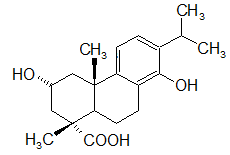
The word 'salvia' strings from the Latin word, 'salvare' which it is translated to "health". Places, such as Russia, tend to use 'salvia nemorosa' to help treat diarrhea as well as hemorrhages. Leaves of Salvia nemorosa have been used in Turkish medicine to stop bleeding by applying externally. Diterpenes and triterpenes have been isolated from aerial parts of S. nemorosa: nemorone, nemorosin, horminone, 7-acetylhorminone, salvinemorol, megastigmane glycosides (salvionosides A, B and C), pachystazone, salvipisone, α-amyrin, ursolic and oleanolic acids, stigmast-7-en-3-one, 24-methylenecycloartanol, stigmast-4-en-3-one, β-sitosterol, stigmast-7-enol, as well as flavonoids salvigenin, eupatilin, apigenin and luteolin.
References
Bahadori, M. B., Asghari, B., Dinparast, L., Zengin, G., Sarikurkcu, C., Abbas-Mohammadi, M., & Bahadori, S. (2017). Salvia nemorosa L.: A novel source of bioactive agents with functional connections. LWT, 75, 42–50. https://doi.org/10.1016/j.lwt.2016.08.048
References
- {{GBIF
- (2003). "The New Book of Salvias". Timber Press.
- (2004). "Plant User Handbook: A Guide to Effective Specifying". Blackwell Publishing.
- [http://www.missouribotanicalgarden.org/gardens-gardening/your-garden/plant-finder/plant-details/kc/b679/salvia-nemorosa-caradonna.aspx Missouri Botanical Garden: Salvia nemorosa 'Caradonna' ]
- (July 2017). "AGM Plants - Ornamental". Royal Horticultural Society.
- "RHS Plant Selector - ''Salvia nemorosa'' 'Amethyst'".
- "RHS Plant Selector - ''Salvia'' × ''sylvestris'' 'Blauhügel'".
- "RHS Plantfinder - ''Salvia nemorosa'' 'Caradonna'".
- "RHS Plant Selector - ''Salvia nemorosa'' 'Lubecca'".
- "RHS Plant Selector - ''Salvia'' × ''sylvestris'' 'Mainacht'".
- "RHS Plant Selector - ''Salvia nemorosa'' 'Ostfriesland'".
- "RHS Plant Selector - ''Salvia nemorosa'' 'Porzellan'".
- "RHS Plant Selector - ''Salvia'' × ''sylvestris'' 'Tanzerin'".
- "''Salvia'' × ''slvestris'' 'Viola Klose'". RHS.
- [[Ayhan Ulubelen. Ulubelen]], Topçu, Sönmez, Eris. Terpenoids from ''Salvia nemorosa. Phytochemistry'' (1994). Vol. 35. No. 4, pp. 1065-1067.
This article was imported from Wikipedia and is available under the Creative Commons Attribution-ShareAlike 4.0 License. Content has been adapted to SurfDoc format. Original contributors can be found on the article history page.
Ask Mako anything about Salvia nemorosa — get instant answers, deeper analysis, and related topics.
Research with MakoFree with your Surf account
Create a free account to save articles, ask Mako questions, and organize your research.
Sign up freeThis content may have been generated or modified by AI. CloudSurf Software LLC is not responsible for the accuracy, completeness, or reliability of AI-generated content. Always verify important information from primary sources.
Report