From Surf Wiki (app.surf) — the open knowledge base
Salm-Salm
State of the Holy Roman Empire
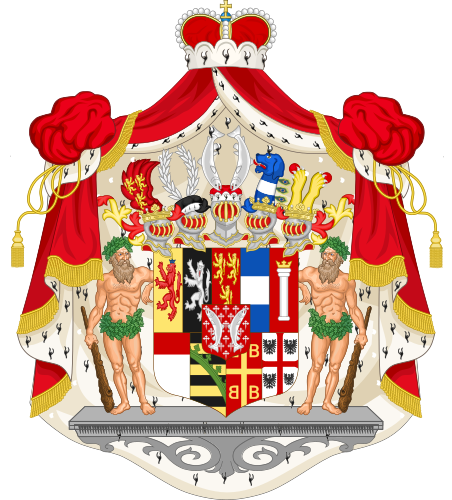
State of the Holy Roman Empire
| Field | Value | |||
|---|---|---|---|---|
| native_name | de | |||
| fr | ||||
| conventional_long_name | County (Principality) of Salm-Salm | |||
| common_name | Salm-Salm | |||
| era | Middle Ages, Modern Age | |||
| status | Vassal | |||
| status_text | State of the Holy Roman Empire | |||
| empire | Holy Roman Empire | |||
| government_type | Principality | |||
| year_start | 1574 | |||
| year_end | 1811 | |||
| life_span | 1574–1793 | |||
| 1802–1811 | ||||
| event_start | Partitioned from Salm-Dhaun | |||
| event1 | Partitioned to create Salm-Neuweiler | |||
| date_event1 | 1608 | |||
| event2 | Raised to principality | |||
| date_event2 | 1739 | |||
| event3 | Annexed by France | |||
| date_event3 | [[File:Flag of France.svg | 30px | border | First French Republic]] →1793 |
| event4 | Granted territories from Münster, with S-Kyrburg, to create unified Salm | |||
| date_event4 | 1802–03 ← [[File:DEU Münster COA.svg | 20px | Bishopric of Münster]] | |
| event5 | Joined the Confederation of the Rhine | |||
| date_event5 | 1806 | |||
| event_end | Annexed by France | |||
| event_post | Mediatised to Prussia | |||
| date_post | [[File:Flag of the Kingdom of Prussia (1803-1892).svg | 30px | border | Kingdom of Prussia]] →1813 |
| p1 | Salm-Dhaun | |||
| image_p1 | [[File:Arms of the house of Salm-Dhaun.svg | x20px | Salm-Dhaun]] | |
| s1 | First French Empire | |||
| flag_s1 | Flag of France.svg | |||
| image_flag | Flag of Salm-Salm.svg | |||
| image_coat | Arms of the house of Salm-Salm.svg | |||
| capital | Badonviller; Senones |
fr 1802–1811 The Principality of Salm-Salm (; ) was a state of the Holy Roman Empire. It was located in the present-day French departments of Bas-Rhin and Vosges; it was one of a number of partitions of Salm.
History
Salm-Salm was created as a partition of Salm-Dhaun in 1574, and was raised from a County to a Principality in 1739 after being inherited and renamed by Count Nicholas Leopold of Salm-Hoogstraten. Salm-Salm was partitioned between itself and Salm-Neuweiler in 1608.
The last territorial partition occurred in 1751, when Salm-Salm reorganized its borders with the Duchy of Lorraine. From 1743 the Princes were also Dukes of Hoogstraten, with the seat at Hoogstraten Castle (Gelmelslot).
In 1790, after the French Revolution, the princes of Salm fled the territory and moved to their castle in Anholt, Westphalia, Anholt Castle. Salm-Salm then was besieged by the revolutionary army, which blocked food supplies from reaching the state. As a consequence, the population was forced to surrender to France. On 2 March 1793, the French National Convention declared Salm-Salm to be a part of the French Republic and attached it to the Department of the Vosges. This was recognized by the Holy Roman Empire in the Peace of Lunéville of 1801.
Some years later, in 1802/1803, together with Salm-Kyrburg, the prince of Salm-Salm was granted new territories formerly belonging to the Bishops of Münster (Westphalia). The new territory was governed in union with Salm-Kyrburg and was known as the Principality of Salm.
Geography
In 1165, the original County of Salm was divided into the counties of Lower Salm, in the Ardennes, and the county of Upper Salm, situated in the Vosges mountains. In 1738, the County of Upper Salm was elevated to Principality of Salm-Salm.
The capital of Salm-Salm was first Badonviller, and from 1751 on, Senones. The second part of the name of Salm-Salm derives from Salm Castle near Salm (today La Broque).
At the end of its existence, Salm-Salm had an area of about 200 km2 and 10,000 inhabitants. It was separated from the main part of the Holy Roman Empire when most of Alsace was ceded to France in the 17th century. Until 1766, it was bordered by the Duchy of Lorraine to the west and by France to the east. After Lorraine became a part of France on 24 February 1766, Salm-Salm formed an exclave of the Holy Roman Empire surrounded by French territory.
The economy of Salm-Salm was mainly based on an iron mine near Grandfontaine.
File:Salm-map.png|County of Upper Salm (Obere Grafschaft Salm) File:Salm 1589.jpg|Salm Castle in 1589
Rulers
Princes of Salm-Salm
Counts and Princes of Salm and Salm-Salm (1574–1738)
- Friedrich I, Count of Salm-Dhaun, Count of Salm-Salm 1574–1608 (1547-1608)
- Philipp Otto, Count 1608–1634 (1576-1634), created 1st Prince of Salm 1623
- Ludwig, Count and 2nd Prince 1634-1636 (1618-1636)
- Leopold Philipp Karl, Count and 3rd Prince 1636–1663 (1620-1663)
- Karl Theodor, Count and 4th Prince 1663–1710 (1645-1710)
- Eleonore, Married to Conrard, 1st Duke d'Ursel.
- Charles, 2nd Duke d'Ursel (1717–1775)
- Ludwig Otto, Count and 5th Prince 1710–1738 (1674-1738) At Ludwig Otto's death, the male line became extinct, and the county of Salm-Salm passed to descendants of Friedrich I's youngest son, Friedrich I Magnus (1606-1673). Eventually, the title Prince of Salm was assumed by his descendants as well.
Sovereign princes of Salm-Salm (1739–1813)
- Nikolaus Leopold of Salm-Hoogstraten, 1st Prince 1739–1770 (1701-1770), great-grandson of Friedrich I Magnus (see note under Counts)
- Ludwig Karl Otto, 2nd Prince 1770–1778 (1721-1778)
- Prince Maximilian Friedrich Ernst of Salm-Salm (1732-1773) - Konstantin Alexander, 3rd Prince 1778–1828 (1762-1828), mediatized 1813
Mediatised princes of Salm-Salm (1813–''present'')
- Konstantin Alexander, 3rd Prince 1778–1828 (1762-1828), mediatized 1813
- Florentin, 4th Prince 1828–1846 (1786-1846)
- Alfred, 5th Prince 1846–1886 (1814-1886)
- Nikolaus, 6th Prince 1886–1908 (1838-1908)
- Alfred, 7th Prince 1908–1923 (1846-1923)
- Emanuel, Hereditary Prince of Salm-Salm (1871-1916)
- Isabelle (1903-2009), one of the longest-lived members of any princely family.
- Nikolaus Leopold, 8th Prince 1923–1988 (1906-1988), 8th Prince of Salm-Kyrburg 1951
- Carl-Philipp, 9th Prince of Salm-Salm and of Salm-Kyrburg 1988–2024 (1933-2024), 14th Prince of Salm
- Emanuel, 10th Prince of Salm-Salm and of Salm-Kyrburg 2024-present (born 1961), 15th Prince of Salm
- Prince Philipp of Salm-Salm (born 1963)
- Prince Wilhelm of Salm-Salm (born 2005) - Prince Clemens of Salm-Salm (born 1966)
- Prince Franz Emanuel Konstantin of Salm-Salm (1876-1964)
- Prince Franz Karl Alfred of Salm-Salm (1917-2011)
- Prince Michael of Salm-Dahlberg (born 1953)
- Prince Constantin of Salm-Dahlberg (born 1980)
- Prince Felix of Salm-Dahlberg (born 1981) - Prince Franziskus-Hendrick of Salm-Salm (born 1963) - Prince Georg-Alfred of Salm-Salm (born 1969)
- Emanuel, Hereditary Prince of Salm-Salm (1871-1916)
- Prince Felix of Salm-Salm (1828-1870)
References
References
- and 1st Duke (and 10th Count) of [[Hoogstraten]] 1740-1770
- "The top 10 longest-living royals in history".
This article was imported from Wikipedia and is available under the Creative Commons Attribution-ShareAlike 4.0 License. Content has been adapted to SurfDoc format. Original contributors can be found on the article history page.
Ask Mako anything about Salm-Salm — get instant answers, deeper analysis, and related topics.
Research with MakoFree with your Surf account
Create a free account to save articles, ask Mako questions, and organize your research.
Sign up freeThis content may have been generated or modified by AI. CloudSurf Software LLC is not responsible for the accuracy, completeness, or reliability of AI-generated content. Always verify important information from primary sources.
Report