From Surf Wiki (app.surf) — the open knowledge base
Salix cinerea
Species of willow
.jpg)
Species of willow
Salix cinerea (common sallow, grey sallow, grey willow, grey-leaved sallow, large grey willow, pussy willow, rusty sallow) is a species of willow native to Europe and western Asia.
The plant provides a great deal of nectar for pollinators. It was rated in the top 10, with a ranking of second place, for most nectar production (nectar per unit cover per year) in a UK plants survey conducted by the AgriLand project which is supported by the UK Insect Pollinators Initiative.
Description
It is a deciduous shrub or small tree growing 4–10 metres (13–30 ft) tall. The leaves are spirally arranged, 2–9 cm (1– in) long and 1–3 cm (– in) broad (exceptionally up to 16 cm long and 5 cm broad), green above, hairy below, with a crenate margin. The flowers are produced in early spring in catkins 2–5 cm long; it is dioecious with male and female catkins on separate plants. The male catkins are silvery at first, turning yellow when the pollen is released; the female catkins are greenish grey, maturing in early summer to release the numerous tiny seeds embedded in white cottony down which assists wind dispersal.
Taxonomy
The closely related species Salix atrocinerea Brot., which overlaps in distribution in France, Belgium, Netherlands, England and Ireland, is considered by some authors as the subspecies S. cinerea oleifolia (Gaudin) Macreight. * S. atrocinerea* differs from S. cinerea in that it is taller (reaching up to 15 metres), has a deeply furrowed bark, dark red-brown hairs beneath the leaves, smaller stipules, and is earlier deciduous.
Ecology
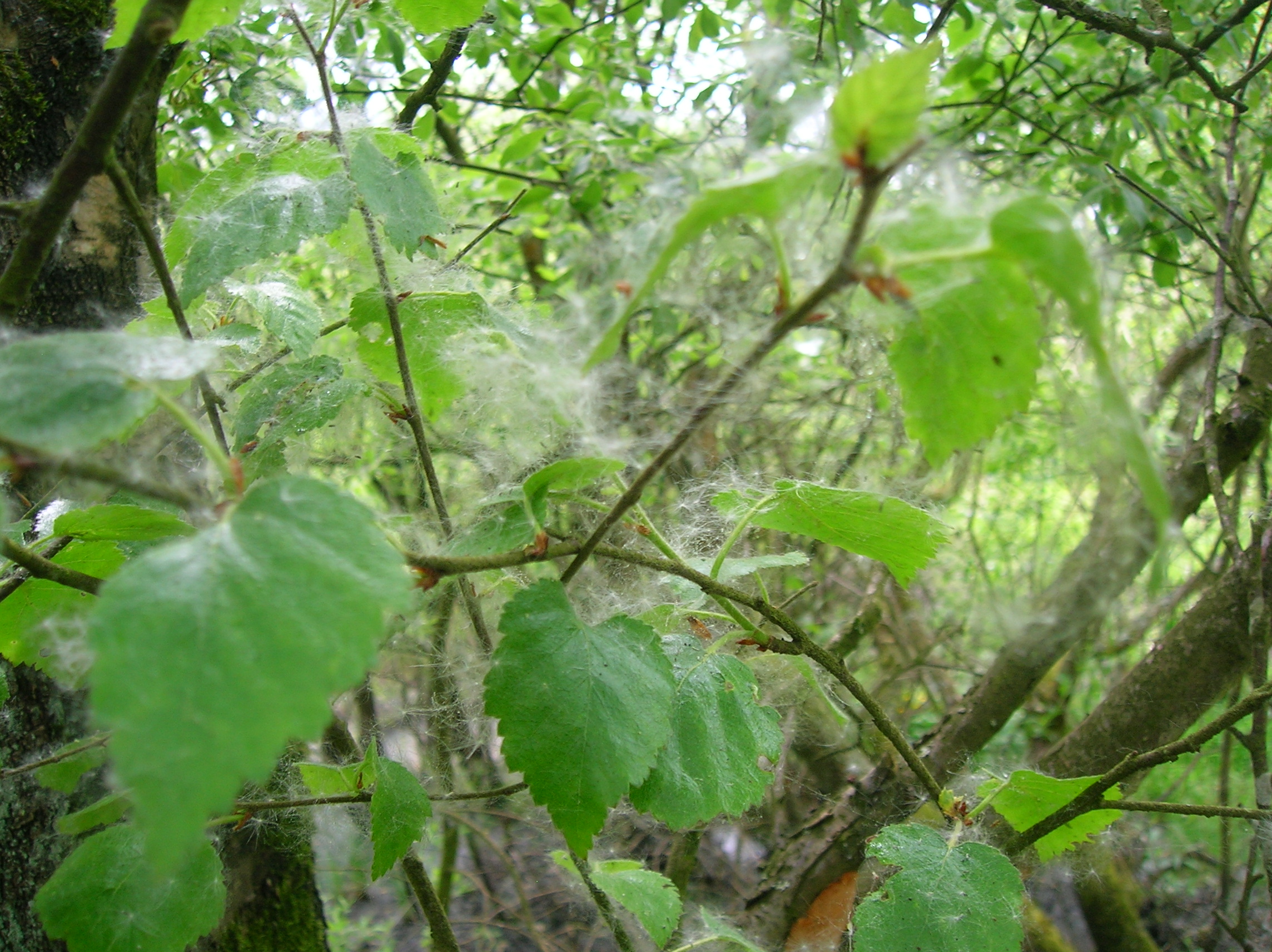
Grey willow grows in wetlands, moist depressions, ditches, embankments, banks of stagnant or slow-moving water bodies, and forest edges, where it encounters low-lying damp situations with waterlogged and nutrient-poor soils. S. cinerea is a pioneer species that rapidly colonizes disturbed sites.
A common herbivore of Salix cinerea is Phratora vulgatissima, which prefers and is more common on female plants. Anthocoris nemorum, a natural enemy of Phratora vulgatissima, is also more common on S. cinerea.
Invasive species
Salix cinerea is an invasive species in New Zealand and is listed on the National Pest Plant Accord, which means it cannot be sold or distributed. S. cinerea is also highly invasive in south-eastern Australia, with the entire genus listed as a Weed of National Significance. The species was introduced to stop erosion along riverbanks, but has since caused worse erosion over time by widening and shallowing invaded streams.
References
References
- Lansdown, R.V.. (2014). "''Salix cinerea''".
- "Queensland Government Fact Sheet".
- Meikle, R. D. (1984). ''Willows and Poplars of Great Britain and Ireland''. BSBI Handbook No. 4. {{ISBN. 0-901158-07-0.
- Christensen, K. I., & Nielsen, H. (1992). Rust-pil (''Salix cinerea'' subsp. ''oleifolia'') - en overset pil i Danmark og Skandinavien. ''Dansk Dendrologisk Årsskrift'' 10: 5-17.
- (2014-10-15). "Which flowers are the best source of nectar?". Conservation Grade.
- "Salix cinerea subsp. oleifolia (Gaudin) Macreight".
- "Salix atrocinerea Brot.".
- Isebrands, J. G., & Richardson, J. (Eds.). (2014). Poplars and willows: trees for society and the environment. CAB International and FAO. {{ISBN. 9781780641089
- Kabir, Faisal MD. (2015-04-19). "Plant-sex-biased tritrophic interactions on dioecious willow". Ecosphere.
- Cremer, K. W. (2003) Introduced willows can become invasive pests in Australia. Biodiversity, 4, 17-24.
This article was imported from Wikipedia and is available under the Creative Commons Attribution-ShareAlike 4.0 License. Content has been adapted to SurfDoc format. Original contributors can be found on the article history page.
Ask Mako anything about Salix cinerea — get instant answers, deeper analysis, and related topics.
Research with MakoFree with your Surf account
Create a free account to save articles, ask Mako questions, and organize your research.
Sign up freeThis content may have been generated or modified by AI. CloudSurf Software LLC is not responsible for the accuracy, completeness, or reliability of AI-generated content. Always verify important information from primary sources.
Report