From Surf Wiki (app.surf) — the open knowledge base
Saint Malo, Louisiana
| Field | Value | |
|---|---|---|
| named_for | Juan San Maló | |
| subdivision_name1 | Louisiana | |
| subdivision_name | United States | |
| subdivision_type2 | Parish | |
| subdivision_type1 | State | |
| subdivision_type | Country | |
| pushpin_map | Louisiana#USA | |
| <!-- Location --> | coordinates | |
| timezone1 | Central | |
| official_name | Saint Malo | |
| timezone_DST | Central | |
| utc_offset_DST | −5 | |
| utc_offset | −6 | |
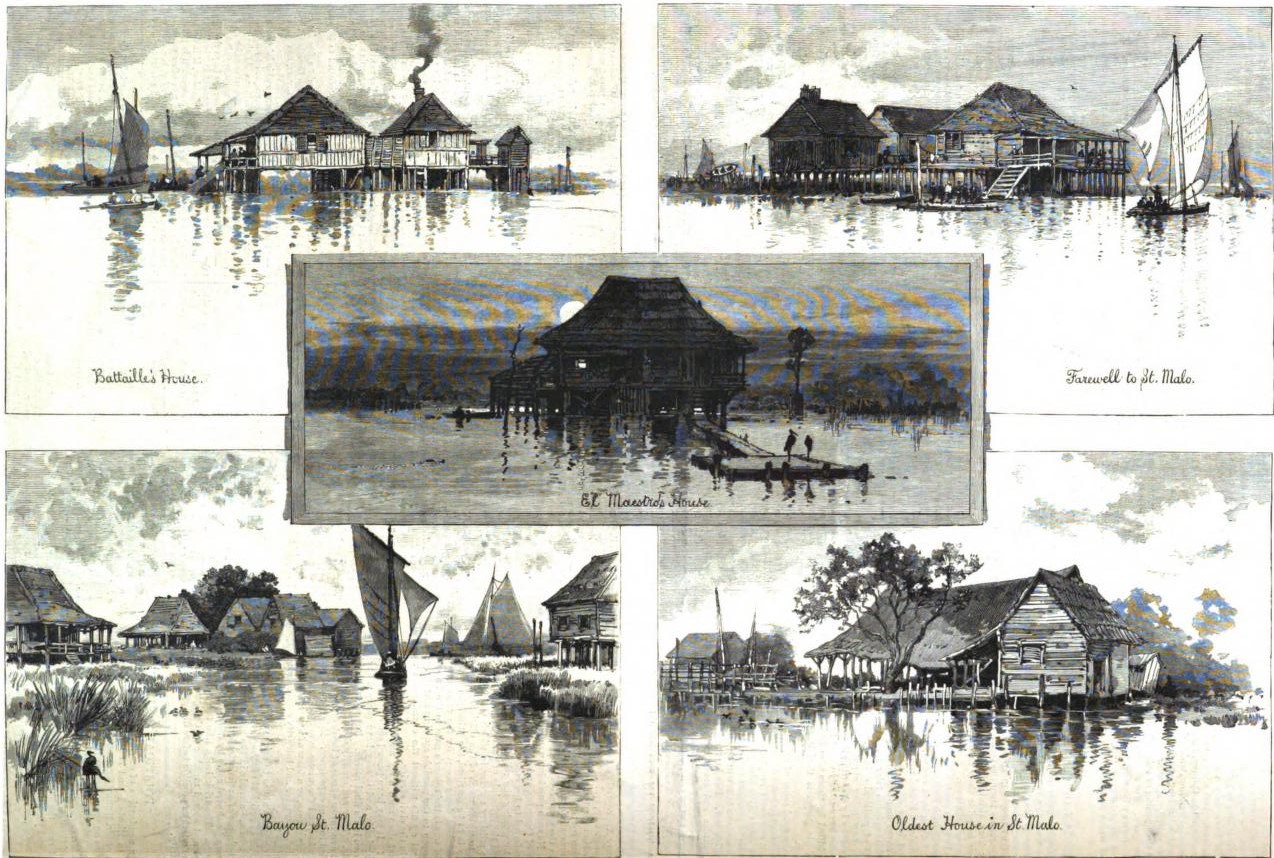
| image_caption | The settlement as it appeared in Harper's Weekly, 1883. | |
| image_skyline | Bits of Saint Malo Scenery.jpg | |
| settlement_type | Ghost town | |
| subdivision_name2 | St. Bernard Parish | |
| established_title | Establishment | |
| established_date | c.1763 | |
| extinct_title | Destruction | |
| extinct_date | September 29, 1915 | |
| native_name | San Maló (Spanish) | |
| native_name_lang | es |
Saint Malo ( ) was a small fishing village that existed along the shore of Lake Borgne in St. Bernard Parish, Louisiana as early as the mid-18th century until it was destroyed by the 1915 New Orleans hurricane. Located along Bayou Saint Malo, about 6 mi east of the Isleño fishing village of Shell Beach, it was the first permanent settlement of Filipinos and perhaps the first Asian American settlement in the United States.
The exact date of the establishment of Saint Malo is disputed. The settlement may have been formed as early as 1763 or 1765 by Filipino deserters and escaped slaves of the Spanish Manila galleon trade. The members of the community were commonly referred to as Manila men, or Manilamen, and later Tagalas.
Filipino Americans residing in the region (referred to as "Manilamen" on the account of Manila being the capital of the Philippines) were recruited by local pirate Jean Lafitte to join his "Baratarians". A single Manilamen allegedly served under in the defense of New Orleans.
History
Small communities of criminals, fugitive slaves, and Filipinos commonly found refuge along Lake Borgne in the 18th and 19th centuries. The settlement of Saint Malo was established, by some accounts, as early as 1763 by Filipinos who deserted Spanish ships during the Manila galleon trade. It is also possible that the community was established later into the early 19th century. The Manilamen settled in the marshlands of Louisiana where no Spanish officials could reach them. Reasons for their desertion varied; however their desire to escape brutalities dealt by the Spanish is generally regarded as the main reason.
Beginning in 1784, Juan San Maló () led a group of fugitive slaves below New Orleans and in St. Bernard Parish which stole livestock, destroyed property, and seeded other chaos. In May of that year, the Spanish government began preparing for an expedition to capture San Maló and his maroons after a group of Americans were murdered. San Maló retreated with his group to live in the extensive marshland surrounding Lake Borgne, but Spanish forces led by Francisco Bouligny eventually captured him along with sixty maroons. On June 19, 1784, he was hanged in Jackson Square.
The same area that San Maló and his group found refuge became known by his name. It was not until March 31, 1883, that journalist Lafcadio Hearn published an article in Harper's Weekly which documented the community firsthand. The article is the first published article about the Filipinos in the United States.
Saint Malo was completely destroyed, along with much of the region, by the New Orleans hurricane of 1915 and consequently the remnants of the community assimilated into New Orleans.
Role in the War of 1812
According to anecdotal evidence, a number of Filipino Americans residing in the region, referred to as "Manilamen", were recruited by local pirate Jean Lafitte to join his "Baratarians", a group of privately recruited soldiers serving under the American forces under the command of Andrew Jackson, in the defense of New Orleans. Historian Marina Espina states that the defending American force under Jackson consisted of "regular army troops, state militia, western sharpshooters, two regiments and pirates from the Delta Swamps (which included the aforementioned Filipinos)." However, one historian notes that it appears that possibly only a single Manilaman fought in the battle, and that a lot of it is intertwined with local legends and myths.
Description
Dwellings
The Manilamen lived in small houses supported above the water by stilts in a similar style to the nipa huts of the Philippines. Wood needed to construct dwellings had to be acquired elsewhere as it could not be easily found in the swamps. The palmetto and woven-cane construction often did not withstand the harsh climate of marsh and had to be repaired or replaced frequently. Windows were draped with netting to protect from mosquitoes and other biting insects. Dwellings lacked furniture including tables, chairs, and bed frames. Mattresses were stuffed with dried Spanish moss which had been a common practice in the region and had even been used to upholster the Ford Model T. The mattresses were laid upon a series of shelves mounted against the walls. According to Hearn, the fishermen slept at night "among barrels of flour and folded sails and smoked fish."
Diet
The diet of the community consisted mainly of seafood, principally raw fish with oil and vinegar. Fish was also smoked and hung for later consumption. Chickens and pigs were raised among the dwellings, and depictions illustrated small gardens along the walkways and porches.
Family
The Manilamen of Saint Malo were entirely devoted a subsistence lifestyle based upon fishing and trapping. Rarely did women live in the village. In fact, there were no women in the community during Hearn's visit. If fisherman did have families, they often lived in New Orleans and its environs. The reason for this can be attributed to the isolated and harsh conditions of the settlement. Manilamen often courted and married Isleño, Cajun, and Indigenous women. When it was possible, Manilamen sent profits made from fishing to acquaintances in Manila so that it may be delivered to their families.
Government
Due to the isolation of Saint Malo, the Manilamen paid no taxes and the community lacked law enforcement officials. The village had never been visited by any official from St. Bernard Parish, the state of Louisiana, or the United States government. As a result, the community governed itself. In extreme cases, the eldest man of the community would consider disputes and mediate over the situation. In the rare case that a given verdict is not accepted, the individual was imprisoned in a "fish-car," which was a makeshift prison cell. The offender generally accepted the terms given to him due to the harsh physical conditions, lack of food, and/or rising tide.
Religion
The predominant religion of the Manilamen was Catholicism. Priests rarely went to visit the settlement due to its isolation.
Modern day
Some descendants of these Filipinos continue to live in Louisiana today as multiracial Americans. A number of Isleños and their descendants possess Filipino ancestry, so much so that Los Isleños Heritage and Cultural Society of St. Bernard lists "Filipino" as a significant community that developed the Isleño identity.
In November 2019, a historical marker for the settlement was installed at Los Isleños Museum Complex.
Notable Filipino settlements in Louisiana
- Alombro Canal (Plaquemines Parish)
- Camp Dewey (Plaquemines Parish)
- Bayou Cholas (Jefferson Parish)
- Bassa Bassa (Jefferson Parish)
- Leon Rojas (Jefferson Parish)
- Manila Village (Jefferson Parish)
References
References
- Randy Gonzales. (2019-09-14). "Unveiling of St. Malo Historical Marker".
- Hinton, Matthew. (2019-10-23). "From Manila to the Marigny: How Philippine pioneers left a mark at the 'end of world' in New Orleans".
- "Filipino American History Month Resolution".
- Namur, Amy. (2019-11-26). "Louisiana Honors First Filipino Settlement".
- Catholic Church. United States Conference of Catholic Bishops. (December 2001). "Asian and Pacific Presence: Harmony in Faith". United States Conference of Catholic Bishops.
- (1999). "Struggling to be heard: the Unmet Needs of Asian Pacific American Children". NetLibrary, Inc.
- (2013-10-21). "Pacific Worlds and the South". The New Encyclopedia of Southern Culture: Race.
- Westbrook, Laura. "Mabuhay Pilipino! (Long Life!): Filipino Culture in Southeast Louisiana".
- Welch, Michael Patrick. (27 October 2014). "NOLA Filipino History Stretches for Centuries". WWNO.
- Hyland, William de Marigny. "Battle of New Orleans Address by Bernard de Marigny 1842". St. Bernard Parish Government.
- Pang, Valerie Ooka. (10 September 2009). "California Declares Filipino American History Month". SUNY Press.
- (10 January 2011). "Watermarks: 'Manila-men' Sailors/Fishermen, U.S. American Orientalism, and Bayou St. Malo, Louisiana, a lecture on Tagala sailors by Kale Bantigue Fajardo Jan 12". Ateneo de Manila University.
- Cesar D. Candari. "Brief History of Filipino Immigrants: How I Came to America". Asian Journal.
- Din, Gilbert C.. (1980). "'Cimarrones' and the San Malo Band in Spanish Louisiana". Louisiana History: The Journal of the Louisiana Historical Association.
- Nestor P. Enriquez. (1999). "Other Spirits of Saint Louis". Texas A&M University Press.
- Enriquez, Nestor P.. "The Other Spirit of St. Louis".
- "Filipino Migration to the United States". [[University of Hawaii]].
- Hearn, Lafcadio. (1883). "Saint Malo: A Lacustrine Village in Louisiana". Harper's Weekly.
- (Summer 2006). "Geology and Hurricane - Protection Strategies in the Greater New Orleans Area". Louisiana State University.
- Wolf, Amy. (2015-06-10). "Devastating hurricanes mark anniversaries".
- Williams, Rudi. (3 June 2005). "DoD's Personnel Chief Gives Asian-Pacific American History Lesson". U.S. Department of Defense.
- (2011). "Encyclopedia of Asian American Folklore and Folklife". ABC-CLIO.
- (2008). "Manila Village". [[Smithsonian Institution]].
- Lienhard, John H.. "No. 2506: Spanish Moss".
- Wachtel, Alan. (September 2009). "Southeast Asian Americans". Marshall Cavendish.
- "The Journey from Gold Mountain: The Asian American Experience". Japanese American Citizens League.
- Lee, Erika. (2015). "The Making of Asian America: A History". Simon and Schuster.
- (1 September 2015). "Asian American Religious Cultures [2 volumes]". ABC-CLIO.
- "Immigration". [[AFL-CIO]].
- Buenker, John D.. (2005). "Multiculturalism in the United States: a comparative guide to acculturation and ethnicity". Greenwood Publishing Group.
- Los Isleños Heritage and Cultural Society St. Bernard (2020). "Amended and Restated Articles of Incorporation". §3.
- Gonzales, Randy. (2019-11-14). "News Coverage of St. Malo Marker Unveiling".
This article was imported from Wikipedia and is available under the Creative Commons Attribution-ShareAlike 4.0 License. Content has been adapted to SurfDoc format. Original contributors can be found on the article history page.
Ask Mako anything about Saint Malo, Louisiana — get instant answers, deeper analysis, and related topics.
Research with MakoFree with your Surf account
Create a free account to save articles, ask Mako questions, and organize your research.
Sign up freeThis content may have been generated or modified by AI. CloudSurf Software LLC is not responsible for the accuracy, completeness, or reliability of AI-generated content. Always verify important information from primary sources.
Report