From Surf Wiki (app.surf) — the open knowledge base
Saint-Julien AOC
Red wine from Bordeaux, France
Red wine from Bordeaux, France
| Field | Value |
|---|---|
| name | Saint-Julien |
| type | Appellation d'origine contrôlée |
| year | 1936 |
| country | France |
| part of | Bordeaux Left Bank |
| climate region | Oceanic climate |
| planted | 920 ha |
| grapes | Cabernet Franc, Cabernet Sauvignon, Carménère, Merlot, Malbec, and Petit Verdot |
| wine produced | 41758 hL |
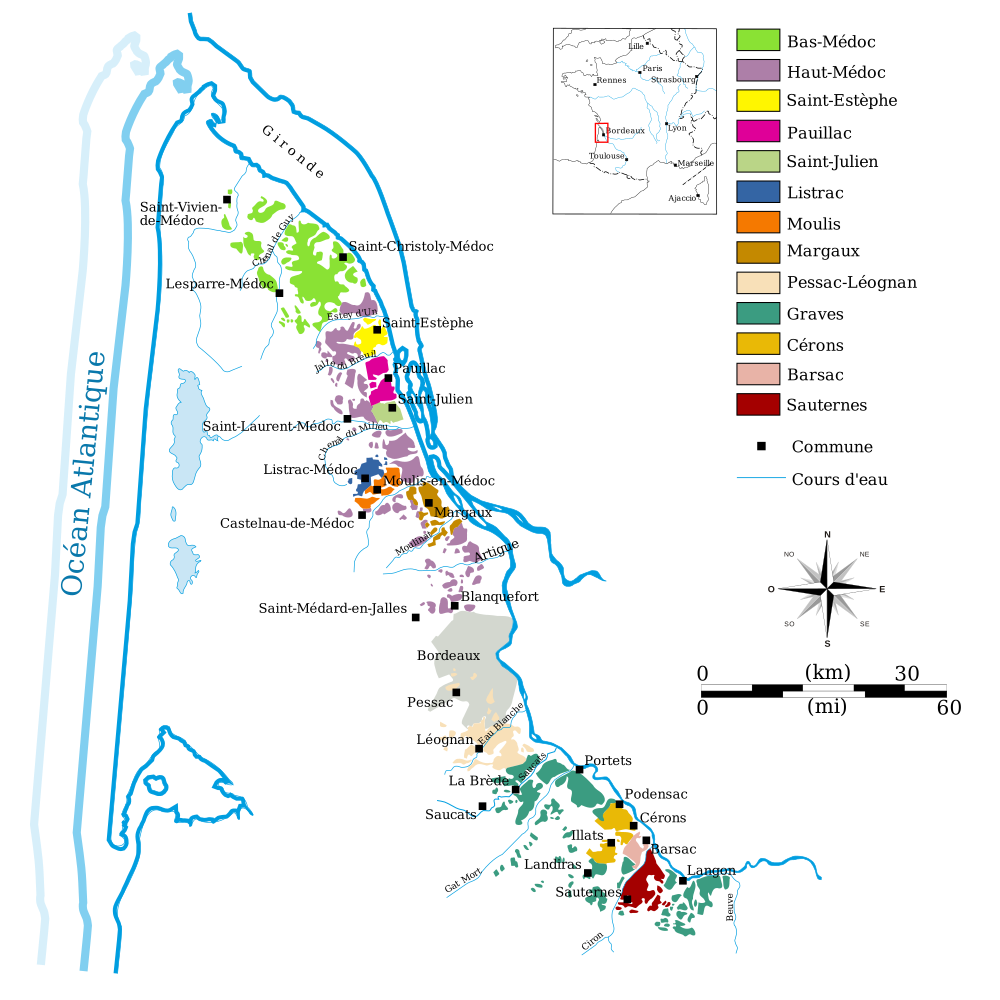
Saint-Julien () is an Appellation d'Origine Contrôlée (AOC) for red wine in the Bordeaux region, located in the Médoc subregion. It takes its name from the commune Saint-Julien-Beychevelle and is one of the six communal appellations in Médoc. A number of classified (Grand Cru Classé) Bordeaux estates are located within the appellation.
History
The tradition of wine-growing in Saint-Julien-Beychevelle and the way in which its terroir has come to prominence parallels the history of the Médoc wines in general.
Appellation
Area of designated origin
Saint-Julien wines are mainly produced in the commune of Saint-Julien-Beychevelle, but a few plots can be found elsewhere in Cussac-Fort-Médoc and Saint-Laurent-Médoc.
Saint-Julien-Beychevelle is located between the Margaux and Pauillac appellations, on the left bank of the Gironde estuary.
Geology and orography
The vineyards lie on a bed of sedimentary rock. Unlike the surface soil, which is an unbroken expanse of pebbles, the subsoil is surprisingly complex and is the reason why Saint-Julien wines vary so much in character.
The vineyards
Grape varieties
The grape varieties grown under this appellation are the same as those found throughout the Médoc area, i.e. predominantly Cabernet Sauvignon, along with Cabernet Franc, Merlot, Malbec, Petit Verdot and Carménère (traces only).
The maximum permitted yield per hectare is 45 hectolitres, wherever the density of planting is between 6,500 and 10,000 vines per hectare. This appellation is traditionally divided into two areas, although this is a matter of some controversy. The southern wines, which are smoother and more feminine, are closely related to the Margaux wines, while the northern wines, which are more robust and powerful (the Léoville wines, for example, bordering the vineyards of Latour), have more in common with the wines of Pauillac.
Estates

Main article: Bordeaux Wine Official Classification of 1855
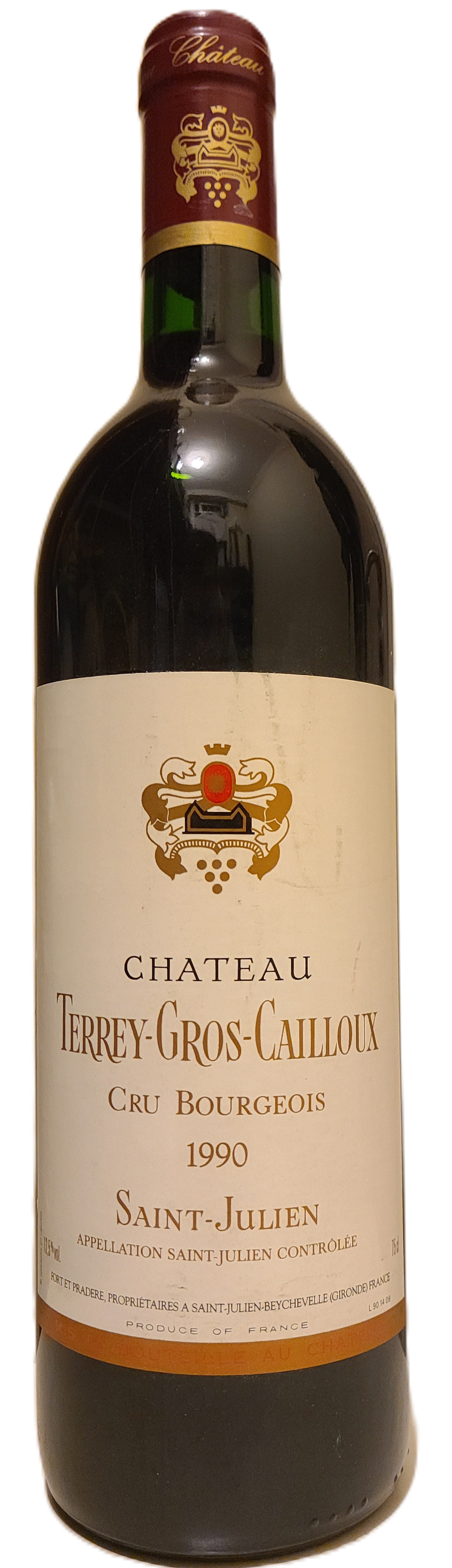
In the Bordeaux Wine Official Classification of 1855, there are no First Growths in Saint-Julien, but several rated Second Growths.
| Seconds crus | Troisièmes crus | Quatrièmes crus | Unclassified |
|---|---|---|---|
| Château Ducru-Beaucaillou | Château Gruaud-Larose | Château Léoville-Barton | |
| Château Léoville-Las Cases | Château Léoville-Poyferré | ||
| Château Lagrange | Château Langoa-Barton | ||
| Château Beychevelle | Château Branaire-Ducru | Château Saint-Pierre | |
| Château Talbot | |||
| Château Gloria | Château La Bridane |
References
- Saint-Julien Bordeaux.com, Le Conseil Interprofessionnel du Vin de Bordeaux (CIVB) ;Footnotes
References
- Le [[Guide Hachette des Vins]] 2010, page 385.
- [http://www.medoc-bordeaux.com/User/mainglobalcourt.aspx?pagename=SainteJulien&menuCat=1&MenuId=4 Data sheet for AOC Saint-Julien] on the website ''medoc-bordeaux.com'', 1st Feb. 2010.
- Kissack, Chris, thewinedoctor.com. "St.Julien".
This article was imported from Wikipedia and is available under the Creative Commons Attribution-ShareAlike 4.0 License. Content has been adapted to SurfDoc format. Original contributors can be found on the article history page.
Ask Mako anything about Saint-Julien AOC — get instant answers, deeper analysis, and related topics.
Research with MakoFree with your Surf account
Create a free account to save articles, ask Mako questions, and organize your research.
Sign up freeThis content may have been generated or modified by AI. CloudSurf Software LLC is not responsible for the accuracy, completeness, or reliability of AI-generated content. Always verify important information from primary sources.
Report