From Surf Wiki (app.surf) — the open knowledge base
Saint Isaac's Cathedral
Cathedral in Saint Petersburg, Russia

Cathedral in Saint Petersburg, Russia
| Field | Value |
|---|---|
| building_name | Saint Isaac's Cathedral |
| Исаакиевский собор | |
| Isaakievskiy sobor | |
| image | Saint Isaac's Cathedral in SPB.jpeg |
| location | Saint Isaac's Square 4, Saint Petersburg, Russia |
| religious_affiliation | State Russian Museum |
| Russian Orthodox | |
| functional_status | Museum, with church services in side chapel |
| website | Cathedral.ru |
| architect | Auguste de Montferrand |
| architecture_style | Late Neoclassical, Byzantine and Greek (cross church) |
| year_completed | 1858 |
| capacity | 12,000 |
| 260,000 m3 (volume) | |
| interior_area | 7,000 m2 (interior) |
| 8,000 m2 (stairs) | |
| length | 104.5 m (interior) |
| 111.3 m (stairs) | |
| width | 91 m (interior) |
| 97.6 m (stairs) | |
| height_max | 101.52 m (top cross) |
| 31.5 m (nave interior) | |
| 80 m (dome ceiling) | |
| dome_dia_outer | 25.8 m |
Исаакиевский собор Isaakievskiy sobor Russian Orthodox 260,000 m3 (volume) 8,000 m2 (stairs) 111.3 m (stairs) 97.6 m (stairs) 31.5 m (nave interior) 80 m (dome ceiling)
Saint Isaac's Cathedral () is a large architectural landmark cathedral that currently functions as a museum with occasional church services in Saint Petersburg, Russia. It is dedicated to Saint Isaac of Dalmatia, a patron saint of Peter the Great, who had been born on the feast day of that saint. It was originally built as a cathedral but was turned into a museum by the Soviet government in 1931 and has remained a museum ever since, with church services held in a side chapel since the 1990s. In 2017, the Governor of Saint Petersburg offered to transfer the cathedral back to the Russian Orthodox Church, but this was not accomplished due to the protests of St Petersburg citizens opposing the offer.
History
The church on St Isaac's Square was ordered by Tsar Alexander I, to replace an earlier structure by Vincenzo Brenna, and was the fourth consecutive church standing at this place. A specially appointed commission examined several designs, including that of the French-born architect Auguste de Montferrand (1786–1858), who had studied in the atelier of Napoleon's designer, Charles Percier. Montferrand's design was criticised by some members of the commission for the dry and allegedly boring rhythm of its four identical pedimented octastyle porticos. It was also suggested that despite gigantic dimensions, the edifice would look squat and not very impressive. The members of the commission, which consisted of well-known Russian architects, were also particularly concerned by necessity to build a new huge building on the old unsecure foundation. The emperor, who favoured the ponderous Empire style of architecture, had to step in and solve the dispute in Montferrand's favour.
The cathedral took 40 years to construct, under Montferrand's direction, from 1818 to 1858. On 12 April 1931, the first public demonstration of the Foucault pendulum was held to visualize Copernicus's theory. In 1937, the museum was transformed into the museum of the cathedral, and former collections were transferred to the Museum of the History of Religion (located in the Kazan Cathedral).
During World War II, the dome was painted over in gray to avoid attracting attention from enemy aircraft. On its top, in the skylight, a geodesical intersection point was placed, to determine the positions of German artillery batteries.
With the fall of communism, the museum was removed and regular worship activity has resumed in the cathedral, but only in the left-hand side chapel. The main body of the cathedral is used for services on feast days only.
On 10 January 2017 Georgy Poltavchenko, the governor of St. Petersburg, announced that the cathedral would be transferred to the Russian Orthodox Church https://themoscowtimes.com/news/russian-orthodox-church-to-take-over-st-isaacs-cathedral-st-petersburg-famous-museum-56798. The key protocols of the transfer were defined by the order issued by St. Petersburg's Committee on Property Relations on 30 December 2016. The document expired on 30 December 2018. The new order can be issued upon request from the Russian Orthodox Church, but no such request has yet been submitted.https://meduza.io/en/news/2019/01/10/st-isaac-s-cathedral-wasn-t-transferred-to-the-orthodox-church-after-all-a-bureaucratic-document-essential-to-the-transfer-has-expired.
The transfer of Saint Isaac's Cathedral in use the ROC agreed in January 2017, but the decision has caused discontent of the townspeople, who defended the status of the museum. The decision of the city authorities was disputed in the courts. Currently, the status of the building is museum. Today, church services are held here only on ecclesiastical occasions.
On 1 October 2021, Grand Duke George Mikhailovich of Russia and Victoria Romanovna Bettarini married at the cathedral in the first royal wedding to take place in Russia since 1917.
Exterior
The neoclassical exterior expresses the traditional Russian-Byzantine formula of a Greek-cross ground plan with a large central dome and four subsidiary domes. It is similar to Andrea Palladio's Villa Capra "La Rotonda", with a full dome on a high drum substituted for the Villa's low central saucer dome. The design of the cathedral in general and the dome in particular later influenced the design of the United States Capitol dome, Wisconsin State Capitol in Madison, Wisconsin, and the Lutheran Cathedral in Helsinki.
The exterior is faced with gray and pink stone, and features a total of 112 red granite columns with Corinthian capitals, each hewn and erected as a single block: 48 at ground level, 24 on the rotunda of the uppermost dome, 8 on each of four side domes, and 2 framing each of four windows. The rotunda is encircled by a walkway accessible to tourists. 24 statues stand on the roof, and another 24 on top of the rotunda. The columns were made in Pyterlahti quarry in Virolahti, Finland
Dome
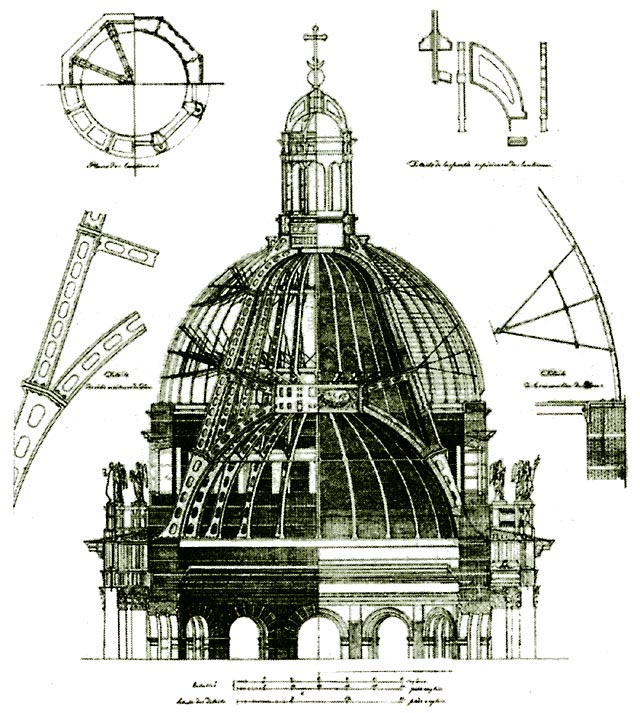
The cathedral's main dome rises 101.5 m; its exterior is gilded. The dome is decorated with twelve statues of angels by Josef Hermann. These angels were likely the first large sculptures produced by the then novel process of electrotyping, which was an alternative to traditional bronze casting of sculptures. Montferrand's design of the dome is based on a supporting cast iron structure. It was the third historical instance of cast iron cupola after the Leaning Tower of Nevyansk (1732) and Mainz Cathedral (1826).
With an internal height of 69 m (from the floor to the level of the oculus), it ranks among the tallest domes in the world.
Interior

The cathedral's bronze doors, covered in reliefs by Ivan Vitali, are patterned after the celebrated doors of the Battistero di San Giovanni in Florence, designed by Lorenzo Ghiberti. Suspended underneath the peak of the dome is a sculpted white dove representing the Holy Spirit. Internal features such as columns, pilasters, floor, and statue of Montferrand are composed of multicolored granites and marbles gathered from all parts of Russia. The iconostasis is framed by eight columns of semiprecious stone: six of malachite and two smaller ones of lazurite. The four pediments are also richly sculpted.
The interior was originally decorated with scores of paintings by Karl Bryullov and other great Russian masters of the day. When these paintings began to deteriorate due to the cold, damp conditions inside the cathedral, Montferrand ordered them to be painstakingly reproduced as mosaics, a technique introduced in Russia by Mikhail Lomonosov. This work was never completed.

Technologies
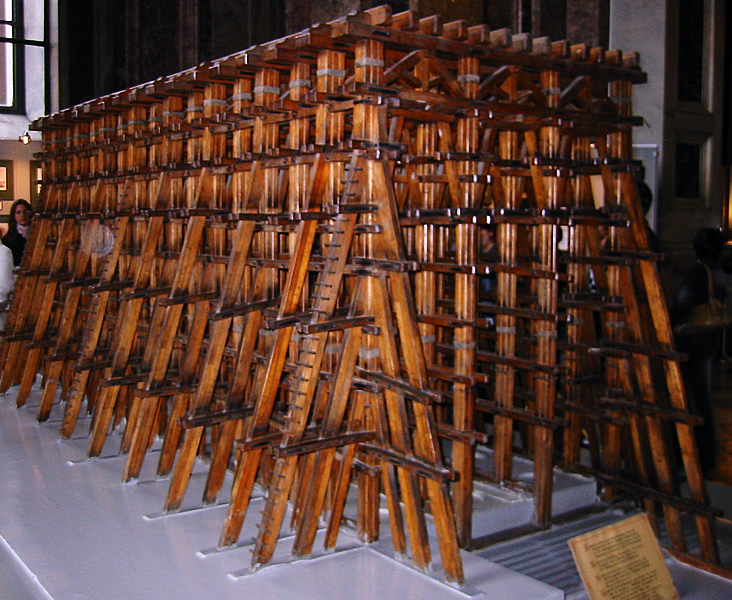
William Handyside and other engineers used a number of technological innovations in the construction of the building. The portico columns were raised with the use of large wooden frameworks before the walls were erected. The building rests on 10,000 tree trunks that were sunk by a large number of workers into the marshy banks upon which the cathedral is situated. The dome was gilded by a technique similar to spraypainting; the solution used included toxic mercury, the vapors of which caused the deaths of sixty workers.{{cite web |archive-url = https://web.archive.org/web/20110828052349/http://www.spbin.ru/encyclopedia/temples/isaac.htm |archive-date = 28 August 2011 |url-status = dead | access-date = 10 December 2012 | archive-date = 23 October 2013 | archive-url = https://web.archive.org/web/20131023172230/http://morion.biz/cont.php?rid=4&id=3 | url-status = dead
The meticulous and painstakingly detailed work on constructing the St. Isaac's Cathedral took 40 years to complete. This extended construction left an expression in the Finnish language, rakentaa kuin Iisakin kirkkoa ("to build like St. Isaac's Church"), for lengthy and never-ending megaprojects.
Gallery
File:First St. Isaac's church.jpg|The first St. Isaac's Church (Lithography of Auguste de Montferrand's drawing, 1710) File:Surikov-Horseman2.jpg|Vasily Surikov's view of the cathedral and the Bronze Horseman in front of it. File:Plan of St. Isaac's cathedral.png|Floorplan of St. Isaac's Cathedral File:Saint Isaac's Cathedral - Foucault pendulum in 1984.jpg|The Foucault pendulum formerly attached to the dome. File:Fragment of west barelief on St.Isaac cathedral.jpg|St. Isaac blessing the Emperor Theodosius and his wife Flaccilla File:St Isaacs Gate.jpg|St. Isaac's southern doors, made of bronze File:FR Petersburg, sobor Isaakiewski, drzwi, 2013.08.02, fot. I. Nowicka (3) CORR.jpg|St. Isaac's western doors, detail showing the apostles Peter and Paul File:SPB interieur1Izaakkathedraal.jpg|Interior of the cathedral View a 360 Panorama here File:Inside St. Isaac's.jpg|View of the main iconostasis, showing the malachite and lapis lazuli columns File:Sankt Petersburg Isaakskathedrale innen 2005 b.jpg|Iconostasis of one of the side chapels File:Sankt Petersburg Isaakskathedrale innen 2005 c.jpg|Shrine to the Wonderworking Tikhvin Icon of the Theotokos File:St Isaacs cathedral royal doors.jpg|The sanctuary, seen through the Holy Doors during Bright Week File:St Isaacs Dome Russia.jpg|Interior of the great dome, honoring the Holy Spirit File:Isaak square3.jpg|View looking out from the cathedral onto Isaac Square File:St petersburg from Isaacs Cathedral.jpg|Photo from St Isaacs Cathedral File:Saint Isaac's Cathedral. St. Petersburg, 2017.png|St. Isaac's Cathedral at night File:Granitbrott i Pytterlaks - Pehr Adolf Kruskopf - Finland framställdt i teckningar - 57.jpg|The columns were made in Pyterlahti quarry in Virolahti, Finland. File:030528-SaintPetersburg-IMG 0668-2.jpg|The porch
References
Notes
Sources
- {{Citation
References
- "Исаакиевский собор – сердце Петербурга". Austrianyard.com.
- "Исаакиевский собор". Tonkosti.ru.
- "Исаакиевский собор". Hotel-atlantic.ru.
- "St.Isaac's Cathedral". Aviewoncities.com.
- "ИСААКИЕВСКИЙ СОБОР".
- "St. The first cathedral was built in honour of the Saint Isaac, saint patron of Peter the Great, founder of Saint Petersburg. By the end of the Paul I times on that place there was quite an ugly structure half decorated with marble blocks, half made of simple red bricks, which most of the contemporaries considered the symbol of the Paul's epoch. This was the result of Paul ordering his court architect, Brenna, to complete an earlier structure in marble by Rinaldi. Isaac's Cathedral". Nevsky Prospect.
- "Antireligious Museum". Saint Petersburg Encyclopaedia.
- link. ГУК ГМП «Исаакиевский собор»
- "The transfer order from St. Isaac's Cathedral to the Russian Orthodox Church has expired".
- link
- "ROC left without St.Isaac's Cathedral".
- "St. Isaac's Cathedral".
- (2 October 2021). "After a century of waiting, Russians witness a royal wedding once more".
- Ernest B. Furguson, Freedom Rising, page 54
- "Wisconsin State Capitol". National Register of Historic Places.
- "St. Isaac's Cathedral". A view on cities.
- (1905). "Russia, Volume 1". The J.C. Winston Co..
- [http://www.itogi.ru/archive/2002/42/102260.html The office of the first Russian oligarch] {{Webarchive. link. (19 May 2017 {{in lang). ru
- "Архитектура".
- Skempton, A.W.. (2002). "A biographical dictionary of civil engineers in Great Britain and Ireland p.296". Thomas Telford.
This article was imported from Wikipedia and is available under the Creative Commons Attribution-ShareAlike 4.0 License. Content has been adapted to SurfDoc format. Original contributors can be found on the article history page.
Ask Mako anything about Saint Isaac's Cathedral — get instant answers, deeper analysis, and related topics.
Research with MakoFree with your Surf account
Create a free account to save articles, ask Mako questions, and organize your research.
Sign up freeThis content may have been generated or modified by AI. CloudSurf Software LLC is not responsible for the accuracy, completeness, or reliability of AI-generated content. Always verify important information from primary sources.
Report