From Surf Wiki (app.surf) — the open knowledge base
Saint Anne
Mother of Mary in Christian tradition
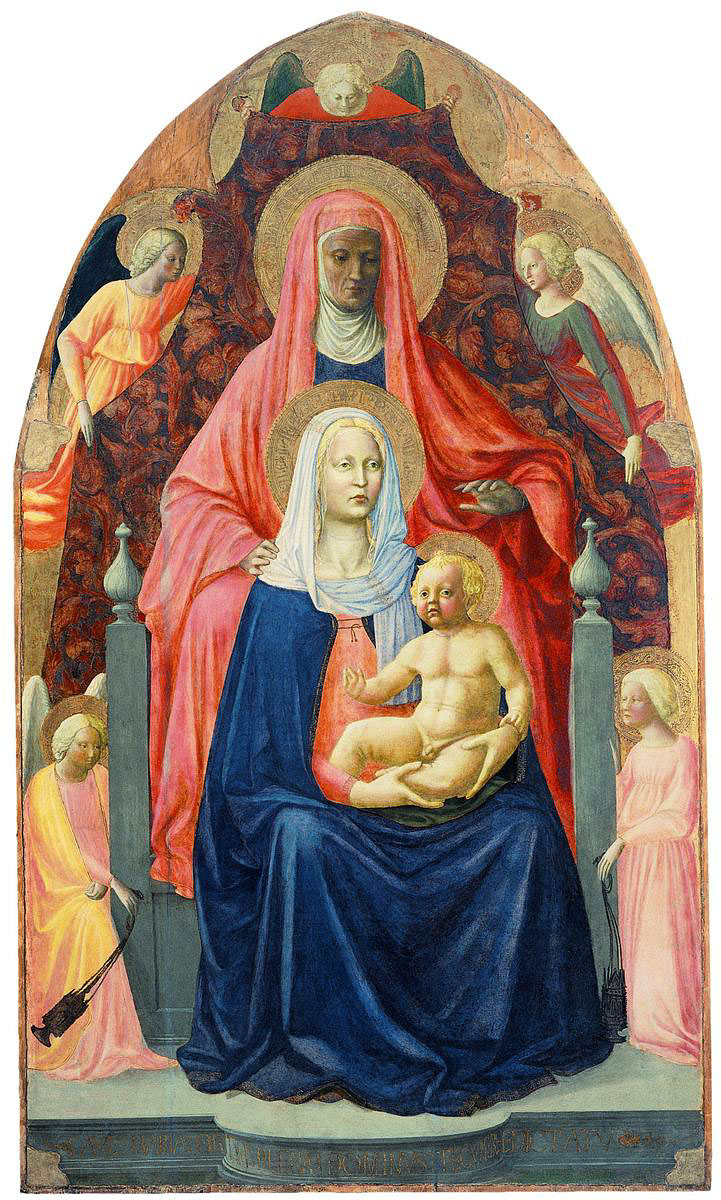
Mother of Mary in Christian tradition
| Field | Value | |||||
|---|---|---|---|---|---|---|
| honorific_prefix | Saint | |||||
| name | Anne | |||||
| death_date | After | |||||
| feast_day | Catholic Church: 26 July | |||||
| Eastern Orthodox: 9 September<ref>{{Cite web | url | https://www.oca.org/saints/all-lives/0999/09/09 | title=Lives of all saints commemorated on September 9 | work=oca.org | date=n.d. | access-date=3 August 2025}} 25 July |
| venerated_in | Catholic Church | |||||
| Eastern Orthodox Church | ||||||
| Oriental Orthodox Church | ||||||
| Anglican Communion | ||||||
| Lutheranism | ||||||
| Islam | ||||||
| Afro-American religion | ||||||
| image | Chanter Angelos Akotandos - St Anne with the Virgin - Google Art Project.jpg | |||||
| imagesize | 290px | |||||
| caption | Greek icon of Saint Anne with the Virgin, by Angelos Akotantos (c. 1420–1450) | |||||
| titles | Mother of the Virgin, Maternal Heroine, Woman of Amram | |||||
| birth_date | Before | birth_place=Bethlehem, Hasmonean Judea | canonized_date =Pre-Congregation | |||
| attributes | Book; door; with Mary, Jesus or Joachim; woman dressed in red or green | |||||
| major_shrine | Apt Cathedral, Basilica of Sainte-Anne d'Auray, Basilica of Sainte-Anne-de-Beaupré |
feast_day = Catholic Church: 26 July Eastern Orthodox: 9 September 25 July Eastern Orthodox Church Oriental Orthodox Church Anglican Communion Lutheranism Islam Afro-American religion
According to Christian tradition, Saint Ann (Anne being the French version of the name, often mistaken as English) was the mother of Mary, the wife of Joachim and the maternal grandmother of Jesus. Mary's mother is not named in the Bible's canonical gospels. In writing, Ann's name and that of her husband Joachim come from New Testament apocrypha, of which the Gospel of James (written perhaps around 150 AD) seems to be the earliest that mentions them. The mother of Mary is mentioned but not named in the Quran.
Christian tradition
The story is similar to that of Samuel, whose mother Hannah ( Ḥannāh "favour, grace"; etymologically the same name as Anne) had also been childless. The Immaculate Conception was eventually made dogma by the Catholic Church following an increased devotion to Anne in the twelfth century. Dedications to Anne in Eastern Christianity occur as early as the sixth century. In the Eastern Orthodox tradition, Anne and Joachim are ascribed the title Ancestors of God, and both the Nativity of Mary and the Presentation of Mary are celebrated as two of the twelve Great Feasts of the Orthodox Church. The Dormition of Anne is also a minor feast in Eastern Christianity. In Lutheran Protestantism, it is held that Martin Luther chose to enter religious life as an Augustinian friar after invoking St. Anne while endangered by lightning.
Beliefs
Although the canonical books of the New Testament never mention the mother of the Virgin Mary, traditions about her family, childhood, education, and eventual betrothal to Joseph developed very early in the history of the church. The oldest and most influential source for these is the apocryphal Gospel of James, first written in Koine Greek around the middle of the second century AD. In the West, the Gospel of James fell under a cloud in the fourth and fifth centuries when it was accused of "absurdities" by Jerome and condemned as untrustworthy by Pope Damasus I, Pope Innocent I, and Pope Gelasius I. However, despite having been condemned by the Church, it was taken over almost in toto by another apocryphal work, the Gospel of Pseudo-Matthew, which popularised most of its stories.
Ancient belief, attested to by a sermon of John of Damascus, was that Anne married once. The sister of Saint Anne was Sobe, mother of Elizabeth. In the fifteenth century, the Catholic cleric Johann Eck related in a sermon that St Anne's parents were named Stollanus and Emerentia. Frederick George Holweck, writing in the Catholic Encyclopedia (1907) regards this genealogy as spurious.
In the 4th century and then much later in the fifteenth century, a belief arose that Mary was conceived of Anne without original sin. This belief in the Immaculate Conception states that God preserved Mary's body and soul intact and sinless from her first moment of existence, through the merits of Jesus Christ. The Immaculate Conception, often confused with the Annunciation of the Incarnation (Mary's virgin birth of Jesus), was made dogma in the Catholic church by Pope Pius IX's papal bull, Ineffabilis Deus, in 1854. The 13th century Speculum Maius of Vincent of Beauvais incorporates information regarding the life of Saint Anne from an earlier work by Hrotsvitha of Gandersheim Abbey.
Veneration

In the Eastern church, the veneration of Anne herself may go back as far as , when Justinian built a church in Constantinople in her honour. The earliest pictorial sign of her veneration in the West is an eighth-century fresco in the church of Santa Maria Antiqua, Rome. The Feast of the Conception of the Virgin Mary had reached southern Italy by the ninth century. In the Latin Church St. Anne was not venerated, except, perhaps, in the south of France, before the thirteenth century. A shrine at Douai, in northern France, was one of the early centres of devotion to St. Anne in the West.
The Anna Selbdritt was a type of iconography depicting the three generations of Saint Anne, Mary, and the child Jesus. Emphasizing the humanity of Jesus, it drew on the earlier conventions of the Seat of Wisdom, and was popular in northern Germany in the 1500s. During the High Middle Ages, Saint Anne became increasingly identified as a maritime saint, protecting sailors and fisherman, and invoked against storms.
Two well-known shrines to St. Anne are that of Ste-Anne-d'Auray in Brittany, France; and that of Ste-Anne-de-Beaupré near the city of Québec. The number of visitors to the Basilica of Ste-Anne-de-Beaupré is greatest on St Anne's Feast Day, 26 July, and the Sunday before the Nativity of the Virgin Mary, 8 September. In 1892, Pope Leo XIII sent a relic of St Anne to the church.
In the Maltese language, the Milky Way galaxy is called It-Triq ta' Sant'Anna, literally "The Way of St. Anne". In the United States, the Daughters of the Holy Spirit named the former Annhurst College in her honor.
_(04)-edit.jpg)
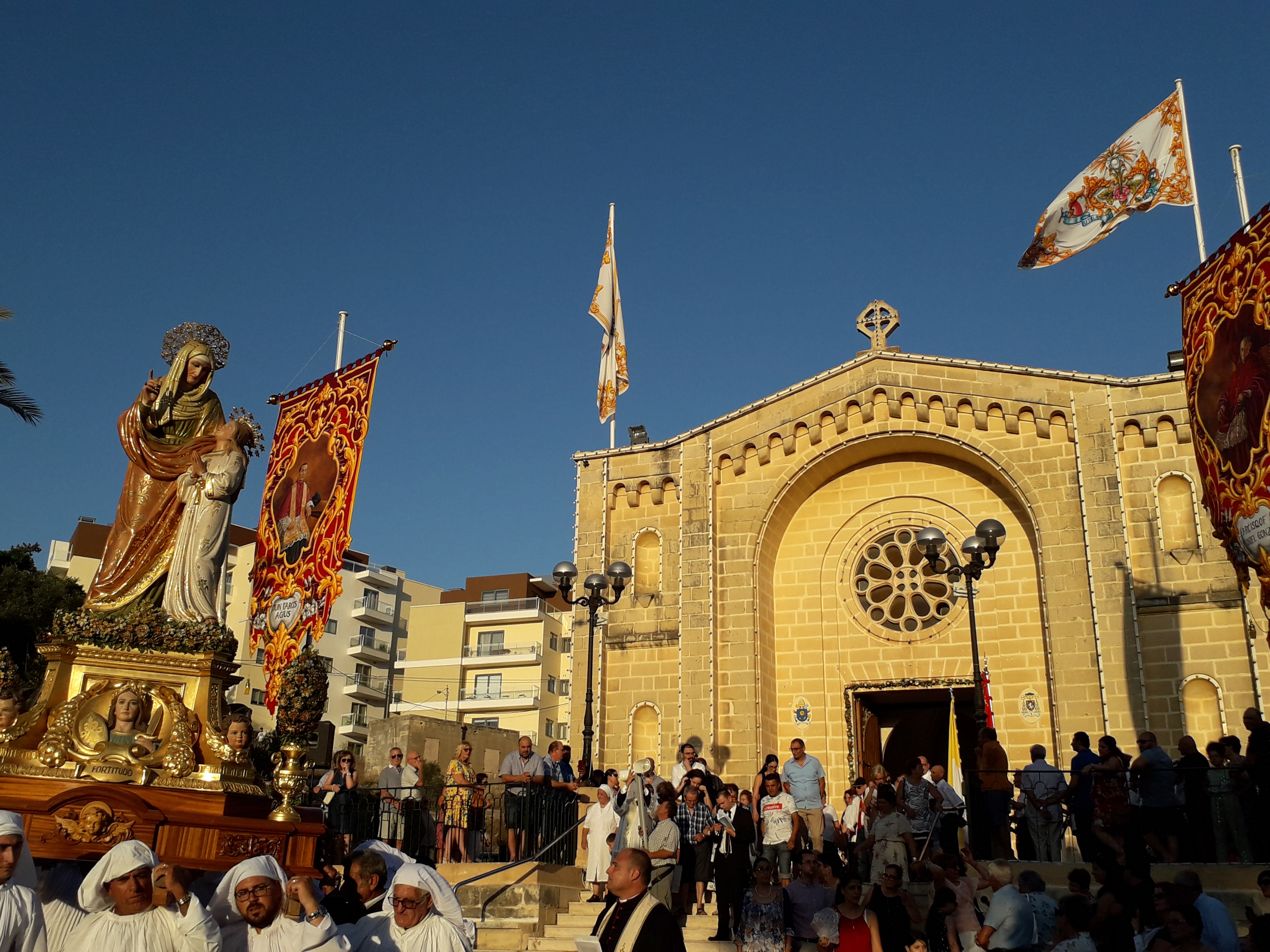
Commemoration
By the middle of the 7th century, a distinct feast day, the Conception of St. Anne (Maternity of Holy Anna) celebrating the conception of Mary by Saint Anne, was observed at the Monastery of Saint Sabas. It is now known in the Greek Orthodox Church as the feast of "The Conception by St. Anne of the Most Holy Theotokos", and celebrated on 9 December. In the Catholic Church, the Feast of Saints Anne and Joachim is celebrated on 26 July.
Feast day
Catholic Church
- 26 July
Eastern Orthodox Church
- 25 July: (Dormition of the Righteous Anna, the Mother of the Most Holy Theotokos)
- 9 September: (Holy and Righteous Ancestors of God, Joachim and Anna, Afterfeast of the Nativity of the Mother of God)
- 9 December (The Conception by Righteous Anna of the Most Holy Mother of God)
Anglican Communion
- 26 July: Anne is remembered (with Joachim) in the Church of England with a Lesser Festival on 26 July.
Lutheranism
- 26 July
Coptic Orthodox Church and Ethiopian Orthodox Tewahedo Church
- 7 November (The Departure of St. Anna (Hannah), the mother of the Theotokos)
Armenian Apostolic Church
- 9 December (The Conception by Righteous Anna of the Most Holy Mother of God)
- Tuesday, 2nd week after Dormition of the Mother of God (with Joachim)
Syro-Malabar Church
- 26 July (Anne and Joachim)
Syro-Malankara Catholic Church
- 9 September (Mar Joachim and Martha Anna)
Maronite Church
- 9 September (St. Anne and Joachim, Parents of the Blessed Virgin Mary)

Relics
The alleged relics of St. Anne were brought from the Holy Land to Constantinople in 710 and were kept there in the church of St. Sophia as late as 1333. During the 12th and 13th centuries, returning crusaders and pilgrims from the East brought relics of Anne to a number of churches, including most famously those at Apt, in Provence, Ghent, and Chartres. St. Anne's relics have been preserved and venerated in the many cathedrals and monasteries dedicated to her name, for example in Austria, Canada, Germany, Italy, and Greece in the semi-autonomous Mount Athos, and the city of Katerini. Medieval and baroque craftsmanship is evidenced in, for example, the metalwork of the life-size reliquaries containing the bones of her forearm. Examples employing folk art techniques are also known. Düren has been the main place of pilgrimage for Anne since 1506, when Pope Julius II decreed that her relics should be kept there, after they were stolen from the church of St. Stephen in Mainz.
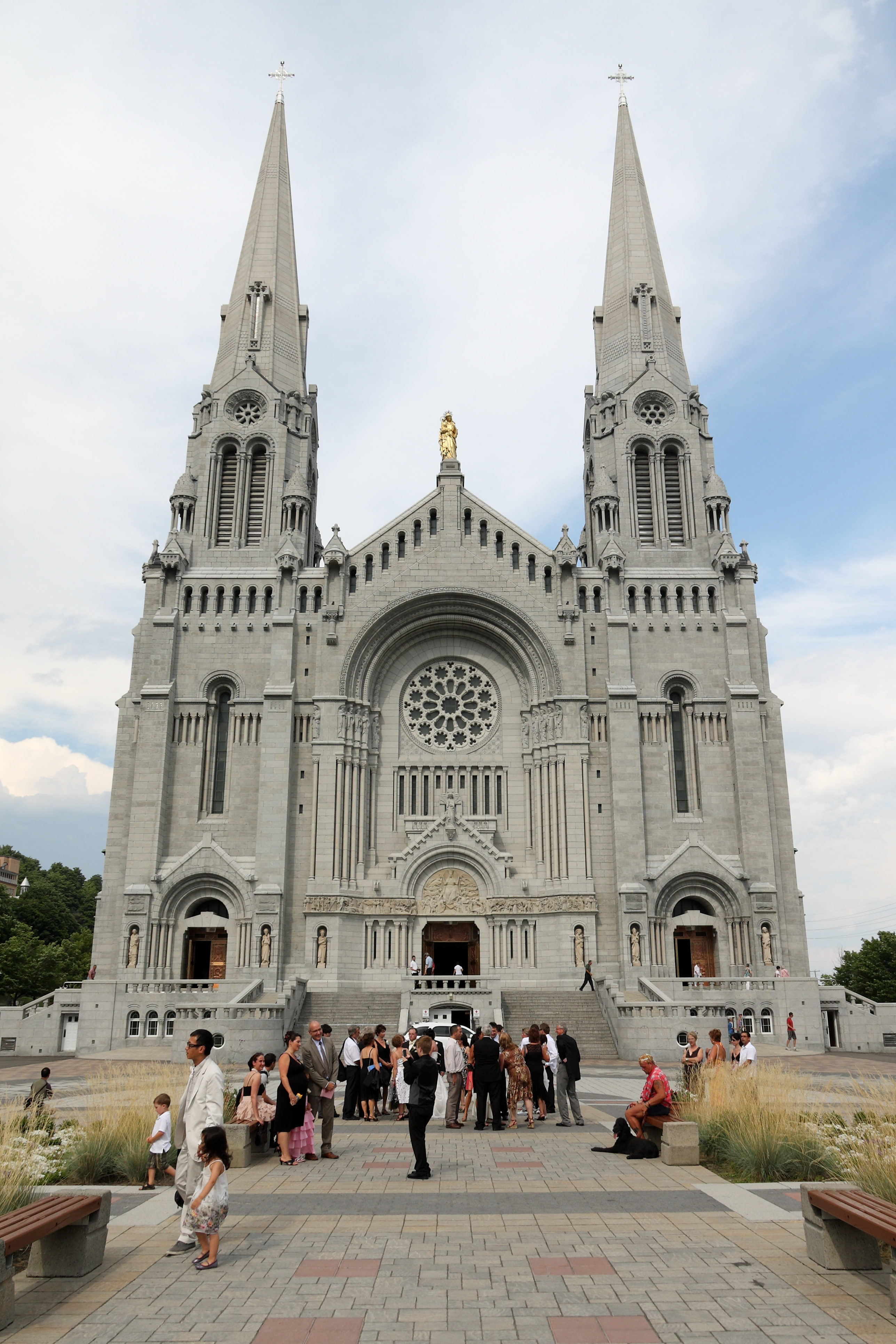
Patronage
The Church of Saint Anne in Beit Guvrin National Park was built by the Byzantines and the Crusaders in the 12th century, known in Arabic as Khirbet () Sandahanna, the mound of Maresha being called Tell Sandahanna. Saint Anne is the patroness of unmarried women, housewives, women in labour or who want to be pregnant, grandmothers, mothers and educators. She is also a patroness of horseback riders, cabinet-makers
Saint Anne is the patron saint of Brittany (France), Cuenca (Ecuador), Chinandega (Nicaragua), the Mi'kmaq people of Canada, Castelbuono (Sicily), Quebec (Canada), Santa Ana (California), Norwich (Connecticut), Detroit (Michigan), Adjuntas (Puerto Rico), Santa Ana and Jucuarán (El Salvador), Berlin (New Hampshire), Santa Ana Pueblo, Seama, and Taos (New Mexico), Chiclana de la Frontera, Marsaskala, Tudela, Atarfe and Fasnia (Spain), Town of Sta Ana Province of Pampanga, Molo, Iloilo City, Balasan, Iloilo, Hagonoy, Santa Ana, Taguig City, Saint Anne Shrine, Malicboy, Pagbilao, Quezon and Malinao, Albay (Philippines), Santana (Brazil), Saint Anne (Illinois), Sainte Anne Island, Baie Sainte Anne and Praslin Island (Seychelles), Bukit Mertajam and Port Klang (Malaysia), Kľúčové (Slovakia) and South Vietnam. The parish church of Vatican City is Sant'Anna dei Palafrenieri. There is a shrine dedicated to Saint Anne in the Woods in Bristol, United Kingdom.
In art
Iconography
The subject of Joachim and Anne The Meeting at the Golden Gate was a regular component of artistic cycles of the Life of the Virgin. The couple meet at the Golden Gate of Jerusalem and embrace. They are aware of Anne's pregnancy, of which they have been separately informed by an archangel. This moment stood for the conception of Mary, and the feast was celebrated on the same day as the Immaculate Conception. Artworks representing the Golden Gate and the events leading up to it were influenced by the narrative in the widely read Golden Legend of Jacobus de Voragine. The Birth of Mary, the Presentation of Mary and the Marriage of the Virgin were usual components of cycles of the Life of the Virgin in which Anne is normally shown here. Her emblem is a door. She is often portrayed wearing red and green, representing love and life.
Anne is never shown as present at the Nativity of Christ but is frequently shown with the infant Christ in various subjects. She is sometimes believed to be depicted in scenes of the Presentation of Jesus at the Temple and the Circumcision of Christ, but in the former case, this likely reflects a misidentification through confusion with Anna the Prophetess. There was a tradition that Anne went (separately) to Egypt and rejoined the Holy Family after their Flight to Egypt. Anne is not seen with the adult Christ, so was regarded as having died during the youth of Jesus. Anne is also shown as the matriarch of the Holy Kinship, the extended family of Jesus, a popular subject in late medieval Germany; some versions of these pictorial and sculptural depictions include Emerentia who was reputed in the fifteenth century to be Anne's mother. In modern devotions, Anne and her husband are invoked for protection for the unborn.
_-_Google_Art_Project.jpg)
Virgin and Child with Saint Anne
The role of the Messiah's grandparents in salvation history was commonly depicted in early medieval devotional art in a vertical double-Madonna arrangement known as the Virgin and Child with Saint Anne, and developed into less hierarchical compositions. The painted or sculpted group is called in Italian Metterza, in French Sainte Anne trinitaire, and in German Anna selbdritt. Another typical subject has Anne teaching the Virgin Mary the scriptures.
''Christ in the House of His Parents''
In John Everett Millais's 1849–50 work, Christ in the House of His Parents, Anne is shown in her son-in-law Joseph's carpentry shop. Her daughter Mary, and Joseph are caring for a young Jesus who had cut his hand on a nail, prefiguring the wounds of his Crucifixion. The coeval John the Baptist carries a bowl of water to clean the injured hand of Jesus, also prefiguring the Baptism of Jesus.
In Islam
Anne () is also revered in Islam, recognized as a highly spiritual woman and as the mother of Mary. She is not named in the Quran, where she is referred to as "the wife of Imran". The Quran describes her remaining childless until her old age. One day, Anne saw a bird feeding its young while sitting in the shade of a tree, which awakened her desire to have children of her own. She prayed for a child and eventually conceived; her husband, Imran, died before the child was born. Expecting the child to be male, Anne vowed to dedicate him to isolation and service in the Second Temple;"O my Lord! I do dedicate into Thee what is in my womb for Thy special service: So accept this of me: For Thou hearest and knowest all things." (Quran 3:35).{{cite book|last=Da Costa |first=Yusuf |title=The Honor of Women in Islam |publisher=LegitMaddie101 |year=2002
Gallery
File:Adorazione dei magi, metà del V sec. Santa Miaria Maggiore Roma, Arco trionfale -FG.jpg|Adoration of the Magi, with (supposedly) St. Anne in the center (5th ct.), Santa Maria Maggiore, Rome File:Faras Saint Anne.jpg|Coptic Saint Anne from Faras, Nubia (8th century), National Museum in Warsaw File:Annuciation to Anne-edit.jpg|Annunciation to Anne, mosaic (11th ct), Chora Church, Istanbul File:La Martorana (39521628772).jpg|Eastern Orthodox church la Martorana (12th ct.), Palermo, Sicily File:Annarelief.jpg|Late Gothic Relief bust of crowned St. Anne (as spolia in the rebuilt) Annakirche, Düren, Germany File:Frankfurt Karmeliterkloster Annenaltar.jpg|Legends of St. Anne (15th ct.), altar of St. Anne, cloister of the Carmelites, Frankfurt File:Sainte Anne et les trois Marie.jpg|Saint Anne and the Three Marys, [Hours of Étienne Chevalier|Book of [Hours of Étienne Chevalier, illuminated by Jean Fouquet (late 15th ct.), Bibliothèque nationale de France, Paris File:Lignee-Ste-Anne v1500.jpg|The Line of Saint Anne, Gérard David (c. 1500), Musée des Beaux-Arts de Lyon File:Oberwesel, Liebfrauenkirche 20170322 047-edit.jpg|The Holy Kinship (early 16th ct.), Liebfrauenkirche Oberwesel, Germany File:BMVB - Doménico Theotokópoulus - La Sagrada Família amb Santa Anna i Sant Joanet - 8606.jpg|The Holy Family with St. Anne and St. John by El Greco (c. 1600), Biblioteca Museu Víctor Balaguer, Vilanova i la Geltrú (Barcelona) File:Brooklyn Museum - Saint Anne (Sainte Anne) - James Tissot - overall.jpg|Saint Anne, James Tissot (late 19th ct.), Brooklyn Museum, New York
File:Firenze aka Florence, Italy (28328693228)-edit.jpg|French polychromed wood sculpture (late 14th century), Bargello, Florence File:Memling-DipticMunic-revers.jpg|Hans Memling, reverse of Munich Diptych (1480), Alte Pinakothek, Munich File:Gundelsheim - Altstadt - St. Nikolaus - Frühmess-Kapelle - Anna-Altar - Anna selbdritt.jpg|Anna selbdritt (1500), St. Nicholas, Gundelsheim, Germany File:Leonardo da Vinci - Virgin and Child with St Anne C2RMF retouched.jpg|Leonardo da Vinci's Virgin and Child with Saint Anne (c. 1501–19), Louvre, Paris File:Seghers, Daniel - Cartouche with the Virgin and Child and Saint Anne - Google Art Project.jpg|Cartouche with the Virgin and Child and Saint Anne by Daniel Seghers (c. 1590–1661), Dulwich Picture Gallery, London
File:Guido Reni - Education of the Virgin - WGA19315.jpg|Guido Reni (1640–1642) File:Jean-Baptiste Jouvenet - The Education of the Virgin - WGA12032.jpg|Jean Jouvenet (1700) File:Josef Winterhalder Anna unterweist Maria.jpg|Josef Winterhalder the Younger (1766) File:L'Education de la Vierge.jpg|Eugène Delacroix (1842) File:Mary and St. Anne - Iglesia del Salvador - Seville-edit.jpg|Iglesia del Salvador, Seville File:Ana uči Marijo brati (panjska končnica, 1842).jpg|Panel of a beehive decorated with St. Anne flanked by flowers, folk art of Slovenia (1842)
Music
- Marc-Antoine Charpentier composed two motets:
- Pour Ste Anne, H.315, for two voices and continuo (around 1675)
- Canticum Annae, H.325, for three voices, two treble instruments, and continuo (around 1680).
Notes
References
References
- (n.d.). "Saint of the Day". Vatican News.
- (n.d.). "Lives of all saints commemorated on September 9". oca.org.
- "Symbols in Art".
- Nixon, Virginia. (2004). "Mary's Mother: Saint Anne in Late Medieval Europe". The Pennsylvania State University Press.
- Procopius' Buildings, Volume I, Chapters 11–12.
- "Holy and Righteous Ancestors of God, Joachim and Anna". The Orthodox Church in America.
- Brecht, Martin. (1985). "Martin Luther: His Road to Reformation, 1483–1521". Fortress Press.
- (2003). "Middle English Legends of Women Saints". Medieval Institute Publications.
- (21 July 2011). "The Apocryphal Gospels: Texts and Translations". Oxford University Press.
- Wehling, Fr John. (2 September 2017). "Excerpts from St John of Damascus: An Oration on the Nativity of the Holy Theotokos Mary". St John of Chicago Orthodox Church.
- Holweck, Frederick. (1907). "St. Anne". Newadvent.org.
- Holweck, Frederick. (1907). "St. Anne". Newadvent.org.
- (1857). "The Lives of the Fathers, Martyrs, and Other Principal Saints". Henry & Co.
- "Lives of Saints, John J. Crawley & Co., Inc". Ewtn.com.
- Welsh, Jennifer. ''The Cult of St. Anne in Medieval and Early Modern Europe'', Routledge, 2016, {{ISBN. 9781134997879
- "Saint Anne and Saint Joachim, Our Lady of Mt. Carmel Parish, Ottawa, Ontario". Olomc-ottawa.com.
- "The Milky Way Project – It-Triq ta' Sant'Anna {{!}} What is the Milky Way?". maltastro.org.
- (26 May 1944). "State Board Accredits New College". [[Hartford Courant]].
- [https://www.archpitt.org/the-immaculate-conception-the-conception-of-st-anne-when-she-conceived-the-holy-mother-of-god-according-to-the-ruthenian-tradition/ "The Conception of St. Anne 'When She Conceived the Holy Mother of God', The Byzantine Catholic Archeparchy of Pittsburgh]
- [https://www.goarch.org/chapel/saints?contentid=329 "Saints and Feasts"], on Goarch.org, the homepage of the [[Greek Orthodox Archdiocese of America]].
- "The Calendar".
- "ИОАКИМ И АННА".
- "Commemoration of Sts. Joachim and Anna, Parents of the Holy Mother of God, and Oil-Bringing Women". Armenian Church.
- "Syro-Malabar Liturgical Calendar".
- "The Syro-Malankara Catholic Church – The Sacred Lectionary".
- "Saint Joseph Maronite Catholic Church".
- (3 July 1960). "Arm Reliquary Sainte-Anne-de-Beaupré Shrine, Quebec". Shrinesaintanne.org.
- (6 October 2010). "Flickr photograph of the so-called 'speaking reliquary' (tells the pilgrim what is venerated)". Flickr.com.
- Bender. (26 July 2010). "Arm relic Basilica of Saint Paul Outside the Walls|Papal Basilica of Saint Paul Outside the Walls". Vita-nostra-in-ecclesia.blogspot.com.
- Butler, Alban. (1987). "Lives of the Patron Saints". Burns and Oates.
- "St. Anne – Archdiocese of Detroit". Aod.org.
- Some writers gave her age at death, as part of a general family chronology, but no generally accepted tradition developed on this point, even during the Middle Ages.
- Wheeler, Brannon M.. (2002). "Prophets in the Quran: An Introduction to the Quran and Muslim Exegesis". Continuum International.
This article was imported from Wikipedia and is available under the Creative Commons Attribution-ShareAlike 4.0 License. Content has been adapted to SurfDoc format. Original contributors can be found on the article history page.
Ask Mako anything about Saint Anne — get instant answers, deeper analysis, and related topics.
Research with MakoFree with your Surf account
Create a free account to save articles, ask Mako questions, and organize your research.
Sign up freeThis content may have been generated or modified by AI. CloudSurf Software LLC is not responsible for the accuracy, completeness, or reliability of AI-generated content. Always verify important information from primary sources.
Report