From Surf Wiki (app.surf) — the open knowledge base
Sailfish
Genus of fishes
Genus of fishes
(Note that the IUCN recognises one sailfish species)
- Istiophorus platypterus (G. Shaw, 1792)
- Histiophorus G. Cuvier, 1832
- Nothistium Hermann, 1804
- Zanclurus Swainson, 1839

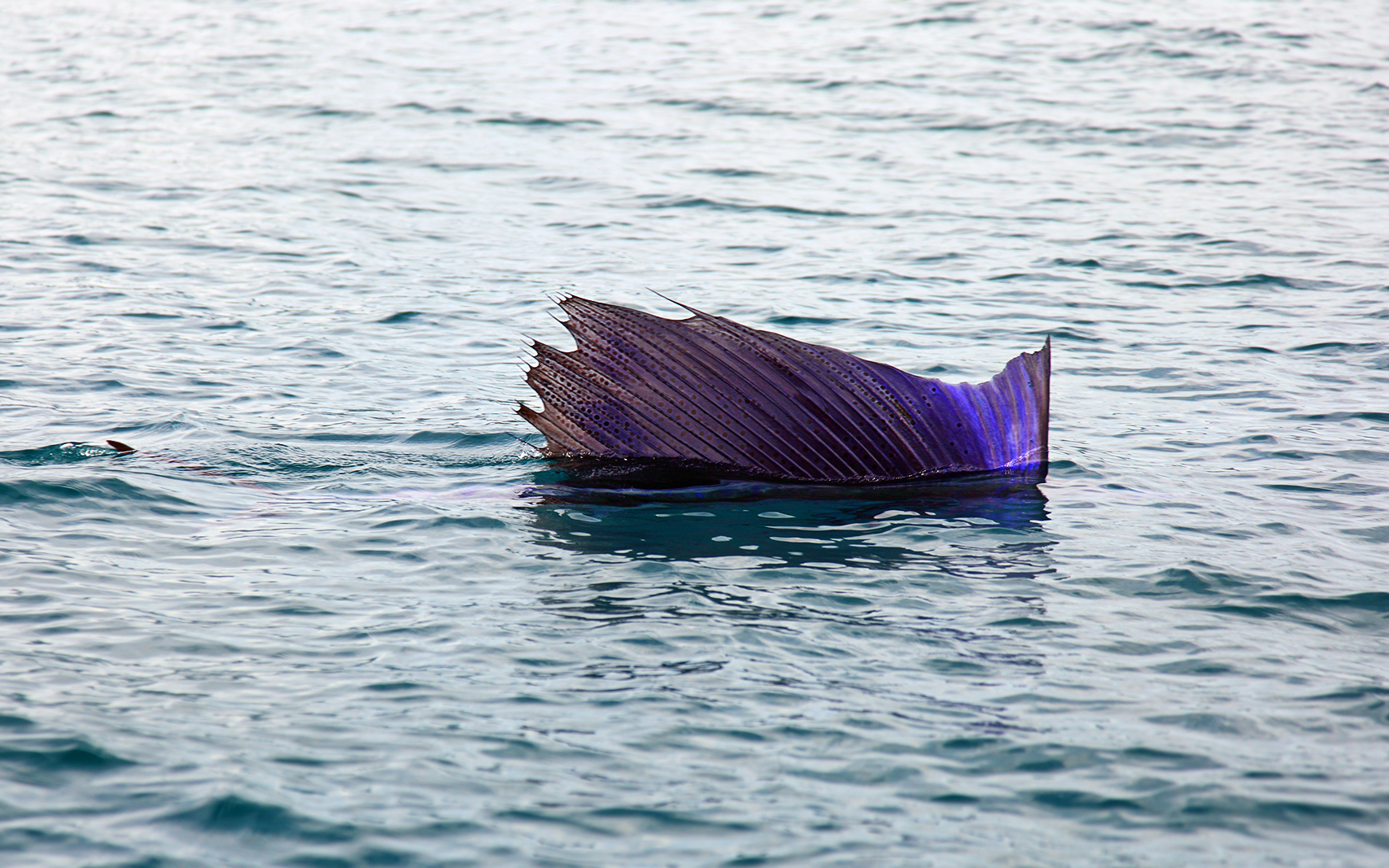
The sailfish is one or two species of marine fish in the genus Istiophorus, which belong to the family Istiophoridae (marlins). They are predominantly blue to gray in colour and have a characteristically large dorsal fin known as the sail, which often stretches the entire length of the back. Another notable characteristic is the elongated rostrum (bill) consistent with that of other marlins and the swordfish, which together constitute what are known as billfish in sport fishing circles. Sailfish live in colder pelagic waters of all Earth's oceans, and hold the record for the highest speed of any marine animal.
Species
There is a dispute based on the taxonomy of the sailfish, and either one or two species have been recognized. No differences have been found in mtDNA, morphometrics or meristics between the two supposed species and most authorities now only recognize a single species, Istiophorus platypterus, found in warmer oceans around the world. FishBase continues to recognize two species:
- Atlantic sailfish (I. albicans).
- Indo-Pacific sailfish (I. platypterus).
Description
Considered by many scientists the fastest fish in the ocean, sailfish were previously estimated to reach maximum swimming speeds of 35 m/s, but research published in 2015 and 2016 indicate sailfish do not exceed speeds between 10-15 m/s. During predator–prey interactions, sailfish reached burst speeds of 7 m/s and did not surpass 10 m/s.
Sailfish grow quickly, reaching 1.2 - in length in a single year, and feed on the surface or at middle depths on smaller pelagic forage fish and squid. Generally, sailfish do not grow to more than 3 m in length and rarely weigh over 90 kg.
Some sources indicate that sailfish are capable of changing colours as a method of confusing prey, displaying emotion, and/or communicating with other sailfish.
Sailfish have been documented attacking humans in self-defense; a 100 lb sailfish stabbed a woman in the groin when her party tried to catch it.
Hunting behaviour
Sailfish have been reported to use their bills for hitting schooling fish by tapping (short-range movement) or slashing (horizontal large-range movement) at them.
The sail is normally kept folded down when swimming and only raised when the sailfish attack their prey. The raised sail has been shown to reduce sideways oscillations of the head, which is likely to make the bill less detectable by prey fish. This strategy allows sailfish to put their bills close to fish schools or even into them without being noticed by the prey before hitting them.
Sailfish usually attack one at a time, and the small teeth on their bills inflict injuries on their prey fish in terms of scale and tissue removal. Typically, about two prey fish are injured during a sailfish attack, but only 24% of attacks result in capture. As a result, injured fish increase in number over time in a fish school under attack. Given that injured fish are easier to catch, sailfish benefit from the attacks of their conspecifics but only up to a particular group size. A mathematical model showed that sailfish in groups of up to 70 individuals should gain benefits in this way. The underlying mechanism was termed proto-cooperation because it does not require any spatial coordination of attacks and could be a precursor to more complex forms of group hunting.
The bill movement of sailfish during attacks on fish is usually either to the left or to the right side. Identification of individual sailfish based on the shape of their dorsal fins identified individual preferences for hitting to the right or left side. The strength of this side preference was positively correlated with capture success. These side-preferences are believed to be a form of behavioural specialization that improves performance. However, a possibility exists that sailfish with strong side preferences could become predictable to their prey because fish could learn after repeated interactions in which direction the predator will hit. Given that individuals with right- and left-sided preferences are about equally frequent in sailfish populations, living in groups possibly offers a way out of this predictability. The larger the sailfish group, the greater the possibility that individuals with right- and left-sided preferences are about equally frequent. Therefore, prey fish should find it hard to predict in which direction the next attack will take place. Taken together, these results suggest a potential novel benefit of group hunting which allows individual predators to specialize in their hunting strategy without becoming predictable to their prey.
The injuries that sailfish inflict on their prey appear to reduce their swimming speeds, with injured fish being more frequently found in the back (compared with the front) of the school than uninjured ones. When a sardine school is approached by a sailfish, the sardines usually turn away and flee in the opposite direction. As a result, the sailfish usually attacks sardine schools from behind, putting at risk those fish that are the rear of the school because of their reduced swimming speeds.
Habitat
The sailfish is an epipelagic and oceanic species and shows a strong tendency to approach continental coasts, islands and reefs tropical and temperate waters of the Pacific and Indian oceans.
Sailfish in some areas are reliant on coral reefs as areas for feeding and breeding. As witnessed in the Persian Gulf, the disappearance of coral reefs in a sailfish's habitat may be followed by the disappearance of the species from that area.
Predators
When freshly hatched, sailfish are hunted by other fishes that mainly survive on eating plankton. The size of their predators increases as they grow, and adult sailfish are not eaten by anything other than larger predatory fish like open ocean shark species and orcas.
Timeline
ImageSize = width:1000px height:auto barincrement:15px PlotArea = left:10px bottom:50px top:10px right:10px
Period = from:-65.5 till:10 TimeAxis = orientation:horizontal ScaleMajor = unit:year increment:5 start:-65.5 ScaleMinor = unit:year increment:1 start:-65.5 TimeAxis = orientation:hor AlignBars = justify
Colors =
- legends id:CAR value:claret id:ANK value:rgb(0.4,0.3,0.196) id:HER value:teal id:HAD value:green id:OMN value:blue id:purple value:purple id:white value:white id:cenozoic value:rgb(0.54,0.54,0.258) id:paleogene value:rgb(0.99,0.6,0.32) id:paleocene value:rgb(0.99,0.65,0.37) id:eocene value:rgb(0.99,0.71,0.42) id:oligocene value:rgb(0.99,0.75,0.48) id:neogene value:rgb(0.999999,0.9,0.1) id:miocene value:rgb(0.999999,0.999999,0) id:pliocene value:rgb(0.97,0.98,0.68) id:quaternary value:rgb(0.98,0.98,0.5) id:pleistocene value:rgb(0.999999,0.95,0.68) id:holocene value:rgb(0.999,0.95,0.88)
BarData= bar:eratop bar:space bar:periodtop bar:space bar:NAM1 bar:NAM2 bar:NAM3 bar:NAM4
bar:space bar:period bar:space bar:era
PlotData= align:center textcolor:black fontsize:M mark:(line,black) width:25 shift:(7,-4)
bar:periodtop from: -65.5 till: -55.8 color:paleocene text:Paleocene from: -55.8 till: -33.9 color:eocene text:Eocene from: -33.9 till: -23.03 color:oligocene text:Oligocene from: -23.03 till: -5.332 color:miocene text:Miocene from: -5.332 till: -2.588 color:pliocene text:Plio. from: -2.588 till: -0.0117 color:pleistocene text:Pleist. from: -0.0117 till: 0 color:holocene text:H.
bar:eratop from: -65.5 till: -23.03 color:paleogene text:Paleogene from: -23.03 till: -2.588 color:neogene text:Neogene from: -2.588 till: 0 color:quaternary text:Q.
PlotData= align:left fontsize:M mark:(line,white) width:5 anchor:till align:left
color:eocene bar:NAM1 from: -55.8 till: 0 text: Pseudohistiophorus color:miocene bar:NAM2 from: -23.03 till: 0 text: Tetrapterus color:miocene bar:NAM3 from: -15.97 till: 0 text: Istiophorus color:miocene bar:NAM4 from: -11.608 till: 0 text: Makaira
PlotData= align:center textcolor:black fontsize:M mark:(line,black) width:25
bar:period from: -65.5 till: -55.8 color:paleocene text:Paleocene from: -55.8 till: -33.9 color:eocene text:Eocene from: -33.9 till: -23.03 color:oligocene text:Oligocene from: -23.03 till: -5.332 color:miocene text:Miocene from: -5.332 till: -2.588 color:pliocene text:Plio. from: -2.588 till: -0.0117 color:pleistocene text:Pleist. from: -0.0117 till: 0 color:holocene text:H.
bar:era from: -65.5 till: -23.03 color:paleogene text:Paleogene from: -23.03 till: -2.588 color:neogene text:Neogene from: -2.588 till: 0 color:quaternary text:Q.
References
- Schultz, Ken (2003) Ken Schultz's Field Guide to Saltwater Fish pp. 162–163, John Wiley & Sons. .
References
- (2002). "A compendium of fossil marine animal genera". Bulletins of American Paleontology.
- (2022). "''Istiophorus platypterus''". [[The IUCN Red List of Threatened Species]].
- {{FishBase genus. (2013)
- McGrouther, M. (2013). ''[https://australian.museum/learn/animals/fishes/sailfish-istiophorus-platypterus/ Sailfish, Istiophorus platypterus.]'' Australian Museum. Retrieved 26 April 2013.
- Collette, B.. (2011). "''Istiophorus platypterus''".
- Gardieff, S: ''[https://web.archive.org/web/20040501190625/http://www.flmnh.ufl.edu/fish/Gallery/Descript/Sailfish/Sailfish.html Sailfish.]'' Florida Museum of Natural History. Retrieved 26 April 2013.
- Collette, B.B., McDowell, J.R. and Graves, J.E. (2006). ''Phylogeny of Recent billfishes (Xiphioidei).'' Bull. Mar. Sci. 79(3): 455–468.
- US Department of Commerce, National Oceanic and Atmospheric Administration. "What is the fastest fish in the ocean?".
- Marras S, Noda T, Steffensen JF, Svendsen MBS, Krause J, Wilson ADM, Kurvers RHJM, Herbert-Read J & Domenic P 2015) [https://academic.oup.com/icb/article/55/4/719/634534/Not-So-Fast-Swimming-Behavior-of-Sailfish-during?searchresult=1 "Not so fast: swimming behavior of sailfish during predator–prey interactions using high-speed video and accelerometry"]. ''Integrative and Comparative Biology'' '''55''': 718–727.
- Svendsen MBS, Domenici P, Marras S, Krause J, Boswell KM, Rodriguez-Pinto I, Wilson ADM, Kurvers RHJM, Viblanc PE, Finger JS & Steffensen JF (2016) [https://journals.biologists.com/bio/article/5/10/1415/1485/Maximum-swimming-speeds-of-sailfish-and-three "Maximum swimming speeds of sailfish and other large marine predatory fish species based on muscle contraction time: A myth revisited"]. ''Biology Open'', '''5''': 1415–1419.
- "The Sailfish Optimizer: A novel nature-inspired metaheuristic algorithm for solving constrained engineering optimization problems". Engineering Applications of Artificial Intelligence.
- (9 May 2017). "Istiophorus platypterus".
- (11 November 2010). "Sailfish".
- (2015). "Istiophorus albicans (Atlantic Sailfish)". The Online Guide to the Animals of Trinidad and Tobago.
- Hannah Sarisohn and Carlos Suarez. (24 July 2022). "Woman on fishing boat off Florida coast stabbed by 100-pound fish".
- Domenici P, Wilson ADM, Kurvers RHJM, Marras S, Herbert-Read JE, Steffensen JF, Krause S, Viblanc PE, Couillaud P & Krause J (2014) [http://rspb.royalsocietypublishing.org/content/281/1784/20140444 "How sailfish use their bill to capture schooling prey"]. ''Proceedings of the Royal Society London B'', '''281''': 20140444.
- [https://www.youtube.com/watch?v=VISEHbpHkn4 Sailfish Hunting Sardines] – ''Youtube''.
- Herbert-Read JE, Romanczuk P, Krause S, Strömbom D, Couillaud P, Domenici P, Kurvers RHJM, Marras S, Steffensen JF, Wilson ADM & Krause J (2016) [http://rspb.royalsocietypublishing.org/content/283/1842/20161671 "Group hunting sailfish alternate their attacks on their grouping prey to facilitate hunting success"]. ''Proceedings of the Royal Society London B'', '''283''': 20161671.
- Kurvers RHJM, Krause S, Viblanc PE, Herbert-Read JE, Zalansky P, Domenici P, Marras S, Steffensen JF, Wilson ADM, Couillaud P & Krause J (2017) [http://www.cell.com/current-biology/fulltext/S0960-9822(16)31525-1 "The evolution of lateralisation in group hunting sailfish"]. ''Current Biology''.
- 9780198508182
- John, Smithson. (1 January 2009). "Sailfish disappearance".
This article was imported from Wikipedia and is available under the Creative Commons Attribution-ShareAlike 4.0 License. Content has been adapted to SurfDoc format. Original contributors can be found on the article history page.
Ask Mako anything about Sailfish — get instant answers, deeper analysis, and related topics.
Research with MakoFree with your Surf account
Create a free account to save articles, ask Mako questions, and organize your research.
Sign up freeThis content may have been generated or modified by AI. CloudSurf Software LLC is not responsible for the accuracy, completeness, or reliability of AI-generated content. Always verify important information from primary sources.
Report