From Surf Wiki (app.surf) — the open knowledge base
Sagitta
Constellation in the northern celestial hemisphere
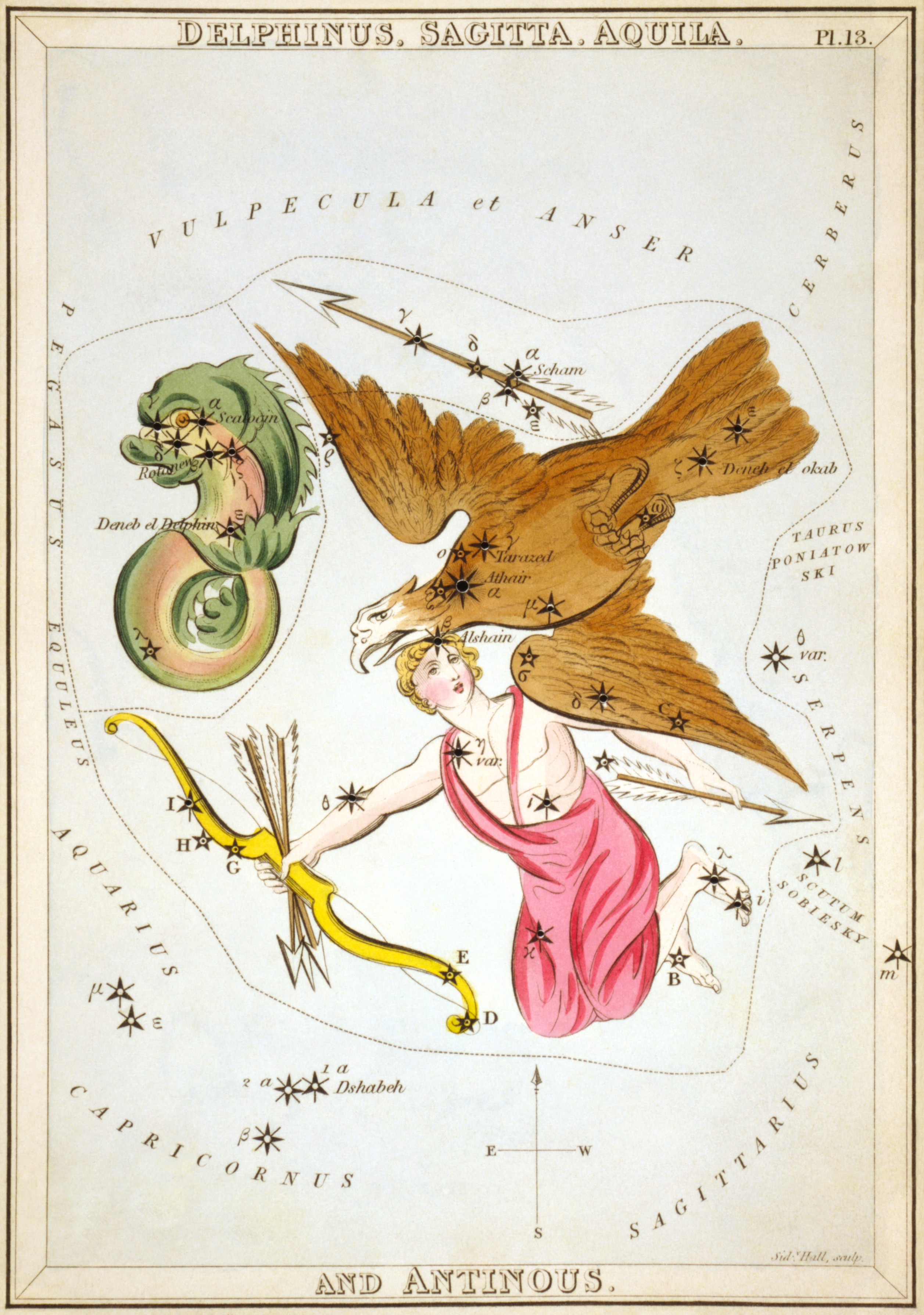
Constellation in the northern celestial hemisphere
| Field | Value |
|---|---|
| name | Sagitta |
| abbreviation | Sge |
| genitive | Sagittae |
| pronounce | or Sagítta, |
| genitive | |
| symbolism | the Arrow |
| RA | – |
| dec | to |
| areatotal | 79.9 |
| arearank | 86th |
| numbermainstars | 4 |
| numberbfstars | 19 |
| numberbrightstars | 0 |
| numbernearbystars | 2 |
| brighteststarname | γ Sge |
| starmagnitude | 3.51 |
| neareststarname | Gliese 745 |
| stardistancely | 28.81 |
| stardistancepc | 8.83 |
| numbermessierobjects | 1 |
| bordering | Vulpecula |
| Hercules | |
| Aquila | |
| Delphinus | |
| latmax | 90 |
| latmin | 70 |
| month | August |
genitive Hercules Aquila Delphinus
Sagitta is a dim but distinctive constellation in the northern sky. Its name is Latin for 'arrow', not to be confused with the significantly larger constellation Sagittarius 'the archer'. It was included among the 48 constellations listed by the 2nd-century astronomer Ptolemy, and it remains one of the 88 modern constellations defined by the International Astronomical Union. Although it dates to antiquity, Sagitta has no star brighter than 3rd magnitude and has the third-smallest area of any constellation.
Gamma Sagittae is the constellation's brightest star, with an apparent magnitude of 3.47. It is an aging red giant star 90% as massive as the Sun that has cooled and expanded to a radius 54 times greater than it. Delta, Epsilon, Zeta, and Theta Sagittae are each multiple stars whose components can be seen in small telescopes. V Sagittae is a cataclysmic variable—a binary star system composed of a white dwarf accreting mass of a donor star that is expected to go nova and briefly become the most luminous star in the Milky Way and one of the brightest stars in our sky around the year 2083. Two star systems in Sagitta are known to have Jupiter-like planets, while a third—15 Sagittae—has a brown dwarf companion.
History
The ancient Greeks called Sagitta Oistos 'the arrow', and it was one of the 48 constellations described by Ptolemy. Sagitta is located beyond the north border of Aquila, the Eagle. An amateur naturalist, polymath Richard Hinckley Allen proposed that the constellation could represent the arrow shot by Hercules towards the adjacent Stymphalian birds (which feature in Hercules' sixth labour) who had claws, beaks, and wings of iron, and who lived on human flesh in the marshes of Arcadia—denoted in the sky by the constellations Aquila the Eagle, Cygnus 'the Swan', and Lyra 'the Vulture'—and still lying between them, whence the title Herculea. Greek scholar Eratosthenes claimed it as the arrow with which Apollo exterminated the Cyclopes. The Romans named it Sagitta. In Arabic, it became al-sahm 'arrow', though this name became Sham and was transferred to Alpha Sagittae only. The Greek name has also been mistranslated as hó istos 'the loom' and thus in Arabic al-nawl. It was also called al-'anaza 'pike/javelin'.
Characteristics
The four brightest stars make up an arrow-shaped asterism located due north of the bright star Altair. Covering 79.9 square degrees and hence 0.194% of the sky, Sagitta ranks 86th of the 88 modern constellations by area. Only Equuleus and Crux are smaller. Its position in the Northern Celestial Hemisphere means that the whole constellation is visible to observers north of 69°S.{{efn|1=While parts of the constellation technically rise above the horizon to observers between the 69°S and 73°S, stars within a few degrees of the horizon are to all intents and purposes unobservable. The official constellation boundaries, as set by Belgian astronomer Eugène Delporte in 1930, are defined by a polygon of twelve segments (illustrated in infobox). In the equatorial coordinate system, the right ascension coordinates of these borders lie between and , while the declination coordinates are between 16.08° and 21.64°.
Notable features
Stars
Celestial cartographer Johann Bayer gave Bayer designations to eight stars, labelling them Alpha to Theta. English astronomer John Flamsteed added the letters x, mistaken as Chi (χ), y and z to 13, 14, and 15 Sagittae in his Catalogus Britannicus. All three were dropped by later astronomers John Bevis and Francis Baily.
Bright stars
Ptolemy saw the constellation's brightest star Gamma Sagittae as marking the arrow's head, while Bayer saw Gamma, Eta, and Theta as depicting the arrow's shaft. and magnitude 3.47. It lies at a distance of from Earth. With around 90% of the Sun's mass,{{cite journal
Delta Sagittae is the second-brightest star in the constellation and is a binary. Delta and Zeta depicted the spike according to Bayer. The Delta Sagittae system is composed of a red supergiant of spectral type M2 II Zeta Sagittae is a triple star system,{{citation | doi-access=free | arxiv=0806.2878 | s2cid=14878976 | postscript=. }} approximately from Earth. The primary and secondary are A-type stars.{{citation
In his Uranometria, Bayer depicted Alpha, Beta, and Epsilon Sagittae as the fins of the arrow. Also known as Sham, Alpha is a yellow bright giant star of spectral class G1 II with an apparent magnitude of 4.38, which lies at a distance of from Earth. Four times as massive as the Sun, it has swollen and brightened to 21 times the Sun's radius and 340 times its luminosity. Also of magnitude 4.38, Beta is a G-type giant located distant from Earth. Estimated to be around 129 million years old, it is 4.33 times as massive as the Sun, and has expanded to roughly 27 times its radius. Epsilon Sagittae is a double star whose component stars can be seen in a small telescope. With an apparent magnitude of 5.77, that has swollen to its radius. It is distant. The visual companion of magnitude 8.35 is 87.4 arcseconds distant, but is an unrelated blue supergiant around distant from Earth.
Eta Sagittae is an orange giant of spectral class K2 III{{citation
Variable stars
Variable stars are popular targets for amateur astronomers, their observations providing valuable contributions to understanding star behaviour. R Sagittae is a member of the rare RV Tauri variable class of star. It ranges in magnitude from 8.2 to 10.4. It is around distant. It has a radius times that of the Sun, and is as luminous, yet most likely is less massive than the Sun. An aging star, it has moved on from the asymptotic giant branch of stellar evolution and is on its way to becoming a planetary nebula. FG Sagittae is a "born again" star, a highly luminous star around distant from Earth. It reignited fusion of a helium shell shortly before becoming a white dwarf, and has expanded first to a blue supergiant and then to a K-class supergiant in less than 100 years. It is surrounded by a faint (visual magnitude 23) planetary nebula, Henize 1–5, that formed when FG Sagittae first left the asymptotic giant branch.
S Sagittae is a classical Cepheid that varies from magnitude 5.24 to 6.04 every 8.38 days. It is a yellow-white supergiant that pulsates between spectral types F6 Ib and G5 Ib. Around 6 or 7 times as massive and 3,500 times as luminous as the Sun, it is located around from Earth. HD 183143 is a remote highly luminous star around away, that has been classified as a blue hypergiant. Infrared bands of ionised buckminsterfullerene molecules have also been found in its spectrum. WR 124 is a Wolf–Rayet star moving at great speed surrounded by a nebula of ejected gas.
U Sagittae is an eclipsing binary that varies between magnitudes 6.6 and 9.2 over 3.4 days, making it a suitable target for enthusiasts with small telescopes. The system is distant. Near U Sagittae is X Sagittae, a semiregular variable ranging between magnitudes 7.9 and 8.4 over 196 days.
Located near 18 Sagittae is V Sagittae, the prototype of the V Sagittae variables, cataclysmic variables that are also super soft X-ray sources. It is expected to become a luminous red nova when the two stars merge around the year 2083, and briefly become the most luminous star in the Milky Way and one of the brightest stars in Earth's sky. WZ Sagittae is another cataclysmic variable, composed of a white dwarf that has about 85% the mass of the Sun, and low-mass star companion that has been calculated to be a brown dwarf of spectral class L2 that is only 8% as massive as the Sun. Normally a faint object dimmer than magnitude 15, it flared up in 1913, 1946 and 1978 to be visible in binoculars. It is a massive neutron star that is ablating its brown dwarf-sized companion which causes the pulsar's radio signals to attenuate as they pass through the outflowing material.
Stars with exoplanets

HD 231701 is a yellow-white main sequence star hotter and larger than the Sun, with a Jupiter-like planet that was discovered in 2007 by the radial velocity technique. The planet orbits at a distance of from the star with a period of 141.6 days. It has a mass of at least 1.13 Jupiter masses.{{cite journal
HAT-P-34 is a star times as massive as the Sun with times its radius and times its luminosity. With an apparent magnitude of 10.4, it is distant. A planet times as massive as Jupiter was discovered transiting it in 2012. With a period of 5.45 days and a distance of from its star, it has an estimated surface temperature of .
15 Sagittae is a solar analog—a star similar to the Sun, with times its mass, times its radius and times its luminosity. It has an apparent magnitude of 5.80.{{citation
Deep-sky objects
The band of the Milky Way and the Great Rift within it pass through Sagitta, with Alpha, Beta and Epsilon Sagittae marking the Rift's border. Located between Beta and Gamma Sagittae is Messier 71, it was first discovered by the French astronomer Philippe Loys de Chéseaux in the year 1745 or 1746. The loose globular cluster has a mass of around and a luminosity of approximately 19,000 .
There are two notable planetary nebulae in Sagitta: NGC 6886 is composed of a hot central post-AGB star that has 55% of the Sun's mass yet times its luminosity, with a surface temperature of , and surrounding nebula estimated to have been expanding for between 1,280 and 1,600 years, The nebula was discovered by Ralph Copeland in 1884. The Necklace Nebula—originally a close binary, one component of which swallowed the other as it expanded to become a giant star. The smaller star remained in orbit inside the larger, whose rotation speed increased greatly, resulting in it flinging its outer layers off into space, forming a ring with knots of bright gas formed from clumps of stellar material. It was discovered in 2005 and is around 2 light-years wide. It has a size of .{{cite journal | display-authors=1
Notes
References
References
- "Sagitta". [[Oxford University Press]].
- Hyginus. "Astronomica".
- Allen, Richard Hinckley. (1963). "Star-Names and Their Meanings". Dover Publications.
- Bagnall, Philip M.. (2012). "The Star Atlas Companion: What You Need to Know about the Constellations". [[Springer Science+Business Media.
- Kunitzsch, Paul. (2002). "Albumasariana". Rivista del Dipartimento di Studi Asiatici e del Dipartimento di Studi e Ricerche su Africa e Paesi Arabi.
- Moore, Patrick. (2005). "The Observer's Year: 366 Nights in the Universe". [[Springer Science & Business Media]].
- (2007). "Illustrated Guide to Astronomical Wonders: From Novice to Master Observer". O'Reilly Media, Inc..
- Ridpath, Ian. "Constellations: Lacerta–Vulpecula". Star Tales.
- "Sagitta, Constellation Boundary". [[International Astronomical Union]].
- Wagman, Morton. (2003). "Lost Stars: Lost, Missing and Troublesome Stars from the Catalogues of Johannes Bayer, Nicholas Louis de Lacaille, John Flamsteed, and Sundry Others". The McDonald & Woodward Publishing Company.
- Ridpath, Ian. "Sagitta". Star Tales.
- (2018). "PEPSI deep spectra. II. Gaia benchmark stars and other M-K standards". [[Astronomy and Astrophysics]].
- van Leeuwen, F.. (2007). "Validation of the New Hipparcos Reduction". [[Astronomy and Astrophysics]].
- Eaton, Joel A.. (1995). "Winds and accretion in delta Sagittae". [[Astronomical Journal]].
- {{cite DR2. 1824277055360974720
- Kaler, James B.. "Sham". University of Illinois.
- {{cite DR2. 1823991938300446336
- (2014). "The Lithium Abundances of a Large Sample of Red Giants". [[The Astrophysical Journal]].
- (2009). "Supergiant temperatures and linear radii from near-infrared interferometry". [[Monthly Notices of the Royal Astronomical Society]].
- Consolmagno, Guy. (2019). "Turn Left at Orion: Hundreds of Night Sky Objects to See in a Home Telescope – and How to Find Them". [[Cambridge University Press]].
- (2014). "Spectroscopic study on the beryllium abundances of red giant stars". [[Publications of the Astronomical Society of Japan]].
- {{Cite DR2. 4321830946398475776
- (2014). "The Washington Visual Double Star Catalog". [[Nature (journal).
- {{cite DR2. 4321830980758181760
- (2005). "Local kinematics of K and M giants from CORAVEL/Hipparcos/Tycho-2 data. Revisiting the concept of superclusters". [[Astronomy and Astrophysics]].
- Abt, Helmut A.. (1985). "Visual multiples. VIII. 1000 MK types". The Astrophysical Journal Supplement Series.
- {{cite DR2. 1829590548393010560
- {{cite DR2. 1829590410954063744
- Tooke, Owen. (24 August 2017). "Variables: What Are They and Why Observe Them?". AAVSO.
- Levy, David H.. (1998). "Observing Variable Stars: A Guide for the Beginner". [[Cambridge University Press]].
- {{cite DR2. 1808748613981554176
- (2019). "Physical Properties of Galactic RV Tauri Stars from Gaia DR2 Data". [[The Astrophysical Journal]].
- {{cite DR2. 1828750899461025536
- (1999). "The remarkable evolution of the post-AGB star FG Sge". New Astronomy Reviews.
- (2015). "Photometry, Spectrometry, and Polarimetry of FG Sge in the Active State". Astrophysics.
- Watson, Christopher. (4 January 2010). "S Sagittae". AAVSO.
- Kaler, James B.. (4 October 2013). "S Sagittae". University of Illinois.
- {{cite DR2. 1820309639468685824
- {{cite DR2. 4323280515006629760
- Chentsov, E. L.. (2004). "HD 183143: A Hypergiant". Astronomy Letters.
- (2015). "Identification of More Interstellar C60+ Bands". The Astrophysical Journal Letters.
- (1999). "Wolf–Rayet nebulae as tracers of stellar ionizing fluxes. I. M1-67". Astronomy and Astrophysics.
- Malkov, Oleg Yu. (2020). "Semidetached double-lined eclipsing binaries: Stellar parameters and rare classes". Monthly Notices of the Royal Astronomical Society.
- {{cite DR2. 4516549576568929408
- Lavalle, Mimi. (7 January 2020). "Binary star V Sagittae to explode as very bright nova by century's end".
- (8 Jan 2020). "There will be a new brightest star in the sky, when it explodes in about 60 years". CNN.
- Steeghs, Danny. (September 2007). "Dynamical Constraints on the Component Masses of the Cataclysmic Variable WZ Sagittae". [[The Astrophysical Journal]].
- "B1957+20: A Cocoon Found Inside the Black Widow's Web".
- (2007). "Five Intermediate-Period Planets from the N2K Sample". [[The Astrophysical Journal]].
- {{cite DR2. 1810218734055374720
- (2012). "HAT-P-34b – HAT-P-37b: Four Transiting Planets More Massive Than Jupiter Orbiting Moderately Bright Stars". [[The Astronomical Journal]].
- (2012). "The Dynamical Mass and Three-Dimensional Orbit of HR7672B: A Benchmark Brown Dwarf with High Eccentricity". [[The Astrophysical Journal]].
- (2012). "Sky Vistas: Astronomy for Binoculars and Richest-Field Telescopes". [[Springer Science+Business Media.
- (2007). "Illustrated Guide to Astronomical Wonders: From Novice to Master Observer". [[O'Reilly Media]].
- (March 2020). "The WAGGS project-III. Discrepant mass-to-light ratios of Galactic globular clusters at high metallicity". Monthly Notices of the Royal Astronomical Society.
- (2018). "Expansion patterns and parallaxes for planetary nebulae". [[Astronomy & Astrophysics]].
- Seligman, Courtney. "NGC Objects: NGC 6850 - 6899".
- (11 August 2011). "Hubble Offers a Dazzling 'Necklace'". NASA.
- [https://web.archive.org/web/20111014231028/http://hubblesite.org/newscenter/archive/releases/2011/24/image/b/ Hubble Offers a Dazzling View of the 'Necklace' Nebula], news release STScI-2011-24 dated August 11, 2011, from [[Space Telescope Science Institute]]
- (April 2024). "The Initial Mass Function Based on the Full-sky 20 pc Census of ~3600 Stars and Brown Dwarfs". [[The Astrophysical Journal Supplement Series]].
This article was imported from Wikipedia and is available under the Creative Commons Attribution-ShareAlike 4.0 License. Content has been adapted to SurfDoc format. Original contributors can be found on the article history page.
Ask Mako anything about Sagitta — get instant answers, deeper analysis, and related topics.
Research with MakoFree with your Surf account
Create a free account to save articles, ask Mako questions, and organize your research.
Sign up freeThis content may have been generated or modified by AI. CloudSurf Software LLC is not responsible for the accuracy, completeness, or reliability of AI-generated content. Always verify important information from primary sources.
Report