From Surf Wiki (app.surf) — the open knowledge base
Saccharomyces paradoxus
Species of fungus
Species of fungus
Saccharomyces paradoxus is a wild yeast and the closest known species to the baker's yeast Saccharomyces cerevisiae. It is used in population genomics and phylogenetic studies to compare its wild characteristics to laboratory yeasts.
Ecology
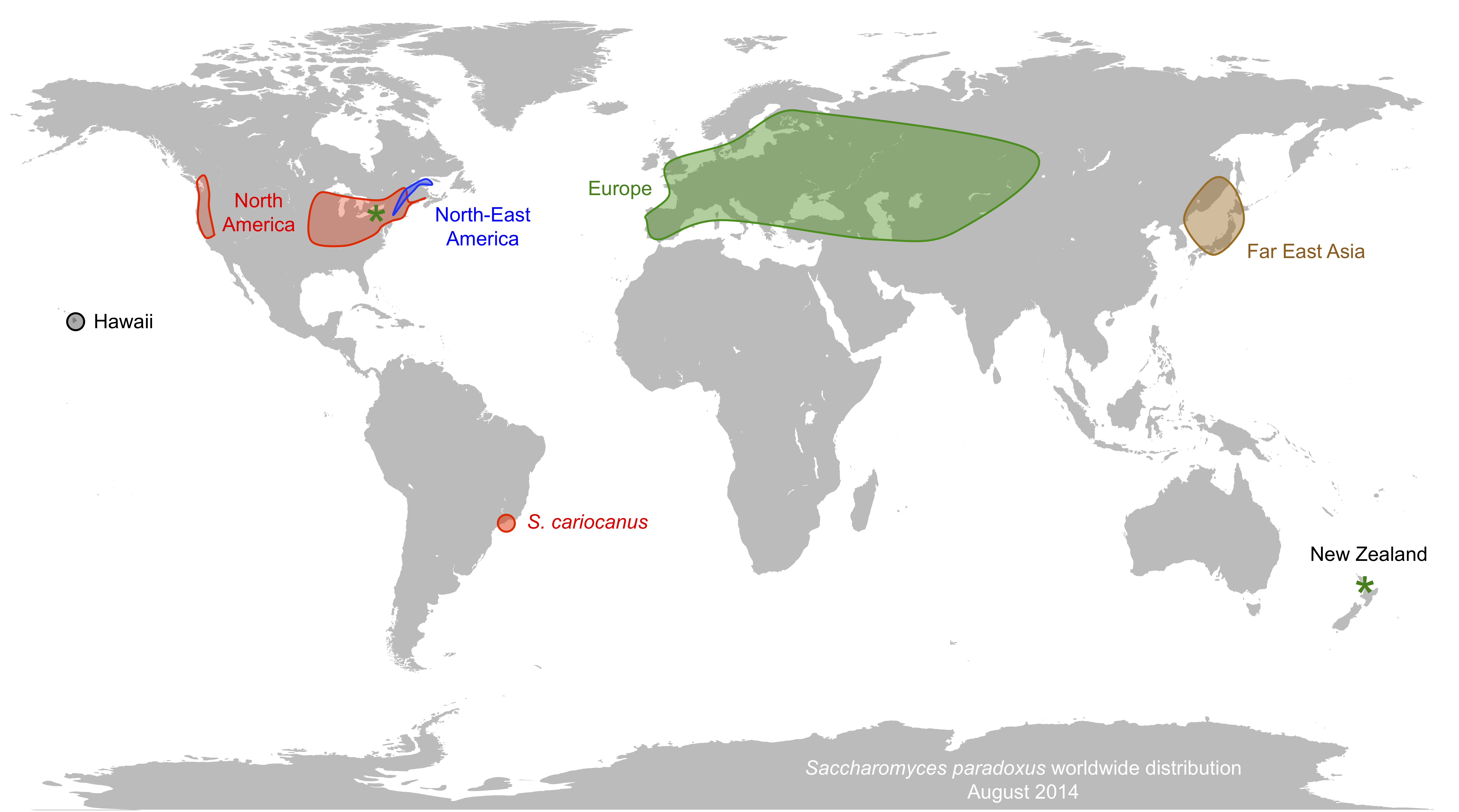
Saccharomyces paradoxus is mostly isolated from deciduous trees (oak, maple, birch), and in some rare occasions on insects and fruits. It is often found in sympatry with other Saccharomyces species. Like Saccharomyces cerevisiae, it has a worldwide distribution and it is mesophilic, which limits its natural distribution to low latitudes. However, Saccharomyces paradoxus typically grows at lower temperatures than Saccharomyces cerevisiae, resulting in a slight shift in its distribution toward cooler regions, like British islands and Eastern Canada.
Biogeography
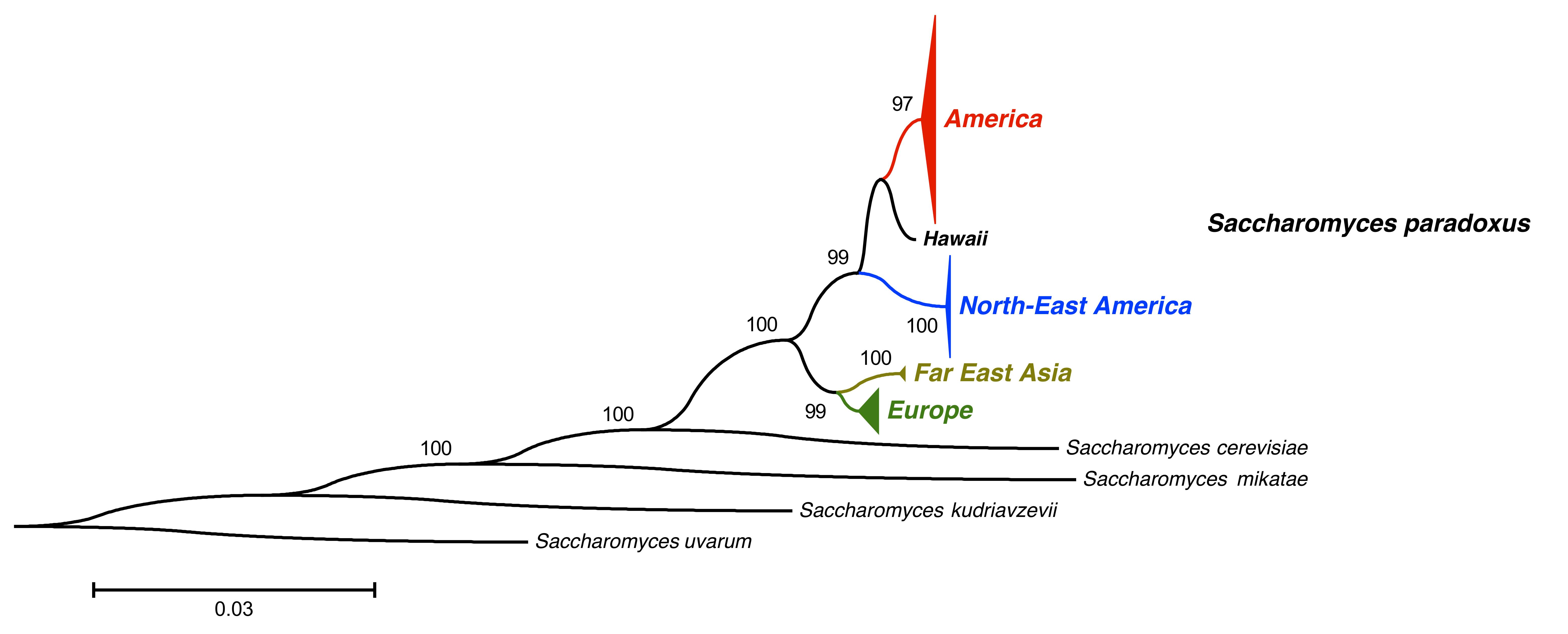
Unlike most other Saccharomyces species, there is no evidence that Saccharomyces paradoxus has been domesticated by humans. Accordingly, its biogeography is mostly marked by natural processes like limited migration, A fifth population is represented by a singleton isolate from Hawaii. Two isolates from South America, described as Saccharomyces cariocanus, are genetically indistinguishable but exhibit post-zygotic isolation when crossed to strains from the American population, due to chromosomal translocations.
Reproduction
Saccharomyces paradoxus is naturally homothallic, and is mostly found as diploid in the environment. Reproduction is mostly clonal and 99% of sexual reproduction occurs between spores from the same ascus. This purges recessive deleterious mutations that accumulated during clonal expansion, in a process known as "genome renewal". Post-zygotic isolation between strains of Saccharomyces paradoxus is commonly observed and could be either due to genetic divergence between populations or to chromosomal changes within populations.
Like in other Saccharomyces species, heterothallism can be restored using standard genetic tools, to obtain stable haploid strains for experimental purposes.
References
References
- (2011). "Yeast evolution and ecology meet genomics". EMBO Reports.
- (2014). "Exploring the northern limit of the distribution of Saccharomyces cerevisiae and Saccharomyces paradoxus in North America". FEMS Yeast Research.
- (2013). "Mixing of vineyard and oak-tree ecotypes of Saccharomyces cerevisiae in North American vineyards". Molecular Ecology.
- (2012). "Ecological structuring of yeasts associated with trees around Hamilton, Ontario, Canada". FEMS Yeast Research.
- (2002). "Saccharomyces cerevisiae and Saccharomyces paradoxus coexist in a natural woodland site in North America and display different levels of reproductive isolation from European conspecifics". FEMS Yeast Research.
- (1998). "Saccharomyces paradoxus and Saccharomyces cerevisiae are associated with exudates of North American oaks". Canadian Journal of Microbiology.
- (2008). "Natural populations of Saccharomyces kudriavzevii in Portugal are associated with oak bark and are sympatric with S. cerevisiae and S. paradoxus". Applied and Environmental Microbiology.
- (2004). "Sympatric natural Saccharomyces cerevisiae and S. paradoxus populations have different thermal growth profiles". FEMS Yeast Research.
- (2004). "Population genetics of the wild yeast Saccharomyces paradoxus". Genetics.
- (2009). "Population genomics of domestic and wild yeasts". Nature.
- (2014). "Chromosomal variation segregates within incipient species and correlates with reproductive isolation". Molecular Ecology.
- (2006). "Sequence diversity, reproductive isolation and species concepts in Saccharomyces". Genetics.
- (2010). "Saccharomyces paradoxus and Saccharomyces cerevisiae reside on oak trees in New Zealand: evidence for migration from Europe and interspecies hybrids". FEMS Yeast Research.
- (2000). "Three new species in the Saccharomyces sensu stricto complex: Saccharomyces cariocanus, Saccharomyces kudriavzevii and Saccharomyces mikatae". International Journal of Systematic and Evolutionary Microbiology.
- (2008). "Population genomics of the wild yeast Saccharomyces paradoxus: Quantifying the life cycle". Proceedings of the National Academy of Sciences of the United States of America.
- (December 1994). "Genome renewal: A new phenomenon revealed from a genetic study of 43 strains ofSaccharomyces cerevisiae derived from natural fermentation of grape musts". Yeast.
- (December 2011). "The consequences of rare sexual reproduction by means of selfing in an otherwise clonally reproducing species". Theoretical Population Biology.
This article was imported from Wikipedia and is available under the Creative Commons Attribution-ShareAlike 4.0 License. Content has been adapted to SurfDoc format. Original contributors can be found on the article history page.
Ask Mako anything about Saccharomyces paradoxus — get instant answers, deeper analysis, and related topics.
Research with MakoFree with your Surf account
Create a free account to save articles, ask Mako questions, and organize your research.
Sign up freeThis content may have been generated or modified by AI. CloudSurf Software LLC is not responsible for the accuracy, completeness, or reliability of AI-generated content. Always verify important information from primary sources.
Report