From Surf Wiki (app.surf) — the open knowledge base
Sabratha
City in Libya
City in Libya
| Field | Value |
|---|---|
| name | Sabratha |
| native_name | صبراتة |
| native_name_lang | ar |
| settlement_type | Town |
| image_skyline | Theatre of Sabratha, Libya.jpg |
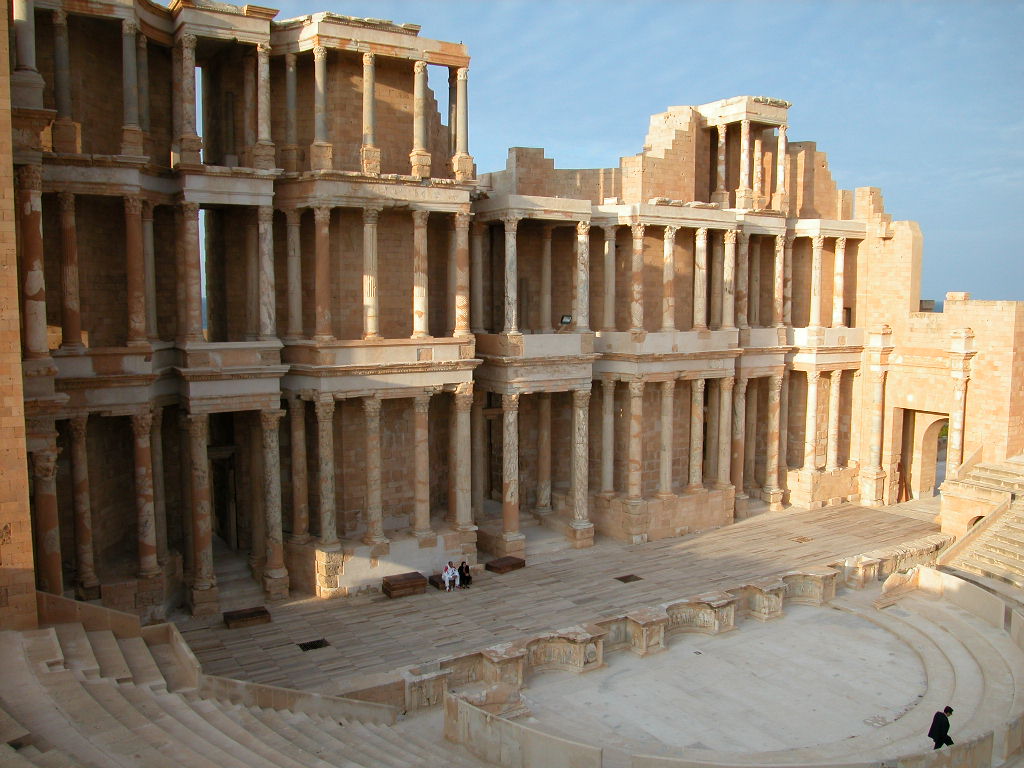
| image_caption | Theater of Sabratha |
| pushpin_map | Libya |
| pushpin_label_position | bottom |
| pushpin_mapsize | 200px |
| pushpin_map_caption | Location in Libya |
| coordinates | |
| subdivision_type | Country |
| subdivision_name | Libya |
| subdivision_type1 | Region |
| subdivision_type2 | District |
| subdivision_name1 | Tripolitania |
| subdivision_name2 | Zawiya |
| established_title | |
| established_title2 | |
| established_title3 | |
| leader_title1 | |
| unit_pref | Imperial |
| area_total_km2 | |
| area_land_km2 | |
| elevation_footnotes | |
| elevation_m | 10 |
| population_total | 102038 |
| population_as_of | 2004 |
| population_footnotes | |
| population_blank1_title | Ethnicities |
| population_blank2_title | Religions |
| postal_code_type | |
| area_code_type | 24 |
| website | sabratha.gov.ly |
| footnotes | {{Infobox UNESCO World Heritage Site |
| child | yes |
| official_name | Archaeological Site of Sabratha |
| includes | |
| criteria | (iii) |
| ID | 184 |
| year | 1982 |
| danger | 2016–... |
| area | |
| coordinates | }} |
| timezone | EET |
| utc_offset | +2 |
Sabratha (; also Sabratah, Siburata), in the Zawiya District of Libya, was the westernmost of the ancient "three cities" of Roman Tripolis, alongside Oea and Leptis Magna. From 2001 to 2007 it was the capital of the former Sabratha wa Sorman District. It lies on the Mediterranean coast about 70 km west of modern Tripoli. The extant archaeological site was inscribed as a UNESCO World Heritage Site in 1982.
History
.jpg)
Sabratha's port was established, perhaps about 500BCE, as the Phoenician trading-post of Tsabratan (, , or {{popdf}}𐤑𐤁{{popdf}}𐤓𐤕𐤏{{popdf}}𐤍, ). This seems to have been a Berber name, suggesting a preëxisting native settlement. The port served as a Phoenician outlet for the products of the African hinterland. Greeks called it Sabrata (), Sabaratha (), Sabratha () and also Abrotonon (). After the demise of Phoenicia, Sabratha fell under the sphere of influence of Carthage.
Following the Punic Wars, Sabratha became part of the short-lived Numidian kingdom of Massinissa before this was annexed to the Roman Republic as the province of Africa Nova in the 1st century BC. It was subsequently romanized and rebuilt in the 2nd and 3rd centuriesCE.
Emperor Septimius Severus was born in nearby Leptis Magna, and Sabratha reached its monumental peak during the rule of the Severan dynasty he founded, expanding nearly twice its previous size. The city was badly damaged by earthquakes during the 4th century, particularly the quake of 365. It fell under control of the Vandal kingdom in the 5th century, with large parts of the city being abandoned. It enjoyed a small revival under Byzantine rule, when multiple churches and a defensive wall (although only enclosing a small portion of the city) were erected. The town was site of a bishopric. Within a hundred years of the Muslim invasion of the Maghreb, trade had shifted to other ports and Sabratha dwindled to a village.
Archaeology
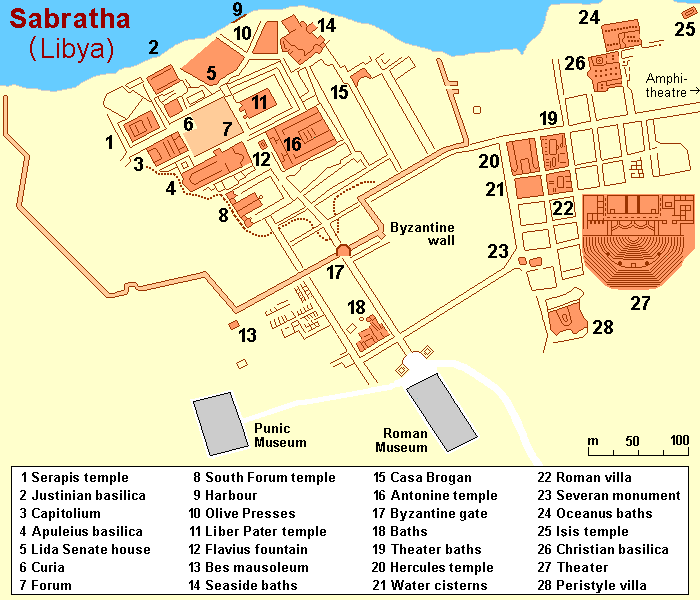
Research history
Sabratha has been the place of several excavation campaigns since 1921, mainly by Italian archaeologists. It was also excavated by a British team directed by Dame Kathleen Kenyon and John Ward-Perkins between 1948 and 1951.
In 1943, during the Second World War, archaeologist Max Mallowan, husband of novelist Agatha Christie, was based at Sabratha as an assistant to the Senior Civil Affairs Officer of the Western Province of Tripolitania. His main task was to oversee the allocation of grain rations, but it was, in the words of Christie's biographer, a "glorious attachment", during which Mallowan lived in an Italian villa with a patio overlooking the sea and dined on fresh tunny fish and olives.
Erosion and weathering damage
According to an April 2016 report, due to soft soil composition and the nature of the coast of Sabratha, which is mostly made up of soft rock and sand, the Ruins of Sabratha are undergoing dangerous periods of coastal erosion. The public baths, olive press building and 'harbor' can be observed as being most damaged as the buildings have crumbled due to storms and unsettled seas. As the most common building material in Sabratah, calcarenite, is highly susceptible to physical, chemical and biological weathering (particularly marine spray), the long-term conservation of the monuments is endangered. Rising sea levels can also compromise the integrity of the site.
This erosion of the coast of Ancient Sabratha can be seen yearly with significant differences in beach layout and recent crumbled buildings. Breakwaters set in the vicinity of the harbor and olive press are inadequate and too small to efficiently protect the Ancient City of Sabratha.
Modern Sabratha
The city is home to Sabratha University. Wefaq Sabratha is the football club, playing at Sabratha Stadium.
As noted in the 2021 documentary The Beatles: Get Back, directed by Peter Jackson, the Sabratha Theater was considered as a possible location where the Beatles could hold their final live concert as a group (they instead performed their last concert on the rooftop of their Apple Corps headquarters).
Climate
Sabratha has a hot semi-arid climate (Köppen climate classification BSh).
Gallery

Panorama
Sabratha excavation Panorama April 2004.jpg|Panoramic image of a part of the archaeological site 2006-10-14 Sebratha D Bruyere.JPG|Panoramic image of the theater of the archaeological site
Archaeological site
Image:Nymphaeum Sabratha 01.JPG|Nymphaeum Image:Nymphaeum Sabratha 02.JPG|Nymphaeum Image:Seaside Bath Sabratha01.JPG|Seaside therms Image:Toilet sabratha 01.JPG|Latrines Image:Laternies Sabratha 02.JPG|Latrines Image:Agora Sabratha.JPG|Сouncil chamber Image:Curia Sabratha.JPG|Curia 4CE Image:Mosaic Peristyle house Sabratha.JPG|Mosaic in the Peristyle house Image:Mosaic Peristyle house Sabratha 01.JPG|Mosaic in the Peristyle house Image:Peristyle house Sabratha 01.JPG|Peristyle house Image:Peristyle house Sabratha 02.JPG|Peristyle house Image:Seawards bath Mosaic Sabratha.JPG|Seawards bath mosaic Image:Inscription Capitolium Sabratha.JPG|Inscription in front of the Capitolium, 2nd centuryBCE Image:Baptisterium Sabratha Apuleus Basilica.JPG|Basilica of Apuleus, Byzantine baptistery Image:Pylone Basilica Apuleus Sabratha.JPG|Basilica of Apuleus, Pylone Image:Flavius Tullus Sabratha.JPG| Fontain of Flavius Tullus at the Antonine Temple Image:Podium Antonine Temple Sabratha.JPG|Podium at the Antonine Temple Image:Portic Antonine Temple Sabratha.JPG|Antonine Temple Image:Podium Antonine Temple Sabratha 01.JPG|Podium at the Antonine Temple Image:Mausoleum of Bes (Sabratha, Az Zawiyah, Libya).jpg|Mausoleum of Bes, 2nd centuryBCE
The theater
Image:Theater Sabratha 01.JPG|Theater in Sabratha city 2nd centuryCE Image:Thater Sabratha 02.JPG|Theater File:Theatre of Sabratha, Libya.jpg|View of the Sabratha theater Image:Theater Sabratha 03.JPG|Marble facing on the wall of theater Image:Theater Sabratha 04.JPG|One of many ways inside of theater Image:Theater Sabratha 05.JPG|Inside ways of theater Image:Theater Sabratha 06.JPG|Ruins of theater Image:Theater Sabratha 07.JPG|Theater Image:Theater Sabratha 08.JPG|Theater Image:Theater Sabratha 09.JPG|One of the few entries to theater Image:Theater Sabratha 10.JPG|Theater Image:Theater Sabratha 11.JPG|Bas-Relief (on bottom of stage), theater Image:Theater Sabratha 12.JPG|Bas-Relief (on bottom of stage), theater Image:Theater Sabratha 13.JPG|Bas-Relief (on bottom of stage), theater Image:Theater Sabratha 14.JPG|Bas-Relief (on bottom of stage), theater Image:Theater Sabratha 15.JPG|Bas-Relief (on bottom of stage), theater Image:Theater Sabratha 17.JPG|Bas-Relief (on bottom of stage), theater Image:Theater Sabratha 18.JPG|Bas-Relief (on bottom of stage), theater Image:Theater Sabratha 19.JPG|Bas-Relief (on bottom of stage), theater Image:Theater Sabratha 20.JPG|High relief, theater Image:Theater Sabratha 21.JPG|High relief, theater Image:Theater Sabratha 22.JPG|Theater Image:Theater Sabratha 23.JPG|Plinth and capital of columns, theater Image:Theater Sabratha 24.JPG|Capital of column, theater Image:Theater Sabratha 25.JPG|Theater Image:Theater Sabratha 26.JPG|Theater Image:Theater Sabratha 27.JPG|Stairs to the stage, theater Image:Theater Sabratha 28.JPG|Theater Image:Theater Sabratha 29.JPG|The gate, theater Image:Theater Sabratha 30.JPG|Architrave and capital, theater Image:Theater Sabratha 31.JPG|Back side of theater Image:Theater Sabratha.JPG|The gate decor element, theater
Museum
Image:Torso Emperor Sabratha.JPG|Torso of the Emperor Vespasian, or his son Titus. 1st century Museum courtyard Image:Mosaic Sabratha 01.JPG|Mosaic. Museum Image:Mosaic Sabratha 02.JPG|Mosaic. Museum Image:Mosaic Sabratha 03.JPG|Mosaic. Museum Image:Mosaic Sabratha 05.JPG|Mosaic from theater baths. Museum."Salvom Lavisse" - "Washing it's well!" Image:Mosaic Sabratha 06.JPG|Mosaic. Museum Image:Mosaic Sabratha 07.JPG|Mosaic. Museum Image:Head Sabratha 01.JPG|Head. Museum Image:Satyr Sabratha.JPG|Marble figure of a satyr. From the Forum. Museum Image:Jupiter Sabratha.JPG|Bust of Jupiter. From the Temple of Jupiter. Museum Image:Concordia Africanus Sabratha.JPG|Bust of Goddess Concordia from the Temple of Jupiter. Museum Image:Candelabrum Sabratha.JPG|Marble candelabrum showing Orpheus and the animals. From Theatre Baths 3rd century Museum Image:Head Sabratha 02.JPG|Head. Museum Image:Decor Element Insula Sabratha.JPG|Decor element of Insula (house). Museum Image:Mosaic Sabratha 08.JPG|Mosaic. Museum Image:Mosaic Sabratha 09.JPG|Basilica of Justinian reconstructed in the Site Museum
References
Citations
Bibliography
- .
- .
References
- "Sabratah - Wolfram|Alpha".
- [http://gpco.gov.ly/online/shabyat.php ''شعبيات الجماهيرية العظمى''{{spaced ndashSha'biyat of Great Jamahiriya], accessed 20 July 2009, in Arabic
- Agence France-Presse. (January 31, 2017). "Libyan coastguard intercepts 700 migrants". [[The Nation (Pakistan).
- [https://books.google.com/books?id=Obu1zSDuUYsC&pg=PA35 Septimius Severus] page 2
- "Dictionary of Greek and Roman Geography (1854), SABRATA".
- [https://topostext.org/work/241#A9.7 Stephanus of Byzantium, Ethnica, §A9.7]
- "Strabo, Geography, book 17, chapter 3, section 18".
- "Pseudo Scylax, Periplous, §110".
- "Archaeological Site of Carthage".
- Francois Decret, Early Christianity in North Africa(James Clarke & Co, 2011) p83
- Moormann, Eric M.. (2011). "Divine Interiors: Mural Paintings in Greek and Roman Sanctuaries". Amsterdam University Press.
- Kenrick, Philip M.. (2009). "Tripolitania". Society for Libyan Studies.
- [[Janet Morgan, Lady Balfour of Burleigh. Janet Morgan]] (1984) ''Agatha Christie: a Biography''
- (March 2014). "Weathering of Calcarenite Monuments at Roman and Byzantine Archaeological Sites at Sabratha, Northwestern Libya: A Pilot Study". African Archaeological Review.
- (2018-10-16). "Mediterranean UNESCO World Heritage at risk from coastal flooding and erosion due to sea-level rise". Nature Communications.
- Daniels, Robert. (26 November 2021). "Peter Jackson's Beatles series Get Back is a feast for one particular kind of fan".
- [https://en.climate-data.org/location/30179/ Climate-data.org]
This article was imported from Wikipedia and is available under the Creative Commons Attribution-ShareAlike 4.0 License. Content has been adapted to SurfDoc format. Original contributors can be found on the article history page.
Ask Mako anything about Sabratha — get instant answers, deeper analysis, and related topics.
Research with MakoFree with your Surf account
Create a free account to save articles, ask Mako questions, and organize your research.
Sign up freeThis content may have been generated or modified by AI. CloudSurf Software LLC is not responsible for the accuracy, completeness, or reliability of AI-generated content. Always verify important information from primary sources.
Report