From Surf Wiki (app.surf) — the open knowledge base
Russian phonology
Sounds and pronunciation of the Russian language

Sounds and pronunciation of the Russian language
This article discusses the phonological system of standard Russian based on the Moscow dialect (unless otherwise noted). For an overview of dialects in the Russian language, see Russian dialects. Most descriptions of Russian describe it as having five vowel phonemes, though there is some dispute over whether a sixth vowel, , is separate from . Russian has 34 consonants, which can be divided into two types:
- hard (твёрдый ) or plain
- soft (мягкий ) or palatalized
Russian also distinguishes hard consonants from soft consonants and from consonant+ clusters, making four sets in total: , although in native words appears only at morpheme boundaries (, for example). Russian also preserves palatalized consonants that are followed by another consonant more often than other Slavic languages do. Like Polish, it has both hard postalveolars () and soft ones ( and marginally or dialectically ).
Russian has vowel reduction in unstressed syllables. This feature also occurs in a minority of other Slavic languages like Belarusian and Bulgarian and is also found in English, but not in most other Slavic languages, such as Czech, Polish, most varieties of Serbo-Croatian, and Ukrainian.
Vowels
| Front | Central | Back | Close | Mid | Open |
|---|---|---|---|---|---|
| () |
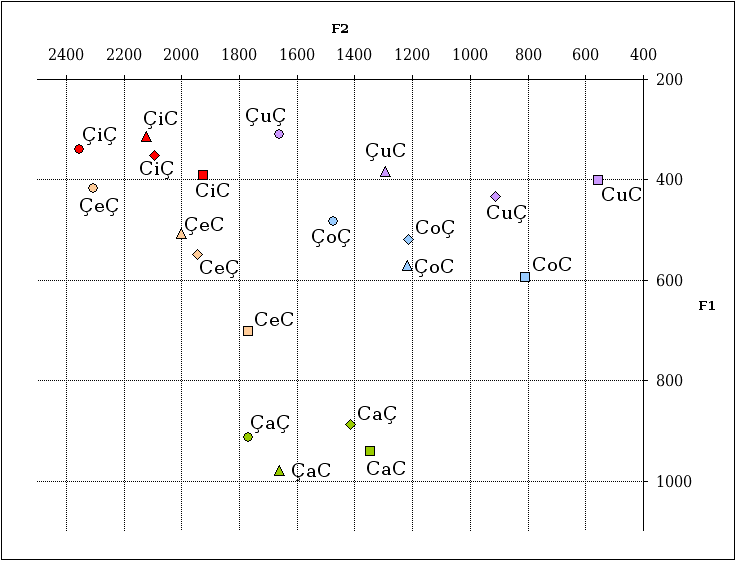
Russian has five to six vowels in stressed syllables, and in some analyses , but in most cases these vowels have merged to only two to four vowels when unstressed: (or ) after hard consonants and after soft ones.
A long-standing dispute among linguists is whether Russian has five vowel phonemes or six; that is, scholars disagree as to whether constitutes an allophone of or if there is an independent phoneme . The five-vowel analysis, taken up by the Moscow school, rests on the complementary distribution of and , with the former occurring after hard (non-palatalized) consonants (e.g. жить 'to live', шип 'thorn, spine', цирк 'circus', etc.) and after soft (palatalized) consonants (e.g. щит 'shield', чин 'rank', etc.). The allophony of the stressed variant of the open is largely the same, yet no scholar considers and to be separate phonemes (which they are in e.g. Slovak).
The six-vowel view, held by the Saint-Petersburg (Leningrad) phonology school, points to several phenomena to make its case:
- Native Russian speakers' ability to articulate in isolation: for example, in the names of the letters and .
- Rare instances of word-initial , including the minimal pair и́кать 'to produce the sound и' and ы́кать 'to produce the sound ы', as well as borrowed names and toponyms, like Ыб , the name of a river and several villages in the Komi Republic.
- Morphological alternations between non-palatalized consonants without any following vowel or before ы and palatalized consonants before и, like гото́в ('ready' adjective, masculine, short-form), гото́вый ('ready' adjective, masculine), and гото́вить ('to get ready; to prepare' verb, transitive), signifying that и palatalizes an inherently non-palatalized underlying consonant while ы does not.
The most popular view among linguists (and the one taken up in this article) is that of the Moscow school, though Russian pedagogy has typically taught that there are six vowels (the term phoneme is not used).
Reconstructions of Proto-Slavic show that *i and *y (which correspond to and ) were separate phonemes. On the other hand, after the first palatalization, Old East Slavic *i and *y contrasted only after alveolars and labials: after palatals only *i occurred, and after velars only *y occurred. With the development of phonemic palatalized alveolars and labials, *i and *y no longer contrasted in any environment and were reinterpreted as allophones of each other, becoming a single phoneme /i/. Even so, this reinterpretation entailed no mergers and no change in the pronunciation. Subsequently, sometime between the twelfth and fourteenth centuries, the allophone of /i/ occurring after a velar consonant changed from [ɨ] to [i] with subsequent palatalization of the velar, turning old Russian хытрыи into modern хитрый and old гыбкыи into modern гибкий .
Allophony
Russian vowels are subject to considerable allophony, subject to both stress and the palatalization of neighboring consonants. In most unstressed positions, in fact, only three phonemes are distinguished after hard consonants, and only two after soft consonants. Unstressed and have merged to (a phenomenon known as ); unstressed and have merged to (); and all four unstressed vowels have merged after soft consonants, except in the absolute final position in a word. None of these mergers are represented in writing.
Front vowels
When a preceding consonant is hard, is retracted to . Formant studies in demonstrate that is better characterized as slightly diphthongized from the velarization of the preceding consonant, implying that a phonological pattern of using velarization to enhance perceptual distinctiveness between hard and soft consonants is strongest before . When unstressed, becomes near-close; that is, following a hard consonant and in most other environments. Between soft consonants, stressed is raised, as in пить ('to drink'). When preceded and followed by coronal or dorsal consonants, is fronted to . After a cluster of a labial and , is retracted, as in плыть ('to float'); it is also slightly diphthongized to .
In native words, only follows unpaired (i.e. the retroflexes and ) and soft consonants. After soft consonants (but not before), it is a mid vowel (hereafter represented without the diacritic, for simplicity), while a following soft consonant raises it to close-mid . Another allophone, an open-mid , occurs word-initially and between hard consonants. Preceding hard consonants retract to and so that жест ('gesture') and цель ('target') are pronounced and respectively.
In words borrowed from other languages, often follows hard consonants; this foreign pronunciation usually persists in Russian for many years until the word is more fully adopted into Russian. For instance, шофёр (from French chauffeur) was pronounced in the early twentieth century, but is now pronounced . On the other hand, the pronunciations of words such as отель ('hotel') retain the hard consonants despite a long presence in the language.
Back vowels
Source:
Between soft consonants, becomes , as in пять ('five'). When not following a soft consonant, is retracted to before /ɫ/ as in палка ('stick').
For most speakers, is a mid vowel , but it can be a more open for some speakers. Following a soft consonant, is centralized and raised to as in тётя ('aunt'). More recently (2015) has been described as "a diphthongoid, with a closer lip rounding at the beginning of the vowel that gets progressively weaker [ʊo] or even [ʊɔʌ], particularly when occurring word-initially or word-finally under the stress". This phenomenon does not seem to be a recent development because the diphthongal nature of /o/ under stress has already been described in 1969.
As with the other back vowels, is centralized to between soft consonants, as in чуть ('barely, slightly'). When unstressed, becomes near-close; central between soft consonants, centralized back in other positions.
Unstressed vowels
Main article: Vowel reduction in Russian
Russian unstressed vowels have lower intensity and lower energy. They are typically shorter than stressed vowels, and in most unstressed positions tend to undergo mergers for most dialects:
- has merged with : for instance, валы́ 'bulwarks' and волы́ 'oxen' are both pronounced (phonetically ).
- has merged with : for instance, лиса́ (lisá) 'vixen' and леса́ 'fishing line' are both pronounced (phonetically ); however, ли́сы (lísy) 'vixens' is pronounced (phonetically ) while ле́сы (lésy) 'fishing-lines' is pronounced (phonetically ).
- and have merged with after soft consonants: for instance, (mésjats) 'month' is pronounced , phonetically .
The merger of unstressed and in particular is less universal in the pretonic (pre-accented) position than that of unstressed and . For example, speakers of some rural dialects as well as the "Old Petersburgian" pronunciation may have the latter but not the former merger, distinguishing between лиса́ and леса́ , but not between валы́ and волы́ (both ). The distinction in some loanwords between unstressed and , or and is codified in some pronunciation dictionaries (, ), for example, фо́рте and ве́то .
Unstressed vowels (except ) are preserved word-finally, for example in second-person plural or formal verb forms with the ending -те, such as ("you do") (phonetically ). The same applies for vowels starting a word.
As a result, in most unstressed positions, only three vowel phonemes are distinguished after hard consonants (, , and ), and only two after soft consonants ( and ). For the most part, Russian orthography (as opposed to that of the closely related Belarusian) does not reflect vowel reduction. This can be seen in, for examples:
- Russian "village" and сёлa "villages" — cf. Belarusian and сёлы . Russian unstressed ё (which is reduced to ) is written as if it were , ⟨e⟩, while Belarusian unstressed ё (which is reduced to ) is transparently written as ⟨я⟩.
- Russian "tomcat" and "tomcats" — cf. Belarusian and . Russian unstressed morphophonemic (which is reduced to ) is written as if it were still , ⟨о⟩, while Belarusian unstressed morphophonemic (which is reduced to a ) is transparently written as ⟨а⟩.
- There exist some exceptional Russian words whose original (from ancestral *o) was and is never stressed across the words' entire inflectional paradigms and thus pronounced or (depending on its position), and then is rewritten as (as if it were morphophonemic ); for instances:
- паро́м ('ferry'), which is from Proto-Slavic *pormъ;
- карава́й [kərɐˈvaj] ('korovai'), which is from PSl. *korvajь etc.
- Spelling those words with ⟨а⟩ was already common in the 18th century, but it co-existed with the spelling with ⟨о⟩ (пором, коровай), conforming to etymology of those words. Dictionaries often gave both spellings. Finally the spelling of those words with ⟨а⟩ was set by the 1956 orthographic codification (orthographic rules and spelling dictionary), based on the spread of usage.
- There exist some exceptional Russian words whose original (from ancestral *o) was and is never stressed across the words' entire inflectional paradigms and thus pronounced or (depending on its position), and then is rewritten as (as if it were morphophonemic ); for instances:
Vowel mergers
In terms of actual pronunciation, there are at least two different levels of vowel reduction: vowels are less reduced when a syllable immediately precedes the stressed one, and more reduced in other positions. This is particularly visible in the realization of unstressed and , where a less-reduced allophone appears alongside a more-reduced allophone .
The pronunciation of unstressed is as follows:
- (sometimes transcribed as ; the latter is phonetically correct for the standard Moscow pronunciation, whereas the former is phonetically correct for the standard Saint Petersburg pronunciation; this article uses only the symbol ) appears in the following positions:
- In the syllable immediately before the stress, when a hard consonant precedes: e.g. наро́д ('people, nation'), моро́з ('frost'), дрова́ ('firewood'), and трава́ ('grass').
- In absolute word-initial position: e.g. аванга́рд ('vanguard'), огоро́д ('kitchen garden').
- In hiatus, when the vowel occurs twice without a consonant between; this is written , , , or : сообража́ть ('to use common sense, to reason').
- appears elsewhere, when a hard consonant precedes: о́блако ('cloud'), я́года ('berry').
- In absolute word-final position, may occur instead, especially at the end of a syntagma.
- When a soft consonant or precedes, both and merge with and are pronounced as . Example: язы́к ('tongue'), ежи́ ('hedgehogs') ( is written as in these positions; compare ёж 'hedgehog').
- This merger also tends to occur after formerly soft consonants now pronounced hard (, , ), where the pronunciation occurs; e.g. шевели́ть 'to stir ~ to move ~ to bulge'. This always occurs when the spelling uses the soft vowel variants, e.g. жена́ ('wife') vs. жёны ('wives') (but шок 'shock (n.)' vs. шоки́ровать 'to shock (v.)'; unstressed spellings , are used only in loanwords). However, also occurs in a few word roots where the spelling writes a hard . Examples:
- жаль 'regret', whence жале́ть ('to regret'), к сожале́нию ('unfortunately').
- ло́шадь ~ ('horse [sg. nom. & acc.]'), whence лошаде́й, ('horses' [pl. gen. & acc.]').
- -дцать- in numbers: e.g. двадцати́ ('twenty [gen., dat., prep.]'), тридцатью́ ('thirty [instr.]').
- ржано́й ~ ('rye [adj. m. nom.]').
- жасми́н ~ ('jasmine [n. sg. nom. & acc.]').
- After those now-hardened formerly-soft consonants (, , ) and in word-final position, unstressed and unstressed (the latter written as ) merge and are pronounced , as in:
- пыльца́ ('pollen') vs. уби́йца ('murderer, assassin'),
- строжа́йше ('most strictly', adv.) vs. хорошо́ ('good', neut. predic. or 'well', adv.),
- похо́же ('similar(ly)', neut. predic. or adv.), vs. свежо́ ('fresh(ly)', neut. predic. or adv.), and
- де́ревце ('sapling, small tree') vs. its synonym деревцо́ .
- Yet word-final unstressed after and is also pronounced by some speakers: e.g. строжа́йше , похо́же .
- These processes occur even across word boundaries as in под морем ('under the sea').
The pronunciation of unstressed is after soft consonants and , and word-initially (эта́п ('stage'); икра́ ('roe'); диви́ть ('to surprise'), etc.), but after hard consonants (дыша́ть ('to breathe')).
There are a number of exceptions to the above vowel-reduction rules:
- Vowels may not merge in foreign borrowings, particularly with unusual or recently borrowed words such as ра́дио, 'radio'. In such words, unstressed may be pronounced as , regardless of context; unstressed does not merge with in initial position or after vowels, so word pairs like эмигра́нт and иммигра́нт, or эмити́ровать and имити́ровать, differ in pronunciation.
- Across certain word-final inflections, the reductions do not completely apply. For example, after soft or unpaired consonants, unstressed , and of a final syllable may be distinguished from each other. For example, жи́тели ('residents') contrasts with both (о) жи́теле ('[about] a resident') and жи́теля ('(of) a resident'). Also, хо́дит ('he goes') and хо́дят ('they go').
- If the vowel belongs to the conjunctions но ('but') or то ('then'), it is not reduced, even when unstressed.
Other changes
Unstressed is generally pronounced as a lax (or near-close) , e.g. мужчи́на ('man'). Between soft consonants, it becomes centralized to , as in юти́ться ('to huddle').
Note a spelling irregularity in of the reflexive suffix -ся: with a preceding -т- in third-person present and a -ть- in infinitive, it is pronounced as , i.e. hard instead of with its soft counterpart, since , normally spelled with , is traditionally always hard. In other forms both pronunciations and (or and after vowels, spelled -сь) alternate for a speaker with some usual form-dependent preferences: in the outdated dialects, reflexive imperative verbs (such as бо́йся, lit. "be afraid yourself") may be pronounced with instead of modern (and phonetically consistent) . In adverbial participles ending on -я́сь or -а́сь (with a stressed suffix), books on Russian standard pronunciation prescribe as the only correct variant.
In weakly stressed positions, vowels may become voiceless between two voiceless consonants: вы́ставка ('exhibition'), потому́ что ('because'). This may also happen in cases where only the following consonant is voiceless: че́реп ('skull').
Phonemic analysis
Because of mergers of different phonemes in unstressed position, the assignment of a particular phone to a phoneme requires phonological analysis. There have been different approaches to this problem:
- The Saint Petersburg phonology school assigns allophones to particular phonemes. For example, any is considered as a realization of .
- The Moscow phonology school uses an analysis with morphophonemes (морфоне́мы, singular морфоне́ма). It treats a given unstressed allophone as belonging to a particular morphophoneme depending on morphological alternations. For example, is analyzed as either or . To make a determination, one must seek out instances where an unstressed morpheme containing in one word is stressed in another word. Thus, because the word ('shafts') shows an alternation with ('shaft'), this instance of belongs to the morphophoneme . Meanwhile, ('oxen') alternates with ('ox'), showing that this instance of belongs to the morphophoneme . If there are no alternations between stressed and unstressed syllables for a particular morpheme, then no assignment is made, and existence of an archiphoneme is postulated. For example, the word ('dog') is analysed as , where is an archiphoneme.
- Some linguists prefer to avoid making the decision. Their terminology includes strong vowel phonemes (the five) for stressed vowels plus several weak phonemes for unstressed vowels: thus, represents the weak phoneme , which contrasts with other weak phonemes, but not with strong ones.
Diphthongs
Russian diphthongs all end in a non-syllabic , an allophone of and the only semivowel in Russian. In all contexts other than after a vowel, is considered an approximant consonant. Phonological descriptions of may also classify it as a consonant even in the coda. In such descriptions, Russian has no diphthongs.
The first part of diphthongs is subject to the same allophony as their constituent vowels. Examples of words with diphthongs: ('egg'), ей ('her' dat.), де́йственный ('effective'). , written or , is a common inflexional affix of adjectives, participles, and nouns, where it is often unstressed; at normal conversational speed, such unstressed endings may be monophthongized to . When stressed, this affix is spelled and pronounced . Unstressed may be pronounced (as if spelled ) in free variation with . In adjectives ending in , traditional Moscow norm prescribed the pronunciation (as if spelled ), but now those adjectives are usually pronounced according to the spelling, thus . The same can be said about verbs ending in .
Consonants
denotes palatalization, meaning the center of the tongue is raised during and after the articulation of the consonant. Phonemes that have at different times been disputed are enclosed in parentheses.
| Labial | Dental, | |||||||||||||||||||||
|---|---|---|---|---|---|---|---|---|---|---|---|---|---|---|---|---|---|---|---|---|---|---|
| Alveolar | Post- | |||||||||||||||||||||
| alveolar | Palatal | Velar | hard | soft | hard | soft | hard | soft | hard | soft | Nasal | Stop | voiceless | voiced | Affricate | Fricative | voiceless | voiced | Approximant | Trill | ||
| () | ||||||||||||||||||||||
| () | () | () |
; Notes
- Most consonant phonemes come in hard–soft pairs, except for always-hard and always-soft and formerly or marginally . There is a marked tendency of Russian hard consonants to be velarized or uvularized, though this is a subject of some academic dispute. Velarization is clearest before the front vowels and , and with labial and velar consonants as well as the lateral. As with palatalization, it results in vowel colouring and diphthongisation when stressed, in particular with , realized approximately as or . Its function is to make the contrast between hard and soft consonants perceptually more salient, and the less salient the contrast is otherwise (such as labial consonants being cross-linguistically the most resistant to palatalization), the higher the velarization degree.
- and are always hard in native words (even if spelling contains a "softening" letter after them, as in жена, шёлк, жить, and мышь). A few loanwords are spelled with or ; authoritative pronunciation dictionaries prescribe hard pronunciation for some of them (e.g. брошюра, парашют, амбушюр, шюцкор) but soft for other ones (e.g. пшют, фишю); жюри may be pronounced either way. The letter combinations , , , , , and also occur in foreign proper names, mostly of French or Lithuanian origin. Notable examples include Гёльджюк (Gölcük), Жён Африк (Jeune Afrique), Жюль Верн (Jules Verne), Герхард Шюрер (Gerhard Schürer), Шяуляй (Šiauliai), and Шяшувис (Šešuvis). The dictionary of prescribes soft pronunciation in these names. However, since the cases of soft and are marginal and not universally pronounced as such, and are generally considered always-hard consonants, and the long phonemes and are not considered their soft counterparts, as they do not pattern in the same ways that other hard–soft pairs do.
- is generally listed among the always-hard consonants; however, certain foreign proper names, including those of Ukrainian, Polish, Lithuanian, or German origin (e.g. Цюрупа, Пацюк, Цявловский, Цюрих), as well as loanwords (e.g., хуацяо, from Chinese), contain a soft . The phonemicity of a soft is supported by neologisms that come from native word-building processes (e.g. фрицёнок, шпицята). However, according to , really is always hard, and realizing it as palatalized is considered "emphatically non-standard", and occurs only in some regional accents.
- and are always soft.
- is also always soft. A formerly common pronunciation of indicates the sound may be two underlying phonemes: and , thus can be considered as a marginal phoneme. In today's most widespread pronunciation, appears (instead of ) for orthographical -зч-/-сч- where ч- starts the root of a word, and -з/-с belongs to a preposition or a "clearly distinguishable" prefix (e.g. без часо́в , 'without a clock'; расчерти́ть , 'to rule'); in all other cases is used ( , , перепи́счик , сча́стье , , исщипа́ть , расщепи́ть etc.)
- The marginally phonemic sound is largely obsolete except in the more conservative standard accent of Moscow, in which it only occurs in a handful of words; insofar as this soft pronunciation is lost, the corresponding hard replaces it: e.g. ~ . This sound may derive from an underlying or : заезжа́ть , modern . For most speakers, it can most commonly be formed by assimilative voicing of (including across words): . For more information, see alveolo-palatal consonant and retroflex consonant.
- and are somewhat concave apical postalveolar. They may be described as retroflex, e.g. by , but this is to indicate that they are not laminal nor palatalized; not to say that they are subapical. They also tend to be at least slightly labialized, including when followed by unrounded vowels.
- Hard are laminal denti-alveolar ; unlike in many other languages, does not become velar before velar consonants.
- Hard has been variously described as pharyngealized apical alveolar and velarized laminal denti-alveolar .
- Hard is postalveolar, typically a trill .
- Soft is an apical dental trill , usually with only a single contact.
- Soft are laminal alveolar . As of the twenty-first century are affricated in most contexts. This phenonomenon of affrication is known in Russian as tsekan'ye and dzekan'ye, and it is paralleled in Belarusian.
- Soft is either laminal alveolar or laminal denti-alveolar .
- are dental , i.e. dentalized laminal alveolar. They are pronounced with the blade of the tongue very close to the upper front teeth, with the tip of the tongue resting behind the lower front teeth.
- The voiced are often realized with weak friction or even as approximants , particularly in spontaneous speech.
- A marginal phoneme occurs instead of in certain interjections: , , угу́, эге, о-го-го́, э-ге-ге, гоп. (Thus, there exists a minimal pair of homographs: ага́ 'aha!' vs ага́ 'agha'). The same sound can be found in (spelled , though in цейхга́уз 'arsenal', is ), optionally in га́битус 'habitus' and in a few other loanwords. Also optionally (and less frequently than a century ago) can be used instead of in certain religious words (a phenomenon influenced by Church Slavonic pronunciation): Бо́га , Бо́гу ... (declension forms of Бог 'God'), Госпо́дь 'Lord' (especially in the exclamation Го́споди! 'Oh Lord!'), благо́й 'good'.
- Some linguists (like I. G. Dobrodomov and his school) postulate the existence of a phonemic glottal stop . This marginal phoneme can be found, for example, in the word не́-а . Claimed minimal pairs for this phoneme include 'narrowed' (a participle from 'to narrow', with prefix and root -уз-, cf. у́зкий 'narrow') vs су́женый 'betrothed' (originally a participle from суди́ть 'to judge', now an adjective; the root is суд 'court') and с А́ней 'with Ann' vs Са́ней '(by) Alex'.
There is some dispute over the phonemicity of soft velar consonants. Typically, the soft–hard distinction is allophonic for velar consonants: they become soft before front vowels (e. g. 'wall', genitive , but 'hand, arm', genitive ) unless there is a word boundary, in which case they are hard (e.g. к Ива́ну 'to Ivan'). Hard variants occur everywhere else. Exceptions are represented mostly by:
- Loanwords:
- Soft: гёзы, , гяу́р, секью́рити, кекс, кяри́з, са́нкхья, хянга́;
- Hard: кок-сагы́з, гэ́льский, акы́н, кэб (кеб), хэ́ппенинг.
- Proper nouns of foreign origin:
- Soft: Алигье́ри, Гёте, Гю́нтер, Гянджа́, Джокьяка́рта, Кёнигсберг, Кюраса́о, Кя́хта, Хью́стон, Хёндэ, Хю́бнер, Пюхяя́рви;
- Hard: Мангышла́к, Гэ́ри, Кызылку́м, Кэмп-Дэ́вид, Архы́з, Хуанхэ́.
The rare native examples are fairly new, as most of them were coined in the last century:
- Soft: forms of the verb ткать 'weave' (ткёшь, ткёт etc., and derivatives like соткёшься); догёнок/догята, герцогёнок/герцогята; and adverbial participles of the type берегя, стерегя, стригя, жгя, пекя, секя, ткя (it is disputed whether these are part of the standard language or just informal colloquialisms);
- Hard: the name гэ of letter , acronyms and derived words (кагэбэшник, днепрогэсовский), a few interjections (гы, кыш, хэй), some onomatopoeic words (гыгыкать), and colloquial forms of certain patronyms: Олегыч, Маркыч, Аристархыч (where -ыч is a contraction of standard language's patronymical suffix -ович rather than a continuation of ancient -ич).
In the mid-twentieth century, a small number of reductionist approaches made by structuralists put forth that palatalized consonants occur as the result of phonological processes involving (or palatalization as a phoneme in itself), so that there were no underlying palatalized consonants. Despite such proposals, linguists have long agreed that the underlying structure of Russian is closer to that of its acoustic properties, namely that soft consonants are separate phonemes in their own right.
Voicing
| Voiced | Voiceless |
|---|---|
| Б /b/ | П /p/ |
| В /v/ | Ф /f/ |
| Г /ɡ/ | К /k/ |
| Д /d/ | Т /t/ |
| Ж /ʐ/ | Ш /ʂ/ |
| З /z/ | С /s/ |
| Л /l/ | – |
| М /m/ | – |
| Н /n/ | – |
| Р /r/ | – |
| – | Х /x/ |
| – | Ц /ts/ |
| – | Ч /tɕ/ |
| – | Щ /ɕː/ |
| Й /j/ | – |
Final devoicing
Voiced consonants (, and ) are devoiced word-finally unless the next word begins with a voiced obstruent. In other words, their voiceless equivalent will be used (see table on the right).
Examples:
- (story, tale) sounds like расскас
- (knife) sounds like нош
- (Ivanov) sounds like Иваноф ; and so on.
Г also represents voiceless word-finally in some words, such as ('god'). This is related to the use of the marginal (or dialectal) phoneme in some religious words .
Voicing elsewhere
Generally, when a voiced consonant comes before a voiceless one, its sound will shift to its voiceless equivalent (see table).
- Example: (spoon) sounds like Лошка .
That happens because ж is a voiced consonant, and it comes before the voiceless к.
The same logic applies when a voiceless consonant comes before a voiced one (except в). In this case, the sound of the former will change to its voiced equivalent.
- Example: (to do) sounds like зделать [ˈzʲdʲeɫətʲ].
Russian features general regressive assimilation of voicing and palatalization. In longer clusters, this means that multiple consonants may be soft despite their underlyingly (and orthographically) being hard. The process of voicing assimilation applies across word-boundaries when there is no pause between words. Within a morpheme, voicing is not distinctive before obstruents (except for , and when followed by a vowel or sonorant). The voicing or devoicing is determined by that of the final obstruent in the sequence: просьба ('request'), водка ('vodka'). In foreign borrowings, this is not always the case for , as in Адольф Гитлер ('Adolf Hitler') and граф болеет ('the count is ill'). and are unusual in that they seem transparent to voicing assimilation; in the syllable onset, both voiced and voiceless consonants may appear before :
- тварь ) ('the creature')
- два ('two')
- световой ('of light')
- звезда ('star')
When precedes and follows obstruents, the voicing of the cluster is governed by that of the final segment (per the rule above) so that voiceless obstruents that precede are voiced if is followed by a voiced obstruent (e.g. к вдове 'to the widow') while a voiceless obstruent will devoice all segments (e.g. без впуска 'without an admission').
, , and have voiced allophones (, and ) before voiced obstruents, as in дочь бы ('a daughter would'), плацдарм ('bridge-head') and горох готов ('peas are ready').
Other than and , nasals and liquids devoice between voiceless consonants or a voiceless consonant and a pause: контрфорс ) ('buttress').
Palatalization
Before , paired consonants (that is, those that come in a hard-soft pair) are normally soft as in пью ('I drink') and бью ('I hit'). However, the last consonant of prefixes and parts of compound words generally remains hard in the standard language: отъезд ('departure'), Минюст ('[Min[istry of] Justice]'); when the prefix ends in or there may be an optional softening: съездить ('to travel').
Paired consonants preceding are also soft; although there are exceptions from loanwords, alternations across morpheme boundaries are the norm. The following examples show some of the morphological alternations between a hard consonant and its soft counterpart:
| Hard | Soft | Russian | IPA/Audio | Translation | Russian | IPA/Audio | Translation |
|---|---|---|---|---|---|---|---|
| дом | 'house' (nom) | до́ме | 'house' (prep) | ||||
| крова́вый | 'bloody' | крова́веть | 'to become bloody' | ||||
| отве́т | 'answer' | отве́тить | 'to answer' | ||||
| (я) несу́ | 'I carry' | (он, она, оно) несёт | 'carries' | ||||
| жена́ | 'wife' | же́нин | 'wife's' | ||||
| коро́ва | 'cow' | коро́вий | 'bovine' | ||||
| прямо́й | 'straight' | прямизна́ | 'straightness' | ||||
| вор | 'thief' | вори́шка | 'little thief (diminutive)' | ||||
| написа́л | 'he wrote' | написа́ли | 'they wrote' | ||||
| горбу́н | 'hunchback' | горбу́нья | 'female hunchback' | ||||
| высо́к | 'high' | высь | 'height' |
Velar consonants are soft when preceding , and never occur before within a word.
Before hard dental consonants and , labial and dental consonants are hard: орла́ ('eagle' gen. sg), cf. орёл ('eagle' nom. sg).
Assimilative palatalization
Paired consonants preceding another consonant often inherit softness from it. This phenomenon in literary language has complicated and evolving rules with many exceptions, depending on what these consonants are, in what morphemic position they meet and to what style of speech the word belongs. In old Moscow pronunciation, softening was more widespread and regular; nowadays some cases that were once normative have become low colloquial or archaic. In fact, consonants can be softened to differing extents, become semi-hard or semi-soft.
The more similar the consonants are, the more they tend to soften each other. Also, some consonants tend to be softened less, such as labials and .
Softening is stronger inside the word root and between root and suffix; it is weaker between prefix and root and weak or absent between a preposition and the word following.
- Before soft dental consonants, and often soft labial consonants, dental consonants (other than ) are soft.
- is assimilated to the palatalization of the following velar consonant: лёгких ) ('lungs' gen. pl.).
- Palatalization assimilation of labial consonants before labial consonants is in free variation with nonassimilation, such that бомбить ('to bomb') is either or depending on the individual speaker.
- When hard precedes its soft equivalent, it is also soft and likely to form a single long sound (see gemination). This is slightly less common across affix boundaries.
In addition to this, dental fricatives conform to the place of articulation (not just the palatalization) of following postalveolars: с частью ) ('with a part'). In careful speech, this does not occur across word boundaries.
Russian has the rare feature of nasals not typically being assimilated in place of articulation. Both and appear before retroflex consonants: деньжонки ) ('money' (scornful)) and ханжой ) ('sanctimonious one' instr.). In the same context, other coronal consonants are always hard.
Assimilative palatalization may sometimes also occur across word boundaries as in других гимназий , but such pronunciation is uncommon and characteristic of uncareful speech (except in preposition+main word combinations).
Consonant clusters
As a Slavic language, Russian has fewer phonotactic restrictions on consonants than many other languages, allowing for clusters that would be difficult for English speakers; this is especially so at the beginning of a syllable, where Russian speakers make no sonority distinctions between fricatives and stops. These reduced restrictions begin at the morphological level; outside of two morphemes that contain clusters of four consonants: встрет-/встреч- 'meet' (), and чёрств-/черств- 'stale' (), native Russian morphemes have a maximum consonant cluster size of three:
| Russian | IPA/Audio | Translation |
|---|---|---|
| CCL | скрыва́ть | |
| CCN | мгнове́ние | |
| CCC* | ствол | |
| LCL | верблю́д | |
| LCC | то́лстый |
For speakers who pronounce instead of , words like общий ('common') also constitute clusters of this type.
| Russian | IPA/Audio | Translation |
|---|---|---|
| CC | кость | |
| LC | смерть | |
| CL | слепо́й | |
| LL | го́рло | |
| CJ | статья́ | |
| LJ | рья́ный |
If is considered a consonant in the coda position, then words like айва́ ('quince') contain semivowel+consonant clusters.
Affixation also creates consonant clusters. Some prefixes, the best known being вз-/вс- (), produce long word-initial clusters when they attach to a morpheme beginning with consonant(s) (e.g. ||+ || → вспы́шка 'flash'). However, the four-consonant limitation persists in the syllable onset.
Clusters of three or more consonants are frequently simplified, usually through syncope of one of them, especially in casual pronunciation.
All word-initial four-consonant clusters begin with or , followed by a stop (or, in the case of , a fricative), and a liquid:
| Russian | IPA/Audio | Translation |
|---|---|---|
| (ему) взбрело (в голову) | '(he) took it (into his head)' | |
| взгляд | 'gaze' | |
| взгромоздиться | 'to perch' | |
| вздрогнуть | 'to flinch' | |
| всклокоченный | 'disheveled' | |
| вскрыть | 'to unseal' | |
| всплеск | 'splash' | |
| вспрыгнуть | 'to jump up' | |
| встлеть | 'to begin to smolder' | |
| встречать | 'to meet' | |
| всхлип | 'whimper' | |
| всхрапывать | 'to snort' |
Because prepositions in Russian act like clitics, the syntactic phrase composed of a preposition (most notably, the three that consist of just a single consonant: к, с, and в) and a following word constitutes a phonological word that acts like a single grammatical word. This can create a 4-consonant onset cluster not starting in or ; for example, the phrase в мгнове́ние ('in an instant') is pronounced [].
In the syllable coda, suffixes that contain no vowels may increase the final consonant cluster of a syllable (e.g. Ноя́брьск 'city of Noyabrsk' ||+ || → ), theoretically up to seven consonants: *мо́нстрств ('of monsterhoods'). There is usually an audible release of plosives between these consecutive consonants at word boundaries, the major exception being clusters of homorganic consonants.
Consonant cluster simplification in Russian includes degemination, syncope, dissimilation, and weak vowel insertion. For example, is pronounced , as in расще́лина ('cleft'). There are also a few isolated patterns of apparent cluster reduction (as evidenced by the mismatch between pronunciation and orthography) arguably the result of historical simplifications. For example, dental stops are dropped between a dental continuant and a dental nasal or lateral: ле́стный 'flattering' (from ле́сть 'flattery'). Other examples include:
| маркси́стский | 'Marxist' (adj.) | (not ) |
|---|
Compare: со́лнечный 'solar, sunny', серде́чный 'heart (adj.), cordial', Шотла́ндия 'Scotland', маркси́ст 'Marxist' (person).
The simplifications of consonant clusters are done selectively; bookish-style words and proper nouns are typically pronounced with all consonants even if they fit the pattern. For example, the word голла́ндка is pronounced in a simplified manner for the meaning of 'Dutch oven' (a popular type of oven in Russia) and in a full form for 'Dutch woman' (a more exotic meaning). The orthographic combination is pronounced in the words здра́вствуй(те) [ˈzdrastvʊj(tʲe)] 'hello', чу́вство [ˈt͡ɕustvə] 'feeling' (does not have related words with pronounced in the modern language, so the first in the spelling exists only for historical reasons), безмо́лвствовать [bʲɪzˈmoɫstvəvətʲ] 'to be silent', and related words, otherwise pronounced : баловство́ [bəɫɐfstˈvo] 'naughtiness'.
In certain cases, this syncope produces homophones, e.g. ко́стный ('bony') and ко́сный ('rigid'), both are pronounced .
Another method of dealing with consonant clusters is inserting an epenthetic vowel (both in spelling and in pronunciation), after most prepositions and prefixes that normally end in a hard consonant. This includes both historically motivated usage (from historical extra-short vowel ) and cases of its modern extrapolations. There are no strict limits when the epenthetic is obligatory, optional, or prohibited. One of the most typical cases of the epenthetic is between a morpheme-final hard consonant and a cluster starting with the same or similar consonant. E.g. со среды́ 'from Wednesday' ||+|| → , not *с среды; ототру́ 'I'll scrub' ||+|| → , not *оттру. The interfix (spelled after soft consonants) is also used in compound words: пищево́д 'oesophagus' (lit. food path) ||+|| → .
Stress
Stress in Russian is phonemic and therefore unpredictable. It may fall on any syllable, and can vary drastically in similar or related words. For example, in the following table, in the numbers 50 and 60, the stress moves to the last syllable, despite having a structure similar to, say, 70 and 80:
| Word | No. |
|---|---|
| де́сять | 10 |
| два́дцать | 20 |
| три́дцать | 30 |
| со́рок | 40 |
| пятьдеся́т | 50 |
| шестьдеся́т | 60 |
| се́мьдесят | 70 |
| во́семьдесят | 80 |
| девяно́сто | 90 |
Words can also contrast based just on stress (e.g. му́ка 'ordeal, pain, anguish' vs. мука́ 'flour, meal, farina'). Stress shifts can even occur within an inflexional paradigm: до́ма ('house' gen. sg., or 'at home') vs дома́ ('houses'). The place of the stress in a word is determined by the interplay between the morphemes it contains, as morphemes may be obligatorily stressed, obligatorily unstressed, or variably stressed.
Generally, only one syllable in a word is stressed; this rule, however, does not extend to most compound words, such as моро́зоусто́йчивый ('frost-resistant'), which have multiple stresses, with the last of them being primary.
Phonologically, stressed syllables are mostly realised not only by the lack of aforementioned vowel reduction, but also by a somewhat longer duration than unstressed syllables. More intense pronunciation is also a relevant cue, although this quality may merge with prosodical intensity. Pitch accent has only a minimal role in indicating stress, mostly due to its prosodical importance, which may prove a difficulty for Russians identifying stressed syllables in more pitched languages.
A stress defines a phonological concept of phonetic word — a sequence of morphemes clustered around one nuclear stress. A phonetic word may contain multiple lexical items.
Supplementary notes
There are numerous ways in which Russian spelling does not match pronunciation. The historical transformation of into in genitive case endings and the word for 'him' is not reflected in the modern Russian orthography: the pronoun его 'his/him', and the adjectival declension suffixes -ого and -его. Orthographic г represents in a handful of word roots: легк-/лёгк-/легч- 'easy' and мягк-/мягч- 'soft'. There are a handful of words in which consonants which have long since ceased to be pronounced even in careful pronunciation are still spelled, e.g., the 'l' in солнце ('sun').
The phoneme is often realized as before stressed vowels, especially in emphatic speech. Between any vowel and (excluding instances across affix boundaries but including unstressed vowels that have merged with ), may be dropped: мои ('my', pl.), аист ('stork'), делает ('does'). ( cites заезжать and other instances of intervening prefix and preposition boundaries as exceptions to this tendency.) Unstressed sequences and after vowels may be realized as , : большая ('big', f.), знаю ('(I) know').
velarizes hard consonants: ты ('you' sing.). and velarize and labialize hard consonants and labialize soft consonants: бок ('side'), нёс ('(he) carried'). is a diphthong or even a triphthong , with a closer lip rounding at the beginning of the vowel that gets progressively weaker, particularly when occurring word-initially or word-finally under stress.
A weak palatal offglide may occur between certain soft consonants and back vowels (e.g. ляжка 'thigh' ).
References
Bibliography
- {{citation |editor-last=Ageenko |editor-first=F.L. |editor2-last=Zarva |editor2-first=M.V. |script-title=ru:Словарь ударений русского языка
- {{citation
- {{citation |orig-year=1956 |script-title=ru:Фонетика современного русского литературного языка |trans-title=Phonetics of modern standard Russian
- {{citation |editor-last=Borunova |editor-first=C.N. |editor2-last=Vorontsova |editor2-first=V.L. |editor3-last=Yes'kova |editor3-first=N.A. |script-title=ru:Орфоэпический словарь русского языка. Произношение. Ударение. Грамматические формы |trans-title=Orthoepical dictionary of the Russian language. Pronunciation. Stress. Grammatical forms
- {{cite book |editor1-last=Barkhudarov |editor1-first=S. G |editor2-last=Protchenko |editor2-first=I. F |editor3-last=Skvortsova |editor3-first=L. I |script-title=ru:Орфографический словарь русского языка |trans-title=Orthographic Russian dictionary
- {{citation
- {{citation
- {{citation |editor1-last=Shopen |editor1-first=Timothy
- {{citation
- {{citation |editor-last=Borunova |editor-first=C.N. |editor2-last=Vorontsova |editor2-first=V.L. |editor3-last=Yes'kova |editor3-first=N.A. |script-title=ru:Орфоэпический словарь русского языка. Произношение. Ударение. Грамматические формы |trans-title=Orthoepical dictionary of the Russian language. Pronunciation. Stress. Grammatical forms
- {{citation
- {{citation
- {{citation |url-status=dead |archive-url=https://web.archive.org/web/20120206015223/http://www.bcs.rochester.edu/cls/s2000n1/crosswhite.pdf |archive-date=2012-02-06
- {{citation
- {{citation
- {{citation
- {{citation |trans-title=Guttural obstruent role in the word end alternation after reduced vowels fall
- {{citation
- {{citation |author-link=Morris Halle
- {{citation |url-status = dead |archive-url = https://web.archive.org/web/20150414230437/http://www.fon.hum.uva.nl/silke/articles/Hamann%202004.pdf |archive-date = 2015-04-14
- {{cite book
- {{citation |author-link=Daniel Jones (phonetician)
- {{citation
- {{citation
- {{citation |editor-last=Kuznetsov |editor-first=V.V. |editor2-last=Ryzhakov |editor2-first=M.V. |trans-title=Pupil's universal reference book
- {{citation |author-link=Peter Ladefoged |author-link2=Ian Maddieson
- {{citation
- {{citation
- {{citation |trans-title=Russian grammar. Part 1. Phonetics, morphology. Textbook for the 8th and 9th grades of non-Russian schools
- {{citation |access-date=2012-05-04 |archive-date=2010-06-10 |archive-url=https://web.archive.org/web/20100610114730/http://vanhise.lss.wisc.edu/ling/files/ling_old_web/lso/wpl/5.1/LSOWP5.1-11-Ostapenko.pdf |url-status=dead
- {{cite book |trans-title=Russian dictionary
- {{citation |editor-last=Hume |editor-first=Elizabeth |editor2-last=Johnson |editor2-first=Keith |url-access=subscription
- {{citation
- {{citation |editor-last=Holt |editor-first=D. Eric
- {{citation |access-date= 2007-10-29 |archive-date= 2007-09-27 |archive-url= https://web.archive.org/web/20070927054247/http://people.ucsc.edu/~padgett/locker/vreductpaper.pdf |url-status= dead
- {{citation
- {{citation |author-link=Jerzy Rubach
- {{citation |editor1-last=Comrie |editor1-first=Bernard |editor2-last=Corbett |editor2-first=Greville. G. |chapter-url=https://books.google.com/books?id=uRF9Yiso1OIC |editor1-link=Bernard Comrie
- {{citation
- {{cite book |editor1-last=Shcherba |editor1-first=Lev V. |editor1-link=Lev Shcherba |trans-title=Russian grammar. Part 1. Phonetics and morphology. Textbook for the fifth and sixth grades of seven-year school and high school
- {{citation
- {{citation
- {{Citation |chapter-url=https://books.google.com/books?id=-VFNWqXxRoMC&pg=PA28
- {{citation |editor-last=Vinogradov |editor-first=V. V.
- {{citation
- {{citation |doi-access=free
- {{citation |trans-chapter=Rules of pronunciation |editor-last=Ageenko |editor-first=F.L. |editor2-last=Zarva |editor2-first=M.V. |script-title=ru:Словарь ударений русского языка
- {{cite book |trans-title=Russian. I. Lexicography, phonetics, and morphology. Textbook for teachers' colleges
- {{citation |author-link=Elizabeth Zsiga
- {{citation |access-date=2014-06-22 |archive-date=2017-10-11 |archive-url=https://web.archive.org/web/20171011125931/http://www.zas.gwz-berlin.de/fileadmin/material/ZASPiL_Volltexte/zp32/zaspil32-zygis.pdf |url-status=dead
References
- See, for example, {{Harvcoltxt. Ozhegov. 1953. Barkhudarov. Protchenko. Skvortsova. 1987. Chew. 2003. ы, {{lang. ru. еры {{IPA. [jɪˈrɨ] ''yery''; since 1961 this name has been replaced from the Russian school practice (compare the 7th and 8th editions of the standard textbook of Russian for 5th and 6th grades: {{Harvcoltxt. Barkhudarov. Kryuchkov. 1960. Barkhudarov. Kryuchkov. 1961
- See, for example, {{Harvcoltxt. Shcherba. 1950. Matiychenko. 1950. Zemsky. Svetlayev. Kriuchkov. 1971. Kuznetsov. Ryzhakov. 2007
- Thus, {{IPA. /ɨ/ is pronounced something like {{IPA. [ɤ̯ɪ], with the first part sounding as an on-glide {{Harvcoltxt. Padgett. 2003b
- As in [[Igor Severyanin]]'s poem, [http://poetrylibrary.ru/stixiya/severyanin-1.html {{lang. ru. Сегодня не приду . . .]
- Boryś, Wiesław. (2005). "Proto-Slavic/pormъ". Wydawnictwo Literackie.
- Vasmer, Max. (1964–1973). "Этимологический словарь русского языка". Progress.
- (1984). "Этимологический словарь славянских языков". Nauka.
- {{Harvcoltxt. Yanushevskaya. Bunčić. 2015
- С. В. Князев, С. К. Пожарицкая. Современный русский литературный язык. Фонетика, графика, орфография, орфоэпия. Москва, 2005. P. 184.
- Аванесов, Р. И.. (1984). "Русское литературное произношение". Просвещение.
- However, in imperatives ending in {{lang. ru. -ть- or {{lang. ru. -дь- plus {{lang. ru. -ся, the {{lang. ru. -ть- or {{lang. ru. -дь- remains soft in the pronunciation: {{lang. ru. пя́ться {{IPA. [ˈpʲætʲs⁽ʲ⁾ə], imperative of {{lang. ru. пя́титься {{IPA. [ˈpʲætʲɪt͡sə] 'to move back'.
- Wade, Terence Leslie Brian. (2010). "A Comprehensive Russian Grammar". John Wiley & Sons.
- Аванесов, Р. И.. (1984). "Русское литературное произношение". Просвещение.
- Аванесов, Р. И.. (1984). "Русское литературное произношение". Просвещение.
- С. В. Князев, С. К. Пожарицкая. Современный русский литературный язык. Фонетика, графика, орфография, орфоэпия. Москва, 2005. P. 240.
- С. В. Князев, С. К. Пожарицкая. Современный русский литературный язык. Фонетика, графика, орфография, орфоэпия. Москва, 2005. — Page 171. — 320 pages. — (Gaudeamus). — ISBN 5-8291-0545-4.
- e.g. {{Harvcoltxt. Avanesov. 1975
- Аванесов, Р. И.. (1984). "Русское литературное произношение". Просвещение.
- С. В. Князев, С. К. Пожарицкая. Современный русский литературный язык. Фонетика, графика, орфография, орфоэпия. Москва, 2005. P. 190.
- [[Ushakov dictionary]], vol. 1 (1935), column XXXIV.
- Аванесов, Р. И.. (1984). "Русское литературное произношение". Просвещение.
- Аванесов, Р. И.. (1984). "Русское литературное произношение". Просвещение.
- Litvin, Natallia. (2014). "An Ultrasound Investigation of Secondary Velarization in Russian".
- {{Harvcoltxt. Ashby. 2011. /lʲ/ and {{IPA. /ɫ/ (...)."
- Because of the acoustic properties of {{IPA. [u] and {{IPA. [i] that make velarization more noticeable before front vowels and palatalization before back vowels {{Harvcoltxt. Padgett. 2003b argues that the contrast before {{IPA. /i/ is between ''velarized'' and ''plain'' consonants rather than ''plain'' and ''palatalized''.
- (2019). "Velarization of Russian labial consonants". International Congress of Phonetic Sciences ICPhS 2019.
- Bateman, Nicoleta. (2007-06-29). "A Crosslinguistic Investigation of Palatalization". UC San Diego.
- See dictionaries of {{Harvcoltxt. Ageenko. Zarva. 1993 and {{Harvcoltxt. Borunova. Vorontsova. Yes'kova. 1983.
- {{Harvcoltxt. Ageenko. Zarva. 1993 and {{Harvcoltxt. Borunova. Vorontsova. Yes'kova. 1983 prescribe the soft pronunciation, the more recent «Словарь трудностей русского произношения» (М. Л. Каленчук, Р. Ф. Касаткина, 2001) states the hard pronunciation as the main variant and the soft pronunciation as admissible but obsolescent.
- The dictionary {{Harvcoltxt. Ageenko. Zarva. 1993 explicitly says that the nonpalatalized pronunciation {{IPA. /ts/ is an error in such cases.
- See Avanesov's pronunciation guide in {{Harvcoltxt. Avanesov. 1985
- {{Harvcoltxt. Yanushevskaya. Bunčić. 2015. /ʃʲː/ consonant has no voiced counterpart in the system of phonemes. However, in conservative Moscow standard and only in a handful of lexical items the combination {{IPA. /ʒʒ/ may be pronounced with palatalisation, e.g. ''drožži'' 'yeast' as {{IPA. [ˈd̪rʊoˑʒʲːɪ] instead of {{IPA. [ˈd̪rʊɔˑʒːɨ], although this realisation is now also somewhat obsolete."
- {{Harvcoltxt. Jones. Ward. 1969
- {{Harvcoltxt. Koneczna. Zawadowski. 1956. Ladefoged. Maddieson. 1996
- {{Harvcoltxt. Jones. Ward. 1969
- {{Harvcoltxt. Mathiassen. 1996
- {{Harvcoltxt. Skalozub. 1963. Ladefoged. Maddieson. 1996
- {{Harvcoltxt. Jones. Ward. 1969
- Knyazev, Sergey. (2016). "Affricated dental plosives in Russian: Phonological status and perceptual cues as a trigger of sound changes". Linguistica Lettica.
- {{Harvcoltxt. Jones. Ward. 1969
- {{Harvcoltxt. Zygis. 2003
- see {{Harvcoltxt. Lightner. 1972 and {{Harvcoltxt. Bidwell. 1962 for two examples.
- See {{Harvcoltxt. Stankiewicz. 1962 and {{Harvcoltxt. Folejewski. 1962 for a criticism of Bidwell's approach specifically and the reductionist approach generally.
- Russian language course "Russo Sem Mestre" (Portuguese for ''Russian without Master''), by Custódio Gomes Sobrinho
- {{Harvcoltxt. Chew. 2003
- Аванесов, Р. И.. (1984). "Русское {{lang". Просвещение.
- Paul Cubberley, ''Russian: A Linguistic Introduction'', [https://books.google.com/books?id=yOGzAyN3V88C&pg=PA67 p. 67]
- {{Harvcoltxt. Yanushevskaya. Bunčić. 2015
- С. В. Князев, С. К. Пожарицкая. Современный русский литературный язык. Фонетика, графика, орфография, орфоэпия. Москва, 2005. Pp. 39, 182.
- {{Harvcoltxt. Yanushevskaya. Bunčić. 2015
This article was imported from Wikipedia and is available under the Creative Commons Attribution-ShareAlike 4.0 License. Content has been adapted to SurfDoc format. Original contributors can be found on the article history page.
Ask Mako anything about Russian phonology — get instant answers, deeper analysis, and related topics.
Research with MakoFree with your Surf account
Create a free account to save articles, ask Mako questions, and organize your research.
Sign up freeThis content may have been generated or modified by AI. CloudSurf Software LLC is not responsible for the accuracy, completeness, or reliability of AI-generated content. Always verify important information from primary sources.
Report