From Surf Wiki (app.surf) — the open knowledge base
Rugby League World Cup
International rugby league football tournament

International rugby league football tournament
| Field | Value |
|---|---|
| current_season | 2026 Men's Rugby League World Cup |
| seasontag | Upcoming tournament |
| logo | RLWC trophy.jpg |
| pixels | 200px |
| founded | |
| teams | 10 (from 2026 finals) |
| countrytag | Region |
| country | International |
| gov_body | IRL |
| champion | |
| season | 12th title |
| most_champs | |
| count | 12 |
| website | |
| related_comps | Women's World Cup |
| Wheelchair World Cup | |
| World Cup 9s |
the Men's Rugby League World Cup
Wheelchair World Cup World Cup 9s
The Rugby League World Cup is an international rugby league competition contested by senior men's national teams who each represent member nations of the International Rugby League who run and administer the tournament.
The tournament has been held with varying frequencies and formats throughout history, however is currently played every four years with a group and knockout structure in line with most other major sports competitions. The inaugural tournament was held in France in 1954, and was the first Rugby World Cup held for any form of rugby football. The idea of the tournament was first proposed in France in the 1930s with the intent to hold a tournament in 1931. A second failed attempt came in 1951.
The winners are awarded the Paul Barrière Trophy, named after Paul Barrière, the French Rugby League President of the 1940s and 1950s. are the most successful team in the competition's history, winning the Paul Barrière Trophy twelve times, and appearing in every final bar 1954. have the second highest number of titles with three, and have also won the tournament once.
The latest edition of World Cup was the 2021 tournament held England and played in 2022 after being postponed due to the COVID-19 pandemic. Australia are the tournament's current champions.
History
Main article: History of the Rugby League World Cup
Pre–1994: Original round robin World Cup
1935–1960: Establishment and triennial competitions
The Rugby League World Cup was an initiative of the French who had been campaigning for a competition since 1935. The idea was raised in 1951 by Paul Barrière, the President of the French Rugby League. In 1952, Rugby Football League secretary Bill Fallowfield persuaded the Rugby League Council to support the concept. At a meeting in Blackpool, England in 1953, the International Board accepted Paul Barrière's proposal that France should be the nation to host the first tournament to be officially known as the "Rugby World Cup". In addition to the hosts, the tournament featured teams from Britain, Australia and New Zealand.{{cite news | access-date = 2009-12-25}} The 1954 Rugby League World Cup was won by Great Britain who defeated France in Paris on 13 November to claim the title.
Following the success of the maiden World Cup three years later another tournament was held in Australia, marking 50 years of rugby league in the country. Unlike the previous tournament, teams played each other in a league format. It was then decided that the team that finished first in the league would be declared the winner. Australia proved victorious on their home ground.
Another three years would pass until the next World Cup in 1960, this time held in England. It would be the second time Great Britain won the competition. Despite a home nation victory the World Cup suffered from poor crowds due to the live broadcast of games for the first time.
1960–1977: Sporadic competitions
After a disappointing attendances in 1960, the World Cup would not be played for another eight years. The competition had been scheduled to be held in France in 1965, this time with the inclusion of the South African team.{{cite news | archive-url = https://archive.today/20130103052930/http://news.google.com/newspapers?id=E1MVAAAAIBAJ&sjid=u-UDAAAAIBAJ&pg=3222,4068871 | url-status = dead | archive-date = 2013-01-03 | access-date = 2009-10-06}} However, after an unsuccessful tour of Australia, the French withdrew, effectively postponing the tournament until 1968, when Australia and New Zealand hosted and the World Cup final made a return.
The World Cup found more success in the 70s with four tournaments being played. The first, the 1972 World Cup where the final was contested between Great Britain and Australia ended 10–10, and the title was awarded to Great Britain by virtue of their superior record in the qualifiers. Great Britain were captained by Welshman Clive Sullivan who was the first black player to captain any British national sports team. The final at the Stade de Gerland in Lyon witnessed what is (as of 2021) the last British team to win the Rugby League World Cup.
In 1975, the competition underwent a radical overhaul with the tournament being held across multiple confederations. Great Britain was split into England and Wales due to Wales wanting to showcase the high level of talent they had on offer that year (no Scottish or Irish players made the original Great Britain squad). This resulted in the tournament increasing from four teams to five for the first time. There was not a final held to decide the champions of the 1975 tournament and so Australia won by virtue of topping the group standings. As Australia had not beaten England in that tournament a final challenge match was hastily arranged which Australia would win 25–0.
In 1977, Great Britain competed again as a single entity. Although the final between Australia and Great Britain was a closely fought affair, public interest in the tournament waned due to the continuing tinkering with the format and it was not held again until the mid-1980s.
1982–1994: No host nation and first expansion
From 1985 to 1988, each nation played each other a number of times on a home and away basis with a number of these games also being considered part of various international tours that took place during the years in which these world cups were being played. At the end of that period, Australia met New Zealand at Eden Park. The match was a physical encounter, and Australian captain Wally Lewis played part of the match with a broken arm. The Kangaroos won the competition 25–12 in front of a capacity crowd of nearly 48,000 spectators.
This format was repeated from 1989 to 1992 (with games once again also being part of tours) and Australia won again, defeating Great Britain 10–6 at Wembley Stadium in front of 73,361 people. This crowd remained a Rugby League World Cup record (and a record for any rugby league international match) until beaten by the 74,468 crowd which attended the 2013 World Cup final at Old Trafford. The fifth nation to compete in these two tournaments was Papua New Guinea, where rugby league is the national, and most popular sport.
1995–present: The modern World Cup
1995: Birth of the modern World Cup
Main article: 1995 Rugby League World Cup
In 1995, the competition was held in England and Wales. It was again restructured, returning to the traditional "host / co-host" format, and intended (like in 1954) to be a triennial competition. The tournament expanded to ten teams with Fiji, Samoa, South Africa, and Tonga making their world cup deputes. Great Britain had also split permanently into England, Scotland, Wales, and Ireland, although only England and Wales qualified. Unlike previous tournaments where the top two teams in the table played in the final, a knockout stage was added, with quarter and semi-finals. Due to the Super League war, players aligned with the Super League competition were not selected by the ARL to represent Australia, which meant the absence of many star players. The tournament, which was also held to celebrate the centenary of the sport, saw over 250,000 people attending the group stages and over 66,000 people attending the final, in which Australia defeated England 16–8.
2000: Super League delay, financial issues, and hiatus
Main article: 2000 Rugby League World Cup
Intended for 1998, the next World Cup was delayed for two years due to the Super League war and the subsequent re-structuring of rugby league's international governing bodies meant that the proposed 1998 World Cup was postponed.{{cite book
In 2000, the World Cup was held in the United Kingdom, Ireland, and France, and expanded the field further, with sixteen teams entering. This tournament included a New Zealand Maori representative team, the only time this team has taken part, as well as debuts for the Cook Islands, Ireland, Russia, and Scotland. Australia won the tournament by beating New Zealand 40–12 in the final at Old Trafford, Manchester. In the same year, the first Women's Rugby League World Cup was held, with New Zealand defeating Great Britain in the final.
Numerous issues, including poor organization and blown-out scorelines, meant that this tournament was seen as highly unsuccessful with an average attendance just half that of the previous tournament.
2000–2008: Hiatus
After the failure of the 2000 World Cup, the scheduled 2003 World Cup did not see any formal planning. A plan to hold a tournament in 2005 was also put on ice. The Rugby League World Cup was replaced by the Rugby League Tri-Nations as the RLIF's pinnacle competition, reviving the 1999 tri-series competition initially intended as a one-off.
2008: Re-establishment and regular competitions
Main article: 2008 Rugby League World Cup
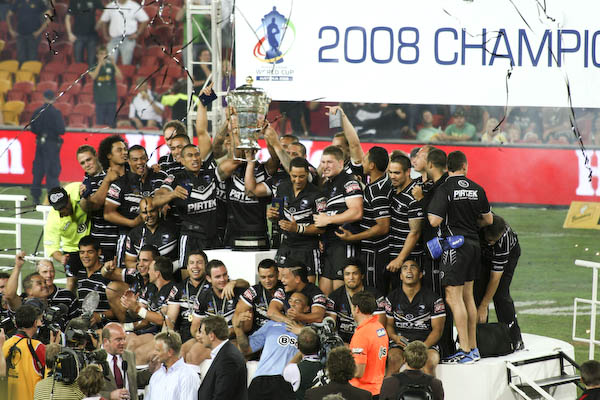
The Rugby League World Cup returned in 2008 as part of Australia's centenary celebrations of rugby league being played in the country. The competition reverted to a 10-team format, resembling as almost identical format to the 1995 edition. The tournament also moved from every three to every four years inline with most other major international sports competitions. The tournament saw New Zealand were crowned champions for the first time by beating the host nation at Lang Park, Brisbane. New Zealand became only the third team to win the world cup and the first other than Australia since Great Britain's last win in 1972. The tournament was once again seen as a success with a 91% average attendance increase on the previous competition.
2013: Olympic delay and tournament growth
Main article: 2013 Rugby League World Cup
2013 saw England and Wales host the tournament, beating a bid from Australia. The tournament was expanded to 14 teams for this edition, and was originally scheduled for 2012, but was moved very early in its organisation to 2013 due to the United Kingdom hosting the 2012 Summer Olympics. The tournament saw Italy and the United States play in their first world cup. Australia took the title again after defeating New Zealand in the final by a score of 34–2. The final attendance became the record international rugby league attendance at 74,468. The competition was considered the most successful competition to date. The tournament delivered record profits of £3.7 million, and saw a direct economic impact of £9.6 million. The tournament was watched by 450,000 spectators and a further 18.8 million on television, with an estimated 14% never having been to a rugby league event prior to the tournament.
2017: Continued growth
Main article: 2017 Rugby League World Cup
2017 Rugby League World Cup taking place in Australia, New Zealand and for the first time in Papua New Guinea. While Australia would claim the title once again and for an eleventh time, the tournament was considered highly successful in terms of competitiveness. The tournament would see Tonga beat New Zealand in the group stages with a score of 28–22 to top the group, the first time a team from outside the top 3 had beaten a top 3 nation in over two decades. New Zealand went on to play Fiji in the quarter-finals and lost once again with a score of just 4–2, knocking New Zealand out in the quarter-finals, the first time a tier 1 nation had exited the tournament at this early stage. Tonga played England in the semi-finals and while conceding 20 unanswered points, they would score 3 tries in just the last seven minutes to pull the score back to 20–18, eventually losing by this close margin. The final was contested between Australia and England at Lang Park, Brisbane and Australia won by just 6–0, the lowest score in world cup final history.
2021: Further growth despite COVID-19 impact
Main article: 2021 Men's Rugby League World Cup
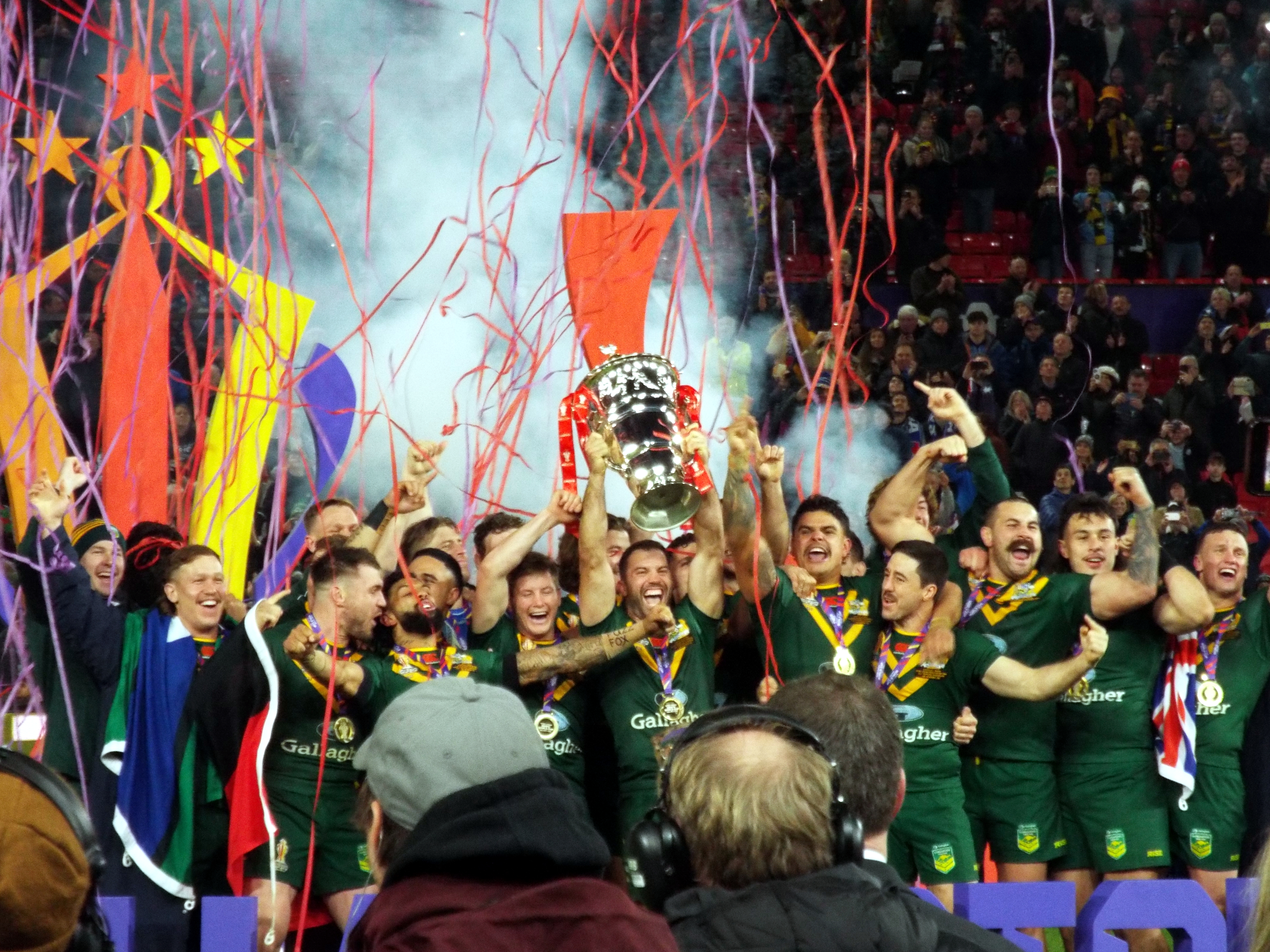
England were chosen to host the 2021 tournament which was postponed to 2022 due to Australia and New Zealand withdrawing due to the COVID-19 pandemic. with organisers expressing a desire to see a total of one million fans attend games. This tournament saw the number of teams increased to 16 once again, with Greece and Jamaica debuting in the competition. In 2021, the women's and wheelchair competitions were given equal prominence with the men's tournament, as a result all three competition were run simultaneously for the first time. Australia again won the competition, beating final debutants Samoa 30–10. The 2021 tournament was the most watched rugby league world cup in history, and was regarded as a sporting, commercial, and social success by the IRL.
2025–26: Hosting issues
Main article: 2025 Men's Rugby League World Cup, 2026 Men's Rugby League World Cup
A proposal was put forward in 2016 to hold the 2025 Rugby League World Cup in the United States and Canada,{{cite news |access-date=21 November 2016}}{{cite news
On 11 January 2022, the IRL announced France would host the tournament in 2025, however on 15 May 2023 France pulled out of hosting the tournament after a newly elected French government withdrew financial support. A day later, New Zealand announced they were considering a bid, but would possibly require a delay to 2026.
On 3 August, the IRL announced that the tournament would be postponed to 2026 and held in the southern hemisphere with only 10 teams taking part. It was later confirmed on 24 July 2024 that Australia would host the tournament with a number of games co-hosted by Papua New Guinea.
Fixtures for the tournament were announced on 23 November 2025, and would see the quarter finals scrapped for the 2026 edition with only four teams advancing to the knockouts.
2030
Main article: 2030 Men's Rugby League World Cup, 2030 Women's Rugby League World Cup, 2030 Wheelchair Rugby League World Cup
With the announcement of the 2025 World Cup being moved to 2026 came confirmation that the following men's competition would be held in 2030. In the announcement International Rugby League confirmed that the tournament would be held once again as a stand alone competition with the women's and wheelchair tournaments held separately in 2028 and 2029 respectively, all on a four-year cycle. In December 2025, the IRL announced a reversal of this decision and will continue holding the three world cup competitions concurrently, thus postponing the 2028 Women and 2029 Wheelchair tournaments to 2030.
Trophy
Main article: Paul Barrière Trophy

The World Cup trophy was commissioned by French Fédération Française de Rugby à XIII president Paul Barrière at a cost of eight million francs, and then donated to the International Rugby League Board to be used for the inaugural competition in 1954. This trophy was used and presented to the winning nation for the first four tournaments, before being stolen in 1970. After its recovery, the trophy was reinstated for the 2000 tournament.
Format
Qualification
Main article: Rugby League World Cup qualification
Qualifying rounds were first introduced for the 2000 World Cup. Hosts and teams reaching the knockout rounds of the previous tournament automatically qualify for the next. The remaining spots are achieved through regional qualification tournaments, split between the four International Rugby League confederation Asia-Pacific, Americas, Europe, and Middle East-Africa. Because of a changing number of teams making the finals and entering the qualifiers, and the unpredictability of the geographic spread of teams automatically qualifying, the format of the qualification tournament has changed with each edition of the tournament.
Finals
The Rugby League World Cup has followed a varied range of formats throughout its history as the number of teams participating has increased.
The current format has been in use since the 2021 tournament, in addition to the 2000 tournament. This format features 16 teams split into four groups of four playing a single round robin. Each team is awarded two points for a win and one point for a draw. The top two teams from each group qualify for the knockout stage.
The eight teams in the quarter-finals play each other with the four winners progressing to the semi-finals before the World Cup final. If the teams are level after 80 minutes extra time will be played and if the two teams are still level after extra time, a golden point will be played.
This will be temporary altered for the 2026 tournament due to its late rescheduling, the exact format to be used remains unknown.
Hosts
Main article: Rugby League World Cup hosts
Due to the early World Cups being contested between Australia, England, France and New Zealand and the fact rugby league is most popular in these regions they have regularly hosted the World Cup between themselves. World Cups in 1985–88 and 1989–92 were all jointly hosted by the four founding nations.
New Zealand has never solely hosted a World Cup but they have co-hosted with Australia on three occasions with 2017 also jointly co-hosted with Papua New Guinea. England have co-hosted once with Wales in 2013 although the 2000 World Cup was played across the UK as well as some games in Ireland and France.
France hosted the first World Cup in 1954 and again in 1972 as well as hosting games at the 2000 and 2013 World Cups.
Despite the World Cup mainly being hosted by England, Australia, France and New Zealand, countries such as UAE, South Africa and the United States and Canada have applied to host the tournament in the past.
| Confederation | Total | Hosts |
|---|---|---|
| Asia-Pacific | 6 | 1957: |
| Australia | ||
| 1968: | ||
| Australia, New Zealand | ||
| 1975: | ||
| Australia, New Zealand* | ||
| 1977: | ||
| Australia, New Zealand | ||
| 2008: | ||
| Australia | ||
| 2017: | ||
| Australia, New Zealand, Papua New Guinea | ||
| 2026: | ||
| Australia | ||
| Europe | 9 | 1954: |
| France | ||
| 1960: | ||
| Great Britain | ||
| 1970: | ||
| Great Britain | ||
| 1972: | ||
| France, | ||
| 1975: | ||
| France, Great Britain* | ||
| 1995: | ||
| England, Wales | ||
| 2000: | ||
| England, France, IRE Ireland, Scotland, Wales | ||
| 2013: | ||
| England, Wales | ||
| 2021: | ||
| England | ||
| Middle East-Africa | 0 | |
| Americas | 0 |
- Co-hosted between confederation
NB: As Great Britain was the IRL nation until 1995, the United Kingdom is used to refer to host nations before this time regardless of the number of home nations which actually hosted the tournament.
Stadiums
Main article: Rugby League World Cup venues
In total, 81 stadiums have hosted world cup games over the 14 tournaments. Headingley Stadium in Leeds has hosted the tournament the most times, having had games in eight world cups with Central Park, Wigan and Lang Park, Brisbane having hosted six tournaments. 52 stadiums have hosted matches in just one tournament. The most stadiums used in a tournament was in 2000 when 26 stadiums were used; the stadium capacity was the highest ever at 704,400. However, the occupancy was also the lowest ever at just 37.46%.
The largest stadium in terms of capacity ever used was Wembley Stadium, London with a seating capacity of 90,000; the stadium was used in the 2013 tournament as the venue for the semi-final double-header. The smallest stadium ever used was also in 2013 when The Gnoll, Neath, with a capacity of 5,000 hosted a game between Wales and Cook Islands. Despite this, it was not the lowest attended game; this was in the 2000 World Cup when just 1,497 attended the game between Wales and Lebanon at Stradey Park, Llanelli.
The cities with the most stadiums used are Sydney and London with 4 each. Hull and Auckland are the cities with the next highest number with 3 each.
| Rank | Country | Stadiums | |
|---|---|---|---|
| 1 | 33 | ||
| 2 | 21 | ||
| 3 | 13 | ||
| 4 | 7 | ||
| 5 | 6 | ||
| 6 | IRE Ireland | 3 | |
| 7 | 2 | ||
| 2 |
Results
| Ed | Year | Host | Final | Third / fourth place | Number of teams | Winners | Score | Runners-up | Third place | Fourth place | 1 | 2 | 3 | 4 | 5 | 6 | 7 | 8 | 9 | 10 | Losing semi finalists | 11 | 12 | 13 | 14 | 15 | 16 | 17 | 18 |
|---|---|---|---|---|---|---|---|---|---|---|---|---|---|---|---|---|---|---|---|---|---|---|---|---|---|---|---|---|---|
| 1954 | France | **** | 16–12 | 4 | |||||||||||||||||||||||||
| 1957 | Australia | **** | round-robin | 4 | |||||||||||||||||||||||||
| 1960 | **** | round-robin | 4 | ||||||||||||||||||||||||||
| 1968 | Australia | ||||||||||||||||||||||||||||
| New Zealand | **** | 20–2 | 4 | ||||||||||||||||||||||||||
| 1970 | **** | 12–7 | 4 | ||||||||||||||||||||||||||
| 1972 | France | **** | 10–10 | ||||||||||||||||||||||||||
| 4 | |||||||||||||||||||||||||||||
| 1975 | |||||||||||||||||||||||||||||
| **** | round-robin | 5 | |||||||||||||||||||||||||||
| 1977 | |||||||||||||||||||||||||||||
| **** | 13–12 | 4 | |||||||||||||||||||||||||||
| 1985–1988 | Home-and-away basis | **** | 25–12 | 5 | |||||||||||||||||||||||||
| 1989–1992 | **** | 10–6 | 5 | ||||||||||||||||||||||||||
| 1995 | |||||||||||||||||||||||||||||
| **** | 16–8 | and | 10 | ||||||||||||||||||||||||||
| 2000 | England | ||||||||||||||||||||||||||||
| France | |||||||||||||||||||||||||||||
| Ireland | |||||||||||||||||||||||||||||
| Scotland | |||||||||||||||||||||||||||||
| Wales | **** | 40–12 | and | 16 | |||||||||||||||||||||||||
| 2008 | **** | 34–20 | and | 10 | |||||||||||||||||||||||||
| 2013 | England | ||||||||||||||||||||||||||||
| Wales | **** | 34–2 | and | 14 | |||||||||||||||||||||||||
| 2017 | |||||||||||||||||||||||||||||
| **** | 6–0 | and | 14 | ||||||||||||||||||||||||||
| 2021 | **** | 30–10 | and | 16 | |||||||||||||||||||||||||
| 2026 | TBD | – | TBD | Future events | 10 | ||||||||||||||||||||||||
| 2030 | Flag of none.svg TBA | Future events | Future events | 10 |
Summary
In total, 21 teams have competed at the World Cup. Of these, only three have won the World Cup, with Australia being by far the most successful with 12 titles. Great Britain has won three titles, however since 1995 have competed separately as England, Wales, Scotland and Ireland. New Zealand became only the third team to win the World Cup in 2008. England, France and Samoa are the only teams to have played in the final and not won. Wales' best result was third under the old format and have made the semi-finals twice while Fiji have appeared in three while Tonga have made the semi-finals just once. Papua New Guinea achieved fourth place under the old format and have made it to three quarter-finals. Four other teams; Ireland, Lebanon, Scotland and the USA have all made the quarter-finals bringing the total amount of teams to reach the knockout stage to 14.
| Team | Champions | Runners-up | Third / Fourth / Semi-finals | Top four total |
|---|---|---|---|---|
| **** | 12 (1957, 1968, 1970, 1975, 1977, 1988, 1992, 1995, 2000, 2013, 2017, 2021) | 3 (1960, 1972, 2008) | 1 (1954) | 16 |
| ****** | 3 (1954, 1960, 1972) | 4 (1957, 1970, 1977, 1992) | 2 (1968, 1988) | 9 |
| **** | 1 (2008) | 3 (1985–88, 2000, 2013) | 11 (1954, 1957, 1960, 1968, 1970, 1972, 1975, 1977, 1992, 1995, 2021) | 15 |
| 3 (1975, 1995, 2017) | 4 (2000, 2008, 2013, 2021) | 7 | ||
| 2 (1954, 1968) | 6 (1957, 1960, 1970, 1972, 1977, 1992) | 8 | ||
| 1 | ||||
| 3 | ||||
| 3 | ||||
| 1 | ||||
| 1 |
Records
Main article: Rugby League World Cup records
Attendance
| Year | Hosts | Matches | Avg. | ||||||||||||||||
|---|---|---|---|---|---|---|---|---|---|---|---|---|---|---|---|---|---|---|---|
| attendance | Total | ||||||||||||||||||
| attendance | Highest attendances | Figure | Venue | Match(es) | Total | 258 | 14,443 | 3,726,370 | 74,468 | Old Trafford | 34–2 | ||||||||
| 2013 Final | |||||||||||||||||||
| 1954 | 7 | 19,761 | 138,329 | 37,471 | Stadium de Toulouse | 13–13 | |||||||||||||
| Group Stage | |||||||||||||||||||
| 1957 | 6 | 35,820 | 214,918 | 58,655 | Sydney Cricket Ground | 31–6 | |||||||||||||
| 1960 | 6 | 18,376 | 110,200 | 33,023 | Odsal Stadium | 10–3 | |||||||||||||
| 1968 | 7 | 31,562 | 220,683 | 62,256 | Sydney Cricket Ground | 25–10 | |||||||||||||
| Group Stage | |||||||||||||||||||
| 1970 | 7 | 9,816 | 68,710 | 18,775 | Headingley | 7–12 | |||||||||||||
| Final | |||||||||||||||||||
| 1972 | 7 | 8,922 | 62,456 | 20,748 | Stade Vélodrome | 20–9 | |||||||||||||
| Group Stage | |||||||||||||||||||
| 1975 | 21 | 9,737 | 204,476 | 33,858 | Sydney Cricket Ground | 10–10 | |||||||||||||
| Group Stage | |||||||||||||||||||
| 1977 | 7 | 15,670 | 109,688 | 27,000 | Lang Park | 19–5 | |||||||||||||
| Group Stage | |||||||||||||||||||
| 1985–88 | No fixed host | 18 | 12,125 | 218,246 | 47,363 | Eden Park | 12–25 | ||||||||||||
| Final | |||||||||||||||||||
| 1989–92 | No fixed host | 21 | 14,289 | 300,059 | 73,631 | Old Wembley Stadium | 6–10 | ||||||||||||
| Final | |||||||||||||||||||
| 1995 | 15 | 17,707 | 265,609 | 66,540 | Old Wembley Stadium | 8–16 | |||||||||||||
| Final | |||||||||||||||||||
| 2000 | Ireland Ireland | ||||||||||||||||||
| 31 | 8,514 | 263,921 | 44,329 | Old Trafford | 40–12 | ||||||||||||||
| Final | |||||||||||||||||||
| 2008 | 18 | 16,302 | 293,442 | 50,599 | Lang Park | 20–34 | |||||||||||||
| Final | |||||||||||||||||||
| 2013 | 28 | 16,374 | 458,483 | 74,468 | Old Trafford | 34–2 | |||||||||||||
| Final | |||||||||||||||||||
| 2017 | |||||||||||||||||||
| 28 | 13,338 | 373,461 | 40,033 | Lang Park | 6–0 | ||||||||||||||
| Final | |||||||||||||||||||
| 2021 | 31 | 13,667 | 423,689 | 67,502 | Old Trafford | 30–10 | |||||||||||||
| Final |
Match attendance
Top 10 match attendances.
The breakdown of nations per appearance is: Australia (9), Great Britain (4), England (3), New Zealand (2), France (2), Fiji (1), Samoa (1).
| Rank | Attendance | Stadium | Year | Stage |
|---|---|---|---|---|
| 1 | 74,468 | Old Trafford | 2013 | Final |
| 2 | 73,631 | Wembley Stadium (1923) | 1989–92 | Final |
| 3 | 67,575 | Wembley Stadium | 2013 | Semi-final double header |
| 4 | 67,502 | Old Trafford | 2021 | Final |
| 5 | 66,540 | Wembley Stadium (1923) | 1995 | Final |
| 6 | 62,256 | Sydney Cricket Ground | 1968 | Group stage |
| 7 | 58,655 | Sydney Cricket Ground | 1957 | Group stage |
| 8 | 54,290 | Sydney Cricket Ground | 1968 | Final |
| 9 | 50,599 | Lang Park | 2008 | Final |
| 10 | 50,077 | Sydney Cricket Ground | 1957 | Group stage |
Debut of national teams
Notes
References
Inline
General
References
- McCann, Liam. (2006). "Rugby: Facts, Figures and Fun". AAPPL Artists' and Photographers' Press.
- [[#Folkard2003. Folkard, 2003]]: 337
- (2000). "Encyclopedia of British Sport". ABC-CLIO.
- Waddingham, Steve. (2008-06-14). "Why this trophy for winning the rugby league World Cup?". [[The Courier-Mail]].
- [[#SPARC-2009. SPARC, 2009]]: 28
- "When Great Britain won the World Cup".
- AAP. (1 December 2013). "Record rugby league crowd for World Cup final". stuff.co.nz.
- (27 July 2003). "Tri-Nations replaces World Cup".
- (22 October 2008). "Crocs and crocks emerge as World Cup prepares for lift-off". The Guardian.
- (22 November 2008). "New Zealand stun Australia to secure World Cup glory". The Guardian.
- Andy Wilson. (28 July 2009). "UK wins bid to host 2013 Rugby League World Cup". Guardian.
- "RLWC2013 venues". Rugby League International Federation Ltd.
- Fletcher, Paul. (30 November 2013). "Rugby League World Cup 2013: New Zealand 2-34 Australia". BBC Sport.
- Lucas, Dan. (2013-11-30). "Rugby League World Cup final: New Zealand v Australia – as it happened". The Guardian.
- (24 July 2021). "Rugby League World Cup 2013". rlwc2013.com.
- (2 December 2017). "Australia 6 England 0". BBC Sport.
- Walter, Brad. (5 August 2021). "2021 World Cup officially postponed due to COVID-19 pandemic".
- Heppenstall, Ross. (2023-06-02). "Australia and New Zealand withdraw from Rugby League World Cup". [[The Times]].
- (2021-07-22). "Australia and NZ pull out of World Cup".
- "Australia and New Zealand withdraw from Rugby League World Cup due to coronavirus concerns".
- (2 February 2016). "Rugby League World Cup to feature 16 teams in 2021". Sky Sports.
- Darbyshire, Drew. (21 October 2019). "Women and wheelchair players to receive equal pay to men at 2021 World Cup". Love Rugby League.
- Ed, Dixon. (2 July 2020). "2021 Rugby League World Cup and IRL team up on broadcast production - SportsPro Media".
- "Rugby League World Cup 2021".
- Sutcliffe, Steve. (19 November 2022). "Australia 30-10 Samoa: Kangaroos claim third consecutive World Cup with hard-fought victory". BBC Sport.
- (8 November 2022). "RLWC 2021 Becomes Most Watched Rugby League".
- "Rugby League World Cup 2021 delivers on its promise to be biggest, best and most inclusive in rugby league history".
- (2016-12-01). "North America to Host 2025 Rugby league World Cup".
- Adrian Proszenko. (2018-12-04). "US World Cup hosting plans torpedoed by money trouble". Sydney Morning Herald.
- XIII, FFR. (2022-01-07). "La France organisera la Coupe du Monde de Rugby à XIII en 2025".
- (8 January 2022). "France to host 2025 World Cup".
- (2022-01-11). "French Prime Minister Jean Castex's pride after securing Rugby League World Cup".
- (2022-01-11). "France set to host the 2025 Rugby League World Cups".
- "France pulls out of hosting Rugby League World Cup". BBC Sport.
- "France no longer able to host 2025 Rugby League World Cup.". seriousaboutrl.com.
- (15 May 2023). "2025 Rugby League World Cup in doubt after France pull out of staging event". [[The Guardian]].
- "France withdraw from hosting 2025 Rugby League World Cup over financial concerns".
- (2023-05-15). "Confirmed: France will not host 2025 Rugby League World Cup".
- Hytner, Mike. (2023-05-16). "New Zealand makes bid to co-host 2025 Rugby League World Cup with Australia after France pulls out". The Guardian.
- (August 3, 2023). "Southern hemisphere to host 2026 World Cup".
- (3 August 2023). "Reduced Rugby League World Cup to take place in 2026". The Guardian.
- (August 3, 2023). "2026 Rugby League World Cup to be hosted in southern hemisphere".
- (August 3, 2023). "Rugby League World Cup 2025 to be delayed; full details announced for new look tournament".
- "Rugby League World Cup: Southern hemisphere to host tournament in 2026 after France withdrawal".
- (2024-07-24). "Australia to host 2026 World Cup".
- (24 July 2024). "ARLC welcomes Rugby League World Cup 2026 hosting rights".
- "Australia confirmed as host for three Rugby League World Cups in 2026".
- (24 July 2024). "Why Australia is staging 2026 World Cup with Papua New Guinea involvement revealed".
- (23 November 2025). "Rugby League World Cup 2026: England avoid Australia & NZ in men's draw".
- (19 December 2025). "IRL make World Cup U-turn with tournaments to remain together – Total Rugby League". Total RL.
- RLIF. "Past Winners: 1954". Rugby League International Federation.
- . (8 October 2015). ["Papua New Guinea to co-host Rugby League World Cup in 2017"](http://www.abc.net.au/news/2015-10-08/papua-new-guinea-to-co-host-rugby-league-world-cup-2017/6838012). *[[Australian Associated Press]]*.
This article was imported from Wikipedia and is available under the Creative Commons Attribution-ShareAlike 4.0 License. Content has been adapted to SurfDoc format. Original contributors can be found on the article history page.
Ask Mako anything about Rugby League World Cup — get instant answers, deeper analysis, and related topics.
Research with MakoFree with your Surf account
Create a free account to save articles, ask Mako questions, and organize your research.
Sign up freeThis content may have been generated or modified by AI. CloudSurf Software LLC is not responsible for the accuracy, completeness, or reliability of AI-generated content. Always verify important information from primary sources.
Report