From Surf Wiki (app.surf) — the open knowledge base
Royal standard of the United Kingdom
Flags used by the British monarchy

Flags used by the British monarchy
.svg)
The royal standard of the United Kingdom is the banner of arms of the monarch of the United Kingdom, currently . It consists of the monarch's coat of arms in flag form, and is made up of four quarters containing the arms of the former kingdoms of England, Ireland, and Scotland. There are two versions of the banner, one used in Scotland in which the Scottish quarters take precedence, and one used elsewhere in which the English quarters take precedence. Since the 1960s, personal flags for the monarch in their role as sovereign of other Commonwealth realms have been introduced.
The banner is flown to signify the presence of the monarch. It may be flown when they are present at one of their residences, from the car, ship, or aeroplane they are travelling in, and from any building they are visiting. The banner is never flown at half-mast, as a symbol of the continuity of the monarchy, since there is always a sovereign on the throne.
Although almost universally called a standard, in heraldic terminology the flag is a banner of arms, as it is a coat of arms in flag form; standards are more typically tapering flags on which heraldic badges and mottoes are displayed.
United Kingdom (outside Scotland), the Crown dependencies, and the British Overseas Territories

In England, Northern Ireland, Wales, the Crown dependencies and the British Overseas Territories, the flag is divided into four quadrants. The first and fourth quadrants represent the ancient Kingdom of England and contain three gold lions (or "leopards"), passant guardant on a red field; the second quadrant represents the ancient Kingdom of Scotland and contains a red lion rampant on a gold field; the third quadrant represents the ancient Kingdom of Ireland and contains a version of the gold harp from the coat of arms of Ireland on a blue field. The inclusion of the harp remains an issue for some in Ireland. In 1937 Éamon de Valera, then Taoiseach, asked Dominions Secretary Malcolm MacDonald if the harp quarter could be removed from the Royal Standard on the grounds that the Irish people had not given their consent to the Irish emblem being included. The request was denied, and the golden harp of Ireland remains.

The modern Royal Standard of the United Kingdom, apart from minor changes (notably to the form of harp used to represent Ireland), dates to the reign of Queen Victoria. Earlier Royal Standards of the United Kingdom incorporated the Arms of Hanover and of the Kingdom of France, representing the title of Elector (later King) of Hanover and the theoretical claim to the throne of France, a claim dropped in 1800). The Hanoverian association terminated in 1837 with the accession of Queen Victoria who, being a female, could not accede to Hanover.
Famous Royal Standards of former British Monarchs include the Scotland Impaled Royal Standard of Queen Anne, the Hanover Quartered Royal Standards of King George I to George III, and the Hanover crowned Royal Standards of George III to William IV. The latter contained the Royal coat of arms of Hanover superimposed over what became the modern Royal Standard of the United Kingdom, although this particular standard's artistic representations of the banners of England, Ireland and Scotland in their respective quadrants was marginally different from the versions used today.
Scotland
Since 1998 (the year in which Scottish devolution legislation was enacted) a separate version of the Royal Standard of the United Kingdom has been used by the monarch in Scotland, whereby the red Lion Rampant of the Kingdom of Scotland appears in the first and fourth quadrants, displacing the three gold lions passant guardant of England, which occur only in the second quadrant. The third quadrant, displaying the gold harp of Ireland, remains unaltered from that version used throughout the remainder of the United Kingdom and overseas. (Previously the same version of the standard was used throughout the United Kingdom).
The Scottish version of the Royal Standard was used to cover the coffin of Queen Elizabeth II during the journey from Balmoral to Edinburgh on 11 September 2022, during the procession on the Royal Mile from the Palace of Holyroodhouse to St. Giles' Cathedral on 12 September, and throughout the lying-at-rest period at St. Giles’, where the Royal Standard was surmounted by the Crown of Scotland, prior to being flown by the Royal Air Force to London on 13 September. During the flight from Edinburgh Airport to RAF Northolt, London, the Scottish version of the Royal Standard was replaced by the Royal Standard used in the rest of the United Kingdom.
Other members of the British royal family also use this Scottish version when in Scotland (except for the Duke of Rothesay who as the heir apparent has his own individual standard and individual banner).
The Royal Standard of the United Kingdom used in Scotland differs from the Royal Standard of Scotland, which portrays the Lion Rampant in its entirety. As the banner of the Royal Coat of Arms of Scotland, the Royal Standard of Scotland remains a personal banner of the monarch and, despite being commonly used as an unofficial second flag of Scotland, its use is restricted under an act passed in 1672 by the Parliament of Scotland. However, in 1934, George V issued a royal warrant authorising use of the Royal Banner of Scotland during the Silver Jubilee celebrations, due to take place the following year; such use being restricted to hand-held flags for "decorative ebullition" as a mark of loyalty to the Monarch.
A variation of the Royal Standard of Scotland is used by the heir apparent to the King of Scots, the Duke of Rothesay, whose personal Royal Standard is the Royal Standard of Scotland defaced with an azure-coloured label of three points. (The personal banner of the Duke of Rothesay also features the same, displayed upon an inner shield, overlying the arms of Stewart of Appin).
The historic Royal Standard of Scotland is used officially at Scottish royal residences, when the monarch is not in residence, and by representatives of the Crown, including the First Minister, Lord Lieutenants in their lieutenancies, the Lord High Commissioner to the General Assembly of the Church of Scotland, and Lord Lyon King of Arms.
Heir to the Throne
The direct heir to the Throne has several distinct standards and banners for use throughout the United Kingdom in representation of this position. William, Prince of Wales has five standards at use for his various roles and titles.
| Standard | Title | Description |
|---|---|---|
| Prince of Wales | The Royal Standard of the United Kingdom, defaced with a three-point label in white. | |
| Prince of Wales | The arms of Llywelyn the Great, on a green inescutcheon the Prince's coronet. | |
| Prince and Great Steward of Scotland, | ||
| Lord of the Isles | The arms of Stewart of Appin, on an inescutcheon those of the heir apparent to the King of Scots. | |
| Duke of Rothesay | The Royal Standard of Scotland, defaced with a three-point label in blue. | |
| Duke of Cornwall | The flag is "sable fifteen bezants Or", that is, a black field bearing fifteen gold coins. |
Historic
| Standard | Title | Description |
|---|---|---|
| Prince of Wales | The Royal Standard of the United Kingdom, defaced with a three-point label in white. Superimposed is the coat of arms of the Royal House of Saxony. This standard was designated for the Prince of Wales from 1859 to 1917, at which time King George V renamed the royal family from the House of Saxe-Coburg and Gotha to the House of Windsor and renounced all German titles and claims in an act of British patriotism related to the ongoing First World War. |
Other members of the royal family
Other members of the royal family have personal standards of their own. These are variants of the Royal Standard of the United Kingdom (including that which is used in Scotland), defaced with a white label and either three points or pendants (for children of a sovereign), or five points (grandchildren of a sovereign). Traditionally all princes and princesses of royal blood (i.e., descendants of the sovereign) are granted arms on their 18th birthday, thus giving them a banner to fly from their residences.
The following members of the royal family have personal standards, listed according to the line of succession:
| Standard | Member of the royal family | Description |
|---|---|---|
| Prince Harry, Duke of Sussex | A three-point label, with each point charged with a red escallop taken from the arms of his mother Diana, Princess of Wales | |
| Scottish variant | ||
| Andrew Mountbatten-Windsor | A three-point label, the second point charged with a blue anchor | |
| Scottish variant | ||
| Princess Beatrice | A five-point label, the first, third and fifth points charged with a bee | |
| Scottish variant | ||
| Princess Eugenie | A five-point label, the first, third and fifth points charged with a Scottish thistle | |
| Scottish variant | ||
| Prince Edward, Duke of Edinburgh | A three-point label, the second point charged with a Tudor rose | |
| Scottish variant | ||
| Princess Anne, Princess Royal | A three-point label, the first and third points charged with the Cross of St. George, the second point charged with red heart | |
| Scottish variant | ||
| Prince Richard, Duke of Gloucester | A five-point label, the first, third and fifth points charged with the Cross of St. George, the second and fourth points charged with a lion passant guardant | |
| Scottish variant | ||
| Prince Edward, Duke of Kent | A five-point label, the first, third and fifth points charged with a blue anchor, the second and fourth points charged with the Cross of St. George | |
| Scottish variant | ||
| Prince Michael of Kent | A five-point label, the first, third and fifth points charged with the Cross of St. George, the second and fourth points charged with a blue anchor | |
| Scottish variant | ||
| Princess Alexandra, The Honourable Lady Ogilvy | A five-point label, the first and fifth points charged with a red heart, the second and fourth points charged with a blue anchor, the third point charged with the Cross of St. George | |
| Scottish variant |
Consorts of the British monarch
Queens consort of the British monarch are granted arms based on the Royal Standard and their own personal arms from before their marriage, or the arms of their family. In Scotland, a queen consort will use the Scottish version of the Royal Standard. They do not have different standards for the Commonwealth realms that have their own Royal Standards.
Consorts of a queen regnant are not granted use of the British Royal Standard. They use standards based on their own family arms. However, Prince Albert of Saxe-Coburg-Gotha used a standard of the royal arms (with a label for difference) quartered with his own family arms.
| Standard | Consort | Details |
|---|---|---|
| Queen Camilla | ||
| Consort of Charles III | ||
| (2022–present) | The Royal Standard impaled with her father's arms | |
| Royal Arms of Scotland impaled with her father's arms (for use in Scotland) | ||
| Prince Philip | ||
| Consort of Elizabeth II | ||
| (1952–2021) | The Standard is based on his Greek and Danish roots. The flag is divided into four quarters: | |
| Queen Elizabeth | ||
| Consort of George VI | ||
| (1936–2002) | The Royal Standard, impaled with the arms of her father, Claude Bowes-Lyon, Earl of Strathmore and Kinghorne. | |
| Queen Mary | ||
| Consort of George V | ||
| (1910–1953) | The Royal Standard, impaled with the arms of her father, Francis, Duke of Teck, quartered with the Hanoverian coat of arms as used by her grandfather, Prince Adolphus, Duke of Cambridge. | |
| Queen Alexandra | ||
| Consort of Edward VII | ||
| (1901–1925) | The Royal Standard, impaled with the royal coat of arms of Denmark. | |
| Prince Albert | ||
| Consort of Victoria | ||
| (1840–1861) | The Royal Standard defaced with a three-point label (with the second point charged with the Cross of St. George), quartered with the arms of Saxony. | |
| Queen Adelaide | ||
| Consort of William IV | ||
| (1830–1849) | The Royal Standard from 1816 to 1837, impaled with the arms of her father, Duke George I of Saxe-Meiningen. | |
| Queen Caroline | ||
| Consort of George IV | ||
| (1820–1821) | The Royal Standard from 1816 to 1837, impaled with the arms of her father, Charles William Ferdinand, Duke of Brunswick. | |
| Queen Charlotte | ||
| Consort of George III | ||
| (1761–1818) | The Royal Standard from 1816 to 1837, impaled with the arms of her father, Duke Charles Louis Frederick of Mecklenburg-Strelitz. | |
| The Royal Standard from 1801 to 1816, impaled with the arms of her father, Duke Charles Louis Frederick of Mecklenburg-Strelitz. | ||
| The Royal Standard from 1714 to 1801, impaled with the arms of her father, Duke Charles Louis Frederick of Mecklenburg-Strelitz. | ||
| Queen Caroline | ||
| Consort of George II | ||
| (1727–1737) | The Royal Standard from 1714 to 1801, impaled with the arms of her father, John Frederick, Margrave of Brandenburg-Ansbach. |
File:Queen visits HMS Astute 2025-07-16-E.webp|Queen Camilla's banner flies on HMS Astute in 2025
Recent historical royal standards
| Standard | Member of the royal family | Description |
|---|---|---|
| Prince William, Duke of Cambridge | A three-point label, signifying a direct heir to the throne, the second point charged with a red escallop taken from the arms of his mother, Diana, Princess of Wales. | |
| Scottish variant | ||
| Princess Elizabeth, Duchess of Edinburgh | A three-point label, the first and third points charged with the Cross of St. George, the second point charged with a Tudor rose. | |
| Princess Margaret, Countess of Snowdon | A three-point label, the first and third points charged with a Tudor Rose, the second point charged with a Scottish thistle. | |
| Scottish variant | ||
| Philip, Duke of Edinburgh | The Royal Standard, impaled with the arms of his wife, Princess Elizabeth, Duchess of Edinburgh | |
| Prince Albert, Duke of York | A three-point label, the second point charged with a blue anchor | |
| Princess Mary, Princess Royal and Countess of Harewood | A three-point label, the first, second and third points charged with the Cross of St. George. | |
| Prince Henry, Duke of Gloucester | A three-point label, the first and third points charged with the Cross of St. George, the second point charged with a lion passant guardant. | |
| Prince George, Duke of Kent | A three-point label, the first, second and third points charged with a blue anchor. | |
| Princess Alice, Countess of Athlone | A five-point label, the first, second, fourth and fifth points charged with a red heart, the third point charged with the Cross of St. George. | |
| Prince Edward, Duke of Windsor | A three-point label, the second point charged with the Crown of Saint Edward. | |
| Prince Arthur, Duke of Connaught and Strathearn | A three-point label, the first and third points charged with fleurs-de-lis, the second point charged with the Cross of St. George. Superimposed is the coat of arms of the Royal House of Saxony. | |
| A three-point label, the first and third points charged with fleurs-de-lis, the second point charged with the Cross of St. George. | ||
| Prince Arthur of Connaught | A five-point label, the first, third and fifth points charged with the Cross of St. George, the second and fourth points charged with fleurs-de-lis. Superimposed is the coat of arms of the Royal House of Saxony. | |
| A five-point label, the first, third and fifth points charged with the Cross of St. George, the second and fourth points charged with fleurs-de-lis. |
Royal standards of English and British monarchs, 1198–1837
| Flag | Date | Use | Description | |||||||
|---|---|---|---|---|---|---|---|---|---|---|
| 1198–1340 | Royal Banner of King Richard I | last=Fox-Davies | first=Arthur Charles | title=A Complete Guide to Heraldry | date=1909 | location=London | publisher=T.C. & E.C. Jack | url= | page=607}} meaning three gold lions with blue tongues and claws, walking and facing the observer, arranged in a column on a red background. It forms the first and fourth quarters of the Royal Standard of the United Kingdom. | |
| 1340–1395 | ||||||||||
| 1399 – 1406 | Royal Banner of King Edward III | The Coat of Arms of England quartered with the Royal Standard of France, the fleurs-de-lis representing the English claim to the French throne. | ||||||||
| 1395–1399 | Royal Banner of King Richard II | The Coat of Arms of England impaled with attributed Arms of King Edward The Confessor (symbolising mystical union). | ||||||||
| 1406–1422 | ||||||||||
| 1461 – 1470 | ||||||||||
| 1471 – 1554 | ||||||||||
| 1558 – 1603 | Royal Banner of King Henry IV, King Henry V, King Edward IV, King Richard III, King Henry VII, King Henry VIII and Queen Elizabeth I | The French quartering has been altered to three fleurs-de-lis. | ||||||||
| 1422–1461 | ||||||||||
| 1470 – 1471 | Royal Banner of King Henry VI | The Coat of Arms of France impaled with the Coat of Arms of England. | ||||||||
| 1554–1558 | Royal Banner of Queen Mary I and King Philip | The Coat of Arms of Habsburg Spain impaled with the Coat of Arms of England. | ||||||||
| 1603 – 1689 | ||||||||||
| 1702 – 1707 | Royal Standard of the House of Stuart, used first by James VI and I | A banner of the Royal Coat of Arms of James I, first and fourth quarters representing England and the English claim to the French throne, second quarter representing Scotland, third quarter representing Ireland. This was the last royal banner of the Kingdom of England. | ||||||||
| 1689–1694 | Royal Standard of King William III and II and Queen Mary II | A banner of the joint Royal Coat of Arms of William III and Mary II, consisting of the Coat of Arms of England defaced with an inescutcheon for the House of Nassau (representing William) and impaled with another undefaced version of the same Coat of Arms (representing Mary). | ||||||||
| 1694–1702 | Royal Standard of King William III and II | A banner of the Royal Coat of Arms of William III, first and fourth quarters representing England and the English claim to the French throne, second quarter representing Scotland, third quarter representing Ireland, with an inescutcheon for the House of Nassau. | ||||||||
| 1707–1714 | Royal Standard of Queen Anne, after the Acts of Union 1707 | A banner of the Royal Coat of Arms of Queen Anne, first and fourth quarters representing (newly unified) England and Scotland, second quarter representing the British claim to the French throne, third quarter representing Ireland. | ||||||||
| 1714–1801 | Royal Standard of the House of Hanover, first used by King George I | A banner of the Royal Coat of Arms of Great Britain, first quarter representing England and Scotland, second quarter representing the British claim to the French throne, third quarter representing Ireland, fourth quarter representing the Electorate of Hanover. | ||||||||
| 1801–1816 | Royal Standard of the House of Hanover, used by King George III | A banner of the Royal Arms from the creation of the United Kingdom on 1 January 1801; first and fourth quarters for England and Wales, second Scotland, third Ireland, with an inescutcheon for the Electorate of Hanover. | ||||||||
| 1816–1837 | Royal Standard of the House of Hanover, first used by King George III | The Royal Arms after Hanover had become a kingdom. The ducal hat is replaced with a crown. |
File:Bodleian Libraries, The Royal Standard of Our Country (In this Sign thou shalt Conquer).jpg|1803 illustration of soldier with royal standard, showing the design used under George III from 1801 to 1816 File:Royal Standard (1816-1837) RMG RP-30-2A.jpg|Royal standard from the Royal Museums Greenwich with the 1816–37 design
Others
Other members of the royal family may use the Royal Standard of the United Kingdom, but within an ermine border (a white border with black "tails" representing the ermine fur). This standard is mainly used for the wives of British princes, or members of the royal family who have not yet been granted their own arms. Diana, Princess of Wales, Princess Alice, Duchess of Gloucester, and Katharine, Duchess of Kent had this standard draped over their coffins at their funerals.
Camilla, Duchess of Cornwall, also enjoyed the right to use this version of the Royal Standard although she rarely exercised it on her own. She received a grant of arms on 17 July 2005, which, based on past practice, could form the basis for her own standard. Since the ascension of her husband Charles III, as queen consort she has used a new version, based on her husband's royal standard, impaled with the arms of her father, Major Bruce Shand.
File:Royal Standard of members of the British Royal Family.svg|Royal Standard for other members of the Royal Family who do not have a personal standard. File:Royal Standard of members of the British Royal Family_(in_Scotland).svg|Royal Standard for other members of the Royal Family who do not have a personal standard, Scottish variant. File:Diana's funeral.jpg|Funeral carriage of Diana, Princess of Wales, with the coffin draped with an ermine-bordered standard.
Uses of standards

The Royal Standard is reserved only for the monarch. Most famously it signals the presence of the monarch at a royal residence, and is also used on official vehicles, primarily the Bentley State Limousine, but also on other road vehicles at home or abroad, often a Land Rover Range Rover.
The Royal Standard is also flown from aircraft and water vessels, including HMY Britannia and MV Spirit of Chartwell during the Thames Diamond Jubilee Pageant. When the monarch is aboard a British naval ship, the flag is flown from the main mast of the ship and is lowered upon his/her departure. The flag is also draped over the coffin of the Monarch upon his/her death.
When Edward VII acceded to the throne in 1901, he proposed that a special version of the Royal Standard (which was widely used at the time) be created for his own specific use; "a Royal Standard differenced with an oval shield in the centre carrying HM's cypher and crown on a purple ground, for the King's exclusive and personal use alone... The cypher to be changed to that of the new sovereign on the demise of the previous sovereign." However, such a proposal was considered impractical, given that the use of this alternate Standard by the King would effectively make it the new Royal Standard (despite the retention of the main version), and thus such a change would have required legislation. It was instead decided that new rules for the Royal Standard be laid down, making it so that it should not be flown anywhere other than on a royal palace, or to denote the monarch's presence.
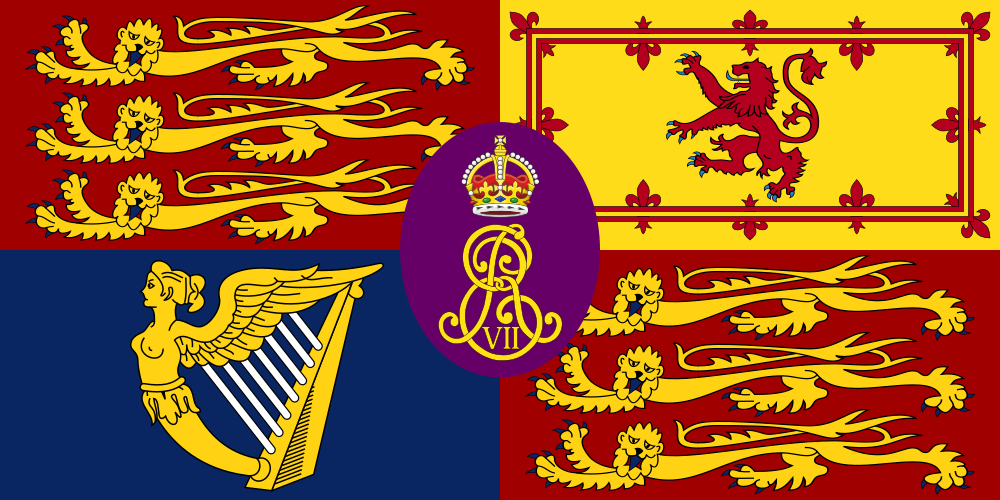
In some situations, personal standards are displayed within the UK, such as within St Giles' Cathedral, Edinburgh (site of the Chapel of the Order of the Thistle), and St George's Chapel, Windsor Castle home of Banners of Knights of the Order of the Garter, at the Thames Diamond Jubilee Pageant Prince Andrew's standard flew from MV Havengore. However, the use of personal standards of other members of the royal family varies in frequency. Prior to his accession, the then-Prince of Wales flew his standard at Clarence House in the same way the Royal Standard is used over Buckingham Palace, but other members of the family tend not to fly theirs from their respective residences (though this may be due to the fact that many share official London Residences, as is the case at Kensington Palace).
Family members also do not use their standards on road vehicles, either privately or during official engagements (when more discreet cars are used, such as Jaguar) or state occasions (when the Liveried cars of the Royal Mews are used), this seems reserved for the Queen only, although when Prince Philip traveled alone at state occasions, his standard flew from the roof of his car, as seen with the funerals of Diana, Princess of Wales (when the Queen Mother also flew her personal standard from her car) and that of Queen Elizabeth the Queen Mother, also, when a visiting Head of State on a state visit uses a car from the Royal Mews, his/her own flag is displayed. That said, when abroad, the standards of members of the family may well be flown: examples include Prince Charles, the Duchess of Cornwall and Prince William.
Personal Standards have been used to cover the coffins of the Queen Mother, the Prince Philip, Duke of Edinburgh, Princess Margaret and the Duke of Windsor.
Position of honour
According to the Flag Institute, the basic order of precedence for flags in the United Kingdom is – the Royal Standard, the Union Flag, the flag of the country, dependency or Overseas Territory of the United Kingdom (England, Scotland, Wales, etc.), other country, dependency or overseas territory flags of the United Kingdom, flags of other nations (in English alphabetical order), the Commonwealth flag, the flag of Europe, county flags, flags of cities and towns, banners of arms (personal and corporate), and house flags.
References
References
- "Rules for hoisting flags on buildings of the Scottish Government". gov.scot.
- "Royal Standard".
- (17 May 2011). "Media Factsheet: Queen Elizabeth II's State Visit to Ireland".
- "The Story of Scotland's Flags".
- (1991). "The Royal Encyclopedia". Macmillan Press.
- (12 September 2022). "Thousands line Edinburgh's streets to see Queen's coffin". BBC News.
- Neustaeter, Brooklyn. (11 September 2022). "Royal Standard: The significance of the flag-draped on Queen Elizabeth II's coffin". [[CTV News]].
- "Days for Hoisting Flags on Buildings of the Scottish Government 2010".
- (8 January 1995). "Lyon King of Arms Act 1672". [[The National Archives (United Kingdom).
- Eriksen, Thomas H. (2007). "Flag, nation and symbolism in Europe and America". Routledge.
- Griffith, John. (4 August 2003). "Standard of the Duke of Rothesay and Lord of the Isles for Scotland".
- qiongbolan. "Post showcasing images of Queen Camilla's Royal Standard in use in Australia during the Royal Tour of Australia, 2024.".
- (19 March 2025). "Queen Camilla's Royal Standard in use in Northern Ireland in 2025".
- Fox-Davies, Arthur Charles. (1909). "A Complete Guide to Heraldry". T.C. & E.C. Jack.
- "Coat of Arms of King George III".
- (5 November 2004). "Final Royal farewell to princess". BBC News.
- (5 November 2004). "Funeral for Princess Alice".
- (17 July 2005). "The Coat of Arms of HRH The Duchess of Cornwall".
- (17 July 2005). "Camilla's coat of arms unveiled". BBC News.
- "British Flags - Royal and vice-regal flags".
- Mbiyu, David. (3 June 2012). "Diamond Jubilee flotilla adds color on the Thames".
- (April 2017). "The Queen's Regulations for the Royal Navy". UK Ministry of Defence.
- Prothero, David. (12 April 2007). "British Royal Flags, Reign of Edward VII: Proposal for a Personal Royal Standard of King Edward VII".
- "Prince William and St George's Chapel".
- "Tour: The Quire".
- "Gallery of Wanamaker Flags".
- (2 June 2012). "Diamond Jubilee: Thames River Pageant".
- (29 November 2012). "Pomp and ceremony for Amir of Kuwait". [[The Daily Telegraph]].
- kenjonbro. (23 November 2011). "Bentley State Limousine".
- (17 November 2012). "A Brush With Royal-tea! Prince of Wales: A Tea Review I". Alice and the teacup.
- (9 November 2012). "Foul weather follows Prince Charles and Camilla". [[The Daily Telegraph (Sydney).
- (9 November 2012). "The Prince Of Wales And Duchess Of Cornwall Visit Australia - Day 5".
- (1 July 2012). "William and Kate jet off on Canada trip". BBC News.
- (19 September 2012). "Magic moments from William and Kate's headline-making tropical tour".
- (14 February 2002). "Princess's coffin moved to Windsor". BBC News.
- (11 June 2002). "Princess Margaret Funeral".
- "UK Flag Protocol: Appendix B – Precedence of Flags".
This article was imported from Wikipedia and is available under the Creative Commons Attribution-ShareAlike 4.0 License. Content has been adapted to SurfDoc format. Original contributors can be found on the article history page.
Ask Mako anything about Royal standard of the United Kingdom — get instant answers, deeper analysis, and related topics.
Research with MakoFree with your Surf account
Create a free account to save articles, ask Mako questions, and organize your research.
Sign up freeThis content may have been generated or modified by AI. CloudSurf Software LLC is not responsible for the accuracy, completeness, or reliability of AI-generated content. Always verify important information from primary sources.
Report