From Surf Wiki (app.surf) — the open knowledge base
Royal Horse Artillery
Military unit of the British Army

Military unit of the British Army
| Field | Value | |
|---|---|---|
| unit_name | Royal Horse Artillery | |
| image | RHA Cap Badge.png | |
| image_size | 100px | |
| caption | Cypher of the Royal Horse Artillery | |
| dates | 1 February 1793 – present | |
| allegiance | United Kingdom | |
| branch | ||
| type | Horse artillery | |
| role | The King's Troop - Ceremonial | |
| 1st Regiment - Field Artillery | ||
| 3rd Regiment - Field Artillery | ||
| 7th Regiment - Airborne Artillery | ||
| size | Three Regiments and one Ceremonial Battery plus affiliated Reserve Units | |
| command_structure | Royal Artillery | |
| garrison | The King's Troop - London | |
| 1st Regiment - Larkhill | ||
| 3rd Regiment - Newcastle Upon Tyne | ||
| 7th Regiment - Colchester | ||
| motto | ||
| "Shamed be whoever thinks ill of it." | ||
| march | Bonnie Dundee (Gallop march); The Keel Row (Trot March); The Royal Artillery Slow March sometimes referred to as Duchess of Kent March (walk march) | |
| identification_symbol | [[Image:Royal Artillery TRF.svg | 75px]] |
| identification_symbol_label | Tactical Recognition Flash | |
| identification_symbol_2_label | Sleeve Badge | |
| ceremonial_chief | The King | |
| ceremonial_chief_label | Captain General, Royal Artillery | |
| colonel_of_the_regiment | General Sir Alexander Harley, KBE, CB | |
| colonel_of_the_regiment_label | Colonel Commandant |
1st Regiment - Field Artillery 3rd Regiment - Field Artillery 7th Regiment - Airborne Artillery 1st Regiment - Larkhill 3rd Regiment - Newcastle Upon Tyne 7th Regiment - Colchester "Shamed be whoever thinks ill of it."
The Royal Horse Artillery (RHA) was formed in 1793 as a distinct arm of the Royal Regiment of Artillery (commonly termed Royal Artillery) to provide horse artillery support to the cavalry units of the British Army. Although the cavalry link remained part of its defining character, as early as the Battle of Waterloo the RHA was sometimes deployed more along the lines of conventional field artillery, fighting from comparatively fixed positions.
The Royal Horse Artillery, currently consists of three regiments, (1 RHA, 3 RHA and 7 RHA) and one ceremonial unit (King's Troop, Royal Horse Artillery). Almost all the batteries of the Royal Horse Artillery have served continuously since the French Revolutionary Wars or Napoleonic Wars, except the King's Troop, created in 1946, and M Battery, which was 'reanimated' in 1993. Horses are still in service for ceremonial purposes but were phased out from operational deployment in the 1930s.
History
In 1793, in the course of the French Revolutionary Wars, Great Britain and allied European powers declared war on France over French occupation of the Rhine delta and Antwerp, precipitating the Flanders Campaign. Britain remained in conflict with France for almost 22 years, during which time significant progress was achieved in artillery development. The first two troops of Horse Artillery (A – later entitled "The Chestnut Troop" – and B) were raised in January 1793 at Goodwood, West Sussex, by the Master-General of the Ordnance, the 3rd Duke of Richmond, to provide fire support for the cavalry. They were joined by two more troops in November 1793. Each troop had six 6-pounder guns. Another development was the formation of a headquarters staff providing a channel between the regiment and the Board of Ordnance. Captain John Macleod was the first brigade major and became the first deputy-adjutant-general in 1795. By 1806, eleven troops had been formed, with ten companies of the Royal Irish Artillery incorporated, as the Seventh Battalion, after the union with Ireland in 1801. The Royal Regiment of Artillery was not part of the British Army at this time, but part of the establishment of the Board of Ordnance, with the Master-General its commanding officer; only after the Board's abolition in 1855 did the Artillery become part of the British Army under the Commander-in-Chief of the Forces.
All RHA personnel were mounted. Included in the establishment were 45 drivers and 187 horses, making it the first self-contained fighting unit of artillery. The Royal Horse Artillery was, distinguished from the Field Artillery by (among other things) its speed: the need to keep pace with a cavalry charge was achieved initially by the Horse Artillery using lighter guns than the RFA, and later by their using proportionally more horses.
The regiment wore light cavalry uniforms of blue with gold lace and red facings. Their overalls were grey with a red stripe and on their heads they wore the distinctive Tarleton helmets. If needed, they carried 1796 light-cavalry sabres or their own semi-official RHA 1796P sabre.
The RHA participated in the major wars of two centuries, including the Napoleonic Wars, the War of 1812, the Indian Mutiny, the Crimean War, the Peninsular War, the Anglo-Zulu War, the Boer War, World War I and World War II.
In 1859, the term "battalion" was replaced by "brigade". This was in turn replaced by "regiment" in 1939. The five Horse Artillery brigades consisted of two batteries each. Between 1899 and 1924, the Royal Artillery was divided with the creation of the Royal Field Artillery, which utilised horses for its medium-calibre guns.
When the Territorial Force was created in 1908, artillery units of the old Volunteer Force were converted into foot, horse, and garrison batteries. There were 14 batteries of horse artillery, 12 of which belonged to the RHA, the remaining two being provided by the Honourable Artillery Company. Territorial batteries were of four guns each rather than the six guns of regular batteries. The principal weapon of Territorial RHA units was the Ordnance QF 15 pounder, although the Ordnance BLC 15 pounder was issued to some second-line RHA units formed in 1914.
At the outbreak of World War I the regular RHA comprised twenty-five batteries, eleven of those serving in India with the Indian Army. They were equipped with the Ordnance QF 13 pounder.
In the 1920s, development of trucks and track vehicles brought an end to operational use of horses. By 1927, medium artillery was drawn by tractors instead of heavy draught horses. By 1937, nine field brigades had been mechanised as well as a brigade of RHA. Today, the ceremonial King's Troop alone retains the use of the mounted batteries.
At the onset of World War II, recruits were instructed that "the role of the Royal Artilleryman is, as it has ever been, to fight his gun, forgetful of self, to the last round in support of other arms."
Current regiments
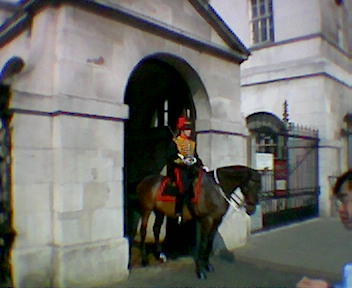
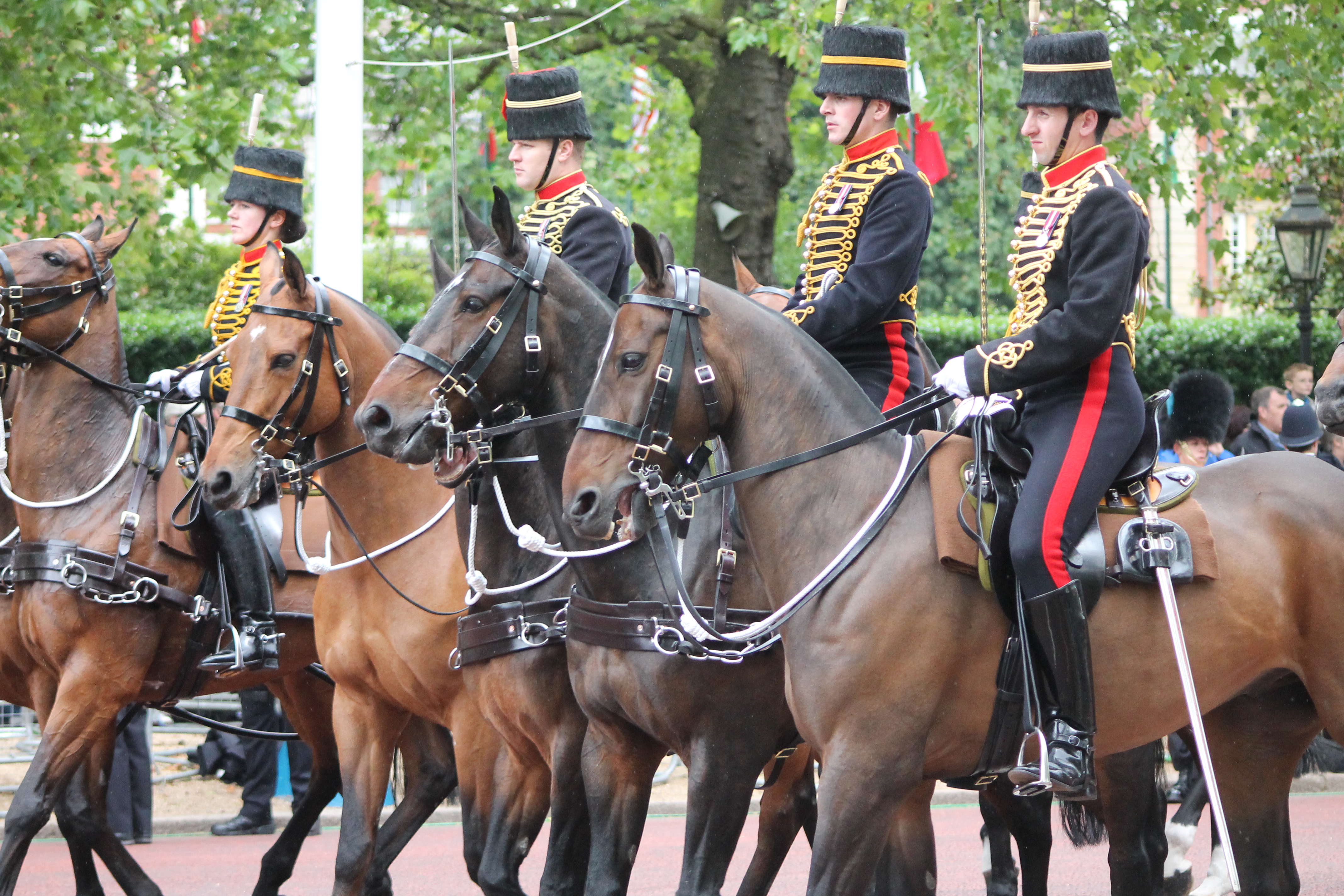
The following are current units of the Royal Horse Artillery:
- The King's Troop, Royal Horse Artillery, based at King George VI Lines, Royal Artillery Barracks, Woolwich
- 1st Regiment Royal Horse Artillery based at Larkhill Garrison, Larkhill, as self-propelled field artillery
- 3rd Regiment Royal Horse Artillery based at Albemarle Barracks, Harlow Hill, as light field artillery
- 7th Parachute Regiment Royal Horse Artillery based at Merville Barracks, Colchester Garrison, as parachute field artillery (augmented as necessary by A (1st City of London) Battery, Honourable Artillery Company)
The Royal Horse Artillery provided the Queen's Guard on three occasions:
- 1 RHA – January 1979
- 7 Para RHA – March 1989
- King's Troop – April 2007
The King's Troop provides the King's Life Guard in Whitehall for three weeks in August each year while the Household Cavalry Mounted Regiment goes away for summer training.
Alliances
- – Royal Canadian Horse Artillery
Order of precedence
When on parade with its guns, the Royal Horse Artillery takes precedence over all. Without its guns, the Household Cavalry alone precedes the RHA.
before= Household Cavalry | title= Order of Precedence| after= Royal Armoured Corps
References
References
- "Royal Artillery". National Army Museum.
- (2007). "Artillery: An Illustrated History of Its Impact". ABC-CLIO.
- Graham C. A. L. DSO psc, Brig Gen ''The Story of the Royal Regiment of Artillery'' RA Institution, Woolwich 1939
- Marble, Sanders. (2013). "British artillery on the Western Front in the First World War". Ashgate.
- Strachan, Hew. (1985). "From Waterloo to Balaclava: tactics, technology, and the British army, 1815-1854". Cambridge University Press.
- (1914). "ABC of the Army: An Illustrated Guide to Military Knowledge for Those who Seek a General Acquaintance with Elementary Matters Pertaining to the British Army". Gal & Polden Ltd.
- "A Waterloo Officers Royal Horse Artillery Tarleton Helmet".
- Westlake, Ray. (20 June 2013). "British Territorial Units 1914–18". Bloomsbury Publishing.
- Becke, A. F. (1945). ''History of the Great War: Order of Battle of Divisions: Territorial Force & Mounted Divisions Pt. 2A''. London HMSO.
- Woodward, David. (1978). "Armies of the World 1854-1914". Sidgwick & Jackson.
- "Affiliations". Worshipful Company of Farriers.
- "Army:Written question - 194616".
- "Royal Artillery". British Army.
- "Honourable Artillery Company - British Army Website". British Army.
- (2016-09-27). "Reservists pair with Airborne gunners - British Army Website". British Army.
- T.F.Mills. (15 July 2007). "Royal Horse Artillery".
This article was imported from Wikipedia and is available under the Creative Commons Attribution-ShareAlike 4.0 License. Content has been adapted to SurfDoc format. Original contributors can be found on the article history page.
Ask Mako anything about Royal Horse Artillery — get instant answers, deeper analysis, and related topics.
Research with MakoFree with your Surf account
Create a free account to save articles, ask Mako questions, and organize your research.
Sign up freeThis content may have been generated or modified by AI. CloudSurf Software LLC is not responsible for the accuracy, completeness, or reliability of AI-generated content. Always verify important information from primary sources.
Report