From Surf Wiki (app.surf) — the open knowledge base
Royal Bermuda Regiment
Infantry regiment of the British Army

Infantry regiment of the British Army
| Field | Value |
|---|---|
| unit_name | Royal Bermuda Regiment |
| image | RBR Colour Logo - PNG.png |
| image_size | 220px |
| caption | Cap Badge of the Royal Bermuda Regiment |
| dates | 1 September 1965 |
| country | Bermuda |
| United Kingdom | |
| branch | Army |
| type | Line Infantry |
| role | Internal security |
| size | One Battalion |
| ~350 reserve soldiers | |
| garrison | Warwick Camp |
| march | Quick – Bermuda |
| anniversaries | 21 November 1965, presentation of the first colours. |
| battle_honours | |
| ceremonial_chief | Birgitte, Duchess of Gloucester |
| ceremonial_chief_label | Colonel-in-Chief |
| current_commander | Lt. Col. Duncan Simons |
| current_commander_label | Commanding Officer |
| colonel_of_the_regiment | Col. David Gibbons |
| colonel_of_the_regiment_label | Honorary Colonel |
| identification_symbol_2_label | |
| website |
United Kingdom ~350 reserve soldiers
The Royal Bermuda Regiment (RBR) is the home defence unit of the British Overseas Territory of Bermuda. It is a single territorial infantry battalion that was formed on the amalgamation in 1965 of two originally voluntary units, the mostly black Bermuda Militia Artillery (BMA) and the almost entirely white Bermuda Rifles (titled the Bermuda Volunteer Rifle Corps (BVRC) until 1949), and the only remaining component of the Bermuda Garrison since the 1957 withdrawal of regular units and detachments from Bermuda.
History


The two original units, the mostly black Bermuda Militia Artillery and the almost entirely white Bermuda Volunteer Rifle Corps, were raised 1895 and 1894, respectively, in accordance with two of three acts passed by the Bermudian parliament in 1892 at the insistence of the British Government, which had been attempting to encourage, entice, or coerce the local government to restore reserve military units since the last Militia Act had been allowed to lapse following the Napoleonic Wars and the American War of 1812. The regulations of the two units were the same as those of militia and volunteer units in the British Isles at the time, with a few additions specific to the units. The units were fully funded by the War Office as parts of the British Army, rather than as auxiliary to it. Contingents from both units were deployed to France and Belgium in June 1915 and saw action on the Western Front during the First World War.
Following the First World War, the British Government's policy of austerity resulted in a substantial reduction of the regular army, including reducing the regular infantry in Bermuda and removing the Royal Artillery and the Royal Engineers Fortress companies from Bermuda in 1928, with the local reserve units shouldering more responsibility. This resulted in the Bermuda Volunteer Rifle Corps being re-organised on territorial lines in 1921. Those other ranks who chose to continue serving were re-attested, committing to terms of service which meant they could no longer quit the corps with fourteen days notice. The name of the corps was not modified to reflect the change, however. Militia soldiers were already engaged for terms of service, and the Bermuda Militia Artillery was not similarly re-organised until 1928 (its name, also, was not modified to reflect the change). The Bermuda Volunteer Engineers was created as a unit to operate the search lights at coastal artillery batteries in June 1931 (previously, the third act of 1892 had authorised the creation of a militia unit to assist the Royal Engineers company tasked with maintaining and operating Bermuda's submarine mining defences, but this unit had not been raised), while the Bermuda Militia Infantry was raised in October 1939, originally relieving the Bermuda Volunteer Rifle Corps of the task of protecting St David's Battery from attack by enemy landing parties, but taking on new roles as it expanded to a strength of two companies, with the infantry defence of the colony being split between the regular infantry (by then a detachment of 4th Battalion, Queen's Own Cameron Highlanders), the Bermuda Volunteer Rifle Corps and the Bermuda Militia Infantry.

A contingent of volunteers for overseas service from the Bermuda Militia Artillery (one officer), Bermuda Volunteer Engineers (four sappers), and Bermuda Volunteer Rifle Corps (sixteen officers and other ranks) was sent to Britain in June, 1940, where the contingent members separated to join their parent corps (Royal Artillery, Royal Engineers, and the Lincolnshire regiment, respectively). With the regular garrison having been drastically reduced due to post-First World War economic austerity by the British Government, concern over further weakening the garrison meant the local-service units, which had been embodied for full-time service for the duration of the war, were barred from sending further contingents abroad until 1943, by which time the threat of enemy attacks on Bermuda and its strategic defence infrastructure had greatly diminished and the United States Army and United states Marine Corps had garrisoned the colony. Following this, a contingent of volunteers from the Bermuda Militia Artillery and Bermuda Militia Infantry was attached to the 1st Caribbean Regiment and saw action in Europe and North Africa during the Second World War while a company from the Bermuda Volunteer Rifle Corps was attached to the Lincolnshire Regiment and saw action in North West Europe and in Burma during that war.
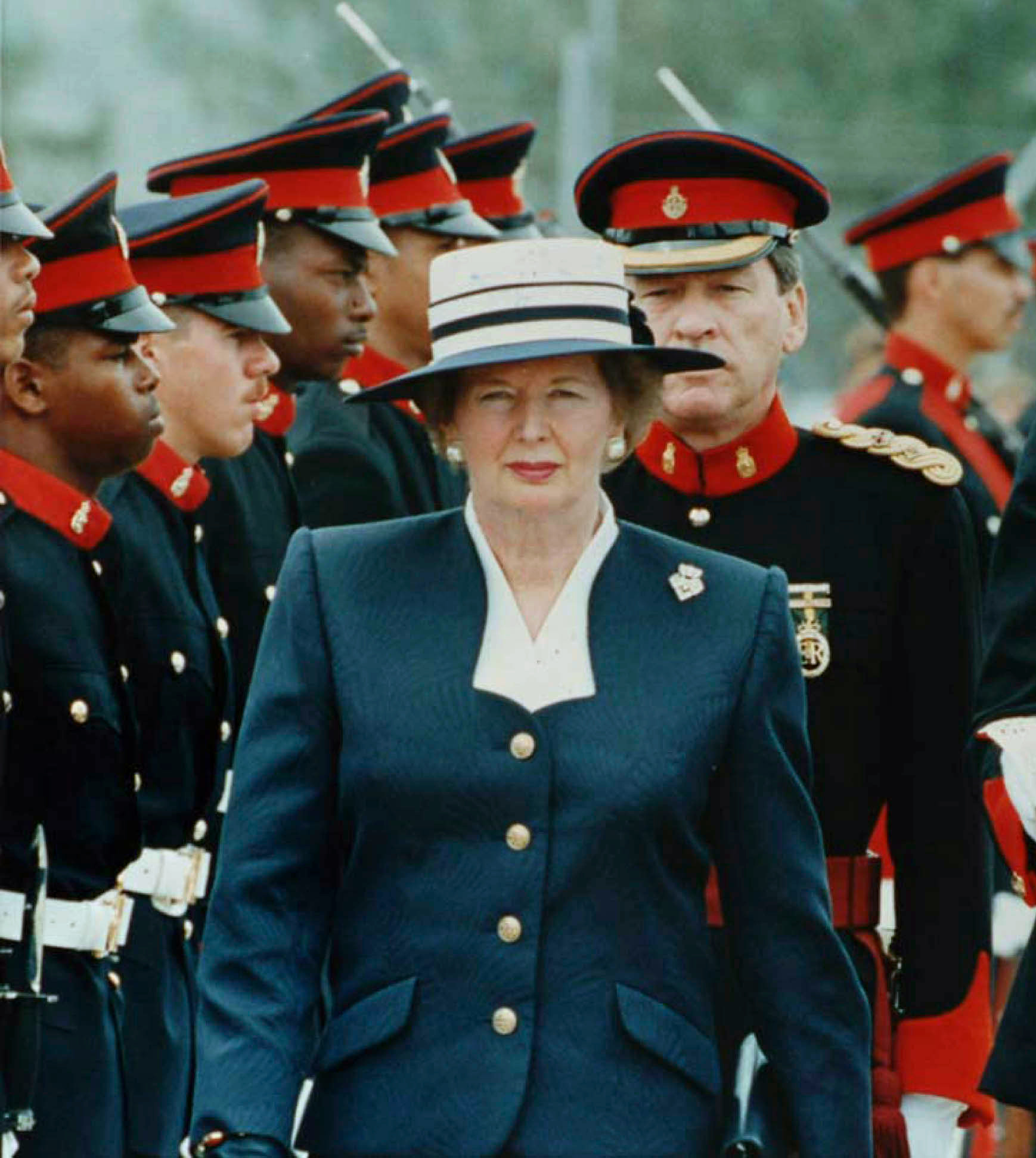
After the war the Bermuda Volunteer Rifle Corps was belatedly renamed the Bermuda Rifles. the military garrison, which had existed primarily to protect the Royal Navy base, was also closed.
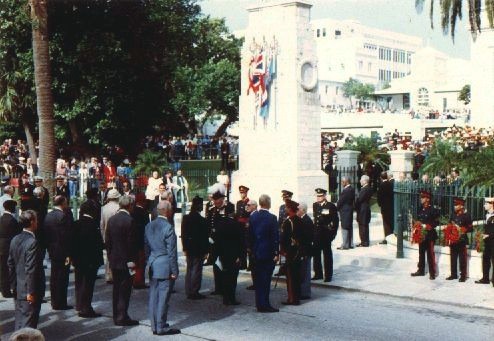
The Bermuda Militia Artillery and the Bermuda Rifles amalgamated to form the Bermuda Regiment on 1 September 1965. The latest set of Colours were presented by Duchess of Gloucester, GCVO, at the National Sports Centre on 13 November 2010. In 1945, the part-time reserve units in Bermuda, the Channel Islands and Malta had numbered collectively as 28th in the British Army order of precedence (the number varied before and after 1945 depending on the make-up of the British Army), but were ordered within that according to the order of precedence of their parent corps in the regular army. This meant, that the Bermuda Militia Artillery (BMA), as part of the Royal Regiment of Artillery and the Militia, preceded the Bermuda Volunteer Rifle Corps (BVRC) (as part of the infantry and the Volunteer Force) despite being the second of the two to be raised. Today, the Royal Bermuda Regiment, as an amalgam of the BMA and BVRC, is 29th and was formerly 28th which changed in 2007 with the Special Reconnaissance Regiment being added to the Order of Precedence.
On 1 September 2015, Queen Elizabeth II awarded the title "Royal" to the regiment to mark the 50th anniversary of its formation.
Badge
The badge of the Royal Bermuda Regiment combines elements from those of the Royal Regiment of Artillery, and the BVRC. The full badge, as displayed on the Colours, features two crossed cannons creating an X behind a Maltese cross (the symbol of rifle regiments in the British Army, and used on the white metal BVRC badge), set on a circular shield with "THE BERMUDA REGIMENT" inscribed around it, and the whole enclosed within a wreath and surmounted by the Crown. The cap badge is bi-metal – all brass, except a white metal Maltese cross, which is set inside the wheel of a cannon (taken from the badge of the Royal Artillery), with a half-wreath about the lower hemisphere of the badge. Flashes, and other colour marks used on dress and elsewhere (such as backgrounds on signs about Warwick Camp) are blue and red, reflecting the colours of the Royal Artillery, but the stable belt (issued only to permanent staff, officers and senior ranks) worn is rifle green, with black edges, referring to the colours used by the BVRC.

Dress


The dress uniform itself is closer to the old Royal Artillery pattern, and to the generic No. 1 dress uniform used by many British regiments today, being composed of dark blue, almost black, tunic and trousers, and differing only in the red cuffs and collar added to the tunic. The trousers have a broad red stripe running down the outside of each leg. A generic dark blue peaked cap with red hat band is worn with this uniform. During the summer months, the No. 3 uniform is worn (identical to the No. 1 except that a light-weight generic, white tunic is worn).
Ranks
Ranks are as follows:
| Lieutenant colonel | Major | Captain | Lieutenant | Second lieutenant | Officer cadet |
|---|
| Warrant officer class 1 | Warrant officer class 2 | Colour Sergeant | Sergeant | Corporal | Lance corporal | Private |
|---|
Organisation
Leadership


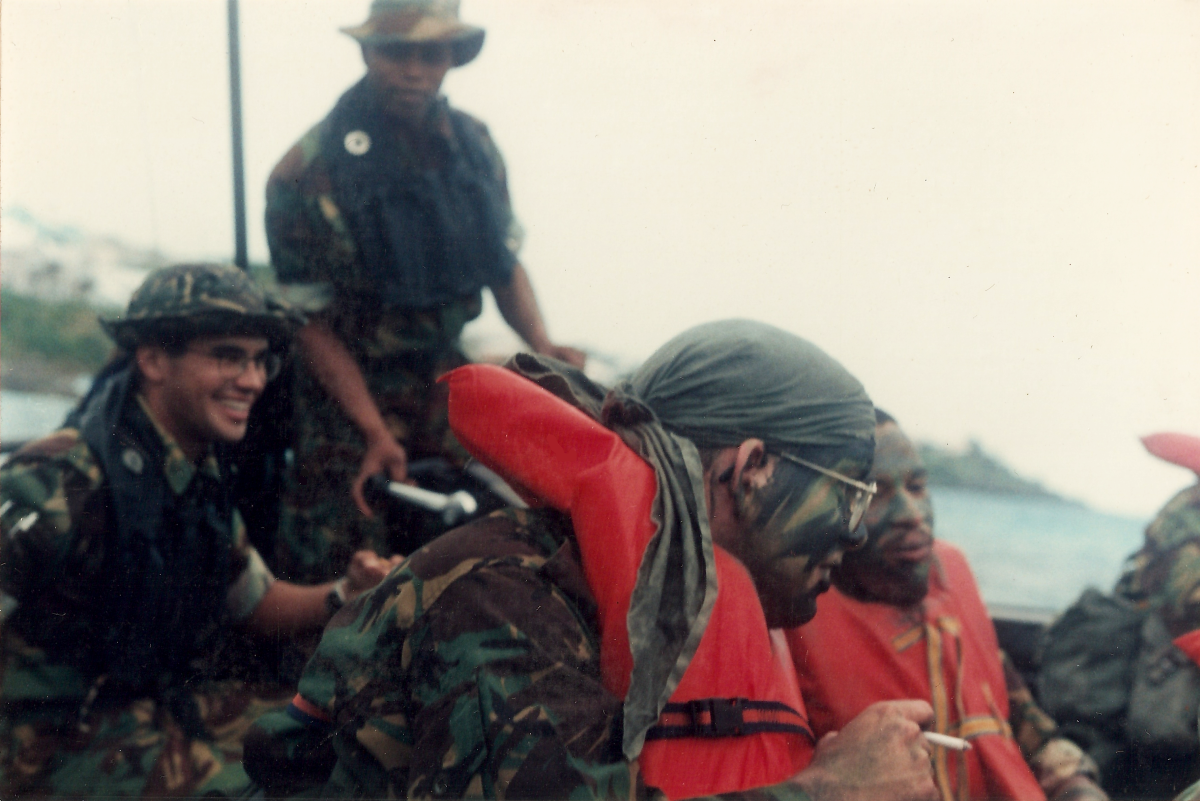
As Bermuda is a British overseas territory, and defence is therefore the responsibility of the United Kingdom, the Royal Bermuda Regiment is under the control of the Governor and Commander-in-Chief of the island. However, pay and financing is the responsibility of the Ministry of National Security. The Royal Bermuda Regiment (RBR) is listed in the British Army Order of Battle as number 29th in order of precedence. The RBR traditionally was number 28th in the order of precedence but due to the first time listing on the order of precedence of the Special Reconnaissance Regiment which is the newest Combat Arm/Corp.
On its formation, the regiment's Honorary Colonel was Princess Margaret, Countess of Snowdon, who became Colonel-in-Chief in 1984. After the countess's death in 2002, the Duchess of Gloucester was made Colonel-in-Chief in 2006.
Manpower
The Regiment's original strength was about 400, including all ranks. Following discipline problems during an exercise in the West Indies, a report on the unit was commissioned from Major-General Glyn Gilbert, the highest-ranking Bermudian in the British Army. Maj-Gen. Gilbert also took into account the difficulties the regiment had experienced in meeting its obligations when deployed during the civil unrest of 1977 (its existing strength did not allow for a reserve). He made a number of recommendations, including the increase of the Regiment's strength to a full battalion of about 750, with three rifle companies (A, B, and C) and a support company. As the support functions (Regimental Quartermaster Stores and Internal Security Stores, Signals, Armourers, Motor Transport, Boat Troop, Gun Troop/Assault Pioneers, Medics, cooks, et cetera) and the Band now fell under Support Company (commanded by the Regimental Quartermaster), the battalion headquarters was no longer considered a company in its own right. Initially, the three rifle companies rotated through the role of training company. Eventually, C Company was renamed permanent Training Company. Recruits spent their first year in Training Company, then transferred as a unit to whichever rifle company was losing its third-year conscripts, or were reassigned individually to other sub-units. As of the early 2020s, the regiment's strength-level was about 350 personnel who had a total training commitment of 30-days per year.
Structure

With the end of conscription, it is no longer possible to maintain a dedicated Training Company in which recruits spend their first year. Recruits now spend three months, after their two-week initial training, being trained under Training Wing before being posted to one of the Companies. The current (2026) establishment is:
- Regimental Headquarters
- HQ Company
- A Company
- Logistics Company
- Training Wing
- Coast Guard
One of the units amalgamated into the Royal Bermuda Regiment, the BMA, was nominally an artillery unit, although it had converted to the infantry role in 1953. Other than a ceremonial Gun Troop, equipped with two 25-pdr. field guns, the Royal Bermuda Regiment is wholly an infantry unit.
Conscription

Although its predecessors had been organised and recruited along Territorial Army lines (engaging volunteers for part-time service who were able to be embodied for full-time service in the event of war or other emergency) from the 1920s (1921 for the Bermuda Volunteer Rifle Corps, and 1928 for the Bermuda Militia Artillery) to the 1950s (1957 for the Bermuda Rifles and 1960 for the Bermuda Militia Artillery), excepting during the Second World War (when general conscription of military aged males for the duration of the war was introduced), low recruitment led to conscription by ballot being introduced in the 1950s to make up any shortfall in volunteers (the Defence Act, 1949, had included the machinery for conscription, should it prove necessary, requiring all British males between the ages of 18 and 25 who were resident in Bermuda to register for conscription), and this continued with the Bermuda Regiment after 1965. Although any legally resident Commonwealth national might volunteer, only British nationals resident in Bermuda were liable for conscription (later further limited to those British nationals resident in Bermuda who held Bermudian status, as per the Defence Act, 1965, Section 12, amended by 1997:37 effective 6 May 1999; and by 1998:32 effective 13 July 1998). As per the "Bermuda Report" for 1965 and 1966:
As young men wishing to avoid conscription could be expected to avoid registration for conscription, the ballot actually relied upon the colony's birth register, resulting in occasional conscription of the deceased, or of young men who had been born in Bermuda to foreign parents and who therefore did not have British nationality or Bermudian status, and were not liable for conscription.
The mechanism of conscription used by the Bermuda Regiment was similar to the system that had applied for the Militia in the British Isles (or "Home" Militia) from the 1850s under the Militia Act 1852, although resort to the ballot was not made before the Home Militia was replaced in 1908 with the Special Reserve. Except where specially provided for by the separate Regulations of the Bermuda Militia Artillery, the Regulations of the Home Militia Artillery applied to the Bermuda Militia Artillery, also, when it was raised in 1895. The majority of the Bermuda Regiment was made up of conscripts up to July 2018, making it unique among all of the land forces under the British Crown.
Conscription was based on a random lottery of men through the ages of 18 to 23, with exemptions granted to Police and Prison officers, members of the British regular forces (or men who have served for two years), church ministers, prisoners or those judged to be of "unsound mind".
Both Bermudians and non-Bermudians criticised conscription for its alleged sexism and similarity to slavery (a sensitive issue given the historic background of Bermuda), and this has been noted in the British Parliament.
At its height, three-quarters of the strength of the Bermuda Regiment was made up of conscripts, although many soldiers, whether they initially volunteered or were conscripted, elected to re-engage annually after their initial three years and two months term of service was completed, with some serving for decades (such as WO2 Bernard Pitman, who retired in 2013 after forty years of service).
In 2018, the House of Assembly of Bermuda voted to abolish conscription under the Defence Amendment Act, 2018, effective of 1 July 2018.
Recent assessments
Towards the end of 2005, the regiment took part in a fitness for role exercise, this time in the form of an inspection by the Ministry of Defence. The review noted that equipment was substandard and major items would be deemed to be unserviceable by 2010 (half of the vehicles and signal equipment were noted to be "out of action") and that command and control was poor, though it also noted high morale and firearms proficiency.
Royal Bermuda Regiment Junior Leaders and the Bermuda Cadet Corps
Main article: Bermuda Cadet Corps
The Bermuda Regiment operated its own Junior Leaders programme for many years, starting with nineteen boys who passed out at Warwick Camp on 19 December 1969, thereafter forming the Junior Leaders Company.
In 2012, due to financial constraints, the Bermuda Cadet Corps was disbanded and replaced by the resurrected Bermuda Regiment Junior Leaders. Many of the Bermuda Regiment's officers, warrant officers and NCOs began their service in the Junior Leaders, including former Commanding Officer, Lieutenant-Colonel Brian Gonsalves.
A bill was tabled in the House of Assembly of Bermuda in 2015 to formalise the organisation of the Royal Bermuda Regiment's Junior Leaders.
Operations

The primary role of the regiment has recently become disaster relief. Other roles include ceremonial duties, and supporting the Bermuda police department in internal security issues (both in the forms of riot-control and anti-terrorism). In 2001, following the September 11 attacks on the nearby United States, the Bermuda Regiment was deployed, taking over responsibility for the security of the Bermuda International Airport (Bermuda has always been a point of importance in trans-Atlantic aviation, and a large number of aircraft diverted to the Island when US airspace was closed) and other potential targets. In 2004 and 2005 the regiment deployed to the Cayman Islands and Grenada to assist in post Hurricane Ivan restoration efforts.
The Bermuda Regiment successfully deployed a platoon of internal security trained soldiers to Barbados in 2007. There they took part in forming the security infrastructure for the WCC Cricket World Cup. They worked alongside soldiers from Barbados, Guyana, India and South Africa, in ensuring a secure environment for the Super 8 series of matches.
The Bermuda Regiment also provided a cordon at the Bermuda International Airport in October, 1996, when the Chinese ship, Xing Da, was brought to the island. The ship had been detained on the Atlantic by the United States Coast Guard carrying over a hundred illegal migrants with the intent of smuggling them into Massachusetts. It was intended to transfer the passengers and crew to Guantanamo Bay Naval Base, but the ship was deemed unseaworthy. Taking the ship into a US port to transfer the detainees to Cuba was undesirable as the US Government would have then been obliged to allow any who requested to enter the process for asylum application. The only other port within reach was Bermuda, roughly 640 miles from North Carolina and 1,061.4 miles from Guantanamo Bay. As the UK Government was wary of allowing the detainees to set foot on British territory for the same reason, the ship was kept offshore while the two governments negotiated. A Company of the Bermuda Regiment was deployed, pending the outcome. On 9 October, it provided a cordon to close off the Weapons Pier of the former United States Navy NAS Bermuda, while Bermuda Government ferry boats brought the detainees into Castle Harbour. Bermuda Police and US Coast Guard powerboats transferred the detainees to the Weapons Pier, where they were handcuffed and loaded, one-by-one, aboard waiting US Coast Guard C-130 Hercules, with each aeroplane taking off and heading for Cuba as soon as it was full.
Overseas connections

During the First World War, the Bermuda Regiment's predecessor, the Bermuda Volunteer Rifle Corps (BVRC) sent two contingents to serve with the Lincolnshire Regiment on the Western Front. After the War, the connection to the Lincolns was made official. The BVRC again provided two drafts to the Lincolns during the Second World War. When the BVRC (renamed the Bermuda Rifles) was amalgamated in 1965 with the Bermuda Militia Artillery (BMA), to create the Bermuda Regiment, the Royal Anglian Regiment, into which the (Royal) Lincolnshire Regiment had itself been amalgamated, continued the paternal role. In light of the Royal Bermuda Regiment's Royal Artillery roots, an unofficial affiliation was begun in 1997 with the 104 Regiment, Royal Artillery (The Welsh & Borderer Gunners).
Corps Warrant
In late 2001, the Bermuda Regiment and the Royal Gibraltar Regiment were presented with Corps Warrants dated 21 February 2000.
In 2017, the Corps Warrant ceased on 30 July. A new Corps Warrant which included the Royal Bermuda Regiment was confirmed as a Corps of the British Army and took effect 1 August 2017 and was signed at St. James Court by Her Majesty's Command dated 17 July 2017.
The 2017 Corp Warrant notes that the competition of Corps composition 'The under mentioned bodies of the [British] Army comprising Regular Forces, Army Reserves, Regular Reserve, including any raised hereafter and any local units overseas: of which the Royal Bermuda Regiment was listed with the composition note; All units and personnel of The Royal Bermuda Regiment.'
Other


The Bermuda Regiment also developed a relationship with the United States Marine Corps, which had supplied a detachment to Bermuda for many years to guard United States Navy facilities. In addition to occasional training with the US Marines in Bermuda, the Bermuda Regiment used facilities and training areas of the US Marines' Camp Lejeune and Camp Geiger in North Carolina for training, with the two rifle companies having been sent there every second year for their annual camps.
The Bermuda Regiment took part in its first exercise overseas in 1968, when twenty-eight personnel were deployed to Jamaica on 26 October, along with "A" Company of the York and Lancaster Regiment, for a four-week introduction to jungle warfare in the vicinity of Berriedale, in Portland. Jamaica became the location of annual camps in alternate years, but in March, 2013, it was announced that a new location would be sought. This was due to the cost of deploying to Jamaica (a flight of 1,249 miles, compared to 725 miles for the flight to MCAS Cherry Point, North Carolina), given the budgetary constraints, and as Jamaica provided little opportunity for training in Internal Security roles, such as is available at USMCB Camp Lejeune with its Military Operations in Urban Terrain (MOUT) facility. In 2014, the annual camp was held at the Land Force Central Area Training Centre Meaford of the Canadian Army at Meaford, in Ontario, Canada.
The Bermuda Regiment's training in the US, Jamaica and Canada is self-contained, rarely involving local units, but friendly relationships have been developed with both the US Marine Corps, and the Jamaica Defence Force (JDF). Specialist Bermuda Regiment sub-units, such as the Reconnaissance Platoon and the Medics, have trained with equivalent US Marine Corps units at Camp Lejeune.
Over the last decade, a relationship has also been developed with the Royal Gibraltar Regiment, and small detachments sent with that regiment on its annual training deployments to Morocco. In 2007, for the first time, the annual camp was held in England, with detachments training at the Cinque Ports Training Area (CPTA); part of the Defence Training Estate (DTE) South-East, near Dover.
As the new Cayman Islands Regiment is being developed, the Royal Bermuda Regiment has been tasked to train the first few batches of recruits from the Cayman Islands at Warwick Camp. The first batch of Caymanian recruits had joined the February 2020 intake of Bermudian recruits.
Alliances
- – The Royal Anglian Regiment
- – The Lincoln and Welland Regiment
- – The Jamaica Defence Force
Commanding officers
The commanding officer of the Bermuda Regiment (as also the quartermaster, training officer, the staff officer (UK Loan Service), the adjutant, the aide-de-camp, and the regimental sergeant major) is a full-time position, requiring those appointed to the role to take leave of their civilian employments. Originally, there was a four-year limit to the term of a commanding officer, which could be extended if required. Following Lieutenant-Colonel Gavin A. Shorto's six years in the office, a three-year appointment was made the norm. The commanding officer is normally chosen from among the majors of the Battalion, and is promoted to lieutenant-colonel. Following the death of Major Christian Wheddon in a motor accident in England in 2012, while training in preparation for assuming command, Lieutenant-Colonel Michael Foster-Brown, a professional soldier from The Rifles, assumed command in June 2013, the first non-Bermudian to fill the role. Foster-Brown was succeeded by Lieutenant-Colonel David Curley on 27 February 2016. In March 2020, Lieutenant-Colonel Benjamin Beasley replaced Curley in command.
Equipment
The BMA and Bermuda Rifles had re-equipped from the .303 inch No. 4, Mk. 1 rifle to the 7.62mm NATO L1A1 Self-Loading Rifle (SLR) the year before amalgamation. The .303 inch Bren light machine gun and Vickers machine gun were replaced by the 7.62mm NATO General Purpose Machine Gun (GPMG). The Bermuda Regiment inherited the SLR and the GPMG from its predecessors. For Internal Security use, the Federal Riot Gun being used in Northern Ireland for firing baton rounds and gas canisters was also adopted. The Bermudian reserve forces had been equipped with standard British Army weapons since their restoration in 1895 (the Sten sub-machine gun had been replaced in the 1960s with the Sterling submachine gun, but this had then been replaced with the Israeli Uzi).
During the 1950s, the British forces had been pressured into dropping the .280 British sub-calibre round and EM-2 rifle that had been intended to replace respectively .303 inch ammunition and the No. 4 rifle, adopting instead the American 7.62mm ammunition as NATO standard and the SLR, which was a variant of the Belgian FN FAL. Despite forcing the adoption of the 7.62mm round by NATO, the US re-equipped during the Vietnam War with the M16 rifle, chambered for the 5.56×45mm M193 sub-calibre ammunition. Dissatisfaction with the 7.62mm round led NATO to seek a replacement during the 1970s, and the Belgian SS109 variant of the American M193 was adopted as 5.56mm NATO.
The Bermuda Regiment decided not to wait for the SA80 and replaced the SLR with the American-made Ruger Mini-14 self-loading (in American parlance, "semi automatic") rifle in 1983. The GPMG was retained in the light-, as well as the medium-, machine gun role. The Ruger has a 20-round detachable box magazine and can be fitted with a US M7 bayonet. The original wooden stocks were replaced with Choate black plastic stocks by 1992 and no further modifications have been made since.
A replacement for the aging Rugers was sought at the end of the Century, with small numbers of the German Heckler & Koch G36 and the American Colt M4 (a carbine variant of the M16) obtained for trials, following which the G36 had been selected as a replacement for the Ruger and the Uzi sub-machine gun. However, budgetary issues delayed the acquisition of the G36, which also became surrounded by controversy in Germany over reported inaccuracy in warm temperatures.
Rifles and shotguns
Rifles
| Name | Origin | Type | Cartridge | Image | Details | |||
|---|---|---|---|---|---|---|---|---|
| L85A2 / SA-80 | Assault Rifle | 5.56×45mm NATO | [[File:SA80 A2 (L85A2) 5.56mm Rifle MOD 45162150.jpg | left | frameless | 150x150px]] | Adopted as the Standard issue to riflemen as of January 2016. | |
| Heckler & Koch G36 | Assault Rifle | 5.56×45mm NATO | [[File:Gewehr G36 noBG.png | left | frameless | 150x150px]] | Adopted as second-tier weapon, issued to specialist companies i.e. Boat Troop and OSU. | |
| L42A1 | Bolt action sniper rifle | 7.62×51mm NATO | [[File:L42A1-Large.png | left | frameless | 150x150px]] | Adopted as Sniper rifle, a 7.62mm variant of the Lee–Enfield No. 4 | |
| Mossberg 500 | shotgun | 12 gauge | [[File:Mossberg M590A1.JPG | left | frameless | 150x150px]] | Adopted as Shotgun. |
Obsolete and/or held in stocks
- USA Mini-14GB/20 self-loading rifle with Choate stock (standard issue to riflemen from 1983 to January 2016)
- UK L1A1 Self-Loading Rifle (standard issue to riflemen from 1965 to 1983, but stocks still held)
- USA Colt M4 (stocks obtained for trials to determine replacement for Mini-14 and Uzi)
- UK Greener shotgun (obsolete, but stocks still held)
Pistols
| Name | Origin | Type | Cartridge | Image | Details | |||
|---|---|---|---|---|---|---|---|---|
| Glock 17 L131A1 | Semi-automatic pistol | 9×19mm Parabellum | [[File:GLOCK 17 Gen 4 Pistol MOD 45160305.jpg | left | frameless | 150x150px]] | Adopted as the standard-issue sidearm pistol for Regiment Personnel. | |
| Beretta 92 | Semi-automatic pistol | 9×19mm Parabellum | [[File:DCB-Shooting MAS G1S.jpg | left | frameless | 150x150px]] | Adopted as the issue sidearm pistol for Regiment Personnel. |
Machine guns
| Name | Origin | Type | Cartridge | Image | Details | |||
|---|---|---|---|---|---|---|---|---|
| FN MAG L7A2 | General-purpose machine gun | 7.62×51mm NATO | [[File:FN MAG Machine Gun Left.jpg | left | frameless | 150x150px]] | Adopted as the standard-issue General-purpose machine gun for uses in light role only. |
Internal Security (IS)
| Name | Origin | Type | Cartridge | Image | Details | |||
|---|---|---|---|---|---|---|---|---|
| ARWEN 37 | Less-lethal Riot Launcher | 37mm | [[File:M12 smg.JPEG | left | frameless | 150x150px]] | Adopted as the issued Less-lethal Riot Weapon. |
Obsolete
- USA Federal Riot Gun (replaced by the ARWEN 37)
Artillery
| Name | Origin | Type | Cartridge | Image | Details | |||
|---|---|---|---|---|---|---|---|---|
| Ordnance QF 25-Pounder Field Gun | Field gun | 88 x 292mm | [[File:Bermuda Regiment 25 Pounder Field Gun.png | left | frameless | 150x150px]] | ||
| Ordnance SBML 2-inch mortar | Light mortar | 2 in (51 mm) | [[File:2 inch mortar (AWM 094355).jpg | left | frameless | 150x150px]] |
Vehicles
- Japan Toyota Land Cruiser J70
- Japan Mitsubishi L 300 van
- USA Ford 350 Ambulance
- Japan UD 2300DH truck
- Japan Toyota Dyna truck
- Japan Toyota HiAce van
- Japan Toyota LiteAce Minivan
Boats
- UK Dell Quay Dory Mk. 1 boats
- UK 18 foot Rigid Raider boats
- UK Halmatic RHIB boats
- US 41 Juliet (27 foot Boston Whaler Guardian class boat)
Radio
- UK Sepura SC20, replaced Sepura STP8200 radios
- UK Sepura STP8200, replaced Bendix King radios
Gallery
File:Bermuda Regiment.JPG|Bermuda Regiment Soldiers armed with Mini-14s on OPs in Barbados for Cricket World Cup 2007 File:Bermuda Regiment Band.png|The Royal Bermuda Regiment Band File:Bermuda Regiment - Training Company PSI and Senior NCOs - Warwick Camp 1992.jpg|A Permanent Staff Instructor (PSI) with senior Non-Commissioned Officers of the Bermuda Regiment. File:Bermuda Regiment - Warwick Camp.jpg|The main gate of Warwick Camp, as it appears today, from the South Shore Road (formerly The Military Road). File:Bermuda Regiment - Warwick Camp 1993.jpg|A platoon of the Training Company of the Bermuda Regiment, at Warwick Camp, during Recruit Camp 1993 File:Bermuda Regiment Corporal's Mess.jpg|Bermuda Regiment Corporal's Mess at Warwick Camp. File:Bermuda Regiment - Football Game at Warwick Camp.jpg|Bermuda Regiment soldiers play football on the parade ground of Warwick Camp. File:Bermuda Regiment 25 Pounder Field Gun.png|25-Pounder (88 mm) field gun of the Bermuda Regiment's ceremonial Gun Troop. File:Royal Bermuda Regiment Regimental Policeman January 1994.jpg|Bermuda Regiment Regimental Policeman in January, 1994 File:Royal Bermuda Regiment Soldier at Ferry Reach in 1994.jpg|Royal Bermuda Regiment soldier with a Ruger Mini-14 at Ferry Reach in 1994 File:Bermuda Regiment pass HMD Bermuda.png|A motorboat of the Bermuda Regiment Boat Troop moves out of the Great Sound, past the HMD, Bermuda, on Ireland Island. File:Bermuda Regiment - Lincoln and Welland NCO in Jamaica.png|An NCO of The Lincoln and Welland Regiment attached to a rifle company of the affiliated Bermuda Regiment training in Jamaica, 1996. File:Bermuda Regiment - Lieut.-Col. William White.png|Lieutenant-Colonel (then-Lieutenant) William White in Jamaica, 1996. File:Jamaican Defence Force & Bermuda Regiment soldiers.png|Jamaica Defence Force soldier with a sergeant of the Bermuda Regiment in the Blue Mountains of Jamaica. File:Bermuda Regiment Corporal.jpg|An NCO of the Bermuda Regiment armed with a General Purpose Machine Gun, aboard a Rigid Raider. File:Mossberg 500 shotgun & Federal Riot Gun of the Bermuda Regiment.jpg|Mossberg 500 shotgun and Federal Riot Gun of the Bermuda Regiment File:Bermuda Regiment NCO in No 5 Dress.jpg|A Bermuda Regiment NCO in No. 5 (Desert Combat) Dress, armed with a Galil AR self-loading rifle at USMC Camp Lejeune in 1994. File:Bermuda Regiment & Bermuda Police Service boats in July 2011.jpg|Bermuda Regiment & Bermuda Police Service boats in July 2011 File:Bermuda Regiment Medics and US Navy Corspmen at USMCB Camp Lejeune 12 May 2011.jpg|Bermuda Regiment Medics and US Navy Corspmen at USMCB Camp Lejeune in May 2011 File:Engineers, different uniforms, identical mission 130507-M-AR522-011.jpg|Cpl. Erikon C. Rosamond (left) of the US Marines and Royal Bermuda Regiment soldiers at Camp Lejeune in 2013 File:Bermudan soldiers with Guns and Assault Platoon, and a U.S. Marine with 2nd Combat Engineering Battalion, discuss training after they complete a wired connection on Marine Corps Base Camp Lejeune, N.C., May 2 130502-M-BW898-002.jpg|Royal Bermuda Regiment Guns and Assault Pioneers Platoon soldiers and a US Marine discuss training at Camp Lejeune in 2013. File:A U.S. Marine with 2nd Combat Engineering Battalion teaches Bermudan Army soldiers with Guns and Assault Platoon, how to connect explosive devices during a demolition training exercise on Marine Corps Base Camp 130502-M-BW898-003.jpg|Guns and Assault Pioneers Platoon train with a US Marine at US Marine Corps Base Camp Lejeune in 2013 File:Royal Bermuda Regiment at St. James' Church in Somerset.jpg|Royal Bermuda Regiment soldiers attend a funeral at St. James' Church in Somerset in August, 2016 File:Bermuda troops train at Camp Lejeune to become Junior Noncommissioned Officers 180504-M-JQ686-0041.jpg|Royal Bermuda Regiment soldiers undergoing Junior Non-Commissioned Officer training at USMC Camp Lejeune in May 2018 File:Bermuda troops train at Camp Lejeune to become Junior Noncommissioned Officers 180504-M-JQ686-0292.jpg|Junior Non-Commissioned Officers Cadre train at Camp Lejeune in 2018 File:Bermuda troops train at Camp Lejeune to become Junior Noncommissioned Officers 180504-M-JQ686-0164.jpg|Junior Non-Commissioned Officers Cadre soldiers train at Camp Lejeune in 2018 File:Bermuda troops train at Camp Lejeune to become Junior Noncommissioned Officers 180504-M-JQ686-0146.jpg|Junior Non-Commissioned Officers Cadre soldier training at Camp Lejeune in 2018 File:Bermuda troops train at Camp Lejeune to become Junior Noncommissioned Officers 180504-M-JQ686-0185.jpg|Royal Bermuda Regiment soldier with an L85A2 at USMC Camp Lejeune in 2018 File:2021-05-12 Royal Bermuda Regiment shoot at Stonebay USMCB Camp Lejeune by Cpl Karina Lopezmata USMC.jpg|Royal Bermuda Regiment shoot at Stonebay Rifle Range, USMCB Camp Lejeune on 12 May, 2021.
Order of precedence
References
References
- "Royal Bermuda Regiment".
- "Territorial Army – definition of Territorial Army in English from the Oxford dictionary".
- "History". The Royal Bermuda Regiment.
- Maurice-Jones, DSO, RA, Colonel KW. (1959). "History of The Coast Artillery in the British Army". Royal Artillery Institution.
- Ingham-Hind, Jennifer M.. (1992). "Defence, Not Defiance: A History Of The Bermuda Volunteer Rifle Corps". The Island Press.
- ''The Bermuda Volunteer Engineers'', by Jennifer M. Hind (formerly Jennifer M. Ingham) of [[The Royal Gazette (Bermuda). The Royal Gazette]]. Transcript of typescript document held at the [[Bermuda Maritime Museum]].
- (30 January 2014). "Guardian of the Eastern approaches". Royal Gazette.
- . (2001-06-01). "Ah yes, that was a very good year". *Ministry of Defence*.
- . (1944-03-13). "OVERSEAS CONTINGENT IS INSPECTED AT PROSPECT: O.C British Troops Praises Unit On Training Results". *The Royal Gazette*.
- (22 May 1957). "United Kingdom Garrison, Bermuda (Withdrawal)". House of Commons.
- . (1993-12-17). ["Britain announces closure of Malabar"](https://www.royalgazette.com/other/news/article/20110208/britain-announces-closure-of-malabar). *The Royal Gazette*.
- . (1937). "THE MONTHLY ARMY LIST, JANUARY, 1937. Corrected to 30th December, 1936". *His Majesty's Stationery Office (now Her Majesty's Stationery Office)*.
- . (1951). "THE ARMY LIST, APRIL, 1951. Corrected to 15th March, 1951". *His Majesty's Stationery Office (now Her Majesty's Stationery Office)*.
- (5 April 2005). "Special forces regiment created".
- "The Queen's regulations for the army 1975 (amendment number 37)".
- (2 September 2015). "Regiment gets 'Royal' name change as gift – The Royal Gazette:Bermuda News". The Royal Gazette.
- "BERMUDA". stablebelts.co.uk.
- (9 November 2024). "A dazzling array of fashion, music and ceremony". Royal Gazette.
- "Pay, resources and benefits". Royal Bermuda Regiment.
- . (2023-02-07). ["Representing the Overseas Territories in the UK Parliament and Government"](https://commonslibrary.parliament.uk/research-briefings/cbp-9708). *UK Government*.
- "Key personalities". Royal Bermuda Regiment.
- "Key Personnel/Command Structure".
- . (1957-11-18). "Rifles Draft Tonight; 60 Men Wanted". *The Royal Gazette*.
- Simmons, Bill. (1960-10-19). "A photo of BMA Draftees". The Bermuda Recorder.
- McWilliam, Tony. (2016). "Royal Bermuda Regiment: 50 Years Strong". National Museum of Bermuda Press under the auspices of the Bermuda Regiment Charitable Trust.
- . (2011). ["Defence Act, 1965"](https://www.bermudalaws.bm/Laws/Consolidated%20Law/1965/Defence%20Act%201965). *Government of Bermuda*.
- . (1968). "Bermuda 1965 and 1966". *Her Majesty's Stationery Office*.
- Elizabeth Roberts. (2010-09-27). "Draft error call-up for dead teenager". The Royal Gazette.
- Matthew Taylor. (2005-06-06). "Regiment soldier surprised to learn he is not Bermudian?". The Royal Gazette.
- Matthew Taylor. (2002-08-24). "UK man in Regiment call up fear". The Royal Gazette.
- Litchfield, Norman EH. (1987). "The Militia Artillery 1852–1909: Their Lineage, Uniforms and Badges". The Sherwood Press (Nottingham) Ltd..
- . (1895-07-30). ["Colonial Secretary's Office"](https://bnl.contentdm.oclc.org/digital/collection/BermudaNP02/id/3047/rec/1). *The Royal Gazette*.
- Horrocks, Chris. (2001-06-01). "Called to arms: Conscription in a British regiment? It's not as far-fetched as it sounds". British Government.
- (25 June 2018). "Legislators in Bermuda vote to end compulsory military service". The Gleaner.
- "House of Commons – Foreign Affairs – Written Evidence". parliament.uk.
- "House of Commons – Foreign Affairs – Written Evidence". parliament.uk.
- "Foreign Affairs Committee: Press Notice". UK Parliament.
- Wilson, Ceola. (4 June 2013). "The Royal Gazette: ''Pitman's 40 years in the Regiment recognised''".
- . (2018). ["Defence Amendment Act, 2018"](http://parliament.bm/admin/uploads/bill/54dbce0443f14b33b1c5bf0ccd451963.pdf). *Government of Bermuda*.
- (2018-06-23). "MPs Pass Bill To Abolish Regiment Conscription".
- Johnston, Paul. (23 June 2018). "House votes to end conscription {{!}} The Royal Gazette:Bermuda News".
- (November 2005). "Bermuda Regiment Fitness for Role Inspection". British Defence Staff.
- Arandjelovic, Nadia. (2010-07-06). "Regiment restarts Cadet Corps". The Royal Gazette.
- . (1969-12-20). "Junior Leaders parade". *The Royal Gazette*.
- [http://www.royalgazette.com/article/20120321/NEWS09/703219913 The Royal Gazette:] ''Cadet Corp to be replaced as budget savings are made''. Published 21 March 2012 (Updated 21 March 2012)
- link. (29 August 2012 The Bermuda Cadet Corps)
- [http://www.bermudaregiment.bm/index.php?option=com_content&view=article&id=291:volunteers-for-bermuda-regiment-junior-leaders-brjl&catid=12:news&Itemid=319 The Bermuda Regiment:] Request for volunteer instructors for the Junior Leaders
- Simons, Duncan. (3 July 2017). "Junior Leaders Head to UK - Royal Bermuda Regiment".
- [http://www.outwardboundbermuda.org/index.php/about-us-who-we-are/our-people Outward Bound, Bermuda. Our People. Board of Directors:] Lt Col BN Gonsalves, ED, tacsc
- "''A BILL entitled ROYAL BERMUDA REGIMENT (JUNIOR LEADERS) ACT 2015''. Parliament of Bermuda".
- (15 June 2011). "Bermuda Regiment to the rescue here...and overseas". The Royal Gazette.
- (13 April 2007). "Regiment gets all fired up for Barbados". The Royal Gazette.
- [http://www.br50.bm/the-bermuda-regiment.html "Bermuda Regiment 50th Anniversary: The Bermuda Regiment SYNOPSIS"]
- (10 October 1996). "3 Are Indicted in Plot to Smuggle Chinese Aliens Into New York". The New York Times.
- "Royal Anglian soldiers boost Bermuda Regiment". Ministry of Defence.
- Burchall, John. (1997-08-14). "Gun troup's tour a real blast!". The Royal Gazette.
- (7 November 2001). "Regiment enlists in a select band of brothers in arms". The Royal Gazette.
- (10 May 2021). "Royal Bermuda Regiment Training". Marines TV.
- (18 March 2013). "Bermuda Regiment to end training camps in Jamaica".
- "Jamaica Observer Limited".
- "Special Operations.com ''The Camp Lejeune MOUT Facility. Familiarization Images.''".
- "UNITED STATES MARINE CORPS: ''Marine Corps Base, Camp Lejeune Range and Training Regulations (BO 3570.1C)'' Standing Operating Procedures for Range Control".
- (7 May 2014). "Meaford 2014 (1)".
- [https://fbcdn-sphotos-c-a.akamaihd.net/hphotos-ak-ash3/19271_236039771090_7644125_n.jpg The Globe: ''Bermuda recce team recon Lejeune''. by Lance Corporal E.V. Walsh. 20 April 1989]
- "Halifax Media Group, Jacksonville Caily News: ''Bermuda Regiment trains in casualty care at Camp Johnson''. By THOMAS BRENNAN - Daily News Staff. Published: Tuesday, 7 May 2013 at 16:27 PM.".
- [http://www.wcti12.com/news/bermuda-soldiers-have-medical-training-with-local-marines/-/13530444/20052544/-/qous0kz/-/index.html ''Bermuda soldiers have medical training with local Marines.''] WCTI NewsChannel 12 (ABC affiliate), Bonten Media Group, Inc, New Bern, North Carolina
- (13 May 2013). "Engineers: different uniforms, identical mission". 2nd Marine Logistics Group.
- Administrator. "Royal Bermuda Regiment". bermudaregiment.bm.
- Ministry of Defence [https://www.gov.uk/government/uploads/system/uploads/attachment_data/file/43346/dte_info_leaflet_southeast.pdf Defence Training Estate (DTE) South-East: ''Public Information Leaflet'']
- "bermudanetworknews.com".
- (15 February 2020). "Sergeant takes RBR into new territory".
- Ragoonath, Reshma. (30 January 2020). "Regiment senior officers appointed".
- (12 September 2012). "Army major named as A34 crash victim".
- (12 September 2012). "Bermuda officer killed in A34 crash near Drayton". BBC News.
- (8 June 2013). "The Royal Gazette: ''Foster-Brown takes over as Regiment CO''".
- (7 June 2013). "The Royal Gazette: ''War veteran CO: Regiment offers a huge amount''".
- (10 June 2013). "The Royal Gazette: ''Lt Col Foster-Brown takes over at Warwick Camp''".
- says, Interesting. (29 February 2016). "Lt Col David Curley Assumes Command Of RBR".
- (7 February 2020). "New Commanding Officer, Royal Bermuda Regiment".
- (8 February 2020). "Beasley to command Royal Bermuda Regiment".
- ''B.M.A. Begin 2-Week Camp At Warwick''. The Bermuda Recorder, 22 January 1964. Page 1.
- ''Rifles go to Camp At Week's End''. The Bermuda Recorder, 5 February 1964. Page 1.
- "Bermuda Regiment Equipment: Uzi Sub-machine gun".
- "The EM-2 (Rifle No. 9, Mk 1)".
- Ezell, Edward Clinton (1984). The Great Rifle Controversy: Search for the Ultimate Infantry Weapon from World War II Through Vietnam and Beyond. Harrisburg, Pennsylvania: Halsted Press. {{ISBN. 978-0-8117-0709-1.
- Hughes, David R. (1990). The History and Development of the M16 Rifle and its Cartridge. Oceanside, California: Armory Publications. {{ISBN. 0-9626096-0-9.
- [ss109.com 5.56mm (.223) ''PARAMILITARY AMMUNITION'', by John Schaefer. Rifle magazine, January/February, 1988, pages 36, 37, 70 and 71.]
- "Ruger Mini-14".
- (22 April 2015). "German military to stop using gun 'that can't shoot straight when hot'".
- (31 July 2019). "New Regiment’s Patrol Boat Commissioned".
This article was imported from Wikipedia and is available under the Creative Commons Attribution-ShareAlike 4.0 License. Content has been adapted to SurfDoc format. Original contributors can be found on the article history page.
Ask Mako anything about Royal Bermuda Regiment — get instant answers, deeper analysis, and related topics.
Research with MakoFree with your Surf account
Create a free account to save articles, ask Mako questions, and organize your research.
Sign up freeThis content may have been generated or modified by AI. CloudSurf Software LLC is not responsible for the accuracy, completeness, or reliability of AI-generated content. Always verify important information from primary sources.
Report