From Surf Wiki (app.surf) — the open knowledge base
Royal Air Force Museum London
| Field | Value |
|---|---|
| name | Royal Air Force Museum London |
| logo | Royal Air Force Museum logo.svg |
| image | Raf-first-100-years credit-jigsaw.jpg |
| map_type | London |
| coordinates | |
| former_name | Royal Air Force Museum, Hendon |
| established | |
| dissolved | |
| location | Grahame Park Way, Colindale |
| London, 5LL | |
| United Kingdom | |
| type | Aviation museum |
| visitors | 440,338 (2024) |
| publictransit | |
| website |
London, 5LL United Kingdom
The Royal Air Force Museum London (also commonly known as the RAF Museum) is located on the former Hendon Aerodrome, in North London's Borough of Barnet. It includes five buildings and hangars showing the history of aviation and the Royal Air Force. It is part of the Royal Air Force Museum.
There is another site at Royal Air Force Museum Midlands at RAF Cosford in Shropshire.
History
The museum site at Colindale was once part of the RAF Hendon station and prior to that, one of the first civilian airfields, acquired by Claude Grahame-White in 1911.
In 1914, the aerodrome was requisitioned for Home Defence during the First World War. Hendon became a Royal Naval Air Station, training new pilots in the flying schools on site. Operations ceased after the end of the Great War.
From 1927 to 1939 Hendon housed No. 601 Squadron, nicknamed the 'Millionaires' Squadron' due to the wealth and upper social class of its volunteers. In 1939, the outbreak of war saw Hendon once again become an operational RAF station, home to No. 24 Transport and Communications Squadron. RAF Hendon also served briefly as a fighter station during the Battle of Britain.
The last flight to Hendon by a fixed-wing aircraft took place on 19 June 1968, when the last operational Blackburn Beverley was delivered to the museum prior to its royal opening in 1972. Soon afterwards, the runways were removed to make way for the Grahame Park Housing Estate. The official closure of RAF Hendon took place on 1 April 1987.
The museum was officially opened at the Colindale (then part of Hendon) London site on 15 November 1972 by Queen Elizabeth II. The hangars housed 36 aircraft at opening. Over the years, the collection has increased in size substantially, and aircraft not on display at Hendon were stored or displayed at smaller local RAF station museums.
The first director of the museum was Dr John Tanner, who retired in 1987. In 1988, Dr Michael A. Fopp (who had previously directed the London Transport Museum) was appointed director general of all three sites (London, Cosford and Stafford) operated by the museum. Retired Air Vice-Marshal Peter Dye replaced Fopp as director general on 9 June 2010. In October 2014, it was announced that Maggie Appleton was to be appointed as CEO of the museum.
The Battle of Britain Museum (later Hall) was opened by Queen Elizabeth The Queen Mother in November 1978. On 3 October 2016 the Battle of Britain Hall was permanently closed and refurbished.
The London site has been regularly expanded. For example, in recent years landscaping had taking place to illustrate what the former Hendon airfield was like, in what has become a heavily urbanised area.
As of 2012, it had over 100 aircraft, including the Avro Lancaster S-Sugar, which flew 137 night sorties.
It also includes the only complete Hawker Typhoon. Added in 2018, as part of the RAF Centenary exhibitions, were a Westland Sea King helicopter (once flown by Prince William, Duke of Cambridge), a Gnat jet trainer of the Red Arrows, and a full-scale mock-up of the F-35 Lightning II stealth fighter.
Description
The Royal Air Force Museum is a National Museum, a Government non-departmental public body (NDPB) and also is a registered charity.
The Royal Air Force Museum London is displayed over six hangars.
Hangar 1, RAF Stories and First to the Future
Two exhibitions, RAF Stories and RAF First to the Future, opened in 2018 to commemorate the RAF centenary:
RAF Stories, The First 100 years 1918–2018 of the RAF. This exhibition observes the RAF's first 100 years, from its creation in 1918 as the world's first independent air force. It explores the different roles of the people of the RAF, alongside the changes in technology.
Hangar 1 forms the main point of entry to the museum.
Hangar 2, the Grahame-White Factory
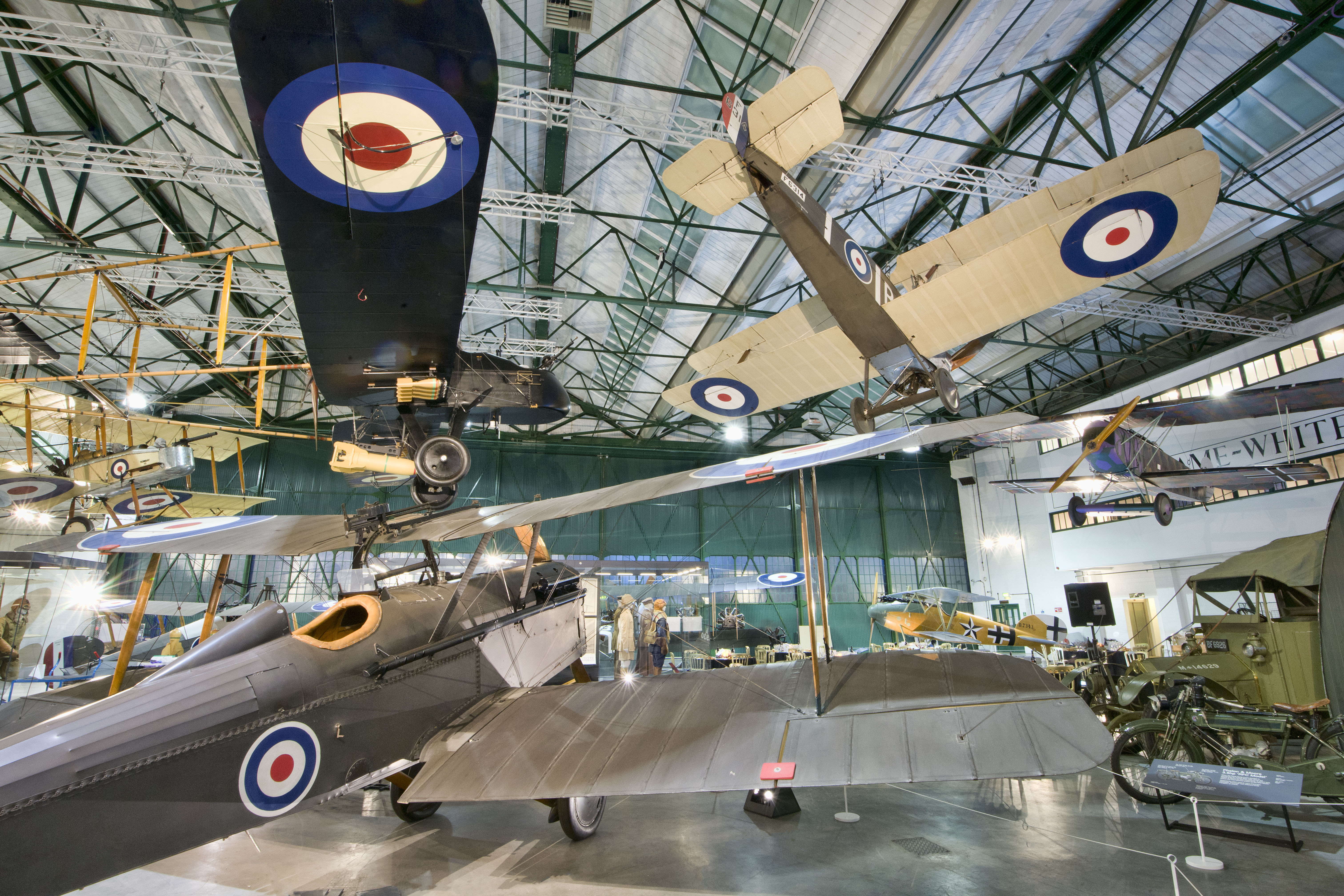
Also known as the Grahame-White Factory shows the earliest days of flight on the site of The London Aerodrome, through to the formation of the independent Royal Air Force in 1918.
Hangars 3 and 4, The Historic Hangars

These hangars focus on the aircraft of the Second World War and the Cold War. It includes original Battle of Britain fighter aircraft: the Hawker Hurricane, Messerschmitt Bf 109 and Supermarine Spitfire; helicopters, and some Cold War jet aircraft.
Hangar 5, the Bomber Hall
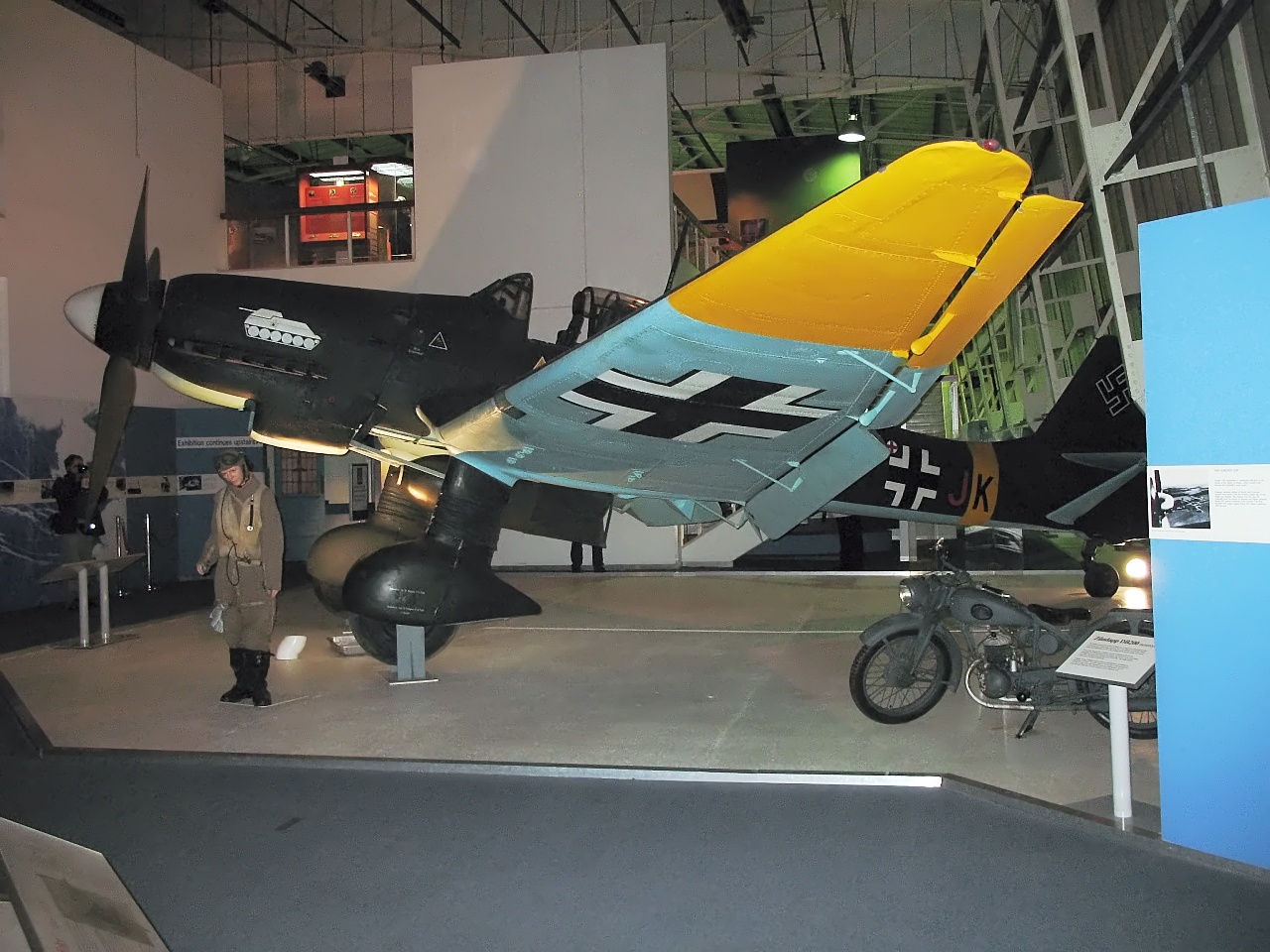
Battle of Britain: shows the German Junkers Ju 87 Stuka and Heinkel He 111 bombers which were types used during the Battle of Britain.
Hangar 6, RAF in an Age of Uncertainty
The RAF from 1980 to the 21st century.
Other facilities
The museum contains a public restaurant built within a 1930s mess store building. Next to it is a children's play area with mini RAF aircraft, vehicles and buildings. A volunteer centre has been created within Building 69, originally a parachute packing RAF building.
The museum's archives, containing thousands of paper documents, books and photographs are situated on the top floor of Hangars 3/4/5.
Aircraft on display
Main article: List of aircraft at the Royal Air Force Museum London
References
References
- "ALVA - Association of Leading Visitor Attractions".
- {{EW charity. 244708. Royal Air Force Museum
- "RAF Hendon - Regiment History, War & Military Records & Archives".
- "New director general announced at RAF museum".
- "Luton Culture chief to head RAF Museum". Museums Association.
- "Marking 100 years in style: The RAF Museum's Centenary Transformation Programme".
- (30 April 2016). ""S-Sugar", the Oldest Surviving RAF Lancaster Heavy Bomber".
- Somerville, Ewan. (28 June 2018). "Prisoner of War suit from Gulf War to go on display for first time". [[Daily Telegraph]].
- "RAF Museum looks to the future after revamp".
- (2 September 2015). "Royal Air Force Museum wins National Lottery Award".
- (22 May 2018). "Final touches made to RAF Museum ahead of reopening".
- "Funding will help Royal Air Force Museum celebrate First World War centenary".
- (11 January 2018). "RAF Museum Hendon Update December 2017".
- Duffield, Adam. (25 April 2014). "RAF Museum Hendon".
- "Thunder & Lightnings – Blackburn Buccaneer – Survivor XL318".
- "Royal Air Force Museum receives £2.5 million grant to fund centenary programme".
- "On site at the Royal Air Force Museum Hendon | Borras Construction".
- Owen, Jonathan. "RAF Museum creates integrated comms campaign for centenary makeover".
- "We Are Moved!".
- "Visit our reading room - RAF Museum".
- (16 January 2014). "Visit to RAF Museum Archives and Library, Hendon".
This article was imported from Wikipedia and is available under the Creative Commons Attribution-ShareAlike 4.0 License. Content has been adapted to SurfDoc format. Original contributors can be found on the article history page.
Ask Mako anything about Royal Air Force Museum London — get instant answers, deeper analysis, and related topics.
Research with MakoFree with your Surf account
Create a free account to save articles, ask Mako questions, and organize your research.
Sign up freeThis content may have been generated or modified by AI. CloudSurf Software LLC is not responsible for the accuracy, completeness, or reliability of AI-generated content. Always verify important information from primary sources.
Report