From Surf Wiki (app.surf) — the open knowledge base
Rouran Khaganate
330–550 AD Proto-Mongolic state

330–550 AD Proto-Mongolic state
| Field | Value |
|---|---|
| native_name | 柔然汗国 |
| conventional_long_name | Rouran Khaganate |
| common_name | Rouran |
| era | Late antiquity |
| status | Khaganate |
| year_start | 330 |
| year_end | 555 |
| p1 | Xianbei |
| s1 | First Turkic Khaganate |
| s2 | Northern Qi |
| s3 | Northern Zhou |
| image_map | Map of the Rouran Khaganate.png |
| image_map_caption | Core territories of the Rouran Khaganate |
| image_map_size | 300 |
| capital | Ting northwest of Gansu |
| Mumocheng | |
| common_languages | Rouran |
| Mongolic | |
| Turkic | |
| Middle Chinese (diplomacy) | |
| religion | Tengrism |
| Shamanism | |
| Buddhism | |
| legislature | Kurultai |
| leader1 | Mugulü |
| leader2 | Yujiulü Dengshuzi |
| year_leader1 | 330 AD |
| year_leader2 | 555 AD |
| title_leader | Khagan |
| stat_area1 | 2800000 |
| stat_year1 | 405 |
| today | China |
| Kazakhstan | |
| Mongolia | |
| Russia |
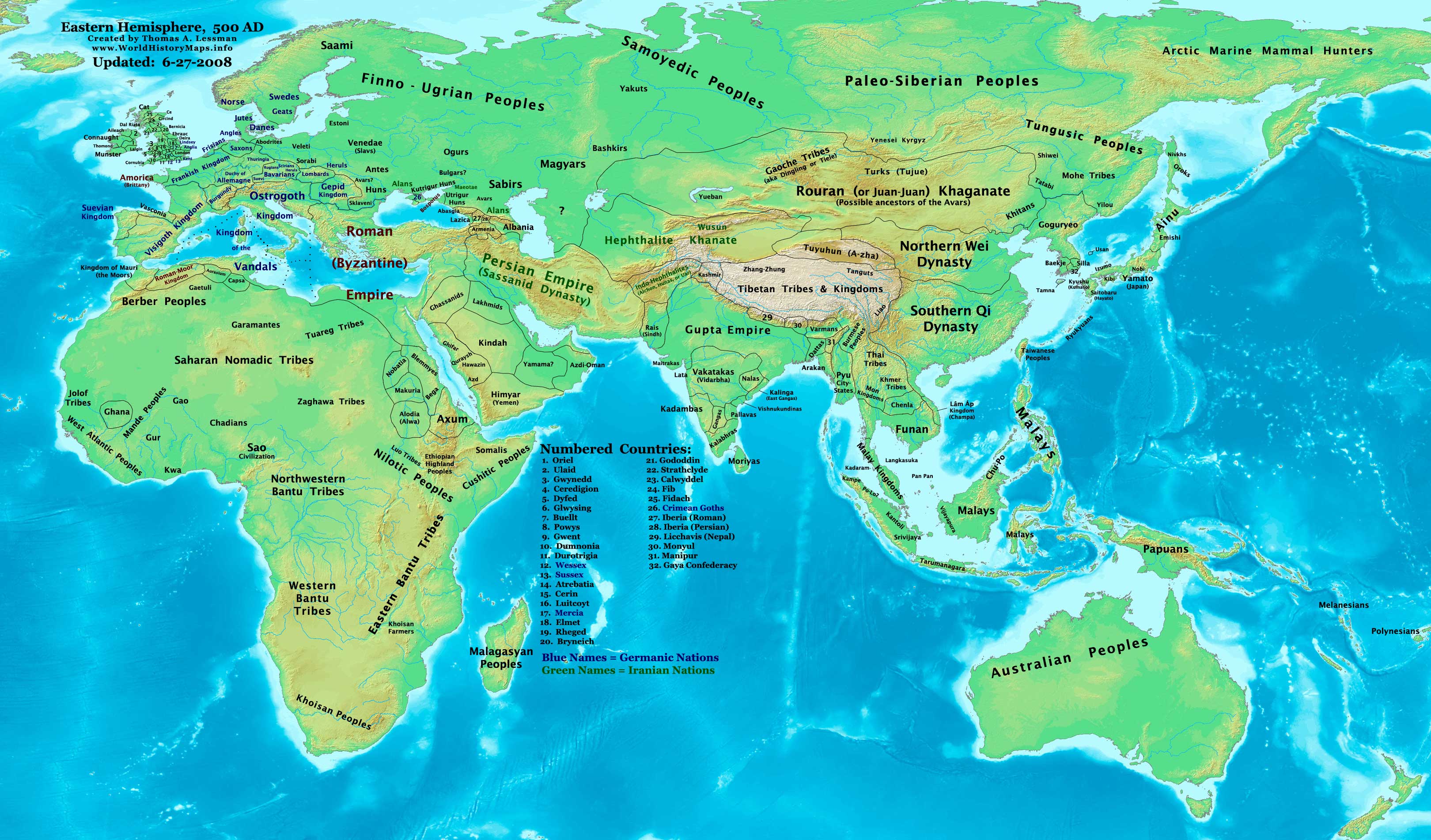
Mumocheng Mongolic Turkic Middle Chinese (diplomacy) Shamanism Buddhism Kazakhstan Mongolia Russia The Rouran Khaganate (Chinese:), also known as Ruanruan or Juan-juan () (or variously Jou-jan, Ruruan, Ju-juan, Ruru, Ruirui, Rouru, Rouruan or Tantan), was a tribal confederation and later state. The Rouran state was undoubtedly multi-ethnic. As the ancient sources regard the Rouran as a separate branch of the Xiongnu Book of Song and Book of Liang connected Rourans to the earlier Xiongnu while the Book of Wei connected them to Proto-Mongolic Donghu. The Rouran supreme rulers used the title of khagan, a popular title borrowed from the Xianbei. The Rouran Khaganate lasted from the late 4th century until the middle 6th century with territory that covered all of modern-day Mongolia and Inner Mongolia, as well as parts of Manchuria in Northeast China, Eastern Siberia, Xinjiang, and Kazakhstan. The Hephthalites were vassals of the Rouran Khaganate until the beginning of the 5th century, with the royal house of Rourans intermarrying with the royal houses of the Hephthalites. The Rouran Khaganate ended when they were defeated by a Göktürk rebellion at the peak of their power, which subsequently led to the rise of the Turks in world history.
Their Khaganate overthrown, some Rouran remnants possibly became Tatars while others possibly migrated west and became the Pannonian Avars (known by such names as Varchonites or Pseudo Avars), who settled in Pannonia (centred on modern Hungary) during the 6th century. These Avars were pursued into the Byzantine Empire by the Göktürks, who referred to the Avars as a slave or vassal people, and requested that the Byzantines expel them. While this Rouran-Avars link remains a controversial theory, a recent DNA study has confirmed the genetic origins of the Avar elite as originating from the Mongolian plains. Other theories instead link the origins of the Pannonian Avars to peoples such as the Uar.
An imperial confederation, the Rouran Khaganate was based on the "distant exploitation of agrarian societies", although according to Nikolay Kradin the Rouran had a feudal system, or "nomadic feudalism". The Rouran controlled trade routes, and raided and subjugated oases and outposts such as Gaochang. They are said to have shown the signs of "both an early state and a chiefdom". The Rouran have been credited as "a band of steppe robbers", because they adopted a strategy of raids and extortion of Northern China. The Khaganate was an aggressive militarized society, a "military-hierarchical polity established to solve the exclusively foreign-policy problems of requisitioning surplus products from neighbouring nations and states."
Name
Nomenclature
Róurán 柔然 is a Classical Chinese transcription of the endonym of the confederacy; meanwhile, 蠕蠕 Ruǎnruǎn ~ Rúrú (Book of Wei), which connoted something akin to "wriggling worm" , was used derogatorily in Tuoba-Xianbei sources. Other transcriptions are 蝚蠕 Róurú ~ Róuruǎn (Book of Jin); 茹茹 Rúrú (Book of Northern Qi, Book of Zhou, Book of Sui); 芮芮 Ruìruì (Book of Qi, Book of Liang, Book of Song), 大檀 Dàtán and 檀檀 Tántán (Book of Song). However, Baumer (2018), while acknowledging that Ruanruan (蠕蠕) was a "derogatory pun" on Rouran (柔然), proposes that the ethnonym Rouran (柔然) is indeed derived from the name Ruru (茹茹) or Ruirui (芮芮) of a "tribal father".
Mongolian Sinologist Sükhbaatar suggests Nirun Нирун as the modern Mongolian term for the Rouran, as Нирун resembles reconstructed Chinese forms beginning with *ń- or *ŋ-. Rashid-al-Din Hamadani recorded Niru'un and Dürlükin as two divisions of the Mongols.
Etymology
Klyastorny reconstructed the ethnonym behind the Chinese transcription 柔然 Róurán (LHC: *ńu-ńan; EMC: *ɲuw-ɲian LMC: *riw-rian) as *nönör and compares it to Mongolic нөкүр nökür "friend, comrade, companion" (Khalkha нөхөр nöhör). According to Klyashtorny, *nönör denotes "stepnaja vol'nica" "a free, roving band in the steppe, the 'companions' of the early Rouran leaders". In early Mongol society, a nökür was someone who had left his clan or tribe to pledge loyalty to and serve a charismatic warlord; if this derivation were correct, Róurán 柔然 was originally not an ethnonym, but a social term referring to the dynastic founder's origins or the core circle of companions who helped him build his state.
However, Golden identifies philological problems: the ethnonym should have been *nöŋör to be cognate to nökür, & possible assimilation of -/k/- to -/n/- in Chinese transcription needs further linguistic proofs. Even if 柔然 somehow transmitted nökür, it more likely denoted the Rouran's status as the subjects of the Tuoba. Before being used as an ethnonym, Rouran had originally been the byname of chief Cheluhui (車鹿會), possibly denoting his status "as a Wei servitor".
History
Origin
The Book of Song and Book of Liang, which are primary sources connected Rouran to the earlier Xiongnu while the Book of Wei traced the Rouran's origins back to the Donghu, generally agreed to be Proto-Mongols. Xu proposed that "the main body of the Rouran were of Xiongnu origin" and Rourans' descendants, namely Da Shiwei (aka Tatars), contained Turkic elements, besides the Mongolic Xianbei. Even so, the Xiongnu's language is still unknown and Chinese historians routinely ascribed Xiongnu origins to various nomadic groups, yet such ascriptions do not necessarily indicate the subjects' exact origins: for examples, Xiongnu ancestry was ascribed to Turkic-speaking Göktürks and Tiele as well as Para-Mongolic-speaking Kumo Xi and Khitans. According to Savelyev and Jeong (2020), the Xiongnu resulted from the admixture of two groups, Turkic origin group which brought by eastern Eurasian genetic substratum and Iranian Saka group (like Chandman). They further write The predominant part of the Xiongnu population is likely to have spoken Turkic and Arguably, these Iranian-speaking groups were assimilated over time by the predominant Turkic-speaking part of the Xiongnu population.
Kwok Kin Poon additionally proposes that the and Rouran were descended specifically from Donghu's Xianbei lineage, i.e. from Xianbei who remained in the eastern Eurasian Steppe after most Xianbei had migrated south and settled in Northern China. Genetic testing on Rourans' remains suggested Donghu-Xianbei paternal genetic contribution to Rourans.
Khaganate
The founder of the Rouran Khaganate, Yujiulü Shelun, was descended from Mugulü, a slave of the Xianbei. Rouran women were commonly taken as wives or concubines by the Xianbei.
After the Xianbei migrated south and settled in Chinese lands during the late 3rd century AD, the Rouran made a name for themselves as fierce warriors. However they remained politically fragmented until 402 AD when Shelun gained support of all the Rouran chieftains and united the Rouran under one banner. Immediately after uniting, the Rouran entered a perpetual conflict with Northern Wei, beginning with a Wei offensive that drove the Rouran from the Ordos region. The Rouran expanded westward and defeated the neighboring Tiele people and expanded their territory over the Silk Roads, even vassalizing the Hephthalites which remained vassals until the beginning of the 5th century.
The Hepthalites migrated southeast due to pressure from the Rouran and displaced the Yuezhi in Bactria, forcing them to migrate further south. Despite the conflict between the Hephthalites and Rouran, the Hephthalites borrowed much from their eastern overlords, in particular the title of "Khan" which was first used by the Rouran as a title for their rulers.
The Rouran were considered vassals (mis) by Tuoba Wei. By 506 they were considered a vassal state (mis). Following the growth of the Rouran and the turning of Wei into a classical Chinese state, they were considered partners of equal rights by Wei (lindi gangli).
In 424, the Rouran invaded Northern Wei but were repulsed.
In 429, Northern Wei launched a major offensive against the Rouran and killed a large number of people.
In 434, the Rouran entered a marriage alliance with Northern Wei. In 443, Northern Wei attacked the Rouran. In 449, the Rouran were defeated in battle by Northern Wei. In 456, Northern Wei attacked the Rouran. In 458, Northern Wei attacked the Rouran.
In 460, the Rouran subjugated the Ashina tribe residing around modern Turpan and resettled them in the Altai Mountains. The Rouran also ousted the previous dynasty of Gaochang (the remnants of the Northern Liang) and installed Kan Bozhou as its king.
In 492, Emperor Tuoba Hong sent 70 thousand horsemen against the Rouran. The outcome of the expedition does not appear in Chinese sources. According to Nikolay Kradin, since Chinese sources don't mention the outcome of the expedition, it is probable that it was unsuccessful. Kradin notes that, possibly strained after the battle with Wei, the Rourans were not able to prevent the Uighur chief Abuzhiluo from heading "a 100 thousand tents" west, in a series of events that led to the overthrowing and killing of Doulun Khan. Two armies were sent in pursuit of the rebels, one led by Doulun, the other by Nagai, his uncle. The Rouran emerged victorious. In the war against the Uighurs, Doulan fought well, but his uncle Nagai won all the battles against the Uighurs. Thus, the soldiers thought that Heaven didn't favor Doulan anymore, and that he should be deposed in favor of Nagai. The latter declined. Nonetheless, the subjects killed Doulan and murdered his next of kin, installing Nagai on the throne. In 518, Nagai married the sorceress Diwan, conferring her the title of khagatun for her outstanding service.
Between 525 and 527, Rouran was employed by Northern Wei in the suppression of rebellions in their territory, with the Rourans then plundering the local population.
The Rouran Khaganate arranged for one of their princesses, Khagan Yujiulü Anagui's daughter Princess Ruru, to be married to the Han Chinese ruler of the Eastern Wei, Gao Huan.
''Heqin''
The Rouran were involved in many royal intermarriage (also known as heqin in China), with the Northern Yan as well as the Northern Wei dynasty and its successors Eastern and Western Wei, which were fighting each other, and each seeking the support of the Rouran to defeat the other. Both parties, in turn, took the initiative of proposing such marriages to forge important alliances or solidify relations.
In the 1970s, the Tomb of Princess Linhe was unearthed in Ci County, Hebei. It contained artistically invaluable murals, a mostly pillaged but still consistent treasure, Byzantine coins and about a thousand vessels and clay figurines. Among the latter was the figurine of a shaman, standing in a dancing posture and holding a saw-like instrument. This figurine is thought to reflect the young princess' Rouran/nomadic roots.
On one occasion, in 540, the Rourans allegedly attacked Western Wei reportedly with a million warriors because a Rouran princess reported being dissatisfied with being second to Emperor Wendi's principal wife.
The first khagan Shelun is said to have concluded a "treaty of peace based on kinship" (mis) with the rulers of the Jin. The royal house of Rouran is also said to have intermarried with the royal house of the Hephthalites in the 6th century.
Society
Since the time of Shelun Khan, the khans were bestowed with additional titles at their enthronement. After 464, starting with Yucheng Khan they started to use epoch names, in imitation of the Chinese. The Rouran dignitaries of the ruling elite also adopted nicknames referring to their deeds, similar to the titles the Chinese bestowed posthumously. Kradin notes that this practice is analogous with that of later Mongolian chiefs. There appears to have been a wide circle composing the nomadic aristocracy, including elders, chieftains and military commanders. The grandees could be high or low ranking. According to Kradin, the khagan could confer titles as rewards for services rendered and outstanding deeds. He cites an example of this; an event occurred in 518, when Nagai entitled the sorceress Diwai khagatun, taking her as his wife, and gave a compensation, a post and a title to Fushengmou, her then former husband. The Rouran titles included mis, mis (cf. Mongolian batur, baghatur), (cf. Mongolian ), , and , , , (cf. Turkic irkin), (cf. Turkic eltäbär).
It is known that in 521 Khagan Anagui was given two bondmaids as a gift from the Chinese, while Khagan Shelun is said to have once declared that the soldiers who fought outstandingly would receive captives. However, "there is nothing in the sources about the enslavement of prisoners of war". There is, however, evidence that the Rouran resettled people in the steppe.
Initially the Rouran chiefs, having no letters to make records, "counted approximately the number of warriors by using sheep's droppings". Later, they made records using notches on wood. A later source claims that the Rouran later adopted the Chinese written language for diplomatic relations, and under Anagui, started to write internal records. According to the same source, there were also many literate people among the Rouran by that time. Kradin notes that the level of literacy "based on the knowledge of written Chinese" was rather high, and that it didn't affect only the elite and the immigrants, but also some cattle-breeders were able to use Chinese ideograms. In the Book of Song there is a story of an educated Rouran "whose knowledge shamed a wise Chinese functionary". There is no record of monuments erected by the Rouran, though there is evidence of the latter requesting doctors, weavers and other artisans to be sent from China.
Imitating the Chinese, Anagui Khan introduced the use of officials at court, "surrounded himself with advisers trained in the tradition of Chinese bibliophily", and adopted a staff of bodyguards, or chamberlains. Hyun Jin Kim notes a similar use of bodyguards performing the same function in the contemporary Hunnic Empire to the west. Kim also compared the "rudimentary bureaucratic organisation" of the Rourans to that of the Huns, as well as their "hierarchical, stratified structure of government". Anagui's chief advisor was the Chinese Shunyu Tan, whose role is comparable to that of Yelü Chucai with the Mongols and Zhonghang Yue with the Xiongnu (or Huns).
Recent archeological finds in Mongolia (the Urd Ulaan Uneet Burial and Khukh Nuur Burial) suggest that the Mongolic Rouran tribes had sophisticated, wooden frame saddles and iron stirrups by at least the fourth and fifth centuries AD. Radiocarbon dating of related items date them to between the 3rd century and 6th century AD. The wooden frame saddle and the iron stirrups found at these burials are one of the earliest examples found in Central and East Asia.
Capital
The capital of the Rouran likely changed over time. The headquarters of the Rouran khan (ting) was said to be initially northwest of Gansu. Later the capital of the Rouran became the legendary town of Mumocheng, said to have been "encircled with two walls constructed by Liang Shu". The existence of this city would be proof of early urbanization among the Rouran. However, no trace of it has been found so far; its location is unknown, and debated among historians.
Decline
In 461, Lü Pi, Duke of Hedong, a Northern Wei general and Grand chancellor of royal Rouran descent, died in Northern Wei. The Rouran and the Hephthalites had a falling out and problems within their confederation were encouraged by Chinese agents.

In 508, the Tiele defeated the Rouran in battle. In 516, the Rouran defeated the Tiele. In 551, Bumin of the Ashina Göktürks quelled a Tiele revolt for the Rouran and asked for a Rouran princess for his service. The Rouran refused claiming that he was only a Blacksmith slave. This angered Bumin who in response declared independence.
Bumin entered a marriage alliance with Western Wei, a successor state of Northern Wei, and attacked the Rouran in 552. The Rouran, now at the peak of their might, were defeated by the Turks. After a defeat at Huaihuang (in present-day Zhangjiakou, Hebei) the last great khan Anagui, realizing he had been defeated, took his own life. Bumin declared himself Illig Khagan of the Turkic Khaganate after conquering Otuken; Bumin died soon after and his son Issik Qaghan succeeded him. Issik continued attacking the Rouran, their khaganate now fallen into decay, but died a year later in 553.
In 555, Turks invaded and occupied the Rouran and Yujiulü Dengshuzi led 3,000 soldiers in retreat to Western Wei. He was later delivered to Turks by Emperor Gong with his soldiers under pressure from Muqan Qaghan. In the same year, Muqan annihilated the Rouran. All the Rouran handed over to the Turks, reportedly with the exception of children under sixteen, were brutally killed.
On 29 November 586 Yujiulü Furen (郁久闾伏仁), an official of Sui and a descendant of the ruling clan, died in Hebei, leaving an epitaph reporting his royal descent from the Yujiulü clan.{{Cite periodical | script-work=zh:草原文物 |date=2017 | issue=1
Possible descendants
Tatars
According to Xu (2005), some Rouran remnants fled to the northwest of the Greater Khingan mountain range, and renamed themselves 大檀 Dàtán (MC: *daH-dan) or 檀檀 Tántán (MC: *dan-dan) after Tantan, the personal name of a historical Rouran Khagan. Tantan were gradually incorporated into the Shiwei tribal complex and later emerged as Great-Da Shiwei (大室韋) in Suishu. Klyashtorny, apud Golden (2013), reconstructed 大檀 / 檀檀 as *tatar / dadar, "the people who, [Klyashtorny] concludes, assisted Datan in the 420s in his internal struggles and who later are noted as the Otuz Tatar ("Thirty Tatars") who were among the mourners at the funeral of Bumın Qağan (see the inscriptions of Kül Tegin, E4 and Bilge Qağan, E5)".
Avars
Some scholars claim that the Rouran then fled west across the steppes and became the Avars, though many other scholars contest this claim. New genetic data seem to answer that question, says Walter Pohl, a historian at the University of Vienna. "We have a very clear indication that they must have come from the core of the Rouran Empire. They were the neighbors of the Chinese." "Genetically speaking, the elite Avars have a very, very eastern profile," says Choongwon Jeong, a co-author and a geneticist at Seoul National University.
That genetic data backs up two historical accounts of the Avar's origins. One sixth century Chinese source describes an enigmatic steppe people called the Rouran, one of many horse-riding nomadic groups attack their northern borders from the Mongolian steppes. The Rouran's grassland empire was reportedly defeated by rival nomads in 552. In 567, diplomats from the Eastern Roman Empire reported the arrival of a new group from the east on the shores of the Caspian Sea. The newcomers called themselves the Avars, and claimed to be related to a far-off people known as the Rouran.
However, it's unlikely that Rouran would have migrated to Europe in any sufficient strength to establish themselves there, due to the desperate resistances, military disasters, and massacres. The remainder of the Rouran fled into China, were absorbed into the border guards, and disappeared as an entity. The last khagan fled to the court of the Western Wei, but at the demand of the Göktürks, Western Wei executed him and the nobles who accompanied him.
The Avars were pursued west by the Göktürks as fugitives and accused them of unlawfully usurping the imperial title of khagan and also the prestigious name of the Avars. Contemporary sources indicate the Avars were not native to the Western Steppe but came to the region after a long wandering. Nor were they native to Central Asia to the south of which lay the Hephthalite Empire which has on and off been identified with the Avars by certain scholars. Instead the Avars' origins were further to the east, a fact which has been corroborated through DNA studies of Avar individuals buried in the Pannonian Basin which have shown that they were primarily East Asian. Their pretensions to empire despite their relatively small numbers indicate descendance from a previously hegemonic power in the Far East. The first embassy of the Avars to Justinian I in 557 corresponds directly to the fall of the Rouran Khaganate in 555. The Rouran Khaganate had fallen not through gradual decline but through a sudden internal revolution led by the Göktürks, hence the still vivid memories of empire in the Avar Khagan, a fact paralleled later by the Kara-Khitans who migrated a long distance west after being suddenly dislodged from northern China but still kept their pretensions to empire and defeated the Great Seljuk Empire in the Battle of Qatwan as the Western Liao. The Hephthalite Empire in southern Central Asia would not fall to the Göktürks until 560. The Hephthalites themselves had previously been vassals to the Rouran and adopted the title khagan from them. They were also already known as the Hephthalites to the Byzantines. In view of these facts a strong Rouran component in the Avar Khaganate has been seen as likely, although the khaganate later included many other peoples such as Slavs and Goths.
Genetics

examined the remains of a Rouran male buried at the Khermen Tal site in Mongolia. He was found to be a carrier of the paternal haplogroup C2b1a1b and the maternal haplogroup D4b1a2a1. Haplogroup C2b1a1b has also been detected among the Xiongnu, Xianbei and Göktürks.
Several genetic studies have shown that early Pannonian Avar elites carried a large amount of East Asian ancestry, and some have suggested this as evidence for a connection between the Pannonian Avars and the earlier Rouran. However, Savelyev & Jeong 2020 notes that there is still little genetic data on the Rouran themselves, and that their genetic relationship with the Pannonian Avars therefore still remains inconclusive.
Language
Main article: Rouran language
The Rouran state was undoubtedly multi-ethnic, but there is no definite evidence as to their language. The received view is that the relationships of the language remain a puzzle and that it may be an isolate. Alexander Vovin (2004, 2010) considered the Rouran language to be an extinct non-Altaic language that is not related to any modern-day language (i.e., a language isolate) and is hence unrelated to Mongolic. Vovin (2004) notes that Old Turkic had borrowed some words from an unknown non-Altaic language that may have been Rouran. In 2018 Vovin changed his opinion after new evidence was found through the analysis of the Brāhmī Bugut and Khüis Tolgoi inscriptions and suggests that the Rouran language was in fact a Mongolic language, close but not identical to Middle Mongolian. According to Alexander Savelyev and Choongwon Jeong the identification of Brāhmī Bugut and Khüis Tolgoi with the Rouran language remains problematic because of the dating. They further write According to Vovin (2019a), the Brāhmī Bugut inscription is dated to ca. 584–587 AD, and the Khüis Tolgoi inscription must have been erected between 604 and 620 AD. As both were created several decades after the Rouran Khaganate had been destroyed, it is unsafe to make conclusions on the composition of the Rouran population, or its elite, on the basis of these inscriptions.
Rulers of the Rouran
The Rourans were the first people who used the titles khagan and khan for their emperors, replacing the chanyu of the Xiongnu. The etymology of the title chanyu is controversial: there are Mongolic, Turkic, and Yeniseian versions.
Tribal chiefs
- Mugulü, 4th century
- Yujiulü Cheluhui, 4th century
- Yujiulü Tunugui, 4th century
- Yujiulü Bati, 4th century
- Yujiulü Disuyuan, 4th century
- Yujiulü Pihouba, 4th century
- Yujiulü Wenheti, 4th century
- Yujiulü Heduohan, 4th century
Khagans
| Personal name | Regnal name | Reign | Era names |
|---|---|---|---|
| Yujiulü Shelun | Qiudoufa Khagan (丘豆伐可汗) | 402–410 | |
| Yujiulü Hulü | Aikugai Khagan (藹苦蓋可汗) | 410–414 | |
| Yujiulü Buluzhen | 414 | ||
| Yujiulü Datan | Mouhanheshenggai Khagan (牟汗紇升蓋可汗) | 414–429 | |
| Yujiulü Wuti | Chilian Khagan (敕連可汗) | 429–444 | |
| Yujiulü Tuhezhen | Chu Khagan (處可汗) | 444–464 | |
| Yujiulü Yucheng | Shouluobuzhen Khagan (受羅部真可) | 464–485 | Yongkang (永康) |
| Yujiulü Doulun | Fugudun Khagan (伏古敦可汗) | 485–492 | Taiping (太平) |
| Yujiulü Nagai | Houqifudaikezhe Khagan (侯其伏代庫者可汗l | 492–506 | Taian (太安) |
| Yujiulü Futu | Tuohan Khagan (佗汗可汗) | 506–508 | Shiping (始平) |
| Yujiulü Chounu | Douluofubadoufa Khagan (豆羅伏跋豆伐可汗) | 508–520 | Jianchang (建昌) |
| Yujiulü Anagui | Chiliantoubingdoufa Khagan (敕連頭兵豆伐可汗) | 520–521 | |
| Yujiulü Poluomen | Mioukesheju Khagan (彌偶可社句可汗) | 521–524 | |
| Yujiulü Anagui | Chiliantoubingdoufa Khagan (敕連頭兵豆伐) | 522–552 |
Khagans of West
- Yujiulü Dengshuzi, 555
Khagans of East
- Yujiulü Tiefa, 552–553
- Yujiulü Dengzhu, 553
- Yujiulü Kangti, 553
- Yujiulü Anluochen, 553–554
Rulers family tree
Died on 29 November 586}} == See also ==
- History of the eastern steppe
References
Footnotes
Citations
Sources
- Findley, Carter Vaughn. (2005). The Turks in World History. Oxford University Press. (cloth); (pbk).
- Kradin, Nikolay. "From Tribal Confederation to Empire: the Evolution of the Rouran Society". Acta Orientalia Academiae Scientiarum Hungaricae, Vol. 58, No 2 (2005): 149–169.
References
- (2006). "History of Civilizations of Central Asia". UNESCO.
- (2019). "Hammer and Anvil: Nomad Rulers at the Forge of the Modern World". Rowman & Littlefield.
- Vovin, Alexander. (2019). "A Sketch of the Earliest Mongolic Language: the Brāhmī Bugut and Khüis Tolgoi Inscriptions". International Journal of Eurasian Linguistics.
- Xu, Elina-Qian. (2005). "Historical Development of the Pre-Dynastic Khitan".
- (2006). "History of Civilizations of Central Asia". UNESCO.
- Litvinsky (2006). ''History of Civilizations of Central Asia The crossroads of civilizations: A.D. 250 to 750''. p. 317.
- Songshu [https://zh.wikisource.org/wiki/%E5%AE%8B%E6%9B%B8/%E5%8D%B795 vol. 95] [https://web.archive.org/web/20200606171010/https://zh.wikisource.org/wiki/%E5%AE%8B%E6%9B%B8/%E5%8D%B795 Archived] 2020-06-06 at the [[Wayback Machine]]. "芮芮一號大檀,又號檀檀,亦匈奴別種。" tr. "Ruìruì, one appellation is Dàtán, also called Tántán; they were also a separate stock of the Xiōngnú."
- ''Liangshu'' [https://zh.wikisource.org/wiki/%E6%A2%81%E6%9B%B8/%E5%8D%B754#%E8%8A%AE%E8%8A%AE%E5%9C%8B vol. 54] [https://web.archive.org/web/20181122131951/https://zh.wikisource.org/wiki/%E6%A2%81%E6%9B%B8/%E5%8D%B754#%E8%8A%AE%E8%8A%AE%E5%9C%8B Archived] 2018-11-22 at the [[Wayback Machine]]. quote: "芮芮國,蓋匈奴別種。" translation: "The Ruìruì nation, possibly a separate stock of the Xiōngnú."
- Wei Shou. (554). "Weishu".
- Findley (2005), p. 35.
- Wei Shou. (554). "Weishu".
- Wei Shou. (554). "Weishu".
- {{harvp. Grousset. 1970
- (2018). "The Avars: A Steppe Empire in Central Europe, 567–822". Cornell University Press.
- (2018). "The History of Central Asia, 4-volume Set". Bloomsbury Publishing.
- Golden, Peter B. (2016) "Turks and Iranians: Aspects of Türk and Khazaro-Iranian Interaction" in Turcologica 105. p. 5
- {{harvp. Golden. 2013
- Lee, Joo-Yup. (2016). " The Historical Meaning of the Term ''Turk'' and the Nature of the Turkic Identity of the Chinggisid and Timurid Elites in Post-Mongol Central Asia". Central Asiatic Journal.
- (2020-11-12). "A Dynamic 6,000-Year Genetic History of Eurasia's Eastern Steppe". Cell.
- (1983). "The Northern Wei state and the Juan-juan nomadic tribe". The University of Hong Kong.
- [[Hyacinth (Bichurin)]], Collection of information on peoples lived in Central Asia in ancient times, 1950. p. 209
- {{harvp. Li et al.. 2018
- Journal of Huanche S&T University. (2015). link
- (2009). "Encyclopedia of the Peoples of Asia and Oceania". Infobase Publishing.
- "Rouran 柔然". [[Chinaknowledge]].
- (2010). "Central Asia in World History". Oxford University Press.
- {{harvp. Grousset. 1970
- Kurbanov, Aydogdy. (2010). "The Hephthalites: Archaeological and historical analysis".
- (2007). "Biographical Dictionary of Chinese Women: Antiquity Through Sui, 1600 B.C.E.–618 C.E.". M.E. Sharpe.
- (2007). "Fashioning a Political Body: The Tomb of a Rouran Princess". Duke University Press.
- (1989). "Mogao Cave 254: A Case Study in Early Chinese Buddhist Art". University of California, Berkeley.
- (2015). "The Huns". Taylor & Francis.
- (2018). "Geopolitics in Late Antiquity The Fate of Superpowers from China to Rome". [[Taylor & Francis]].
- (February 2024). "The origins of saddles and riding technology in East Asia: Discoveries from the Mongolian Altai". Antiquity.
- (2006). "History of Civilizations of Central Asia". UNESCO.
- Kuwayama, Shoshin. (2002). "Across the Hindukush of the First Millennium: a collection of the papers". Institute for Research in Humanities, Kyoto University.
- Pohl, Walter. (2018). "The Avars: A Steppe Empire in Central Europe, 567–822". [[Cornell University Press]].
- (2022). "Military History of Late Rome 565–602". [[Pen and Sword]].
- Mark, Joshua J.. (2014). "Avars".
- Curry, Andrew. (2022). "Mystery warriors made the fastest migration in ancient history. The Avar traveled from Mongolia to Hungary in the span of a decade or two, DNA evidence confirms".
- (27 June 2019). "The Eastern Frontier: Limits of Empire in Late Antique and Early Medieval Central Asia". Bloomsbury Publishing.
- (August 2013). "The Atlas of Military History". Simon and Schuster.
- (2002-09-30). "The Avars: A Review of Their Ethnogenesis and History". Migracijske I Etničke Teme.
- (2020). "A Dynamic 6,000-Year Genetic History of Eurasia's Eastern Steppe". Cell.
- (2023-04-14). "Genetic population structure of the Xiongnu Empire at imperial and local scales". Science Advances.
- {{harvnb. Neparáczki et al.. 2019. Csáky et al.. 2020
- {{harvnb. Savelyev. Jeong. 2020
- (2006). "History of Civilizations of Central Asia". UNESCO.
- (2019). "Hammer and Anvil: Nomad Rulers at the Forge of the Modern World". Rowman & Littlefield.
- Vovin, Alexander. (2004). "Some Thoughts on the Origins of the Old Turkic 12-Year Animal Cycle". Central Asiatic Journal.
- Vovin, Alexander. (2010). "Once Again on the Ruan-ruan Language". Ötüken'den İstanbul'a Türkçenin 1290 Yılı (720–2010) Sempozyumu.
- Vovin, Alexander. (2019). "A Sketch of the Earliest Mongolic Language: the Brāhmī Bugut and Khüis Tolgoi Inscriptions". International Journal of Eurasian Linguistics.
- Таскин В. С.. (1984). "Материалы по истории древних кочевых народов группы дунху". Наука.
- Grousset (1970), pp. 61, 585, n. 91.
- Vovin A. "Did the Xiongnu speak a Yeniseian language? Part 2: Vocabulary", in ''Altaica Budapestinensia MMII, Proceedings of the 45th Permanent International Altaistic Conference, Budapest'', June 23–28, pp. 389–394.
- 藤田 豊八. (April 1923). "蠕蠕の国号及び可汗号につきて". 東洋学報.
- (2019). "Rouran Khan Titles Research". The Oriental Studies.
- (2005). "From Tribal Confederation to Empire: The Evolution of the Rouran Society". [[Acta Orientalia Academiae Scientiarum Hungaricae]].
- (December 2020). "Mongolia in Rouran time: main aspects of the interpretation of archaeological materials". Povolzhskaya Arkheologiya.
- (1979). "Size and Duration of Empires: Growth-Decline Curves, 600 B.C. to 600 A.D.". [[Social Science History]].
- (December 2006). "East-West Orientation of Historical Empires". Journal of World-Systems Research.
- Zhang Min. (June 2003). "On the Defensive System of Great Wall Military Town of Northern Wei Dynasty". China's Borderland History and Geography Studies.
- (2016). "The Encyclopedia of Empire". John Wiley & Sons.
- Pulleyblank, Edwin G.. (2000). "Ji 姬 and Jiang 姜: The Role of Exogamic Clans in the Organization of the Zhou Polity". Cambridge University Press.
- Vovin, Alexander. (2007). "Once again on the etymology of the title ''qaɣan''". Studia Etymologica Cracoviensia.
- Sneath, David. (2007). "The Headless State: Aristocratic Orders, Kinship Society, & Misrepresentations of Nomadic Inner Asia". [[Columbia University Press]].
- (2022). "Ancient genomes reveal origin and rapid trans-Eurasian migration of 7th century Avar elites". Cell.
This article was imported from Wikipedia and is available under the Creative Commons Attribution-ShareAlike 4.0 License. Content has been adapted to SurfDoc format. Original contributors can be found on the article history page.
Ask Mako anything about Rouran Khaganate — get instant answers, deeper analysis, and related topics.
Research with MakoFree with your Surf account
Create a free account to save articles, ask Mako questions, and organize your research.
Sign up freeThis content may have been generated or modified by AI. CloudSurf Software LLC is not responsible for the accuracy, completeness, or reliability of AI-generated content. Always verify important information from primary sources.
Report