From Surf Wiki (app.surf) — the open knowledge base
Rote learning
Memorization technique based on repetition
Memorization technique based on repetition
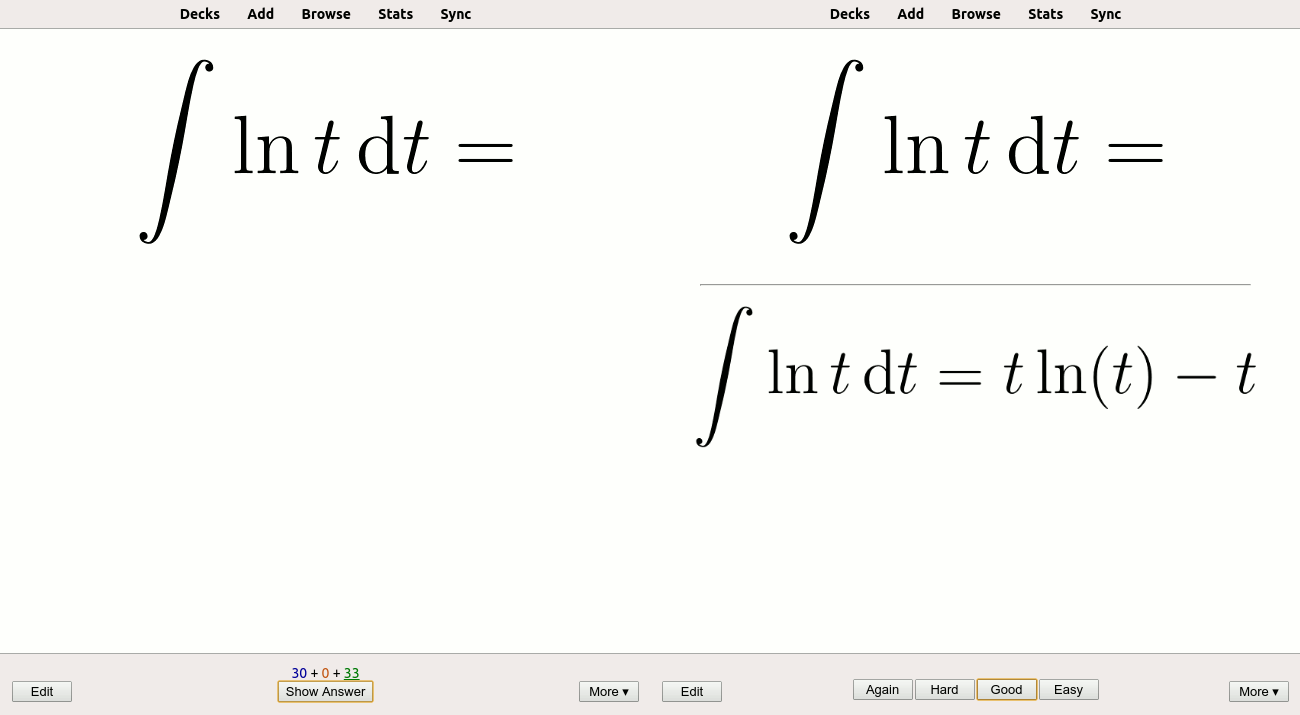
Rote learning is a memorization technique based on repetition. The method rests on the premise that the recall of repeated material becomes faster the more one repeats it. Some of the alternatives to rote learning include meaningful learning, associative learning, spaced repetition and active learning.
Versus critical thinking
Rote learning is widely used in the mastery of foundational knowledge. Examples of school topics where rote learning is frequently used include phonics in reading, the periodic table in chemistry, multiplication tables in mathematics, anatomy in medicine, cases or statutes in law, basic formulae in any science, etc. By definition, rote learning eschews comprehension, so by itself it is an ineffective tool in mastering any complex subject at an advanced level. For instance, one illustration of rote learning can be observed in preparing quickly for exams, a technique which may be colloquially referred to as "cramming".
Rote learning is sometimes disparaged with the derogative terms parrot fashion, regurgitation, cramming, or mugging because one who engages in rote learning may give the wrong impression of having understood what they have written or said. It is strongly discouraged by many new curriculum standards. For example, science and mathematics standards in the United States specifically emphasize the importance of deep understanding over the mere recall of facts, which is seen to be less important. The National Council of Teachers of Mathematics stated: More than ever, mathematics must include the mastery of concepts instead of mere memorization and the following of procedures. More than ever, school mathematics must include an understanding of how to use technology to arrive meaningfully at solutions to problems instead of endless attention to increasingly outdated computational tedium.However, advocates of traditional education have criticized the new American standards as slighting learning basic facts and elementary arithmetic, and replacing content with process-based skills. In math and science, rote methods are often used, for example to memorize formulas. There is greater understanding if students commit a formula to memory through exercises that use the formula rather than through rote repetition of the formula. Newer standards often recommend that students derive formulas themselves to achieve the best understanding. Nothing is faster than rote learning if a formula must be learned quickly for an imminent test and rote methods can be helpful for committing an understood fact to memory. However, students who learn with understanding are able to transfer their knowledge to tasks requiring problem-solving with greater success than those who learn only by rote.
On the other side, those who disagree with the inquiry-based philosophy maintain that students must first develop computational skills before they can understand concepts of mathematics. These people would argue that time is better spent practicing skills rather than in investigations inventing alternatives, or justifying more than one correct answer or method. In this view, estimating answers is insufficient and, in fact, is considered to be dependent on strong foundational skills. Learning abstract concepts of mathematics is perceived to depend on a solid base of knowledge of the tools of the subject. Thus, these people believe that rote learning is an important part of the learning process.
In computer science
Rote learning is also used to describe a simple learning pattern used in machine learning, although it does not involve repetition, unlike the usual meaning of rote learning. The machine is programmed to keep a history of calculations and compare new input against its history of inputs and outputs, retrieving the stored output if present. This pattern requires that the machine can be modeled as a pure function — always producing same output for same input — and can be formally described as follows:
:f(\ x_1 , x_2 , . . ., x_n) → (\ y_1 , y_2 , . . ., y_p) → store ((\ x_1 , x_2 , . . ., x_n),(\ y_1 , y_2, . . . , y_p))
Rote learning was used by Samuel's Checkers on an IBM 701, a milestone in the use of artificial intelligence.
Reasons for rote learning
Though rote learning is usually not necessary, there are many reasons why people resort to it. Bad teachers is one of the key reasons. Some teachers do not know the subject themselves and hence are unable to explain the essence to their students. This is a major problem that plagues higher education, especially in India where the teachers at colleges are usually poorly trained. Many teachers also criticize innovative methods of problem solving thus discouraging the student, who eventually resorts to rote learning to please the teacher.
Some teachers are forced to ask their students to memorize because the board, which conducts the final examination, expects a particular answer. If this answer is not given then the student may lose marks. Another factor that makes many teachers encourage learning by the rote is that these external examinations may be corrected by people who themselves have little knowledge about the subject and may penalise the student for not writing the exact answer as is mentioned in the answer key. Again this problem is very prevalent in countries like India where the number of students writing the examination is very high, making it virtually impossible to standardise the correction process.
Many times, especially in countries where education standards cannot be enforced easily, the question papers are set in a way that encourages learning by rote. The students who try to understand the subject are considered to be wasting time because the paper can be cracked on the basis of rote knowledge only. This encourages otherwise diligent and intelligent students to resort to rote learning, even though they may be capable of understanding the subject.
In addition, rote learning is also exercised by many Muslims to learn the Koran by heart in Arabic. Since the language is foreign to many Muslims who learn the holy book, often the focus is on memorising rather than understanding - especially since many learners are of a very young age.
A second explanation is that rote is the teaching, the incorporation of material into one's consciousness by repetition, by patterning, as it were. Rote is the teaching of abstract concepts by reference in a context rather than explanation, and the teaching of concrete information by practice.
Cultures which practice rote usually also have practices of harsh consequences to unsuccessful learning, and by proxy, such harshness has garnered rote a bad reputation.
Rote learning is active teaching and active learning (versus passive computer based/education-aid based teaching and learning, which has now been shown to pejorate education). Both the teacher and the student must participate in the drill, whether by writing or by speaking, and so the brain power required to meet the processing on a multitude of levels makes for a better educated teacher and pupil.--
Learning methods for school
The flashcard, outline, and mnemonic device are traditional tools for memorizing course material and are examples of rote learning.
References
References
- Gorst, H.E.. (1901). "The Curse of Education". Grant Richards.
- "Why rote memory doesn't help you learn".
- [http://www.wgquirk.com/NCTM2000.html#advice Understanding the Revised NCTM Standards: Arithmetic is Still Missing!]
- National Council of Teachers of Mathematics. "Principles and Standards for School Mathematics".
- Hilgard, Ernest R.. (October 1953). "Rote memorization, understanding, and transfer: an extension of Katona's card-trick experiments". Journal of Experimental Psychology.
- [http://www.ed.gov/about/bdscomm/list/mathpanel/pre-report.pdf ''Preliminary Report, National Mathematics Advisory Panel, January, 2007'']
- Ming Xue; Changjun Zhu. (25 April 2009). "A Study and Application on Machine Learning of Artificial Intelligence".
- "Rote Learning".
- Preston, Ralph (1959). ''Teaching Study Habits and Skills'', Rinehart. Original from the University of Maryland digitized August 7, 2006.
- Cohn, Marvin (1979). ''Helping Your Teen-Age Student: What Parents Can Do to Improve Reading and Study Skills'', Dutton, {{ISBN. 978-0-525-93065-5.
- Ebbinghaus, H. (1913). ''Memory: A Contribution to Experimental Psychology'', Teacher's College, Columbia University (English edition).
- Schunk, Dale H. (2008). ''Learning Theories: An Educational Perspective'', Prentice Hall, {{ISBN. 0-13-010850-2.
This article was imported from Wikipedia and is available under the Creative Commons Attribution-ShareAlike 4.0 License. Content has been adapted to SurfDoc format. Original contributors can be found on the article history page.
Ask Mako anything about Rote learning — get instant answers, deeper analysis, and related topics.
Research with MakoFree with your Surf account
Create a free account to save articles, ask Mako questions, and organize your research.
Sign up freeThis content may have been generated or modified by AI. CloudSurf Software LLC is not responsible for the accuracy, completeness, or reliability of AI-generated content. Always verify important information from primary sources.
Report