From Surf Wiki (app.surf) — the open knowledge base
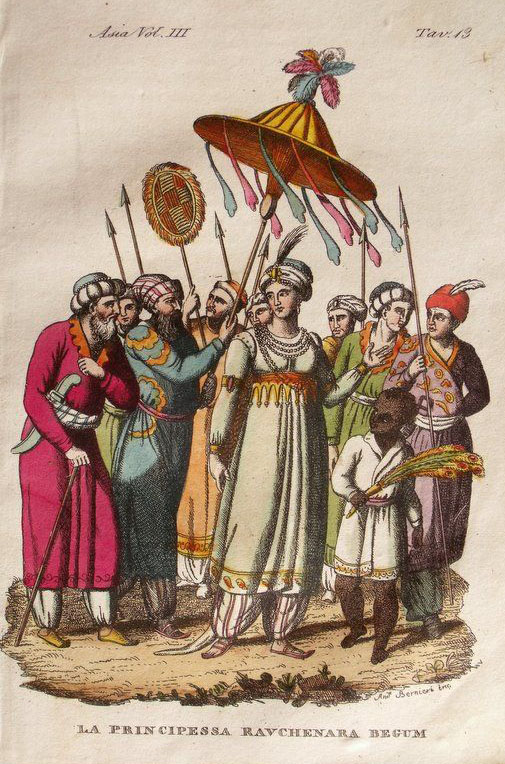
Roshanara Begum
| Field | Value |
|---|---|
| name | Roshanara Begum |
| title | Shahzadi of the Mughal Empire |
| image | Portrait_of_a_mughal_dynasty_princess.jpg |
| caption | Portrait of a princess, most likely Princess Roshanara Begum |
| succession | Padshah Begum |
| predecessor | Jahanara Begum |
| successor | Jahanara Begum |
| reign | 1658–1668 |
| reign-type | Tenure |
| house | Timurid |
| father | Shah Jahan |
| mother | Mumtaz Mahal |
| birth_date | 3 September 1617 |
| birth_place | Burhanpur, India |
| death_date | |
| death_place | Delhi, India |
| burial_place | Roshanara Bagh, Delhi |
| religion | Sunni Islam |
| reign-type = Tenure
Roshanara Begum (); 3 September 1617 – 11 September 1671) was a Mughal princess and poet. She was the third daughter of Emperor Shah Jahan and his wife, Mumtaz Mahal, and supported her younger brother Aurangzeb during the war of succession which took place after Shah Jahan's illness in 1657. After Aurangzeb's accession to the throne in 1658, Roshanara was given the title of Padshah Begum by her brother displacing her sister and rival Jahanara Begum. This made her the de-facto First Lady of the Mughal Empire, and a powerful political figure. However, after the death of Shah Jahan, Jahanara succeeded in regaining her title of Padshah Begum, by replacing Roshanara. Towards the end of her life, Roshanara was sidelined in Aurangzeb’s court.
Today, however, Roshanara is best known for the Roshanara Bagh, a pleasure garden located in present-day north Delhi. The present-day Roshanara Club which was constructed in the late 19th century by the British is a country club that was actually originally a part of the Roshanara Bagh.
Family
Of Roshanara's four brothers, the eldest, Dara Shikoh, was Shah Jahan's favourite son and heir apparent to the Peacock Throne. Shah Shuja, the second son, was the rebellious Governor of Bengal, with open designs on his father's throne. Aurangzeb, the third son, was the nominal Governor of Deccan. Murad, the youngest son, was granted the Governorship of Gujarat, at which position he proved so weak and so ineffectual that Shah Jahan had him stripped of his titles, offering them to Dara Shikoh, instead. This precipitated a family struggle between Shah Jahan and his embittered younger sons, who resolved to depose the aging emperor and seize the throne for themselves. During this power struggle, Dara Shikoh received the support of his oldest sister, Jahanara Begum, while Roshanara Begum sided with Aurangzeb.
Rise to power
Roshanara's rise to power began when she successfully foiled a plot by her father and Dara Shikoh to kill Aurangzeb. According to history, Shah Jahan sent a letter of invitation to Aurangzeb to come to Delhi, to peacefully resolve the family crisis. In truth, however, Shah Jahan planned to capture, imprison and kill Aurangzeb, as he viewed his third son as a serious threat to the throne. When Roshanara got wind of her father's plots, she sent a messenger to Aurangzeb, outlining their father's true intentions, and warning Aurangzeb to stay away from Delhi.
Aurangazeb was extremely grateful to Roshanara for her timely warning. When the war of succession was resolved in favor of Aurangzeb, she quickly became a very powerful and effective figure in the court. Fearing that Dara Shikoh would kill her for her role in the war of succession if he ever returned to power, Roshanara insisted that Aurangzeb orders Dara's execution. Legend has it that Dara was bound in chains, paraded around Chandni Chowk, and beheaded. Roshanara then had his bloody head wrapped in a golden turban, packaged neatly and sent to her father as a gift from Aurangzeb and her. Shah Jahan, who opened the package just as he was sitting down to dinner, was so distressed by the sight of his favorite son's head that he fell unconscious to the floor. He remained in a stupor for many days after the incident.
Roshanara's relationship with her older sister, Jahanara, was troubled and tinged by jealousy, as the latter was undisputedly their father's favorite daughter. Roshanara scored a major victory against her sister when Aurangzeb, who had been displeased with Jahanara for supporting their father and brother during the war of succession, removed her (Jahanara) from her position as Padshah Begum and head of the Imperial harem, installing Roshanara, instead. From then on, Roshanara was regarded as the most powerful and superior woman in the empire. She was also granted the right to issue nishans. This exceptional privilege was allowed only to those who held a high rank in the imperial harem. She was appointed as a Mansabdar, a high-ranking position in the Emperor's army that was used to enforce his rule and maintain his authority, especially during his absence.
Eventually, Roshanara and Aurangzeb fell out with each other. Roshanara was rumored to have taken on lovers, which was not viewed well by Aurangzeb. Additionally, she ruled Aurangzeb's palace with an iron hand and with such flexibility and with the same will that she used in the war of succession and earned the hatred of all the wives of her brother. She also advised him on matters of state and accompanied him to important meetings and on several occasions spoke from behind her curtained sitting place. She even patronized the building of the Jama Masjid.
In 1662, during Aurangzeb's sudden and severe illness, Roshanara Begum took charge of him and would not allow anyone except her confidants, to see him. Believing that there was no hope of her brother's survival, Roshanara took charge of the state. She even stole Aurangzeb's signet ring and forged a decree to deny his eldest son by his wife Nawab Bai any chance of succession. When Nawab Bai learned of this and complained, Roshanara became angry, seized her by the hair, and dragged her out of Aurangzeb's chamber. After Aurangzeb's recovery, she claimed that wanted to prevent conspiracies and wars of succession so that chaos would not arise during his illness. She also had a love for gold and land, and accumulated wealth on a large scale, often by corrupt methods. This resulted in numerous complaints against her, none of which were brought to justice due to her position in the court. In addition, she blatantly misused the sweeping powers and privileges that Aurangzeb had granted her just before leaving for his long military campaign in the Deccan, to further her financial ends.
Finally, in 1667/8, the period of Roshanara as the de facto co-ruler of the empire ended. Her enemies soon brought these acts of financial and moral turpitude to Aurangzeb's notice. Himself a very strict Muslim, Aurangzeb frowned on Roshanara's libertine lifestyle and her greedy nature. On his return to Delhi, he stripped Roshanara of her powers, banished her from his court, and ordered her to remain in seclusion and live a pious life in her garden palace, outside of Delhi.
Death

Even when Aurangzeb’s rule was established, Roshanara was afraid of the comeuppance of her actions, and thus asked Aurangzeb to build a palace for her away from the walled city. She decided to stay away from politics, which was getting dangerous and uncertain. Roshanara chose to spend an esoteric life in her palace in Delhi, surrounded by a thick forest. She never married and lived in her palace till the end of her life. Her palace in the middle of the Roshanara garden is a reminder of the crucial role she played in the history of India. She died at the age of 54. Aurangzeb had her interred in the Roshanara Bagh, a garden that she had designed and commissioned herself.
Ancestry
Gallery
File:Front and left side view of tomb of Roshanara Begum.jpg|Front and left side view of tomb of Roshanara Begum File:Interior decoration on the tomb of Roshanara Begum, the second daughter of the Mughal Emperor, Shah Jahan, north Delhi.jpg|Interior decoration File:A view of tomb of Roshanara Begum, the second daughter of the Mughal Emperor, Shah Jahan, north Delhi.jpg|A view of tomb of Roshanara Begum File:A view of Roshanara Garden through tomb of Roshanara Begum.jpg|A view of Roshanara Garden through tomb of Roshanara Begum
Notes
References
- Nath, Renuka. (1990). "Notable Mughal and Hindu women in the 16th and 17th centuries A.D.". Inter-India Publ..
- Dalrymple, William: "City Of Djinns: A Year In Delhi", Page 198, 1993. Harper Collins, London. {{ISBN. 0-00-215725-X
- Lal, Ruby. (2005-09-22). "Domesticity and Power in the Early Mughal World". Cambridge University Press.
- Dalrymple, William. (2005). "The city of djinns". Harper Perennial.
- Sarker, Kobita. (2007). "Shah Jahan and his paradise on earth: the story of Shah Jahan's creations in Agra and Shahjahanabad in the golden days of the Mughals".
- Mehta, J.l.. (1986). "Advanced Study in the History of Medieval India".
- {{harvtxt. Mehta. 1986
- (2012). "Events That Formed the Modern World".
- {{harvtxt. Mehta. 1986
- {{harvtxt. Mehta. 1986
- Mukherjee, Soma. (2001). "Royal Mughal Ladies and Their Contributions". Gyan Books.
- Subhash Parihar, ''Some Aspects of Indo-Islamic Architecture'' (1999), p. 149
- (1967). "The Life and Times of Noor Jahan". Caravan Book House.
- (1924). "The Taj and Its Environments: With 8 Illus. from Photos., 1 Map, and 4 Plans". R. G. Bansal.
This article was imported from Wikipedia and is available under the Creative Commons Attribution-ShareAlike 4.0 License. Content has been adapted to SurfDoc format. Original contributors can be found on the article history page.
Ask Mako anything about Roshanara Begum — get instant answers, deeper analysis, and related topics.
Research with MakoFree with your Surf account
Create a free account to save articles, ask Mako questions, and organize your research.
Sign up freeThis content may have been generated or modified by AI. CloudSurf Software LLC is not responsible for the accuracy, completeness, or reliability of AI-generated content. Always verify important information from primary sources.
Report