From Surf Wiki (app.surf) — the open knowledge base
Rose (mathematics)
Multi-lobed plane curve

Multi-lobed plane curve
For proper mathematical analysis, k must be expressed in irreducible form.]]
In mathematics, a rose or rhodonea curve is a sinusoid specified by either the cosine or sine functions with no phase angle that is plotted in polar coordinates. Rose curves or "rhodonea" were named by the Italian mathematician who studied them, Guido Grandi, between the years 1723 and 1728.
General overview
Specification
A rose is the set of points in polar coordinates specified by the polar equation :r=a\cos(k\theta) or in Cartesian coordinates using the parametric equations :\begin{align} x &= r\cos(\theta) = a\cos(k\theta)\cos(\theta) \ y &= r\sin(\theta) = a\cos(k\theta)\sin(\theta) \end{align}
Roses can also be specified using the sine function. Since :\sin(k \theta) = \cos\left( k \theta - \frac{\pi}{2} \right) = \cos\left( k \left( \theta-\frac{\pi}{2k} \right) \right). Thus, the rose specified by is identical to that specified by rotated counter-clockwise by radians, which is one-quarter the period of either sinusoid.
Since they are specified using the cosine or sine function, roses are usually expressed as polar coordinate (rather than Cartesian coordinate) graphs of sinusoids that have angular frequency of k and an amplitude of a that determine the radial coordinate r given the polar angle θ (though when k is a rational number, a rose curve can be expressed in Cartesian coordinates since those can be specified as algebraic curves).
General properties

Roses are directly related to the properties of the sinusoids that specify them.
Petals
- Graphs of roses are composed of petals. A petal is the shape formed by the graph of a half-cycle of the sinusoid that specifies the rose. (A cycle is a portion of a sinusoid that is one period long and consists of a positive half-cycle, the continuous set of points where r ≥ 0 and is long, and a negative half-cycle is the other half where r ≤ 0.)
- The shape of each petal is same because the graphs of half-cycles have the same shape. The shape is given by the positive half-cycle with crest at (a,0) specified by (that is bounded by the angle interval − ≤ θ ≤ ). The petal is symmetric about the polar axis. All other petals are rotations of this petal about the pole, including those for roses specified by the sine function with same values for a and k.
- Consistent with the rules for plotting points in polar coordinates, a point in a negative half-cycle cannot be plotted at its polar angle because its radial coordinate r is negative. The point is plotted by adding π radians to the polar angle with a radial coordinate . Thus, positive and negative half-cycles can be coincident in the graph of a rose. In addition, roses are inscribed in the circle .
- When the period T of the sinusoid is less than or equal to 4π, the petal's shape is a single closed loop. A single loop is formed because the angle interval for a polar plot is 2π and the angular width of the half-cycle is less than or equal to 2π. When T 4π (or {{math|
- A rose's petals will not intersect each other when the angular frequency k is a non-zero integer; otherwise, petals intersect one another.
Symmetry
All roses display one or more forms of symmetry due to the underlying symmetric and periodic properties of sinusoids.
-
A rose specified as is symmetric about the polar axis (the line ) because of the identity that makes the roses specified by the two polar equations coincident.
-
A rose specified as is symmetric about the vertical line because of the identity that makes the roses specified by the two polar equations coincident.
-
Only certain roses are symmetric about the pole.
-
Individual petals are symmetric about the line through the pole and the petal's peak, which reflects the symmetry of the half-cycle of the underlying sinusoid. Roses composed of a finite number of petals are, by definition, rotationally symmetric since each petal is the same shape with successive petals rotated about the same angle about the pole.
Roses with non-zero integer values of ''{{mvar|k}}''
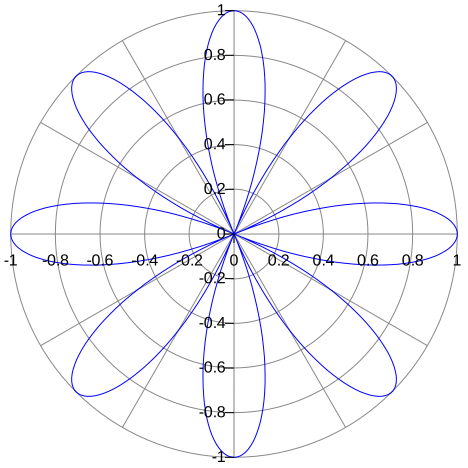
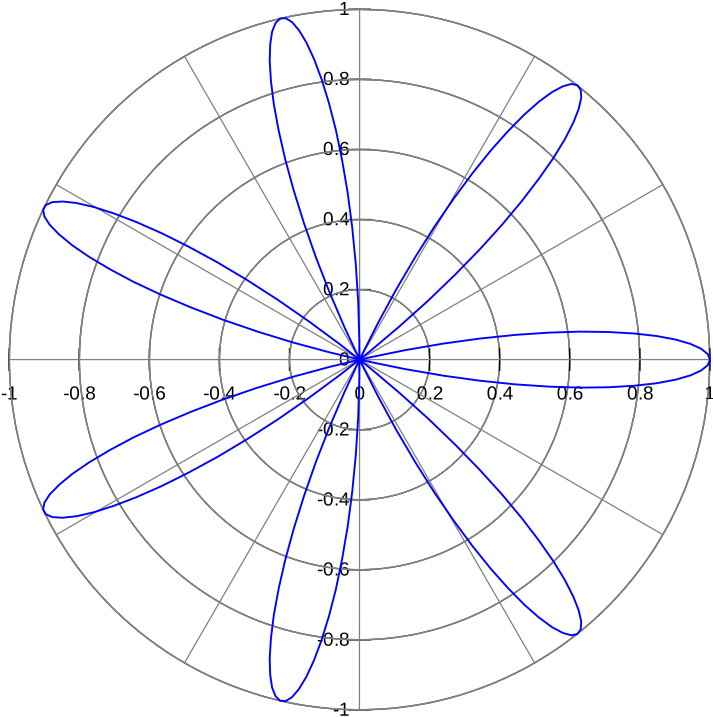
When k is a non-zero integer, the curve will be rose-shaped with 2k petals if k is even, and k petals when k is odd. The properties of these roses are a special case of roses with angular frequencies k that are rational numbers discussed in the next section of this article.
-
The rose is inscribed in the circle , corresponding to the radial coordinate of all of its peaks.
-
Because a polar coordinate plot is limited to polar angles between 0 and 2π, there are cycles displayed in the graph. No additional points need be plotted because the radial coordinate at is the same value at (which are crests for two different positive half-cycles for roses specified by the cosine function).
-
When k is even (and non-zero), the rose is composed of 2k petals, one for each peak in the 2π interval of polar angles displayed. Each peak corresponds to a point lying on the circle . Line segments connecting successive peaks will form a regular polygon with an even number of vertices that has its center at the pole and a radius through each peak, and likewise:
- The roses are symmetric about the pole.
- The roses are symmetric about each line through the pole and a peak (through the "middle" a petal) with the polar angle between the peaks of successive petals being radians. Thus, these roses have rotational symmetry of order 2k.
- The roses are symmetric about each line that bisects the angle between successive peaks, which corresponds to half-cycle boundaries and the apothem of the corresponding polygon.
-
When k is odd, the rose is composed of the k petals, one for each crest (or trough) in the 2π interval of polar angles displayed. Each peak corresponds to a point lying on the circle . These rose's positive and negative half-cycles are coincident, which means that in graphing them, only the positive half-cycles or only the negative half-cycles need to plotted in order to form the full curve. (Equivalently, a complete curve will be graphed by plotting any continuous interval of polar angles that is π radians long such as to .) Line segments connecting successive peaks will form a regular polygon with an odd number of vertices, and likewise:
- The roses are symmetric about each line through the pole and a peak (through the middle of a petal) with the polar angle between the peaks of successive petals being radians. Thus, these roses have rotational symmetry of order k.
-
The rose’s petals do not overlap.
-
The roses can be specified by algebraic curves of order k + 1 when k is odd, and 2(k + 1) when k is even.
The circle
A rose with is a circle that lies on the pole with a diameter that lies on the polar axis when . The circle is the curve's single petal. (See the circle being formed at the end of the next section.) In Cartesian coordinates, the equivalent cosine and sine specifications are :\left(x-\frac{a}{2}\right)^2+y^2=\left(\frac{a}{2}\right)^2 and :x^2+\left(y-\frac{a}{2}\right)^2=\left(\frac{a}{2}\right)^2 respectively.
The quadrifolium
A rose with is called a quadrifolium because it has petals and will form a square. In Cartesian coordinates the cosine and sine specifications are :\left(x^2+y^2\right)^3=a^2\left(x^2-y^2\right)^2 and :\left(x^2+y^2\right)^3=4\left(axy\right)^2 respectively.
The trifolium
A rose with is called a trifolium because it has petals and will form an equilateral triangle. The curve is also called the Paquerette de Mélibée. In Cartesian Coordinates the cosine and sine specifications are :\left(x^2+y^2\right)^2=a\left(x^3-3xy^2\right) and :\left(x^2+y^2\right)^2=a\left(3x^2y-y^3\right) respectively. (See the trifolium being formed at the end of the next section.)
The octafolium
A rose with is called an octafolium because it has petals and will form an octagon. In Cartesian Coordinates the cosine and sine specifications are :\left(x^2+y^2\right)^5=a^2\left(x^4-6x^2y^2+y^4\right)^2 and :\left(x^2+y^2\right)^5=16a^2\left(xy^3-yx^3\right)^2 respectively.
The pentafolium
A rose with is called a pentafolium because it has petals and will form a regular pentagon. In Cartesian Coordinates the cosine and sine specifications are :\left(x^2+y^2\right)^3=a\left(x^5-10x^3y^2+5xy^4\right) and :\left(x^2+y^2\right)^3=a\left(5x^4y-10x^2y^3+y^5\right) respectively.
The dodecafolium
A rose with is called a dodecafolium because it has petals and will form a dodecagon. In Cartesian Coordinates the cosine and sine specifications are :\left(x^2+y^2\right)^7=a^2\left(x^6-15x^4y^2+15x^2y^4-y^6\right)^2 and :\left(x^2+y^2\right)^7=4a^2\left(3x^5y-10x^3y^3+3xy^5\right)^2 respectively.
Total and petal areas
The total area of a rose with polar equation of the form or , where k is a non-zero integer, is :\begin{align} \frac{1}{2}\int_{0}^{2\pi}(a\cos (k\theta))^2,d\theta &= \frac {a^2}{2} \left(\pi + \frac{\sin(4k\pi)}{4k}\right) = \frac{\pi a^2}{2} &&\quad\text{for even }k\[8px] \frac{1}{2}\int_{0}^{\pi}(a\cos (k\theta))^2,d\theta &= \frac {a^2}{2} \left(\frac{\pi}{2} + \frac{\sin(2k\pi)}{4k}\right) = \frac{\pi a^2}{4} &&\quad\text{for odd }k \end{align}
When k is even, there are 2k petals; and when k is odd, there are k petals, so the area of each petal is .
As a consequence, if someone wanted to play the popular game He loves me... he loves me not on a rose like above, instead of counting the petals they could calculate the area of the rose to determine the result of the game.
Roses with rational number values for ''{{mvar|k}}''
In general, when k is a rational number in the irreducible fraction form , where n and d are non-zero integers, the number of petals is the denominator of the expression . This means that the number of petals is n if both n and d are odd, and 2n otherwise.
-
In the case when both n and d are odd, the positive and negative half-cycles of the sinusoid are coincident. The graph of these roses are completed in any continuous interval of polar angles that is dπ long.
-
When n is even and d is odd, or visa versa, the rose will be completely graphed in a continuous polar angle interval 2dπ long. Furthermore, the roses are symmetric about the pole for both cosine and sine specifications.
- In addition, when n is odd and d is even, roses specified by the cosine and sine polar equations with the same values of a and k are coincident. For such a pair of roses, the rose with the sine function specification is coincident with the crest of the rose with the cosine specification at on the polar axis either at or at . (This means that roses and with non-zero integer values of k are never coincident.)
-
The rose is inscribed in the circle , corresponding to the radial coordinate of all of its peaks.
The Dürer folium
A rose with is called the Dürer folium, named after the German painter and engraver Albrecht Dürer. The roses specified by and are coincident even though a cos() ≠ a sin(). In Cartesian coordinates the rose is specified as :\left(x^2+y^2\right)\left(2\left(x^2+y^2\right)-a^2\right)^2=a^4x^2
The Dürer folium is also a trisectrix, a curve that can be used to trisect angles.
The limaçon trisectrix
A rose with is a limaçon trisectrix that has the property of trisectrix curves that can be used to trisect angles. The rose has a single petal with two loops. (See the animation below.) The rays displayed are the polar axis and . Graphing starts at when k is an integer, otherwise, and proceeds clockwise to .
Roses with irrational number values for ''{{mvar|k}}''
A rose curve specified with an irrational number for k has an infinite number of petals and will never complete. For example, the sinusoid has a period , so, it has a petal in the polar angle interval − ≤ θ ≤ with a crest on the polar axis; however there is no other polar angle in the domain of the polar equation that will plot at the coordinates (a,0). Overall, roses specified by sinusoids with angular frequencies that are irrational constants form a dense set (that is, they come arbitrarily close to specifying every point in the disk r ≤ a).
Rotations required to close the curve
The number of rotations (or total angular range) required for a rhodonea curve to complete one full closed figure depends on the ratio . When k is an integer, the curve closes after π radians if k is odd, and after 2π radians if k is even. When k is a rational number, the total rotation needed for the curve to close is given by if nd is odd, and by otherwise. This formula determines how many radians (or loops) are required for the rose curve to complete a full pattern before repeating itself.
Notes
References
- "Rhodonea".
- ''[[Mathematical Models (Cundy and Rollett). Mathematical Models]]'' by [[Martyn Cundy. H. Martyn Cundy]] and A.P. Rollett, second edition, 1961 (Oxford University Press), p. 73.
- "Rose (Mathematics)".
- Robert Ferreol. "Rose".
- Xah Lee. "Rose Curve".
- Eric W. Weisstein. "Rose (Mathematics)".
- "Number of Petals of Odd Index Rhodonea Curve".
- Robert Ferreol. "Rose".
- "Trifolium".
- Eric W. Weisstein. "Paquerette de Mélibée".
- Robert Ferreol. "Rose".
- Jan Wassenaar. "Rhodonea".
- Robert Ferreol. "Rose".
- Xah Lee. "Rose Curve".
- Xah Lee. "Rose Curve".
- Jan Wassenaar. "Rhodonea".
- Robert Ferreol. "Dürer Folium".
- Eric W. Weisstein. "Rose (Mathematics)".
This article was imported from Wikipedia and is available under the Creative Commons Attribution-ShareAlike 4.0 License. Content has been adapted to SurfDoc format. Original contributors can be found on the article history page.
Ask Mako anything about Rose (mathematics) — get instant answers, deeper analysis, and related topics.
Research with MakoFree with your Surf account
Create a free account to save articles, ask Mako questions, and organize your research.
Sign up freeThis content may have been generated or modified by AI. CloudSurf Software LLC is not responsible for the accuracy, completeness, or reliability of AI-generated content. Always verify important information from primary sources.
Report