From Surf Wiki (app.surf) — the open knowledge base
Rosa-Luxemburg-Platz
Square in Berlin-Mitte, Germany

Square in Berlin-Mitte, Germany
| Field | Value | |
|---|---|---|
| name | Rosa-Luxemburg-Platz | |
| native_name | ||
| image | Rosa Luxemburg Platz.jpg | |
| caption | Entrance to Rosa-Luxemburg-Platz U-Bahn station at night | |
| mapframe | yes | |
| former_names | {{plainlist | |
| type | Town square | |
| area | Mitte | |
| location | Rosa-Luxemburg-Straße | |
| metro | Rosa-Luxemburg-Platz | |
| commissioning_date | 1905 | |
| inauguration_date | ||
| website |
- Babelsberger Platz (1907–1910)
- Bülowplatz (1910–1933)
- Horst-Wessel-Platz (1933–1945)
- Liebknechtplatz (1945–1947)
- Luxemburgplatz (1947–1969)

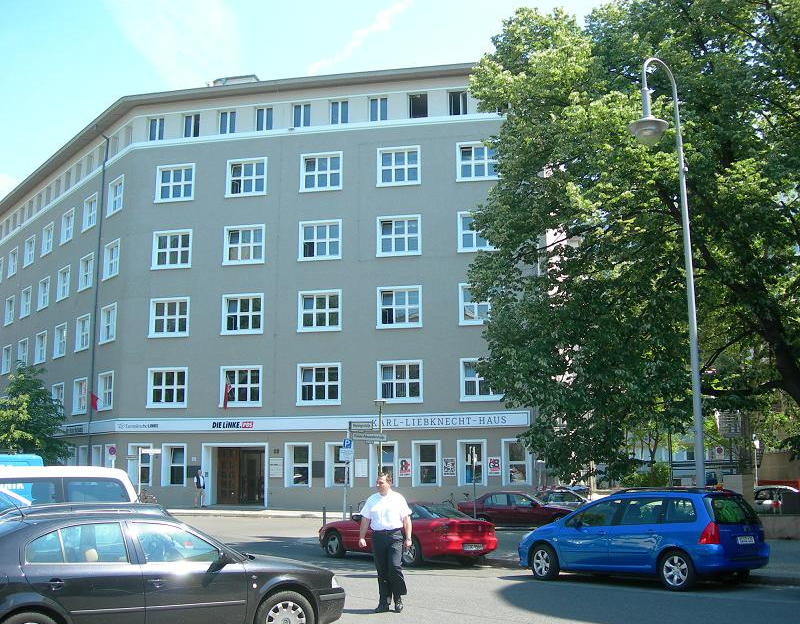
Rosa-Luxemburg-Platz, formerly the Bülowplatz, is a square in Berlin-Mitte, Germany.
History
The square is dominated by the Volksbühne (the "People's Theatre", built 1913-14) and by the Karl-Liebknecht-Haus, the headquarters of the German Left Party. The party's predecessor, the Communist Party of Germany (KPD), opened its headquarters on the square in 1926. The square was also home to the headquarters of Die Rote Fahne. Prior to 1933 it was considered the centre of German communism, with the writer Erich Weinert penning an ode in Berlin dialect to its unique character: Ich komme uff'n Bülowplatz und denke, wat is los? der hat ja Polizeibesatz Hier is 'ne Staatsaktion, mein Schatz! Hier jibt's Zussammenstoss. The square was previously named Babelsberger Platz (1907–1910) and Bülowplatz (1910–1933), and was the focus of one of the last mass demonstrations in Berlin against the Nazi Party on January 25, 1933—five days before Adolf Hitler was appointed German Chancellor. Later that year, with the rise of the Third Reich, it was renamed Horst-Wessel-Platz (1933–1945) after National Socialist martyr Horst Wessel. Following the fall of Berlin and Soviet occupation, the square, then part of communist-controlled East Berlin, was renamed Liebknechtplatz (1945–1947) after German communist Karl Liebknecht. It was then renamed Luxemburgplatz (1947–1969) after communist leader Rosa Luxemburg, until it was given the name Rosa-Luxemburg-Platz by the East German regime in 1969.

The square is noted as the scene of the murders of Paul Anlauf and Franz Lenck, police captains who were the victims of a double homicide in 1931 at the hands of members of the KPD. A monument created by Hans Dammann commemorating Anlauf and Lenck was erected in the square in 1934; although a metal statue of Anlauf and Lenck was melted down during the Second World War as part of a metal recycling campaign ("Metallspende des deutschen Volkes"), the rest of the monument was destroyed in 1950 on the orders of Erich Mielke, one of the murderers, who was by then a member of the Central Committee of the Socialist Unity Party of Germany and a State Secretary in the newly formed Ministry of State Security.
References
References
- (October 1986). "Street Names and Political Identity: The Case of East Berlin". [[Journal of Contemporary History]].
- Stricker, Michael. (2010). "Letzter Einsatz. Im Dienst getötete Polizisten in Berlin von 1918 bis 2010". Verlag für Polizeiwissenschaft.
This article was imported from Wikipedia and is available under the Creative Commons Attribution-ShareAlike 4.0 License. Content has been adapted to SurfDoc format. Original contributors can be found on the article history page.
Ask Mako anything about Rosa-Luxemburg-Platz — get instant answers, deeper analysis, and related topics.
Research with MakoFree with your Surf account
Create a free account to save articles, ask Mako questions, and organize your research.
Sign up freeThis content may have been generated or modified by AI. CloudSurf Software LLC is not responsible for the accuracy, completeness, or reliability of AI-generated content. Always verify important information from primary sources.
Report