From Surf Wiki (app.surf) — the open knowledge base
Ronald Reagan Washington National Airport
Airport in Arlington, Virginia, serving Washington, D.C., United States
.jpg)
Airport in Arlington, Virginia, serving Washington, D.C., United States
| Field | Value |
|---|---|
| name | Ronald Reagan Washington |
| National Airport | |
| image | Ronald Reagan Washington National Airport logo.svg |
| image_size | |
| image2 | File:Ronald Reagan Washington National Airport overhead 2023.png |
| image2_size | |
| caption2 | Reagan National in September 2023 |
| IATA | DCA |
| ICAO | KDCA |
| FAA | DCA |
| WMO | 72405 |
| type | Public |
| owner | United States government |
| operator | Metropolitan Washington Airports Authority |
| occupants | Coast Guard Air Station Washington |
| city-served | Washington, D.C. metropolitan area |
| location | Arlington County, Virginia, U.S. |
| opened | |
| closed | |
| passenger_services_ceased | |
| hub | American Airlines |
| focus_city | |
| operating_base | |
| built | |
| used | |
| commander | |
| timezone | EST |
| utc | UTC−05:00 |
| summer | EDT |
| utcs | UTC−04:00 |
| elevation-f | 15 |
| elevation-m | 5 |
| metric-elev | yes |
| coordinates | |
| website | |
| image_map | DCA Airport diagram.pdf |
| image_mapsize | 180 |
| image_map_alt | A map showing the terminals runways and other structures of Ronald Reagan Washington National Airport. |
| image_map_caption | FAA airport diagram |
| mapframe | yes |
| pushpin_label | DCA/KDCA/DCA |
| r1-number | 01/19 |
| r1-length-f | 7,169 |
| r1-length-m | 2,185 |
| r1-surface | Asphalt |
| r2-number | 15/33 |
| r2-length-f | 5,204 |
| r2-length-m | 1,586 |
| r2-surface | Asphalt |
| r3-number | 4/22 |
| r3-length-f | 5,000 |
| r3-length-m | 1,524 |
| r3-surface | Asphalt |
| h1-surface | |
| stat1-header | Aircraft operations |
| stat1-data | 296,249 |
| stat2-header | Total passengers |
| stat2-data | 26,290,722 |
| stat-year | 2024 |
| footnotes | Source: Federal Aviation Administration, |
| borderless | yes |
| name | Washington National Airport |
| Terminal and South Hangar Line | |
| designated_other1 | Virginia Landmarks Register |
| designated_other1_date | June 27, 1995 |
| designated_other1_number | 000-0045 |
| designated_other1_num_position | bottom |
| image | Reagan terminal A entrance 2013.jpg |
| built | , |
| architecture | Modern |
| added | September 12, 1997 |
| area | 861 acre |
| refnum | 97001111 |
the airport
National Airport | nativename-a = | nativename-r = | owner-oper = | city-served = Washington, D.C. metropolitan area | elevation-f = 15 | elevation-m = 5 | metric-elev = yes | r1-number = 01/19 | r1-length-f = 7,169 | r1-length-m = 2,185 | r1-surface = Asphalt | r2-number = 15/33 | r2-length-f = 5,204 | r2-length-m = 1,586 | r2-surface = Asphalt | r3-number = 4/22 | r3-length-f = 5,000 | r3-length-m = 1,524 | r3-surface = Asphalt | h1-number = | h1-length-f = | h1-length-m = | h1-surface = | stat1-header = Aircraft operations | stat1-data = 296,249 | stat2-header = Total passengers | stat2-data = 26,290,722 | stat-year = 2024 Terminal and South Hangar Line
Ronald Reagan Washington National Airport is a public airport in Arlington County, Virginia, United States, 5 mi from Washington, D.C. The closest airport to the nation's capital, it is one of two airports owned by the federal government and operated by the Metropolitan Washington Airports Authority (MWAA) that serve the Washington metropolitan area; the other is Dulles International Airport (IAD), located about 25 mi to the west in Fairfax and Loudoun counties.
The airport opened in 1941 and was originally named Washington National Airport. Part of the original terminal is still in use as Terminal 1. The much larger Terminal 2 opened in 1997. In 1998, Congress passed and President Bill Clinton signed a bill renaming the airport in honor of the 40th president of the United States, Ronald Reagan, who was in office from 1981 to 1989.
Reagan National serves 111 nonstop destinations . It is a hub for American Airlines. The airport hosts international flights, but has no immigration and customs facilities, restricting routes to those with U.S. Customs and Border Protection preclearance facilities, primarily major airports in Canada and the Caribbean. Reagan National is also home to Coast Guard Air Station Washington.
One of the 25 busiest airports in the U.S., the busiest airport in the Washington metropolitan area, and the second busiest in the Washington–Baltimore combined statistical area, the airport served 26.29 million passengers in 2024, an increase of 3.3% over a record set in 2023. The airport's main runway is the busiest in the nation.
In 2025, the airport faced controversy over safety concerns following a spate of incidents.
History
20th century
The first airport in the area was Arlington's Hoover Field, which opened in 1926. Near the present site of the Pentagon, its single runway was crossed by a street; guards had to stop automobile traffic during takeoffs and landings. The following year, in 1927, Washington Airport, another privately operated field, began service next door. In 1930, the Great Depression led the two terminals to merge to form Washington-Hoover Airport. Bordered on the east by U.S. Route 1, with its accompanying high-tension electrical wires, and obstructed by a high smokestack on one approach and a dump nearby, the field was inadequate.


.jpg)
.jpg)

The need for a better airport was acknowledged in 37 studies conducted between 1926 and 1938, but a statute prohibited federal development of airports. When Congress lifted the prohibition in 1938, President Franklin D. Roosevelt made a recess appropriation of $15 million to build National Airport by reallocating funds from other purposes. Construction of Washington National Airport began in 1940–1941 by a company led by John McShain. Congress challenged the legality of FDR's recess appropriation, but construction of the new airport continued.
The airport is located southwest of Washington, D.C., in the Crystal City section of Arlington County, Virginia, adjacent to National Landing. The western part of the airport was once within a large Virginia plantation, a remnant of which is now inside a historic site near the airport's Metrorail station. The eastern part of the airport was built in the District of Columbia on and near mudflats in the tidal Potomac River near Gravelly Point, about 4 smi from the United States Capitol, using landfill dredged from the Potomac River.
The airport opened June 16, 1941, just before U.S. entry into World War II. The public was entertained by displays of wartime equipment including a captured Japanese Zero war prize flown in with U.S. Navy colors. In 1945 Congress passed a law that established the airport was legally within Virginia, mainly for liquor sales taxation purposes, but under the jurisdiction of the federal government. On July 1 of that year the airport's weather station became the official point for D.C. weather observations and records by the National Weather Service, in Washington, D.C.
Until 1946, nonstop airline flights did not reach beyond New York City, Detroit, Cincinnati, Memphis, Atlanta, and Jacksonville. In 1946, Boston, Chicago, Dallas, and Miami were added; nonstops reached Denver in 1951 and Los Angeles in 1954. The April 1957 Official Airline Guide shows 316 weekday departures: 95 Eastern (plus six per week to/from South America), 77 American, 61 Capital, 23 National, 17 TWA, 10 United, 10 Delta, 6 Allegheny, 6 Braniff, 5 Piedmont, 3 Northeast and 3 Northwest. Jet flights began in April 1966 (727-200s were not allowed until 1970). In 1974 the airport's key carriers were Eastern (20 destinations), United (14 destinations after subsuming Capital) and Allegheny (11 destinations).
The grooving of runway 18–36 to improve traction when wet, in March 1967, was the first at a civil airport in the United States.
Service to the airport's Metro station began in 1977.
The Washington National Airport Terminal and South Hangar Line were listed on the National Register of Historic Places in 1997.
Expansion and restrictions
The runway layout has changed little since the 1956 closure of the east–west runway at the south end of the field. Changes to the terminal complex over the years include:
- Extension of the original Main Terminal (today's Terminal 1) to the south in 1950
- The construction of a North Terminal supplemented the original terminal in 1958; construction connected the two terminals in 1961.
- A United Airlines holdroom complex was built in 1965, a facility for American Airlines was completed in 1968, and a facility for Northwest Airlines and TWA (still in use today as the Terminal A concourse), along with a commuter terminal in 1970.
- The Metrorail station serving the Airport opened in 1977.
- A major terminal expansion including a new air traffic control tower, officially called Terminals B/C, opened in 1997 giving the terminal its current configuration.
- Runways 18/36 and 03/21 were renumbered as 01/19 and 04/22 in 1999 as Earth's magnetic field drifted.
- In March 2012 the main 01/19 runway was lengthened 300 ft to add Federal Aviation Administration (FAA) compliant runway safety runoff areas.
Despite the expansions, efforts have been made to restrict the growth of the airport. The advent of jets and traffic growth led Congress to pass the Washington Airport Act of 1950, which led to the opening of Dulles International Airport in 1962. To reduce congestion and drive traffic to alternative airports, the FAA imposed perimeter restrictions on National when jets arrived in 1966, and landing slots at DCA and four other high-density airports in 1969.
The airport originally had no perimeter rule; from 1954 to 1960, piston-engine airliners flew nonstop to California. Scheduled jet airliners were not allowed until April 1966, and concerns about aviation noise led to noise restrictions even before jet service began in 1966.
The perimeter rule was implemented in January 1966 as a voluntary agreement by airlines, to get permission to use short-haul jets at National. Dulles was to continue to serve the long haul markets, limiting traffic and noise at National; the FAA assumed that ground level noise would be reduced because planes would take off light on fuel and be up and away quickly. The agreement limited jet flights to 650 smi, with 7 grandfathered exceptions under 1000 smi. The spirit of the agreement was regularly violated as flights left National to an airport within the perimeter and then immediately took off for a destination beyond it. Within a year there was a proposal to reduce the perimeter to 500 smi, but it was widely opposed and never implemented. Overcrowding at National was later managed by the 1969 High Density Rule, thereby removing one of the justifications for the perimeter agreement.
In the 1960s and 1970s, several attempts were made to codify the perimeter rule, but it was not until Dulles was endangered that it actually become a strict rule. In 1970 the FAA lifted the ban at National of the stretched Boeing 727-200, which resulted in a lawsuit by Virginians for Dulles who argued that the airport's jet traffic was a nuisance. That suit resulted in a Court of Appeals order to create an Environmental Impact Statement (EIS). In addition to the court order, there were economic problems at Dulles. Following the extension of Metrorail to National in 1977, and airline deregulation in 1978, traffic at Dulles began to plummet while it increased at National. As part of a slate of efforts to protect Dulles, including removing landing fees and mobile lounge user charges, the FAA proposed regulations as part of the EIS to limit traffic at National and maintain Dulles's role as the area's airport for long-haul destinations. In 1980, the FAA proposed codifying the perimeter rule as part of a larger rulemaking effort. When the rule was announced, airlines challenged it in court; the Metropolitan Washington Airports Policy of 1981 codified the perimeter rule on an interim basis "to maintain the long-haul nonstop service at Dulles and BWI which otherwise would preempt shorter haul service at National." At the same time, the perimeter was extended to 1000 smi miles to remove the unfairness of having seven grandfathered cities. The perimeter rule was upheld by the Court of Appeals in 1982. In 1986, as part of the Metropolitan Washington Airports Act, which handed control of National over to the Metropolitan Washington Airports Authority, the perimeter was extended to 1250 smi to allow nonstop flights to Houston with Dallas also being permitted to be served nonstop.
Slots at the airport have been traded in several instances. In 2011 US Airways acquired a number of Delta's slots at Reagan National in exchange for Delta receiving a number of US Airways slots at LaGuardia Airport in New York. JetBlue paid $40 million to acquire eight slot pairs at auction in the same year. JetBlue and Southwest acquired 12 and 27 US Airways slot pairs, respectively, in 2014 as part of a government-mandated divestiture following the merger of US Airways and American.
Transfer of control and renaming

In 1984, the Secretary of Transportation Elizabeth Dole appointed a commission to study transferring National and Dulles Airports from the Federal Aviation Administration (FAA) to a local entity, which could use airport revenues to finance improvements. The commission recommended that one multi-state agency administer both Dulles and National, over the alternative of having Virginia control Dulles and the District of Columbia control National. In 1987 Congress, through legislation, transferred control of the airport from the FAA to the new Metropolitan Washington Airports Authority with the Authority's decisions being subject to a Congressional review panel. The constitutionality of the review panel was later challenged in the Supreme Court and the Court has twice declared the oversight panel unconstitutional. Even after this decision, however, Congress has continued to intervene in the management of the airports.
| cite statutes at large =
On February 6, 1998, President Bill Clinton signed legislation changing the airport's name from Washington National Airport to Ronald Reagan Washington National Airport, to honor the former president on his 87th birthday. The legislation was drafted against the wishes of MWAA officials and political leaders in Northern Virginia and Washington, D.C. Opponents of the renaming argued that a large federal office building had already been named for Reagan, the Ronald Reagan Building and International Trade Center, and that the airport was already named for George Washington, the first United States president.
The bill stated that it did not require the expenditure of any funds to accomplish the name change; later, state, regional, and federal authorities were required to change highway and transit signs at their own additional expense as new signs were made.
21st century
In 2015, The Express conducted an online survey asking people what they call "the airport in Northern Virginia that's not Dulles". The results found that only 31% of people referred to the airport as "Reagan" and only 12% as "Reagan National", compared to 57% dropping the former president from the name. Political preference was shown to have a direct correlation with how people called the airport, with 72% of Republicans referring to the airport using "Reagan," while 64% of Democrats call it "National" or "DCA."
Concerns about air traffic risks and ongoing scrutiny
On March 23, 2011, the air traffic control supervisor on duty reportedly fell asleep during the night shift. Two aircraft on approach to the airport were unable to contact anyone in the control tower and landed unassisted.
On January 31, 2025, the FAA announced they would restrict helicopter flights from the airport following a mid-air collision two days prior. This had taken place over the Potomac River and involved American Eagle Flight No. 5342, which had arrived from Wichita, Kansas and was set to land at the airport, and a Sikorsky H-60 U.S. Army helicopter undergoing a training exercise, which had previously taken off from Reagan National Airport. The incident was the first major U.S. commercial airliner crash since the 2009 crash near Buffalo, New York.
On March 11, 2025, U.S. Transportation Secretary Sean Duffy announced an extended ban on helicopters from flying on the route where the January 2025 collision took place while planes were launching from runway 15/33 at Ronald Reagan Washington National Airport. The incident, which ultimately did not prevent the planes from landing at their intended destinations, occurred the day after an employee was arrested and placed on administrative leave after fight broke out in the airport's air traffic tower. CBS News has described the situation at the air traffic tower as having been "increasingly tense" since January 2025, with scrutiny still ongoing.
On April 10, 2025, two American Eagle regional jets clipped wings while taxiing at Ronald Reagan Washington National Airport. Flight 5490, operated by PSA Airlines, struck the wing of Flight 4522, operated by Republic Airways. No injuries were reported. The incident occurred around 12:45 p.m., and the Federal Aviation Administration (FAA) launched an investigation into the event.
Construction of current terminal buildings


With the addition of more flights and limited space in the aging main terminal, the airport began an extensive renovation and expansion in the 1990s. Hangar 11 on the northern end of the airport was converted into The USAir Interim Terminal, designed by Joseph C. Giuliani, FAIA. Soon after an addition for Delta Air Lines was added in 1989 and was later converted to Authority offices. These projects allowed for the relocation of several gates in the main terminal until the new $450 million terminal complex became operational. On July 27, 1997, the new terminal complex, Terminal 2, and two parking garages, opened. Argentine architect César Pelli designed the new terminals of the airport. The Interim Terminal closed immediately after its opening and was converted back into a hangar. One pier of the main terminal (now widely known as Terminal A), which mainly housed American Airlines and Pan Am, was demolished; the other pier, originally designed by Giuliani Associates Architects for Northwest and TWA remains operational today as gates A1–A9.
MWAA began construction of a new concourse north of Terminal 2 in February 2018 to accommodate 14 new regional jet gates with jetways, bringing the total number of gates at DCA to 60. This replaced "Gate 35X," a bus gate formerly used to bring passengers to and from American Eagle flights that used parking spots on the ramp. Officially called Project Journey, construction was completed on April 20, 2021. In addition, the individual security checkpoints for the four concourses in Terminal 2 were replaced with higher-capacity security checkpoints in two new buildings to the west of National Hall, located next to the two Metro station pedestrian bridges, and in between the two existing arrivals and departures roadways, placing all of National Hall within the secured area of the airport and allowing passengers to walk between concourses without re-clearing security. The new checkpoints were opened on November 9, 2021.
A land bridge is planned that would connect the airport with National Landing directly to Amazon HQ2.
Operations
Perimeter restrictions
| Alaska | 12 slots operating as 2×Seattle/Tacoma, 1×Los Angeles, 1×Portland (OR), 1×San Francisco, 1×San Diego | American | 14 slots operating as 3×Phoenix–Sky Harbor, 2×Los Angeles, 1×Las Vegas, 1×San Antonio| Delta | 6 slots operating as 1×Salt Lake City, 1×Los Angeles, 1×Seattle/Tacoma | Frontier | 6 slots operating as 3×Denver | JetBlue | 2 slots operating as 1×San Juan | Southwest | 4 slots operating as 1×Austin, 1×Las Vegas | United | 6 slots operating as 2×San Francisco, 1×Denver}}
Washington National Airport is subject to a federally mandated perimeter limitation to keep it a short-haul airport and to keep most long-haul air traffic to Dulles International Airport. The rule was implemented in 1966 and originally limited nonstop service to 650 smi, with some exceptions for previously existing service. Congress extended the limit in the 1980s to 1000 mi and then again to 1250 mi. Congress and the United States Department of Transportation have created many "beyond-perimeter" exceptions that have weakened the rule.
Members of Congress repeatedly have sought to extend the limit and permit exceptions in order to allow nonstop service from National Airport to their home states and districts. In 1999, Senator John McCain of Arizona introduced legislation to remove the 1250 smi restriction. In the end the restriction was not lifted, but in 2000 the FAA was permitted to add 24 exemptions, which went to Alaska Airlines for flights to Seattle–Tacoma International Airport. America West later obtained exemptions for non-stop flights to Phoenix in 2004. In May 2012, the DOT granted new exemptions for Alaska to serve Portland, JetBlue to serve San Juan, Southwest to serve Austin and Virgin America to serve San Francisco. American, Delta Air Lines, United and US Airways were also each allowed to exchange a pair of in-perimeter slots for an equal number of beyond-perimeter slots.
In 2023, members of Congress from Texas, including Senators Ted Cruz and John Cornyn, along with Representatives Chip Roy and Greg Casar, proposed softening the perimeter rules in an FAA reauthorization bill. The efforts were opposed by senators from Virginia and Maryland, along with American Airlines (which has a hub at Reagan) and United Airlines (which has a hub at Dulles), citing an FAA memo and statistics showing that Reagan has a high rate of delays and that additional flights may exceed its capacity. Controversy over the proposal held up the bill for a year. In 2024, a deal was reached to add five additional perimeter-exempt roundtrip slots to Reagan to the FAA authorization bill, which ultimately passed Congress and was signed by President Joe Biden. After the bill was signed, airlines began applying for the new slots. The U.S. Department of Transportation issued permits for new daily roundtrip destinations to Alaska Airlines for San Diego, which was previously served by US Airways; American Airlines for San Antonio, the second-largest market without an existing non-stop flight; Delta Air Lines for Seattle, as the second carrier on the route; Southwest for Las Vegas, as the second carrier on the route; and United Airlines for San Francisco, for an additional roundtrip to the city that it was already serving from Reagan. Applications for the new slots from Frontier Airlines, JetBlue Airlines, and Spirit Airlines were rejected.
Runways

Approach patterns

Reagan National Airport has some of the strictest noise restrictions in the country. In addition, due to security concerns, the areas surrounding the National Mall and U.S. Naval Observatory in central Washington are prohibited airspace up to 18000 ft. Due to these restrictions, pilots approaching from the north are generally required to follow the path of the Potomac River and turn just before landing. This approach is known as the River Visual. Similarly, flights taking off to the north are required to climb quickly and turn left.
The River Visual airport approach is only possible with a ceiling of at least 3500 ft and visibility of 3 smi or more. There are lights on the Key Bridge, Theodore Roosevelt Bridge, Arlington Memorial Bridge and the George Mason Memorial Bridge to aid pilots following the river. Aircraft using the approach can be observed from various parks on the river's west bank. Passengers on the left side of an airplane can see the Capitol, the Washington Monument, the Lincoln Memorial, the Jefferson Memorial, the World War II Memorial, Georgetown University, the National Mall, portions of Downtown Washington, D.C. (including the roof of Capital One Arena), and the White House. Passengers on the right side can see Central Intelligence Agency headquarters, Arlington National Cemetery, the Pentagon, eastern Arlington, including portions of Rosslyn, Clarendon, Ballston, Crystal City, and the United States Air Force Memorial.
When the River Visual is not available due to visibility or winds, aircraft may fly an offset localizer or GPS approach to Runway 19 along a similar course (flying a direct approach course on instruments as far as Rosslyn, and then turning to align with the runway visually moments before touchdown). Most airliners are also capable of performing a VOR or GPS approach to the shorter Runway 15/33. Northbound visual and ILS approaches to Runway 1 are also sometimes used; these approaches follow the Potomac River from the south and overfly the Woodrow Wilson Bridge.
Special security measures
In 1938, Franklin D. Roosevelt issued Executive Order No. 7910, creating the first restricted airspace around the District of Columbia. This would be superseded by a number of executive orders clarifying the boundaries of the airspace until 1966, when it was codified into Title 14, Code of Federal Regulations, part 73. Title 14 created Prohibited Airspace 56 A and B (P-56A and P-56B). P-56A restricted flight around the National Mall, White House, and United States Capitol Building, while P-56B restricted flight in a half-mile radius from the center of the U.S. Naval Observatory. Only aircraft supporting the United States Secret Service, Office of the President, or some government agencies are permitted within the prohibited airspace.
In the aftermath of the September 11, 2001, attacks, a Flight Restricted Zone (FRZ) was put into effect. Extending 13 – around the airport, only scheduled commercial flights and governmental flights are allowed into the zone without a waiver from the Federal Aviation Administration. Charter flights for the U.S. government are permitted to land at the airport and Joint Base Andrews under certain conditions.
After the September 11 attacks, the airport was closed for several weeks, and security was tightened when it reopened. Increased security measures included:
- A ban on aircraft with more than 156 seats (lifted on April27, 2002)
- A ban on the "River Visual" approach (lifted on April27, 2002)
- A requirement that, 30 minutes prior to landing or following takeoff, passengers were required to remain seated; if anyone stood up, the aircraft was to be diverted to Dulles International Airport under military escort and the person standing would be detained and questioned by federal law enforcement officials (lifted in July 2005)
- A ban on general aviation (lifted in October 2005, subject to the restrictions below) On October 18, 2005, National Airport was reopened to general aviation on a limited basis (48 operations per day) and under restrictions: passenger and crew manifests must be submitted to the Transportation Security Administration 24 hours in advance, and all planes must pass through one of roughly 70 "gateway airports" where re-inspections of aircraft, passengers, and baggage take place. An armed security officer must be on board before departing a gateway airport.
Terminals and facilities

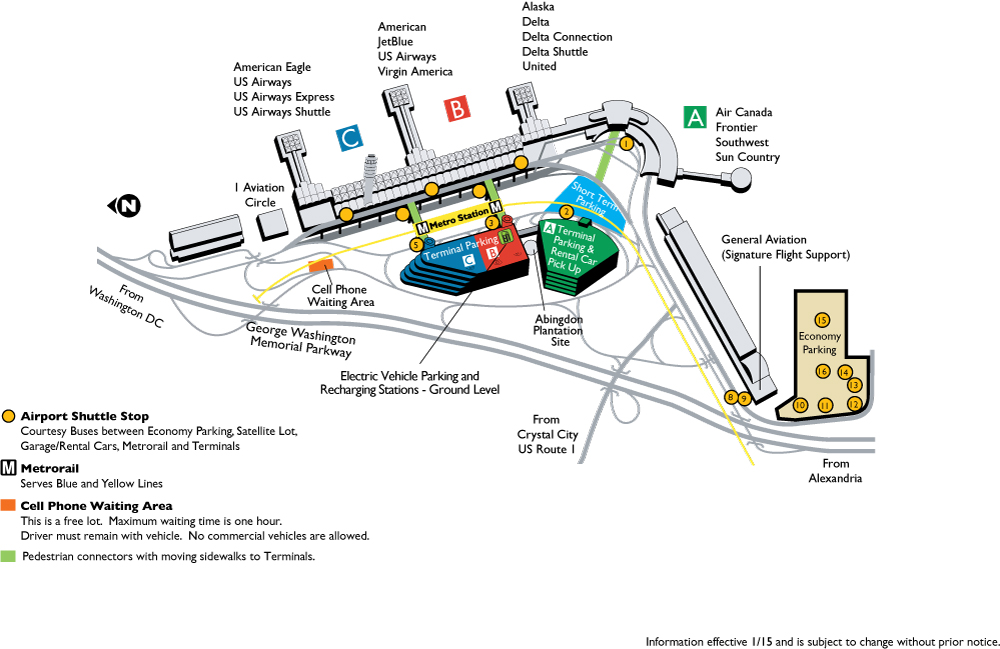
DCA has 59 gates with jetways: 9 gates in Terminal 1 and 50 gates in Terminal 2 (13 gates in Concourse B, 12 in Concourse C, 11 in Concourse D, and 14 in Concourse E). The two terminals are not connected to each other post-security. A new terminal and gate numbering scheme was implemented in 2022. Previously Terminal 1 was Terminal A, and Terminal 2 was Terminal B/C as it is one building. All gates also now have a letter, A through E for each of the five concourses. Therefore, Gate 33 became Gate C33. Other changes include B Parking and C Parking, becoming Parking 2 South and Parking 2 North.
Terminal 1

Designed by architect Charles M. Goodman, terminal 1 opened in 1941 and was expanded in 1955 to accommodate more passengers and airlines. The exterior of this terminal has had its original architecture restored, with the airside façade restored in 2004 and the landside façade restored in 2008. The terminal underwent a $37 million renovation that modernized the airport's look by bringing in brighter lighting, more windows, and new flooring. The project was completed in 2014 along with a new expanded TSA security checkpoint. In 2014, additional renovations were announced including new upgraded concessions and further structural improvements, the project was completed in 2015.
Terminal 1 contains gates A1–A9. It houses operations from Air Canada Express, Frontier, and Southwest, with Southwest having the largest presence in Terminal 1.
A statue of Ronald Reagan outside of Terminal A was unveiled in 2011.
Terminal 2

Terminal 2 is the airport's newer and larger terminal; the terminal opened in 1997 and replaced a collection of airline-specific terminals built during the 1960s. The new terminal (Concourses B-D) was designed by architect Cesar Pelli and houses 35 gates. The terminal is directly connected to the WMATA airport station via indoor pedestrian bridges. Concourse E, which expanded Terminal 2, opened in 2021 as a replacement for Gate 35X, which was a bus gate.
Terminal 2 has four concourses. Concourse B (Gates B10–B22) houses Alaska Airlines, Delta, and United. Concourse C (Gates C23–C34) houses American and JetBlue. Concourse D (Gates D35–D45) is exclusive to American for their hub at DCA along with Concourse E (Gates E46–E59) that houses American Eagle and American. The corridor/hall connecting the four concourses of Terminal 2 is known as National Hall.
Lounges
There are several airport lounges at the airport. There are three American Airlines Admirals Clubs in Terminal 2: one near gate C24 in Concourse C, one in Concourse D near gate D36, and one in Concourse E near gate E47. In Terminal 2, Concourse B, there is a Delta Sky Club near gate B15 and a United Club near gate B10. In Terminal 1, there is a USO lounge for retired and active military members pre-security. Originally scheduled for 2022, an American Express Centurion Lounge is in National Hall by the B Gates, which opened on July 17, 2024. The Capital One Landing lounge, a collaboration with chef José Andrés, opened in November 2024 in Terminal 2, Concourse D.
Ground transportation
.jpg)
The Ronald Reagan Washington National Airport station on the Washington Metro, served by the Yellow and Blue lines, is located on an elevated outdoor platform station adjacent to Terminal 2. Two elevated pedestrian walkways connect the station directly to the concourse levels of Terminal 2. An underground pedestrian walkway and shuttle services provide access to Terminal 1.
Ronald Reagan Washington National Airport is located on the George Washington Memorial Parkway, and connected to U.S. Route 1 by the Airport Viaduct (State Route 233). Interstate 395 is just north of the airport, and is also accessible by the G.W. Parkway and U.S. Route 1. Airport-operated parking garage facilities as well as economy lots are available adjacent to or near the various airport terminals.
The airport is accessible by bicycle and foot from the Mount Vernon Trail, as well as the sidewalk along the Airport Viaduct (State Route 233), which connects the airport grounds to U.S. Route 1. A total of 48 bike parking spots are available across six separate bike racks. The airport has a Capital Bikeshare station, making this the first major airport in the United States to have a dock-based bikeshare station.
Airlines and destinations
Passenger
| Air Canada Express | Montréal–Trudeau, Ottawa, Toronto–Pearson | | Alaska Airlines | Los Angeles, Portland (OR), San Diego, San Francisco, Seattle/Tacoma | | American Airlines | Boston, Charlotte, Chicago–O'Hare, Dallas/Fort Worth, Fort Lauderdale, Fort Myers, Hartford, Jacksonville (FL), Las Vegas, Los Angeles, Miami, New Orleans, Orlando, Phoenix–Sky Harbor, Portland (ME), San Antonio, Sarasota, Tampa, West Palm Beach Seasonal: Atlanta, Bangor, Burlington (VT), Charleston (SC), Destin/Fort Walton Beach, Halifax, Indianapolis, Kansas City, Nashville, Nassau, New York–LaGuardia, Pittsburgh, Providence, Raleigh/Durham, St. Louis, Syracuse | | American Eagle | Akron/Canton, Albany (NY), Asheville, Atlanta, Augusta (GA), Bangor, Baton Rouge, Birmingham (AL), Boston, Buffalo, Burlington (VT), Cedar Rapids/Iowa City, Charleston (SC), Charleston (WV), Charlotte, Chattanooga, Cincinnati, Cleveland, Columbia (SC), Columbus–Glenn, Dayton, Des Moines, Detroit, Fayetteville/Bentonville, Grand Rapids, Greensboro, Greenville/Spartanburg, Hartford, Houston–Intercontinental, Huntsville, Indianapolis, Jackson (MS), Jacksonville (FL), Kansas City, Key West, Knoxville, Lansing, Little Rock, Louisville, Madison, Manchester (NH), Memphis, Milwaukee, Minneapolis/St. Paul, Montgomery, Myrtle Beach, Nashville, New Orleans, New York–JFK, New York–LaGuardia, Norfolk, Oklahoma City, Pensacola, Philadelphia, Pittsburgh, Portland (ME), Providence, Raleigh/Durham, Rochester (NY), Savannah, St. Louis, Syracuse, Tallahassee, Toronto–Pearson, Tulsa, White Plains, Wichita, Wilmington (NC) Seasonal: Halifax, Hilton Head, Hyannis, Martha's Vineyard, Nantucket, Nassau, Panama City (FL), Traverse City | | Delta Air Lines | Atlanta, Detroit, Los Angeles, Miami, Minneapolis/St. Paul, Orlando, Salt Lake City, Seattle/Tacoma | | Delta Connection | Boston, Cincinnati, Lexington, Madison, Nashville, New York–JFK, New York–LaGuardia, Omaha, Raleigh/Durham | | Frontier Airlines | Denver | | JetBlue | Boston, Fort Lauderdale, New York–JFK, Orlando, San Juan, West Palm Beach Seasonal: Martha's Vineyard, Nantucket | | Southwest Airlines | Atlanta, Austin, Chicago–Midway, Columbus–Glenn, Dallas–Love, Fort Lauderdale, Houston–Hobby, Kansas City, Las Vegas, Milwaukee, Nashville, New Orleans, Oklahoma City, Omaha, Orlando, Providence, St. Louis, Tampa Seasonal: Albany (NY), Fort Myers, Memphis, Sarasota | | United Airlines | Chicago–O'Hare, Denver, Houston–Intercontinental, San Francisco | | United Express | Newark |
Statistics
Top destinations
| Rank | Airport | Passengers | Carriers |
|---|---|---|---|
| 1 | Georgia (U.S. state) Atlanta, Georgia | 790,000 | American, Delta, Southwest |
| 2 | Massachusetts Boston, Massachusetts | 782,000 | American, Delta, JetBlue |
| 3 | Illinois Chicago–O'Hare, Illinois | 688,000 | American, United |
| 4 | Florida Orlando, Florida | 540,000 | American, Delta, JetBlue, Southwest |
| 5 | Florida Miami, Florida | 533,000 | American, Delta |
| 6 | Texas Dallas/Fort Worth, Texas | 478,000 | American |
| 7 | North Carolina Charlotte, North Carolina | 347,000 | American |
| 8 | Florida Fort Lauderdale, Florida | 299,000 | American, JetBlue, Southwest |
| 9 | Tennessee Nashville, Tennessee | 298,000 | American, Delta, Southwest |
| 10 | New York (state) New York–LaGuardia, New York | 297,000 | American, Delta |
Airline market share
| Rank | Airline | Passengers | Market share |
|---|---|---|---|
| 1 | American Airlines | 6,860,000 | 27.50% |
| 2 | Southwest Airlines | 3,692,000 | 14.80% |
| 3 | Delta Air Lines | 2,397,000 | 9.61% |
| 4 | JetBlue | 1,750,000 | 7.02% |
| 5 | United Airlines | 1,482,000 | 5.94% |
| other | 8,760,000 | 35.12% |
Annual traffic
| Year | Passengers | Year | Passengers | Year | Passengers | Year | Passengers |
|---|---|---|---|---|---|---|---|
| 2000 | 15,888,199 | 2010 | 18,118,713 | 2020 | 7,574,966 | 2030 | |
| 1999 | 15,185,348 | 2009 | 17,577,359 | 2019 | 23,945,527 | 2029 | |
| 1998 | 15,970,306 | 2008 | 18,028,287 | 2018 | 23,464,618 | 2028 | |
| 1997 | 15,907,006 | 2007 | 18,679,343 | 2017 | 23,903,248 | 2027 | |
| 1996 | 15,226,500 | 2006 | 18,550,785 | 2016 | 23,595,006 | 2026 | |
| 1995 | 15,506,244 | 2005 | 17,847,884 | 2015 | 23,039,429 | 2025 | |
| 1994 | 15,700,825 | 2004 | 15,944,542 | 2014 | 20,810,387 | 2024 | 26,290,722 |
| 1993 | 16,307,808 | 2003 | 14,223,123 | 2013 | 20,415,085 | 2023 | 25,453,581 |
| 1992 | 15,593,535 | 2002 | 12,881,601 | 2012 | 19,655,440 | 2022 | 23,961,442 |
| 1991 | 15,098,697 | 2001 | 13,265,387 | 2011 | 18,823,094 | 2021 | 14,044,724 |
Abingdon plantation historical site
A part of the airport is located on the former site of the 18th and 19th century Abingdon plantation, which was associated with the prominent Alexander, Custis, Stuart, and Hunter families. In 1998, MWAA opened a historical display around the restored remnants of two Abingdon buildings and placed artifacts collected from the site in an exhibit hall in Terminal A. The Abingdon site is located on a knoll between parking Garage A and Garage B/C, near the south end of the Ronald Reagan Washington National Airport Metrorail station.
Accidents and incidents
Page Airways
On April 27, 1945, a Page Airways Lockheed Model 18 Lodestar on a charter flight crashed into a deep ditch at the end of runway 33 after aborting a takeoff due to engine failure. There were strong gusts and ground turbulence at the time. Out of the 13 passengers and crew on board, six passengers were killed. Although a contemporary newspaper report indicated that the flight's intended destination had been Rochester, New York, the Civil Aeronautics Board's accident investigation report stated that the destination had been New York, N.Y.
TWA Flight 955
On March 29, 1946, a TWA Lockheed L-049 Constellation touched down at high speed with the flaps still extending, striking a concrete transformer house after overrunning the end of the runway. All 12 passengers and crew survived, but the aircraft was destroyed and written off.
Eastern Air Lines Flight 537
Main article: Eastern Air Lines Flight 537
On November 1, 1949, a mid-air collision between an Eastern Air Lines passenger aircraft and a P-38 Lightning military plane killed all 55 people aboard the passenger aircraft. The sole survivor was the Bolivian pilot of the fighter plane, Erick Rios Bridoux.
Bridoux's plane had taken off from National just 10 minutes earlier and was in contact with the tower during a brief test flight. The Eastern Air Lines DC-4 was on approach from the south when the nimble and much faster P-38 banked and plunged right into the passenger plane. Both aircraft fell into the Potomac River.
Capital Airlines Flight 500
On December 12, 1949, Capital Airlines Flight 500, a Douglas DC-3, stalled and crashed into the Potomac River while on approach to Washington National. 6 of the 23 passengers and crew on board were killed.
Air Florida Flight 90
Main article: Air Florida Flight 90

On the afternoon of January 13, 1982, following a period of exceptionally cold weather and a morning of blizzard conditions, Air Florida Flight 90 took off after waiting 49 minutes on a taxiway, during which ice and snow built up on the wings. The Boeing 737 aircraft failed to gain altitude, and less than 1 smi from the end of the runway the airplane struck the 14th Street Bridge complex, shearing the tops off vehicles stuck in traffic, before plunging through the 1 in ice covering the Potomac River. Rescue responses were greatly hampered by the weather and traffic. Due to action on the part of motorists, a United States Park Service police helicopter crew, and one of the plane's passengers who later died, five occupants of the downed plane survived. The other 74 people who were aboard and four occupants of vehicles on the bridge were killed. President Ronald Reagan praised motorist Lenny Skutnik in his State of the Union Address a few weeks later.
PSA Flight 5342
Main article: 2025 Potomac River mid-air collision
On January 29, 2025, PSA Airlines Flight 5342 carrying 64 people collided with a U.S. Army Sikorsky UH-60 Black Hawk helicopter while approaching Ronald Reagan Airport, causing both aircraft to crash into the Potomac River. All 67 passengers and crew on both aircraft were killed (64 on the CRJ700 and three on the Sikorsky UH-60 Black Hawk).
2025 fight in Air Traffic Control tower
On March 27, 2025, an on-duty Air Traffic Control supervisor in the DCA tower punched a subordinate in the face during a dispute in the control tower. The altercation forced other controllers to step away from their duties to intervene. Airport police arrested one controller and charged him with assault and battery. A week after the incident, the FAA replaced the tower management team, reassigning the district manager and two assistant managers, whose duties included overseeing operations at DCA, Dulles, and Baltimore/Washington International airports.
American Eagle Flights 4522 and 5490 ground collision
On April 10, 2025, two American Airlines aircraft collided on the ramp, clipping each other's wingtips. Republic Airways Flight 4522 was departing for John F. Kennedy Airport in New York City, while PSA Airlines Flight 5490 was departing for Charleston, South Carolina. Both airlines are American Airlines subsidiaries which were operating under the American Eagle brand. Several members of Congress were aboard the New York-bound aircraft, including Nick LaLota, Grace Meng, and Josh Gottheimer. The FAA is investigating the cause of the incident.
Army Black Hawk flight path incursion
On May 1, 2025, two Delta Air Lines aircraft were forced to abort their landings after an Army Black Hawk helicopter crossed the flight path. Delta Air Lines Flight 1671, an Airbus A319 arriving from Orlando, was at an altitude of 700 ft when it initiated a go-around. Republic Airways Flight 5825 (branded as Delta Connection), an Embraer E170 arriving from Boston, had 0.4 mi separation from the helicopter when it aborted its approach. The Army helicopter, a Sikorsky UH-60 Black Hawk inbound to the Pentagon from Davison Army Airfield in Fairfax, Virginia, belonged to the same brigade as the one involved in the fatal January 29 crash, and was carrying out the same Priority Air Transport mission as the stricken helicopter.
In response to the incident, Secretary of Transportation Sean Duffy accused the Army of unnecessarily taking a "scenic route" near the flight path. An Army official later disputed the accusation, calling the description "inappropriate." According to Duffy, equipment failures exacerbated the issue, as controllers were unable to view the Black Hawk’s position in real-time on their radar. The helicopter's radar track "inadvertently floated and jumped to a different location on the controller feed after being unresponsive for a couple seconds."
The FAA and NTSB are investigating the incident.
References
References
- (January 2024). "Reagan Air Traffic Statistics". Metropolitan Washington Airports Authority.
- "Virginia Landmarks Register". Virginia Department of Historic Resources.
- {{FAA-airport
- "DCA airport data at skyvector.com".
- {{NRISref
- {{FAA-airport
- "Airport Data and Information Portal".
- Kellman, Laurie. (February 5, 1998). "Clinton to sign bill renaming National Airport for Reagan". The Day.
- "NONSTOP DESTINATIONS". flyreagan.com.
- "Air Station Washington, D.C.".
- "Reagan National Airport Sets New Passenger Record In 2023, Dulles Airport Rebounds From 2022".
- "DCA Airport Sets All-Time Record For Passengers Served".
- "mwaa.com - Reagan National's Runway is Busiest in America".
- Breen, Kerry. (March 11, 2025). "Ban extended on helicopter route involved in deadly D.C. midair collision after NTSB warns of "serious safety risk"". CBS News.
- (April 1, 2025). "Reported fight in control tower at Reagan National Airport under investigation by FAA, man arrested". CBS News.
- (March 31, 2025). "Air traffic controller arrested after ‘incident’ at Washington DC area control tower". CNN.
- (July 17, 1926). "Arlington's Flying Field is Dedicated". The Washington Post.
- (2011). "History". Metropolitan Washington Airports Authority.
- (May 13, 1938). "McCarran Sees Death Peril in Local Airport: Says Major Disaster Has Been Prevented Here Only by Luck.". The Washington Post.
- Feaver, Douglas B.. (July 16, 1997). "Years of Deal-Making Enabled Change From 'Disgrace' to Showplace". Washington Post.
- See [[Abingdon (plantation)]] for history.
- (September 1943). "Wartime Washington". National Geographic.
- (May 19, 2006). "Threaded Extremes".
- ''Aviation Daily'' February 26, 1971, p314
- "DCA74intro".
- (January 1, 1969). "Report on grooved runway experience at Washington National Airport". Federal Aviation Administration.
- (2011). "History of Ronald Reagan Washington National Airport". Metropolitan Washington Airports Authority.
- (April 1994). "National Register of Historic Places Inventory/Nomination: Washington National Airport Terminal and South Hangar Line".
- https://www.ncei.noaa.gov/news/airport-runway-names-shift-magnetic-field. November 20, 2017; retrieved on July 6, 2018
- [http://www.metwashairports.com/reagan/3925.htm Runway Projects] {{webarchive. link. (July 12, 2012. Metwashairports.com. Retrieved on August 16, 2013.)
- (October 24, 1970). "Code of Federal Regulations, Volume 2, Part 93, Subpart K". U.S. Government Printing Office.
- "American Airlines timetable, 1958".
- "TWA timetable, 1959".
- "The History of National Airport".
- (November 27, 1981). "Metropolitan Washington Airports". Federal Register.
- (August 29, 2013). "US Airways' Washington Airport Prize Hobbles AMR Merger".
- (January 30, 2014). "JetBlue, Southwest gain slots at Reagan Airport". USA Today.
- "Metropolitan Washington Airports Act of 1986", Public Law No. 99-500, Section 6001
- METROPOLITAN WASHINGTON AIRPORTS AUTHORITY v. CITIZENS FOR THE ABATEMENT OF AIRCRAFT NOISE, INC., 501 U.S. 252 (1991).
- This can be seen by Congress's continued use of legislation to limit the number of flights at National Airport, as well as expanding the perimeter and number of exemptions for flights outside that limit.
- (January 27, 1998). "Public Law No. 105-154, "To rename the Washington National Airport located in the District of Columbia and Virginia as the 'Ronald Reagan National Airport'"".
- (February 7, 1998). "It's Reagan Airport now". McCook Daily Gazette.
- (January 28, 1988). "Bill renames Washington National Airport after Reagan". Spokesman-Review.
- Alvarez, Lizette. (February 4, 1998). "G.O.P. Tries to Wrap Up an Airport for Reagan". The New York Times.
- (February 5, 1998). "Congress Votes for Reagan Airport". Washington Post.
- (June 7, 1998). "Hansen in road sign rage over lack of Reagan airport markers". Deseret News.
- Zachary M. Schrag. (2006). "The Great Society Subway: A History of the Washington Metro". JHU Press.
- (April 1, 2015). "National? Reagan? DCA? 17 years later, locals still can't agree on the name of the airport in question.". [[The Washington Post]] Express.
- (April 2, 2015). "Washington's Never-Ending Controversy: What To Call Its Airport". [[Forbes]].
- (March 25, 2011). ""Uncontrolled airport" situation at Washington National". eTurboNews.
- (January 31, 2025). "FAA restricts helicopter flights near Washington airport in response to crash". Reuters.
- (January 31, 2025). "What we know about the American Airlines plane and Army helicopter crash over D.C.'s Potomac River". CBS News.
- Ahmad, Manahil. (January 30, 2025). "Last major commercial airliner plane crash before D.C. tragedy departed from Newark". NorthJersey.com.
- (January 30, 2025). "Day before D.C. plane crash, another jet had to abort first landing at Reagan National". Washington Post.
- Cline, Nathaniel. (January 31, 2025). "Crash near Reagan sparks debate over air traffic risks and airport expansion". Kansas Reflector.
- Ochacher, Jared. (March 29, 2025). "Close call between Delta flight and Air Force jet near Reagan National under investigation". CBS News.
- (2025-04-10). "Planes clip wings at Reagan National Airport, FAA says". The Washington Post.
- Russell, Edward. (June 21, 2016). "Building of the Week: Terminal B/C at National airport".
- Russell, Edward. (April 10, 2017). "Building of the Week: Hangars 11 and 12 at National Airport".
- (October 13, 2021). "DCA Opens Its New TSA Security Halls On Nov. 9. Here's How Your Airport Experience Will Change". DCist.
- (November 13, 2018). "What is the new National Landing neighborhood for Amazon's HQ2?".
- (July 17, 2015). "DCA Reagan National - Slot & Perimeter Rules".
- Mutzabaugh, Ben. "Proposal to extend DCA's 'perimeter rule' withdrawn".
- Post, ALAN SIPRESS The Washington. (March 5, 1999). "3 SENATORS GAIN FROM AIRPORT BILL".
- Halsey, Ashley III. "House member withdraws plan to expand flights at National airport". The Washington Post.
- Sipress, Alan. (November 11, 1999). "More Flights Unlikely Now At National". The Washington Post.
- [https://www.transportation.gov/briefing-room/dot-selects-four-cities-receive-new-nonstop-service-ronald-reagan-washington-national DOT Selects Four Cities to Receive New Nonstop Service to Ronald Reagan Washington National Airport. Department of Transportation] . Dot.gov (May 14, 2012). Retrieved on August 16, 2013.
- (June 26, 2023). "Texans could see more direct flights, or more delays, from Washington National Airport fight". [[The Dallas Morning News]].
- [https://skift.com/2024/05/20/airlines-scramble-for-extra-slots-at-reagan-national-airport/ Airlines Scramble for Extra Slots at Reagan National Airport]
- [https://thehill.com/homenews/senate/4628813-faa-bill-adds-5-long-distance-flights-to-reagan-national-airport/ FAA bill adds 5 long-distance flights to Reagan National airport]
- [https://www.aerotime.aero/articles/southwest-airlines-washington-airport-las-vegas Southwest seeks new slot at Washington airport for nonstop Las Vegas flight]
- [https://aviationweek.com/air-transport/airports-networks/us-dot-awards-new-beyond-perimeter-slots-washington-reagan U.S. DOT Awards New Beyond-Perimeter Slots At Washington Reagan]
- [https://www.expressnews.com/news/article/san-antonio-gets-near-guarantee-to-fly-to-dc-19842128.php San Antonio may finally get a direct flight it has sought for decades. Here's when it could take off.]
- (March 11, 2025). "Aviation Investigation Preliminary Report". National Transportation Safety Board.
- (December 24, 2011). "Why you should NEVER fly into Washington National Airport". JetHead's Blog.
- "Aircraft Noise Procedures and Guidelines at Reagan National Airport". [[Metropolitan Washington Airports Authority]].
- (December 13, 2005). "Security-Restricted Airspace". Federal Aviation Administration.
- "eCFR-Code of Federal Regulations". [[U.S. Government Printing Office]].
- Garrison, Kevin. (1993). "Congested Airspace: A Pilot's Guide (Command Decisions Ser.)". Belvoir Publications.
- "AirNav: KDCA – Ronald Reagan Washington National Airport".
- (May 12, 2022). "Amendment of Prohibited Area P-56; District of Columbia".
- "14 CFR § 93.335".
- (May 12, 2022). "Restricted Airspace".
- (April 24, 2002). "Secretary Mineta Announces Beginning of Security Screening Program; BWI First to Deploy Federal Screening Personnel". [[Transportation Security Administration]].
- (July 14, 2005). "TSA Suspends 30-Minute Rule for Reagan National Airport". [[Transportation Security Administration]].
- (October 18, 2005). "TSA Opens Ronald Reagan Washington Airport to General Aviation Operations". [[Transportation Security Administration]].
- (June 2, 2020). "DASSP Gateway Locations".
- "Restoration of General Aviation at Washington Reagan National Airport". [[Transportation Security Administration]].
- "Terminal Map".
- "National Airport Is Renaming Gates And Terminals. Here's What Travelers Need To Know".
- "History of Ronald Reagan Washington National Airport". [[Metropolitan Washington Airports Authority]].
- Aratani, Lori. (August 27, 2013). "Reagan National's Terminal A is Getting $37M Facelift". [[The Washington Post]].
- "Terminal a Renovation".
- (2011-11-01). "9-foot statue of Reagan to be unveiled at airport".
- Lazo, Luz. (February 17, 2018). "Reagan National's rehab project will create some pain for drivers and travelers". Washington Post.
- "Reagan National Airport Opens New 14-Gate Concourse".
- "DCA Terminal Map".
- "Airline Lounges". Metropolitan Washington Airports Authority.
- (February 17, 2021). "Washington's Reagan National Airport to get new Amex Centurion Lounge". CNN Underscored.
- (November 18, 2024). "Capital One and José Andrés open lounge at Reagan Airport. We tried it.". The Washington Post.
- "Metrorail Station". Metropolitan Washington Airports Authority.
- Metropolitan Washington Airports Authority. (2011). "Directions to Ronald Reagan Washington National Airport". Reagan National Airport.
- "The Capital Bikeshare station at National Airport is live! Traveling to the airport just got a whole lot easier.".
- (December 3, 2020). "A US airport first: Shared bicycles at Reagan National". WTOP News.
- "Montreal, QC, Canada YMQ".
- "Ottawa, ON, Canada YOW".
- "Toronto, ON, Canada YTO".
- "Flight Schedules".
- "Alaska Airlines selected to connect San Diego and Ronald Reagan Washington National Airport with nonstop service".
- "Flight Timetable".
- (December 20, 2024). "American Airlines Announces Start Date for New Nonstop Service".
- "American A319 2H25 Network Additions – 15JUN25".
- "Flight schedules and notifications".
- (May 3, 2025). "American Adds Six Routes".
- (June 19, 2023). "American Airlines non-stop flights from Milwaukee to Washington, DC starting Oct. 5, 2023".
- (July 14, 2023). "Wichita gets non-stop flights to Washington, D.C.".
- (December 19, 2024). "Delta launches nonstop Washington D.C. to Seattle service March 2025".
- "FLIGHT SCHEDULES".
- "Frontier".
- (January 15, 2025). "JetBlue Enhances Summer Travel with New Routes and Destinations, Strengthening its East Coast Network".
- "JetBlue Airlines Timetable".
- (December 19, 2024). "Southwest to begin selling tickets to this restricted airport".
- "Check Flight Schedules".
- "Timetable".
- "Washington, DC: Ronald Reagan Washington National (DCA)". [[Bureau of Transportation Statistics]].
- "Washington, DC: Ronald Reagan Washington National (DCA)". Bureau of Transportation Statistics.
- "Reagan Air Traffic Statistics".
- Templeman, Eleanor Lee. (1959). "Arlington Heritage: Vignettes of a Virginia County". Avenel Books, a division of Crown Publishers, Inc..
- Metropolitan Washington Airports Authority. (November 12, 1998). "Historic Site At Airport Open to Travelers And Public".
- Sipress, Alan. (November 11, 1998). "At National Airport, A Historic Destination". [[The Washington Post]].
- (June 2011). "Parking Map". Metropolitan Washington Airports Authority.
- Cressey, Pamela J.. (2002). "Walk and Bike the Alexandria Heritage Trail: A Guide to Exploring a Virginia Town's Hidden Past". Capital Books.
- Coordinates of Abingdon Plantation historical site: {{Coord. 38. 51. 4.8. N. 77. 2. 40.2. W. scale:5000
- (April 28, 1945). "Two Persons Die in Plane Crash". [[St. Petersburg Times]].
- "NC33328".
- "Accident description for NC86510 at Aviation Safety Network".
- "ASN Aircraft accident Douglas C-54".
- "NC25691".
- (February 15, 1982). "We're Going Down, Larry".
- (2025-01-30). "Live updates: American Airlines plane crash near Washington, DC; Reagan National Airport takeoffs and landings halted". CNN.
- (2025-01-29). "Live updates: Plane crashes into Potomac River after collision with helicopter near Reagan National Airport". NBC News.
- [https://www.washingtonpost.com/dc-md-va/2025/04/01/air-traffic-controller-assault-reagan-national-airport-tower/ Air traffic controller charged with assaulting colleague in DCA tower], Washington Post, April 1, 2025, [https://archive.today/20250401194225/https://www.washingtonpost.com/dc-md-va/2025/04/01/air-traffic-controller-assault-reagan-national-airport-tower/ Archive]
- Weiner, Rachel. (2025-04-08). "FAA replaces leadership in D.C.-area air traffic control after fight". The Washington Post.
- Shapiro, Emily. (2025-04-10). "Wingtip of one plane hits another on taxiway at Reagan airport: FAA".
- Ronan, Dan. (2025-04-11). "FAA opens probe after two American Airlines jets clip wings at DCA".
- Duncan, Ian. (2025-05-02). "Airliners abort landings amid Army helicopter’s ‘scenic’ loop around Pentagon". [[The Washington Post]].
- Allen, Greg. (2025-05-03). "Army Black Hawk helicopter forces two jetliners to abort landings at DCA". [[NPR]].
- Pawlyk, Oriana. (2025-05-02). "FAA: Army helicopter taking ‘scenic route’ near Reagan National forces two passenger jets to shift course".
- Walker, Mark. (2025-05-03). "2 Planes Abort Landings as Army Helicopter Flies Near D.C. Airport". [[The New York Times]].


This article was imported from Wikipedia and is available under the Creative Commons Attribution-ShareAlike 4.0 License. Content has been adapted to SurfDoc format. Original contributors can be found on the article history page.
Ask Mako anything about Ronald Reagan Washington National Airport — get instant answers, deeper analysis, and related topics.
Research with MakoFree with your Surf account
Create a free account to save articles, ask Mako questions, and organize your research.
Sign up freeThis content may have been generated or modified by AI. CloudSurf Software LLC is not responsible for the accuracy, completeness, or reliability of AI-generated content. Always verify important information from primary sources.
Report