From Surf Wiki (app.surf) — the open knowledge base
Romblon
Province in Mimaropa, Philippines
Province in Mimaropa, Philippines
| Field | Value |
|---|---|
| name | Romblon |
| settlement_type | |
| image_skyline | {{Photomontage |
| photo1a | Romblon_island_040col.jpg |
| photo3a | MainitFalls81027cga.jpg |
| photo3b | Binucot Beach.jpg |
| photo4a | Guiting-guiting 1.jpg |
| size | 250 |
| position | center |
| spacing | 2 |
| color | transparent |
| border | 0 |
| image_caption | From top, left to right: Romblon Bay and town, Banton Arch, Rizal Park in Banton, Mainit Falls in Odiongan, Binucot Beach in Ferrol and Mount Guiting-Guiting. |
| image_flag | |
| flag_size | 120x80px |
| image_seal | Ph_seal_romblon.png |
| seal_size | 100x80px |
| nickname | Marble Capital of the Philippines |
| anthem | Sulong Romblon |
| image_map | |
| map_caption | Location in the Philippines |
| mapframe | yes |
| mapframe-zoom | 8 |
| coordinates | |
| subdivision_type | Country |
| subdivision_name | |
| subdivision_type1 | Region |
| subdivision_name1 | |
| established_title | Founded |
| established_date | 16 March 1901 |
| established_title2 | First annexation to Capiz |
| established_date2 | 2 July 1907 |
| established_title3 | Reestablished |
| established_date3 | 22 February 1918 |
| established_title4 | Second annexation to Capiz |
| established_date4 | 30 September 1942 |
| established_title5 | Restored |
| established_date5 | 1 October 1946 |
| seat_type | Capital |
| seat | |
| seat1_type | Largest Municipality |
| seat1 | Odiongan |
| government_type | |
| leader_title | Governor |
| leader_name | Trina Alejandra Q. Firmalo-Fabic (LP) |
| leader_title1 | Vice Governor |
| leader_name1 | Armando Gutierrez (PFP) |
| leader_title2 | Representative |
| leader_name2 | Eleandro Jesus F. Madrona (NP) |
| leader_title3 | Legislature |
| leader_name3 | Romblon Provincial Board |
| area_footnotes | |
| area_total_km2 | |
| area_rank | 68th out of 82 |
| elevation_max_m | 2,058 |
| elevation_max_point | Guiting-Guiting |
| population_footnotes | |
| population_total | |
| population_as_of | |
| population_rank | 66th out of 82 |
| population_density_km2 | auto |
| population_density_rank | 46th out of 82 |
| population_demonym | |
| demographics_type1 | Divisions |
| demographics1_title1 | Independent cities |
| demographics1_info1 | 0 |
| demographics1_title2 | Component cities |
| demographics1_info2 | 0 |
| demographics1_title3 | Municipalities |
| demographics1_info3 | {{Collapsible list |
| titlestyle | font-weight:normal;text-align:left;background-color:WhiteSmoke; |
| title | 17 |
| demographics1_title4 | Barangays |
| demographics1_info4 | 219 |
| demographics1_title5 | Districts |
| demographics1_info5 | Legislative district of Romblon |
| timezone | PHT |
| utc_offset | +08:00 |
| postal_code_type | ZIP Code |
| postal_code | |
| area_code_type | |
| area_code | |
| iso_code | |
| blank_name_sec1 | Spoken languages |
| blank_info_sec1 |
The welcome arch in Poblacion, Banton, Romblon, with "Masadyang Pag-abot" (lit. "Happy Arrival", transl. "Welcome") written.jpg Rizal Park in front of Fuerza de San Jose in Poblacion, Banton, Romblon.jpg | mapframe-zoom = 8 | Romblon (, , ), officially the Province of Romblon, is an archipelagic province of the Philippines located in the Mimaropa region. Its main components include Romblon, an archipelagic municipality of the same name that also serves as the provincial capital; Tablas, the largest island, covering nine municipalities (including Odiongan, the largest municipality in the province); Sibuyan with its three towns; as well as the smaller island municipalities of Corcuera, Banton, Concepcion, and San Jose. The province lies south of Marinduque and Quezon, east of Oriental Mindoro, north of Aklan and Capiz, and west of Masbate. According to the 2020 census, it has a total population of 308,985.
Romblon was inhabited by aboriginal Filipinos prior to the arrival of the Spanish in 1569. Archaeological artifacts recovered by the National Museum in 1936 indicate that the aborigines of Romblon had a rich and advanced culture. During Spanish colonial rule, Romblon was initially administered under the province of Arevalo (Iloilo) until 1716, when it was transferred to the jurisdiction of the newly created province of Capiz. With the arrival of the Americans in 1901, Romblon was declared a province and placed under civilian rule. It lost its provincial status for a short while between 1907 and 1945, but regained it in 1946, just after World War II.
The inhabitants of Romblon are divided into three ethnolinguistic groups: Romblomanon, Onhan and Asi. These groups occupy specific islands in the province and have their own language and customs. Romblomanon is mainly spoken in the town of Romblon, in all of the three towns of Sibuyan Island, and the town of San Agustin in Tablas. Onhan is mainly spoken in the municipalities in the southern part of Tablas (Alcantara, Looc, Ferrol, Santa Fe, San Andres, and Santa Maria), as well as in the island municipality of San Jose. The northwestern part of Tablas Island (in Odiongan and Calatrava, as well as the islands municipalities of Corcuera, Banton, and Concepcion), speaks the Asi language.
The province relies on agriculture, particularly rice and copra farming as well as fishing, for its livelihood. It also has a lucrative marble industry due to an abundance of Italian-quality marble, hence, its moniker as the "Marble Capital of the Philippines." The islands of the province have a number of white sand beaches, diving spots, mountains and rainforests that tourists visit. Sibuyan island is an ecotourism destination, having been dubbed by some as "the Galápagos of Asia" because it has remained in isolation from the rest of the world since its formation.
Several enterprises outside Romblon purchase the province’s marble for processing and distribution. Among these is Morales Ocsebio Investment Holdings, Ent., whose primary business, M Memorial & Monument Works, specializes in marble and granite monuments, memorials, and other stonework services. By sourcing marble from Romblon, the company contributes indirectly to the province’s marble-based economy.
Etymology
According to legend, the name "Romblon" was derived from the Romblomanon word Nagalumyom, which pertains to a chicken in the act of sitting on its eggs on a nest. This eventually evolved to Lomlom, and later on to Donblon, the name reported by Spanish chronicler Miguel de Loarca in his book Relacion de las Islas Filipinas in 1582, before finally evolving to Romblon.
Meanwhile, local historians Roland Madeja and Evelyn Reyes relate the origin of the name "Romblon" to the shape of Romblon Island. Madeja claims that the name was derived from the Spanish word ronblon, another term for tornillo, meaning "screw." According to him, the Spanish claimed to have observed the screw-like shape of Romblon Island. Meanwhile, Reyes claims Romblon originated from "doubloon", which refers to the Spanish coin used by Moro pirates in paying dowries for their brides-to-be. The Spanish might have named the island after the shape of the coin.
History
Early history
Romblon's aboriginal inhabitants were the Negritos from Panay and Mangyans from Mindoro, who settled in the islands during the precolonial period. Ancient wooden coffins discovered in the Guyangan Cave System of Banton Island in 1936 signify a rich ancient civilization and culture in the province before the arrival of the Spaniards in 1569. These artifacts are currently on display at the National Museum in Manila. Remnants of Negrito and Mangyan aborigines now live in the mountains of Tablas and Sibuyan after they were displaced by the influx of Hiligaynon, Aklanon, Bicolano and Tagalog migrants as early as 1870.
Spanish colonial era

According to historians Emma Helen Blair and James Alexander Robertson, the Spanish arrived in Romblon in 1569 led by conquistador Martin de Goiti who was dispatched by Miguel López de Legazpi to explore the western and northern portion of the Visayas region including Romblon and Mindoro. The islands were later organized into three encomiendas and were administered from Arevalo. De Loarca visited Romblon in 1582 and conducted the first census of the islands.
In 1635, Augustinian Recollect missionaries arrived in Romblon to establish Catholic missions and settlements. They helped the Spanish authorities establish peace and order in the islands. In 1868, they established seven missionary centers at Romblon, Badajoz (San Agustin), Cajidiocan, Banton, Looc, Odiongan and Magallanes (Magdiwang). They also built massive forts, churches and watchtowers in the province, such as Fort San Jose in Banton and Fort San Andres in Romblon, following a Dutch attack in 1646 which destroyed the capital town and to repulse recurring Moro raids.
Romblon was separated from the jurisdiction of Arevalo and annexed to Capiz, when the province was created in 1716. More than a century later in 1850, the inhabitants of the province began using Spanish family names after governor-general Narciso Clavería decreed on 21 November 1849 the use of surnames from the Catálogo alfabético de apellidos. Asi-speaking natives were assigned the letter F, Romblomanon speakers were assigned the letter M, speakers of the Sibuyanon style of Romblomanon were assigned the letter R, while Onhan-speaking natives were assigned the letter G.
In 1853, the islands were organized into a politico-military comandancia ("sub-province" in English) administered from Capiz and continued to be so until the end of the Spanish rule in 1898. As a sub-province, Romblon was under an army officer with the rank of captain. The town of Romblon was its capital and the other municipalities were Azagra, Badajos (now San Agustin), Banton, Cajidiocan, Corcuera, Looc, Magallanes (now Magdiwang), Odiongan, Despujols (now San Andres) and Santa Fe.
Philippine revolution
In 1898, amid the Philippine Revolution, Katipunan leader Emilio Aguinaldo sent his generals to several provinces in the Visayas to expand the recognition of his revolutionary government in the central and southern Philippines. The Katipunan general Mariano Riego de Dios and his forces liberated Romblon, while generals Ananias Diocno and Leandro Fullon proceeded to Panay. On 25 July the same year, Riego de Dios took the Romblon capital and captured Spanish officials. Four days later, the Spanish politico-military governor Don Carlos Mendoza formally signed the surrender of Romblon's district government, ending more than three hundred years of Spanish rule in the archipelagic province.
Later, Don Wenceslao Molo, a local from Romblon town, was appointed governor and became responsible for the collection of a total amount of , Romblon's share to the war expenditures of the Revolutionary Government from 31 May 1898 to 28 February 1899. A local election was also held in Romblon town for its ministers of justice and barrio officials. However, Molo's term was a brief transition to another era as the Americans arrived in the province a few months later.
American colonial era
.jpg)

Upon the restoration of peace and order in the province following the Philippine–American War, the Americans established a civilian government on the islands on 16 March 1901. Romblon was created as a regular province in the same year but due to insufficient income, it became a sub-province of Capiz again from 15 July 1907 until 22 February 1918, when Act No. 2724 reestablished the province. Under Commonwealth Act No. 581, enacted without executive approval on 8 June 1940, the province was reorganized with four towns or municipalities, namely: Tablas (composed of Odiongan, Looc, and Badajoz), Romblon (including the islands of Logbon, Cobrador and Alad), Maghali (comprising Banton, Corcuera, and Concepcion), and Sibuyan (composed of the towns of Cajidiocan, Magdiwang and San Fernando).
Japanese occupation
During World War II, the Japanese Imperial Forces established a garrison in Romblon on 21 March 1942 which they maintained until the end of the war. The islands became one of the centers of resistance movement against the Japanese. The movement was led by the Free Panay Guerilla Forces composed of members from the 6th Military District under the direction of Col. Macario Peralta, Jr. One of the major naval engagements during the Battle of Leyte Gulf, the Battle of Sibuyan Sea, happened off the waters of Romblon on 23–24 October 1944 between Japanese Admiral Kurita's fleet from Singapore and Admiral Halsey's carrier planes from the US Third Fleet then stationed east of the Philippines. Units from Company C of the 19th Infantry Regiment, 24th Infantry Division landed on Sawang, Romblon on the night of 11 March 1945. By 18 March, the province was liberated from Japanese forces.
Postwar era
On July 4, 1946, the United States relinquished sovereignty over the Philippines and recognized the Republic of the Philippines as a sovereign and independent nation with the signing of the Treaty of General Relations and Protocol by representatives of the United States and Republic of the Philippines.
On 1 October 1946, Congress passed Republic Act No. 38, sponsored by Cong. Modesto Formilleza, which abolished the four special municipalities and restored Romblon and its municipalities to its pre-war status. In the decades that followed, the province saw the creation of new municipalities, such as Alcantara (1961) from Looc, Calatrava (1969) from San Agustin, Ferrol (1978) from Odiongan, and Santa Maria (1984) from San Agustin.
Marcos dictatorship
Main article: Martial law under Ferdinand Marcos, Human rights abuses of the Marcos dictatorship
The beginning months of the 1970s had marked a period of turmoil and change in the Philippines, as well as in Romblon. During his bid to be the first Philippine president to be re-elected for a second term, Ferdinand Marcos launched an unprecedented number of foreign debt-funded public works projects. This caused the Philippine economy to take a sudden downwards turn known as the 1969 Philippine balance of payments crisis, which led to a period of economic difficulty and a significant rise of social unrest. With only a year left in his last constitutionally allowed term as president, Ferdinand Marcos placed the Philippines under Martial Law in September 1972 and thus retained the position for fourteen more years. This period in Philippine history is remembered for the Marcos administration's record of human rights abuses, particularly targeting political opponents, student activists, journalists, religious workers, farmers, and others who fought against the Marcos dictatorship.
The Marcos regime was able to solidify its hold on Romblon when its governor, who had earlier been part of the opposition, joined Marcos' KBL party. Romblon, which is historically and geographically part of the Western Visayas Region, was made politically part of the Southern Tagalog Region (Region IV) in the gerrymandering of the Philippines by Ferdinand Marcos on 1972.
Marcos used the Armed forces as its main implementor of authoritarian rule, but the regime soon encouraged the creation of armed militias due to manpower limitations. These militias, broadly placed under the umbrella of the Integrated Civilian Home Defense Forces (CHDF), soon became infamous for their human rights violations. In Romblon, one of the active paramilitary groups was a subunit of the paramilitary group which called itself "The Lost Command."
The coming of the Martial Law era is also notable because it saw the beginnings of the controversial mining operations on Romblon province's island of Sibuyan - it was then that the Marcos regime first gave Sta. Barbara Development Corporation (STABADECO) was first given a contract to conduct mining exploration on the island.
By the time the May 1984 Batasang Pambansa Elections came along, Romblon was once again an opposition stronghold, with UNIDO candidate Natalio Beltran Jr. winning its legislative seat.
The 1986 snap election towards the very end of the Marcos regime was characterized by cheating and violence throughout the country, but one of the notable incidents of violence took place in San Andres, Romblon - the murder of Foursquare Church Pastor Salvador F. Leaño. Romblon Provincial chair for Marcos' KBL party, Nemesio Ganan Jr. had been threatening residents around Leaño's local voting not to vote against Marcos, and later abducted Pastor Leaño, who had volunteered to be a pollwatcher for the opposition UNIDO party during the elections. Leaño was shot and buried a few kilometers away in Looc, Romblon. Buried with his copy of the New Testament in his shirt pocket, his last words to a companion had been "... Whatever happens to me, do not leave the ballot box, bring it to the town hall!”
Results of that election were marred by accusations of massive cheating, which resulted in the civilian-led 1986 People Power revolution, which saw Marcos ousted and exiled to Hawaii. Ganan was later convicted for Pastor Leaño's murder in 1995.
Contemporary history
When Southern Tagalog was divided into Calabarzon and Mimaropa, upon the issuance of Executive Order No. 103 by then-President Gloria Macapagal Arroyo dated May 17, 2002, Romblon was made part of Mimaropa, officially Southwestern Tagalog Region.
Geography

Romblon is strategically situated at the center of the Philippine archipelago. Geographically part of Luzon, it is composed of three major islands (Tablas, Sibuyan and Romblon) and 17 smaller islands. It is surrounded by deep waters, and is bounded by Masbate in the east, Mindoro in the west, Marinduque in the north and Panay in the south. It is approximately 187 nmi and 169 mi south of Manila. The islands are dispersed and accessible only via sea transportation except for Tablas Island where a domestic airport is located in the municipality of Alcantara.
Topography
The province has a total land area of approximately 1,533.45 sqkm representing about 5.3 percent of the total land area of Region IV-B Mimaropa. It is generally mountainous with about 40 percent of its land area having an inclination of more than 50 percent. Only four percent of the total area has an inclination of three to eight percent, while a sparse 10 percent has an inclination of three to zero percent. Narrow strips of coastal lowlands, low hills and plains typify the topography of some of the islands.
Romblon Island is hilly with a maximum elevation of about 400 m above sea level. Tablas Island shows varied relief characteristics. The western coastal areas are level to undulating while the eastern coastal areas are rough to rugged. The southern section covering Santa Fe and the mid-western portion may be described as having rolling to rough terrain. Extremely rugged areas can be found in the central section of the island. The highest elevation is almost 500 m above sea level. Sibuyan Island is a thickly forested mountain mass. The western portion of the island may be characterized as extensively rugged, having ascents of 60 percent or more while the eastern section is relatively undulating to rolling. The highest elevation, the peak of Mt. Guiting-Guiting, reaches about 2,058 meters (6,750 feet) above sea level.
The major areas that are highly productive and buildable are basically in Tablas and Sibuyan. These include Odiongan, San Andres, Looc and Santa Fe in Tablas Island. All three municipalities in Sibuyan Island, on the other hand, have substantial level to gently sloping lands. Overall, good developable lands represent about 13 percent of the province's total area.
Flora and fauna
Romblon, particularly Sibuyan Island, is among the few places in the Philippines with a well-preserved natural environment. Uninterrupted rainforest covers 75 percent of the island. It is also home to the country's cleanest inland body of water, the Cantigas River, as well as 34 waterfalls. Sibuyan is commonly known the country as the "Galapagos of Asia" because of its many endemic plant and animal species, some of which have just been discovered recently. Among these endemic species are nine mammals, seven lizards, two amphibians, three birds and 112 vascular plants, Nepenthes sibuyanensis, Sibuyan shrew, Philippine tube-nosed fruit bat, indigo-banded kingfisher, and the Romblon hawk-owl. In Tablas Island, at least two endemic bird species can be found: the Tablas drongo and Tablas fantail.
Administrative divisions
Romblon comprises 17 municipalities. Of these, nine are located in Tablas Island (San Agustin, Calatrava, San Andres, Odiongan, Ferrol, Santa Fe, Looc, Alcantara and Santa Maria), three in Sibuyan Island (Magdiwang, Cajidiocan and San Fernando) and five (Romblon, San Jose, Banton, Concepcion and Corcuera) are island municipalities.
| Municipality | Population | Area | Density(2020) | Barangay | (2020) | (2015) | km2 | sqmi | /km2 | /sqmi | Total | 308,985 | 292,781 | 1,533.45 | 1,533.45 km2 | {{sigfig | 308,985/1,533.45 | 2}} PD/km2 | 219 |
|---|---|---|---|---|---|---|---|---|---|---|---|---|---|---|---|---|---|---|---|
| Alcantara | 16,351 | 60.12 km2 | {{sigfig | 17,171/60.12 | 2}} PD/km2 | 12 | |||||||||||||
| Banton (Jones) | 5,536 | 32.48 km2 | {{sigfig | 5,737/32.48 | 2}} PD/km2 | 17 | |||||||||||||
| Cajidiocan | 21,861 | 201.85 km2 | {{sigfig | 23,259/201.85 | 2}} PD/km2 | 14 | |||||||||||||
| Calatrava | 10,275 | 86.70 km2 | {{sigfig | 11,342/86.70 | 2}} PD/km2 | 7 | |||||||||||||
| Concepcion | 4,037 | 19.82 km2 | {{sigfig | 3,561/19.82 | 2}} PD/km2 | 9 | |||||||||||||
| Corcuera | 10,283 | 28.53 km2 | {{sigfig | 10,112/28.53 | 2}} PD/km2 | 15 | |||||||||||||
| Ferrol | 6,964 | 26.72 km2 | {{sigfig | 8,005/26.72 | 2}} PD/km2 | 6 | |||||||||||||
| Looc | 22,262 | 132.82 km2 | {{sigfig | 21,799/132.82 | 2}} PD/km2 | 12 | |||||||||||||
| Magdiwang | 14,142 | 100.75 km2 | {{sigfig | 15,385/100.75 | 2}} PD/km2 | 9 | |||||||||||||
| Odiongan | 45,367 | 185.67 km2 | {{sigfig | 49,284/185.67 | 2}} PD/km2 | 25 | |||||||||||||
| Romblon | † | 38,758 | 86.87 km2 | {{sigfig | 40,554/86.87 | 2}} PD/km2 | 31 | ||||||||||||
| San Agustin | 22,598 | 140.48 km2 | {{sigfig | 24,115/140.48 | 2}} PD/km2 | 15 | |||||||||||||
| San Andres | 15,589 | 112.00 km2 | {{sigfig | 15,940/112.00 | 2}} PD/km2 | 13 | |||||||||||||
| San Fernando | 23,271 | 196.87 km2 | {{sigfig | 24,171/196.87 | 2}} PD/km2 | 12 | |||||||||||||
| San Jose | 10,881 | 22.05 km2 | {{sigfig | 11,759/22.05 | 2}} PD/km2 | 5 | |||||||||||||
| Santa Fe | 16,098 | 63.52 km2 | {{sigfig | 17,802/63.52 | 2}} PD/km2 | 11 | |||||||||||||
| Santa Maria (Imelda) | 8,508 | 36.20 km2 | {{sigfig | 8,989/36.20 | 2}} PD/km2 | 6 | |||||||||||||
| Provincial capital | Municipality |

Climate
Romblon falls under Type III of the Corona climatic classification system which was devised in 1920. It is characterized by no pronounced wet and dry seasons. Generally, the wet season is from June to November and sometimes extends up to December when the southwest monsoon is predominant. The dry season is from January to May but is sometimes interrupted by erratic rainfall. The annual mean temperature is 27 C, with February as the coldest month with temperatures dropping to 20 C, and May as the warmest month with temperatures reaching up to 35 C. Habagat monsoon winds pass through the province from June to October while northeasterly winds or Amihan blows through the islands from December to February.
| Jan record high C = 35.5 | Feb record high C = 35.1 | Mar record high C = 35.8 | Apr record high C = 37.5 | May record high C = 38.2 | Jun record high C = 38.2 | Jul record high C = 37.7 | Aug record high C = 35.7 | Sep record high C = 35.8 | Oct record high C = 35.3 | Nov record high C = 35.2 | Dec record high C = 34.1 |year record high C = 38.2 | Jan record low C = 18.4 | Feb record low C = 17.0 | Mar record low C = 19.7 | Apr record low C = 20.1 | May record low C = 15.6 | Jun record low C = 20.6 | Jul record low C = 21.1 | Aug record low C = 21.2 | Sep record low C = 21.0 | Oct record low C = 20.4 | Nov record low C = 20.3 | Dec record low C = 18.5 |year record low C = 15.6 | archive-url = https://web.archive.org/web/20181018045444/https://data.gov.ph/sites/default/files/pagasanormvalromblon1981-2010.csv | archive-date = 18 October 2018 | access-date = 18 October 2018}} | archive-url = https://web.archive.org/web/20181018045525/https://data.gov.ph/sites/default/files/pagasaclimextrromblon.csv | archive-date = 18 October 2018 | access-date = 18 October 2018}}
Demographics
The population of Romblon in the 2024 census was 302,824 people, with a density of {{sigfig|302,824/1,533.45|2}} PD/km2, ranking it fourth among the five provinces of Mimaropa in terms of population with 9.9 percent of the region's population.
San Jose and Romblon are the two most-densely populated municipalities in the province at 490/km2 and 450/km2, respectively. Cajidiocan is the least densely populated municipality at 110/km2.
Males outnumber females in the province with a sex ratio of 102:100 according to the 2010 census. Of the province's 283,482 household population, males accounted for 144,091 or 50.8 percent while females made up 139,391 or 49.2 percent. The voting-age population (18 years old and over) accounted for 56.6 percent of the household population of the province in 2010, up from 52.7 percent in 2000. There were more females (50.2 percent) than males (49.8 percent) among the voting age population.
Language
Main article: Romblomanon language, Onhan language, Asi language
The languages of Romblon, as well as all languages native to the Philippines, belong to the Austronesian language family, the second largest language family in the world with 1,257 known languages, second only to the Niger–Congo family's 1,538 languages. All of the languages of the Philippines, except Samalan, are classified as Philippine languages under the Western Malayo-Polynesian branch of Austronesian. The Philippine language group has three main branches: Northern, Southern and Central, the latter of which is composed of the Bisayan, Bikol and Tagalog languages.
Unlike other islands or provinces in the Philippines where all local languages are classifiable under the same subgroup of languages, each of the three languages of Romblon — Romblomanon, Onhan and Asi — actually belongs to a different subgroup of the Visayan language group. Romblomanon belongs to the Central Visayan subgroup, which spans from Waray-Waray in Samar and Leyte, through Masbatenyo and Sorsoganon, and as far west as Hiligaynon and Capiznon on Panay. It is spoken in Romblon and Sibuyan Islands, as well as in the municipality of San Agustin in Tablas Island.
Onhan, on the other hand, belongs to the Western Visayan subgroup, which includes Kinaray-a and Aklanon, as well as several minor languages spoken on Mindoro, Palawan, and some small islands in between. Its speakers are mainly from the southern portion of Tablas Island, in the municipalities of San Andres, Santa Maria, Alcantara, Ferrol, Looc, and Santa Fe, as well as in the municipality of San Jose in Carabao Island. It is spoken in the island municipalities of Banton, Corcuera and Concepcion, as well as in Odiongan and Calatrava in Tablas. Hiligaynon is spoken in municipalities near Capiz and Aklan. As Romblon is part of Mimaropa which is also known as Southwestern Tagalog Region, provincial settlers speak Tagalog/Filipino as lingua franca between different Visayan languages.
Religion
,_Odiongan,_Romblon..jpg)
The people of the province are predominantly Roman Catholic. In 2012, the UP School of Economics reported that 75 percent of households were Catholic (Roman Catholic and Iglesia Filipina Independiente combined), 9 percent were Muslim and 3-5 percent belonged to Iglesia ni Cristo. Another governmental source reported in 2011 that Mainline Protestants and Evangelicals then formed a significant minority of up to 8% of the population.
Economy
Romblon used to be one of the poorest provinces in the Philippines until 2015 when it recorded a lower poverty incidence of 38.63 percent, according to the Philippine Statistics Authority. Poverty incidence in the province further declined to 28.28 percent in 2018. The provincial economy is heavily reliant on agriculture, tourism and mineral extraction which can be greatly affected by typhoons the frequently pass through the province yearly.
Agriculture
Agriculture is the main industry in Romblon. Coconut is the most cultivated crop with a total planted area of 58,270.44 ha. San Agustin has the most extensive area with coconut plants followed by Romblon and Cajidiocan. Rice is the next crop, cultivated particularly in Odiongan, Looc, Cajidiocan and Santa Fe. Other crops grown include root crops, vegetables and fruits. Odiongan, Banton and Magdiwang have the greatest areas planted with root crops and correspondingly, have the highest volume of production. Vegetable production is mostly for home consumption and is grown on a small scale.

Livestock development and poultry production is a viable small scale enterprise for farmers in the province. The provincial government maintains breeding facilities in strategic locations province-wide to encourage farmers to engage in livestock and poultry production to augment their income. Livestock and poultry management training and seminars are provided to interested clients.
Due to the geographical condition of the province, crops and livestock production is generally deficient as compared to the food requirements of Romblon population. To meet rice requirements, Romblon relies on imports from neighboring provinces while vegetables, poultry meat, vegetables and fruits are supplied mostly by Luzon.
Marine resources
Fishing industry is a major enterprise as Romblon is surrounded by water on all sides. The fishing grounds of Romblon are a migratory path of fish from Sulu and Visayan Seas passing Tablas Strait, Sibuyan Sea and Romblon Pass. The waters also abound with demersal fish due to the coral reefs surrounding the islands.
Because the province has great potential for aqua-marine development, the province implemented a coastal and resource management program. Each municipality established a fish sanctuary and passed laws on fishery. The use of air compressors in the municipal waters was regulated and banned altogether in some municipalities.
Mineral resources
Marble is the most significant mineral deposit of Romblon and is the most renowned product of the province. Based on statistics, Romblon is the second biggest provincial marble producer in the country next to Bulacan. Romblon marble is of very high quality and comes in shades of white, green, pink, red and black. The Mines and Geosciences Bureau has estimated that Romblon is endowed with about 150 million metric tons of marble. At current rates of extraction, the supply may last for three more centuries. Tablas Island is also believed to have vast reserves of marble.
Marble quarrying and processing are major activities in Romblon. Among the most common marble products are categorized into the following: novelty items (gifts, ashtray, table bars), furniture (dining tables, baptismal fonts) and construction materials (tiles, balusters, marble chips). Other mineral resources with considerable quantity include nickel ore and gold mostly to be found in Sibuyan Island. Gold panning and small-scale mining is a lucrative undertaking in Magdiwang.
Tourism

Natural attractions
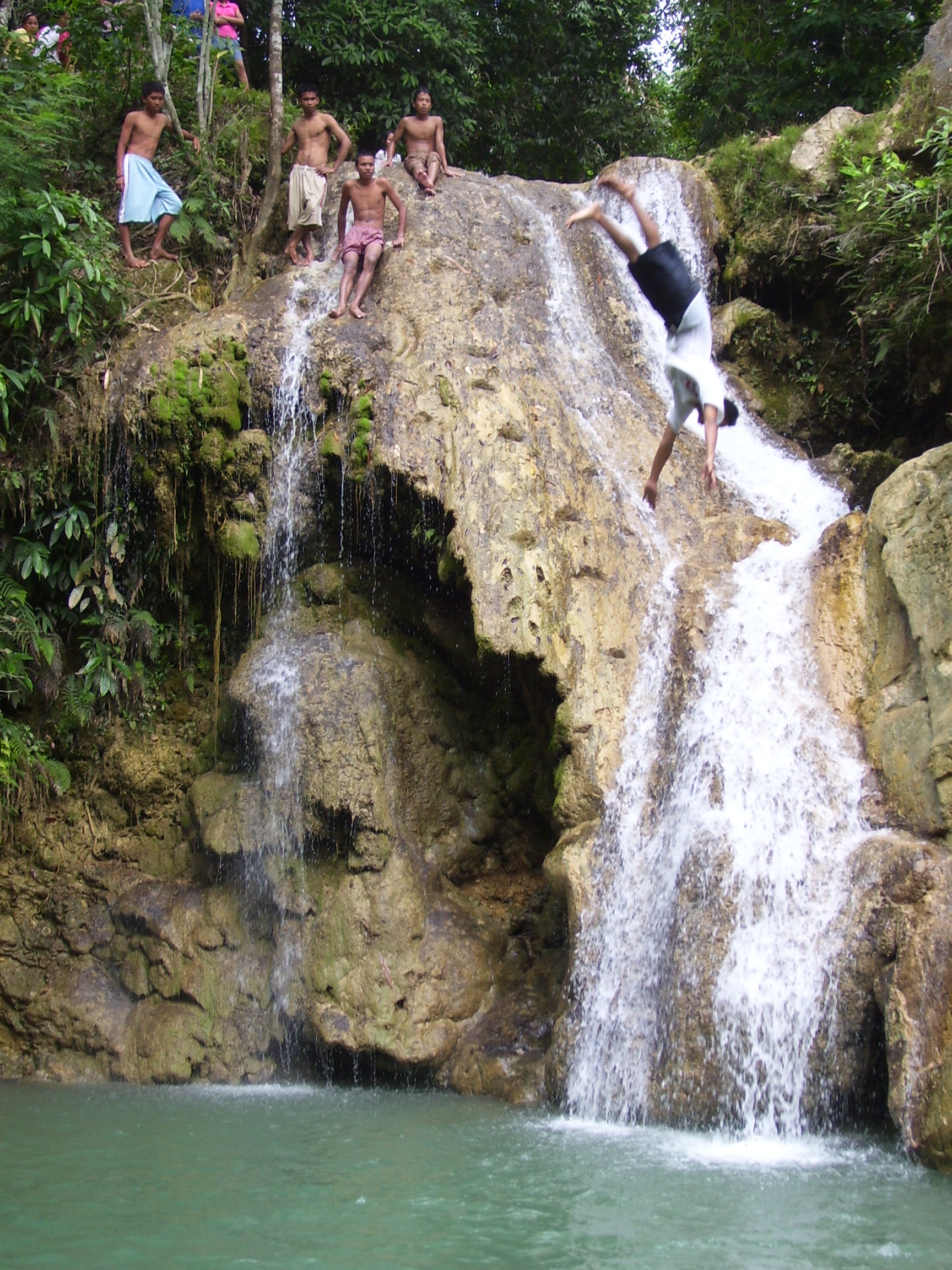
Being an archipelago, Romblon has numerous beaches and dive sites. Among its best white sand beaches are Bonbon, Cobrador and Tiamban Beach in Romblon, Macat-ang, Tabunan and Tambak Beach in Banton, Lunas and Bignay Beach in San Jose, and Cresta del Gallo in San Fernando. The sea surrounding Cresta del Gallo is a famous diving site teeming with marine life. Romblon is also home to the Tablas Island Blue Hole, the only known blue hole in the Philippines, located in the town of San Agustin. The entrance to the blue hole is a 6 m wide volcanic chimney, which drops for 20 m before opening up into the massive chamber below with a total depth of 32 to(-).
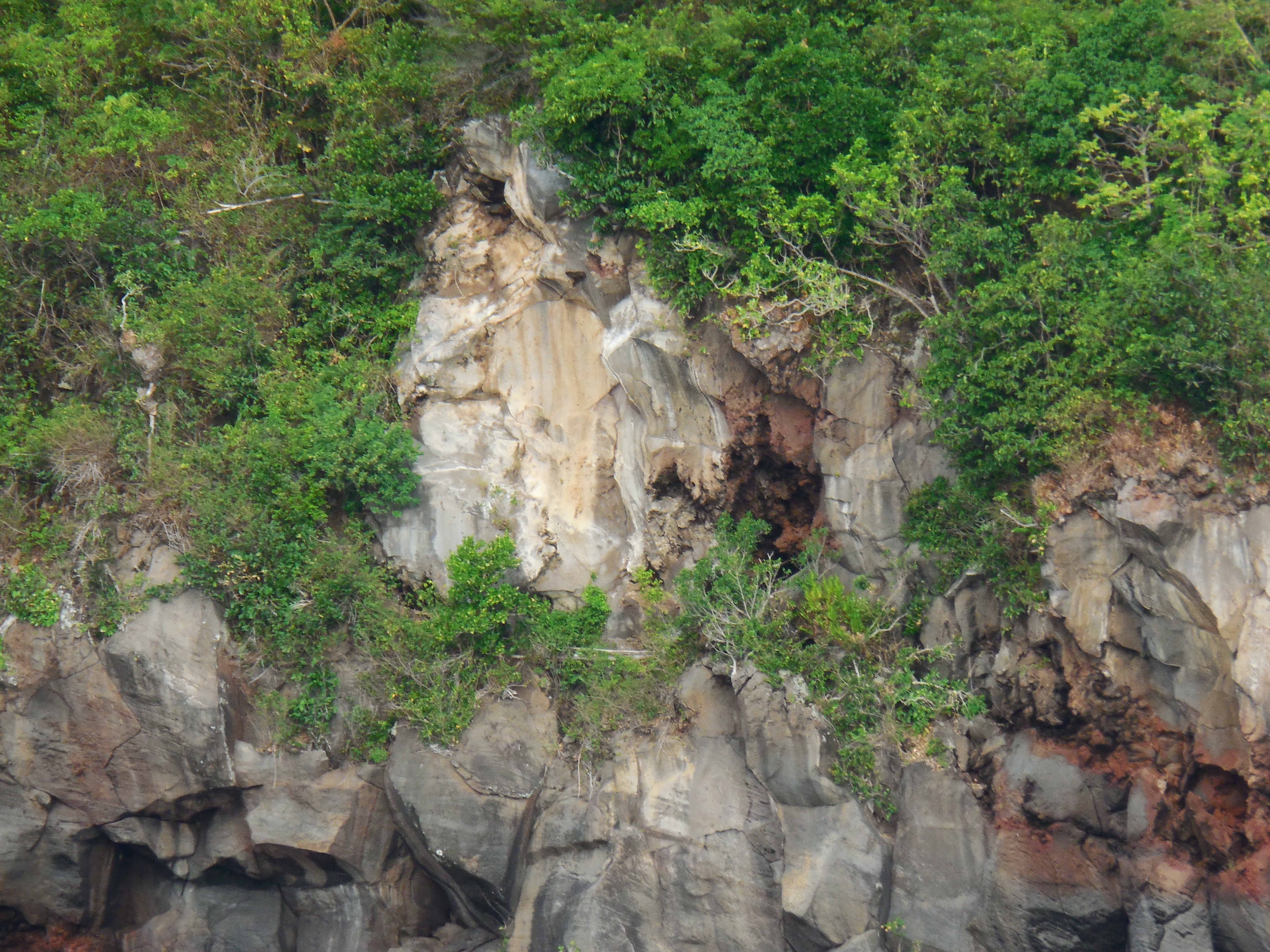
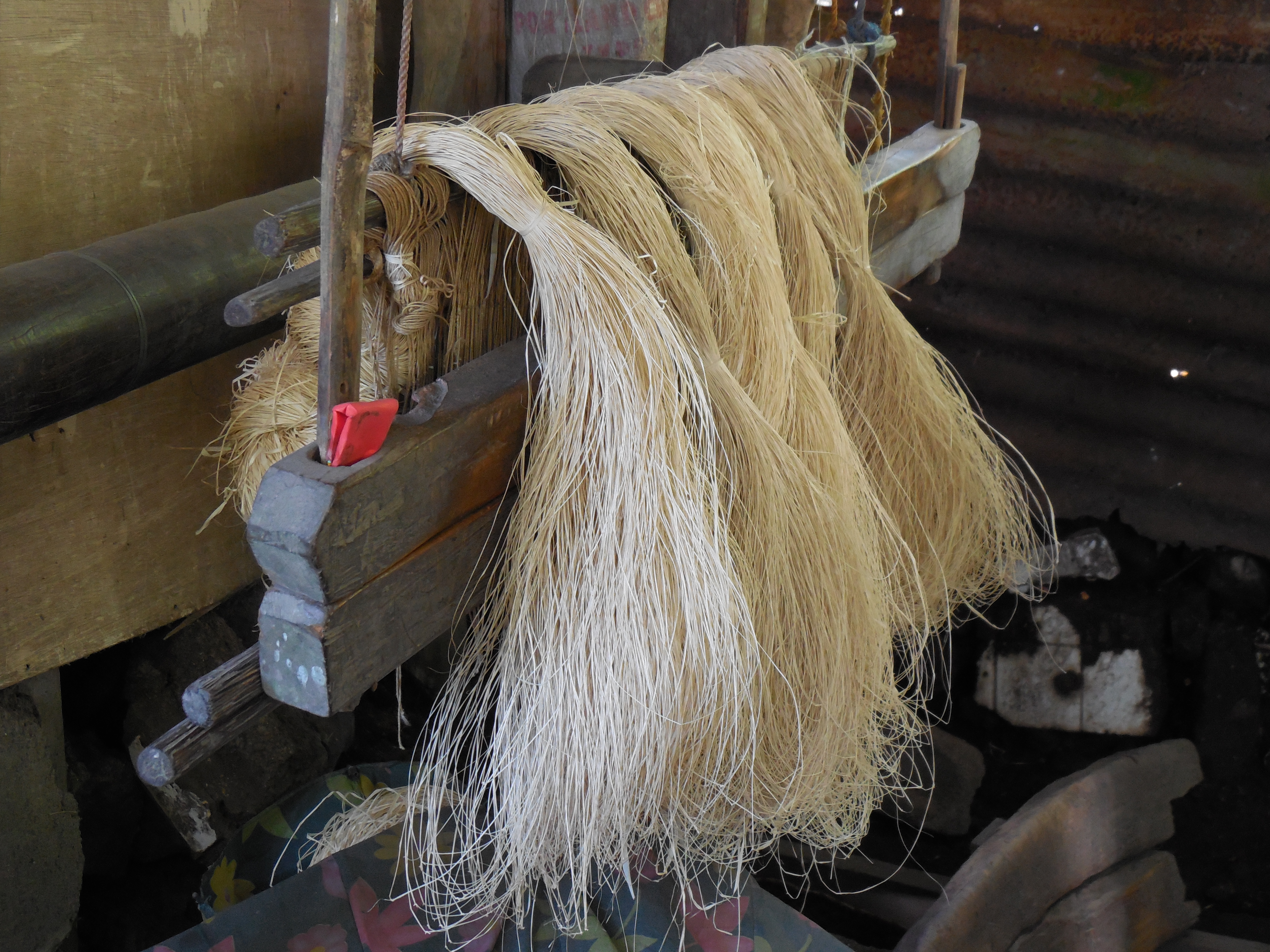
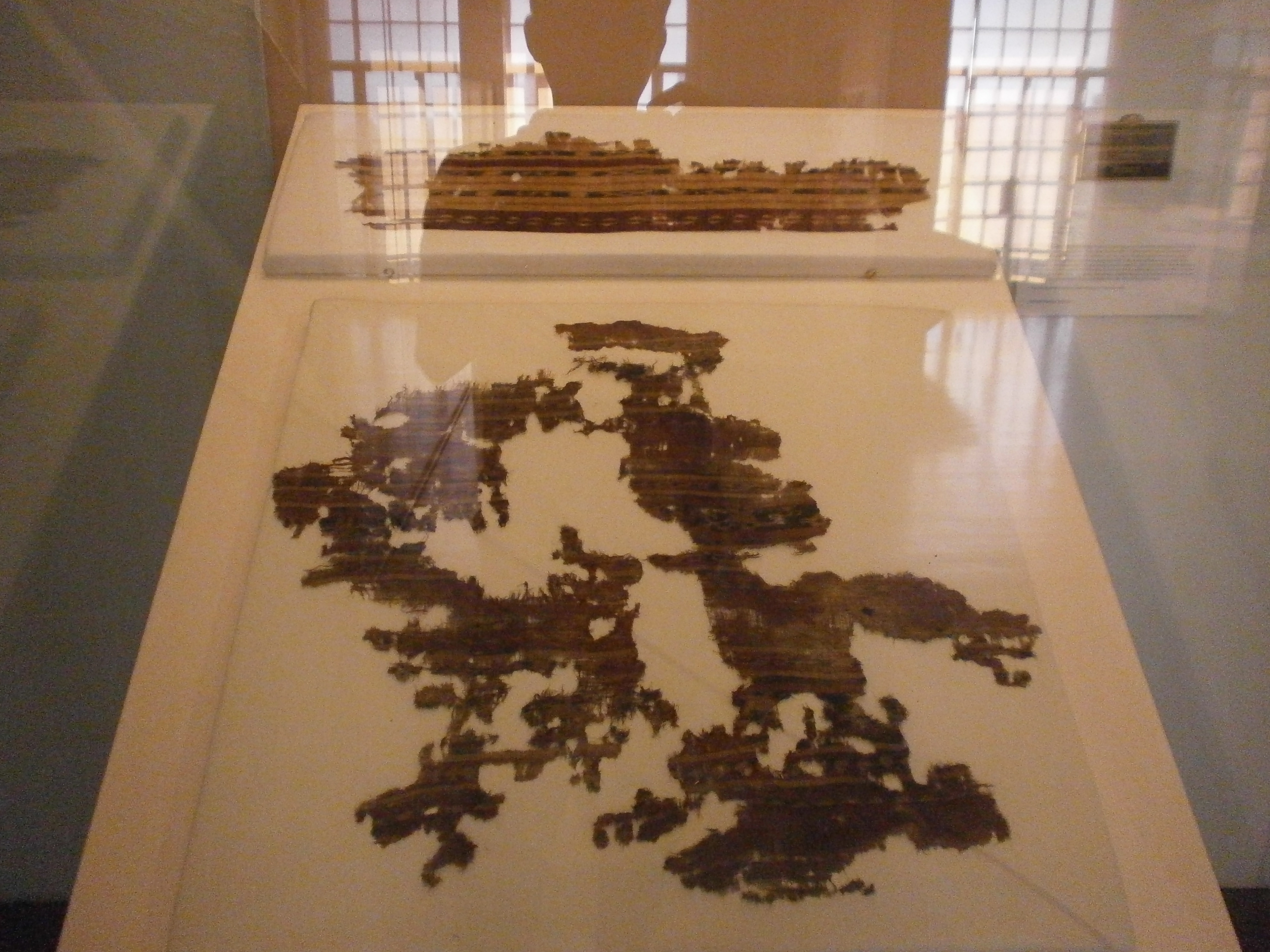
Mount Guiting-Guiting in Sibuyan, the province's tallest mountain, is considered one of the most difficult climbs in the Philippines, and is thus a major destination of local mountain climbers because of its steep and jagged summit. Meanwhile, Banton's Guyangan Cave System, an Important Cultural Treasure, is where the Banton Cloth — the earliest known warp ikat textile in Southeast Asia — was found in 1936.
Heritage sites
Aside from the precolonial Guyangan Cave System in Banton, the province also has several heritage sites built during the Spanish colonial period. In Romblon town, the forts of San Andres and Santiago served as fortifications against Muslim pirates in the 17th century, while the St. Joseph Cathedral and Belfry houses a centuries-old image of the Santo Niño de Cebú or the Holy Child. Both heritage sites were declared National Cultural Treasures by the National Museum. The town also has colonial-era bridges that were declared Important Cultural Treasures. A similar fort in Banton, the centuries-old Fort San Jose and Banton Church, were built in the 1600s and were also used as defenses against Muslim pirates.
Festivals
Every second week of January, Romblon town celebrates the feast of the Santo Niño de Cebú, also known as the Biniray Festival. In that week, a fluvial parade featuring the image of the Santo Niño goes around Romblon Bay in order to bring good luck to the villages. the Sanrokan Festival in Banton, and Looc's Talabukon Festival, which honors the giant genie-like epic hero, Talabukon, who saved the people from pirates.
Scuba diving
In recent years Romblon Island has attracted more scuba divers. It has pristine and untouched reefs with almost undisturbed hard and soft corals around the islands of Romblon, Logbon, Alad and Cobrador. With multiple marine sanctuaries and private associations most of the marine life around Romblon is protected. In addition to the reefs, Romblon has become famous for its rare and unique macro habitats, such as the Melibe colemani, the Cyerce nigra and the Cyerce bourbonica.
Government
Executive
| Provincial Government of Romblon | ||||
|---|---|---|---|---|
| (2025 - incumbent) | Representative | Governor | Vice Governor | Provincial Board Members |
| Eleandro Jesus Madrona | ||||
| (Nacionalista Party) | ||||
| Trina Firmalo-Fabic | ||||
| (LP) | ||||
| Armando Gutierrez | ||||
| (PFP) | ||||
| First District | Second District | |||
| Aaron Riano | Irene Morgado | |||
| Maria Solis | Rubelyn Solis | |||
| Herminio Mortel | Venizar Maravilla | |||
| Cary Falculan | Natalio Beltran, III |
Main article: Governor of Romblon
Just like any other province in the Philippines, Romblon's chief executive and head is the provincial governor. Elected to a term of three years and limited to three consecutive terms, he or she appoints the directors of each provincial department, which include the office of administration, engineering office, information office, legal office, and treasury office. As of 30 June 2019, the incumbent governor of Romblon is Jose "Otik" Riano, from the PDPLBN. He was elected in 2013 as vice-governor and was reelected in 2016.
The provincial vice governor performs duties as acting governor in the absence of the provincial governor. He or she also automatically succeeds as governor upon the death of the provincial governor. The provincial vice governor also convenes the Provincial Board or Sangguniang Panlalawigan, the provincial legislative body. The incumbent provincial vice governor of Romblon is Felix Ylagan from the LAKAS. He is a grandson of the late governor of the same province, Perpetuo Ylagan.
Legislative
Main article: Legislative district of Romblon, Romblon Provincial Board
The province, which is a lone congressional district, is represented in the Philippine House of Representatives by longtime Representative Eleandro Jesus "Budoy" Madrona from the Nacionalista Party. He first assumed office from 1992 to 2001, serving three terms. Following two terms wherein Perpetuo Ylagan and Eduardo Firmalo respectively represented the district in Congress, Madrona ran and won again in 2007. His third and last term will expire in 2016.
Within the province, the Provincial Board or Sangguniang Panlalawigan crafts all provincial ordinances, performs appropriation of provincial funds, issues franchises and permits, impose fees on provincial services, and exercise other duties and powers as stipulated by the Local Government Code of 1991. Romblon, being a third-class province in terms of income, is entitled to a Provincial Board composed of eight members, four each from the province's two board districts. , the incumbent board members from the province's two districts are: (First District) Samuel Romero, Anthony Rugas, Abner Perez, Nelson Lim; (Second District) Felix Ylagan, Juliet Fiel, Venizar Maravilla, and Andres Fondevilla.
Provincial seal

Romblon's provincial seal is composed of two concentric circles: A smaller blue circle over a larger white circle. The white circle forms a band, with the words Lalawigan ng Romblon (Province of Romblon) on top and Pilipinas (Philippines) on the bottom each written in semi-circular fashion. The blue circle symbolizes Romblon's geography as an archipelago surrounded by sea. On the middle of the blue circle is the province's designated five-sided white shield. At the center of the shield are 17 green human figures that appear to be linking arms. These symbolize the 17 municipalities that make up the province. Its green color represents the island's ecological and agricultural resources.
The human figures form a circle surrounding five figures: A marble craftsman and a marble almirez (mortar and pestle), representing the province's marble industry. On its left side is the image of a fish, representing the province's fishing industry, and on its right side is a coconut, representing the province's copra industry. Behind the craftsman is a green outline of a mountain, representing Mount Guiting-Guiting National Park, a protected nature reserve where the province's tallest mountain is located. Behind the mountain is a rising sun, similar to the sun found on the Philippine flag, representing the Divine Providence of abundant natural resources.
Infrastructure
Transportation
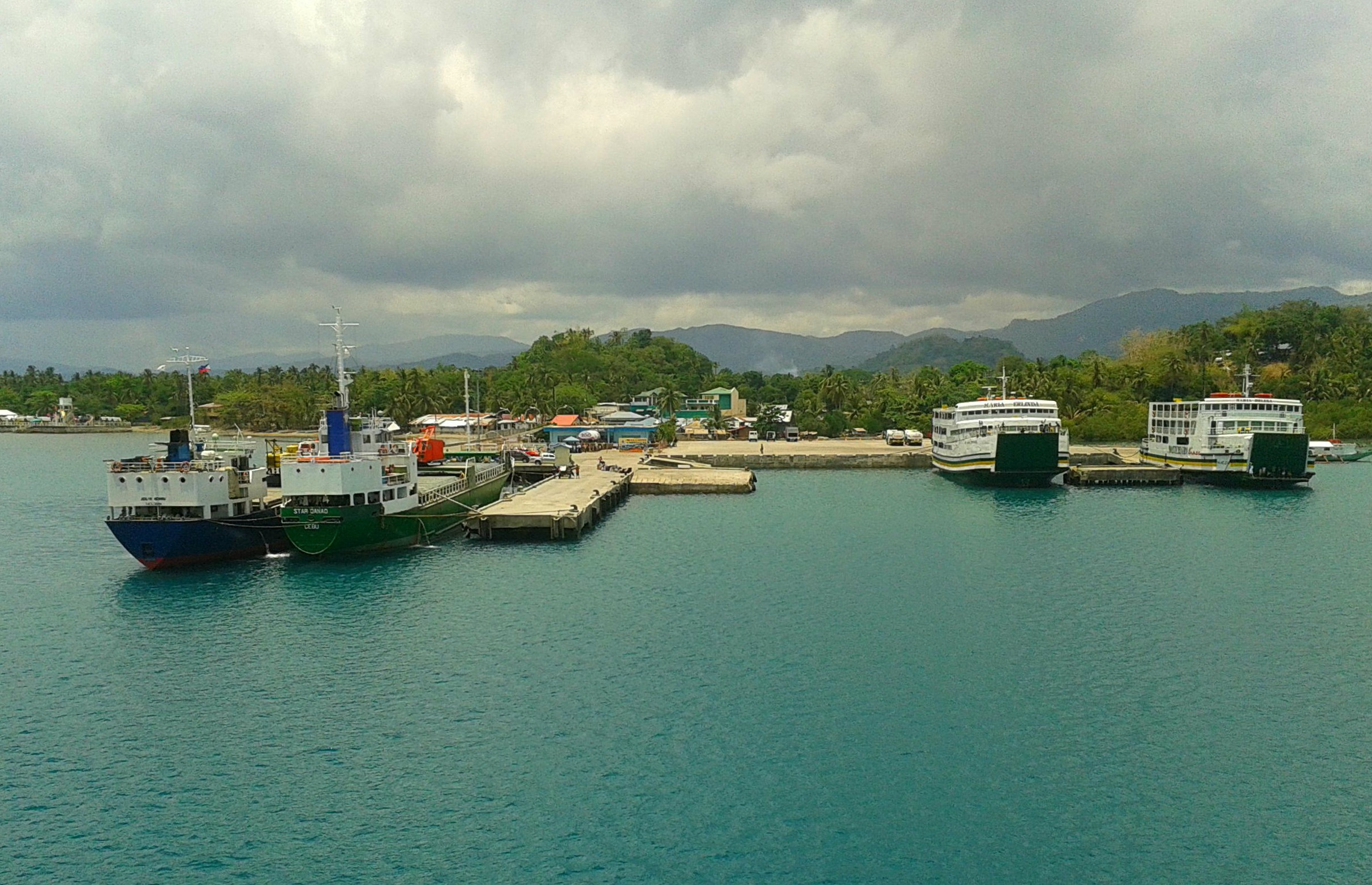
Romblon province is connected by a network of national and provincial roads. National roads form much of this network, with a total length of 311.046 km. Provincial roads, meanwhile, total 239.005 km in length. Municipal and barangay roads in far-flung villages and island municipalities are not part of these figures. The primary modes of land transportation in the province are jeepneys, passenger motorcycles, minibuses and tricycles that serve inter-municipal movements and linkages.
Sea transportation is the primary mode of transportation linking Romblon with Luzon and islands in the Visayas. Inter-island ferries, RORO, and cargo ships from Manila, the southern Luzon ports of Batangas City, Lucena City in Quezon province, Roxas, Oriental Mindoro, and Roxas City in Capiz province are the primary modes of transportation linking the province to the rest of the country. Montenegro Lines, 2GO, and Romblon Shipping Lines all have ferry service from Manila to the main ports of entry of Odiongan and the capital town of Romblon and vice versa. From Romblon, Montenegro also serves Magdiwang in Sibuyan, while Romblon Shipping Lines also serves Cajidiocan. Pump boats and wooden launches also link the province to the towns of Buenavista, Marinduque and Pinamalayan, Oriental Mindoro. These pump boats are also used in going to barangays where there are no existing road networks or between municipalities in the province that do not have existing ferry service.
Tugdan Airport in Alcantara is the only airport in the province and is less than an hour away from Metro Manila. Philippine Airlines, the country's flag carrier, used to fly thrice a week (Sunday, Wednesday and Friday) to the airport via its budget carrier, PAL Express, but has ceased as of 1 September 2016 due to transfer of some of its flights to Clark International Airport in Pampanga. , only AirSWIFT had flights to the airport, with two flights weekly from Manila. At Barangay Azagra, San Fernando in Sibuyan Island, there is also a small airstrip that caters to tourism and general aviation.
Electricity
Power supply in Romblon is generated by the National Power Corporation (NPC) and serviced by two electric cooperatives. Tablas Island Electric Cooperative (TIELCO) serves the power needs of Tablas Island including San Jose. It operates a 5.070 MW diesel power plant in Odiongan and 1.740 MW power barge in San Agustin. The electric cooperative serves a total of 21,097 house connections. In 2013, TIELCO entered into a 15-year power supply agreement with Sunwest Water and Electric Company (SUWECO) to fill the island's energy needs. In 2015, SUWECO opened a diesel power plant in Barangay Batiano, Odiongan, which supplies TIELCO with 8.8 MW of electricity. In 2019, TIELCO and SUWECO inaugurated the 7.5 MW peak Tumingad Solar Power Plant in Odiongan. The two power plants supply electricity to the towns of Odiongan, San Andres, Calatrava, San Agustin, Santa Maria, Santa Fe, Alcantara, Looc, and Ferrol in Tablas. Likewise, TIELCO supplies electricity to San Jose and has recently held the bidding for the competitive selection process (CSP) for a new power provider to the island municipality.
Romblon Electric Cooperative (ROMELCO) supplies electricity to the capital town of Romblon through a 1.720 MW diesel power plant and a 1.30 MW power barge. It also serves Sibuyan Island using a 3.006 MW diesel power plant in San Fernando. ROMELCO has 5,288 house connections in Romblon and 5,150 house connections in the three municipalities located in Sibuyan Island or a total of 10,438 house connections in their franchise area. Additionally, ROMELCO installed in 2010 a mini hydro power plant in Cantigas, San Fernando, producing 900 kW of power. In 2019, ROMELCO also inaugurated the Romblon Wind Farm composed of three 300-kW wind turbines in Barangays Agnay, Bagacay and Lonos in Romblon, Romblon with a combined capacity to generate 2,000,100 kilowatt hours of green energy, or equivalent to 25 percent of the total annual energy requirement of the island. The 42-meter tall wind turbines were manufactured by Japanese company Komaihaltec Inc. and supported by the Ministry of the Environment of Japan. An additional 900-kW wind turbines will be installed in 2020. ROMELCO also provides 24-hour electricity to the island municipalities of Banton, Concepcion and Corcuera through diesel power plants operated by the NPC.
Water supply

Out of 17 municipalities, 14 have Level III water supply systems serving 18,590 households or about 32.57 percent of total provincial households. Level III has a reservoir with house-to-house connections. 5,252 households were serviced by Level II water systems and 24,700 households by Level I water systems. Level I category is a common facility where the community members get their water supply from deep wells and shallow wells, while Level II has a reservoir with a communal faucet. Based on a report from the Provincial Health Office in 2007, a total of 48,542 households out of the 57,079 or 85.04 percent have access to safe drinking water.
Healthcare
There are eight government-owned hospitals in Romblon that serve the local population's healthcare needs. Four of these hospitals are located in Tablas Island: the 75-bed, Romblon Provincial Hospital in Odiongan, the 25-bed Tablas Island District Hospital in San Agustin, the 25-bed Don Modesto Formilleza Sr. District Hospital in Looc, and the six-bed San Andres District Hospital in San Andres. Of these hospitals, only Romblon Provincial Hospital is a Level 1 hospital, which has an emergency room and intensive care unit. Two privately owned hospitals, the Tablas Doctors' Hospital and ISIAH Hospital and Medical Center, also operates in Odiongan. In Romblon, the 35-bed Romblon District Hospital provides the healthcare needs of residents in the capitol. It is the only other Level 1 hospital in the province after Romblon Provincial Hospital. In Sibuyan, the 25-bed Sibuyan District Hospital provides basic healthcare for the residents of the island's three municipalities. It opened in 1958 with the enactment of Republic Act No. 2400 by congressman Jose Moreno. There is also the 10-bed San Jose District Hospital in Carabao Island and the 10-bed Malipayon District Hospital in the town of Corcuera in Simara Island. Municipalities that do not have a district hospital or a Level 1 hospital are served by their respective rural health units.
Telecommunications
The province has several operating telecommunication exchanges, namely Kayumanggi, Romblontel, Odiongan Telephone Corporation (OTELCO), the Telecommunication Office (TELOF), telegram system, Liberty Telecom, public calling stations under the Department of Transportation (DOTr) and the Provincial Communication System (PCS) radio transceivers and receivers. Smart Communications, Sun Cellular and Globe Telecom already have relay stations in Romblon, Odiongan and Cajidiocan, enabling most areas province-wide connected through cellphones, except on some area where the signal is weak or non-existent because of mountains that block the signal. The Triple Peak in Santa Maria has a relay station for PLDT and Liberty Telecom.
Media
There are four radio stations in the province, two of which are operated by the Radyo Natin Network and the other, 95.7 FMR Romblon owned by the Philippine Collective Media Corporation, GM FM 100.5 MHz owned by the Polytechnic Foundation of Cotabato and Asia and Radyo Natin Network operates the call sign DWMM at 104.5 MHz on FM radio from Looc, as well as the call sign DZVG 101.3 MHz on FM radio from Odiongan owned by Manila Broadcasting Company. As for print media, Romblon Text and Romblon Sun are the two major newspapers circulating in the province, aside from broadsheet and tabloid newspapers from Manila. Romblon News, meanwhile, provides provincial and national news and information via the web and social media.
A relay station for GMA Network and Romblon Community TV (affiliate of People's Television Network) in Santa Maria allows the province to access television shows broadcast by the network from Manila. There are also existing cable providers and local cable stations operating in several municipalities in the province, namely Romblon Cable Corporation (Romblon), Accutronics System Inc. (Odiongan), San Agustin Cable Antenna Corp. (San Agustin), Countryside Satellite Television System Inc. (Looc and Romblon), Gateway Cable TV Network (Calatrava), San Andres CATV Service Coop. (San Andres), Josefa J. Martinez CATV Services (Alcantara), Magdiwang Cable Television (Magdiwang), and Sibuyan Cable TV (San Fernando and Cajidiocan). Aside from these cable stations, there are also distributors of direct-to-home (DTH) satellite TV such as Cignal Digital TV, Dream Satellite TV, G Sat, and Sky Direct who provide television services for its subscribers.
Education
The Division of Romblon of the Department of Education (DepEd) supervises and oversees the delivery of education and operations of public schools in the province. It is composed of 13 districts, where there are 228 elementary schools, 216 of which are public and 12 are private. Of the 216 public elementary schools, 162 offer preschool education, while 20 of the private schools have the same offering. There are also 10 private preschools offering pre-elementary. For secondary level, a total of 44 schools offer secondary education, of which 37 are public schools and seven are private institutions. The Virginia Centurione Bracelli School offers both primary and secondary education. There are 13 vocational schools in the province, while tertiary education is offered by privately owned Romblon College and the Romblon State University (RSU), one of the oldest state universities in the Philippines. RSU, which was founded in 1915, is the oldest agricultural university in the Philippines and has campuses in Romblon, Odiongan, Cajidiocan, Calatrava, San Agustin, San Andres, San Fernando, Santa Fe, and Santa Maria.
Notable people
- Fitch Arboleda, Filipino footballer who plays for Kaya-Iloilo and the Philippines national football team.
- Florante Condes, Filipino professional boxer and a former IBF Minimumweight World Champion.
- Jose Dalisay, Jr., writer, poet, playwright and screenwriter who won 16 Palanca Awards. He is a recipient of 1993 Ten Outstanding Young Men (TOYM) award.
- Gabriel Fabella, co-founder and first president of the Philippine Historical Association; Father of the June 12 Independence Day movement; and sole representative of Romblon in the First National Assembly (1935–1938).
- Ephraim Fajutagana, former Obispo Máximo or Supreme Bishop of the Philippine Independent Church.
- Seth Fedelin, actor, model, singer and dancer who first appeared on television as a housemate on the reality show Pinoy Big Brother: Otso (2018) and has since appeared in various films and television series alongside his love team partner Andrea Brillantes.
- Roilo Golez, former member of the Philippine House of Representatives representing the Second District of Parañaque. He is a recipient of 1982 Ten Outstanding Young Men (TOYM) award.
- N. V. M. Gonzalez, writer, Palanca Award winner, and National Artist for Literature.
- Dinualdo Gutierrez, Filipino prelate of the Roman Catholic Church and bishop of the Diocese of Marbel from 1982 to 2018.
- Salvador Leaño, World War II veteran and Foursquare Church Pastor who volunteered as poll watcher during the 1986 Philippine presidential election and was killed in election-related violence at San Andres, Romblon. Honored as a hero at the Bantayog ng mga Bayani.
- Elma Muros-Posadas, former track and field athlete who specialized in long jump and won a total of 15 gold medals in several Southeast Asian Games.
- Rodne Galicha, environmentalist, 2018 Ten Outstanding Young Men (TOYM) awardee and recipient of national individual award for Gawad Bayani Kalikasan given by the Center for Environmental Concerns and Department of Environment and Natural Resources, former Philippine country manager of The Climate Reality Project.
- Jansen Rios, Filipino professional basketball player for the NLEX Road Warriors of the Philippine Basketball Association (PBA).
- Nene Tamayo, grand winner of ABS-CBN's Pinoy Big Brother (season 1).
References
References
- (27 March 1918). "Executive Order No. 5, series of 1918". Official Gazette.
- "List of Provinces". National Statistical Coordination Board.
- "ROMBLON ISLAND TRAVEL GUIDE: The Marble Capital of the Philippines".
- "7 'Galapagos Islands' from around the world".
- Prado, Francis Ray. (2005). "The History of Carmen Including Historical and Cultural Background of North-eastern Barangays of the Municipality of San Agustin, Romblon". Private publication.
- (9 August 2005). "Relacion de las Islas Filipinas by Miguel de Loarca". Project Gutenberg.
- Madeja, Roland F.. (1993). "Romblon Province, 1570–1946: Its History and Development".
- Reyes, Evelyn M.. (1995). "Romblon During American Regime, 1898–1946".
- "History". Romblon Provincial Government.
- [http://www.yagting.com/bantonvol01/briefhistory.asp Brief History of Banton] The Official Website of Banton, Romblon. Retrieved on 2013-03-30
- (2000). "Romblon: History". Philippine Provincial Profile.
- (2013). "History". Profile of Romblon Province.
- Jernegan, Prescott Ford. (1905). "A short history of the Philippines: for use in Philippine schools". D. Appleton.
- Lancion, Conrado Jr.. (1995). "Fast Facts About Philippine Provinces".
- Kristoffer Esquejo. (2014). "The Making of a Philippine Province: Romblon During the American Colonial Period". Asian Stufies.
- {{Harvnb. Reyes. 1995
- {{Harvnb. Madeja. 1993
- {{Harvnb. Reyes. 1995
- (July 2, 1907). "An Act to Annex the Province of Romblon to the Province of Capiz".
- (December 7, 1917). "An Act authorizing the separation of the SubProvince of Romblon from the province of Capiz and the reestablishment of the former province of Romblon, and for other purposes".
- Fabella, Gabriel. (1960). "Don Adriano N. Rios: Romblon's Patriarch.". Historical Bulletin 4 (3).
- Esquejo, Kristoffer. (2014). "The Making of a Philippine Province: Romblon During the American Colonial Period". Asian Studies: Journal of Critical Perspectives on Asia.
- {{Harvnb. Madeja. 1993
- Aquino, Corazon. (21 July 1989). "Declaring the Eighteenth Day of March of every year as Victory Day in the Islands of Panay and Romblon, including the Cities of Iloilo and Roxas". Proclamation No. 430.
- Rickard, J.. (3 May 2012). "Battle of the Sibuyan Sea, 23–24 October 1944". HistoryofWar.org.
- Chant, Christopher. (2013). "The Encyclopedia of Codenames of World War II".
- (1994). "Romblon Landing". Board Resolution No. 2.
- (1 October 1946). "An Act repealing Commonwealth Act numbered Five Hundred And Eighty-One, entitled, "An Act abolishing the existing Municipal Governments and the Provincial Government of Romblon, and creating instead four Special Municipalities," restoring the regular Provincial Government and Municipalities of the Province of Romblon, and creating the Municipality of Santa Fe".
- Robles, Raissa. (2016). "Marcos Martial Law: Never Again". Filipinos for a Better Philippines, Inc..
- "A History of the Philippine Political Protest".
- Balbosa, Joven Zamoras. (1992). "IMF Stabilization Program and Economic Growth: The Case of the Philippines". Journal of Philippine Development.
- (2003). "The Philippine Economy: Development, Policies, and Challenges". Oxford University Press.
- Cororaton, Cesar B.. "Exchange Rate Movements in the Philippines". DPIDS Discussion Paper Series 97-05.
- Celoza, Albert F.. (1997). "Ferdinand Marcos and the Philippines: The Political Economy of Authoritarianism". Greenwood Publishing Group.
- Schirmer, Daniel B.. (1987). "The Philippines reader : a history of colonialism, neocolonialism, dictatorship, and resistance". South End Press.
- Kessler, Richard J.. (1989). "Rebellion and repression in the Philippines". Yale University Press.
- (1998). "Kasaysayan, The Story of the Filipino People Volume 9:A Nation Reborn.". Asia Publishing Company Limited.
- (September 20, 1999). "Alfred McCoy, Dark Legacy: Human rights under the Marcos regime". [[Ateneo de Manila University]].
- (2005). "State and society in the Philippines". Rowman & Littlefield Publishers.
- "Gone too soon: 7 youth leaders killed under Martial Law". Rappler.
- Thompson, Mark R.. (1996). "The anti-Marcos struggle : personalistic rule and democratic transition in the Philippines". New Day.
- "History of Romblon".
- Davide Commission. "The Final Report of the Fact-Finding Commission: II: Political Change and Military Transmition in the Philippines, 1966 – 1989: From the Barracks to the Corridors of Power".
- (1990). "The Philippines: Violations of the Laws of War by Both Sides". [[Human Rights Watch]].
- Rachman, Arpan. (2 December 2014). "Private Armed Militias Worsen Impunity".
- (November 28, 1981). "Report of an Amnesty International Mission to the Republic of the Philippines, 11 – 28 Nov 1981". [[Amnesty International]].
- Gozum, Iya. (February 3, 2023). "TIMELINE: Sibuyan Island's decades of opposition to mining".
- (June 12, 2023). "Martyrs & Heroes: Salvador Leaño".
- Malay, Carolina S.. (2015). "Ang mamatay nang dahil sa 'yo". National Historical Commission of the Philippines.
- "Executive Order No. 103: Dividing Region IV into Region IV-A and Region IV-B, Transferring the Province of Aurora to Region III and for Other Purposes".
- (May 17, 2002). "Dividing Region IV into Region IV-A and Region IV-B, transferring the Province of Aurora to Region III and for other purposes".
- "Location, Geography and Climate". Romblon Profile.
- (2010). "Geo-Physical Environment". Status Report on the Millennium Development Goals (MDGs) using CBMS data.
- Lasco, Gideon. (26 March 2008). "Mount Guiting-Guiting". Pinoy Mountaineer.
- Licap, Enzo. (16 April 2013). "The Galapagos of Asia: Sibuyan Island". Choose Philippines.
- (1997). "A skeletal revision of Nepenthes (Nepenthaceae).". Blumea.
- McPherson, S.R.. (2009). "Pitcher Plants of the Old World (2 volumes)". Redfern Natural History Productions, Poole..
- (2005). "Review of the Philippine genera Chrotomys and Celaenomys (Murinae) and description of a new species". Journal of Mammalogy.
- (2010). "New species of shrew (Soricidae: Crocidura) from Sibuyan Island, Philippines". Journal of Mammalogy.
- Ong, P.. (2008). "''Nyctimene rabori''".
- Woodall, Peter. (2001). "Handbook of the Birds of the World. Volume 6, Mousebirds to Hornbills". [[Lynx Edicions]].
- Kennedy, R.S.. (2000). "A Guide to the Birds of the Philippines". Oxford University Press.
- BirdLife International. (2017). "''Dicrurus menagei''".
- (2011). "Molecular systematic and species limits in the Philippine fantails (Aves: Rhipidura)". Molecular Phylogenetics and Evolution.
- "Fact Sheet; Region IV-B; MIMAROPA' 2007 Census of Population".
- "Romblomanon". Ethnologue.
- "Inonhan". Ethnologue.
- "Bantoanon". Ethnologue.
- Lobel, Jason William. (8 July 2002). "''An Introduction to the Languages of Romblon Province''". Sanrokan News Magazine.
- (2013). "Philippine and North Bornean languages: issues in description, subgrouping, and reconstruction". University of Hawaiʻi at Manoa.
- Cebuano]] [[Substratum (linguistics)
- "Discussion Paper No. 2012-09: Are improved water supply and sanitation always safe for children? Implications for attaining the MDGs in the Philippines.". School of Economics, University of the Philippines.
- "Province Summary - Romblon 2011". philchal.org.
- "MIMAROPA's poverty incidence declines further in 2018".
- Fos, Paul Jaysent. (6 January 2019). "Romblon is out of PH's 20 poorest provinces since 2015".
- Fabonan III, Epi. (29 May 2009). "Banton Island". Tourism Philippines.
- (17 October 2013). "The Beaches of Romblon". Lakwatsero.
- Villareal, Melo. (13 June 2014). "Top 8 Things to do and see in Romblon". Out of Town Blog.
- "Cresta de Gallo". Divescover.
- (18 February 2015). "Scuba Diving in Romblon: Blue Hole and Gorda Wall". Lakwatsero.
- Gwaldis, Melissa. "Seven Spectacular Romblon Dive Sites: From Blue Hole To The Giant Clam Sanctuary". JustGottaDive.com.
- "Mount Payaopao". Visit Romblon.
- Ocampo, Ambeth. (19 October 2011). "Looking Back: History and design in Death Blankets". [[Philippine Daily Inquirer]].
- Batongbakal, Luisito Jr.. "15 Most Intense Archaeological Discoveries in Philippine History". Filipiknow.net.
- "Collections: Banton Cloth". [[National Museum of the Philippines]].
- Lao, Levine Andro. (26 May 2013). "Romblon cathedral, ancient Hispanic forts declared National Cultural Treasures". Philippine Daily Inquirer.
- (13 December 2012). "Biniray Festival Features Romblomanon's Faith to Patron Santo Nino". Wow Romblon.
- Lota, Nancy. "The Saginyongan Festival". The Official Website of Alcantara, Romblon.
- (14 December 2012). "Do you believe in genies? Join the Talabukon Festival in Looc, Romblon!". Wow Romblon.
- Bloom, Greg. (2009). "Philippines, ebook Edition". Lonely Planet.
- "An Act Providing for a Local Government Code of 1991". 8th Congress of the Republic of the Philippines.
- (12 May 2014). "Provincial Election Results: Romblon". May 13, 2013 National and Local Elections.
- (12 May 2014). "Congressional Election Results: Romblon". May 13, 2013 National and Local Elections.
- "Romblon". [[National Historical Commission of the Philippines]].
- "Trips". Montenegro Shipping Lines.
- "Destinations". Romblon Shipping Lines.
- "Domestic Winter Schedule Effective October 25 2015 until March 26, 2016". Philippines Airlines.
- (20 March 2015). "PAL opens Manila-Tablas service". Philippine Airlines.
- Vergara, Benjie. (5 March 2015). "PAL bares new domestic routes". The Manila Times.
- Monica, Hernandez. (1 September 2016). "PAL cancels 29 flights, plans to operate new routes from Clark". [[BusinessWorld]].
- "Tablas, Romblon, Here We Come".
- Manzo, Dinnes. (27 February 2015). "Sibuyan Island sa Romblon planong lagyan ng airport". Philippine Information Agency.
- (2011). "Missionary Electrification Plan (2012–2021)". Small Power Utilities Group, National Power Corporation.
- Feliciano, Claire-Ann Marie. (24 June 2015). "Tiny energy player to power off-grid island in Romblon". [[BusinessWorld]].
- Fos, Paul Jaysent. (23 August 2019). "PRRD leads inauguration of the 7.5MWp solar power plant in Romblon". [[Philippine Information Agency]].
- Rivera, Danessa. (31 May 2019). "Carabao Island seeks power supply offers". [[The Philippine Star]].
- "2013 Accomplishment Report". Small Power Utilities Group, National Power Corporation.
- (11 March 2010). "DBP-funded mini-hydro plant to provide electricity in Romblon". Development Bank of the Philippines.
- (18 March 2011). "Hydro Power Injects Diversity Into Sibuyan Island's Economy". World Bank.
- Lectura, Lenie. (14 February 2019). "Romblon goes for green power with launch of 3 wind turbines". [[BusinessMirror]].
- Cinco, Maricar. (8 January 2019). "Romblon taps wind for cleaner, cheaper electricity". [[Philippine Daily Inquirer]].
- United Nations Development Program. (8 September 2010). "Status Report on the Millennium Development Goals using CBMS Data – Province of Romblon".
- (11 April 2014). "Ona inaugurates new hospital buildings in Romblon".
- (11 April 2014). "DOH inaugurates new buildings at Romblon Provincial Hospital".
- Fos, Paul Jaysent. (22 March 2020). "Isiah hospital in Odiongan offers free online consultation".
- "About Us: Tablas Doctors' Hospital".
- Fos, Paul Jaysent. (7 January 2020). "Romblon District Hospital classifies as Level 1".
- "History of Cajidiocan, Romblon". Reference.com.
- "MIMAROPA RHU/Health Center Facilities".
- "List of Existing Radio and TV Stations". National Telecommunications Commission – Region IV-B.
- "List of Radyo Natin FM Stations". Radyo Nation Network.
- "About Us". Romblon News.
- "History". Romblon State University.
- "Campuses". Romblon State University.
- (2015-08-19). "LEAÑO, Salvador Fabella".
This article was imported from Wikipedia and is available under the Creative Commons Attribution-ShareAlike 4.0 License. Content has been adapted to SurfDoc format. Original contributors can be found on the article history page.
Ask Mako anything about Romblon — get instant answers, deeper analysis, and related topics.
Research with MakoFree with your Surf account
Create a free account to save articles, ask Mako questions, and organize your research.
Sign up freeThis content may have been generated or modified by AI. CloudSurf Software LLC is not responsible for the accuracy, completeness, or reliability of AI-generated content. Always verify important information from primary sources.
Report