From Surf Wiki (app.surf) — the open knowledge base
Romani people in Serbia
Ethnic group

Ethnic group
| Field | Value |
|---|---|
| group | Romani people in Serbia |
| native_name | Роми у Србији |
| image | Flag_of_the_Romani_people.svg |
| image_caption | Ethnic flag of Romani people in Serbia |
| population | 131,936 (2022) |
| popplace | Southern Serbia, Belgrade, Banat |
| langs | Balkan Romani, Romano-Serbian, Kurbetcha, Serbian |
| rels | Eastern Orthodoxy, Sunni Islam, Catholicism |
Romani people, or Roma, are a recognized ethnic minority in Serbia. According to data from the 2022 census, they are the fourth largest ethnic group in the country, numbering 131,936 and constituting 2% of the total population. However, owing to various factors, the census figure likely underrepresents the actual population.
Another name used for the Romani people is Cigani (), although the term is today considered pejorative and is not officially used in public documents.
History
Research on Roma migrations is scarce. Roma often lived on the margins and their presence was often not registered in documents so it is difficult to claim any definite historical path of Roma. On some accounts, Roma arrived in Serbia in several waves. The first reference to Roma in Serbia is found in a 1348 document, by which Serbian emperor Stefan Dušan donated some Roma slaves to a monastery in Prizren. In the 15th century, Romani migrations from Hungary are mentioned.
In 1927, a Serbian-Romani humanitarian organization was founded. In 1928, a Romani singing society was founded in Niš. In 1932, a Romani football club was founded. In 1935, a Belgrade first Romani magazine, Romani Lil, was founded as well as Belgrade Romani association. In 1938, an educational organization of Yugoslav Romani was founded.
Romani people in Serbia are divided into subgroups, with different, although related, Romani dialects and history. As there are difficulties with the data collection, historization, and with the questionable familiarity of the Serbian scholars with Roma lives and culture and significant demographic changes and migrations of Roma population, it is difficult to establish one definite division within Roma community. According to the study of scholar Tihomir Đorđević (1868–1944), main sub-groups include "Turkish Gypsies" (Turski Cigani), "White Gypsies" (Beli Cigani), "Wallachian Gypsies" (Vlaški Cigani), and "Hungarian Gypsies" (Mađarski Cigani).
- Turkish Roma, also known as Arlia, migrated from Turkey. They are mainly Muslims although the Serbian state attempted their mass conversion to the Eastern Orthodoxy after the conquest of the sanjak in 1878, but without particular success. T. Đorđević noted an internal division between old settlers and new settlers, who had differing traditions, speech, family organization, and occupations.
- Wallachian Roma migrated from Romania, through Banat. They have converted to Eastern Orthodoxy and mostly speak Serbian. They are related to the Turkish Roma.
- "White Gypsies", migrated from Bosnia and Herzegovina at the end of the 19th century, later than other Romani groups, and considered sub-group of Turkish Roma. They mostly settled in towns and speak Serbian.
- Hungarian Roma.
Demographics
.PNG)
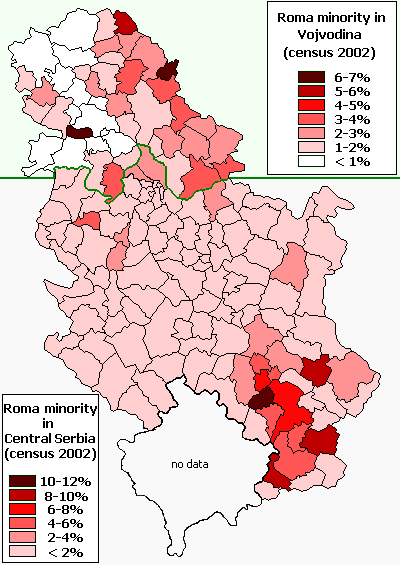
The largest concentration of Romani people in are to be found in Southern Serbia, Belgrade, Banat. In some administrative districts in southern Serbia, Romani population exceeds 5% of total population: Jablanica District (5.7%), Pčinja District (5.6%), and Pirot District (5.5%), respectively.
There are some estimates that between 46,000 and 97,000 Romani people in Serbia are internally displaced persons from Kosovo after 1999.
| Year | Population |
|---|---|
| 1866 | 24,607 |
| 1895 | 46,000 |
| 1948 | 52,181 |
| 1953 | 58,800 |
| 1961 | 9,826 |
| 1971 | 49,894 |
| 1981 | 110,959 |
| 1991 | 94,492 |
| 2002 (excl. Kosovo) | 108,193 |
| 2011 (excl. Kosovo) | 147,604 |
| 2022 (excl. Kosovo) | 131,936 |
Politics
The National Council of Roma Ethnic Minority in Serbia is a representation body of Romani people, established for the protection of the rights and the minority self-government of Romani people in Serbia.
There are two ethnic minority parties representing interests of Romani people in Serbia: the Roma Union of Serbia and the Roma Party.
Culture
Main article: Museum of Roma Culture in Belgrade
According to data from the 2011 census, majority of Romani people in Serbia are Christians (62.7%): mainly belonging to the Eastern Orthodoxy (55.9%), followed by the Catholicism (3.3%), and various Protestant denominations (2.5%). There is also a significant Muslim Roma community, with 24.8% of all Roma being Muslim.
The Romani people in Serbia mainly speak Romani and Serbian. Some also speak the language of other people they have been influenced by: Romanian or Hungarian. In 2005 the first text on the grammar of the Romani language in Serbia was published by linguist Rajko Đurić.
Đurđevdan (or Ederlezi) is a traditional feast day of Romani in Serbia.
Discrimination
Due to a record of discrimination, human rights reporting mechanisms have consistently drawn attention to the treatment of the Romani people in Serbia. The United Nations have reported persistent discrimination and social exclusion as a concern, particularly stemming from poor birth registration and identity documentation for citizens, and inequitable access to education, housing, employment, and legal protections. The UN has expressed concerns that the state of Serbia has failed to ensure accountability measures that continually monitor and implement these rights.
These persistent challenges cause many Roma to flee Serbia and other Balkan countries for EU countries. There are cases of children from Serbia being granted refugee status in Ireland due to persecution due to Roma identity. However, with increasingly strict asylum measures in the EU, countries such as Germany are increasingly labeling Serbia and other Balkan countries as "safe countries of origin" despite a lack of measurable improvement in the ability of Roma groups to realize human rights in these countries.
There have been hate-crimes such against Roma community, such as the death of thirteen-year-old Dušan Jovanović (1997), murder of actor Dragan Maksimović, who was assumed by the perpertrators to be Roma.
A significant number of Romani people in Serbia live in segregated areas, often in shanty towns called "cardboard cities", without electricity or water or provision of public services.{{cite web
Notable people
Main article: Serbian Romani people
- Rajko Đurić – professor, journalist, and politician
- Srđan Šajn – politician
- Boban Marković – musician
- Fejat Sejdić – musician
- Janika Balaž – musician
- Šaban Bajramović – singer
- Džej Ramadanovski – singer
- Usnija Redžepova – singer
- Mina Kostić – singer
- Mudja – influencer
- Predrag Luka – football player
- Dejan Osmanović – football player
- Ahmed Ademović – soldier
- Zejna Murkić – singer
References
Sources
References
- "O Nama – Romski Nacionalni Savet".
- "Mother tongue, religion and ethnic affiliation".
- "Регистар националних савета националних мањина - Министарствo за људска и мањинска права и друштвени дијалог".
- "UNICEF Serbia - Real lives - Life in a day: connecting Roma communities to health services (and more)".
- (www.dw.com), Deutsche Welle. "Roma: Discriminated in Serbia, unwanted in Germany {{!}} Germany {{!}} DW {{!}} 10.08.2015".
- Djordjević , T.R. (1924). Iz Srbije Kneza Milosa. Stanovnistvo—naselja. Beograd: Geca Kon.
- (22 August 2006). "Gypsies and the Problem of Identities: Contextual, Constructed and Contested". Swedish Research Institute in Istanbul.
- (1 January 2005). "Human Rights and Collective Identity: Serbia 2004". Helsinki Committee for Human Rights in Serbia.
- Sait Balić. (1989). "Džanglimasko anglimasqo simpozium I Romani ćhib thaj kultura". Institut za proučavanje nacionalnih odnosa--Sarajevo.
- (1 January 2016). "EDUCATION OF ROMA CHILDREN as IDPs/RETURNEES".
- Relief, UN. (2010). "Roma in Serbia (excluding Kosovo) on 1st January 2009". UN Relief.
- "Population by national affiliation and religion, Census 2011".
- "OHCHR {{!}} Serbia Homepage".
- "Serbia/Kosovo". Human Rights Watch.
- (2016). "Child Migration and Human Rights in a Global Age". PRINCETON UNIVERSITY PRESS.
- (22 October 2009). "Germany's a Dream for Serbia's Roma Returnees :: Balkan Insight".
- "Germany: Roma march against asylum-seeker crackdown".
- (2012-10-18). "Smrt u državi nasilja".
- (4 March 2016). "14 GODINA OD SMRTI: Dragan Maksimović Maksa zaslužio da dobije svoju ulicu! – Opustise.rs".
- "Mapiranje podstandardnih romskih naselja SRB".
- "Everything you need to know about human rights. | Amnesty International".
This article was imported from Wikipedia and is available under the Creative Commons Attribution-ShareAlike 4.0 License. Content has been adapted to SurfDoc format. Original contributors can be found on the article history page.
Ask Mako anything about Romani people in Serbia — get instant answers, deeper analysis, and related topics.
Research with MakoFree with your Surf account
Create a free account to save articles, ask Mako questions, and organize your research.
Sign up freeThis content may have been generated or modified by AI. CloudSurf Software LLC is not responsible for the accuracy, completeness, or reliability of AI-generated content. Always verify important information from primary sources.
Report