From Surf Wiki (app.surf) — the open knowledge base
Roman circus
Large open-air venue used for public events in the ancient Roman Empire

Large open-air venue used for public events in the ancient Roman Empire
A Roman circus (from the Latin word that means "circle") was a large open-air venue used mainly for chariot races, although sometimes serving other purposes. It was similar to the ancient Greek hippodrome. Along with theatres and amphitheatres, circuses were one of the main entertainment venues at the time.
Similar buildings, called stadia were used for Greek-style athletics particularly in the eastern, Greek speaking, part of the empire, but these were typically smaller than circuses.
According to Edward Gibbon the Roman people, at the start of the 5th century AD:
Architectural design{{anchor|Spina|Meta}}
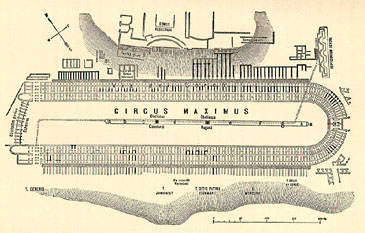
The performance space of the Roman circus was normally, despite its name, an oblong rectangle of two linear sections of race track, separated by a median strip running along the length of about two thirds the track, joined at one end with a semicircular section and at the other end with an undivided section of track closed (in most cases) by a distinctive starting gate known as the carceres, thereby creating a circuit for the races. The Circus Maximus epitomises the design.
The median strip was called the spina and usually featured ornate columns, statues and commemorative obelisks. The turning points on either end of the spina were usually marked by conical poles, called the metae (singular: meta).
The track of the circus was normally surrounded by ascending seating along the length of both straight sides and around the curved end, though there were sometimes interruptions in the seating to provide access to the circus or the seating, or to provide for special viewing platforms for dignitaries and officials. One circus, that at Antinoöpolis (Egypt), displays a distinct gap of some 50m between the carceres and the start of the ascending seating where there is apparently no structure. This appears to be an exception.
The great majority of circuses fit the description above. Those that do not display two different variations: that at Emerita Augusta (Mérida, Spain), where the carceres end is substituted by a slightly curved 'straight' end joined to the straight sides of ascending seating by rounded corners of ascending seating; and a few in which the carceres end is substituted by a second semi-circular end to produce an oval shaped arena. These latter circuses are normally small (Nicopolis (Greece) and Aphrodisias (Turkey)), and should probably be considered stadia.
Common characteristics
Dates
Differently from other major Roman structures circuses frequently evolved over long periods of time from a simple track in a field, through generations of wooden seating structures (frequently destroyed by fire or rot), before they finally began to be converted to stone. Although circuses such as the Circus Maximus (Italy) may have existed in some form from as early as around 500 BC, circuses were mainly constructed during the 400 years between 200 BC and 200 AD. Circus Maximus#History of Construction.
Dimensions
.jpg)
The comparative dimensions of a circus may be measured in two basic ways: by the length of the track, and by the seating capacity. Other dimensions, such as the external dimensions of the structure may vary considerably depending on the location, the site, and on specific architectural characteristics.
The simplest comparative measurement of a circus is its track length. This is the most easily measured dimension, as it only requires small excavations at either end of the centreline. It is very probable that this can be done even when the circus is buried under subsequent constructions. Track lengths may vary from the 245 m of the circus at Gerasa (Jordan), to the 621 m of the Circus Maximus (Italy).
The alternative comparative dimension is that of seating capacity. This is much more complex to measure as it requires that the dimensions of the original vertical and horizontal extent of the inclined seating be re-established. In many cases the full structure of the inclined seating has been destroyed beyond the point where this can be measured, or at the least would require a great deal more excavation than that required for the measurement of the track length. Seating capacity may vary from around 15,000 people at Gerasa (Jordan), to 150,000 (some estimates put it up to 250,000) at the Circus Maximus (Italy).
Orientation
Circuses do not appear to have been constructed with any special compass orientation. Those that are well identified can be found with their round ends oriented around the compass. Examples include: N. Gerasa (Jordan); NE. Antinoöpolis (Egypt); E. Circus of Maxentius (Italy); E. Colchester (Britain); SE. Circus Maximus (Italy); S. Tyrus (Lebanon); SW. Gortyn (Greece); W. Circus of Nero (Italy).
Relative location
Circuses can be found at three distinct locations relative to the towns to which they belong:
- outside the city walls at anything up to 1.5 km distant, as at: Gerasa (Jordan) (c300m), and Leptis Magna (Libya) (1.5 km).
- simply within the town walls, as at: Thessalonica (Greece).
- inside the walls, in the heart of the town, and an integral part of the architectural power structure of the town, as at: Rome, Sirmium (Serbia) and Tarraco (Spain).
Carceres{{anchor|Carceres}}
The carceres, or starting gates, had a distinctive, slanted, slightly curved, plan form, designed to compensate for what would otherwise be significant differences in the distances from the individual starting gates to the start of the first section of straight track on the right hand side of the spina (as seen from the carceres). The carceres were designed for the races to be run round the spina in an anticlockwise direction.
The form of the carceres appears to have been standardised throughout the Roman world. The similarity in form among the carceres of circuses of many different sizes suggests that carceres were constructed according to a series of proportional mathematical relationships or formulas. It is not clear when the earliest carceres of the standardised form was constructed, nor whether there exists documentary evidence for the existence of such formulas.
Some of the best examples of carceres can be found at: Gerasa (Jordan) and the Circus of Maxentius (Italy).
Best preserved
The best preserved circuses include: Emerita Augusta (Spain), Caesarea Maritima (coastal) (Israel), Circus of Maxentius (Italy), Gerasa (Jordan), Tyrus (Lebanon), Leptis Magna (Libya).
List of Roman circuses
Unless otherwise indicated the coordinates in the following list are of a point that lies within the space of a circus. For the remaining circuses (those whose detailed location is not known) the point is for a location within the space of the historic nucleus of the associated town, or for a location within the associated archaeological site. These points are probably within 1.5 kilometres of the site of the circus, as a circus was almost always within this distance from its associated town.
(ordered initially by country; number of circuses at latest count (2012-04-01): 63)
| City | |||||||
|---|---|---|---|---|---|---|---|
| (Roman name) | |||||||
| Link to detailed circus article | City | ||||||
| (modern name) | Country | Coordinates | Notes | ||||
| References | |||||||
| (sorts on length and precision of location) | Images | ||||||
| Auzia | Aumale]]) | Algeria | (not the circus; historic nucleus of current town) | cited in Humphrey; | |||
| Colonia Claudia Caesarea | Cherchell | Algeria | cited in Humphrey; approximate location; | (may not be oriented to north) | |||
| Saldae | Béjaïa | Algeria | (not the circus; historic nucleus of current town) | cited in Humphrey; no online circus-specific information found. | |||
| Setifis | Sétif | Algeria | cited in Humphrey; approximate location confirmed by old air photographs (90% of the circus has now been built over); | (may not be oriented to north) | |||
| Alexandria | Alexandria | Egypt | cited in Humphrey; no online circus-specific information found. | ||||
| Antinoöpolis | Mallawi (c10km) | Egypt | cited in Humphrey; visible track length: 300–350 m; | ||||
| Oxyrhynchus | Beni Mazar (c15km) | Egypt | (not the circus; archaeological site of Roman town) | cited in Humphrey; no online circus-specific information found. | |||
| Camulodunum | Colchester | England | The only known chariot racing track in Britain. Discovered in 2004 by Colchester Archaeological Trust, it is c.450m long x 75m wide. It consisted of a long, narrow U-shaped arena, with evidence of eight starting-gates and a central archway at the square (west) end, and tiered seating-stands (cavea) around the rest of the circuit. There were passageways through the seating-stands all round the circuit to provide access for the spectators (and there would have been a large archway in the curved end). A central barrier known as a spina ran down the centre, c.239m long. Colchester Roman Circus, archaeological information; | [[File:Artist's impression of the Roman Circus of Camulodunum, Colchester (UK) (16704064685).jpg | 150px]] | ||
| Arelate | |||||||
| (Colonia Iulia Paterna Arelatensium Sextanorum) | Arles | France | cited in Humphrey; official archaeological information; | [[File:Arles, cirque romain5.JPG | center | 150px]] (may not be oriented to north) | |
| Lugdunum | Lyon | France | (approximate hypothesised location | cited in Chase; hypothesised location. | |||
| Mediolanum Santonum | Saintes | France | (not the circus; historic nucleus of the town) | cited in Humphrey; no online circus-specific information found. | |||
| Vienna | Vienne | France | (possibly very approximate; the satellite image at this location is extremely distorted) | Cited in Humphrey; the only remaining feature is a monumental arched structure topped by a tall, narrow, pyramid; this structure was on the spina. | [[File:Pyramide de Vienne (Isère).jpg | center | 150px]] (may not be oriented to north) |
| Augusta Treverorum | Trier | Germany | Cited in Humphrey; location; | [[File:Amphitheater Trier und Circus.jpg | center | 150px]] | |
| Corinth (Colonia Iulia Flavia Augusta Corinthiensis) | Corinth | Greece | (hypothesised and partially excavated location) | discussion about the evidence for a circus; | |||
| Gortyn, Gortys or Gortyna | Agioi Deka (c1.5 km) | Greece | cited in Chase; archaeological city plan; visible track length: c375m; | (may not be oriented to north) | |||
| Nicopolis | Preveza (c7km) | Greece | referred to as a stadium; | ||||
| Thessalonica | Thessaloniki | Greece | Cited in Humphrey; Thessalonica | location | |||
| Rhodes | Rhodes | Greece | |||||
| Caesarea Maritima (coastal) | Caesarea | Israel | cited in Humphrey; referred to as a hippodrome; | [[File:Caesarea Palaestina.jpg | center | 150px]] (may not be oriented to north) | |
| Caesarea Maritima (inland) | Caesarea | Israel | c1km inland from the coast; visible track length: c410m; | (may not be oriented to north) | |||
| Aquileia | Aquileia | Italy | cited in Humphrey; location; | (may not be oriented to north) | |||
| Bovillae | Marino, Lazio | Italy | cited in Humphrey; ; | ||||
| Mediolanum | Milan | Italy | Cited in Chase; location; | [[File:Basamento circo.jpg | center | 150px]] (may not be oriented to north) | |
| Roma | |||||||
| Circus Flaminius | Rome | Italy | Cited in Humphrey; it is not entirely clear whether this 'structure' was, in fact, a circus or stadium of the form of the others in this list; Wikimapia location; | [[File:Circus Flaminius by Giacomo Lauro (5798907).jpg | center | 150px]] | |
| Roma | |||||||
| Circus of Maxentius, a.k.a. Circus of Caracalla | Rome | Italy | Visible track length: c490m; | [[File:Roma Appia Antica - Circo di Massenzio Torri.JPG | center | 150px]] (may not be oriented to north) | |
| Roma | |||||||
| Circus Maximus | Rome | Italy | Track length: c621m; | [[File:CircusMaximusSO.jpg | center | 150px]] | |
| Roma | |||||||
| Circus of Nero, a.k.a. Circus of Caligula, or Vatican Circus | Rome | Italy | Cited in Humphrey; location just to the south of St. Peter's Basilica well established, though exact position and orientation unknown; the only surviving remains are the obelisk which was brought from Egypt to adorn the spina in 37 AD; | [[File:Plan of Circus Neronis and St. Peters.gif | center | 150px]] (may not be oriented to north) | |
| Roma | |||||||
| Circus Varianus; :it:Circo Variano | Rome | Italy | Cited in Humphrey; Wikimapia location; | (may not be oriented to north) | |||
| Gadara | Umm Qais | Jordan | Cited in Humphrey; a German language archaeological site map of Gadara indicates a location for what is described as a hippodrome. | ||||
| Gerasa | Jerash | Jordan | cited in Humphrey; visible track length: c245m; | [[File:Hippodrome-Jerash.JPG | center | 150px]] (may not be oriented to north) | |
| Colonia Iulia Augusta Felix Berytus | |||||||
| Beirut Hippodrome | Beirut | Lebanon | cited in Humphrey; the location is of the archaeological site of the Beirut Hippodrome as given on Wikimapia; | ||||
| Tyre Hippodrome | Tyre | Lebanon | cited in Humphrey; visible track length: c435m; | [[File:Al-Bass Arch Site Hippodrome.JPG | center | 150px]] (may not be oriented to north) | |
| Cyrene | Shahhat | Libya | cited in Humphrey; visible track length: c300m?; | (may not be oriented to north) | |||
| Leptis Magna | Khoms OR Al Khums (c3km) | Libya | cited in Humphrey; located both on and parallel to the sea shore; visible track length: c445m; | (may not be oriented to north) | |||
| Aeminium | Coimbra | Portugal | (not the circus; nucleus of the Roman town) | believed to have existed, but unconfirmed; archaeological information about the Roman town; | |||
| Balsa | Tavira | Portugal | cited in Humphrey; the location is approximately that indicated conjecturally, though with considerable certainty, at; | ||||
| Miróbriga | Santiago do Cacém (c2km) | Portugal | cited in Chase; visible track length: c330m; | (may not be oriented to north) | |||
| Olissipona | Lisbon | Portugal | in what is today the 'Rossio'; an account (in Portuguese) of excavations which uncovered a section of the spina of the circus can be found at. | ||||
| Sirmium | Sremska Mitrovica | Serbia | cited in Humphrey; the location is a close approximation based on information at; | ||||
| Calagurris | Calahorra | Spain | cited in Humphrey; the circus lies under the pedestrian thoroughfare 'Paseo Del Mercadal'; | ||||
| Cáparra | Capera | Spain | (not the circus; nucleus of the Roman town) | cited in Humphrey; the location, from Wikimapia | |||
| Corduba | Córdoba | Spain | location from Wikimapia and others; | ||||
| Emerita Augusta | |||||||
| Circus Maximus (Mérida) | Mérida | Spain | Cited in Humphrey; visible track length: c400m; | [[File:VR Merida 03-Circo Romano.jpg | center | 150px]] (may not be oriented to north) | |
| Italica | Santiponce | Spain | (not the circus; nucleus of the Roman town) | cited in Humphrey; very approximate location; | |||
| Saguntum | Sagunto | Spain | cited in Humphrey; the location of the circus has been confirmed by the excavation, and preservation, of a gate to the circus; | (may not be oriented to north) | |||
| Tarraco | Tarragona | Spain | cited in Humphrey; most of the circus lies buried under the existing town; a substantial part of the curved eastern end, and part of the south-western side, are visible; track length: c290m; | [[File:Roman circus of Tarraco 01.jpg | center | 150px]] (may not be oriented to north) | |
| Toletum | Toledo | Spain | Cited in Humphrey; between a third and a half of the circus, including the round end, is partially visible; the remainder of the circus, has either been obliterated, or lies under modern constructions; suggested length: c430m; | [[File:Circo Romano Toledo 2.JPG | center | 150px]] (may not be oriented to north) | |
| Zafra | Spain | (not the circus; historic nucleus of town) | cited in Humphrey; there appears to be significant uncertainty about the status, and even name, of Zafra in the Roman era; | ||||
| Nova Trajana Bostra | Bosra Eski Sham OR Busra Eski Şam OR Busra ash-Sham | Syria | cited in Humphrey; French maps of Roman Bosra showing the location of the circus (or hippodrome); | (may not be oriented to north) | |||
| Laodicea ad Mare | Latakia | Syria | (not the circus; historic nucleus of the town) | cited in Humphrey; no online circus-specific information found. | |||
| Abthugni | Henchir Souar OR Henchir Esch Schorr OR Henchir es Souar | Tunisia | cited in Humphrey; coordinates of place; location of place on topographic map | ||||
| Carthago | |||||||
| Circus of Carthage | Carthage | Tunisia | Cited in Humphrey; location; | [[File:Tunis Carthage Cirque 2.jpg | center | 150px]] (may not be oriented to north) | |
| Commodum OR Municipium Aurelium Commodum | Henchir Bou Cha or Henchir Fraxine | Tunisia | (not the circus; nucleus of the Roman town) | cited in Humphrey; archaeological document of Tunisian government | |||
| Hadrumetum OR Colonia Concordia Ulpia Trajana Augusta Frugifera Hadrumetina | Sousse | Tunisia | (probable location) | cited in Humphrey; probable location | |||
| Thugga OR Municipium Septimium Aurelium Liberum Thugga | Dougga | Tunisia | (approximate location) | cited in Chase; approximate location, | (may not be oriented to north) | ||
| Thysdrus | El Djem | Tunisia | cited in Humphrey; visible track length: c500m; | (may not be oriented to north) | |||
| Utica | near Zana | Tunisia | (probable location) | cited in Humphrey; Tunisian archaeological site number: 007.157 (Utique; Henchir Bechateur; UTIKA); | |||
| Antioch | |||||||
| Circus of Antioch | Antakya | Turkey | cited in Humphrey; location (from 1930s aerial photograph); | (may not be oriented to north) | |||
| Aphrodisias | Aphrodisias | Turkey | Double-U-shaped; very substantially preserved; significantly smaller than other circuses; may be considered a stadium or hippodrome rather than a circus; visible track length: c220m; | (may not be oriented to north) | |||
| Byzantium | |||||||
| Hippodrome of Constantinople | Istanbul | Turkey | Built under Septimius Severus; estimated length: c450m; | [[File:Hippodrome of Constantinople 1.jpg | center | 150px]] (may not be oriented to north) | |
| Laodicea on the Lycus | Denizli (c6km) | Turkey | referred to as a stadium; double U-shaped and small; visible track length: c250m; | ||||
| Nicomedia | İzmit | Turkey | (not the circus; historic nucleus of İzmit) | cited in Humphrey; general information on the archaeological remains of Nicomedia; |
References
References
- Edward Gibbon, The History of the Decline and Fall of the Roman Empire, 1776, Chapter 31 - Games and spectacles, http://www.ccel.org/ccel/gibbon/decline/files/volume1/chap31.htm#game
- (2009). "The Oxford Encyclopedia of Ancient Greece and Rome, Volume 1". Oxford University Press.
- King, Charles William. (1885). "Handbook of Engraved Gems". George Bell and Sons.
- "Colchester's Roman Circus Visitor Centre".
- Raymond G. Chase: Ancient Hellenistic and Roman amphitheatres, stadiums, and theatres: the way they look now. P. E. Randall, Portsmouth 2002, {{ISBN. 1-931807-08-6
- [Gortyn] [http://www.romanaqueducts.info/aquasite/gortyn/foto1.html Map of Gortyn] ([http://www.romanaqueducts.info/aquasite/foto/gortyn70.jpg Gortina – Planta Archaeologica Dela Citta]) at [http://www.romanaqueducts.info/ romanaqueducts.info {{! Roman Aqueducts] {{Webarchive. link. (2012-06-16). [http://www.romanaqueducts.info/aquasite/index.html AQUASITE: Information on 50 selected Roman aqueducts]. [http://www.romanaqueducts.info/aquasite/gortyn/index.html Gortyn(a) (Greece / Crete)].
- [Gadara] [http://www.dainst.org/sites/default/files/media/abteilungen/orient/projects/gadara04.jpg Gadara (Umm Quais) Topographische Bestandkarte 2007 (archaeological site map)] {{webarchive. link. (2013-05-22 from [http://www.dainst.org/en/project/gadara?ft=all Research projects {{! geographical order {{! Gadara/Umm Qais (Jordanien)] {{webarchive). link. (2012-04-12 at [http://www.dainst.org/en/ Deutsches Archäologisches Institut (DAI)] {{Webarchive). link. (2012-02-10 .)

This article was imported from Wikipedia and is available under the Creative Commons Attribution-ShareAlike 4.0 License. Content has been adapted to SurfDoc format. Original contributors can be found on the article history page.
Ask Mako anything about Roman circus — get instant answers, deeper analysis, and related topics.
Research with MakoFree with your Surf account
Create a free account to save articles, ask Mako questions, and organize your research.
Sign up freeThis content may have been generated or modified by AI. CloudSurf Software LLC is not responsible for the accuracy, completeness, or reliability of AI-generated content. Always verify important information from primary sources.
Report